Tag: Procter & Gamble

  • FMCG product launches dry up in a tough market

    By Ratna Bhushan & Sagar Malviya


    Consumer product companies drastically cut down on product launches in 2013 to avoid additional cost pressures in a year when sales growth slipped to a decade low. Growth in product launches in the fast moving consumer products (FMCG) segment dropped to just 5 per cent last year from 35 per cent in 2012, according to data shared by research firm IMRB. Consumer product companies confirmed the slowdown in product launches and said they will bring out new variants and products once overall market improves.


    “This is not the best time to launch new products. We are waiting for consumer sentiment to improve, which we believe will be in the second quarter of the next financial year,” Sunil Duggal, chief executive officer at Dabur India, said. Dabur restricted its new products, Real drinking yogurt and premium chyawanprash Ratanprash, to select markets instead of a national rollout.


    Companies want to keep their expenses low even as they increase ad spends to protect existing brands and roll out higher promotional offers or price cuts to mop up volume growth. “Any FMCG company will have to take into consideration the high expense of taking a new launch national. The second half last year was bad in terms of cost perspective,” said Anil Chugh, senior VP at Wipro Consumer Care and Lighting.


    Consumer product companies have been facing relentless rise in the prices of raw materials such as crude and palm oil that went up by 19 per cent and 32 per cent, respectively, in the last 12 months. Consistent demand pressures weakening margins also resulted in the BSE FMCG Index underperforming Sensex by 10 per cent in the past six months. Some experts, however, feel marketers are making a mistake by not exciting a dull market with new launches. “It’s an irony that marketers take upon themselves to open consumers’ purse strings while they themselves tighten theirs,” Devendra Chawla, CEO at Future Group’s Food Bazaar, said. He said companies that continue to invest and innovate in a slowdown will benefit once the economy rebounds.


    According to IMRB’s group business director Manoj Menon, categories such as tea, breakfast cereals, hair, washing powders and noodles drove the slowdown last year while skincare and oralcare products saw higher launches.


    Several product launches in the past three years have been in the premium category – a space which slowed down the most as consumers cut back on discretionary spends.


    Some companies said the slowdown in product launches is temporary and it will pick up in the coming months as raw material prices stabilise and food-inflation is controlled. That’s already happening in some cases. L’Oreal has introduced a hair care range called 6 Oil Nourish, ITC has launched Sunfeast Farmlite and Procter & Gamble has rolled out a shampoo for men -Head & Shoulders Men. A recent Goldman Sachs report said marketers expect things to improve after the general elections. “Most companies pinned hopes on improved consumer sentiment post elections,” it said.


    Source:The Economic Times

    Copyright © 2014, Bennett, Coleman & Co. Ltd. All Rights Reserved

    Licensed to republish


  • Watch out, TVwallahs. P&G, Coke eyeing mobile video streaming for effective & cheaper advertising

    By Deepali Gupta


    Procter & Gamble and Coca-Cola are considering launching video channels over mobile phones to deliver branded content and advertisements directly to consumers in India, because it is cheaper than running ads on television and easier to measure the impact. The launch of third- and fourth generation mobile technology is making this possible and more affordable for advertisers, allowing them to sidestep, at least partially, the traditional mass media.


    Airing ads over telecommunication networks will also allow the companies to know who is watching their ads, something that is difficult to measure in TV advertisements.


    P&G and Coca-Cola, two of the biggest advertisers globally, are in preliminary discussions with India’s top telecom operators to start their own streaming video channels which consumers could access free of charge, three people familiar with the talks said. Another executive at one of the two consumer-goods companies said it was too early to say if his company would launch such a channel. “We have just had a meeting with the telecom operators, that’s it. There is no way to say whether this will happen or if it does when,” this person said.


    Initially, the brands may make their programmes available to customers of the nation’s top two mobile operators, Bharti Airtel and Vodafone India, that roughly account for 60 per cent of the subscribers across India, said one of the three people cited above. Bharti Airtel and Vodafone did not respond to emails seeking comment. P&G and Coca-Cola declined to comment.


    The talks come close on the heels of Hindustan Unilever launching a dedicated radio station on mobile phone in Bihar which has already acquired more than five million subscribers. P&G and Coca-Cola are also encouraged by the response to their existing online video content.


    Beverages-maker Coca-Cola has branded content such as the Coke Studio musical performance which receives lot of hits on You Tube, one of the people said. “We can push that content to users on their mobile phones,” this person said, adding that the channels would also carry company or brand logo through all shows which will be interspersed with advertisements. “It is cheaper than running campaigns on national television.”


    There is huge demand for mobile video content. Bharti Airtel’s Re 1 per video offer had 22 million hits within the first two months of its launch in May 2013, with nearly a quarter of them by first-time data users, according to data released by the company. Much of the content was Bollywood or fashion. As much as 80 per cent of that was accessed on feature phones – phones that can access Internet but are cheaper than smartphones – and nearly half in rural, content-starved markets. “Now imagine this is free to access,” said one of them, referring to the video channels these companies are considering. “I think there would be much more viewership.”


    However, the concept is still in its inception, added another. It involves a content aggregator creating the channel, the brand buying bulk data and an operator pushing the site to data-enabled phones. Offering this service requires the operator to enable data connections also on phones that don’t subscribe to data service and allow free connectivity as long as the device accesses merely the streaming channel.


    For telecom operators, offering free programmes will likely help attract voice consumers to data, and once they get hooked, the companies can sell services outside the free channel. According to analyst estimates, India has around 400 million phones that can use Internet or data services, such as viewing streaming video. However, only around 140 million actively connect to the Internet.


    Smartphone maker BlackBerry too has spoken of monetising its dedicated channels that brands like Café Coffee Day, Mercedes-Benz and even some political parties such as the Bharatiya Janata Party and Aam Aadmi Party use to connect with Blackberry Messenger customers. The channels started by the brands involve posting text and pictures that are shared by followers accumulated through invites.


    Source:The Economic Times

    Copyright © 2014, Bennett, Coleman & Co. Ltd. All Rights Reserved

    Licensed to republish


  • Light at the end of the VUCA tunnel


    By Fatema Rajkotwala


    It’s a VUCA, VUCA world. Indeed. Even as former Procter & Gamble chairman and managing director Bharat Patel may have made light of the acronym with the lyrics of a famed Shakira song, almost all of the 350-odd delegates at the inaugural Indian Society of Advertisers (ISA) Global CEO conference held on Wednesday were in agreement that the prevailing times were indeed VUCA – Volatile, Uncertain, Complex and Ambiguous.


    Unilever’s Global CEO Paul Polman was chief guest at the day-long event which had “Navigating through a VUCA World” as its theme. Mr Polman urged business leaders and marketers present to shift their focus to undeniable international struggles through corporate responsibility. Acknowledging the power of the internet, he stated how the concentration of wealth from few was now passing on as power to many as consumer connectivity has increased and being discovered by the youth.


    R Gopalakrishnan, Executive Director, Tata Sons led the conversation with his illustrative presentation titled “India’s VUCA Moment”. Manu Anand, President, India and South Asia, Mondelez International Managing Director, Cadbury India and Ravi Kant, Vice Chairman, Tata Motors spoke in the pre-lunch session. Later, Marten Pieters, Managing Director and CEO, Vodafone India addressed the gathering, followed by a panel discussion moderated by Sunil Kataria, COO, Sales, Marketing and SAARC, Godrej Consumer Products Limited with stakeholders Sanjay Behl, CEO, Raymond representing advertisers, Kirthiga Reddy, Director, Online Operations and Head, Facebook India from the new media and Ashok Venkatramani, CEO, MCCS from the traditional media side. Before the Polman session, Pawan Munjal, MD & CEO, Hero Motocorp shared his approach and attitude to business in his talk, “Taking Risks in a Volatile World”.


    Meanwhile, Hemant Bakshi, ISA Chairman and Executive Director, Home & Personal Care, HUL, expressed satisfaction with the Global CEO Conference. “We hope to make it an annual affair, and see greater participation in the years to come,” he said. Paulomi Dhawan, Chairperson, Events Committee and Treasurer of the ISA attributed the success to the emphasis on content and the speakers.


    For the record, the ISA was established in 1939 which aims at safeguarding and promoting the interests of organizations involved in Indian advertising, marketing and media industry. Today, the association consists of 160 members of small and large advertisers in the country.


    First half sessions:

    With the population growing steadily, which translates into new consumers and newer markets, while resources are limited, and even though India’s growth rate is slow, it is comparatively better than that of Europe or USA. In an increasingly globalised and boundary-free market, digitization is unleashing forces that are significantly changing the game. In such a setting, a changing market is the new normal and presents huge opportunities for businesses.


    So, is the Indian market and are Indian companies new to a VUCA environment? How real is the Indian downturn or recession with simultaneous stories of companies growing? What adaptive measures need to be taken by businesses in their leadership and business models in the current times? Instead of deploying defensive strategies, how can companies gain a competitive advantage in such a scenario? Hemant Bakshi Executive Director, Home & Personal Care, HUL and Annurag Batra, media entrepreneur and Editor-in-Chief, Exchange4media group threw light on the chosen theme and set the context for the sessions for the day.


    R Gopalakrishnan, Executive Director, Tata Sons argued that VUCA has always been a reality for India and that technological response has kept pace with a constant delta, while it is human adaptiveness that takes time to change. He urged audiences to focus on the implications hereof by developing three insights and observations with the help of examples. “We’ve always been a VUCA country and now our moment has come. That is why Indians are successful entrepreneurs.” In terms of practical implications, he listed out, “We’ve forgotten to look back at nature. We have been programmed to achieve efficiency whereas nature works at effectiveness. We also need to rediscover intuition to make important decisions as a faculty that would be foolish to ignore its role in a VUCA world, as rationality can bring you this far. We need to invest in market and consumer research and face competition with élan.”


    Manu Anand, President, India and South Asia, Mondelez International Managing Director, Cadbury India took the floor next for his talk on “Reigniting Growth in an Economic Slowdown”.  Mr Anand led his speech with the backdrop of how in an economic downturn demand for products decreases, inflation and commodity costs are high which leaves companies two routes – Either buckle down and cut costs or look at this market as an opportunity and ride the wave. Acknowledging that there is no right way and a combination of both can be done, he discussed Mondelez’s growth story during the 2008-2010 slowdown to highlight what techniques worked effectively for the company.


    Finding a balance between where to selectively reduce costs and where to invest for the future; increase brand investments with a focus on master branding and the lead brand propositioning; create innovation pillars by launching new categories through different brand portfolios and focusing on your people, customers and stakeholders – these are some insights listed out by Mr Anand. “There needs to be a greater reliance on intuitive based decision making in a price expectation sensitive market such as India, VUCA times present high opportunities. It would be a mistake to make no change in management models or on the other extreme, to make aggressive investments.” To sum up, during a downturn, management leaders were asked to switch off their auto-pilot business model, keep a check on cash flow, focus on strengthening core business portfolio, increase revenue speeds, and most importantly, exploit and not waste a downturn to emerge stronger and leaner.


    “Leading Business in the New Reality” by Ravi Kant, Vice Chairman, Tata Motors addressed the topic by peering into the past and see how companies have navigated through it. Citing Tata Motors’ example, he stated that the company has moved its business model from hierarchial to cross-functional; from vertically integrated o outsourced; from centralized to poly-centric, from a purely Indian market to one that gets up to three-fourths  of its business from outside the country. “Any change happening in the transitional or contextual environment will have an impact on your business. The new reality is that of high uncertainty with natural disasters no longer being rare events; complexity due to globalization presenting diverse demographics or climate changes; and rapid changes in industries within a span of the last 10 years.”


    As solutions, Mr Kant offered the following advice, “Companies that are quick to self-check, able to experiment and collaborative are the ones that grow profitably in such times. Predictive analysis helps in giving short-term insights and with the help of technology and available data, the power of analytics and anticipation gives time to face situations better. Innovation is key to keep you going, to gain market share or within internal processes. Finally, collaborate because in today’s times, no company can do anything without networking, integrating or information-sharing.”


    Second-half sessions

    Shedding light on the cut-throat industry of telecomm operators, Marten Pieters, Managing Director and CEO, Vodafone India took on a positive approach in his presentation titled, “Not every Consumer has Sealed her Wallet: Finding New Pockets of Growth”. Sharing simple rules that helped Vodafone prosper in the economic slowdown, he pointed out, “As business professionals, we have no other choice but to embrace the change. As a marketer or advertiser, make VUCA a friend, instead of a foe.”


    In the Vodafone context, he shared marketing mantras that worked. His key pointers were – 1. Understanding your customer better – our future customer is already with us. 2. Behaviour change happens more slowly than expected. 3. Business grows by leveraging opportunity not only by solving problems. 4. Acquisition is a must and not optional for brands. 5. Light or infrequent buyers matter. 6. Intensify investments during lean period. “Satisfy consumer needs – customers bend if there is something worth to be picked up. Marketeers tend to get impatient while consumers take time to accept and embrace change. Businesses need to be light on their feet to mine opportunities. During a downturn, brand building can be done while media costs are low. While suggestions for VUCA times may be different for different industries, consumer behavior broadly does not change across categories regardless.”


    A panel discussion on the sensitive issue of “Cut Costs, Not Corners: Smart Marketing for Turbulent Times” moderated By Sunil Kataria, COO, Sales, Marketing and SAARC, Godrej Consumer Products Limited. On the panel were reprentatives of three sides – Sanjay Behl, CEO, Raymond, as the advertiser; Kirthiga Reddy, Director, Online Operations and Head, Facebook India as the new media and Ashok Venkatramni, CEO, MCCS from the traditional media side. The panel gave their views on what is withholding open-hearted collaborations between the media and marketing fraternities and why has this scenario developed. Some interesting suggestions for a VUCA world that emerged from the conversation was of the need for more responsible marketing due to marketing spends being one of the few operational costs that is based on speculation and a plethora of choices. ‘Personalization of messages ‘was pegged as one of the biggest themes leveraged by marketers. CSR moving to BSR, that is, Brand Corporate responsibility was yet another interesting insight by the panelists.


    Sharing the brand’s success story, Pawan Munjal, MD & CEO, Hero Motocorp shared his approach and attitude to business in his talk, “Taking Risks in a Volatile World”. As a pioneer brand in the category that has reached international markets, Mr Munjal shared Hero’s VUCA times. “VUCA is equal to Opportunity. We at Hero, believe in disruption. A clear and steadfast vision will be the anchor that will bring order to chaos and help you make the right decisions in the interest of your stakeholders and consumers with resolve and confidence. It is important to have a mindset of anticipation and embracing change within the organization. Ensuring flexibility is key to diversifying risks. Lastly, courage and unflinching belief will help you through any uncertain times.”


    The Polman Session

    Paul Polman, Global CEO, Unilever shared his eye-opening and inspiring viewpoints on “How Responsible Business Models Can Help in VUCA Times”. Looking beyond short-term ROIs or pricing strategies, Mr Polman took on a human stance at viewing the current global scenario. Citing global realities of lack of food or sanitation for a large part of the planet’s population, or the European slowdown or the political upheaval in Syria – Mr Polman urged business leaders and marketers to shift their focus to undeniable international struggles through corporate responsibility not just as an obligation but as a business idea.


    Acknowledging the power of the internet, he stated how the concentration of wealth from few was now passing on as power to many as consumer connectivity has increased and being discovered by the youth. “If you can get an ingrained political regime out of government in 17 days, you can out a company within nanoseconds. If a political system doesn’t work, trust in businesses also goes down. This is an end of the era of abundance. Transparency can be built only on trust, which will lead to prosperity. This is a unique moment for mankind. As businesses, we have to become solution providers and not just by-standers in the system that helps us grow. It’s time marketers run ahead instead of behind and look at mainstream corporate responsibility. The biggest tool you have as a marketer, is to build your brand to build trust. Give brands a social mission and purpose as a changed business model or become isolated.”


  • Creative agencies have allowed themselves to be dumbed down: Vikram Sakhuja


    By Anil Thakraney


    Vikram Sakhuja heads GroupM, India’s largest media buying conglomerate. In a long and animated discussion, the ace number cruncher shares with us insights from the Indian media industry. As well as his own organization’s approach to the various challenges staring at the media business.


    Fifty-year-old Sakhuja is an IIT/IIM grad, and he did a number of years in marketing before he shifted to the world of media in 2001, when he signed up as Managing Director of Mindshare Fulcrum. During our meet, I could see that the outspoken GroupM boss is extremely passionate about his work, and is someone who could get easily agitated over provocative questions. Thankfully, we had a smooth run. Guess it’s all thanks to Yoga which Sakhuja has recently taken up. 🙂


    You were a hard-core marketing man at one point. What prompted the switch to media?

    I believe in taking the career as it goes, and taking decisions at different points of time. Let me take you through my career graph to explain this. After IIM, Calcutta, I was pretty clear I wanted to get into the marketing side of things. So I joined P&G and did eight years there. When I joined them, Richardson Hindustan Limited (RHL) was becoming Procter & Gamble (P&G). So when I started out, the company had RHL values and very quickly the organization got Procterised.


    And you were not happy with that?

    I was happy with that, but Procter believed in the system of specialization. So the guy who gets into sales, stays in sales. The guy who gets into advertising, sticks to advertising. I was in research and they extended that to marketing services. I learnt a lot there, but later on I wanted to move to brand management and P&G wasn’t allowing me that. And I didn’t want my epitaph to read ‘Marketing Researcher’. So I moved to Coca-Cola which was more flexible in these areas. Out there I managed the entire brand portfolio. That worked very well for 5 years. I was reporting to Sanjeev Gupta in those days, and he was handling both, marketing and bottling. And later he went on to take up a bigger job. So they got Shripad (Nadkarni) to head marketing, and I felt my job would get undermined a little bit. And so I left to join Star TV.


    And you lasted there for just one year.

    It was a mistake. I call it jawaani ki bhool. Peter (Mukerjea) said they wanted to start a strategic marketing function there, and it would include marketing of the creative product as well as on-air marketing, which is where the bulk of the spending goes. But it didn’t pan out like that because the programming department had a territorial interest in the programming piece. So it became very clear to me this was going to be an off-air game, and that didn’t have too many legs. And I left Star without a job. Later, Ranjan Kapur introduced me to Andre Nair (this is year 2001) who was looking for people to start Mindshare in India. We had a drink and one thing led to another. I felt a little trepidation in the beginning because I perceived ad agencies to be a little unprofessional. But later I thought about it rationally and it made sense. And so here I am.


    There are large media shops under the GroupM umbrella. How do you manage to give personal attention to each one?

    I am running GroupM, I am not running Mindshare or Maxus. There are capable people running those. I am a management by objectives kind of a person. One aspect of my deliverable is Profit & Loss, there’s no getting away from it. I have told my guys we should get growth from our existing clients. We should have the source credibility to go to them and manage 100% of their marketing investments. That is the agenda I drive. Then, I have to create an eco system for technology, talent and on how to do things better. The scope of service has actually dumbed down, clients are paying peanuts and they are getting monkeys. So I go and tell my clients if they want the right kind of talent and want to get the value out of it, then this is how it works.


    I suppose you operate more as a coach than as a player.

    Do I meet clients? Yes, I do. Am I directly involved in the day to day plans? No, I am not. Unilever is our biggest client. So every year at least one or two deals I will sit in on. Also for other clients. I love to be there for the sheer passion of it.


    What is Sir Martin Sorrell’s brief to you?

    Martin is pretty hands-on in most of the businesses. I rely on him more for counsel. I whet my new plans with him. For example, I went to him with the idea of celeb endorsements. And he felt it wouldn’t work, but asked us to try it anyway. And it didn’t work. Then there was a time we were offered some sweat equity in the IPL Deccan Chargers team. I took it up to Martin and he didn’t think it was a good idea, because he didn’t know the nature of the animal. But he’s brilliant, he is one of the few guys who understands our business, he wants to get in deeper.


    What is your stand on the shift from the commission system to the fixed fee system for media agencies?

    I definitely support the fee system. Though I would prefer a balance of commission and fee. Because in a growing economy you win with commissions. But when spends are not looking good at all, as is the case this year, fee bails you out. In principle, however, I like the fee system.


    How are the clients reacting to it?

    The people who take their marketing seriously believe in the fee system in letter and spirit. The top notch companies like Unilever, Ford, Pepsi, etc, totally get this. I believe clients should pay us Cost + for service, and a factor of that for the value we are able to demonstrate.


    What qualities do you look for in a media buyer in today’s time?

    You must understand that in our organization we don’t just buy media. I would like to believe that our agencies are actually driving the marketing agenda, probably more than the creative agencies. Most of the creative agencies have allowed themselves to be dumbed down, most of them are only interpreting briefs in a TV commercial format. They are only driven by the tactical creative idea rather than a long term view of the brand. All these wonderful creative minds should spend a little time thinking brand stewardship. Out here, we want people who can think account planning and communications. People who can understand the brand, the consumer, and then have the ability to unlock all the media solutions. So the media person needs to understand content, activation, digital, conventional media, and then he has to see how all this comes together.


    Key challenges ahead for media agencies?

    The clichéd one of course is that the commissions we earn are not allowing us to invest in the best talent. But we have to all individually work ourselves, show value and then ask for stuff. The other challenge is in the digital space. The erstwhile DNA of the media companies excluded digital. I believe integrated media planning is the way to go. This is distinct from multimedia planning, which had the TV plan, print plan, radio plan, etc, all working in silos. But with the increasingly multi media environment, the key is integrated planning. And digital is allowing that seamlessness even more. We have embraced this some time back.


    And yet, the media buying business, after the unbundling, has got totally commoditized. Shashi Sinha said to me the media planner has become a zombie.

    I was the first guy to bring the AOR into the country. So you can blame me for the disintegration of the full service agency. (Laughs) I would say each of our agencies has its own planning way. Maxus has something called ‘Relationship Media’, MEC has got ‘Navigator’, and so on. Each of them talks the consumer journey. They talk much more about the communication challenge. I am actually finding the plans looking more different now than they were earlier. So I disagree with my dear friend Shashi Sinha. Maybe I am not cynical. The planner is alive and kicking. It’s in fact the most exciting time to be in the media because of the large amount of fragmentation and the large amount of media choices.


    You did a stint with television. Do you foresee threats to this medium in the near future?

    Yes. The problem with TV today is that it has become a media game of the value of the inventory. At the end of the day, there are only about four million commercial GRPs being broadcast every year at an all India level. And that’s growing at 2 or 3% per year. This is the market for TV eyeballs. So like it or not, you have to extract value out of this. Today, at last count, we have 500 or 600 channels, and it’s getting fragmented. If an Imagine TV dies, someone else will pick up ratings. And if someone else launches, there’s further fragmentation. So the problem is that the same money is chasing some eyeballs. Until the new ratings system comes up and there’s a tectonic shift, you are talking about a metastable equilibrium. Now if the value has to go up, either you have to deliver more reach, or you have to deliver some associated imagery or sponsorships or incremental value.


    When do you expect the shake-out to happen in television?

    We’ve been expecting a shake-out since 1996. I guess some people seem to be having deeper pockets. I am not a finance guy so I don’t know how it works. But I can’t imagine many of them are making money.


    Think the IPL is losing some of its sheen?

    No. The ratings this year were a tad higher than the last year. But for all practical purposes, have held on to last year’s levels. It has stabilized at about 5 rating points. In fact, this year was the best year primarily because of the games, which went down to the wire.


    And it’s a good investment for team owners?

    For them it’s going to be a slow burn. You have do it sensibly, like the KKR franchise does, and I think they make money. Whereas a large number of other people don’t make money. It’s about how you manage the entire franchise.


    There’s a perception that you guys are not passing on bulk rates you get from the media to your clients.

    We have something called the WPP Compliance. And we take it very, very seriously. So we are making sure that we do everything as per our contract with each client. In letter and spirit. We are definitely not holding back anything which is due to a client. We have a media owner invoice and it’s backed by an agency invoice. If the clients want to audit us, they are most welcome to do so. We are a global leader in this space doing global deals, we won’t mess around with something where there’s a breach of trust involved. We can’t afford that.


    Perhaps this was one of the reasons Reckitt Benckiser came up with the idea of agencies paying to pitch, and compensating them in case of a drop in ratings.

    They invited us to pitch and we asked them if they were being ridiculous. We turned them down. If somebody has an obscene point of view, I cannot subscribe to it.


    And yet, some agencies pitched for that account. Isn’t the industry united in these things?

    I thought we were united on that but obviously we weren’t. What do I say now?


    You’ve done many years in this business. Ever thought of starting out on your own?

    The thought has crossed my mind but I didn’t pursue it. I am not a very entrepreneurial guy. My philosophy is: Don’t fix it unless it’s broken.


    Does the lack of adequate talent in the media industry frustrate you? Is it a constant battle to find the right people?

    Yes, it is. But we have to be able to pay right to get the right talent. And for that we have to work our own internal financial structures. The level at which we work, there’s only so much we can afford to pay people at the entry level.


    Is there corruption in this business? There are allegations of planners taking money and other favours.

    One hears about these things from time to time. There is an opportunity for something like this, and clearly we have to plug it. This is where I believe organization culture is very important. If conversations in an organization involving integrity are strong, then the one or two people who entertain these thoughts will find themselves in a very uncomfortable situation.


    Have you ever fired people from your company because of this?

    Oh yes, I have.


    I saw a Youtube video of yours where you mention something about getting stressed out at work.

    I tend to be very animated and passionate, and I do get worked up. But I have been doing Yoga and stuff like that. And that’s helped. I have also started taking it a bit easier now, we have a good team. And at the end of the day, tension lene ka nahin, dene ka! (Laughs.)



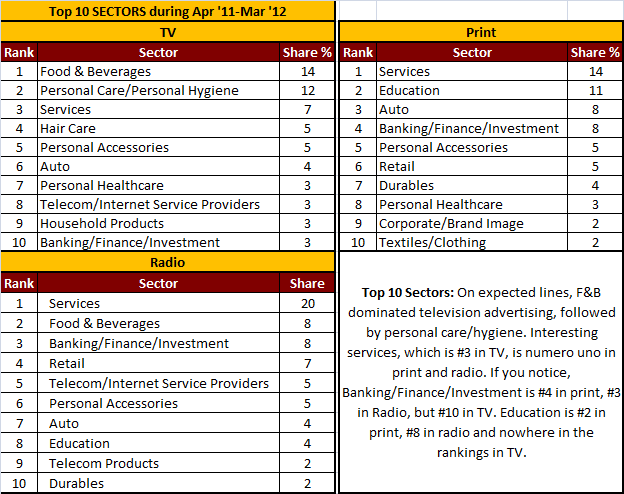
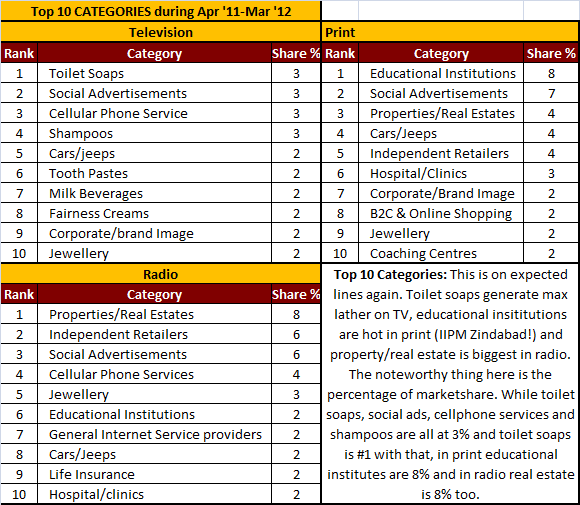
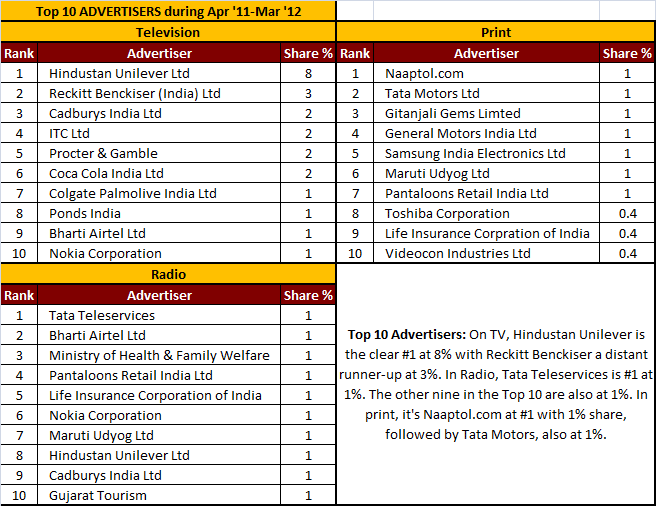
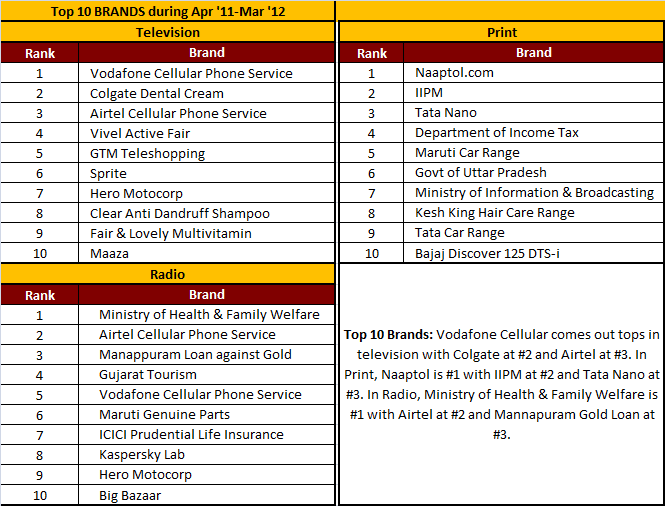
  • AdEx 2011-12: Print grows 14%, TV 11%, Radio 0%


    By A Correspondent


    This is perhaps the shortest Big Story you’ve read in the eight-month existence of MxMIndia. But then more than words, it’s numbers that have got to do to the talking.


    MxMIndia requested TAM Media Research which painstakingly computes data for ad volumes for the television, print and radio sectors. The growth figures are indicative of how these are doing: print isn’t down and out yet with 14%, TV is growing but it’s not as dramatic as we thought it would and Radio hasn’t degrown. In fact we must urge radio practitioners to interpret the 0% in a positive way because there were enough naysayers willing to rubbish the potential of the business.


    Note: the analysis is based on ad , that is duration in seconds/CCMs and excludes promos.


  • Hindustan Unilever to study how we shop

    By Sagar Malviya


    World’s third-largest consumer goods firm Unilever has set up a Customer Insight and Innovation Centre in Mumbai to study how consumers shop FMCG products – its first such hub in India and seventh in the world.


    The centre at Hindustan Unilever’s headquarter at Andheri will be used by several group companies in developing and emerging markets to understand how people shop in both neighbourhood stores as well as modern trade. This is the first such centre that provides shopper insight for both general stores as well as retail chains.


    “The learning will go typically in developing and emerging markets where traditional trade is big,” said Punit Misra, vice-president, customer development, at Hindustan Unilever. “We have been doing consumer marketing forever where the basic premise is consumers are truly the same,” he added.


    The insight centre will simulate the retail environment of any supermarket or neighbourhood store and then invite consumers to shop the virtual store. A device will scan their retina to track the movement of the eye, and then a map will display the spot that catches the consumers’ attention.


    Simply put, the centre will help the Anglo-Saxon consumer goods maker advice grocers on how category growth, profit per sq ft and availability can be improved using virtual reality tools.


    The company will use the data and insights from the centre to plan packaging design for future products. It will also test new product through virtual reality platform and use the facility for their promotions. So far, the company has engaged grocer outlets with promotions, display materials and margins. The development is seen as a part of Hindustan Unilever’s efforts to increase its sales and widen lead over rivals such as Procter & Gamble, ITC and Godrej Consumer.


    Analysts say the company wants to connect more with the trade at a time when millions of kirana stores it sells products to are being increasingly covered by its rivals too. While Hindustan Unilever still enjoys the country’s largest retail network of over 7.2 million outlets as per Nielsen estimates, its closest rival Procter & Gamble now reaches around 5.6 million outlets.


    “This means the company wants to come as close to the customer as it can get,” said Anand Mour, senior FMCG analyst at brokerage Ambit Capital. “It will not only increase the category but also help in getting more sales of its products since HUL is present in most FMCG categories,” he added.


    But getting millions of kirana stores to sport a look that HUL advises is a challenge. Mr Misra knows that, and feels that the company is ready to overcome that problem. “Modern trade is simpler. General trade is a bit tricky on how do you disseminate a repeatable model to five lakh family grocers,” said Mr Misra. “So we do the creation, the testing, the learning and the models, and then our execution teams on the field convert them into ready-to-use kits which they can take to the retailers,” he added.


    The maker of Lux soaps and Pond’s cream has been taking several initiatives to increase its sales and consumer base in the country. One of the recent such projects was Mission Bushfire – an employee-led market execution and customer interaction exercise initiated in 2010 to get the home and personal care giant to connect with the market place in order to increase product visibility.


    Bush Fire resulted in over 40 per cent spike in sales in store wherever the initiative were implemented, according to internal company estimates. Recently, a company official on condition of anonymity told ET that Hindustan Unilever has set a target to more than double its turnover to Rs50,000 crore by 2015 in a plan christened ’50 by 15′.


    Source: The Economic Times
    Copyright © 2012, Bennett, Coleman & Co. Ltd. All Rights Reserved


  • Rohit Surfactants to launch mid-premium laundry brand Uni Wash to challenge HUL & P&G brands

    By Sagar Malviya


    Maker of India’s largest-selling detergent brand Ghari, Kanpur-based Rohit Surfactants plans to launch a mid-premium laundry brand to take on Hindustan Unilever’s Rin and Procter & Gamble’s Tide.


    “We want to tap into mid-priced category which has good potential as well as offer higher margins,” Rahul Gyanchandani, director at Rohit Surfactants, said. Ghari competes in the highly competitive mass-priced segment, where companies are under margin pressure due to high raw material costs. “In addition, apart from brands such as Rin and Tide, there is a vacuum in the segment which we want to fill,” said Gyanchandani.


    The new brand, Uni Wash, will be launched in the next 2-3 months and be priced similar to Rin and Tide, the company said. Rin’s 1-kg pack costs Rs50, while Tide Naturals’ 870-gram pack is sold at 30. Spokesperson of HUL and P&G said as a company policy they do not comment on competitors.


    Rohit Surfactants’ Ghari beat HUL’s Wheel late last year to become the top brand in the 13,000-crore laundry industry. The firm’s entry into the mid-premium segment is expected to make the infamous Rin-Tide fight even murkier. HUL, early this year, priced Rin lower than P&G’s Tide and released an advertisement asking consumers to choose the better brand-the latest in a series of aggressive commercials from either brand targeting the other. Some blatant ads even attracted legal recourse from the other side.


    According to an industry insider, Tide’s share has doubled in the last two years to over 13.7 per cent in 2011 while Rin’s share has grown from 4 per cent in 2009 to around 6 per cent.


    TOUGH MARKET

    Analysts feel that Rohit Surfactants’ entry could further dent margins in laundry, one of the largest segments that contribute to more than a quarter of the revenues for both HUL and P&G.


    “The category has limited pricing power already and a new brand entering will surely affect the exiting brands in the long term,” Gautam Duggad, an analyst at brokerage Prabhudas Lilladhar, said. Mr Duggad, however, added that it would not be easy for Rohit Surfactants to build a brand from scratch.


    “Launching a completely new brand altogether would be a challenge in this cut-throat market as it will take a long time for a brand to start from scratch,” he said. Rohit Surfactants has been building its distribution network to reach most of the country and believes it now has the wherewithal to compete with established brands.


    “We already have a solid platform now, which we can leverage for the new brand to push it,” Mr Gyanchandani said.


    Rohit Surfactants entered 10 new states in the last three years to expand its reach to 19 states through more than 3,500 dealers. It has 21 manufacturing units, 15 of which were added since 2006. The company now plans to expand its distribution and build manufacturing plants in markets such as Bihar, Raipur and Karnataka.


    Launched in 1987 by brothers Muralidhar and Bimal Kumar Gyanchandani, Rohit Surfactants had sales of over Rs2,500 crore in the year ending March 2012.


    But there is increasing pressure on the margins of detergent makers due to increasing prices of key raw materials such as LAB, or linear alkyl benzene,  that has increased 19 per cent, and soda ash that climbed 4 per cent in the last three months.


    HUL, the Indian unit of Anglo-Dutch Unilever, has indicated that it is facing the heat of inflation in categories such as soaps and detergents, and has tried to moderate its advertising spends to protect margins.


    At the same time, P&G is looking to expand production capacity in India so that it can make products cheaper locally.


    Source: The Economic Times
    Copyright © 2012, Bennett, Coleman & Co. Ltd. All Rights Reserved

  • Maxus names Madhvi Pahwa as first global talent director

    By A Correspondent


    Madhvi Pahwa, veteran media agency executive with extensive experience in talent development and marketing, has been named Global Talent Director for Maxus.


    The announcement was made by Maxus Global CEO Mr Kelly Clark, who said Ms Pahwa will be based in New Delhi where she currently works as Managing Partner for Learning and Culture at GroupM India.


    “This is a hugely important step for Maxus,” Mr Clark said. “Following our explosive growth over the past few years, we need to improve how we recruit, inspire and motivate our people. Madhvi can help us do this.”


    Mr Clark noted that locating the talent director’s role in India rather than New York or London signalled a break from tradition for media agencies, one that provides the agency with an important distinction from its competitors. “I’ve always believed there’s big opportunity for a media agency to take an exciting new direction in talent management, one that really differentiates the agency,” Mr Clark said in a communique. “Maxus can be that agency, and I think we can make that happen with Madhvi’s leadership, advice and partnership. Having Madhvi based in Asia also recognizes the importance of our fastest-growing region to the future of our talent agenda.”


    Before joining GroupM in India in 2006, Ms Pahwa has held several senior marketing and brand management roles with marketers including Procter & Gamble and Coca-Cola India, where she spent a decade in marketing roles ranging from managing brand portfolios to consumer insights to media planning and buying.