Tag: Ogilvy

  • BMW urges ‘Don’t postpone Joy’ through new campaign

    By A Correspondent


    Known for its sheer driving pleasure, BMW has now opted for a brand campaign to rekindle love in the age of EMIs.


    Through its new campaign, Don’t Postpone Joy, BMW exalts Indians to embrace the present over the future. The key message seems to be that the earlier you buy a BM car, the longer you enjoy it, so why postpone?


    The film opens on a new born child and quickly the child turns into a 60 year old – going through various life stages in matter of seconds with a VO saying a human being goes from 0-60 in under 2 billion seconds and at what point in your life would you start enjoying the ride. Conceptualised and made by Ogilvy Gurgaon for BMW India, this film has been specifically made for the Indian market.


    Frank-E. Schloeder, Director Marketing, BMW India said, “The luxury car market has a great potential in India. Our latest campaign “Don’t Postpone Joy” addresses certain mental and cultural barriers that we feel exist towards luxury consumption in India. Since JOY is BMW – BMW in this campaign is reminding people that life is passing by and it’s about living for the moment & enjoying rather than worrying about the future.”


    Kapil Arora, President – Branch Head, Ogilvy North said, “A large part of affluent India that spends on homes, holidays, weddings and jewellery, still deny them-selves the joy of a luxury car. They spend their lives running the race, living for others and postponing their own joy. This campaign talks to that segment, extolling them to stop postponing joy and to not let life pass by, without experiencing the joy that is BMW.”


  • Ogilvy promotes ‘Gracious Living’ proposition for Kohler

    By A Correspondent


    In keeping with its vision to offer ‘Gracious Living’ to its consumers, Kohler has taken a new route of communication for its range of bidet seats – PureClean. Instead of going the utilitarian route, the company is promoting the concept of going hands-free with its new campaign themed “Hands are made for Love”.


    The TVC explains the utility and insight behind the launch of PureClean and encourages consumers to go hands free with the product. It begins with two little kids enjoying a pillow fight with each other while a voice-over says ‘Hands are made to Play’. The next frame shows a little girl carrying a Halloween pumpkin for trick-or-treating. The voice-over adds- ‘Hands are made to Share’. The next frame moves to show a couple enjoying an evening together with the voice-over saying ‘Hands are made for Joy’. The film then moves on to show the PureClean multi-functional bidet seat which are positioned as ‘Hands-free hygiene for everyday routine’. The final voice-over says ‘Hands are made for Love’


    Talking about the new campaign, Kapil Arora, President-Branch Head, Ogilvy North said, “This campaign and TVC in particular has been designed keeping in mind hygiene conscious consumers. It highlights the hands-free concept as an extension of the gracious living philosophy behind all Kohler products.”


  • Ogilvy & Mather to do branding campaign for Diu & Daman tourism

    By Vishal Dutta


    Diu & Daman, the Union territory located near Gujarat’s coastline, will promote itself as tourism destination through a branding blitz to be led by Ogilvy & Mather. The Centre has raised the budget allocation from Rs 550 crore, two years ago, to Rs 1,460 crore.


    “In the first week of August, we will unveil a logo for Diu & Daman Union Territory” said Bhupinder S Bhalla, Administrator, UT of Daman & Diu. The union territory is mainly flocked by tourists from dry Gujarat looking for liquor. The new plan will have other tourists interests too.


    “We will release the Vision 2020 document for Dadra & Nagar Haveli,” said Mr Bhalla, who was on a visit to Ahmedabad to unveil its first dedicated cycle track in Diu. Already 4.2 km has been build and 7 Km would be completed by 2014 with an estimated cost of Rs 37 crore that would provide connectivity between almost all parts of the city. Similar kinds of projects for Daman and Silvassa have also been planned.


    Mr Bhalla, who took charge as Administrator of both the Union Territories in September 2012 and approximately around the same year, when the Union Government increased its annual budget allocation from Rs 550 crore to Rs 1460 crore, he aggressively pursued to increase the infrastructure quality of the UT areas in Daman and Diu and Dadar Nagar Haveli (DNH).


    He said that about Rs 400-500 crore has been spend on islands infrastructure upgradation in last two years that includes old and new roads, bridges and other infra projects. While he had awarded long-term (10 to 20 years) solid waste management collection contracts to private players in DNH, the tendering process of Diu and Daman islands would soon get completed.


    Modern underground sewage system and solid waste management system will be implemented to develop the region. Silvassa, the capital city of Dadra and Nagar Haveli (DNH), has seen Rs 200-crore investments for tourism projects that include Rs 100 crore for a river front project on Daman Ganga.


    “I have to struggle to make others identify the island. Most of them believe that it’s near to Goa, while the reality is that it’s near to Gujarat” said Mr Bhalla. He further adds that Daman & Diu and Silvassa did not do much for developing tourism, but it developed on its own as a tourist destination mainly for the local population from Gujarat.


    “But now we intend to make a serious attempt to develop it as a tourist destination that matches global standards,” he said adding that the purpose of having a tourism promotion campaign and branding is to increase the average number of days stay from 1.7 days to 3 days for the tourist, but that can be achieved only if the infrastructure facilities are better in the island.


    Daman & Diu and Dadra & Nagar Haveli were under Portuguese rule till 1961.


    Source:The Economic Times

    Copyright © 2014, Bennett, Coleman & Co. Ltd. All Rights Reserved

    Licensed to republish

     

  • Gunning for more ad awards, creativity loses plot

    By Ravi Balakrishnan


    A little over a decade ago, when the Abby awards were still the only show in town, the after party found Prasoon Joshi in a pensive mood. As team Ogilvy celebrated their ‘agency of the year’ win with a characteristic lack of subtlety – drums, horns, and people in black posing for interminable photoshoots – Mr Joshi, then early in his stint at Mc-Cann Erickson reasoned, “There are youngsters from many agencies who’ve won their first trophy tonight. But all of that is being forgotten in this obsession with who won most. We should celebrate the work and not the numbers.”


    Mr Joshi may have been among the first to voice this concern, but he’s far from the last. Several creative leaders in India are increasingly vocal about missing the forest of creativity for the trees of a final tally.


    Festivals like Cannes Lions have arguably made things worse, adding layers to the competition like Holding Company of the Year. WPP won for the fourth time running in 2014, which according to media reports led Interpublic to boast of its far better win to entry ratio. Closer home, Goafest officially scrapped ‘agency of the year’, ostensibly to make it more about the work and less about the numbers. It however resulted in a cottage industry where previously math-phobic creatives sliced and diced the numbers till they were left with a rank that satisfied them.


    Apart from no year being complete without some controversy, protest or conspiracy theory, the numbers game is tainting large parts of the industry.


    Remember all the worldwide chief creative officers who’ve lashed out against scams? Creative directors in their employ will tell you, off the record of course, that the scamming happens entirely with their approval, frequently on their insistence. Truth be told, it’s hard to say no when even a laggard that gets lucky and scores bronze adds one more to the total tally. It’s resulted in a business where scams are the worst thing to happen only so long as you get caught.


    The judging process too is compromised as long as tallies – official or unofficial – continue to be important. Says Bobby Pawar, chief creative officer, Publicis, “Judges may be more open to acknowledging how they feel about a piece of work when voting for it doesn’t make them losers. When you have younger people on the jury who haven’t won that much, it’s hard (for them) to be charitable.” In every award jury, if some industry folk are to be believed, there are people wondering “what’s in it for me?”


    With the role of tallies coming into question, the Gunn Report is perceived to be the biggest villain of the piece. Started in 1999 by former Leo Burnett adman Donald Gunn, it’s currently the largest, most authoritative source of league table on ad agencies. The 2013 edition considered 46 award shows – global, regional and national. While undoubtedly a definitive source of information on the varying creative fortunes of agencies, doing well in the Report has become an unhealthy obsession.


    Mr Pawar says sardonically, “It’s a great idea – for Donald Gunn. Or CEOs and creative guys looking to put notches on the belt. I don’t think it’s a good idea for work. Let’s not reduce creativity to accounting because that’s what these things do.” Adds a creative chief who wishes to remain anonymous, “I know the networks love Gunn but does the report motivate me to break the mould? Is it inspirational?


    Or just an impotent report card?” The latter has no place in an industry that’s playing it fast and loose, finding ideas from unlikely sources, some of whom are not agencies. The Gunn Report had not responded to our questions at the time of going to print.


    The alternative: Let the year be remembered not for who scored the maximum but for the best work. Irrespective of where it came from or what else the agencies who created those pieces won. In spite of being the top ranked Indian shop by Gunn this year, Mr Joshi, currently president – South Asia, McCann Worldgroup continues to have a purist perspective.


    “The creative world is more like a garden than a wrestling ring. We shouldn’t be trying to outshine each other but to complement each other. People will say ‘here comes Prasoon again with his poetry’, but I’ve said this since I was in school. Every child is unique but the moment you ask ‘kitne number aaye?’ you make him start thinking in those terms.”


    However, in spite of these pious and occasionally poetic sentiments, it’s unlikely that tallies are going anywhere. Because as KV Sridhar aka Pops, chief creative officer at SapientNitro points out Gunn and accounting are unnecessarily being pilloried. For one, the report is a lot more nuanced, measuring both the width as well as depth of wins.


    At worst, it represents a deeper malaise: “Gone are the days when creative people were obsessed with peer recognition. Awards are now more about business development. There’s nothing wrong (in wanting to win big) since this is how advertising agencies sell themselves. It’s both for the benefit of new marketers and to tell your existing clients ‘we’ve still got it.’”


    The obsession with tallies is less about creative oneupmanship. Says Mr Sridhar, “It’s the obsession of people like Martin Sorrell and Maurice Levy. It’s a global diktat to every agency since this is how a brand seeking to enter the country decides on who to start talking to. Every country head is measured by creative reputation as much as bottomline. If you deliver 21 per cent instead of 23 per cent you are sacked, but if you’ve got a creative reputation with 21 per cent, you get your bonus.”


    And so what it comes down to is this; when the agency man’s stuck at the wrong end of the barrel, even the most virtuous will start Gunning for more awards. Don’t blame the player, blame the game.


    Source:The Economic Times

    Copyright © 2014, Bennett, Coleman & Co. Ltd. All Rights Reserved

    Licensed to republish


  • Ogilvy to participate in Kyoorius Awards. Leo Burnett entries in too

    By A Correspondent


    Okay, it’s official. Ogilvy is participating in an Indian creative advertising awards event this year.  This was confirmed to MxMIndia by Abhijit Avasthi, National Creative Director, Ogilvy via the agency spokesperson.


    It may be recalled that Ogilvy had chosen to not participate in the Creative Abby last year (2013) and this is the second successive year when the agency – which has traditionally dominated the awards tally – has stayed away.


    According to a Kyoorius official, Leo Burnett, which was rumoured to be staying away from all awards this year, has sent in entries.


    Although the entries closed yesterday (May 5), given some requests from a few agencies, a few entries will be accepted till early tomorrow morning (May 7).


    Meanwhile, the entries for the Abby at Goafest have also closed and according to numbers that Goafest organising committee members have informally told us, the aggregate number of entries for all the Abby – Creative, Media, Digital, Broadcast, PR and others – is in the region of 2700. An Advertising Club officebearer told MxMIndia that a communiqué will be issued on the numbers.


  • Mediaah!: Why Goafest hasn’t lost the plot and deserves one more chance

    By Pradyuman Maheshwari


    I write this more in response to Anant Rangaswami’s article on Firstbiz and his Facebook posts. What I like about Anant’s writing is his definite views on issues, many of which I agree with.


    But on Goafest, he’s been unduly harsh. His point on Facebook: Goafest has lost the plot. It’s press release offered a programme with just time slots and no mention of speakers and topics.


    I received the communique too, and chose to not carry a report on it because it didn’t say anything at all. It was an advance intimation of the programme, but could have been held back for a few days with some names.


    I also agree with Anant that Goafest in the summer is a nightmare (my descriptor, not his). Since I sweat a lot, I can say that it’s terrible even in the aircon. So, even though the event is indoors, the walk or buggy ride to your rooms could see you drenched in sweat. Your eyes could be burning all day and even the world’s best coolants wouldn’t work.


    Last year’s Goafest could best be described as forgettable. It had loads of negatives. The Creative Abby was a disaster (albeit for a fault that wasn’t of the organising committee). First a controversy about the Ford Figo scam ads saw the exits of some high profile staff at JWT and Ford, then the Tata Chemicals scam ads that were eventually pulled out of the competition and later the controversy around scam ads and plagiarism.


    Somewhere along this was the decision by Ogilvy to not participate in the Abby. Ogilvy had huge misgivings about the awards, and Ad Club prez Shashi Sinha tried his damnedest to get them back. But Messrs Piyush Pandey & Co didn’t budge.


    When Pratap Bose took charge as Ad Club president last year, he resolved to ensure a buy-in from all towards the Creative Abby. That doesn’t seem to have happened thus far.


    To add to the confusion, the AAAI delayed the Goafest announcement and later found the elections as reason to postpone the dates. Then came the news that Nakul Chopra had opted out of the Goafest chair position.


    Finally Srinivasan K Swamy, better known in the frat as Sundar, took charge. I’ve interacted with Sundar a fair deal in the recent past, especially as head of the International Advertising Association India Chapter of which he is the head. I believe if there’s one person from the AAAI who can pull it off, it’s him. The IAA is supremely active thanks to Sundar’s leadership. I find him exceedingly keen on doing things and he knows the art of getting things done.


    I am not sure how Goafest 2014 will be. I have heard people say that some regular sponsors have declined to be associated this year. But Sundar is confident of a turnaround and I think he ought to be given a chance.


    Yes, I do think Rajesh Kejriwal’s Kyoorius Awards with the coveted D&AD partnership, has stolen the thunder from the Abby, but there’s space for multiple awards. We’ve seen how other disciplines – radio, digital, outdoor and PR, for instance – have multiple awards and they are all doing well. So ditto with creative.


    I have heard some angry comments amongst industry elders about Anant’s Firstbiz piece and I was told that some pressure may be exerted on Network18 via the media agencies asking him to refrain from writing nasties against Goafest. I hope that doesn’t happen, that wouldn’t be right.


    Sadly, Anant’s views are echoed by many in the industry. Before Sundar’s name was announced, even I wasn’t sure whether there was any point in conducting this year’s edition.


    Sundar & Co have an uphill task ahead of them. But I think they need to be given a chance.


    The industry deserves a good, celebratory Goafest. The format, the timing and the awards are a problem. Perhaps the organising committee and AAAI need some younger blood taking the lead on Goafest. Perhaps it may be a good idea to get a professional body to conduct the show – Kyoorius, e4m, Campaign/Haymarket… whosoever.


    I know what I am going to do: have MxM support Goafest until before the event happens. The coverage of the conference (and the awards and the fun element) will then take over. And on that, we’ll be brutally honest about how it is.


  • Google ‘Pledge to Vote’ film with India’s first voter

    By A Correspondent


    Independent India’s first general elections may have happened in early 1952, but an exception was made for Kinnaur in Himachal Pradesh as snowfall was expected. Hence the polls were held in October 1951 and there lies the story of Shyam Saran Negi, India’s very first voter, and a 97-year-old retired schoolteacher. This is the theme of the new Google commercial in the crafted by leading ad agency Ogilvy.


    Since 1951, Negi has voted in every single election, including each of the 15 Lok Sabha polls held thus far. The years haven’t diminished his belief in democracy and the power of elections. He also continues to be an inspiration to his family, friends and community in Kalpa.


    The film was shot in Mr Negi’s hometown, Kalpa, over several days in early March. The team worked closely with the village folk and Negi.


    Says Sandeep Menon – Director, Marketing, Google India: “Perhaps more than any other election in the past, these elections are about capturing the imagination of millions of both first-time as well as experienced voters. This video has been developed to inspire Indian voters to vote this election. The story of Mr Negi is a testimony of Indian voters’ belief in the power of democracy.”


    Abhijit Avasthi

    The film – part of the #Pledgetovote series – hopes to inspire both – seasoned, as well as first-time voters, said an Ogilvy India spokesperson. Added Abhijit Avasthi, National Creative Director at Ogilvy: “While all of us have cribs about the state of affairs in the country and a cynicism about the government, we forget that the only weapon of change we have in our hands is our vote. Like so many others, Google too wants to motivate people, especially youngsters to exercise their right to vote. But rather than being preachy, it wants to do it the inspirational and emotional way. And who better to inspire us than Mr Negi.” Leading internet services conglomerate Google has been attempting to integrate with the country through ad films that strike a chord. Its film on showing an Indian and Pakistani reuniting for the first time after Partition, has received rave reviews.


  • Abhijit Avasthi: As of today, Ogilvy not participating in Abby. But if Ad Club accepts its demands, it could…

    By A Correspondent


    Abhijit Avasthi

    Even as the Advertising Club, the Advertising Agencies Association of India and the Goafest committee finalise the dates of Goafest 2014, there’s no confirmation on whether Ogilvy & Mather will participate in this year’s Creative Abby.


    At its inhouse Envies awards, National Creative Director Abhijit ‘Kinu’ Avasthi , had told MxMIndia: “There are certain changes that we are looking for at the Abbys and till the time they do not happen, we definitely would not be thinking about it.” And should the changes happen? “We will think about it then.”


    So when we called Mr Avasthi for his reactions of the D&AD-backed Kyoorius Advertising Awards yesterday and asked him on the Abby participation, he said matter-of-factly: “No, not as of now. However, if they accept our conditions and change their stand, we may consider.”


    Last year, while confirming the news on not participating in the Abby, Mr Avasthi had told us: “We felt that they were not energizing our people as they used to earlier.”


    And when asked if Ogilvy will participate at the Kyoorius Awards, Mr Avasthi said: “We’ll want to hear a little more. I don’t know much about it.”


    An industry and Abby observer told us that by deciding to hold the awards in Mumbai and having very few judges, the Kyoorius hosts meet two of the main demands of Ogilvy. In addition, Mr Avasthi & Co are said to be peeved about too many unimportant categories and a skew towards domains where there is not much creative work done through the year.


    Watch this space for more.


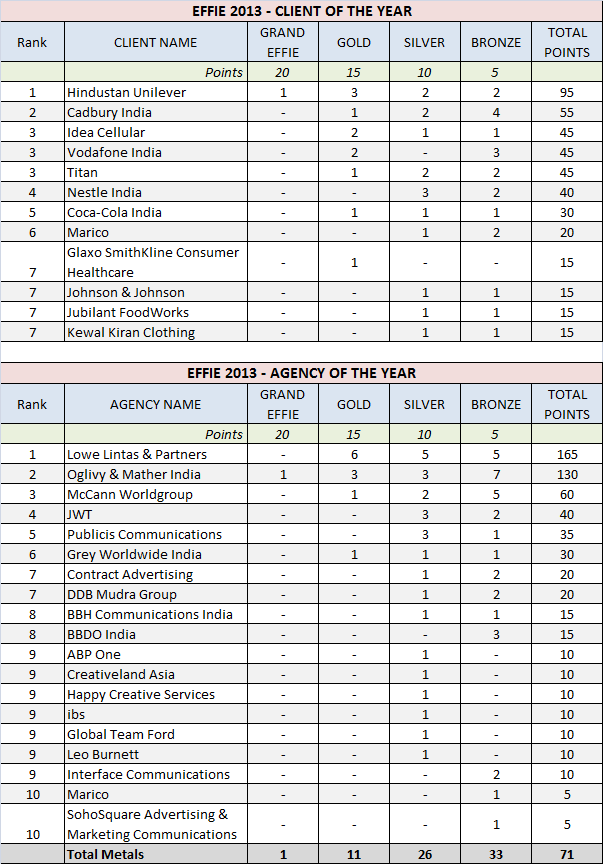
  • Cadbury misses a hat-trick as Ogilvy misses 5th consecutive crown + Effies 2013 Tally tables

    By Our Research Associate


    The last time Lowe Lintas & Partners was Agency of the Year was in the year 2006. Hindustan Unilever was Client of the Year that year too. In 2008, the Effies were awarded on the day when the terrorist struck Mumbai – November 26, and JWT was the Agency of the Year (AOY) while Bennett, Coleman & Company was Client of the Year (COY).


    From 2009 onwards, Ogilvy has been AOY. But the COY title has moved around a bit – in 2009, Vodafone, in 2010 to Tata Teleservices and in 2011 and 2012 to Cadbury.


    Cadbury would’ve scored a hat-trick but this time thanks to both Lowe Lintas and Ogilvy contributing to its kitty, Hindustan Unilever forged ahead.


    According to a member of the jury who requested anonymity, entering the Effie requires some extra effort on the case study presentation. Remember you need to prove the fact that creativity has worked for the advertiser, and unless that’s done, you won’t win.


    A senior member of the industry told MxMIndia that given the body of work that Ogilvy had done, it could’ve surely been #1 had it presented some of its cases better.


    Perhaps.


    Meanwhile, take a look at the AOY and COY tally tables:


  • What next for TAM?


    By Pradyuman Maheshwari [updated]


    Is it a cul de sac for TAM? Was the cabinet approval for the TRAI guidelines the final nail on TAM’s 15-year-plus existence?


    Created by a decision of the Joint Industry Body way back in 1998 with stakeholders Indian Society of Advertisers (ISA), Indian Broadcasting Foundation (IBF) and the Advertising Agencies Association of India (AAAI) agreeing to back the body. For a while, there was an alternative in the form of aMap, but that fizzled out thanks to a lack of patronage.


    Had aMap existed today, one wouldn’t be sure of its future because it always quoted a consortium of unnamed investors as its primary owner.


    Policy Guidelines for Television Rating Agencies in India


    The Union Cabinet today approved the proposal of the Ministry of Information and Broadcasting for bringing out a comprehensive regulatory framework in the form of guidelines for Television Rating Agencies in India. These guidelines cover detailed procedures for registration of rating agencies, eligibility norms, terms and conditions of registration, cross-holdings, methodology for audience measurement, a complaint redressal mechanism, sale and use of ratings, audit, disclosure, reporting requirements and action on non-compliance of guidelines etc. The proposal is based on recommendations made by the Telecom Regulatory Authority of India (TRAI) on “Guidelines for Television Rating Agencies” dated 11th September, 2013.


    Based on the recommendations of TRAI, comprehensive policy guidelines for television rating agencies have been formulated.


    Salient features of these guidelines are as follows:

    • All rating agencies including the existing rating agencies shall obtain registration from the Ministry of Information and Broadcasting.


    • Detailed registration procedure, eligibility norms, terms and conditions, cross-holding norms, period of registration, security conditions and other obligations have been delineated.


    • No single company / legal entity either directly or through its associates or interconnect undertakings shall have substantial equity holding that is, 10 percent or more of paid up equity in both rating agencies and broadcasters/advertisers/advertising agencies.


    • Ratings ought to be technology neutral and shall capture data across multiple viewing platforms viz. cable TV, Direct-to- Home (DTH), Terrestrial TV etc.


    • Panel homes for audience measurement shall be drawn from the pool of households selected through an establishment survey. A minimum panel size of 20,000 to be implemented within six months of the guidelines coming into force. Thereafter the panel size shall be increased by 10,000 every year until it reaches the figure of 50,000.


    • Secrecy and privacy of the panel homes must be maintained. 25 percent of panel homes shall be rotated every year.


    • The rating agency shall submit the detailed methodology to the Government and also publish it on its website.


    • The rating agency shall set up an effective complaint redressal system with a toll free number.


    • The rating agency shall set up an internal audit mechanism to get its entire methodology/processes audited internally on quarterly basis and through an independent auditor annually. All audit reports to be put on the website of the rating agency. Government and TRAI reserve the right to audit the systems /procedures/mechanisms of the rating agency.


    • Non-compliance of guidelines on cross-holding, methodology, secrecy, privacy, audit, public disclosure and reporting requirements shall lead to forfeiture of two bank guarantees worth Rs. one crore furnished by the company in the first instance, and, in the second instance shall lead to cancellation of registration. For violation of other provisions of the guidelines, the action shall be forfeiture of bank guarantee of Rs. 25 lakh for the first instance of non-compliance, forfeiture of bank guarantee of Rs.75 lakh for the second instance of non compliance and for the third instance, cancellation of registration.


    • 30 days time would be given to the existing rating agency to comply with the guidelines.


    • The guidelines would come into effect immediately from the date of notification.


    The Guidelines for Television Rating Agencies in India are designed to address aberrations in the existing television rating system. These guidelines are aimed at making television ratings transparent, credible and accountable. The agencies operating in this field have to comply with directions relating to public disclosure, third party audit of their mechanisms and transparency in the methodologies adopted. This would help make rating agencies accountable to stakeholders such as the Government, broadcasters, advertisers, advertising agencies and above all the people.


    Background:

    Television Rating Points (TRPs) have been a much debated issue in India since the present system of TRPs is riddled with several maladies such as small sample size which is not representative, lack of transparency, lack of reliability and credibility of data etc. Shortcomings in the present rating system have been highlighted by key stakeholders that include individuals, consumer groups, government, broadcasters, advertisers, and advertising agencies etc. Members of Standing Committee on Information Technology had also expressed concern over the shortcomings.


    In 2008, the Ministry of Information & Broadcasting (MIB) had sought recommendations of TRAI on various issues relating to TRPs and policy guidelines to be adopted for rating agencies. TRAI, in its recommendations in August 2008, had amongst other things recommended the approach of self-regulation through the establishment of an industry-led body, that is the Broadcast Audience Research Council (BARC).


    The Ministry had constituted a Committee under the Chairmanship of Dr. Amit Mitra, the then Secretary General FICCI, in 2010 to review the existing TRP system In India. The committee also recommended that self-regulation of TRPs by the industry was the best way forward.


    Since, the BARC could not operationalise the TRP generating mechanism, the Ministry of Information & Broadcasting sought recommendations of TRAI in September 2013 on comprehensive guidelines/accreditation mechanism for television rating agencies in India to ensure fair competition, better standards and quality of services by television rating agencies. TRAI recommendations on Guideline for Television Rating Agencies were received in September 2013. While supporting self-regulation of television ratings through an industry-led body like BARC, TRAI recommended that television rating agencies shall be regulated through a framework in the form of guidelines to be notified by MIB. It also recommended that all rating agencies, including the existing rating agency, shall require registration with MIB in accordance with the terms and conditions prescribed under the guidelines.


    Source: Press Information Bureau website – pib.nic.in


    The problem with the TRAI guidelines for TAM is its ownership – TAM is a 50-50 jv between Nielsen and Kantar Media Research. The third point on the cabinet approved TRAI guidelines is very clear on the ownership issue. “No single company / legal entity either directly or through its associates or interconnect undertakings shall have substantial equity holding that is, 10 percent or more of paid up equity in both rating agencies and broadcasters/advertisers/advertising agencies,” it says.


    With Kantar being owned by WPP which in turns owns Group M, Ogilvy, JWT and a host of advertising and marketing services firms in India, there’s little that TAM can do.


    Perhaps not. For, as they say in India, for every law, there’s a mother-in-law, brother-in-law, and son-in-law. So Kantar can retain a 9.9 percent stake and the rest of the 40.1% can be bought by one or multiple entities, who can then have some longwinded alliance or consulting arrangement with one of the many WPP group entities.


    For instance, MxMIndia could own the 40.1 percent stake and then MxM can retain Ogilvy, or JWT or whatever for creative services. Or the 40.1 percent stake could be owned by a Trust… TAM could seek inspiration from the ownership of other similar moves made in the past.


    What’s happened though is unfortunate. By giving the government a handle to police it, the broadcast ecosystem has had it. The development also shows that the broadcasters may seem more powerful but can’t keep off the government from interfering in its affairs. It may be remembered that until last year, the print readership study was undertaken by Hansa, which is owned by the RK Swamy BBDO and Hansa group. This group also has interests in advertising and runs a media agency, but no one raised a question on the issue of ownership. Or even if people did, it wasn’t public and certainly didn’t call for a government intervention.


    Logically, the government ought to have no business to police the TV measurement business. An intervention should be necessary only if there’s a fraud and then the law enforcers – the courts and the cops can get into the picture.


    It will be interesting to see if an agency like Group M – which is owned by WPP – decides to say that it will have its own system of measuring TV audiences. It’s unlikely that it will do it as Hindustan Unilever, one of its main clients, is a key member of the ISA and a senior HUL executive is a member of the BARC technical committee for the new audience measurement system. Also, an HUL may not want to take on the government for its own business reasons.


    The clock may be ticking for TAM, but the next step in this drama is the notification of the guidelines. TAM could of course take the government to Court. In the event that the notification happens and TAM doesn’t take the government to court, it will need to do something about its ownership. And increase boxes from 9450 to 20,000 etc etc.


    There’s of course another all-important factor. From the reports we receive at MxMIndia, BARC has kind-of decided on awarding the critical tech contract to Mediametrie, the French industry body and a couple of other vendors. The deal may not have been signed, but it’s just a matter of tam, er, time. Nielsen had also made a fresh pitch at a lower cost, but the informal industry view was to think long-term and give the contract to Mediametrie.


    In that event, it may well be a cul de sac for the way TAM is today. Perhaps, like in the Hindi movies, it will need to be reborn as something else. Or wait for divine intervention.

    In the meantime, we hear of a pressure building within the industry of how the notification could impact broadcasting. The earliest the BARC-approved measurement system will come up is the second quarter of 2014. It will take a quarter or two for it to find stability and earn the confidence of the fraternity. Advertisers and broadcasters (and media agencies) can ill-afford a period of no measurement.

    That perhaps would do more harm to the industry than any other move to shore up the media ecosystem.


  • McCann’s Rahul Mathew joins DDB Mudra West as Creative Head

    By A Correspondent


    Rahul Mathew

    DDB Mudra West has roped in Rahul Mathew as Creative Head. He will lead the agency’s creative output for clients including Future Group, Volkswagen, Johnson & Johnson, Kalpataru, Hindustan Unilever, Union Bank, Marico, Emirates, Gulf Oil, Godrej, Lavasa, Arvind, Adani Group, CenturyPly and Raj Petro among others. Mr Mathew will partner Rajiv Sabnis, President, DDB Mudra Group, West and will work closely with Sonal Dabral, Chairman & CCO, DDB Mudra Group, who he will be reporting in to.


    Mr Mathew joins DDB Mudra from McCann Erickson where he was Executive Creative Director. With over 15 years of experience, Rahul has worked with Ogilvy, JWT, Leo Burnett, Y&R (in Kuala Lumpur and India).


    Commenting on his new role, Mr Mathew said, “Few agencies, the world over, can boast of a creative culture the likes of DDB. And to be appointed a custodian of such a celebrated culture is both exciting and frightening.  But with the talented bunch at the agency, Sonal and I hope to make DDB Mudra West one of the brightest stars in the DDB constellation.”


    On the appointment, Sonal Dabral, Chairman & CCO, DDB Mudra Group, said, “I’m very excited to welcome Rahul to the DDB Mudra Group family. I’ve known Rahul for a while now and have followed his career across countries and agencies, seeing him build brands and win multiple awards along the way. A new age creative thinker equally adept at traditional and non traditional media,Rahul is just the talent to lead the creative teams in DDB Mudra West.”


    Added Rajiv Sabnis, President, DDB Mudra Group, West: “With Rahul coming on board, our ability to provide creative business solutions to our clients gets a strong fillip.”


  • Ogilvy shows off its digital power with ‘Techtonic’

    By A Correspondent


    The agency’s dominance in the traditional creative advertising has been so major that one doesn’t really associated Ogilvy with the digital media.


    But over the past few years, OgilvyOne has grown to become India’s largest, most awarded full-service digital agency. But there is more to this story than just growth and fame. It’s built specialist capabilities, completed digital acquisitions and now has over 400 digital resources across Ogilvy India.


    On Thursday, the agency organized Ogilvy Techtonic in Mumbai with an attempt to bring to its clients a series of relevant, usable conversations around the shifting digital landscape. Perspectives from industry leaders from Facebook, Google, Myntra, social influencers Miss Malini and Gabbar Singh and Ogilvy’s own digital leaders from across the country. The venue was the Bluefrog nightspot in Central Mumbai… we aren’t like some of those newspapers which only carry the venue name if it’s paid for.


    Guest speakers included Kirthiga Reddy, Guneet Singh, Mukesh Bansal, Miss Malini and Gabbar Singh and the Ogilvy speakers were Abhijit Avasthi, Vikram Menon, Karthik Srinivasan, Sanjay Ramakrishnan, Shivakumar Viswanathan, Nalini Guhesh, Anand Morzaria, Upasana Roy, Dharam Valia and Kunal Jeswani. And we even spotted bossman Piyush Pandey also in the house.