Tag: newspapers

  • Claims and counter-claims start after IRS 2011Q2 release


    By A Correspondent

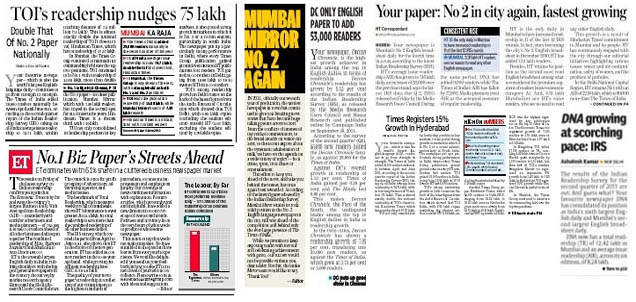
    The claims and counter-claims have begun. In Mumbai, Mumbai Mirror said it’s No 2 again. So did Hindustan Times. Both weren’t incorrect: Mirror may have the second-largest readership, next only to The Times of India, but Hindustan Times is the second-most read broadsheet English daily. DNA’s report too says it’s the second-largest broadsheet daily.

    Sadly, the conferences which the Market Research Users Council and Hansa Research Group would conduct to release every round of the Indian Readership Survey have been done away with. The detailed dump is curiously no longer handed out to the trade media.

    Consequently, what the MRUC and Hansa expect the trade media to do is to either carry unverified claims of various media entities. Or depend on friendly publications and agencies to give out data.

    MxMIndia.com requested veteran media consultant Sundeep Nagpal and his firm Stratagem Media to dig a little deeper and help us come up with a variety of insights given IRS 2011 Q2 data.

    For instance: the DNA report quotes a total readership (TR) figure for itself which most media agencies do not recognise. Media agencies and MxMIndia recognise Average Issue Readers (AIR) as currency. Interestingly,  when you look at the numbers for Greater Mumbai, while DNA is a distant third amongst English language broadsheets vis-a-vis The Times of India, it’s difference with #2 English broadsheet Hindustan Times is just 63,000. For HT of course the growth story in Greater Mumbai is tremendous: 27.2% year-on-year and 4.1% in the second quarter.

    We asked Strategem for the following:

    1. Given the toplines mailed to us by IRS, could we analyse it vis-a-vis the Q1 data for 2011 as well as the Q2 data for 2010 so that we can do a year-on-year analyses?

    2. Can we also similary analyse the data region-wise – Hindi belt and North, West, South and East and North East?

    3. Can we look at the numbers for the 8 metros combined and separately?


    Stratagem has provided us this data, and we present these to you as follows:


    First, take a look at the table withe the Top 10 publications across the country – urban and rural India.


    Publications

    IRS 2011 Q2

    IRS 2011 Q1

    % growth in IRS 11 Q2 over 11 Q1

    IRS 2010 Q2

    % growth in IRS 11 Q2 over 10 Q2

    Est. Individuals (000s)

    889070

    885122

    0.4

    871443

    2.0

    Dainik Jagran

    16393

    15910

    3.0

    15925

    2.9

    Dainik Bhaskar

    14174

    14016

    1.1

    13303

    6.5

    Hindustan

    11985

    11810

    1.5

    10143

    18.2

     Malayala Manorama (Daily)

    9962

    9938

    0.2

    9841

    1.2

    Amar Ujala

    8891

    8747

    1.6

    8417

    5.6

     Lokmat

    7595

    7486

    1.5

    7402

    2.6

     The Times Of India

    7471

    7442

    0.4

    7088

    5.4

     Daily Thanthi

    7290

    7187

    1.4

    7402

    -1.5

    Rajasthan Patrika

    6941

    7033

    -1.3

    6900

    0.6

     Mathrubhumi

    6690

    6800

    -1.6

    6566

    1.9


    Let’s also look at the combined numbers for the eight metros of Mumbai, Delhi, Kolkata, Chennai, Bengaluru, Hyderabad, Pune and Ahmedabad.


    Combined 8 metros-Mum,Kol,Ahm,Bang,Pune,Chen,Del,Hyd

    Publications

    IRS 2011 Q2

    IRS 2011 Q1

    % growth in IRS 11 Q2 over 11 Q1

    IRS 2010 Q2

    % growth in IRS 11 Q2 over 10 Q2

    Est. Individuals (000s)

    73117

    72672

    0.6

    71138

    2.8

     The Times Of India

    5114

    5073

    0.8

    4879

    4.8

     Ananda Bazar Patrika

    2708

    2725

    -0.6

    2821

    -4.0

     Hindustan Times

    2690

    2675

    0.6

    2566

    4.8

     Navbharat Times

    2392

    2349

    1.8

    2216

    7.9

     Gujarat Samachar

    1606

    1641

    -2.1

    1503

    6.9

     Daily Thanthi

    1365

    1319

    3.5

    1233

    10.7

     Lokmat

    1224

    1268

    -3.5

    1295

    -5.5

     Daily Sakal

    1175

    1213

    -3.1

    1089

    7.9

     Hindustan

    1128

    1142

    -1.2

    1167

    -3.3

     Divya Bhaskar

    1124

    1129

    -0.4

    1039

    8.2


    The growth story is undoubtedly that of Hindustan which has grown 18.2 percent over the second quarter of 2010, though the growth in the second quarter of this year has now steadied at 1.5 percent. But the winner of the quarter from the toplines of 2011Q2 for across the country is undoubtedly Dainik Jagran with a 3% growth. On a base of 1.59 crore this is big.  The other stories of the big players is also noteworthy. Bhaskar 6.5% y-o-y, Amar Ujala 5.6% y-o-y and The Times of India too at 5.4% y-o-y. Jagran’s y-o-y is 2.9% and Lokmat has grown 2.6 percent over 2010 Q2.
    We urge you to click on the links below (these will come up later in the day) for detailed numbers.It is important to note that the numbers thrown up in the above table are not truly indicative of the power of the various publications. Remember, these ratings are only for metros, and the picture is dramatically different for an ABP in West Bengal, and Gujarat Samachar in Gujarat or Thanthi in TN and Sakal and Lokmat in Maharashtra. Ditto with Hindustan and Bhaskar.

    Links:

    IRS Q2 2011 Hindi Belt & North


    IRS Q2 2011 – South


    IRS Q2 2011 – East


    IRS Q2 2011 Maharashtra & Gujarat

    Information courtesy:



  • Join the MxMIndia Monday Debate: Are our papers and channels scared of taking on Big Biz?

    The Monday News Debate @MxMIndia

    The news media today is an exciting place – not just because of phenomenal growth but also because of all the questions that this growth throws up. The advent and massive expansion of television and now the explosion of the internet pose new challenges every day to traditional precepts and practices of journalism. The Radia tapes, the Murdoch revelations, the Anna Hazare movement all led to much discussion and even heat within and outside the media.

    Keeping this in mind, MxMIndia announces a new feature – a series of debates (and discussions) on issues which affect, concern or threaten the news media. Some of these will be by invitation but we also invite our readers to participate by suggesting issues that need taking up and contributing to the debates.

    We are starting out with the news media, but will in addition move to areas of marketing, advertising and the media later.

    Here’s how it will go. Each month, we will tackle one issue. So October will be Big Business and the News Media.

    It’s an old problem and one that never seems to go away: how does a media house reconcile between the principles of journalism and the need to make money? In today’s context of paid news and adspace-for-equity deals, is the media frightened to take on big business for fear of losing revenue? Are they not therefore, in the long run, depriving the reader of legitimate news which may well make a difference to their lives? We foresee an exciting discussion in the making. Did someone say slanging match?


    If you have a view on Big Business and the New Media, email us at editor@mxmindia.com with the subject line BBNM. On every Monday in the month of October, we’ll carry your views as well as those of commentators whom we invite to write.


    MxM News Debates will be coordinated by Ranjona Banerji, senior journalist and Contributing Editor, MxMIndia.

  • Anil Thakraney’s Hard Knocks: Are newspaper owners in sleep mode?

    The latest IRS figures are in. And as usual, newspaper edits get busy boasting about rise in readership. Or, they’ll work out ingenious ways to interpret the findings, to keep their board of directors and advertisers in good cheer. By the way, I often wonder if everyone’s readership is healthy, who’s taking the fall? Anyway, that’s not the point of my article. And neither do I wish to discuss IRS’s methodology.

     

    What I want to say is this: Newspaper proprietors in India should be thrilled even if there is no growth for their brands. India is that unique nation where dailies continue to thrive even as they struggle to survive in the rest of the world. And that’s purely because, as Indian Express chief Shekhar Gupta said to me in an interview for GQ mag, and I quote: “India has more space for media than most societies. People read multiple newspapers. We may see a shakeout, but not in the near future. Simply because of the demographics. India is adding nearly three crore literate people to the market every year. That’s the size of a large European country.”


    Shekhar is right. India’s large population base and rise in education will sustain newspapers for a pretty long time. But the proprietors will do well not to get complacent and sit on their laurels. Because the global trends will sooner or later catch up with India. Soon the tech revolution will hit India hard, and many newspaper brands will be compelled to shut shop.


    And innovations and out-of-the-box thinking must start NOW before it’s too late. Sadly, I haven’t seen any signs of that so far. Almost every single news that gets ‘broken’ on the covers of our dailies, I have already been made aware of the previous night by TV and/or Twitter.


    So people, do gloat if you wish on the IRS figures. But also do take care to smell the coffee.


    ***


    PS: I badly wanted to stay inside the Bigg Boss house this time. But couldn’t think of anyone to kill, rape, molest, abuse or cheat. So I didn’t qualify. The loss is all mine.

  • Freaking News by Ranjona Banerji: Where’s the fizz gone?

    Life is dull, I have to admit, when television is not having hysterics about some issue or the other. And this week has been particularly short on made-for-television news events. I know I’ve grumbled about the neglect of subjects like the civil war in Libya or the collapse of the world economy but even I know that we cannot whip ourselves into a jingoistic frenzy with such sparse material to work on. No anchors foaming at the mouth, no calls for answers and no heartfelt pleas for justice, mercy or anything at all, nothing in fact that makes television news compete with the top general entertainment channels.
    So yes, the collapse of the world’s economy did make it to Indian television at last but that’s only after the Sensex fell at the end of last week and investors lost a notional amount that ran into lakhs of crores. By now we are so used to inflation and rising interest rates that no one can drum up even one fleck of hysterical foam at the mouth.

    In fact, we seem to be so wrung out and tired by recent events that even some T20 cricket tournament has not filled us with our normal passionate exuberance. We did try to drum up some enthusiasm for that mysterious note that one finance minister wrote to another former finance minister, something to do with the 2G scam, but no one knows enough about it and the people who know aren’t telling.

    Then Headlines Today, which is trying to steal the top patriotic channel slot from Times Now, did get quite excited about the current fight between the US and Pakistan but even that didn’t go far. Shoaib Akhtar, the Pakistani cricketer, said something about Sachin Tendulkar in his new book (yes, apparently he can write). But for all the patriotic fervour which we could have shown, the only people who managed to make something of it were some political parties in Maharashtra.

    CNN IBN remained steadfast in its coverage of the earthquake in Sikkim and its aftermath while by Monday morning, the floods in Orissa and Bihar were all over television.

    Talking about Pakistan, the BBC has a fascinating Hard Talk with Imran Khan, asking some very tough questions as usual and allowing the guest to answer them.

    **

    The newspapers, obviously, were in the same boat. They also realised that the world economy was in trouble. They managed to explain something of it, throwing the collapse of Greece into the mix as well. The unfortunate plane crash in Nepal got the front pages. Patriotism is everywhere so the Hindustan Times headlined the number of Indians who had died. Lesser mortals of other nations not so fortunate to be Indian also died.

    The weekend saw some newspapers telling us that Paris Hilton, general celeb and heiress of the eponymous hotel chain, was in town. The opinion pages were still obsessed with Narendra Modi and his prime ministerial ambitions and whatever else. Am not sure that anyone else still cares, especially since we are currently in this non-news cycle.

    This morning The Times of India came to me bright yellow as if it had been dipped in haldi and this made reading it very difficult.


    **

    I can only hope that things pick up as the week moves on.

  • Paid news: Who will bell the cat?

    By Akash Raha

    While it is generally agreed that paid news is a menace, newspaper editors across India are averse to the idea of a government regulatory body to check it. It could turn out to be a Big Brother and usurp the freedom that the media enjoys today. Yet, it is also acknowledged that something does need to be done to stop the iniquity of paid news, which affects the whole industry.

    Some critics suggest that a government-funded body be found which can be a regulator, yet remain independent of government intervention. Such a body will also be independent of media and corporate interests. The regulator thus formed will not only keep the print media, but also the electronic media under check from paid news. Some editors have suggested that the Press Council of India could be the regulator and given more teeth to take punitive action. As the debate seethes, MxM India reflects some voices and concerns from the industry.

    Paranjoy Guha Thakurta

    I think that organizations which indulge in such malpractices are undoing their own cause. Putting up ads in the name of news is not going to help them in the long run. Hence, it is in the self-interest of the media to act in a more responsible manner and discontinue such unethical practices. Moreover, now it is up to the Election Commissioner or India, Securities and Exchange Board of India (SEBI) and a group of ministers, a process that has already been initiated, to decide whether the government will make the law bring the corrupt practice of paid news under the conduct of election rules. What the group of ministers will eventually decide I cannot guess, but I think such a step should be taken.

    Some government intervention and interference is perhaps required if media can’t keep its own actions under check. Self-regulation is good, but only when everyone behaves like nice guys and we won’t have a problem. It is because self-regulation is failing, that’s why you need an independent regulator. I think the regulator should be independent of media and other corporate interests. Likewise, it could be funded by the government, yet not directly under the government.

    Moreover, whatever regulatory authority is set up, it should be empowered. Right now, we have the Press Council of India (PCI) which is a quasi-judicial authority, but unfortunately, it has no punitive powers. It can’t punish a journalist or newspaper management indulging in corrupt practice. Even if the PCI says that a particular newspaper should be denied government advertisements, which are released by Directorate of Audio Visual Publicity (DAVP)… Even that the PCI does not have the power to ensure that it is implemented. Government bodies are not obliged to implement the recommendations of the PCI. So basically we currently have a PCI which is toothless body without punitive power. On top of that the electronic media does not come under the purview of the PCI.

    Jayant Mammen Mathew, Deputy Editor, Malayala Manorama

    “I am not sure how paid news came in to being… However, I think the reader will see through those carrying paid news and this will ultimately end in erosion of trust the reader has with the newspaper. The Malayala Manorama group’s editorial policy is very clear about paid news. We have a zero tolerance policy and we are completely against paid news.”

    Shashi Shekhar, Editor, Hindustan

    I am strongly opposed to the idea of government interference in any form. It is true that paid news has to be checked, yet government interference is going to mess with the workings of the media industry. Debates are on in the industry if self-regulation is the best and the media industry as a whole should decide what is best for it. I can’t speak for other media houses, but as far as we are concerned, we have given a signed affidavit to the Editors Guild to stay away from paid news.

    Kulbir Chikara, Group Editor, Hari Bhoomi

    The problem of paid news cannot be solved by government intervention and there can be no law to differentiate between paid and un-paid news. Moreover, paid news can be camouflaged to suit purpose. For example, liquor owners were banned from advertising their product, but they have camouflaged their way out of it. Those who want to indulge in such malpractices will always find a way around it… There is a massive difference in promotional feature stories and paid news in political context. I think the second is more harmful as the future of India depends on it. It is indeed a problem when the readers are unsure whether it is the neutral media speaking or a political party. Such practices are bad and unethical. I think the efforts of PCI and government will be of no use till news broadcasters and publishers themselves understand that such practice hits credibility and thereafter the whole business. Regulation or law of any kind, according to me, will be ineffective.

    Ranvijay Singh, Group Editor, Rashtriya Sahara

    I strongly believe in the ethics of journalism and hence, evils such as paid news should be done away with. Having said that I am totally opposed to any sort of government role in this matter. I think that there is still a substantial part of media who are driven by ethics and they will decide the course of what should be done to curb paid news. I think PCI should come up as a strong body. PCI should be able to impeach a journalist or media house if there is evidence against them.

    Shyam Parekh, Resident Editor, DNA Ahmedabad

    I feel the newspaper industry survives on credibility. If newspapers lose credibility, there is no business. I am talking not only talking in terms of being a journalist but also in terms of the business. Newspaper is the first thing a consumer spends his money on to begin a day, and he would certainly not like to read bogus news. Eventually, the audience will see through the network of paid news and will stop spending time on something which is not in his interest, but in someone else’s interest.

    Sachin Kalbag, Editor, Mid-Day

    My opinion on paid news is very simple: It’s an abhorrent practice. It demeans journalism. I don’t really know when this crept in, but it has plagued the media for decades. Unscrupulous journalists have been on the take for several years, and this is not a new phenomenon. The widely cited example of institutional selling of content space is Bombay Times which introduced a rate card for coverage in the supplement. Recently, the supplement began putting a disclaimer under its masthead. The phenomenon of institutional selling of content space crept into the media for various reasons – but the root cause was always to increase revenue.

    Our editorial policy is very clear: any “Advertorial” is placed in a two-page section called Centre Stage, which is part of the Classifieds section of the newspaper. Centre Stage in Mid-Day is differentiated in various ways from the editorial part of the newspaper. Here’s how: 1) The Centre Stage carries a prominent disclaimer in a large point size under the masthead “People, Parties, Promotions”. This has been happening since the day Mid-Day started Centre Stage, which was more than two years ago. In Centre Stage, we carry items on movie releases and profiles of actors, fashion designers, parties, etc, that happened in Mumbai that week, apart from product launches.

    Close to 85 percent of the Centre Stage advertorial section is non-paid, that is to say the Centre Stage team of writers (this team is not part of the Mid-Day editorial team) interviews people or writes about their parties or products. Around 15 per cent of the items are placed where the content space is sold by the sales team. Once again, these items are only about Bollywood, fashion, parties or product launches. There is a separate, specialized sales team that sells this space, and at no point in time do they dictate terms to

    Editorial, mainly because Centre Stage is not editorial space, but marketing real estate. In fact, there have been several instances when the Editorial staff in Mid-Day has trashed Centre Stage advertisers in the review section of the newspaper, and the sales team has gotten into trouble due to that negative coverage. Yet, we are very clear at Mid-Day that the Sales and Editorial wires do not cross, and that the Chinese wall between them stays even though we may be good friends outside the office.

    We are also very clear that Centre Stage will not carry any “news”, but only information on these three or four categories listed above. There is neither any opinion nor any recommendation made in the section that is endorsed by the editor. In the strictest sense of the term, it is an advertorial. Mid-Day, therefore, has stayed away from “paid news” and will continue to do so.

    Photograph: Fotocorp