Tag: newspapers

  • Don 2 marketing on overdrive


    By Tuhina Anand


    It’s another SRK release on December 23 and the marketing team for Don 2 is on its feet to get the maximum audience thronging the cinemas to watch the magic of King Khan. The December 19 edition of Bombay, Delhi and Bangalore Times carried a front-page invitation from Farhan Akhtar for the 3D music premiere of the movie on Google +Hangout – with a pair of 3D glasses encouraging people to watch Don 2’s videos in 3D on YouTube. The strategy is to attract audiences as the movie is being released in 2D as well as 3D.


    Priti Shahani, Chief Strategy Officer, Reliance Entertainment, said, “The TOI innovation is a tactical move. For us the strategy for Don 2 has been to partner with marketers and media that reach out to large numbers. We have looked at all platforms that would give us visibility so while our partnership might not be as grand as RaOne, it should reach a large platform.” Don 2 has associated with platform partners and media partners including Sakal, Lokmat and Amar Ujala to reach beyond metros.


    The Don 2 marketing may not be ubiquitous as the blitzkrieg for RaOne, but as Vishal Ramchandani, the Marketing Manager of Excel Entertainment puts it, it has been consistent and concentrated, and peaking at the right time with the movie release slated for this week.


    The marketing effort has been 360-degree including even a comic launch published by Om Books. The comic is on the origin of Don and fills in details on the making of Don, thus acting as a prequel to the sequel. Mr Ramchandani also said that on December 23, two sets of games will be launched, made in collaboration with Gameshastra. These games are compatible on PS3, iPad and Android platforms and are basically shooter games where the player gets to be the Don. The social media presence is taken care of with the Facebook game.


    Mr Ramchandani said, “We have looked at various innovative and interactive ways to connect with the audience. While SRK is a big name, these marketing bursts ensure in keeping the excitement alive. When tickets today are priced around Rs 300-350 in the first week of the launch, there is a need to create urgency to get people to the theatre and these activities help in doing that.”


    Besides the comic and games, there is also a tie-up with Microsoft India where the contest promotes ‘Meet the Don in Berlin’ on various platforms. There is a spin to the Don on the city tours where the hunt is for a Don from each city. This is a positive take on the search for Don. Last week eight cities were toured and more city tours are slated.


    The makers are also relying on the highly popular Don ‘sayings’ and marketing it in a big way. ‘The Don says…’ have been popularized on the 360-degree platform.  These dialogues have also been showcased at cinemas halls and even washrooms, thus trying to catch more eyeballs.


    In terms of merchandise, one can see T-shirts, bobbleheads and Think Tank board games. There are also a few brands present in the movie, though Mr Ramchandani vouches that these associations are not just for the sake of it but is in sync with flow of the story or, as he puts it, “requirement of the script”. Though a number could not be put on the marketing spend, it is estimated to be running into single-digit crores.  Trade pundits suggest that any big ticket movie spends at least Rs 7-8 crore on advertising and marketing.


    Explaining the reason behind marketing even an SRK release, who is a big brand himself, and the need to be promoted aggressively, Ms Shahani said, “Today, the reality is that the shelf life of a movie at best is around 8 weeks and the audience window is even shorter and shrinking. To capture the mind, a brand like SRK helps where like in this movie he stepped out 10 days ago to promote and the impact has been instantaneous. Owning the minds of the audience is impossible today and that’s where marketing and SRK helps.”

  • Pankaj Tibrewal and Rajesh Ramakrishnan join HT

    By A Correspondent


    Mr Pankaj Tibrewal is set to take over from Mr Salil Sadanandan as Business Head, South & West, HT Media Group. Mr Sadanandan joined HT Media in May 2008, and led from the front. Today the Mumbai edition, in a highly competitive market, is a strong and clear No 2 in readership as well as in advertising volumes.


    Rajiv Verma, Group CEO, HT Media Group, said: “It’s never easy to let go of such passionate leaders but it’s only fair that a leader who has contributed so much to our enterprise must be enabled with this opportunity.”


    Mr Tibrewal comes to HT Media from the Future Group where he was the COO and Business Head for Pantaloons. At Pantaloons, Mr Tibrewal established global best practices in retail and implemented a new customer-first strategy, and, under his leadership, Pantaloons achieved an annual growth of 30-35%. Prior to the Future Group, Mr Tibrewal worked with McKinsey and Company in their Chicago office. Previous to this, he was an entrepreneur.


    Mr Tibrewal holds an MBA from Kellogg School of Management at the Northwestern University and an MS in manufacturing systems from the University of Texas at Austin. Mr Tibrewal’s wife, Pallavi, also an MBA from Kellogg, works for Disney, heading heir accessories & footwear licensing.


    Mr Tibrewal will be reporting to the Rajiv Verma in his new endeavour.


    Mr Rajesh Ramakrishnan has also joined Hindustan Times as the Head of Marketing. Mr Ramakrishnan will initially be responsible for the marketing of the Hindustan Times brand in the North and the East.


    Mr Ramakrishnan is an alumnus of BITS Pilani and XLRI Jamshedpur, and has over 17 years of experience in Sales and Marketing across companies like Reckitt Benckiser, Marico and Pepsico. He has worked on a diverse set of brands including Cherry Blossom, Kurkure and Quaker. His last assignment was Head, Global Marketing with Apollo Tyres.


    Commenting on his joining, Shantanu Bhanja, VP Marketing, HT Media, said: “Mr Ramakrishnan combines a strong sense of result-orientation with an ability to bring the best out of people. He will bring exceptional Marketing depth to our biggest Brand and key markets”


    Apart from being a marketeer, Mr Ramakrishnan is also a passionate photographer whose work has been exhibited, as also published in several magazines and newspapers. He also conceptualized and shot two calendars over the last two years, with prominent celebrities, in support of NGOs.


    Mr Ramakrishnan’s wife Nirupama Subramanian is a Corporate Trainer and also the author of the best selling novel Keep the Change.


    Mr Ramakrishnan will report to Shantanu Bhanja, and consequent to this, Diptakirti Chaudhuri, Marketing Head, HT Delhi.


  • Newswatch: Kalpana Sharma on the falling standards in newspapers

    By Kalpana Sharma


    When the new chair of the Press Council of India, Justice Markandey Katju held forth on the competence, or rather incompetence and lack of learning of journalists, we were outraged. How dare a person from outside the media cast aspersions on our competence? Has he any idea how difficult it is to produce readable newspapers and magazines and watchable TV shows?


    Yet what was considered inexcusable only a few decades ago now passes without anyone being hauled over the coals. By this I mean the bloomers one can find almost every day, particularly in print. On TV we now know that there probably are as many mistakes as in print. It took the former chair of the Press Council, Justice PB Sawant to catch one such “inadvertent” mistake and to ensure that it was never forgotten. But in print, the errors jump out at you every day – wrong photographs, captions, erroneous headlines, inaccurate data. Are all these inadvertent or do they reflect a lowering of standards in the media – where the rush to print has introduced carelessness that can sometimes prove costly?


    Earlier, nothing you wrote could find its way into print without passing through several filters, including people who were clued in on the law. Headline writers generally read the whole story before giving a headline. Even these would be checked before the page was passed. Much of this still exists but there is an obvious slackening of rigour. If there is a ‘post-mortem’ the next morning, and many media organisations have dispensed with this altogether, heads probably don’t roll if there is a mistake unless it provokes a legal notice.


    Take just one day in the life of newspapers in Mumbai. On November 28, three newspapers that I read carried stories on the efforts of two NGOs to have a car-free day in South Mumbai. The divergence in the numbers quoted in the reports tells its own story.


    On page 5, The Times of India had the following headline: “8,000 ditch vehicles to celebrate car-free SoBo”. (For the uninformed, SoBo is the fashionable name for south Mumbai.) But while the headline was unambiguous about 8,000 people participating, the first paragraph of the report read:


    “An initiative to reclaim south Mumbai for pedestrians and cyclists got off to a great start on Sunday morning, with around 800 Mumbaikars ditching their vehicles to participate in a walkathon and a bike-a-thon.”


    So who is right? The headline writer or the reporter?


    If you thought reading another paper might yield more accurate information, you would be mistaken. Hindustan Times, on the same day, had a six column headline on page 5 stating, “SoBo’s Car Free Day fails to gather steam” and below that: “Poor response: Only 150 people turn up for event, participants complain of poor arrangements.”


    How did HT spot only 150 people when TOI counted 800? Or 8,000?


    In frustration, I then turned to Express Newsline of Indian Express. It echoed HT’s headline: “Lukewarm turnout, but walkers and cycling enthusiasts have free run”. But unlike the 150 number of HT, Express quoted an organiser claiming that 150 cyclists and 200 pedestrians had participated. So that adds up to 350. So in the end were there 8,000, 800, 350 or 150?


    For those outside the media, this might sound like nitpicking. What does it matter? In any case, people only read one newspaper – that is if they read anything except the entertainment supplement.


    Yet, the fact that a simple report like this could show such variance actually points to a very basic problem in journalism today. The golden rule about statistics and numbers is: if in doubt, leave out. The structure of newspapers is supposed to provide the checks so that inaccuracies are caught. Journalists are supposed to be trained to be especially careful with numbers. And to double- check everything, even the most trivial detail. When something so basic begins to break down, then you are laying the ground for the kind of mistakes that bring in lawsuits.


    So even if Justice Katju’s remarks were sweeping generalisations, I would suggest that they were not entirely off the mark.


    Kalpana Sharma is an independent journalist and columnist.

  • Newswatch: News cannot be customized

    By Parsa Venkateshwar Rao Jr


    It is the old story of a death foretold, and which is for ever deferred. The novel died and it has managed to live on. Poetry died, but a Swedish poet gets the Nobel for literature this year. Philosophy has died. And still there are a few too many philosophers around. So it is with the print media. The newspaper is dead. This was what that ostensibly venerable but really pseudo-ish news paper, The Economist, had prophesied not too long ago. And in the middle of market meltdown in the western world, most of the newspapers editors and owners are singing the dirge as well.

    India seems to be bucking the trend as of now. Newspaper circulation, including that of the English language ones, is rising and rising briskly too. Many social and economic factors have been invoked to explain the phenomenon. It is being said that the explosion of literary in a billion plus country means millions of readers every year, and that the high will persist longer than imagined. There is of course the cliche that we are a booming economic power in a world flattened by recession.

    Whether the newspaper survives as we know it is indeed a billion rupee question with long-term implications and with no philosophical or existential strings attached. Newspapers may change and even disappear but news will remain with what the 1930s British (Anglo-Irish really) poet Louis MacNeice summed up in a sardonic spirit, “Give us this day our daily news.” I an information age, news is not going to disappear into a black hole though there is the real danger of too much trivial news creating a mountain of information trash.

    Beyond the playful and woeful prospect of dealing with too much news, what seems to be of greater interest is whether the reader should be able to choose what he or she wants, the so-called customized news, whether in the newspaper, on the radio, on television and on the Internet. This seems to make immense market sense, and the idea is being bandied about as the ultimate winner in the business of purveying news.

    The dangers seem to be obvious to anyone except those who want to live by a new, untested and unexamined idea. News by definition should not be customized. The consumer – the reader in this instance – should not be choosing what he wants and ignoring the rest. For that he can walk through the libraries and go for the books he wants to read or even browse through racks of DVDs to get the sub-genre of films he or she is interested in. A similar exercise can be carried through on the iInternet as well, where you can Google and Yahoo the subject or theme you are interested in. You will not have to know anything about anything else.

    The idea of news is that a person gets to know things which one is not necessarily interested in. The Greek economic crisis is indeed of no interest to anyone but the Greeks themselves, and thanks to the overvaulting ambition of Eurozone, it has become the nightmare of rest of the European Union as well. News is all about something that has happened which may or may not impact you either in the immediate or in the distant future. The fact that it has happened needs to be noted – the word recorded sounds a little too pompous – for whatever it is worth and relegated to the archives. Someone interested in it will retrieve it sometime somewhere.

    So, those in the business of news cannot afford to package things for the consumers. That is a retail exercise that can take place lower down the supply chain as it were. The basic issue is that news – whatever has happened or said – has to be collected and gathered. Newsgathering is the primary function. The choices come much later. Customization of news cannot be made the basic premise.


    The writer works with the DNA newspaper at its Delhi office.

  • INMA 2011: New Oxygen, New Growth

    By Tuhina Anand

    Earl J Wilkinson, Executive Director and CEO, INMA spoke on New Oxygen, New Growth at the INMA-5th South Asia Annual Conference, titled ‘Roots and Wings – strengthening our core business and exploring new opportunities’. During his presentation, Wilkinson spoke about the transformation from being a newspaper to newsmedia which is where the opportunity for growth lies. The key is to identify the platform values of each medium be it newspaper, Smartphones  or tablets and use them accordingly.

    Wilkinson said, “The consumer view of newspaper is changing today as they are accessing news from webs or apps. With the changing view there is also need of new skill sets for the new media including next generation data analysis and deep understanding of consumer behavior among other factors.” He pointed that culture change is the foundation for growth story line.

    He listed three challenges that publishers are facing today- identify growth, how to remain relevant and manage complexity. He also listed the growth levers for news publishers which include operational efficiency, superior competitive strategy, best practices, sales excellence among others but what is relevant is that in this list culture change has moved up the ladder and become a key lever for growth.

    On Culture Change, he underlined the importance of listening to the market, focus relentlessly on differentiators and prioritize expenditure while putting away the rest. Wilkinson said, “Culture change is the only path to growth and in the new ecology to succeed one needs to prioritise platforms and diversify revenue streams.”

    He also talked about integration being the future and pointed how many print people are touching digital but not vice versa. He added, “While culture change is crucial to revenue, there is also a need to speak, understand and invest in readers and not indulge in one way conversation with them.”

    Opening the session and giving an overview, Tariq Ansari, INMA South Asia President and MD, Mid-Day Multimedia Ltd said that the sessions over the two days will look at imparting pointers on ways of strengthening existing business , understanding verticals where investments can be made and at the same time think on new horizons and take their business forward.

    I Venkat, Conference Moderator and Director, Eenadu talked about reinventing the print medium. He mentioned how print has undergone change with segmentation with introduction of city supplements and focusing on its target audience. He also highlighted the example of Filmfare and Femina which have enlarged their purview with awards and beauty competition. The newspapers are leaving no stone unturned to reach its TG by getting into festivals, awards, educations and job fairs too.

    He also talked about localized newspaper where Eenadu has gone beyond city, district, zone to constituency. He concluded by saying that for a newspaper every column is an opportunity. He added, “The print advantage is that while you can zap an ad on television, same is not possible in print.”

  • INMA 2011: Readership, Rate Cards & a small newspaper’s success

    By Tuhina Anand


    On Day 1 of INMA-5th South Asia Annual Conference, there was a CEO Roundtable which saw discussion on the topic: ‘Have we reached an end to readership growth?’ The session was moderated by Bhaskar Das, President, The Times of India Group and on the panel were Sanjay Gupta, Director, CEO and Editor, Jagran Prakashan Ltd, KN Tilak Kumar, Joint Managing Directorand Editor, Deccan Herald, Shahrukh Hasan, Group Managing Director, Jang Group Pakistan and Tariq Ansari, MD, Mid-Day Multimedia Ltd.


    Mr Das started the session by saying that it’s a known fact that the newspaper business is undergoing challenging times and one of them is about finding a balance between a content that caters to a diverse age group at many Indian homes and remaining relevant. He also remarked that if one is bothered about physical readership when a consumer is accessing media through various touch points, shouldn’t virtual readership also be considered? He also questioned the merit of measurement vis -a-vis frequency and periodicity.


    Mr Ansari said, “The truth is that the readership of urban English newspaper has reached a plateau and the growth in terms of numbers in SEC C and D but the question is if that category is also the one which advertisers would be interested in and then the answer becomes doubtful.”


    The session also looked at growing readership in a new market with an old product as well as raised question on the need to show yoy growth of readership where in actuality it should be yoy growth of advertiser?


    In all this grim scenario, Titak Kumar of DH brought the example of Karnataka language daily which has been seeing growth since both income and literacy levels have gone up.


    Another staggering point that gives players to think about is the pricing of a newspaper. While in India, the you can get a newspaper even at Rs 1.50, Shahrukh Hasan from Jang Group pointed that in Pakistan the paper would cost anywhere between Rs 15-23 and yet not cover its production cost.


    The idea that emerged was to innovate and seize the opportunity in the industry today. Also if multiple touch points is the new reality how does one update, upgrade and monetize from these various platforms.


    In another session, the panel discussed, ‘The Advertising Challenge: Space Selling in the Age of Multiple Platforms and Vanishing Rate Card’. On the panel were, Ambika Srivastava, Chairperson, ZenithOptimedia and Vivaki Exchange, Bijou Kurien, President and Chief Executive, Lifestyle, Reliance Retail, Jayen Mehta, GM, Marketing, Gujarat, Co-Operative Milk Marketing Federation, Rohit Gupta, President, Sony Entertainment Television, Bhaskar Das, President, The Times of India Group and Aritra Sarkar, VP, Strategy, ABP Pvt Ltd.


    The panel discussed if the rates cards have a value and Ms Srivastava endorsed this view along with Bhaskar Das though he differed that the rate card can be in different format and packaged differently to create a value proposition. Mr Gupta however giving the TV industry side of the story was of the opinion that in his industry rate cards doesn’t apply as the window of opportunity is less in television and rates vary from deal to deal and client to client.


    There was another session on ‘Good Editorial Content and Credibility are Good Business Also’  where Harisvansh, Chief Editor, Prabhat Khabar took the audience on the journey of success of the newspaper which is through doing hard hitting, pro people stories that have brought transformation in the lives of a common man. For them its trust and credibility that has paid off and just like Indian Captain MSD who is also from Ranchi like Prabhat Khabar both have emerged victorious by being dependable.

  • Newspapers: Reinvent or Perish?


    By Tuhina Anand

    The newspaper industry is undergoing transformation and the only way ahead is to look within and reinvent. While it may be too much to say that for the print industry the only option is to reinvent, else they will perish, but it won’t be far from the truth to say that if they don’t adapt to the changing times they will be groping in the dark and will only pave the way for their downfall. Early adoption and partnership with technology are a few ways by which the industry can look at transforming itself to cater to the Gen Y.

    Expressing his view, Mr I Venkat, Director, Eenadu, said, “Yes, we have to reinvent. I think the time has come when we no longer can continue in the traditional way. While the future of newspapers in India is still strong and will be for at least for 10-15 years and what happens henceforth I can’t really say. But in that time period, one should have reinvented and come up with multiple platform and strengthen them so that they become established models to generate revenue.”

    He maintains that printed word will remain sacrosanct though the content would undergo change to meet with the various platforms. In fact, Mr Venkat points that even now the way news is being consumed is changing where they have witnessed a significant rise in people coming to digital platform to access news.

    Shahrukh Hasan, Group Managing Director, Jang Group, Pakistan is of the opinion that the newspaper industry would not perish even if they don’t reinvent because there is lot of inherent growth still left in the print business. He said, “That said, I think reinvent I would, even if there are no threats as it is imperative for our continued growth. As it happens the print media is under lot of strain and we have seen globally it has been losing readership but in our part of the world the fundamentals that drive the business is strong, like literacy rates going up, growing middle class, migration from rural to urban areas, a very young population and the erosion of the joint family system. These are factors which impact growth and circulation. In fact they are all working in our favour.”

    “The important thing is that we have to realize that the business we are in is evolving and we have to adapt for that reason. We have to abandon tradition and adapt to reengineer to remain relevant. We are not competing with new media or television but we have to adapt in terms of how we process the news and understand what kind of news we have to provide to our readers in these changing scenario where different platforms with different speed of delivering news exist.”

    While Mr Hasan points that reinvention is not necessary but he will still go with it to be future ready. There is also another opinion which stresses that the newspaper business doesn’t need to be reinvented but it’s the newsroom that need to reinvent. Sanjay Gupta, Director, CEO and Editor, Jagran Prakashan Ltd, said, “Newspapers will remain. It will never die and it’s seen that in the most advanced economies where digital has taken over newspaper still exist. But it’s their relevance to the marketers that is changing.” Newspapers may not be relevant to the marketer as a touch point because of more varied and systematic approach that digital offers and for media companies to make journalism sustainable, Mr Gupta points that there is need to go into different revenue streams and digital comes into play in that aspect.

    So the interesting point that comes in this discussion is the decreasing relevancy of newspaper to a marketer hence bringing the digital platform to up the revenues. Also many media company pointed of unbundling of packages to advertisers that comprised a 360 degree approach.

    Reinvention in terms of digital may be the mantra for many to follow but for KN Tilak Kumar, Joint Managing Director and Editor Deccan Herald, the potential in print in its existing avatar is immense.  He said, “There is a lot of scope for print media especially rising population, growing literacy and urbanization signify that there is a lot of potential for print media to grow. We have been trying to reinvent in terms of content, design and layout. Digital is the future but it’s not a concern In India as we see it now.”

    Content is the key and even for Prabhat Khabar’s MD, KK Goenka. He reaches to his consumers in Bihar, Jharkhand and West Bengal and the paper has reached the status of the 7th largest read Hindi daily and this has happened primarily by the physical newspaper. Digital he says doesn’t play a role in the growth of his paper but yes content is the key. He says, “It’s the credibility and trust of people that we have built over the years that is responsible e for our success. It’s the issue that we have taken that is no less than a movement that has helped in building what Prabhat Khabar is today.”

  • Dainik Bhaskar Indian Pride Awards given

    By A Correspondent

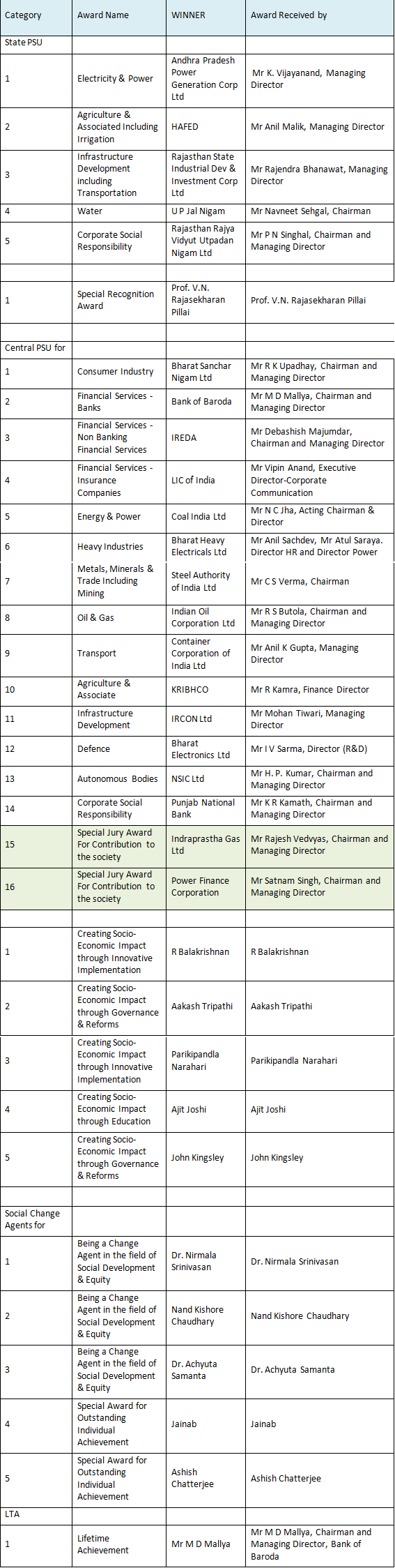
    The third edition of the Dainik Bhaskar India Pride Awards in association with DNA was held at Taj Palace, New Delhi. The Award recognized and felicitated the contribution made by the Public Sector Undertaking and Civil Servant. Presided by Shr. Montek Singh Walia as the Chief Guest the award function ignited a sense of pride for the winners at the awards night.

    In the opening address, Mr Ramesh Chandra Agarwal, Chairman, Dainik Bhaskar Group said that India lives in Tier II & Tier III markets and the PSUs have extended their reach in such areas and Town and it’s great pride for Dainik Bhaskar to honor, the efforts taken by them for the development of the nation.

    Mr Montek Singh Ahluwalia, Deputy Planning Commission, Govt. of India, in his address, appreciated and thanked Dainik Bhaskar for their initiative and said “such acknowledgement of the work done for the economic development of the nation, by the special vehicles called the PSUs is note-worthy”. He further added that Dainik Bhaskar’s recognition of the outstanding work done by the members of the civil society towards the welfare of the nation and a better change for the society at large was a big step.”

    Addition to this, Mr Jairam Ramesh, Union Minister for Rural Development, Govt. of India, the Guest of Honour, said, “Introducing Impact Creator-Civil Servant and Social Change Agent category awards for the individual contribution would serve as a source of inspiration for more and more citizens, specially the youth, who will get encouragement to work for the welfare of the society.”

    Also, Mr V.Narayanasamy, MOS for Parliamentary Affairs, Govt. of India, added “PSUs and civil servants are working hard for the economic development of the country and their contributions should be duly acknowledged. Dainik Bhaskar group is the first in taking up such an initiative at such a grand level.” He termed this as a welcome step.

    The grandeur of the ceremony was the Life Time Achievement Award which was bagged by Mr M D Mallya, Chairman & Managing Director, Bank of Baroda. Speaking on behalf of all the PSUs he mentioned, “Be it the Central or the State PSUs, they are giving their important contribution in the economic development of the nation. This includes development of the rural as well as the corporate sector. Dainik Bhaskar has identified the contributions of the PSUs and appreciated the same on a huge platform. India Pride Awards also instils a sense of healthy competition amongst PSUs.”

    This high powered function commenced with the performance of two time Grammy award winner Robin Hogarth and Indian classical vocalist Padamshree Sumitra Guha. It was a fusion of traditional African and Indian classical music. Adding glitter to the function was, the famous Sufi singer Kailash Kher enthralled the audience with him famous numbers.

    The initiative was supported by SKNL, Title Sponsors, ADANI Group, Principal Associate Sponsor and VIDEOCON, Associate Sponsor.


  • Newspapers’ reach greater than internet’s

    By A Correspondent

    Newspaper circulation declined in print world-wide last year but was more than made up by an increase in digital audiences, the World Association of Newspapers and News Publishers (WAN-IFRA) has said in its annual update of world press trends.

    “Circulation is like the sun. It continues to rise in the East and decline in the West,” said Christoph Riess, CEO of WAN-IFRA, who presented the annual survey Thursday at the World Newspaper Congress and World Editors Forum in Vienna, Austria.


    The survey found:

    – Media consumption patterns vary widely across the globe. Print circulation is increasing in Asia, but declining in mature markets in the West.

    – The number of titles globally is consolidating.

    – The main decline is in free dailies. “For free dailies, the hype is over,” said Mr Riess.

    – For advertisers, newspapers are more time efficient and effective than other media.

    – Newspapers reach more people than the internet. On a typical day newspapers reach 20 percent more people world-wide than the internet reaches, ever.

    – Digital advertising revenues are not compensating for the ad revenues lost to print.

    – Social media are changing the concept and process of content gathering and dissemination. But the revenue model for news companies, in the social media arena, remains hard to find.

    – The business of news publishing has become one of constant updating, of monitoring, distilling and repacking information.

    – The new digital business is not the traditional newspaper business.


    Mr Riess’s presentation focused on six key areas: the media consumption shift; economic developments; newspaper circulation and number of titles; advertising expenditure by media; newspaper revenue; and internet versus mobile.

    This represented a significant shift from past versions of the world press trends survey, which WAN-IFRA has been carrying out since 1988. Long a statistical compendium of information from more than 200 countries, the 2011 report focuses on the 69 countries that account for 90 percent of global industry value in terms of circulation and advertising revenue. “We’re concentrating on value rather than volume, focusing on key numbers in key markets,” said Mr Riess. “Our approach puts a premium on insight over numbers.” This reflects feedback from industry stakeholders, as part of the new WAN/IFRA review. But the survey will continue to monitor all countries.


    Media Consumption Shift

    When measured in minutes per day, media consumption patterns vary widely. For example, television dominates in the United States, internet accounts for one-third of media time in Austria, and digital gets just a fraction of consumption time in Russia. Time spent with newspapers is low when considering their impact and influence on society, compared with other media – and to their advertising revenues.

    “Newspapers have always had a lower percentage of the time spent by the media user, relative to the high advertising revenues that newspapers produce,” said Mr Riess. Newspapers account for 8 percent of media consumption time, but 20 percent of all advertising revenue. “We have always been extremely efficient in using the time of our readers. But now we are in a more challenging environment, because readers are more promiscuous, they have more choices, they read newspapers with less frequency. We have to do more to attract them, find new ways to garner loyalty.”

    There is no doubt that internet consumption is increasing world-wide, to the cost of broadcast more than other media, the report found. Radio consumption. in terms of minutes per day has fallen 23 percent since 2006, compared to 7 percent for newspapers, it found.


    Economic developments

    There appears to be a structural shift in advertising and newspaper revenues. Long mirroring the growth and contraction of Gross Domestic Product, both global advertising revenues and newspaper revenues appear to be decoupling from their patterns related to GDP.

    In the 20 years to 2001, advertising revenue increased more than GDP in an upturn, and fell farther than GDP in a downturn. “But this has not been true since the 2001 downturn,” said Mr Riess. “After 2001, we have had good growth in Asia, but, contrary to the previous 20 years, advertising revenues increases were not higher than GDP during a recovery. And we have a greater decoupling of newspaper advertising revenues, which don’t follow the recovery as in the past. We have a structural change in general, especially in newspapers.”


    Newspaper circulation

    Daily print newspaper circulation declined from 528 million in 2009 to 519 million in 2010, a drop of about 2 percent. But what has been lost to print has been more than made up by digital newspaper readers. Digital audiences are typically a third of print readership. So against a 2 percent decline, digital growth is significantly greater.

    In fact, when measured in terms of readership, newspapers reach 2.3 billion people every day, 20 percent more than the 1.9 billion that the internet reaches world-wide.

    But the significance of this is not the total numbers, but in changes in purchasing patterns. “We get readers, but less regularly,” Mr Riess said. “It’s the same with digital – the problem isn’t visitors, but frequency and depth.” Mr Riess said the patterns required a reconsideration of newspaper subscription models, and of finding new ways to convince readers to come back.

    Again, circulation patterns vary greatly world-wide. In the Asia Pacific region, circulations increased 7 percent from 2009 to 2010, and 16 percent over five years. Latin America also saw significant circulation increases – 2 percent last year and 4.5 percent over the past five years. But drops occurred in Europe – 2.5 percent year-on-year and 11.8 percent over five years in Western Europe and 12 percent last year and 10 percent over five years in Eastern and Central Europe. The decreases were greatest in North America, where newspapers have lost 11 percent of circulation year-on-year and 17 percent over five years.

    The number of newspaper titles worldwide increased by 200 in 2010, to 14,853, but the rate of increase is slowing due to consolidation in many markets as publishers close unprofitable titles and the number of free newspaper titles decreases worldwide. This was particularly pronounced in Eastern Europe, where freedom of expression led to the creation of numerous titles that were not sustainable economically. The number of newspaper titles declined 4 percent in Eastern Europe in 2010, and 8 percent over 5 years.

    In fact, free newspapers took a big hit in 2010 – a drop in total distribution to 24 million copies from a high of around 34 million in 2008. “The hype is over,” said Mr Riess. “In many cities, too many free titles were launched. There were newspaper wars. Now the market is maturing, and though the number of titles has declined, there are still opportunities.

    Mr Riess noted that free newspapers have a strong impact on younger audiences. “Free newspapers added energy to our industry,” he said. “They encouraged a lost younger generation to read newspapers, and this was positive.” Audience research across European cities where free newspapers are available shows that readership among 15- to 24 year-olds is 50 percent higher for free dailies than for paid-for dailies.

    Newspaper readership is highest in Iceland, where 96 percent of the population reads a daily newspaper, followed by Japan (92 percent), Norway, Sweden and Switzerland (82 percent), and Finland and Hong Kong (80 percent). Japan is the leader when it comes newspaper sales, with the average circulation of its newspapers at 461,000 – an enormous total. Austria comes second with an average of 162,000 per title.

    But bigger isn’t always better, said Mr Riess, noting the worldwide circulation average is about 17,000 per newspaper. “Newspapers are about communities, either of geography or of interest,” he said. “It is in satisfying these communities that newspapers can still flourish.”


    Advertising expenditures by media

    Television continues to be the world’s largest advertising medium, with a total ad expenditure of 180 billion US dollars in 2010. Newspapers were second with 97 billion, followed by internet (62 billion), magazines (43 billion) and radio (32 billion).

    But newspapers are lagging behind both television and internet when it comes to growth trends, and internet is outpacing both, the survey found. Internet advertising grew 22 percent year-on-year in Asia in 2010, compared with 11 percent for television and 3 percent for newspapers. In Europe, internet advertising rose 14 percent from 2009, compared with 9 percent for TV, while newspaper advertising fell 1 percent.

    In South America, internet advertising rose 31 percent year-on-year in 2010, compared with 19 percent for television and 6 percent for newspapers. In North America, internet advertising was up 13 percent and television 8 percent, while newspaper advertising fell 9 percent. Internet’s share of the advertising market has surpassed newspapers in the United States, and will reach newspaper levels in Europe and Asia very soon.


    Newspaper revenues

    Newspaper advertising revenues took a big hit in the global recession, but the decline slowed in 2010. Globally, newspaper advertising revenues declined 23 percent over five years and only 3 percent last year.

    In North America, newspaper advertising revenues were down 17 percent for the five-year period but increased 1 percent last year. In Western Europe, they were down 12 percent over five years and up 2 percent last year. Eastern Europe saw advertising revenues fall 3 percent over five years and 3 percent last year. In the Asia Pacific, newspaper advertising revenues were down 1 percent over five years but up 4 percent last year. In Latin America, the revenues declined 23 percent over five years and 3 percent last year.


    Mobile vs internet

    Which offers a better business model for newspaper companies – internet or mobile? Again, it depends on the market, said Mr Riess, and there are wide variations around the world.

    In Russia, for example, mobile penetration is 130 percent compared with 30 percent for internet, so clearly mobile offers better opportunities. The same goes for India, where 60 percent of its 1 billion population has mobile telephones. In the United States, where the penetration of both mobile and internet is high, both platforms offer opportunities.

    The internet advertising model has been well-established, but most of the revenue goes to search engines – 65 percent to Google alone.

    On the mobile platform, the paid-content model is well-established, since users accept monthly contracts, pre-paid phones and paid-for apps. But here too, new players – Apple and the mobile operators – take a large share of the revenue. “If we’re not careful in the newspaper industry, they will take away our business,” Mr Riess said.

    “But this world isn’t easy, it isn’t either internet or mobile, there will be different ways to use these channels and there will by hybrid ways – like tablets – that will use both the paid content and the advertising models. Every company has to look at its target group and readership, and this group defines how best to reach it. And this has to be reconsidered constantly.”

    WAN-IFRA, based in Paris, France, and Darmstadt, Germany, with subsidiaries in Singapore, India, Spain, France and Sweden, is the global organisation of the world’s newspapers and news publishers. It represents more than 18,000 publications, 15,000 online sites and over 3,000 companies in more than 120 countries. Its core mission is to defend and promote press freedom, quality journalism and editorial integrity and the development of prosperous businesses.

    Learn more about WAN-IFRA at http://www.wan-ifra.org or through the WAN-IFRA Magazine at http://www.wan-ifra.org/magazine.

  • ‘Diplomacy? Not for Mail Today’

    Rahul Thappa, COO, Mail Today in a candid conversation with MxM India’s Akash Raha.

    Q: For a long time you had been in Malaysia, how does it feel to come back to India and join the India Today Group?

    Well, these are two different questions and I will take them separately. Coming back to India… I don’t think I ever had a big departure from India. Perhaps, there a few more cars on the road and lots of development since then, but the people are still familiar and the same. Moreover, I was in India fairly often even when I was working abroad, so coming back wasn’t a shock. As far as the rest of the family is concerned, and it was important decision for them too, they have been doing very good. Whereas joining India Today Group is concerned, I think it has been an excellent experience and a very good opportunity thus far. It is one of the best media houses and also one of the oldest. Usually in media, the oldest have the advantage of having settled down well and not being in a state of flux, like many new media organizations trying to find their DNA. So it’s been good on both accounts.

    Q: What is change of tactic that you are adopting, since you have been on the other side of the business too – Media Planning?

    How I characterize it is, I came from the demand side (for media) which would be the advertiser, advertising agency side of the business. And now, I have come to the supply side. I know how the demand side works. I know the psyche of the demand side and that helps me to understand on our end how our supply is to be sold to the demand side, what changes they may need to facilitate the exchange better etc. The knowledge helps us in building and positioning our product better in their mindset and in the way they conceive our product.  Since, we all have an ad-revenue model it is essential know more about the demand side. If we were a subscription based model, it would, perhaps be not as essential. I think that is what I bring to the table apart from the fact that I have been in senior managerial roles for a while now which helps me shape an organization; you could call us (Mail Today) a start up considering that we have spent merely three and a half years in the industry. I hope my past experience will help shape our team further as we will have exciting times ahead. We bring a strong differentiated product in the market and it’s doing very well. I am not saying it will meet the main stream newspapers head-on, as it was never meant to. It might very well contest against the magazines. It was purposed differently and not to take on the big boys on, and our aim was never so. It might look like such a product, but our content is packaged very differently, unlike other newspapers. Hindustan Times and Times of India are everything for everyone. And anyone who wants to read an English newspaper can pick them up. They are fairly democratic that ways and the entry barrier for those who want to come in is low. They have something for everybody. However, we are not everything for everyone… Our content is curated and our content is for a certain demographic.  And in that demographic itself we have several focal points. SEC as we know it today is not as flat as it is… IRS in the coming years with developed and enhanced methodology will aptly point out the fact where they will have a more living standard measure gauge of SEC’s rather than educational and occupational parameters. So if I were to see SEC as a pyramid, which it rightly is, then we as a product, we cater to the top half of that pyramid. Hence, we will not go deep in the market, because we don’t intend to…We don’t intend to access that audience. By choice we have defined our own playing field and it is, in a way, a niche product. We have lower values in mass product and yet, we are a subscription based product. Since we are a subscription based model in time we will have the leeway or flexibility to depend less on ad revenue and focus more on subscription.

    Q: So what are some of the changes that Mail Today has seen since you joined the group and what are some of the changes that the group is likely to see in future?

    Change in management doesn’t mean change in the way how a company is run. There are only subtle changes where efficiencies are creamed out of each system. A person X will look in efficiencies in one place and a person Y will look at efficiencies at another. That is how they are made and that is how they think. But yes, since I have joined, I have looked for efficiencies in certain places… Given the state of economy currently, everyone is making sure across all boards that all processes are running smoothly and efficiently. But a change in management doesn’t change a way in which a newspaper works… the DNA of our product can’t be changed. As we learn about the market, consumers and demand side of the industry, if any process needs to be changed/improved then so be it.

    Q: Efficiency since the slowdown has become an euphemism for job cuts, is that what you are hinting at?

    No, job cuts happens when one process grows faster, builds up fat and then realizing that that process wasn’t necessary to begin with . But in a media industry all processes are equal and that is not what I am hinting at.

    Q: Mail Today began as a paper for the newer audience – the office goers, to put more literally, the metro commuters. Being a ‘compact’ it is easier to handle and read? Are we right in understanding that this focus still continues?

    No, our compact size had nothing to do with the ease at which it could be handled in tight situation, like the model Mid Day in Mumbai. At least, that was never the overt intention. However, if does mean that a person travelling in a metro finds it easier to read, then so be it. One can observe a trend that successful international newspaper are or have switched to compacts such as Daily Mail, Independent, Guardian… One, it is good for savings in terms of the newsprint cost on the other hand it is also fairly easy to read. Ease of reading, pleasing to the eye, logistical advantages, cost advantages… We think that the newspaper industry can take this (compact) route in the years to come. We have taken a bold decision first and we are proud of that. We have taken the first step towards taking compact forward this format that has been a trend internationally too.  If people say only broadsheet is a serious daily then they are out of date… their size has got nothing to do with the seriousness of content. That’s just stereotyping. One cannot compartmentalize the products content by its size.

    Q: Talking about content… Mail Today was known as the ‘Paper Tiger’.

    Yes that focus still continues and will always continue because that is the belief on which media organizations are built. There is no ‘Madhyam Marg’ to it for us…which is what we call our competitors. They are large and fairly entrenched and they take the ‘Madhyam Marg’, or what we will call, being diplomatic. And we don’t believe in that. We tell a story straight, take the bull by the horns… several idioms come to my mind, but in essence we are very direct. We say what we mean and mean what we say, whatever be the consequences.

    Q: Not too long ago Mail Today used to have their circulation number on the masthead. We see that it is not there anymore… Any specific reasons for this change?

    We can put it back there… that is not a problem. But if it becomes two million and two hundred copies I can’t change it every day. It is a little tedious too and is nothing short of a live ticker. We started it only to tell that we were approaching a milestone and thereafter, that we have crossed it. Printing it every day will not make any difference to anybody’s mindset. Eventually, it will become a blind spot. We are currently at over two lakh copies and when we reach our next big milestone, we will put it up too. But keeping it up there permanently solves no purpose. It was for our detractors who said that we won’t grow. The market is growing and with it we are growing too. The market is not only growing only vertically but also horizontally… and there is enough space for us to grow in it. Everything is being diced up and segmentalized according to age, gender and so many other parameters. So the way media is going to grow is with more choice and there is going to be space for everybody; in fact, journalists will have far more trouble keeping their roots. But getting back to your point, the numbers were just to point out to the fact that we are alive and kicking and growing at a steady rate. In three and half half years, I think the numbers we have got in this cut-throat market is phenomenal.

    Q: Since Mail Today was launched in 2007, it was said that expansion was on the cards. Especially Mumbai and Chandigarh were being talked about. Yet, the industry is still awaiting the expansion. Is it still on or has it been scrapped?

    Hopefully you will hear of it soon, expansion has always on the cards. But expansion just for the sake of expansion, what you would have seen in several publications, is something we won’t like to do. We have seen several premiere media houses which saw splits, mergers, acquisitions expanding and trying to enter into every business, launching in every market that they can think off. And look where they are, look what the recession has done to them… Yes, money has become scarce; funding has become scarce too… There are companies in the market close to 80 and 150 years old and that’s why they are successful. We won’t take that long to be successful as they are, but we will get there. But we won’t ruin our work by trying too hard to get into newer markets. Delhi is our market and we know this market and stabilizing Delhi is of critical importance, which we have done. And very soon you will hear of us launching into major markets in a major way. We don’t want to be insignificant players in several markets. We won’t go into a market just because it’s large and growing… Big newspapers which are meant for all audience types can do that but not us. We are also looking for a certain/specific audience type; be it Bhopal, Cuttack or Port Blair. However, we already have a few marked city, the plans are at place and are being deliberated by the management. And very soon you will hear of our first foray out of Delhi.

    Q: What is your annual revenue from Mail Today, and what is your revenue target for 2011-12 and what is the growth number it has seen?

    Our readership is constantly growing. As far supply side, we are growing on that front too. As far as revenue side, we are growing at high double digits. Our growth over the last year is well into 40 per cent. For us, being a relatively new organization and having faced the slowdown, and yet being in the market with such a substantial growth figure is an even bigger achievement. Otherwise the way we started in 2007, we would have been growing currently at 60-70 per cent. We would love those times to come around but till then we are fairly happy with our growth rate.

    Q: It is being said that the IRS-NRS merger are at hand. Do you think it will solve the measurement problem that the industry faces?

    It won’t solve the measurement problem but it will certainly reduce the confusion. We will have one metric to go by and it will make it easy to everybody to look for improvements. When there are two measurements, it’s like having a pound and metric systems working together. The merger won’t solve the endemic problems immediately that publications may have but it will benefit if everyone focuses on one metric. For example, the simplest thing is when you go to a client or planner or agency you might find one of them focusing on one set of data and another one on the other. You waste a lot of productive time that way, which we can now do away with. Two sets of money which was used in setting up samples can now be used to set up double the samples, hence more robust data.

    Q: What are your digital plans?  We have seen your epaper on the digital space but do you have a plan to do more on the digital space and monetize it with advertising revenue, and perhaps subscription revenue through partial pay walls etc.

    We realize that the digital era is already here, yet, none of the Indian players have been able to do anything substantial on it. But I can’t hide behind and say since it’s not working and we will not go there. Digital has become a way of life, information is dynamic and people want information at any time and at any place. When the demand will increase, so will the entire market and then, people will have many models. For example, if you have a complete pay wall it might not work, yet, if you have a partial pay wall it might just work. Also, you can focus on advertising and give content for free. Ad rates, as we see today differ for a digital pixel and a print pixel, which is not right. It is a peculiarity of mindset and it has to change. In years to come, digital will reign. Yet as I say that, I believe that physical product will co-exist. In 20 -25 years when today’s generation consuming digital grow older and new generation of people consuming arrive, print might see a little fall, yet it will co-exsist and then better product will reign. Mobile, tabs and more futuristic system will come into existence and then the sole factor will be how you reach out to a consumer throughout his day on various mediums. Answering your question, eminently, we have been a little slow on that front (going digital) because we are just a start up and we wanted our editorial to focus on the paper product first and we wanted to keep it growing. The demand side still understands print better and hence it was understandable to keep that going before we jump into anything new. We are already making plans to go digital… But we want to come up with something different… Not something regular and utility base like the other Indian websites we have today. The idea will be to be a Huffington Post equivalent, otherwise, the content and the medium will not be differentiated. For example, god-forbid, if there is a bomb-blast everyone in a matter of 10 minutes will have the news. Hence, time is not a differentiator in that space because everyone has caught up and is as fast. Wealth, is the second dimension (one could be paid, one is not) yet, there is yet to be a successful model in it. Lastly it is skill, which is where one can differentiate. A well curated news and content is important. How does an event affect a person’s life and how you add value to it, which is the skill dimension… Currently at number two, Mail Today, our parent in the UK are competing on time and content. They have most of the news and on time too… You have to see it to believe it, how they put content together, on time and seamlessly where the designing is superb.

    Q: It is interesting how you say Daily Mail is your parent, I was more expecting a term like partner.

    Yeah, they are our parent as far as the website is concerned. And then again, I could say that we have two parents, one is Daily Mail and the other is India Today group, which undoubtedly is a parent. If you see the mast head (of Mail today), one can say that they are similar. We borrow a lot from them. Our DNA in terms of look, feel and the physical self of the paper is from Daily Mail. The way the content is put together is an India Today DNA.

    Q: What is the interaction level of Daily Mail with Mail Today after three years?

    We are very interactive. In content sharing of course we are the equity partners. Apart from that, they provide us the glimpse into the future and whole lot of other learning, as to how to handle multi-national clients. They have been handling the same format for a longer duration of time than us, hence the expertise. Our relationship is a fairly active and very cohesive.

    Q: Do you think that media houses should do something to change the current overdependence on advertisement revenues? Do you think rationalizing cover prices will help? What are the challenges?

    Yes they should. The biggest challenge is, the fear that if prices are hiked circulation will be affected. For example, there are houses where there are 4-5 a paper going in each day and the fear is with a hike in price they might cut down on 1-2 paper. But I don’t really see it as fear, rather it is a affirmation of two things –How valuable your product was in that person’s life if he can do away with it? On the other hand if that person was so price elastic that he couldn’t pay another two rupees for valuable information he or she is buying the first thing in  the morning, it creates serious doubts over the buyability of the reader as a valuable asset to an advertiser. For certain advertisers selling regular day to day stuff it will be bad. But for an advertiser selling a car, it becomes interesting… Let’s say my circulation is one million. If all products become double the price, the people who drop out are for instance 300 thousand. In that case, I would value that 700,000 more than the entire 1 million. Now that 700,000 I have are taking me no matter what the cost, they are actually reading the product and see value in it. The other 300 million weren’t reading me and taking me only because I was cheap.

    My argument to the advertiser would be, as it is earlier only 700 thousand were reading the product. And hence you continue paying me as much as you were, since that’s the exact number I still have. Then, my cost comes down and my revenue stays stable and I am a little more profitable. Some of these costs can be shared with the advertisers like they will want you to, but there are other ways of doing that; by elongating their campaigns, making content for them, doing events etc.,  not by giving them a price off.  The aims should not be to talk to everyone, but to talk to fewer people and be sharper in the communication.   It is time we bite the bullet, it is time we increase our price and it is time we do something rational for ourselves rather than keep digging ourselves deeper in the pit. If two rupees a day can bring down the edifices of large organizations then it is a slap on their face. If the whole network of large newspapers is built on Rs 2 a copy then there is no point discussing their value anyway.  It speaks a lot about what you have built over the past so many years. If you have built content-based credible organizations then the consumers will read you irrespective of a Rs 2-3 price hike. It can’t do away with what I call ‘Elasticity of Doom’. ‘Elasticity of Doom’ will come irrespective of the money – Sorry, you didn’t build a strong enough organization. You can very well increase 50 paise every month for four month. Then people in the industry say that do it all together, how would it make a difference, what is the point of doing it slowly. But like one of my colleagues in Mindshare used to say, you don’t boil a frog by putting it in hot water, it jumps out. You heat it slowly, and sooner or later you can boil the frog and make a nice broth. And all publishers can do it together, 1st of every quarter, across all boards. So that one is not costlier than the other and the parity stays. So it’s possible, you just need will to do it, because the ‘Elasticity of Doom’ eventually is inevitable. The cost of paper has to rise up, it’s not a renewal source, so might as well do it right now. Especially in the paper industry there is no reverse logistic. So till reverse logistics become a part and parcel of life, you will never have cheap recycling and cheap paper. Most of the paper today gets imported and there are tariffs, company disputes etc., due to which prices will always keep rising.

    Q: Talking about lighter subjects, Mail Today comes up with interesting initiatives. What are some of the upcoming marketing initiatives that the paper has planned?

    We have planned a lot of initiatives. But unfortunately we can’t talk much about it as it is a revenue stream for us. Olympics, Delhi centenary year we plan to do a lot on a lot of topics. Delhi has its own problems and being Delhi’s own paper we will try to tackle it in the best way possible. You will see several campaigns in times to come.

    Q: On a broader note, what are the new emerging trends in print media?

    There are wiser people who can talk about trends, but there is one trend that I will talk about which is the rise of tablets. I think it’s at our doorstep right now. While it might seem very quiet… you see cheap tablets of Reliance, Beetel. Samsung too have been known to lower costs drastically. The ipad market, I feel, will grow faster than the penetration of smart phones. There is still very little Indian content on the ipad. Yes the Times of India has an ipad app and a few others too, which is good and evolving, but it is not seamless yet. It is nothing like the foreignpolicy.com apps. We were talking about consuming content at ease in a metro. Consider the iPad which collapses a newspaper to one-eighth its size. You don’t have to open it any more, you can just slide your way through the complete newspaper. There are already about 250 thousand iPads in the country by official or unofficial estimate. Every second member in our industry has an iPad. It’s just a matter of time before the market explodes, and when it does, it will be everywhere without anyone having to curate content for it. That is something we should all keep our eyes on.

    Q: Can we expect Mail Today to come out with an iPad app soon?

    Mail Today would certainly like to do it; but probably as an organization we don’t think we ‘need’ to do it right now. But we have our eyes pinned on it, and will offer a value package to our consumers if and when we think it is the right time.


  • IRS 2011Q2 | State Watch: Dailies

    By Ritu Midha

    A quick look at data for top 10 dailies in a handful of states brings out a few interesting observations. Do write to us at editor@mxmindia.com with your own observations and insights.

    Bihar: All the newspapers show a positive growth vis-a-vis the previous quarter. Even when compared with the same quarter previous year, all the publications show a good growth except I Next. Interestingly English dailies too have grown – and in case of Times of India, it has maintained the same level as the previous year same quarter.

    Jharkhand: When it comes to its neighbour and a part of Bihar till recently it is quite a different story – six out of top 10 dailies show a negative growth – and it is across Hindi & English dailies.

    UP: Just like Bihar, UP too has shown a growth in all the publications as compared to the previous year with the exception of DLA. Amar Ujala compact is growing the fastest with readership increasing to double in comparison to same quarter previous year.

    Uttaranchal: Uttaranchal too shows growth in all the publications but one, when compared to the previous quarter. Interesting thing however is that Amar Ujala compact that shows the fastest growth figures in UP, here shows a drop of 61%, as compared to same quarter last year.

    MP: If one compares data for Q2, 2011 with Q2, 2010, Nava Bharat (MP) and Raj Express are the only two publications that shows a fall. Another interesting factor here is that The Times of India is the only English publication in the top 10, unlike UP and Bihar where there is almost an equal number of Hindi and English Publications.


    Chattisgarh: In case of Chattisgarh, there are three English dailies in the top 10, however all three show a negative growth when compared to the previous quarter. Though, in case of The Times of India, if compared with Q2, 2010, figures show a 27.3% growth.


    Himachal Pradesh: Six out of top 10 dailies show a negative growth when compared with the same quarter in 2010. Amar Ujala, on the surface, seems to have gained at the cost of Punjab Kesai, while in case of The Hindustan Times, it is at the expense of The Times of India. A deeper analysis, perhaps, can throw more light on it.


    Haryana: In case of Haryana, q2 2010 to Q2 2011, three publications show a downturn, but when it comes to Q1 2011 vs Q2, the downturn is seen in seven publications – all the three English papers in the top 10 show a percentage fall when compared to the previous quarter.


    Punjab: In case of Punjab, only two publications of the top 10 have witnessed positive growth when compared to Q2, 2010 – These are Ajit and Dainik Bhaskar. However, if one compares Q2 2011 with Q1, 2011 even The Times of India and The Tribune show positive growth.


    Maharashtra: In Maharashtra’s top 10 dailies, Times of India and its co-publication Mumbai Mirror are the only two English dailies. Market, as expected, is dominated by Marathi dailies. Deshonatti is the only daily that sees a double digit growth when compared to Q1, 2011 – however, that too shows a 17% fall when compared to Q2, 2010.


    Gujarat: Gujarat too has just one English daily in its top 10 – The Times of India, and it shows good growth in both quarters. Other non Gujarati daily in the top 10 shows a growth of 83.9%, when compared to Q2, 2010.

    To be continued…

  • Puja with The Telegraph in Bengal

    By Akash Raha

    Durga Puja, by far the biggest festival in West Bengal, is the event of the year. Festivities touch dizzy heights in Kolkata where more than 2,000 pujas take place in neighbourhoods, not counting pujas in apartment complexes/RWAs, which touch about 500.

    West Bengal’s top English daily The Telegraph is all set to activate three big initiatives during this period so as to enable its readers to make the most of this festive season. It also partners with clients to set up meaningful interaction opportunities with relevant target audiences and help create a special bond through the festive route.

    Speaking about the initiatives Mr Dhruba Mukherjee, Associate Vice President, The Telegraph said, “Durga Puja is the most important festival of Bengal and being Bengal’s favourite English daily, we wanted to do something for the city. Our activities, even though fun, take up a social cause and exemplify our responsibility towards the city.”


    True Spirit Puja

    More than 300 neighbourhood pujas participate in this initiative, the objective of which is to make the Puja experience safe, happy and meaningful. Organizing committees are judged on the basis of their display of civic consciousness, social contribution and safety measures. After a preliminary judging round a panel of celebrities visit the shortlisted pujas to rate them. Based on the ratings the pujas are accorded stars from five stars to one star. Thereafter one puja is given the model puja status.

    Each star rated puja is given a fund to undertake a development project in their locality. This initiative is now in its ninth year and is co-partnered from the beginning by Calcutta Electric Supply Corporation (CESC) of the RP Sanjiv Goenka Group. It is also supported by Kolkata Police, Kolkata Municipal Corporation, West Bengal Fires Services and NGO – The Bengal.  It is extensively promoted editorially in the pages of The Telegraph.

    Hand in Hand

    Here, The Telegraph ties up with 100 SEC A apartment complexes/RWAs, each with a minimum of 100 flats. Overall about 20,000 flats participate in this initiative. During the five days of festivities The Telegraph helps the societies to organize various cultural programmes and fun activities for residents, and also arranges for prizes. Some of the activities organized are antakshari, sit and draw, dhunuchi dance, recipe contest and so on. The Telegraph through this also creates an engagement opportunity for various other interested clients to interact with the target audience through the Hand in Hand pavilion it sets up within societies. This activity is in its seventh year and is the centre of puja celebrations for apartment blocks in Kolkata. The entire proceeding is amplified in a big way using the pages of The Telegraph as well as TV, radio and web. This year the event is being presented by Lewis Berger and associate partners are Bajaj Almond Hair Oil and Reliance 3G.

    Festival of Joy

    This initiative, in its second year, is modelled on the ‘True Spirit Puja’ concept and is executed only for apartment societies/RWAs. The idea is to promote civic, social and safety consciousness among residents of these societies. This in turn ensures that their cause of celebration does not become a cause of concern to the environment around. In its second year this is rapidly gaining ground and has already seen participation from about 50 apartment societies/RWAs this year. A panel of celebrity judges visits the shortlisted apartments and accords ratings. Each rated apartment is given a funding for a development project in their locality. The whole activation is supported editorially in The Telegraph to amplify the just cause it intends to promote. This year the event is being presented by the Eureka Forbes group.