Tag: Nestle India

  • Can the new Nestle CEO restore confidence in Maggi?


    By Kala Vijayraghavan & Ratna Bhushan


    More than allegedly selling Maggi with excessive lead content or mislabelling packs, perhaps Nestle India’s biggest transgression in the run-up to the noodles hitting the fan in early June may well have been the inadequate communication with government and regulators. Small wonder, then, Suresh Narayanan, the 55-year-old Indian managing director at Nestle India, who’s been brought in to douse the fire, talks about “stepping up engagement with the government.” This, of course, will be in addition to taking “all necessary steps to engage with the consumer,” and the “first task” of getting “Nestle as an organisation to regain its self-confidence.”


    Narayanan’s predecessor, Etienne Benet who took over in October 2013, replaced another expat, Antonio Helio Waszyk. To be sure, Nestle India has almost always had expat CEOs since it began operations in the country over a century ago; and Narayanan is the first Indian in that role, although he has come in from an overseas Nestle outpost (the Philippines).


    Having an Indian at the helm is doubtless good for perception, credibility and communication, with regulators, consumers and even employees, reckon human resource experts. Says R Suresh, founder of RGF Executive Search: “Some European companies tend to have a mindset that expats should be at the helm of the company. But for Nestle India, which wants to get Maggi up and going, an Indian as CEO is a great decision.” D Shivakumar, chairman of PepsiCo, feels two strengths of Narayanan will come to fore at Nestle India. “He excels at customer management and boosting the morale of those who work with him.”


    The new CEO, though, will be the first one to remind you that he does not have “a magic wand,” and the journey back to normalcy promises to be a long, winding one. Nestle posted its first loss in over three decades for the April-June 2015 quarter (of Rs 64.4 crore compared to a net profit Rs 288 crore in the corresponding quarter a year ago), thanks to the disruption in the instant noodles business. Consider what Maggi is up against: the 30-year-old brand with over 75 per cent market share has disappeared from shelves, virtually overnight. The national food regulator has banned sale of Maggi noodles nationally citing excessive lead levels, more than the permissible quantity of 2.5 parts per million; mislabelling on packs which declared ‘no added MSG (monosodium glutamate, a controversial flavour enhancer); and for selling Maggi oats masala noodles without product approval. Nestle has insisted that neither its noodles nor pasta contain added MSG, adding that many packaged foods contain hydrolysed groundnut protein, onion powder and wheat flour, all of which contain glutamate. The matter is in the courts.


    For its part, the top brass at Nestle stresses that Narayanan has not been airdropped just because of his nationality, although being Indian has its advantages. Says Wang Ling Martello, executive vice president, Nestle SA, head of Zone Asia, Oceania and Africa: “Suresh is Indian, knows the market here, can hit the ground running. But when I scanned the world, I did not look for nationality. I looked for the skillsets… We don’t pick people depending on nationalities,” she says.


    A former CEO at a multinational consumer goods company points out that an Indian in the hot seat is also good for PR – a front Nestle hasn’t emerged smelling of roses not just in India but globally too. In 2010, for instance, the Swiss MNC found itself at the receiving end of flak from environment group Greenpeace – and consequently on social media – which accused it of not heeding a cry to stop buying palm oil from an Indonesian company that was allegedly consciously destroying Indonesian forests. Nestle was duly slammed on social media for its apparent arrogance.


    When the Maggi crisis broke in June, fingers were similarly pointed at Nestle India for living in denial, not communicating with consumers and a poor attempt at countering the criticisms on social media. The former CEO at the MNC says Nestle culturally has had condescending attitude towards the marketplace. “This is a world where leadership and brands have to be humble —to admit that, yes, we made mistakes, we will rectify them, and move on”.


    “It is a tough one to resolve. Nestle allowed too much delay and let doubts creep into consumers’ minds, who have moved on to rearrange life around new habits. The company failed to present a different story. It will not be easy for Suresh even as an Indian to fix the damage,” says Santosh Desai, MD & CEO, Futurebrands, a brand management and marketing consulting firm.


    Rajeev Bakshi, a former CEO at PepsiCo India, reckons that more than winning over the consumer, Narayanan’s biggest challenge is to win over the government. “This is not an attack from third party, unlike when Pepsi was attacked by an NGO.” In 2010, the Centre for Science and Environment had alleged that leading food brands including PepsiCo’s Lays, McDonald’s, KFC and, yes, Maggi, were guilty of “large scale misbranding and misinformation.” But today the government is the protagonist. “Nestle can’t afford to take an adversarial role here. They have to align and collaborate with the government,” says Bakshi, now managing director of wholesaler Metro Cash & Carry India.


    Fifty-five-year-old Narayanan, who began his career with Hindustan Unilever, doubtless has his toughest mandate yet. “Deep down in my gut, the words that come to me are, we shall overcome… we (employees, colleagues, associates) can rebuild brick by brick, together.”


    They’ll need plenty of help from government and consumer.


    Source:The Economic Times

    Copyright © 2015, Bennett, Coleman & Co. Ltd. All Rights Reserved

    Licensed to republish


  • Nestle replaces Maggi ads with Nescafe & KitKat commercials, to lose about Rs 10 crore

    By Pritha Mitra Dasgupta & Shramana Ganguly


    Nestle India stands to lose advertising inventory of about  Rs 10 crore due to Maggi recall despite its move to air commercials of Nescafe or KitKat in all advertisement slots booked for the instant noodles brand, broadcasters and media planners say.


    “The channels have been told to subtly replace Maggi ads with Nescafe and KitKat commercials,” a senior media planner said. “But despite this attempt to recover as much inventory possible, Nestle will have to let go of advertising inventory worth  Rs 8-10 crore,” the person said on the condition of anonymity.


    On Saturday, Nestle notified broadcasters and other media houses in India to stop publishing Maggi ads from Sunday. While the Swiss company has stopped digital advertising for the brand as well, it is using various social media platforms liberally to sell its side of the story to Indian consumers.


    A Nestle India spokesperson said that while the firm has taken action to stop Maggi ads, “you may see a few since changing the programming pipeline could take a little longer”.


    Nestle is one of the biggest advertisers in India, spending over  Rs 400 crore on advertising a year. Its ad spend on Maggi brand alone is estimated at over Rs 150 crore, according to industry insiders.


    Publicis Worldwide is Maggi’s creative agency, while Zenith-Optimedia handles the brand’s media buying and selling activities. The digital mandate of Maggi is handled by GroupM’s Maxus. Sources in these agencies said that Nestle stopped airing Maggi Oat Masala noodle commercial featuring actor Madhuri Dixit right after the scandal broke.


    In February, Maggi had launched a campaign, ‘Khushiyon Ki Recipe’, which was on air till Saturday despite Food Safety and Standards Authority of India (FSSAI) dismissal of Nestle’s defence about the brand embroiled in controversy over excessive lead content and mislabelling on MSG.


    Nestle has now instructed channels to take these commercials off air.


    Meanwhile, Ahmedabad-based Consumer Education Research Centre (CERC) is contemplating legal action to push Nestle to do corrective advertising across print and television space.


    “Considering Nestle advertisements have been misleading the consumers, they ought to engage in corrective advertising to tell the consumer in as many words about what is factually correct,” said Pritee Shah, chief general manager at CERC and a member of an inter-ministerial monitoring committee for misleading advertisements under the ministry of consumer affairs.


    G Gurucharan, additional secretary (consumer affairs), too, had recently stated that Nestle could be asked to put out corrective advertisements.


    Shah said that considering Nestle has been misleading the consumer about the health aspect of Maggi, it should redo its commercials. In addition to lead and MSG, the firm needs to clarify that one helping of Maggi is not equivalent to three chapatis as claimed by one of its ads, he said.


    Source:The Economic Times

    Copyright © 2015, Bennett, Coleman & Co. Ltd. All Rights Reserved

    Licensed to republish
     

  • Publicis takes the hunger route for Maggi in new campaign

    By A Correspondent


    MAGGI Noodles, Nestle India’s flagship brand has launched its new brand campaign for Masala Noodles. The campaign celebrates the age old bond between mother and child with a new-age twist.


    Partha Sinha, Director and Chief Strategy Officer, Publicis said “With years, the work on MAGGI is becoming more and more fundamental. We were looking for one such fundamental truth and we figured that ‘Hunger’ probably is the most primal bond between a mother and a child.”


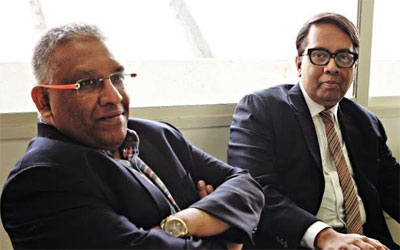
    Left – Bobby Pawar, Right – Partha Sinha

    Since the last 30 years Maggi has been creating a stronger bond between a mother and a child their insight locates the brand in a more primal and fundamental space.


    Bobby Pawar, Director and Chief Creative Officer, Publicis adds “Once we had a powerful fundamental insight, the job of the creative was to tell a story contexted in current cultural shift. We came up with two stories that demonstrates the power of hunger bond.” The context is always modern, the content is always universal. That’s MAGGI for you”.


    The communication has taken off well with the campaign crossing 1.5 million views in just two days.


  • Nestle India enters into an agreement with Magic Bus India Foundation

    By A Correspondent


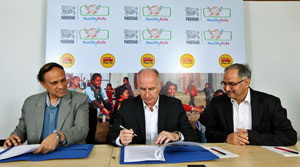
    Nestlé India has recently signed an agreement with Magic Bus India Foundation. This initiative is on the lines of the Nestlé Healthy Kids Global Programme that focuses on providing nutrition and health awareness to adolescents.
     

    The programme will reach out to 50,000 students aged between 10–17 years through government schools. The cities, where the programme will be running for a year, include Delhi, Mumbai, Chennai, Bangalore and Hyderabad. Magic Bus, which works on breaking the poverty cycle, one child at a time, will create a curriculum based on Sports for Development (S4D) approach, imparting knowledge about nutrition and a healthy, active lifestyle.


    Speaking on this occasion, Etienne Benet, Managing Director, Nestlé India Limited, said, “Being a leading Nutrition, Health and Wellness (NHW) company, Nestlé India intends to enhance the quality of life by creating awareness regarding nutritional health. In line with the already operational Nestlé Healthy Kids Global Programme, we intend to reach out to adolescents across metros in India.”


    The Nestlé Healthy Kids Global Programme is adapted in India to create and raise awareness regarding good nutritional practices. Added Benet, “The partnership between Nestlé India and Magic Bus, will promote healthy eating habits amongst children in government schools, basis food availability and accessibility in cities.”


    Commenting on the partnership, Sanjay Khajuria, Senior Vice President, Corporate Affairs, Nestlé India said, “In India, we have done an assessment of nutritional needs in the community and want to create and raise awareness regarding good nutritional practices amongst children and adolescents. Through the Magic Bus partnership, Nestlé India will reach out to over 50,000 less privileged children in five metros within the span of a year.”


    Pratik Kumar, CEO, Magic Bus India Foundation added, “There is a strong synergy in the commitment towards better health and wellness of both the partners. Along with sensitising parents and teachers, this program will steer adolescent children in marginalised communities towards a life with better awareness and improved life skills, in the journey from childhood to livelihood.”


    For the Nestlé Healthy Kids Programme, Magic Bus will create and customise its existing curriculum into three major buckets with the objective of raising awareness on ‘Nutrition and Health’, ‘Getting Active’ and ‘Hygiene and Sanitation’ amongst children in government schools. It will identify and train youth mentors who will be responsible for implementing the sessions in these schools and train them to deliver the curriculum on the ground. The programme also intends to ensure that girls and boys get equal opportunities to play and learn. An awareness drive for gender sensitisation will form an integral part of the programme.


  • Nestle urges consumers to ‘share your goodness’

    By a correspondent


    Nestlé India has unveiled a couple of emotional campaigns with an aim to connect with the consumers with a simple message – ‘Share your goodness’.

     

    According to a statement issued by the company, the campaign originates from the belief that each one of us has an element of goodness and it comes from the values, beliefs, strengths, ideas, understanding, and capabilities that we have learnt through others. All of us are capable of sharing this goodness. When we share these with others around us, we make their lives richer and our world more harmonious. As the leader in Nutrition, Health, and Wellness, Nestlé understands that food is often the most effective way to share our goodness.


    In our culture in India, consuming food goes beyond the pleasure of consumption and nutrition, and is a natural opportunity to share our lives and build healthy relationships with our family and the community. We have all grown up in family environments. We have sat together over meals, shared stories and our experiences, learnt of joy and pain, developed our values and created our dreams. Our lives became richer in those moments of preparing, serving and eating together, and experiencing the Goodness that everyone shared.  Today unfortunately, we are so involved with the routine and stress in our lives that we are forgetting this simple act of sharing our goodness. If we want our world to be harmonious and healthy, and become better, then we need to keep the cycle of goodness moving by continuously sharing our Goodness. Nestlé’s promise is ‘Good Food, Good Life’ and since it also reflects our own traditions and culture in India, our effort is to make everyone refocus on the cycle of goodness.


    In this campaign, Nestlé seeks to motivate people to look into their own experiences, share their goodness, recognize the goodness of others, engage with each other, and create conversations that bring alive the values and emotions that spread warmth. In its first phase the campaign has been launched on the digital media with two films that touch upon instinctive human emotions and values, and is also visible on television.


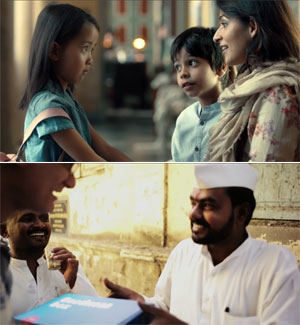
    The first film is a story of two siblings and their insecurities, and how they bond with each other while the second film is about the Dabba-walas of Mumbai and how Nestlé India showed its appreciation for these precious people who have delivered hot home-made food to Mumbaikars every-day, and thanked them for their values of dedication, punctuality and commitment. Each of the 5000 Dabbawalas was given a ‘Goodness Box’ filled with our products.


    The campaign will be rolled out across media platforms in a sustained manner and will encourage people to share their goodness with others and recognize the goodness that they see. Nestlé India has also activated #ShareYourGoodness on Twitter to help enable conversations and sharing of ideas, experiences and personal stories.


  • Nestle consolidates digital & social wt Maxus Digital

    By A Correspondent


    Nestle India has been successfully executing various digital initiatives on brand websites, social media and mobile across brands. Nescafe, Maggi and Milkmaid among others are some of the largest Facebook communities in their respective businesses. These digital assets of Nestle India that were being managed by multiple agencies have now been consolidated with Maxus Digital.


    Nestle India has recently established a comprehensive digital hub at its Head office in Gurgaon that will enable its marketing teams to listen to digital consumers and engage in meaningful conversation. Maxus Digital will work closely with the company and also help manage the Digital Acceleration and Services Hub ‘Dassh’. Maxus has dedicated a team for Nestle India with skills in social media platforms, measurements and creative and some of these team members will be operating from Dash in the Nestle head office.


    “We are very proud to be a part of Nestle’s digital journey. In a digitally connected world, reaching and engaging consumers requires expertise and understanding in diverse areas of Creative, content, technology, media and the ability to measure,” said Unny Radhakrishnan, Head of Digital Maxus South Asia.


    Ajit Varghese

    Ajit Varghese, Maxus MD, South Asia said, “We are excited to partner Nestle India and at being able to set up the first of its kind digital team for them. Nestle has already developed some good digital assets and we will work closely with the Nestle team to mesh them with mainstream marketing.”