
Tag: MediaSENse

  • Indrani Sen: E-commerce muddles advertising growth in 2016

    By Indrani Sen


    Last week, Pitch Madison released its mid-year advertising report for 2016 and revised the annual advertising growth forecast from 16.8% to 13.2%. It appears that our advertising growth rate will take a plunge in 2016 after achieving growth rates of 16.5% in 2014 and 17.6% in 2015. Madison no longer expects the total advertising in India to cross Rs 50,000 crore by end of 2016.

    A slowdown in TV advertising in the first half of the current year has compelled the agency to cut down on its original projection of TV advertising annual growth rate from 20% to 11%, the same as the growth rate achieved by the medium during the first half of 2016. The TV advertising expenditure has lagged below the estimated level for the first half of 2016 largely due to the lower contribution from the e-commerce sector. The shortfall in TV advertising has downgraded the overall advertising growth forecast by 3.5%.

    Shortly after the release of “Pitch Madison Advertising Report 2016” in February 2016, the Union Government gave a blow to the e-commerce industry by prohibiting them to offer direct discount to the consumers in March 2016. Financial Express warned in an article on March 29, 2016 about a slowdown of funding in e-commerce companies from last quarter of 2015 (http://www.financialexpress.com/industry/companies/flipkart-bigbasket-alibaba-flows-to-e-commerce-slow-down/230340/ ) backed by some hard data.

    In its issue dated April 24, 2016, Business Today carried a cover story “The Party is over” by Goutam Das (http://www.businesstoday.in/magazine/cover-story/realism-now-takes-root-among-indian-e-commerce-cos/story/230732.html) suggesting that “After two years of reckless funding and growth, realism takes root among Indian e-commerce companies.” The article showed that venture funding in e-commerce had slowed down since October 2015.

    However, around the same time Deloitte, supported by Mjunction and CloudBuy released the report “E commerce in India: A Game Changer for the Economy” commissioned by CII which (https://www2.deloitte.com/content/dam/Deloitte/in/Documents/technology-media-telecommunications/in-tmt-e-commerce-in-india-noexp.pdf) marginally raised the hopes of the advertising industry.

    The writing on the wall was all over the financial and trade media during the last two months (June and July 2016) with various articles appearing on the changes in India’s e-commerce industry.  It became quite clear that all is not well in the e-commerce sector even before Pitch Madison released its mid-year advertising report. The revision in the advertising growth rate of e-commerce sector raises a question if it is too conservative. The festive season advertising spends usually yields a higher growth rate in the second half of the year compared to the first half in most categories, but we find that the Madison has pegged the revised advertising annual growth rate for the e-commerce sector at the same level as the first half of the year.

    GroupM released its “This Year Next Year” report in January 2016, a few weeks before the Pitch Madison Advertising Report. In 2015, the adspending in India grew by 14.2% which was higher than their predicted growth rate of 12.4%. GroupM projected a growth rate of 15.5% in advertising spend in India in 2016 to Rs 57486 crore driven by Digital. TV remained as the dominant medium with a 47.1% share, up from 46.3% in 2015. It also predicted that consumer product, automobile and e-commerce companies would continue to drive the growth in advertising expenditure as they did in 2015. The e-commerce sector has been burning less money on the traditional media as well as digital media for advertising, which will also affect the GroupM projections.

    The government has recently set up a high-powered committee to review all issues including FDI of the e-commerce industry in India. The committee will submit its report within two months. The introduction of Goods & Services Tax (GST) is also supposed to give relief to the e-commerce companies. However, the effects of all these measures will not be felt in immediate future and media and advertising industry will have to wait and watch for the revival of e-commerce advertising spends.


    Indrani Sen is a veteran media agency and marketing services professional. She is currently an Independent Consultant and Adjunct Professor, Media Management at Symbiosis Institute of Media & Communication, Pune. The views expressed here are her own.

     

  • Indrani Sen: Free Wi-Fi: A Privacy Paradox

    By Indrani Sen


    Last week, TRAI released a consultation paper on how a sustainable service of providing free Wi- Fi to the general public can be introduced in India. I read the report published in exchange 4media (http://www.exchange4media.com/digital/trai-moots-ad-based-models-for-free-wi-fi;-estimates-cost-at-less-than-2p-per-mb_65238.html), which described the consultation paper as a summary of the various models of deployment and monetisation which are being practised around the world and does not include any specific guideline for how the same structures can be adopted in India or what kind of rules and regulations will be applicable in each case.


    It seems the TRAI paper merely indicates that the costs of access of free Wi-Fi may be borne by the end user, owner of the site where the access point is deployed, advertisers, sponsors or the government and lists the four types of models available globally: Paid Model, Freemium Model, Advertisement-based Model and Aggregators’ Model. It is surprising that the exchange4media report mentioned only under the advertisement-based model that personal data collected from the user at the time of sign-in could also be monetised to earn revenues, where as in reality such practices can be adopted by any of the four financial models described by TRAI, based on how they choose to develop their financial models.


    Free Wi-Fi services are a privacy paradox as generally they come at the cost of the users sharing valuable information on their personal, locational and behavioral data. Companies providing the services can collect, store, analyse and sell the same information to earn revenues. Indian consumers who often agree to accept the rules which allow them access to internet services without going through the fine prints need to be aware about the price which they are paying for the services including free Wi-Fi. Does TRAI plan to have any guidelines for collecting, analyzing and selling personal data of the users by the service providers?


    Some time back, I read an interesting article in Forbes magazine by Alex Konrad, (http://www.forbes.com/sites/alexkonrad/2014/01/22/airport-wifi-free/#777e90b311cd) titled “Who is paying for your free Airport Wi-Fi?” Konrad observed about the situation in US in that article “As ad-supported Wi-Fi has taken off, the biggest partner to airports has remained Boingo Wireless, which has traditionally paid for the equipment and installation and split its monthly and daily access fee revenue with the airports in multi-year contracts.” Needless to mention that we will also need investors/ access providers who will be prepared to sink in the money required for setting up the infrastructure. Boingo sells advertising on its Wi-Fi platform, through landing page access and display advertising and provides information on their users across airports to marketing companies for better targeting of their products and services.


    The Aam Admi Party promised availability of free Wi-Fi in public places across Delhi in their election manifesto. There was an interesting analysis by Pravin Prashant early last year “Who will pay for free Wi-Fi in Delhi” (http://www.teleanalysis.com/analysis/who-will-pay-for-free-wi-fi-in-delhi-12917.html) where he mentioned “According to experts, the capex (only capital expenditure and not RoW cost) cost for free Wi-Fi in Delhi would cost around Rs 500 crore if one plans Wi-FI in government buildings and tourist places and Rs 1000 crore if one plans street based Wi-Fi in Delhi. On top of this, government needs to pay any agency who provides Wi-Fi service which would be around Rs 100- Rs 200 crores.” No wonder that Arvind Kejriwal has not been able to fulfill this promise made to Delhites. The construction of the Wi-Fi networks is a significantly large part of their overall cost. In India the process is bound to create some public-private partnerships. Does TRAI plan to have any guidelines for such partnerships? Can TRAI safeguard the privacy of Indian people while detailing their rules and regulations?


    Indrani Sen is a veteran media agency and marketing services professional. She is currently an Independent Consultant and Adjunct Faculty, Media Management at Symbiosis Institute of Media & Communication, Pune. This column MediaSENse will appear fortnightly. The views expressed here are her own.
     

  • Indrani Sen: Media design v/s media planning in digital age

    Indrani Sen

    By Indrani Sen


    I read an interesting article last week in The Guardian by Ana Andjelic, SVP, Global strategy Director at Havas Lux Hub, “Why media design is the new media planning” which I would like to share with readers of this column. (http://www.theguardian.com/media-network/2016/may/24/media-design-media-planning-brands?CMP=ema-1698&CMP). Andjelic quoted the analytics used by Netflix for developing personalised genre for describing television and film content and argued that in the digital world “If we apply this same micro- and human-centred approach to media planning, we get media design”.


    In other words, where the success of Netflix has come from focussing on personalised genres for marketing its universe of audio visual entertainment, brands will succeed by putting their customers’ personal preference and expectations at the centre of digital media planning.  According to Andjelic, consumers today take for granted superior brand service and experience; therefore what is more relevant is an understanding of the steps taken by the customer in her journey. Media design becomes the crucial aspect of media planning, allocating investments across steps or key touchpoints “that are most desirable from the customer’s point of view and critical in their decision-making process”.


    Currently, like traditional media planning, digital media planning is also centred on campaigns driven by brand messages with the goal of driving the customers towards a purchase or transaction. Unlike traditional media planning where success of the campaign is still measured through reach/ frequency and awareness, success of digital media planning is generally measured through ROI and sales. Media design has very little role to play in the process of digital media planning.


    While appreciating the observations made by Andjelic, I  felt that to embrace the process of media design in media planning, we need more media research into the context (place, day part, exact time) of how customers experience the various touchpoints while undertaking their journey in the digital media world. If we compare with the analytics done by Netflix, we can safely conclude that the marketing organisations and their media agencies have adequate understanding about their customers or their target audiences, but there is a definite knowledge gap related to the ideal target context, when the audience is most favourably disposed to receiving the brand message. Needless to mention that similar gap also exists in our traditional media planning driven by GRP. Many digital media planners are aware of this gap and use their instincts and intuitions for identifying target media context. This critical gap in our digital media research needs to be addressed by the industry.


    Indrani Sen is a veteran media agency and marketing services professional. She is currently an Independent Consultant and Adjunct Faculty, Media Management at Symbiosis Institute of Media & Communication, Pune. This column MediaSENse will appear fortnightly. The views expressed here are her own.
     

  • Indrani Sen: Measuring Radio Audience & ROI: Insights from India Radio Forum16

    By Indrani Sen


    The India Radio Forum 16 held last Friday (13th May, 2016) in Mumbai had a number of interesting sessions/ panel discussions related to the various current issues relevant for the radio industry before the grand award ceremony.  Apart from the two presentations “Measuring ROI for Radio” by Gaurav Mehta of OLX South Asia and “How can Radio kill the Video Star” by Hari Krishnan of ZenithOptimedia, there were four panel discussions on “Telling brand stories through effective and creative radio”, “Radio selling beyond FCT”, “Is Radio relevant in a mobile world’ and “Streaming Music – Threat or Opportunity for FM”.


    It was clear from the choice of topics and the deliberations that lack of a currency for selling the medium is not a major concern for the radio industry. In the panel discussion “Radio selling beyond FCT” moderated by Nisha Narayanan of Red FM, the three panellist Jaideep Singh (Viacom 18), Suresh Balakrishna (Kinetic) and Vanita Keswani (Madison) did not waste any time on discussing the merit and demerit of selling radio with and without FCT. Balakrisna commented “Going beyond FCT is not a choice; how you are going to do it is the question under the current economic structure.” Singh argued that “Branded properties do not survive; properties need to be created to fill need gaps of the consumers.” Keswani cautioned about “the difference between large and small markets” in the same context. Narayan finally summed up by saying that radio industry must take the absence of the proper currency as an advantage and continue with perception selling. TAM, the only research agency providing Radio Audience Measurement (RAM), should take a note and review their research. The radio industry is not only managing without using the current RAM findings, but also is indifferent to the need for audience ratings for selling radio time.


    Gaurav Mehta’s presentation on “Measuring ROI for radio” reassured number-crunchers like me about the merit of research and analytics and at the same time raised the question if media planners can take the same approach for TV and radio planning. Mehta shared about his experience related to TV advertising with IPL where his investment resulted in a substantial increase in reach and awareness about OLX but created no spike in his sales matrix. On the contrary, his venture into radio advertising gave him a much better ROI related to sales. On the contrary, his venture into radio advertising gave him a much better ROI related to sales. OLX, according to Mehta is a regional marketer because the consumer psyche differs from region to region. Therefore OLX needs to use different advertising communications in different parts of India which makes radio a natural fit in its media mix. Mehta explained in details about the research and analytics undertaken by OLX in relation to measurement of ROI, where around 800 pieces of information are used in a media optimiser model developed in-house for radio planning, buying and scheduling.  OLX chops and changes the radio plan on a two day cycle in order to get the most effective ROI.


    Academic research and modelling in the above area started in the first decade of this century. In 2012 an interesting while paper was developed by Arbitron showing how to do ROI modeling. http://www.arbitron.com/downloads/ROIonMarketingModelMix.pdf. In 2012 an interesting while paper. In the same year, Drew Kondylas, Marketing Consultant at The Radio Agency wrote in his blog“Using radio is a powerful and efficient tool to generate leads and revenue — one of the most efficient in fact — and tracking results should never get in the way of getting results.” http://www.radiodirect.com/calculate-roi-for-your-radio-campaign/. In 2014, Ad Age India carried report of a Nielsen Catalina Study showing that the ratio of incremental sales revenue per thousand to advertising cost per thousand is highest for radio. Radio also delivers result consistently and gives massive return on advertising investment. http://www.adageindia.in/media/what-medium-scores-highest-roi-it-may-be-radio/articleshow/45733960.cms.


    It is extremely reassuring to find that the management of a young marketing organisation has given the necessary financial support and freedom to their marketing head for developing a system for measuring ROIs for the media mix in general and radio in particular. Media Agencies should take a note and explore with their clients the scope of measuring ROI for radio through analytics.


    Indrani Sen is a veteran media agency and marketing services professional. She is currently an Independent Consultant and Adjunct Faculty, Media Management at Symbiosis Institute of Media & Communication, Pune. This column MediaSENse will appear fortnightly. The views expressed here are her own.

    http://www.arbitron.com/downloads/ROIonMarketingModelMix.pdf.

  • Indrani Sen: The Gamechanger: Storytelling through online video

    By Indrani Sen


    Recently read an interesting article in The Guardian arguing how today’s brands can learn story telling lessons from Shakespearean theatre (http://www.theguardian.com/media-network/marketing-agencies-association-partner-zone/2016/may/03/shakespeare-lessons-interactive-immersion-marketing?CMP=ema-1698&CMP=) which made me again conscious about the disappearing line between the creative agencies and the media agencies in the rapidly changing media scenario where innovation through online content is emerging as a major player.


    Online video is being increasingly used for creating branded content which is storytelling beyond advertising. These videos are not constrained by duration like TV commercials; they are free to air and easy to share. They can be interesting and interactive with potential to go viral. It is free for all playing fields today with digital marketing agencies, creative agencies and media agencies competing with each other.


    Last year, an article by Satrajit Sen in afaqs quoted from a report by the IAMAI and IMRB (http://www.afaqs.com/news/story/42895_Online-Advertising-The-Rise-of-Video) saying spends on video ads will grow at a compounded annual growth rate (CAGR) of 56 per cent and contribute 12 per cent to overall digital advertising spends in 2015 up from seven per cent in 2014. According to ComScore report, one in five internet users watch videos online daily and on an average, a user watches seven hours of online video a month of the 55 million unique video viewers in India. Today, the number of unique video viewers is growing exponentially, thanks to improving Bandwidth, mobile internet speed and cheaper 3G plans.


    ComScore has been continuously reporting on the growth of Indian’s online video consumption. Back in 2013, an article by Saloni Surti in exchange4media.com quoted from a report by ComScore, stating India’s online video consumption per month had doubled in the last two years.  The article talked about the limitations of the ecosystem of online video advertising in India (http://www.exchange4media.com/digital/online-video-ads-gaining-popularity-amongst-advertisers_51425.html). However, over the last three years, the proliferation of branded online video content beyond advertising has changed the game plans of Indian advertisers. Initially, we saw only youth-centric brands using this medium, but now advertisers regardless of their primary TG have pitched in.


    A recent report on Digital Media by Deloitte explores the global and Indian situations in relation to consumption of on demand digital video content. The report concludes with (https://www2.deloitte.com/content/dam/Deloitte/in/Documents/technology-media-telecommunications/in-tmt-rise-of-on-demand-content.pdf) “More and more media consumption is happening on digital media, and people are more time on digital media as compared to traditional media. This increase can be credited to the improvement in mobile devices technology and internet connectivity, which has provided the viewers with the option of accessing digital media content on the go…….Like digital music players, digital video players are also adopting both subscription and ad monetization models and offering personalised offerings to maximize adoption. Going forward, digital audio and video on-demand services will see a lot of activity. As this space heats up, getting business model right will be critical for success.”


    The FICCI-KPMG – M&E Report 2016 “The future now streaming” quotes “An increase in transactions in the digital content creation segment has been witnessed in 2015 and this trend is likely to continue in 2016”. So, we can expect that the use of on demand digital video content over the Internet will continue to change and evolve.


    What are the trends which are taking place in the western countries which we can expect to see in India in near future? In my view, we can expect the following trends:


    i/ Video services providers will market and promote the quality of their content independently and through digital/ media and creative agencies.

    ii/ There will be demand for affordable digital storage in the high growth areas

    iii/ Videos have traditionally required cinema type workflows with pre- and post-production activities. Automation of video creation / specialised tools will eliminate the need for extensive production hours and will offer cost-effective solutions.

    iv/ There will be rapid growth of various business applications for videos as the delivery vehicle across first and second screens.

    v/ Finally, webcasting will become an everyday part of the Unified Communications Continuum (UCC) and is likely to play a role in the education segment.


    To sum up, storytelling through online videos is going to be a gamechanger in our industry in the near future. It will continue to be an open playing field for all interested parties and a major contender for awards for innovations.


    Indrani Sen is a media services veteran, having worked with JWT, later Mindshare and then with Emami. In recent years, she is an independent consultant and academic. She is Adjunct Professor in charge of the Media Management programme at the Symbiosis Institute of Media & Communication, Pune. The views expressed here are her own. 


  • Indrani Sen: Adblocking knocking on our doors!

    By Indrani Sen


    Globally, adblocking has been a cause of concern for publishers, advertisers and agencies for quite some time, but industry in India have been generally oblivious to its effect. A survey conducted in 2015 by GlobalWebIndex was an eyeopener. The survey showed that number of people actively using adblockers in India increased over one year from 2 million (second quarter of 2014) to 4 million (second quarter of 2015) with a trend of steady growth. (http://www.livemint.com/Industry/p3FZbvf9oulswnCf4zGxbN/iPhone-users-in-India-embrace-ad-blocking-survey.html). The survey showed that 42% of India’s iPhone 6 users use the software to block ads on their devices compared with a global average of 31%.. India ranked fourth among the 34 countries surveyed by the market researcher—after Russia, Poland and Indonesia—in terms of adoption of adblock.


    During the last few weeks, the online media erupted with various news of adblocking. On March 11, Opera became the second web browser after Apple’s Safari browser to introduce a new feature ‘native adblocking’ in its browser. While Apple enabled its mobile operating software iOS9 to block ads on the Safari browser, Opera has equipped its new desktop browser with the feature. Users of Opera browser can compare the time taken to load a page or a website with the adblocking device turned on and off. It also gives the user an option to view the white list pages with advertising like the popular apps Adblock Plus.


    On March 30, 2016 Samsung announced that adblocking feature will be available on its Android browser which comes preloaded in all Samsung phones. Samsung’s first attempt to introduce adblocking was thwarted by Google when it debarred all adblocking apps from its PlayStore as per its policy guidelines. This announcement will surely have effects on online advertising revenue in India as Android-based phones have more than 90% share in the smartphone market in India while Apple has less than 2% share.


    Next day, on April 1, we learnt that Microsoft Corp. Is planning to introduce a built-in adblocker into the next version of its web browser Microsoft Edge which has already replaced Internet Explorer as the default browser of Windows 10. Indians will take time to adopt Windows 10 and Microsoft Edge, so this may not be an immediate threat to the Indian system. However, if Microsoft decides to withdraw Internet Explorer, then it will be a different story.


    Adblocking is definitely knocking on our doors which may burst open soon. The comparatively high cost of data consumption in India, is likely to attract more and more smartphone users to adblocking in order to save money. Video ads, particularly animated ones require more bandwidth and shrink battery life. Indian consumers, who are not yet ready to pay for viewing online content, will not pay for viewing online ads if they can help it.


    On March 31, 2016, Advertising Age India published an interesting article “AdBlocking & User Experience: A Classic Case of Cobra Effect” by Upal Pradhan, Founder & CEO, Kratos (http://www.adageindia.in/blogs-columnists/viewpoint/ad-blocking-user-experience-a-classic-case-of-cobra-effect/articleshow/51614001.cms). Mr Pradhan has advocated against comprehensive blocking of ads on mobiles by pointing out its adverse effect on the entire ecosystem.


    “The Guardian’s Changing Media Summit 2016” held in London on March 23-24 had a panel discussion on “Will the rise of adblocking lead to the reinvention of advertising?”It turned out to be one of the most controversial and talked about topic of the event. The round-up of the event titled “Six things we learned from The Guardian Changing Media Summit 2016” (http://www.theguardian.com/media-network/2016/mar/29/guardian-changing-media-summit-2016-roundup) published on March 29, 2016, gave highlight of the various opinions expressed on adblocking by leading speakers from different cohorts of the media industry.


    Among the nuggets of wisdom shared by the speakers in the above Summit, I liked most the comment by Helen McRae, UK chief exec and chair of Western Europe at Mindshare, “We’ve forgotten that human insight is the determining factor into how successful your message is going to be. Adblocking is a symptom of something much larger – consumers want interesting, engaging and useful content, or they’ll block it.”


    Our advertising and media industry, still in the process of adopting and adjusting to the changing world of digital media, need to simultaneously explore reinvention of advertising for countering adblocking.


    Indrani Sen is a media services veteran, having worked with JWT, later Mindshare and then with Emami. In recent years, she is an independent consultant and academic. She is Adjunct Professor in charge of the Media Management programme at the Symbiosis Institute of Media & Communication, Pune. The views expressed here are her own. 

  • Indrani Sen: The new kid on the media block

    By Indrani Sen


    The digital video entertainment is the new kid on our media block. Indian broadcasters, production firms, telecom operators,  video on demand players as well as international players are all crowding the in the space vying for a share of the rapidly growing segment.  Every business publication as well as industry websites have been carrying news and views on the topic. Broadcast Audience Research Council (BARC) has already announced their intention of starting measurement of digital viewership from end of 2016. Shuchi Bansal,  Media, Marketing and Advertising Editor of Mint recently reviewed the Indian Video on Demand (VOD) market scenario in her article “Video on Demand services set to explode in 2016”. (http://www.livemint.com/Opinion/k18JBjPyvSD7BZSgJcFjQK/Videoondemand-services-set-to-explode-in-2016.html). The lead-in to the article read “What is happening in video-on-demand services sector right now is similar to what happened to private satellite television in India in the early nineties” It will be interesting to wait and see if her premonition comes true, as this time the success of the new players reaching out to the consumers through mobile platform will result in a total churning of the Indian TV scenario and may lead to the death of many smaller TV channels.

    Of course, the big TV players will not be affected as they are all jumping into the brand wagon of video on demand (VOD) or digital video entertainment to ensure that if the audience viewership shifts from large screen to small screen, their revenue goes from one pocket to the other. Star India was the first mover with the launch of Hotstar in February 2015. In first nine months, Hotstar earned the distinction of being one of the fastest growing mobile digital services across the world with 40 million consumers downloading it.  Balaji Telefilms followed suit with announcement of the launch of ATL Digital Media in April 2015. Eros Now from Eros International which had launched earlier in 2012 as an on demand digital movie library expanded their offer in 2015.  Airtel Digital TV was another early mover in this space from 2012 and tied up with Disney India in 2014 to launch an English Subscription Video on Demand (SVOD) Service – “Disney Family Movies”.

    Notable among the others players who entered the Indian market last year were Hooq, Sony Liv and Yuup TV. Hooq, backed by Warner Bros., Sony Pictures and Singapore telecom giant Singtel offered Indian audience Hollywood content from Sony, Warner, Disney, Dreamworks and Miramax along with Indian content from leading banners. Multi Screen Media’s video on demand service Sony Liv rolled out before the festive season in 2015. Yuup TV with their offer of Live TV, Catch up TV and unlimited movies also entered India last October.

    In January 2016, Netflix, world’s leading internet television network, entered the Indian market. After the early move by Star India in 2015, Zee Entertainment Enterprises Ltd (ZEEL) and Viacom took one more year to put their act together.  In February 2016, ZEEL launched their new video on demand platform OZEE earlier this year. In keeping with their business strategy in the linear TV space, Zee Group has entered this new space shooting with a double barrel gun. Apart from launching OZEE, ZEE New Media also launched Ditto TV, India’s first Over The Top (OTT) TV distribution platform. Ditto TV plans to offer live TV channels and on demand video content to consumers through all types of screens, connected TV, desktops, laptops, Tablets and smart phones. Viacom 18 Digital Ventures is planning to launch their VOD brand called VOOT by end of this month. Various start ups like Arre from UDigital Content Pvt. Ltd, promoted by Ronnie Screwvala and B. Saikumar are also crowding in this space. Recently launched Vodaphone 4G LTE service offers VOD services like HOOQ and Hungama Play among other facilities.

    The two major Dish TV operators chose different marketing strategy for entering OOT TV. Dish TV launched Dish Flix in 2015 with a separate hardware along with a monthly subscription fees for watching ad free movies. Tata Sky is inviting their consumers to set up VOD services by connecting their internet to the TV set which is included in their subscription package. Quicker Entertainment is offering movies on demand to Cable TV operators which may help cable services to get additional revenue.

    There is no doubt that we have now an ecosystem that supports VOD platforms with improving bandwidth and increasing smartphones. The young Indians who prefer entertainment on the go rather than appointment viewing on linear TV are turning out to be the early adopter of digital video entertainment.  Low percentage of multiple TV households will help in adoption of personal devices for finding individual solutions to entertainment. Our e-commerce system is also ready to support the transactions.

    The real challenge for all the players is two fold. Firstly, they need to find a sustainable monetization model. Three  types of business models are currently operating in Indian VOD market-  (i) Subscription supported video on demand (Airtel, Tata Sky, Dish Flix, Quirk Entertainment, Netflix etc.), (ii) advertisement  supported video on demand (Hotstar, OZEE, VOOT,  You Tube, etc.) and (iii) transactional video on demand (pay per view).  Some of the subscription based models are offering ad free viewing while the others are combining subscription with advertisement support (Balaji ATL). Some are trying out the Fremium revenue model. However, time will only tell how Indian consumers with their penchant for consuming free content on internet and used to free downloading via Torrent will react to paying extra for digital video entertainment. Secondly, the heterogeneous Indian market makes it difficult for the VOD players to offer an ideal package of quality content to the consumers for which they will be ready to pay.

    While many advertisers have already started experimenting with this new medium, the industry is now eagerly waiting for the BARC inputs to legitimise their expenditure. The large VOD players also need to build up their own analytics based on data generated by mobile users. Personalisation of VOD offering based on consumer insights will become a key differentiator which will make this medium stand out from other mass media.  How different VOD players use mobile analytics in addition to the BARC data for customising mobile user data for different advertisers will be an important factor in determining their success in the growing Indian market.


    Indrani Sen is a media services veteran, having worked with JWT, later Mindshare and then with Emami.  In recent years, she is an independent consultant and academic. She is Adjunct Professor in charge of the Media Management programme at the Symbiosis Institute of Media & Communication, Pune. The views expressed here are her own.


  • Indrani Sen: Rural Media: Moving from Darkness to Light

    By Indrani Sen


    Indrani Sen
    Sanjay Kaul

    Recently, Sanjay Kaul, CEO of Impact Communications and President of Rural Marketing Association of India visited Symbiosis Institute of Media and Communication in Pune. He had an interaction with the students studying for MBA in Communication Management and shared his rich experience in rural marketing. Later, I had an interesting interaction with him exploring the changes happening in rural marketing and media, which I would like to share with the readers of this column.


    IS: What impact do you think BARC’s Rural TV Ratings will have on rural marketing?

    SK: Marketing companies will take more judicious decisions in terms of how much to spend where. Assuming that GECs and other TV channels have access to rural areas, it will not make sense for brands to go one to one, use BTL or other tactical marketing tools in those areas. It will make more sense to leverage TV based on popular ratings for media planning. Earlier these ratings were not available, now a large chunk of the TV viewership seems to be in rural areas, the bigger question is what percentage and at what cost. However, marketers now can take more informed decisions about media spends in rural areas which earlier were considered to be media dark.


    IS: So, the marketers’ spends on non-traditional media for rural campaigns will decrease with the availability of Rural TV Ratings?

    SK: That is likely to happen. Earlier when we did not have the measurement of TV reach, we relied more on non-traditional media. Now, we have a better understanding of TV penetration in rural areas which is more cost-effective than non-traditional media. But, when we want the audience to experience the product or to give a demonstration of its use that cannot be done through traditional media. There, we will have to use non-traditional media. If you see the urban space today, there you will find more and more use of non-traditional media over and above the traditional media. So, both will exist in the rural space.


    IS: With the increase of literacy in rural India, do you think the reach of newspapers can improve in rural areas?

    SK: Newspaper penetration and reading habits are different in urban and rural areas which are not just based on literacy. When a copy of a newspaper goes to a rural chaupal, it is read by 20/30 people or more. More educated villagers read out the newspaper to less literate people. News and information get disseminated in the rural areas, but not in the same way as in urban areas where you have newspapers delivered on your doorstep every day.  Now one or two persons in a village or establishments like barber shops and tea stalls subscribe to the newspapers and this pattern may not change. Literacy going up may not get huge traction in numbers in terms of circulation of newspapers.


    IS:  How do you think the reach of radio can improve in rural areas?

    SK: In the unban space, radio saw a revival through FM. The rejuvenation of content radically changed the listenership of radio. Primary stations of All India Radio need to change their content and make the same more contemporary. FM is not getting penetration in rural areas due to Governments policies and regulations which prohibit acquisition of one FM channel by another. Otherwise players like Reliance would have established huge network of private radio stations. Big FM and some other radio brands are going to smaller towns and are combining activation and events with radio broadcasting with a rural spill over in surrounding areas.


    IS:  You mentioned in your talk that toady mobile is the most viewed screen in rural India. How are the marketers leveraging the growth of mobile in the rural areas?

    SK: Mobile is going to be a game-changer.  This is the only thing which is in everybody’s hand in India today. Where there is no media penetration, there is still reach of mobile. Marketers are using it today both for control of their sales forces and facilitation of their business. They are also using it for sustenance of their business, for trade engagements and for pushing ideas. Coke is doing “Coke Sampark” riding on mobile; we are doing for Tata Chemicals a programme called “Sparsh” for various Kishan Kendras through mobile; BBC and Miranda Gates Foundation have done the program “Doctor on Mobile”, etc. Mobile is used today in every rural campaign in some or other form. Looking at mobile as a medium, the maximum downloads of entertainment clips from Hangama Digital happening in rural areas, so does the rupee one clippings of the cell phone operators.


    IS: Do you think the current structure of rural marketing based on events, activation and mobile screens will continue in Digital India of future?

    SK: We are thinking that something like a revolution is going to happen soon with Digital India. But, if we look at the Government’s plan for Digital India, it will take at least 16/17 years before whole India gets digitally connected. Government’s current plan of CSE centres is for facilitating e-commerce and various services offered by the Government. Social media traction is different in rural areas from urban areas. Anyway, rural people are more social and mutually connected than their urban counterparts. Digitization has to be seen more from the point of view of empowerment of rural people than from the point of view of extension of social media. The current structure of rural marketing will continue parallel with our shift towards Digital India for many years.


    IS: Finally, do you think with the advancement of technology, rural fairs and festivals can be brought to the urban audience as a virtual experience? Like taking a virtual dip in the Kumbh Mela; or virtually visiting the Pushkar Mela?

    SK: I never thought of it in that way. You have given me an idea. Sai Baba Trust offers you the scope of doing a virtual aarti and it may be possible to extend the experience of rural fairs and festivals to urban audience with help of technology.


    IS:  I think it will open the scope of a reverse integration between rural and urban India. Thank you for sharing your experience with our students and for agreeing to do this interview.


    Indrani Sen is a media services veteran, having worked with JWT, later Mindshare and then with Emami. In recent years, she is an independent consultant and academic. She is Adjunct Professor in charge of the Media Management programme at the Symbiosis Institute of Media & Communication, Pune. The views expressed here are her own.


  • Indrani Sen: Boomtime for Media. A review of the Pitch Madison Advertising Report 2016

    Indrani Sen

    By Indrani Sen


    The official press release of the Pitch Madison Advertising Report (PMAR) 2016 predicting a 16.8% growth rate in advertising spends and a promise to cross the Rs 50,000 crore mark in 2016, instructed that the news should be carried only on Monday, February 15 or later. In true Indian style, the highlights of the report hit the online media on February 11! Before our Advertising & Media Industry could rejoice the prediction of “Boom Time” in 2016, on February 12, the Sensex posted biggest weekly fall in over six years with some sceptics in the industry murmuring about the possibility of a mid-year review by the authors of the report with a downward revision of the predicted trends.


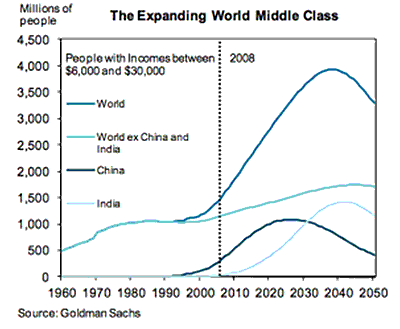
    It will not be surprising if our Advertising Expenditure gets on a roller coaster ride keeping in line with the predictions of PMAR 2016. Let us recall that as early as in 2003, Goldman Sachs forecasted that China and India would become the first and third largest economies by 2050, with Brazil and Russia capturing the fifth and sixth spots. It seems we have a date with the destiny if India has to live up to the forecast of Goldman Sachs. The real growth driver will be the increasing middle class population in India and their sheer numbers will absorb the shocks of falling Sensex, etc. According to Goldman Sachs, the middle class population in India is expected to grow exponentially between 2010 and 2020.


    Sam Balsara’s quote in the Press Release confirms that similar factors have been considered by them– “In arriving at the numbers we are conditioned by the fact that the Indian economy has become the fastest growing economy of the world; our GDP growth rate at 7%+ is the envy of the western world, now  looking at India in new light…”.  Indian advertising market has grown consistently across last three years to achieve a growth of 60 %from 2013 to 2016, compared to the previous 3 years from 2010 – 2013, when the growth was only 28%.


    In February 2015, the Pitch Madison Media Advertising Outlook 2015 first predicted a growth rate of 9.6% in advertising spend from 2014 to 2015. In September 2015, it was subsequently revised to 13. 8%. The final tally has emerged as 4 percentile point higher than their revised predictions. The year on year growth has not helped in our ranking in the global listing, which continued to be 12th with only 2% share of the global advertising pie. However, we have managed to increase our share by 1 percentile point.


    Percentage share in Global Advertising
     

    2013

    2014

    2015

    Brazil

    5%

    5%

    5%

    Russia

    3%

    2%

    2%

    India

    1%

    1%

    2%

    China

    11%

    12%

    13%

    Source: WARC International AD Forecasts


    We should remember that while 1 USD equals 68.13 INR, 1 USD equals only 6.53 Chinese Yuan. Like the practice of calculating normalised GRP in media planning, if we could have normalised the global advertising expenditure, then probably our ranking and share of the global advertising pie would have improved.

    According to PMAR 2016, FMCG clients continued to be the largest contributor in 2015 and spent Rs. 12,364 crore or 28% in advertising across media, followed by Ecommerce players which contributed to 10% by spending Rs. 4,231crores, Auto and Telcom are next in line contributing 9% and 8% respectively.  Contrary to the common belief that Ecommerce was the growth driver in 2015, organic growth from the FMCG sector played a major role in the growth of advertising expenditures. HUL topped the list of advertisers with a whopping Rs 2500 crore (approximate) spent in advertising.


    In the nearly Rs.44,000 crore of Indian advertising expenditure in 2015, TV and Print continued to be the two dominant media with Digital enjoying the highest growth rate. After a gap of five years, TV has again emerged as the number one contributor in 2015 with Print loosing 3 percentile points in share which got distributed  across TV (+1%), Digital (+1%), Radio (+0.5%) and Cinema (+0.5%). The projection for 2016 shows a further dip in the share of Print in spite of a 10% growth over 2015.


    Media wise share in advertising pie
     

    2014

    2015

    2016(P)

    TV

    38%

    39%

    40%

    Print

    41%

    38%

    36%

    Digital

    11%

    12%

    13%

    OOH

    6%

    6%

    6%

    Radio

    3.50%

    4%

    4%

    Cinema

    0.50%

    1%

    1%


    Source: PMAR 2016 & PMAO2015


    TV grew by 22% in 2015 and is expected to grow by another 20% in 2016 and add 1 percentile point in its share of the advertising pie.  Hindi GEC channels continue to enjoy the highest share followed by News Channels (Hindi & English). All regional language channels earned additional revenue with Tamil, Kannada and Bengali channels also getting additional share of the business.  The potential of the regional channels will be exploited by advertisers in 2016 for reaching out to rural audiences and perhaps the same has not been fully explored in the growth projections.


    Print, the second largest medium, grew by 11% in 2015 and is expected to grow by 10% in 2016. However, it is projected to grow by another 10% but concede 2 more percentile point of its share to other media. In the language wise highlights presented in the presentation of PMAR 2016, newspapers and magazines have been combined while in PMAO 2015, similar analysis was presented for only dailies. However, as magazines reflected a negative growth of -3% in 2015, we can presume that most of the growth in Print in 2015 came from dailies. PMAO 2015 showed most of the languages dailies suffering negative growth rate (2013/2014) apart from dailies in Marathi. Gujrati, Kannada, Telegu and Bengali languages. In PMAR 2016 a reverse picture emerged with most of the language dailies enjoying accelerated growth rates except Gujarati which showed a negative growth. Oriya and Bengali (Dailies & Magazines) showed double digit growth rates (2014/1015) which came as a surprise.


    Digital grew by 29% in 2015 and established itself as the third largest medium with a 12% share of the total ad pie in 2015. Digital is projected to grow at a 30% rate (2015/16) and increase its share in the advertising pie by 1 percentile point to 13%. Digital’s share in the advertising pie (11.6%) is more than the combined total share of Outdoor, Radio and Cinema (10.6%). However, the growth of Digital may have been underestimated considering the growth of smart phones and internet accessibility in India and the affinity of our youth with Digital and social media.


    Outdoor revenues have been recast for last three years to include Digital OOH and Malls which are growing rapidly. Total OOH revenue including transit was Rs.2665crores in 2015 and is expected to grow to Rs. 3010crores in 2016.


    Radio is predicted to grow to 1823crores in 2016 from 1545croers in 2015 and maintain its share of 4% in the advertising pie.  While it grew by 20% in 2015, the above prediction means only 18% growth in 2016 when we are expecting the new bunch of radio stations to be operative before the year end. Again, the predicted growth of Radio seems to be conservative rather than bullish.


    Cinema estimates have been revised to include advertising from various Government Agencies as well as local/ retail advertisers in 2015 as well as in the previous years. In 2015 Cinema contributed Rs. 465crores to the total advertising expenditure and is expected to grow to Rs.535crores in 2016.


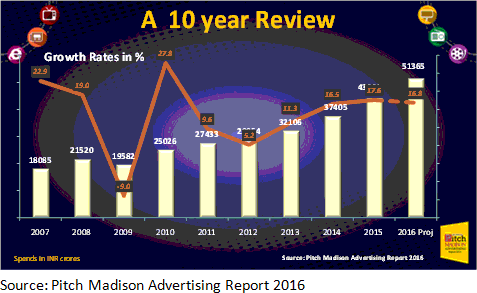
    As always, the Pitch Madison Advertising Report 2016 is a very useful document which will be used as a reference in the industry till the next report comes out.  When we look at the ups and downs from 2007 to 2012 (chart above “A 10 Year Review”), we find it difficult to believe in the upward swing which we are witnessing over the last three years. Can the growth in 2016 be actually higher than 17.6% which we achieved in 2015? A million dollar question only time will tell.


    Indrani Sen is a media services veteran, having worked with JWT, later Mindshare and then with Emami. In recent years, she is an independent consultant and academic. She is Adjunct Professor in charge of the Media Management programme at the Symbiosis Institute of Media & Communication, Pune. The views expressed here are her own.


  • Indrani Sen: A New Year’s wish for an Indian Chapter of the Internet Society

    By Indrani Sen


    This New Year let our marketing, advertising and media (traditional and new) industries join hands to create an Indian Chapter of the Internet Society and help the Ministry of Information and Broadcasting and TRAI form rules and regulations for governing the development of internet and digital media in India. The active netizens of India should also be allowed to participate in the chapter as individual members.


    By now, the readers of this column will be familiar with the debate on “net neutrality” which hit the Indian media in April 2015 after TRAI came out with a consultation paper March 2015 on the growth of Over-the-top (OTT) players like WhatsApp or Skype and exploring a regulatory framework for these apps. Among the various articles which I read at that time, I found the two in Indian Express by Shruti Dhapola in April 2015 quoting from various other sources to be quite informative and would like to share the link with those who might have missed it-  http://indianexpress.com/article/technology/social/net-neutrality-in-india-debate-zuckerberg-to-flipkart-to-aib-who-said-what/ and http://indianexpress.com/article/technology/social/net-neutrality-in-india-licensing-to-zero-ratings-its-a-complicated-debate/ . Around that time, Pavan Duggal, Advocate, Supreme Court of India and India’s leading expert on Cyberlaw and Mobile Law, wrote an excellent article on tech.firstpost.com cautioning our lawmakers -http://tech.firstpost.com/news-analysis/net-neutrality-in-india-heres-why-india-shouldnt-jump-the-gun-on-net-neutrality-263311.html.


    Recently, the topic of Net Neutrality again exploded in December, 2015 when TRAI reportedly requested RCom to impose a temporary ban on Free Basics. We saw the volunteer-led group savetheinternet.in who had earlier mobilized responses supporting net neutrality to spring into action again with “Save Free Basics” campaign. Face Book reacted strongly with an aggressive  full-page ads in English and vernacular newspapers across the country. Among the various articles which flooded the online media, Sunil Abraham, Executive Director of the Centre for Internet and Society wrote in www.firstpost.com supporting strongly TRAI’s decision- http://www.firstpost.com/india/the-net-neutrality-debate-trai-has-a-point-in-imposing-temporary-ban-on-free-basics-2558884.html. I found the article of Jay Vikram Bakshi on www.linkedin.com very interesting as he suggested an alternative route for resolving the debate around net neutrality in his article- https://www.linkedin.com/pulse/free-basics-vs-net-neutrality-jay-vikram-bakshi . Bakshi ended his article with a statement “After all, if it’s for common good, let all the stakeholders in, and allow all citizens equal and rightful access to services, which are based on their common assets (land, airwaves, energy, and water)” which I really applaud.


    The leaders of our marketing, advertising and media industries can contribute positively to the forming of Internet Regulations by forming an Indian Chapter of the Internet Society, which does not have a strong presence in India though it has an APAC Bureau which works across the region http://www.internetsociety.org/what-we-do/where-we-work/asia/south-asia. Internet Society is a member of the International Telecommunication Union (ITU) who is the custodian of the International Telecommunication Regulations (ITRs) Treaty. The last ITRs Treaty was developed after the World Administrative Telegraph and Telephone Conference (WATTC-88) held in Melbourne in 1988. In December 2012, a World Conference on International Telecommunications (WCIT) was held in Dubai, but it did not result in development of a new ITRs Treaty.


    Internet Society is working actively with International Telecommunications Union (ITU) on the formulation of a new International Telecommunication (ITRS) Treaty.  Ultimately, our internet rules and regulations will have to fall in line with the international guidelines. By taking a proactive step in 2016, our industry leaders can contribute effectively to India’s digital future.


    Indrani Sen is a veteran media agency and marketing services professional. She is currently an Independent Consultant and Adjunct Professor, Media Management at Symbiosis Institute of Media & Communication, Pune. This column MediaSENse appears fortnightly. The views expressed here are her own.


  • Indrani Sen: English vs. Vernacular: The Language Anomaly

    By Indrani Sen


    Recently an interesting discussion was held in Mumbai on localisation of language on digital media and if the same will become a game changer for brands. The discussion focused on the two separate India with different language orientation and different habits of media consumption and hence the need for developing digital media in vernacular languages. The participants debated if it is worthwhile to take the effort of designing marketing communication for targeting vernacular language speakers and felt that the individual brands will have to take the call “after reviewing the cost of acquisition or lead and whether it then seems worthwhile” (http://www.exchange4media.com/marketing/the-growing-importance-of-vernacular-content-in-digital-advertising_62721). While reading the report of the event, I contemplated again on the language anomaly in India between English and vernacular languages.


    There has been an overwhelming craze for English medium education across India which was reflected in the statistics published by NUEPA (National University of Education, Planning and Administration) in 2012. The report showed a growth of 274% in the number of children studying in English-medium schools between 2003 and 2011.  According to the same report in 2011, over 20 million Indian children were studying on English medium schools reflecting the growing aspirations of the Indian middle class. It is generally felt by parents that studying in an English medium school will offer better employment opportunities to their children. Our policy-makers also seem to feel that the English language advantage will set the country on its desired path of growth as they are allowing unplanned and haphazard development of education in English medium. In the absence of a National Language Policy, each state has been taking its own call regarding the medium of education at primary and secondary school levels at the whim of the political party in power.


    Are we doing the correct thing by pushing for English medium education at school level? What is the global view on school level education in a language which is different from the child’s mother tongue? In an article published on September 2, 2015 in Scroll, Anjali Mody, a freelance journalist and researcher, wrote “Yet across the world, and in India, there is a consensus among educators, educationists and linguists that children learn most effectively in their mother tongues. Research collated by UNESCO shows that ‘children who begin their education in their mother tongue make a better start, and continue to perform better, than those for whom school starts with a new language’” (http://scroll.in/article/750187/).


    Our policy-makers and educationists have to resolve certain basic issues related to education policy. They can also debate and decide on the medium of education at school and college levels.  As a media practitioner, my concern evolves from a different angle. What is the media consumption pattern of these English medium educated children and youth and how the same is different from their counter parts educated in vernacular medium? Unfortunately, the syndicated research carried out in our country only collects data on the education level and does not try to probe further into the medium of education of the respondents. By studying the general pattern of media consumption as well as advertising communication we can make some observations related to this issue.


    Year after year, the Indian Readership Survey has been showing the supremacy of the vernacular publications. In IRS 2014, among the top ten dailies, nine are in the vernacular and only one (Times of India) is in English. Similarly among top ten magazines, only one (India Today) is in English. It is interesting to note that India Today Hindi edition with a readership of 1.36 million was breathing down the neck of the India Today English edition with a readership of 1.63 million. If we have started producing more and more of English medium educated youth, then why their readership preferences are not skewed towards English? Why their preference for the medium of education is not getting reflected in the growth of readership of English newspapers and magazines? Vanita Kohli Khaderkar pointed out in her book Indian Media Business, that between 2006 to 2011 circulations of English newspapers increased by 70% but the readership increased by only 2% and the time spent on English newspapers dropped by 6.5%!


    Even if we argue that the youth is shifting away from print to digital, what about the television programmes, which are still the main source of entertainment in all middle class households? The viewership of Hindi and other language GECs are on the growing comfortably, but there is no similar growth in viewership of English TV channels across different genres. Bollywood blockbusters in Hindi keep on drawing movie goers across social strata. Regional film industries in East and South are also showing good score cards.  Most of the content of FM radio stations is also in Hindi or in other regional languages. We can reach out to the affluent upwardly mobile consumers through all these traditional media. It can be safely concluded that our English medium educated consumers (youth and above) are regularly consuming media content related to information and entertainment in vernacular instead of English.


    When it comes to designing advertising content, we design original content in vernacular for TV and radio, but show a preference for English when it comes to creating content for print. English publications command a premium over vernacular publications in advertising rates and are considered to be better positioned for reaching out to consumers in higher socio-economic brackets. We need to probe more deeply into the media consumption habit of our English medium educated consumers to understand the effect of the education on their media consumption habit.


    The question which our policy-makers and educationists need to grapple with is can the formal education in English medium be complete without continuously supplementing it through additional exposure in English through mass media?  What kind of hybrid citizens we are producing in India who get educated in English medium, but depend on vernacular media for news, infotainment and entertainment? The digital media can perhaps put an end to this controversy if the English medium educated consumers embrace digital and social media platforms in English and start consuming more English audio and video content through the internet. In such a situation, the divide between the two separate India will get sharper. However, the sheer numbers of the other India educated in vernacular medium will compel the marketing and advertising industry to design content and communication in different languages for digital media.


    Indrani Sen is a veteran media agency and marketing services professional. She is currently an Independent Consultant and Adjunct Professor, Media Management at Symbiosis Institute of Media & Communication, Pune. This column MediaSENse will appear fortnightly. The views expressed here are her own.


  • Indrani Sen: Outreaching by Outdoor: From Static to Interactive

    By Indrani Sen


    Global Industry Analyst, Inc (GIA) in its report on “The Global Outdoor Advertising Market” in January 2015, talked about the growing popularity of digital platforms for out of home advertising. According to that report “Asia Pacific represents the largest market worldwide. The region is also forecast to emerge as the fastest growing market with a CAGR of 8.6% over the analysis period, led by the retail boom in countries such as China, Singapore, Malaysia, Thailand, Hong Kong and India.” (http://www.strategyr.com/MarketResearch/Outdoor_Advertising_Market_Trends.asp) In a press release dated February 10, 2015, GIA spoke about technology development and replacement of traditional static billboards and posters with digital signage as the prime drivers of the growth in outdoor industry and predicted rise in oversized digital billboards/ large screen digital displays.


    Compared to the global trend, how has our Outdoor Advertising Industry been faring over the recent years? FICCI-KPMG reports have been predicting healthy CAGRs over the last five years. In the last two reports, a CAGR of 9.2% over 2013-2018 was posted in 2014, followed by a marginally higher CAGR of 9.8% over 2014-2019 in 2015. We have also been talking about digital OOH driving the growth, but our usage of digital OOH have been limited to place-based networks in cafes, restaurants, health clubs, educational institutes, sports arenas, malls, some public spaces like airports. In spite of the predictions of the global industry experts, our use of DOOH (digital out of home) has been limited to small screens, interactive kiosks, jukeboxes and jumbotrons. Large standalone screens/ billboards with digital content which needs larger investment in the infrastructure have still not arrived in India.


    Annie Rickard, the Global CEO of Posterscope, spoke about pioneering dynamic real-time content on OOH screens and the challenge of implementing the same due to infrastructural constraints in an interview during her recent visit to India. Speaking about the relevance of outdoor medium in a digital world, she said: “The whole world of OOH has shifted. There was a time when OOH was only about awareness and impact. But now you can have a conversation with consumers.” She also pointed out the need for consolidation on the media owners’ side and the need for all players to work together backed by a valuable insight- “What we have seen everywhere else in the world is that when you have less players, the investment goes up. When you have lots of small players, they actually invest less collectively in the medium. You also get more collaboration when you have a smaller number of players.” (http://www.exchange4media.com/outofhome/our-focus-will-be-on-continued-investment-to-make-the-ooh–medium-accountableannie-rickard_62497).


    Is our outdoor industry ready for consolidation and collaboration? Apart from a few mergers and acquisitions at the top and networking and trading of sites across the width and breadth of the industry, there has not been any serious attempt at any consolidation. In August, 2015 AAAI (Advertising Agencies Association of India) and IOAA (Indian Outdoor Advertising Association) signed an agreement to better regulate outdoor advertising in India and there was no reference to consolidation in that agreement. Their focus will be on regulating and disciplining advertiser behaviour in matters concerning outdoor trade, agency remuneration, corporate governance and adherence to payment deadlines (http://www.campaignindia.in/Article/397183,aaai-and-ioaa-join-hands-to-channel-ooh-advertising-growth.aspx) Ideally it should have been a tri- party agreement between AAAI, IOAA and ISA (Indian Advertisers Association). The absence of ISA has raised some doubts about the long term success of the efforts.


    While making announcement about the joint agreement, N D Mehta, President of IOAA, mentioned about outdoor research and a census of billboards/ hoarding across all major cities. IOAA has been involved for a while in an ambitious project of conducting viewership research on OOH, starting with major cities. However, we do not have any indication regarding the timeline or progress of the research project. The first Indian Outdoor Survey (IOS) was spearheaded by MRUC (Market Research Users Council) and conducted by Hansa Research in Mumbai in 2008. The report was released in June 2009 by MRUC with a promise of extending the research to other cities. Due to lack of financial support from the outdoor Industry, MRUC had to abandon its plans. Since then, no syndicated research has been conducted in this space, though various outdoor advertising agencies have carried out their own research. Market research organizations like IMRB have developed outdoor research models which the advertisers can commission. Does IOAA have enough muscle power to bring outdoor industry under one umbrella for supporting syndicated research on outdoor on a regular basis? Can IOAA and AAAI generate the required funds of outdoor research without active support from ISA?


    The advertising Industry will welcome the move of conducting a census of 100% of sites and identifying them with unique ID number in major cities. But, the IOAA will have to conduct a health check of the sites first. A search on the IOAA site (http://www.ioaa.co.in/ news on facebook) shows various news items related to removal of illegal hoardings. A news item dated October 7, 2015 talks about a survey conducted by the Bruhat Bengaluru Mahanagara Palike (BBMP) ascertaining that out of 6,119 hoardings within city limits of Bengaluru, only around 2,000 had legal permissions! Paradoxically, the size of our country, which is the foundation of the structure of the current developments in our media industry, is the biggest roadblock for organised development of our outdoor industry.


    Outdoor regulations are mostly governed by the local authorities/ civic bodies and various state governments and there is a lack of uniform structure. Can the Ministry of Information & Broadcasting instruct TRAI to create a template for the outdoor rules and regulations which can be adopted locally in each state? It is probably wishful thinking as there are many political under currents when it comes to the relationship between Central Government and State Governments regarding formulation of rules and regulations related to matters under state control and jurisdiction. Alternatively, is it possible for IOAA to develop such a uniform guideline for outdoor rules and regulations and solicit for the support of all state governments?


    Indian advertisers have not yet come to grasp with the concept of interactive outdoor with real time content. Outdoor industry leaders need to resolve many issues before visualising a roadmap for evolving towards the digital future. In the meantime, shall we just sit back and watch the rest of the countries in the Asia Pacific region passing us by in the race towards the digital future? Can we create a model city where all outdoor sites will be legal with unique ID numbers, where a large number of static hoardings will be converted to oversized digital billboards with real-time content having conversations with consumers, where research will be measuring the impact of the new avatar of outdoor on a regular basis? Needless to mention, the model city experiment cannot be conducted in a metro where the scale of operation will be too huge. So, it will have to be a Tier-2 city with strong growth in retail sector. Outdoor Industry will need active support from the local government for conducting the experiment. If all the stakeholders in the industry join hands together to make such a plan successful, that example will automatically propel the growth of our outdoor industry into the digital future. Amen!


    Indrani Sen is a veteran media agency and marketing services professional. She is currently an Independent Consultant and Adjunct Faculty, Media Management at Symbiosis Institute of Media & Communication, Pune. This column MediaSENse will appear fortnightly. The views expressed here are her own.