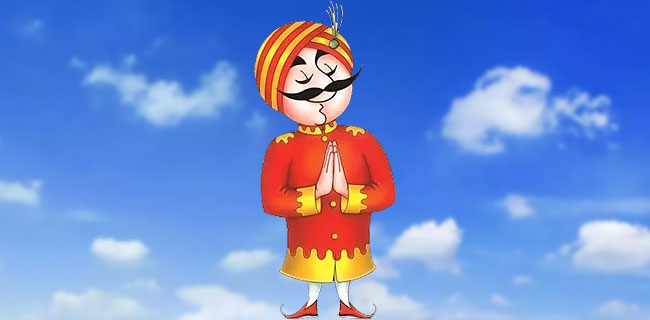
With apologies to none at all
By Vikas Mehta
 I call my column ‘With apologies to none at all’ for a reason. And my article today actually justifies the title.
For the last almost a month, since it was announced that McCann Worldgroup India shall be handling the Air India account, marketing and advertising professionals have been tying themselves in knots arguing for and against the use of the iconic Maharaja identity for the brand. Arguments ranging from nostalgia, royalty, Indianness, contemporary image and what not have been flung in the rung. Suggestions like contemporise the Maharaja or that royalty is defunct in today’s day and age are being touted. Compromises are being suggested and a few are sticking their neck out, asking to bin the Maharaja.
And this is where most marketers exasperate. It’s also the reason why digital experts are gleefully claiming that advertising is dead. For, we forget that while marketing is an art, it’s foremost a science. And when we think from the gut or the heart and not follow simple marketing dictums then advertising opens itself to debate about its existence. We tend to go all mushy-mushy, not following some simple logic that defines marketing.
The one big mistake which I see all advertisers make is not defining their target group and more importantly, not understanding the difference between target group and the user. Please do indulge me for a moment.
Everyone uses a soap but a Lifebuoy soap talks to a mother. A Lux soap talks to a youngster who aspires film star beauty. A Dove soap user talks to a slightly middle-aged lady who feels that she is losing the softness of her skin. That does not mean that Dove will not be used by young females or even men. Similarly, Lifebuoy is used by working men too. But the brand always talks to a predefined TG. Just because everyone uses a soap all soaps do not talk to everyone.
So, everyone may be wanting to fly but Air India has to decide who will it talk to. Just as Indigo clearly decided that it will talk to the no-frills guy who wants to reach from Point A to Point B with some basic amneties at an affordable price. This person is not looking for meals or a newspaper or a luxurious seat. He or she just wants an inexpensive ticket with a professional experience and on time flights.
The question that needs to be debated therefore is who will Air India be talking to. And once that decision is taken the debate about the Maharaja is resolved by itself. So, please indulge me again.
Air India is very clear that it is not a no-frills airline. In industry parlance, it’s a full-service airline. Young fleet of aircraft (on its way). Tick. Comfortable reclining seats. Tick. Choice of meals as part of the ticket. Tick. Entertainment on board. Tick. Higher ratio of cabin crew to passengers. Tick. Frequent Flyer programme. Tick. Lounge facility. Tick. Choice of premium classes. Tick. So, the whole experience is premium, specially when compared to no frill airlines like Indigo.
Therefore, when we are debating Air India’s Target Group, very clearly we are talking to the premium-seeker. Someone who prefers fine dining over quick service restaurants. Someone who would much rather be looking for a vehicle at Nexa and not Arena. Maybe, someone who is not into Maruti Suzuki at all but into Honda or Hyundai or Kia.
Very clearly, we are talking to someone who has that much bit more to spend. Or someone who wants to be seen in a slightly elevated company. Someone who has tasted some success in life and wants to enjoy it. Now, for argument sake, let’s say that this person is mostly the Millennial. Gen Y.
My question therefore is simple. What is Air India to this person? Maharaja? Premium? Royalty? Or is it bureaucratic? Not dependable? Poor service? Surly cabin crew? I am not giving any answers but I do think that millennials had the worst of Air India in terms of their brand experience and for them Air India is anything but Maharaja. So, does it make sense to pitch the Maharaja to them?
On the other hand, the Tata story could appeal to the millennial. Caring. Customer-first. Quality. Trustworthy. All these are the association with the Millennials. And of course how the Tata group treated its employees and customers post the 9/11 carnage is something that the millennial empathises with.
Therefore, if Air India has the millennial as its target group, then more than the Maharaja, it’s the Tata association which will work. And that’s just one option. There could be many more.
I am in no way suggesting that Air India ditch Maharaja or use the Tata connection. I don’t have enough data or research to back me up but as a hypothesis, it could work. And that’s my point. Rather than aimlessly get into a debate about the goodness of Maharaja or its non-relevance today, the marketing and advertising gurus must first try and define the Target Group for Air India. Rest will follow automatically.
There is a very interesting corollary to this. Is there any Target Group for which the Maharaja is relevant? Does this Target Group have sufficient numbers to be attractive enough as a target group?
Am not sure if there is any? Tales, nostalgia, reminiscences and stories are not good enough. Experience is. Air India was a Maharaja when? In the sixties or maybe till early seventies. Is the nostalgia or reminiscences of a few vanishing breed good enough?
Not to forget the fact that Air India aspires to be a major international player. Is an airlines from India, in today’s day and age all about royalty and land of exotic animals and snake charmers. Or is India shining for them?
And what about the future? The current Gen Z. These people in a few years will be looking at premium flying experience. Does the Maharaja mean anything to them? Will a 50-60-year-old icon excite them?
The answers are there. But only if we ask the right questions. Unfortunately, that’s not what is happening now.
 The Advertising Club has unveiled a campaign for the upcoming Abby Awards powered by One Show 2024.
 Complan, the health food drink from Zydus Wellness Ltd, has announced a new “I’m Complan Boy-Girl” campaign featuring Madhuri Dixit and South Indian actress Sneha. In the new communication Madhuri & Sneha are highlighting criticality of Protein for growing kids.