Tag: KV Sridhar

  • ASCI refreshes ‘future-facing’ brand identity

    By Our Staff


    New ASCI logo
    The refreshed identity

    The Advertising Standards Council of India (ASCI) has unveiled a new brand identity to reflect, as its communique points out,  the “agenda of becoming future-facing and more inclusive”. The refresh comes close on the heels of new initiatives such as the guidelines for influencer marketing and online real money gaming and asci.social. Adds a communique: “ASCI has always been the conscience-keeper of the Indian advertising industry, and in this new phase, it aims to expand its offerings and services that will help advertisers balance creativity and responsibility.”

    Subhash Kamath
    Subhash Kamath

    Said Subhash Kamath, Chairman, ASCI: “ASCI has stepped into the next phase of challenges that impact the interests of consumers in new ways. With new-age challenges posed by the digital age, it is imperative for ASCI to take a leap into becoming a contemporary thought leader and add greater value to consumers, industry and all our stakeholders. The new logo represents this very interesting phase of ASCI’s journey, and the vibrant and optimistic outlook of responsible advertising. Our ideology and aim remain unchanged; however, we are now on the path to becoming a more dynamic and future facing organization.”

    KV 'Pops' Sridhar
    KV ‘Pops’ Sridhar

    Added KV Sridhar, Chief Creative Officer (Global), Nihilent Ltd, the company which designed the refreshed logo: “The colourful logo palette denotes the vibrancy of advertising and communication itself, as well as the diversity of ASCI’s stakeholders who have taken the oath to self-regulate and create ads with responsibility. The idea of creativity with responsibility is central to ASCI. The logo also reflects the dynamic nature of media platforms and the newer interesting ways in which communication is being created and consumed today. The elegant and inclusive font reflects an organization opening up to newer kinds of stakeholders, an organization that is collaborative and demonstrates leadership in bringing together the needs of different stakeholders. It signals that ASCI is gearing up towards this fast evolving and dynamic environment of consumers and advertising.

    Roger CB Pereira
    Roger CB Pereira

    Said marketing services veteran Roger C B Pereira, Founder Member, ASCI: The world today is remarkably different from when we started ASCI in 1985. However, what is noteworthy is that the twin principles of consumer protection and fostering creativity remain unchanged.


  • Disney+ Hotstar joins CoinSwitch Kuber to back cryptocurrrency

    By Our Staff

    CoinSwitch Kuber, India’s largest cryptocurrency investment platform for retail investors, has announced the launch of its new ad campaign, Trade Kar, Befikar.  With this, CoinSwitch Kuber becomes the first player in the Indian cryptocurrency space to launch a campaign to evangelise cryptocurrencies as an alternate asset class and build equity amongst Indian investors. The company is also the Associate Sponsor with Disney+ Hotstar for the Indian Premier League.

    Created by Nihilent, the campaign consists of three interconnected ad films. Actor Kunaal Roy Kapur has been roped in to play all the roles in the ad films. The campaign will be aired on Disney+ Hotstar throughout the Indian Premier League and will also be amplified using social media platforms like Twitter, Facebook and Instagram.

    Said Ashish Singhal, CEO and Co-founder, CoinSwitch Kuber: “Millennials and GenZ are emerging as the biggest backers of cryptocurrencies in India. With our new ad campaign we aim to showcase how it is a smart move to invest early in cryptocurrencies. Crypto has been the fastest growing asset class of the last decade and the momentum is only growing stronger now. Through our partnership with Disney+ Hotstar, we aim to amplify this message to millions of young and upwardly mobile Indians. It is time to join the crypto revolution by investing in cryptocurrencies through CoinSwitch Kuber – the safest and most friendly platform for crypto investments.”

    Added KV ‘Pops’ Sridhar, Global Chief Creative Officer, Nihilent: “The CoinSwitch Kuber ad films are special for us as they give us an opportunity to involve our audience into experiencing a completely new investment category that most of them may not be familiar with. We therefore decided to go for stories which not only highlight the utility of this new asset class but also place it firmly within the Indian family context as something that everyone can invest in and which is not a domain of the elite.”


  • Nihilent acquires Pop’ Hypercollective

    By A Correspondent


    Nihilent, a leading consulting and services company, has announced the acquisition of Hypercollective, a a creative agency network billed as an “innovation agency that solves real world problems for brands, corporations, and governments”.


    Further to this acquisition, KV Sridhar, popularly known as Pops, who was Founder and Chief Creative Officer of Hypercollective will continue to look after all the creative initiatives at Nihilent and Hypercollective.


    Commenting on the acquisition, LC Singh, Director and Executive Vice-Chairman, Nihilent, said: “Nihilent is glad to have Hypercollective onboard, we look forward to providing our customers a greater degree of interaction experience by offering them in-depth insights on consumer behaviour. This will not only help them understand granular details of what the consumer wants, but also enable businesses to undergo a smooth digital transformation.”


    Added Minoo Dastur, President and CEO, Nihilent: “The customer is all-pervasive, granulating their needs, wants and aspirations is the key to any successful service. Given this backdrop, this acquisition gives us the unique capabilities that will further complement our human-centered approach. Leveraging our mutual strengths, we are well-positioned to offer brand management, UI design, digital, creative, spatial and consumer research.”


    Added Sridhar: “While technology plays a vital role for any enterprise, Hypercollective’s strengths in creating an interaction experience will be amalgamated with Nihilent’s consulting, design thinking, and technology capabilities which will enhance our offerings. I have always had a keen interest in technology, specifically in Artificial Intelligence (AI). I look forward to achieving that perfect balance between technology and creativity.”


  • Coco takes on gender stereotypes with inaugural brand film

    By A Correspondent


    Coco by DHFL General Insurance has launched its first digital-only campaign #CareMoreHaveMore for its retail two-wheeler policy – Coco Ride. The digital campaign focuses on two key aspects – women empowerment and protection for one’s loved ones and prized possessions.


    Speaking about the campaign, Vijay Sinha, MD & CEO, DHFL General Insurance, said: “Brand COCO by DHFL General Insurance is built on the tenet of empowering individuals to learn and be able to take care of the things that matter to them, thereby helping them have more of those things. A little care now, a lot more gain in the future. Utilizing this one insight – the brand film for COCO Ride plays on two angles simultaneously. One is the more obvious one that is shown through the dynamics between the father and his daughter that caring for your bike also means readily being able to bank on your insurer. The second is more subtle and nuanced, which is of the father letting the daughter chart her own path in life without spoon-feeding her. This gives her a sense of achievement that is beyond him–but individually her own. In the end, when she’s handed the bike – it actually is a metaphor that she is now ready to take on the world because she has learnt the best lesson – to care more is to have more.”


    The #CareMoreHaveMore campaign has been conceptualized by Hypercollective. Added KV Sridhar aka Pops, CCO and Chairman, Hypercollective: “As an organisation, we’ve always believed that brands that live by a purpose are the brands that can truly thrive. Add cultural truths to this mix and you have a campaign that can break through the clutter and touch your audience. After all, we’re in the business of human to human connection. Through this campaign, we’re not just breaking the stereotype that biking is a men’s game, but also extending the human value of care by exploring the relationship of a daughter and her father. The narrative of the entire campaign is powerful and enriching, every time you go through it, it grows on you. And it’s a delight to work with a client like COCO by DHFL General Insurance who believe in taking higher grounds and giving freedom to explore something completely uncharted in this category.”


  • Hyper Collective renders a moving Father’s Day film for Building Blocks Group

    By A Correspondent


    A father chooses his daughter’s education over their marriage and decides to empower his daughters to pursue their dreams. This is the plot of the latest short film produced by Building Blocks Group on eve of Father’s Day.


    The ad film is part of a larger transformation drive conceptualised by KV ‘Pops’ Sridhar’s Hyper Collective.


    On his thought process and vision for the campaign, Pops said: “At the heart of Building Blocks Group are core values of Transparency, Integrity, Growth, Unity, and Excellence. We created a vision and purpose that would reflect exactly that. Your true wealth is not your money. Your true wealth is the happiness and growth of your children. With the context of Father’s Day, the film not only shows a father choosing to empower his daughters. But also where the new India is heading. Progress and change are the long term dreams of not just Building Blocks but all of India.”  The ad film is directed by Nitesh Tiwari.


    Added Mallikarjun Reddy, Chairman & Managing Director of Building Blocks Group: “We are not in the business of selling land, we are in the business of helping people progress. We want to be people’s financial progress partners and the brand philosophy Your True Wealth stems from the same belief system. In a world driven by materialism, we want to emphasize the importance of investing in true wealth and that is your children’s future. This campaign will strengthen our vision as a brand and a company even more. I’m delighted to have Nitesh and Pops’ team create this iconic film for us.”


  • It’s here. It’s by Pops. And it’s HyperCollective


    Veteran adperson KV Sridhar aka Pops unveiled his all-new venture: a collaboration of independent communication-led agencies called HyperCollective.


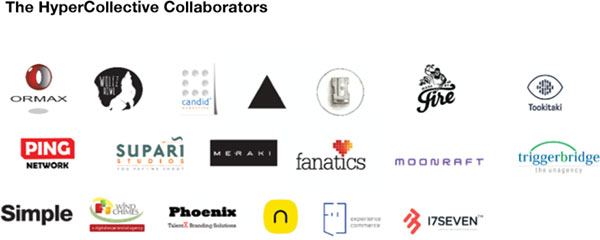
    Pops believes that HyperCollective’s business model will be gamechanging and enable clients to forge a seamless connection between brand, technology and consumers. “The need of the hour is cocreation, collaboration with swiftness and agility,” he said, adding: “There is no single agency that excels in all four areas of content, communication, technology, and strategy. Through HyperCollective we have got on board some of the sharpest minds in these areas who have been pushing the envelope through their work. Our clients will have full access to all our collaborators at all times. As required, collaborators can be on-boarded in short span of time. Furthermore, we can add newer competencies in a blink of an eye. Collectively, we will orchestrate brand story seamlessly across platforms to cater to today’s always on world.”


    Based in Mumbai, a strategic team at HyperCollective, helmed by Pops, will team up with its collaborators to offer services to brands, institutions, and government organisations. There are 21 collaborators on board, additionally, it has support of brand gurus, independent marketing consultants, media buying agency, PR agency, and celebrated filmmakers. Over the coming months, it aims to further strengthen the collective by onboarding collaborators offering niche, disruptive services. HyperCollective has been in ‘stealth mode’ for the past several months, working for iconic global brands and a handful of large Indian companies. Acting up on Nestle India’s vision, it has helped set up a Live Content Studio in the company’s HQ in Gurugram.


    Ormax Consultants

    Vispy Doctor, CMD, Ormax
    Rajeev Sharma, CEO, Ormax Rhodium
    Anand Bhatia, CEO, Ormax Money Pvt Ltd
    www.ormaxworld.com


    Wolfzhowl Strategic Instigations

    Kalyan Ram Challapalli, Founder & Chief Strategist
    www.wolfzhowl.wordpress.com


    Umbrella Design
    Bhupal Ramnatkar, Founder & Chairman

    www.umbrelladesign.in


    Sharpener  Hetal

    Ajmera, Co-Founder
    Bianca D’sa, Co-Founder
    www.sharpenerinc.com


    PING Digital Broadcast Pvt Ltd

    Govindraj Ethiraj, Founder
    Prashanto Das, Co-Founder


    Supari Studios

    Advait Gupt, Co- Founder

    Akshat Gupt, Co-Founder
    www.suparistudios.com


    Meraki VR Studio

    Sairam Sagiraju, Co-Founder

    Parth Choksi, Co-Founder
    Agam Garg, Co-Founder
    www.merakivr.com


    Fanatics Karl

    Gomes, Chief Fanatic at Fanatics
    www.fanatics.in


    Simple Creative Inc

    Sainath Saraban, Founder

    www.cargocollective.com/SainathSaraban


    Windchimes Communications Pvt Ltd

    Nimesh Shah, Head Maven

    www.windchimes.co.in


    Candid Marketing

    Atul S. Nath, Founder & Managing Director
    Amrita Kumar, Executive Director

    www.candidmarketing.com


    Phoenix TalentX Branding

    G.M. Singh, Co-founder

    hello@phoenixtalentxbranding.com


    NetBramha Studios

    Aashish Solanki, Principal Designer & Founder
    www.netbramha.com


    Experience Commerce

    Sandip Maiti, Co-Founder and CEO
    Rajeev Sreenivasa, Co-Founder
    www.experiencecommerce.com


    Made by Fire

    Vernon Dias, Founder and Managing Director
    www.madebyfire.com


    Moonraft Innovation Labs

    Somakumar Kolathur, Co-Founder & CEO
    www.moonraft.com


    17Seven

    Vimal Kutmutia, Founder & Strategist

    www.17seven.co


    Tookitaki

    Abhishek Chatterjee, CEO
    www.tookitaki.com


    triggerbridge, the un-agency

    S Yesudas, Managing Director & Co-founder
    Ajit Nair, Director & Co-founder
    Amit Tripathi, Director & Co-founder
    www.triggerbridge.com

  • DHFL urges customers to own their dream home

    By A Correspondent


    Leading housing finance company Dewan Housing Finance Corporation Limited (DHFL) will be launching its latest TV campaign which is an extension of the earlier ‘Ghar Jaisa Loan’ Campaign on January 14. Featuring brand ambassador Shah Rukh Khan, the new campaign comprises TVCs which will be on air across leading channels and is directed by Nitesh Tiwari and created by Sapient Nitro.


    Said Sevantika Bhandari, Senior VP and Head Marketing at DHFL: “Housing is a basic human need and home buying is an important long term life decision. So with this new campaign, we are trying to build conviction among our segment for owning a home. Shah Rukh Khan with his universal appeal connects well with the audience urging to them to take their first step towards home ownership thereby complementing our vision to transform the lives of Indian households by enabling access to home ownership.”


    Said KV Sridhar: “The new ad campaign has been brilliantly written, acted and directed to address the dilemma faced by a consumer with regards to identifying the right time to purchase his/her own home. The campaign further complements the previous campaigns launched by the company in the last two years. Shah Rukh Khan has immensely contributed in transforming the brand by creating further awareness and making it relatable to the common man who looks to partner or avail a home loan from a company he/she can trust.”


    Added Nitesh Tiwari: “I have been associated with DHFL from the launch of the Ghar Jaisa Loan Campaign. DHFL understands the customer and has captured the emotional moments in the life of people when they actually consider buying a house. Shah Rukh Khan is portrayed as an approachable and friendly person in this campaign. We have conceptualised the campaign with great detail basis the indepth insights gathered from the brand over the years. Taking this route has worked for the campaign as people can relate to him as a friend and as an advisor for helping them take the home buying  decision.”


  • Big Nite for the Datawallahs!


    By A Correspondent


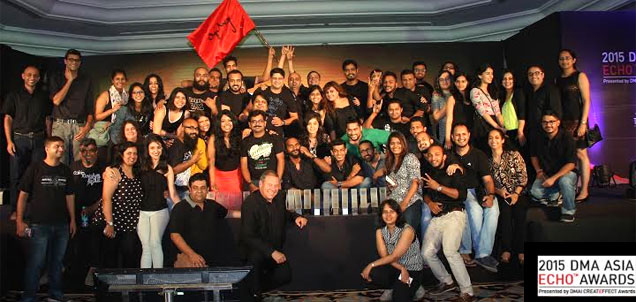
    What’s one awards nite where many of the Big Pros of the A&M-land assembled and, no, it wasn’t the Abby, the Effies, the Emvies or Kyoorius? We’re talking of names like Piyush Pandey, D Shivakumar, Madhukar Kamath, Nagesh Alai, KV Sridhar, Bobby Pawar, Manish Bhatt, Damodar Mall, Tarun Katial and many, many others?  It was the DMA Asia Echo Awards, held last Friday (Aug 6) in Mumbai.


    Fast Facts:

    Entries from 542 participants, 75 agencies, 175 Brands


    Entries from 8 countries – India, Singapore, Hong Kong, Malaysia, Phillipines, China, Japan, Thailand.


    Awards presented:

    4 Overall

    1 Best of Show

    1 Diamond

    142 Metals

    29 Golds

    26 Leaders


    Unilever was adjudged Client of the Year, while OgilvyOne Worldwide was Agency of the Year. Ogilvy & Mather was Network of the Year and WPP the Holding Company of the Year. The Best of Show for Creativity was awarded to Visa India for Visa Sarees and the Diamond for Effectiveness was taken away by OgilvyOne Worldwide Philipines.


    The International Echo Awards are the most prestigious awards in the data-driven marketing and advertising world. This year, DMAi, the Indian association which has been in existence since 1992, was accepted entries from across 17 countries in Asia for both the awards – the 2015 DMA Asia Echo Awards and The DMA International Echo Awards 2015.


    Underscoring the importance of the Echo awards, Rakhshin Patel, Managing Director, Pi Communications & Grand Jury Chairperson, said:  “For an athlete, the Olympics are the ultimate stage. Data-driven marketers share the same feeling about the Echo programme. There is indeed no bigger stage to showcase ideas and work that have yielded measurable, tangible, real results.”


    There were 15 Effectiveness categories and 3 Creative Effectiveness categories each headed by a biggie – Piyush Pandey, D Shivakumar, Madhukar Kamath, Geetu Verma, Nagesh Alai, Jasmin Sohrabji, Anupriya Acharya, Agnello Dias, Pratap Bose, Bobby Pawar, KV Sridhar, Tarun Katial, Manish Bhatt, Nishi Vasudeva, Damodar Mall, Susana Tsui, Anant Rangaswami  and Rajesh Kumar.


    Said Vatsal Asher, CEO & Shelly Singh, COO, DMAi: “We are honoured to be hosting and managing the Asia Echo Awards. Campaigns got judged with the best in the Region. We had a fantastic panel of Jury Presidents and 194 online judges this year. We hope to see an increase the list of Asian winners at the International Echo 2015 awards in the US where all Asian winners will fasttrack to Round 2.”


    As an apex, not for profit DMAi, since 1992, brings about collective action for advancing & protecting responsible Data Driven Marketing and Advertising. The DMAi is run on a day-to-day basis by Vatsal Asher (CEO) and Shelly Singh (COO) and the awards have been championed by Rakshin Patel (Grand Jury Chairperson) and Ajay Chandwani, (Chairman Emeritus).


  • @CannesLions15: Day 1 report: With 945 entries, India eyes bagful of Lions

    By Shephali Bhatt


    Delegates of the 62nd Cannes Lions International Festival of Creativity were yet to start making their plans for the day via the Cannes app when the awards committee announced shortlists for the Press, Mobile, Innovation, Direct and Promo & Activation categories.


    No show from India on any of the categories, except Press — which fetched them 18 shortlists — and Direct, which got TBWA a shortlist.


    How many entered in the category? 132 and 74, respectively. A 13 per cent conversion rate in Press and 1.3 per cent in Direct but the percentage doesn’t matter as long as the shortlists go on to win big, says KV Sridhar, chief creative officer of SapientNitro. “People will remember that one great campaign that won across categories and not the number of entries you’d sent,” he adds, citing the example of Duracell’s positive negative stories campaign that won a handful of Lions last year.


    With mobile replacing digital in the ‘digital is the future’ prophecy, one would’ve expected some shortlists in the mobile category. “Maybe we are actually not doing enough exciting work in the space just yet. And perhaps rightly so,” says Sanjay Mehta, joint CEO of Social Wavelength and one of the Mobile jurors at the festival. “Whatever got shortlisted, I have truly not seen anything of that calibre in India,” he says.


    The total number of entries has also come down this year, marginally so, from 979 to 945. Sridhar, also one of the Press jurors for Cannes Lions this year, attributes this to the declining agency participation in domestic awards. “Only if I play well at domestic cricket do I stand a better chance at excelling at international cricket,” he says.


    Advertising isn’t very different in this regard. Agencies like Ogilvy and Lowe have started inhouse awards and Leo Burnett has stopped entering awards with the enthusiasm it used to. “All this comes through in the craft and quality of the work that’s entered at international awards,” he Sridhar. The pressure for validation isn’t the same anymore.


    “A lot of work entered to win at Cannes isn’t mainstream work anyway,” notes Grey’s Dheeraj Sinha. Only a matter of 24 hours (until the awards ceremony) before we find whether India is on its way to equalling or topping a great run last year.


    Source:The Economic Times

    Copyright © 2015, Bennett, Coleman & Co. Ltd. All Rights Reserved

    Licensed to republish


  • Gunning for more ad awards, creativity loses plot

    By Ravi Balakrishnan


    A little over a decade ago, when the Abby awards were still the only show in town, the after party found Prasoon Joshi in a pensive mood. As team Ogilvy celebrated their ‘agency of the year’ win with a characteristic lack of subtlety – drums, horns, and people in black posing for interminable photoshoots – Mr Joshi, then early in his stint at Mc-Cann Erickson reasoned, “There are youngsters from many agencies who’ve won their first trophy tonight. But all of that is being forgotten in this obsession with who won most. We should celebrate the work and not the numbers.”


    Mr Joshi may have been among the first to voice this concern, but he’s far from the last. Several creative leaders in India are increasingly vocal about missing the forest of creativity for the trees of a final tally.


    Festivals like Cannes Lions have arguably made things worse, adding layers to the competition like Holding Company of the Year. WPP won for the fourth time running in 2014, which according to media reports led Interpublic to boast of its far better win to entry ratio. Closer home, Goafest officially scrapped ‘agency of the year’, ostensibly to make it more about the work and less about the numbers. It however resulted in a cottage industry where previously math-phobic creatives sliced and diced the numbers till they were left with a rank that satisfied them.


    Apart from no year being complete without some controversy, protest or conspiracy theory, the numbers game is tainting large parts of the industry.


    Remember all the worldwide chief creative officers who’ve lashed out against scams? Creative directors in their employ will tell you, off the record of course, that the scamming happens entirely with their approval, frequently on their insistence. Truth be told, it’s hard to say no when even a laggard that gets lucky and scores bronze adds one more to the total tally. It’s resulted in a business where scams are the worst thing to happen only so long as you get caught.


    The judging process too is compromised as long as tallies – official or unofficial – continue to be important. Says Bobby Pawar, chief creative officer, Publicis, “Judges may be more open to acknowledging how they feel about a piece of work when voting for it doesn’t make them losers. When you have younger people on the jury who haven’t won that much, it’s hard (for them) to be charitable.” In every award jury, if some industry folk are to be believed, there are people wondering “what’s in it for me?”


    With the role of tallies coming into question, the Gunn Report is perceived to be the biggest villain of the piece. Started in 1999 by former Leo Burnett adman Donald Gunn, it’s currently the largest, most authoritative source of league table on ad agencies. The 2013 edition considered 46 award shows – global, regional and national. While undoubtedly a definitive source of information on the varying creative fortunes of agencies, doing well in the Report has become an unhealthy obsession.


    Mr Pawar says sardonically, “It’s a great idea – for Donald Gunn. Or CEOs and creative guys looking to put notches on the belt. I don’t think it’s a good idea for work. Let’s not reduce creativity to accounting because that’s what these things do.” Adds a creative chief who wishes to remain anonymous, “I know the networks love Gunn but does the report motivate me to break the mould? Is it inspirational?


    Or just an impotent report card?” The latter has no place in an industry that’s playing it fast and loose, finding ideas from unlikely sources, some of whom are not agencies. The Gunn Report had not responded to our questions at the time of going to print.


    The alternative: Let the year be remembered not for who scored the maximum but for the best work. Irrespective of where it came from or what else the agencies who created those pieces won. In spite of being the top ranked Indian shop by Gunn this year, Mr Joshi, currently president – South Asia, McCann Worldgroup continues to have a purist perspective.


    “The creative world is more like a garden than a wrestling ring. We shouldn’t be trying to outshine each other but to complement each other. People will say ‘here comes Prasoon again with his poetry’, but I’ve said this since I was in school. Every child is unique but the moment you ask ‘kitne number aaye?’ you make him start thinking in those terms.”


    However, in spite of these pious and occasionally poetic sentiments, it’s unlikely that tallies are going anywhere. Because as KV Sridhar aka Pops, chief creative officer at SapientNitro points out Gunn and accounting are unnecessarily being pilloried. For one, the report is a lot more nuanced, measuring both the width as well as depth of wins.


    At worst, it represents a deeper malaise: “Gone are the days when creative people were obsessed with peer recognition. Awards are now more about business development. There’s nothing wrong (in wanting to win big) since this is how advertising agencies sell themselves. It’s both for the benefit of new marketers and to tell your existing clients ‘we’ve still got it.’”


    The obsession with tallies is less about creative oneupmanship. Says Mr Sridhar, “It’s the obsession of people like Martin Sorrell and Maurice Levy. It’s a global diktat to every agency since this is how a brand seeking to enter the country decides on who to start talking to. Every country head is measured by creative reputation as much as bottomline. If you deliver 21 per cent instead of 23 per cent you are sacked, but if you’ve got a creative reputation with 21 per cent, you get your bonus.”


    And so what it comes down to is this; when the agency man’s stuck at the wrong end of the barrel, even the most virtuous will start Gunning for more awards. Don’t blame the player, blame the game.


    Source:The Economic Times

    Copyright © 2014, Bennett, Coleman & Co. Ltd. All Rights Reserved

    Licensed to republish


  • Pops goes Now. Joins SapientNitro as Chief Creative Officer

    By Ravi Balakrishnan


    K V Sridhar

    KV Sridhar, former chief creative officer of Leo Burnett for South Asia, has joined digital agency SapientNitro as chief creative officer. It marks the first time the SapientNitro, which works with brands like Coca-Cola and Absolut in India, has created such a role.


    Says Rajdeep Endow, managing director – India, Sapient: “We feel there’s a space for a new type of agency given what is happening in the consumer space and with marketers looking at creating new experiences. One of the things we needed was a creative storyteller.”


    Speaking on why he chose Sridhar in particular, Mr Endow says, “We had a shared worldview on where advertising and the brand consumer interaction was going.” On his part, Mr Sridhar claims to have been a fan of the agency ever since he saw a piece of work it created four years ago called Best Job In The World for Queensland Tourism which invited applicants to be the caretaker of an island off the Great Barrier Reef.


    He says, “It was an incredible way of selling a country and I felt there was a new way of communication.” The job, he claims, is an attempt to reinvent himself and stay relevant for the next 20 years.


    “I couldn’t live in the past and wanted to connect with the audience of today and try and connect them with brands. My patience was running out since I am an angry young man. I saw a perfect fit with a new age agency. I feel like a teenage boy. After years of teaching I will now be learning,” he elaborates.


    While currently focused on the digital end of the business, Messrs Sridhar and Endow have ambitious plans. However in most cases digital agencies are still expected to collaborate with mainline agencies who lead on creative and strategy.


    Asked if he foresees problems in collaboration, Endow says, “It’s a given in this context. I don’t see cultural issues at our end. And if others have these issues, hopefully the client interest will prevail.”


    Source:The Economic Times

    Copyright © 2014, Bennett, Coleman & Co. Ltd. All Rights Reserved

    Licensed to republish


  • How effective are Focus Groups?


    By Rahul Sachitanand, Shephali Bhatt, Amit Bapna & Ravi Balakrishnan


    “It’s really hard to design products by focus groups. A lot of times, people don’t know what they want until you show it to them.” That was Steve Jobs, back in 1998, just before Apple launched the hugely successful iPod. If Jobs’ statement had a touch of swagger to it – much like everything Apple – his words were prescient. A decade-and-a-half later, creatives and marketers are coming face-to-face with the decline of one of the most preferred qualitative measurement tools. As consumers get smarter and more connected, companies find it harder to keep focus groups honest. A tool first used in the 1940s at The Bureau of Applied Social Research at Columbia University to study the then revolutionary medium head – radio – is now struggling for a sense of purpose.


    THE DUBIOUS WISDOM OF CROWDS

    Focus groups may be the most popular mode of qualitative research, but things can get hilariously out of hand


    KV Sridhar, CCO, LEO BURNETT

    “Focus groups are sometimes like award jury members: if one dumb guy doesn’t get it the entire group gets muddled. Once we tested an ad where someone attempts suicide and from the time of him jumping off a building till he falls there is a courier company that delivers a safety net. It was trying to demonstrate the criticality and speed in a hyperbolic way. They never got the connect. They said “Woh toh mar jata tha.” (He would’ve died.) The van was painted in brand colours and they said it should’ve been an ambulance to help the guy.”


    Sarang Panchal, CO-FOUNDER, MRSS INDIA

    “A focus group in Egypt we once conducted bombed because of one incident. A group of female smokers included some non-smokers (of course, a wrong recruitment). We ended up asking all the women to smoke. The non smokers were also made to carry a pack of 10 with lighters. The moment we asked them to smoke, a nonsmoker actually held the cigarette the wrong way – filter ahead and tobacco end in mouth and started praying! “I am sorry Allah to commit this crime, I know it is haram.” We cancelled the whole group before she could light up. In the end, all we got were a few belly laughs at her expense.


    Ambi G Parameswaran, ADVISOR, FCB ULKA

    “The same set of women attends a focus group every day. At a group in Delhi, we overheard the women remarking “Kal ke group mein snacks better the.” (The snacks were a lot better in yesterday’s group).


    Prasoon Joshi, PRESIDENT – SOUTH ASIA, MCCANN WORLDGROUP

    “This was in 2002. We were working on creating a campaign to spread the word about HIV for NACO. Researchers were asking men from men Tier-2, Tier-3 towns if they were inclined to wear a condom. One respondent told them that he wears a condom everyday but added that it gets loose by the evening. He didn’t know a condom is to be worn during sexual intercourse and was wearing it as an accessory that he believed was magically helping prevent STDs like AIDS. It was a great insight to create a campaign.”


    Ajay Kakar CMO – FINANCIAL SERVICES, ADITYA BIRLA GROUP

    “Hum to sab jaante hain. Hum ko koi bewaqoof nahin bana sakta” (We know everything and cannot be fooled) is a very common refrain, capturing the macho attitude of Indian males. If you are knowledgable and sitting on the marketer side, you soon realise such a person has nothing but confidence.”


    Focus groups use a set of people to test what they are thinking about specific new products or solutions. For example, Café Coffee Day may put together a team to tentatively consider additions or subtractions to its menu and overhauling the ambience of its stores. HDFC Bank has used these groups as a sounding board for new products such as offers for the Solitaire credit card specifically targeted at women. They helped Godrej Tyson Foods build a market for its packaged chicken. “In 2002, consumers were not exposed to fresh packaged chicken,” recounts Sushil Sawant, associate vice president with the firm. “Findings culled out from focus groups were used to position and communicate our strategy,” he adds. Companies such as Britannia have even avoided missteps: putting an Indian sweet – Kaaju Katli – as a filling between biscuits, got an emphatic thumbs-down.


    Despite their uses, focus groups are under sustained fire. Saji Abraham, EVP – planning, Lowe Lintas is dismissive: “They are a misnomer,” he argues. “They usually ramble all over the place, trying to pass superficial observations off as insights.” Focus groups are under siege because of the lack of depth and limited interpretation of the data provided, he adds. “Directly asking a question or keeping it thinly disguised through projection techniques is useless, as it alerts the consumer and influences the answer.”


    The madness, it appears, is in the method. For most marketers, the biggest concern is the quality of the audience. Ajay Kakar, CMO – financial services, Aditya Birla Group likens it to visiting the filthy kitchen of a dhaba reputed to serve excellent food. A provider of men’s grooming products discovered the perils of the technique on putting together a small group to try to explore the nuances of men’s fairness creams. Soon after they assembled, not only were the guys reduced to monosyllables; previously talkative men spent their time examining their shoelaces. It turns out even the vainest men preen only in front of their mirrors and not before complete strangers. Instead of getting nuanced insights, the company ended with a bunch of stilted, predictable reactions.


    A bigger problem is when companies and agencies discover their audience is, if anything, a little too much “on message”, or as an agency head cheekily puts it “have lost their research virginity.” Rajesh Mehta, the former marketing head for Western Union and founder of marketing consultancy Agora recounts: “I have seen agencies and field work where recruiting agents have the same respondents across categories.” He adds, “Sometimes the agents are housewives who hold groups at home and reach out only to acquaintances, family and friends. Maybe 20 or 30 people rotate across groups.” Agrees marketing consultant Suvodeep Das, “Unfortunately, there is a widespread incidence of ‘professional respondents’. Seasoned researchers can easily identify them – they are usually asked to leave within a few minutes.” However there are cases where they aren’t and these appear to be on the rise according to most of the people we talked to. Suave respondents with studied and deliberate answers are of no use to anybody – especially not a company trying to extrapolate their opinions to a larger set. And then there are the bullies; the superficially knowledgeable assertive types who speak for the group, not letting anyone else get a word in edgeways. To the point where several agencies and marketers are thinking of alternative routes to consumer insights.


    Research agencies say companies give them little notice and then expect miracles. “They can give us as little as three days,” says Rohini Abraham, senior vice president, IMRB. In this time, she argues, it is challenging to assemble a strong group, a moderator who can guide attendees through questions and then expect cogent findings. Research agencies offer options to standard focus groups. Sarang Panchal, co-founder of MRSS India, suggests “A better use of say conflict groups or jury groups helps meet the client’s marketing objective, compared to a plain vanilla discussion.” In the former, brand advocates face off against a neutral set of consumers. However, most companies are yet to evolve, since they prefer using ordinary groups to meet their needs.


    Of course it’s unfair blaming just the research agencies. In ad agencies too, research and consumer outreach are low on the totem pole. Leo Burnett’s CCO KV Sridhar says wryly, “Everyone wants to come for a shoot with Amitabh Bachchan. But try getting them to show up for discussion on the same film in a small town and they’ll immediately talk about how there are no direct flights and only poor accommodation options.”


    For too many clients, the group is a box that needs to be ticked. It becomes less about uncovering insights and more about playing safe, claiming a course of action was ratified by research. And so, in this as in so many other industry issues, marketers and agencies are their worst enemies. This time around though, there’s a convenient scapegoat.


    Source:The Economic Times

    Copyright © 2014, Bennett, Coleman & Co. Ltd. All Rights Reserved

    Licensed to republish