Tag: KPMG

  • Sports market: Rs 9,500cr in FY22: KPMG, CII & IBDF report


    By Our Staff


    Television remains the largest media platform in India, both in terms of reach, as well as consumer engagement in terms of time spent. As per KPMG Analysis 2022, the number of TV households in India is expected to reach 250 million by 2026, from 210 million in 2020. When it comes to TV consumption, sports has the highest reach among all genres on TV at 722 million in the first nine months of this year. The genre has remained largely resilient to the COVID-19 headwinds and is expected to scale the 2019 highs by the close of this year. The advertiser interest in sports broadcast has grown strongly with the increasing viewership and demographic reach offered by sports properties. Both traditional and new age businesses have turned the spotlight on sports TV broadcasting with the segment clocking revenues of INR7,560 crore in FY22 (with the TV + digital OTT sports market at INR 9,500 crore in FY22) as per KPMG India.


    Through this whitepaper, “Sports broadcasting on TV – A match made in heaven”, launched at the CII 11th Big Picture Summit 2022, KPMG in India, CII & IBDF presented a report on the growth drivers for sports broadcasting in India, the potential runway ahead and how the value chain stands to gain from it.


    TV has an unparalleled reach of 900 million viewers, the largest of any media platform in the country. Apart from the significant scale advantage of TV, relevance of TV for sports consumption stems from the fact that sports is essentially developed and shot for the large screen owing to the ability of TV to create a more engaging viewing experience compared to smaller screens like smartphones. Co-viewing is an intrinsic part of the sports consumption experience across the world and even more so in India owing to the emphasis on family viewing, for not only sports but also other genres – thus underscoring the importance of TV for sports consumption.


    The carefully packaged entertainment rendered by domestic sports league and India’s performance in international platforms like the Commonwealth Games furthers the viewer interest in and engagement with sports. Corporates are also increasing their involvement in sports beyond advertising and are participating as franchise owners and/or engaging in grassroot development programs – thus playing an active role in development of India as a sporting nation. These efforts set in motion a virtuous cycle, as an increasing interest in sports fuels further consumption, which is beneficial for the entire value chain including the sports broadcasters.


    Commenting on the findings, Akhilesh Tuteja, Partner and Head, Technology Media and Telecom, KPMG in India said: “Given its wider reach and interest as compared to other content genres, sports on Television is one of the most monetisable genres. The Television and Digital OTT sports market is estimated at close to INR 10,000 crore in FY22, with sports on TV holding a lion’s share. With a large screen experience, co/family viewing and investments by broadcasters, bringing the best of Cricket and other sport to Indian viewers, sport on TV is likely to remain highly relevant for the foreseeable future.”


    Added Vibhor Gauba, Associate Partner, Deal Advisory – M&A Consulting, KPMG in India: “Advertisers on TV see tremendous value when it comes to sport. Whether it be traditional or digital first brands, the premium NCCS AB audiences that sport on TV has access to; means that these brands continue to see TV as the first port of call for increasing reach, building brand recall and relevance; and getting their messages across to consumers. Impact properties like IPL and PKL will continue to see brands flocking to them in the coming years.”


  • KPMG & Infomo announce partnership to fight FB-Google duopoly

    By Our Staff


    KPMG in India and Infomo today announced its alliance to develop digital advertising solutions for enterprises and large publishers utilising the InfomoR3- a sell-side adtech platform.

    Notes a communique: “The current programmatic digital marketing value chain is currently plagued by ad-fraud and privacy issues (user data abuse). The KPMG in India – Infomo solution transfers total control back to the sell-side stakeholders and is a transparent real time alternative to advertisers and agencies.”

    Speaking about the partnership, KPMG in India’s Head of TMT sector- Satya Easwaran, said that as “digital marketing gains centrestage in advertising arena, publishers will need to strengthen their technology footprint to ensure there is a direct connect between the advertisers and the target audience. KPMG in India – Infomo solution, aims to do just that by providing performance marketing opportunities to advertisers.”

    Added KPMG in India’s head of Digital Consulting practice Akhilesh Tuteja: “KPMG in India-Infomo digital marketing solution is a comprehensive solution, which aims to maximize the effectiveness of digital interactions. It offers win-win outcomes to all the members of the ecosystem and including large publishers, enterprises, telecom carriers and consumers. The solution is innovative and enables direct interaction and engagement with advertisers, agencies, channel promotions and campaigns through digital channels.”

    Said Harsha Razdan, KPMG in India Head of Business Consulting practice: “By leveraging our telecom and media experience, we believe we can assist clients with their digital transformation journey enabling them to take control over pricing and monetise performance marketing opportunities.”

    Added Infomo Founder & CEO Ananda Rao: “By working closely with KPMG in India we address two critical components in our solution set that we offer, Strategy and Managed Services that will enable telecom operators and publishers to monetise their first party data but also offer new offerings to its enterprise and SME customers.” Speaking of the current limitations faced by the industry Rao said: “Advertisers in the digital world require extensive audience reach, known audience targeting, and measurable audience engagement. Our partnerships with telecom carriers and leading publishers around the world provide advertisers access to massive known audiences. Our platform provides a range of new and powerful capabilities enabling sell-side stakeholders to directly enable their inventory buyers to directly interact and engage the known consumer bases they bring to the table within the value chain.”

  • KPMG predicts bright future for M&E

    By Our Staff


    Himanshu Parekh, Partner and Head, Corporate and International Tax, KPMG in India, foresees high expectations for M&E sector with good budget promised by finance minister this year.


    Here goes:


    “The tepid economic environment owing to a slowdown in domestic consumption and COVID-19 crisis has had an adverse impact on the Media and Entertainment (M&E) sector in India. 2020 has been a year “off script” for the M&E sector. There are high expectations, especially given that the Finance Minister has promised a never before like Budget this year.


    One of the major expectations of the M&E sector revolves around Equalisation Levy (EL). The way the EL provisions are drafted, there are several interpretational issues and ambiguities surrounding them. It would do well for the Government to demystify these issues in the Budget. Another ask of the industry is to reduce the rate of TDS on domestic payment towards non-theatrical rights to 2% on par with the TDS rate in respect of sale, distribution and exhibition of cinematographic films. Further, the tax law should be suitably amended to allow TDS credit reflected in Form 26AS, irrespective of the year in which the corresponding income is offered to tax. In case of amalgamation of companies, provisions should be amended to allow benefit of carry forward of losses to the companies involved in M&E sector as well. On GST front, allowing input tax credit on certain expenses relating to production of content and on payment of advance for acquisition of rights, would go a long way to improve the working capital position, especially during the ongoing pandemic. Suitable amendments to address the aforesaid issues would act as a much needed vaccine for the M&E sector.”


  • M&E to rebound by FY22, notes KPMG


    By A Correspondent


    On Wednesday, on the last day of the second quarter of FY 2020-21, KPMG in India launched the twelfth edition of its Media and Entertainment (M&E) Report, titled ‘A year off script: Time for resilience’. It examines the performance of the M&E sector in “particularly challenging” period that prevails.


    Notes a communique: “India was already experiencing a slowdown in economic activity even prior to the outbreak of COVID-19 in March, and the onset of the global pandemic and ensuing lockdown dealt a severe blow to the Indian economy. The M&E sector has been affected but to varying degrees: outdoor entertainment formats (films and events) and traditional media (print and TV to some extent) have been badly impacted as people stayed indoors and advertising spends dried up. Digital advertising, OTT and gaming fared much better, with massive spikes in digital consumption during the lockdown across geographies and socio-economic classes. Digital advertising spends are now set to overtake those on TV by FY21, which is an important milestone and turning point in the evolution of M&E in India.


    Said Satya Easwaran, Partner and Head, Technology, Media and Telecom, KPMG in India: “The distinction among segments of M&E has become more pronounced with the experience of the lockdown. Marketing spend has moved perceptibly towards digital media and away from traditional segments like print, radio and to some extent TV. A greater reliance on subscription and other paid options as well as the development of a credible digital business model is going to be inevitable for these traditional media segments.”


    Added Girish Menon, Partner and Head, Media and Entertainment:  “There will be a deeper integration of digital technology across the M&E value chain – from content production to distribution. Technology adoption could however face some challenges in terms of skill development and the shift to a digital-first mindset but will result in operational cost savings and potentially lower lead times over the longer term.”


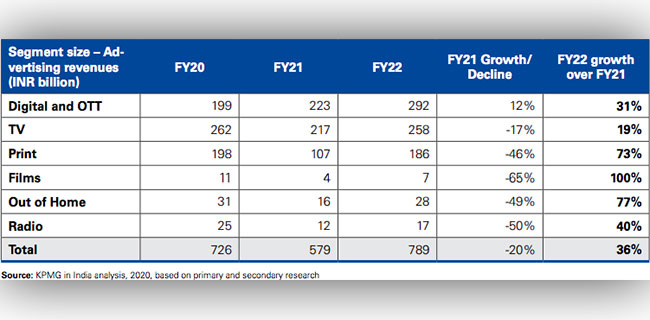
    According to the report, the M&E sector should recover to its current levels and post a 33 per cent growth in FY22 (following a contraction of 20 per cent in FY21), which still implies a loss of around two years of growth. The two areas that offer encouragement are the continued economic growth of Bharat and the universal acceleration of digital adoption among users across geographies and SECs. As per our revised estimates, India could be home to a billion digital users by 2028 rather than the earlier projected 2030 timeline. There have been several structural changes to digital behaviour on account of the experience of the lockdown resulting in a new homogeneity among users, and it is our belief that many of these changes will translate into a more democratic and sophisticated digital citizenry within the country.


  • Will OTT consumption trends last beyond the Lockdown?


    By Indrani Sen


    Starting March 25, Covid-19 imposed four phases of a lockdown over 68 days in India. We have seen many changes in our Media & Entertainment industry during this period. The rise of consumption of video streaming or OTT platforms is a major one among the various changes. As we enter the Phase 5 of lockdown with gradual unlocking of restrictions, the questions which are foremost among the various sectors of the M&E industry ‘will the gain made during the Lockdown last/ can the loss made during the Lockdown be reversed?’


    How long does it actually take to form a new habit? Maxwell Maltz, a plastic surgeon published his thoughts on behaviour changes in an audio book called Psycho-Cybernetics which was not only a blockbuster hit, but also influenced thinkers like Zig Ziglar, Brian Tracy, Tony Robbins etc. Maltz’s submission “it takes minimum 21 days to form a new habit” was shortened to “it takes 21 days to form a new habit” and the ‘21 days’ myth was born.


    There have been other scientific studies on the subject and a study by Phillippa Lally published in European Journal of Social Psychology found that on average, it takes minimum 66 days before a new behaviour becomes a habitual one. Though we have had 68 days’ of lockdown, the consumption of OTT platforms did not increase at one stroke at the beginning of Lockdown, but has increased gradually over this period. Still, it would be fair to assume that a large percentage of the viewers contributing to increased OTT consumption is on the verge of forming a new habit which is likely to last as we slowly emerge from the lockdown.


    From only nine in 2012, today the number of OTT platforms in India now stands at 35. The technique of personalisation of content for individual viewers has been helping them to increase their subscriber base which in turn has started attracting distribution of recent movies and other interesting contents. According to TAM AdEx data, the OTT platforms have been advertising aggressively during the Lockdown period on national and regional TV channels across different genres. Most of the platforms have been rewarded with growth of paid viewers and rise in viewing time.


    Apart from the above increases, what other trends we can expect to emerge in OTT viewing in India? As the consumption of OTT platforms increase both vertically and horizontally, the bandwidth required for delivery would continue to remain as an issue. The Cellular Operators’ Association of India has already asked OTT platforms to limit the quality and quantity of video to reduce the strain on the cellular network infrastructure.


    The shift of OTT viewing from small screen to large screen would be a trend to watch out for. As we would be living under the cloud of COVID 19 till an effective vaccine is discovered and is available globally at an affordable price, we will be accepting ‘new normal’ in various wakes of life including spending more time at home with family. The urge to view content together as well as the limitations of the broadband internet may lead to a shift of OTT viewing from the small screen of the mobile to the large screen of TV, a fact which was highlighted in the recent KPMG study.


    Another trend to watch out for would be a shift in prime time viewing of OTT platforms due to WFH and early return from work to home due to night curfew.  A recent article in Financial Times stated: “According to a recent survey by mobile marketing platform InMobi, 46% viewers are watching more content online. Another consumer survey conducted by Hammerkopf has found that OTT consumption primetime has moved to 7 pm onwards, as opposed to 10 pm-12 am before.” (https://www.financialexpress.com/brandwagon/how-is-coronavirus-impacting-the-streaming-platforms-with-an-increasing-appetite-of-viewers/1919916/).


    Various websites have recently carried articles on the ad spend on OTT platforms based on the TAM AdEx report of January to April 2020 showing that ad insertions doubled from 16000 in March to 33000  in April on this medium. An article on www.warc.com made an excellent analysis of the same ( https://www.warc.com/newsandopinion/news/adspend-on-ott-platforms-double-as-advertiser-mix-shifts-in-india/43633) pointing out that while some  categories/advertisers/ brands withdrew their advertising from OTT platforms, many new categories/ advertisers/ brands started advertising in their place. The churning of traditional to new advertisers would be the third trend that we can expect to see in near future on OTT platforms.


    Could there be a negative impact on the Lockdown on OTT business? If there is a further spike in Coronavirus cases after unlocking and the Government is forced to impose Lockdown again, then the economy may take a grievous down turn due to prolonged Lockdown resulting in a severe cash crunch and loss of employment. In such a situation, there may be de-growth in subscription of the video streaming platforms along with de-growth across M&E industry.


    The OTT platforms have restructured the content creation and distribution in the entertainment industry and it appears that the Lockdown would be acting as catalyst to accelerate the growth of this sector and the current consumption trends would last beyond the Lockdown period.


  • Dark Days Ahead for Adspends


    By Indrani Sen


    Last week, KPMG released a report titled “Covid-19: The Many Shades of a Crisis” trying to provide stakeholders in media and entertainment a perspective of the effects of Covid-19 on M&E sector (https://home.kpmg/content/dam/kpmg/in/pdf/2020/04/the-many-shades-of-a-crisis-covid-19.pdf).


    The report reviews three alternative scenarios related to the overall performance of Indian economy. The first scenario assumes that the spread of covid-19 would be largely contained by April-May and Indian economy could grow in the range of 5.3-5.7% in FY21. The second scenario assumes that under the shadow of a global recession with a containment of spread of the virus in India, the country could witness 4-4.5% growth for FY21. The third scenario assumes a proliferation of the virus in India accompanied by a global recession, GDP growth could fall below 3%. However, the report does not throw any light on how the three alternative scenarios may affect the M&E sector in different ways.


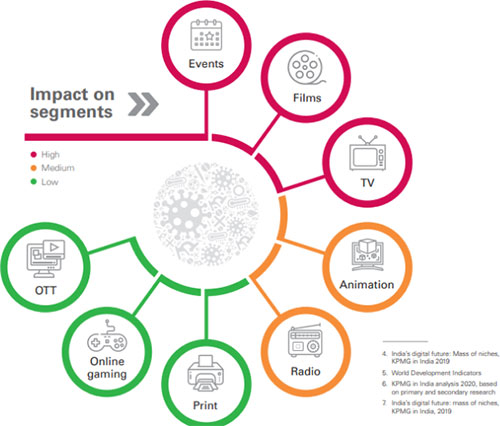
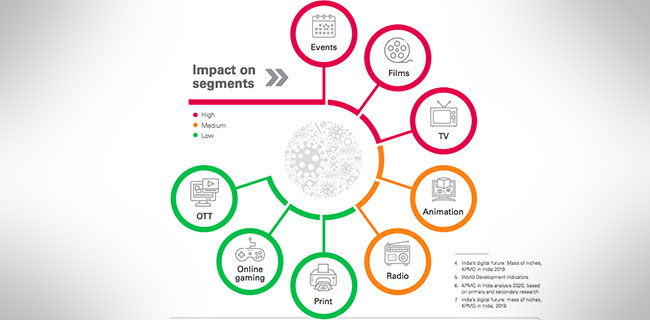
    The title “The many shades of a crisis” relates to how Covid-19 has affected the different segments in the M&E sector. The graphical presentation of their assessment (shown below) raises some doubts regarding the parameters used for making the assessment, particularly in relation to traditional media where print has been shown as having low impact against television having medium impact.


    Source: KPMG Report “COVID 19: The many shades of a crisis”


    While BARC data is showing a week-on-week increase in TV consumption, at the same time there is de-growth of advertising revenue leading to slowing down of monetisation with additional crisis of production of new content /episodes of the serials. KPMG has predicted for TV “slow ad spend recovery in medium term with long term risk due to digital competition”.

    On the other hand, KPMG has predicted “a new lease of life” for print riding on the credibility of the printed words against proliferation of fake news in social media and has advised print media to “leverage positive consumer segment and build strong digital products to capture the opportunity”. This advisory ignores the current scenario related to printing and distribution of hard copies of newspapers and the various hurdles which they may face in recovering their circulation and readership post COVID 19. It is difficult to agree with KPMG’s views that the impact of COVID 19 will be less on print than on television.


    Animation sector also has been hit severely as work from home poses a challenge to implementation of the tools and techniques which are difficult to access from home of the individual illustrators. High fixed costs and high investment costs of the animation sector clubbed with cancellation/ postponement of contracts have created a serious cash flow crisis.


    The impact on radio also has been quite high as there is a loss of listenership due to lack of travel and work from home. Many advertising campaigns on FM radio are linked with activation and events at various social gatherings which have been as badly affected as the events sector. KPMG agrees that ad spends on radio will take time to recover and assures that demand for timely localised content should remain high even after the recovery from the virus. Given the restriction on production of news content by FM radio, they can do very little to satisfy the demand for timely localised content during lockdown and after removal of lockdown.


    KPMG shows that Events and film sectors have been badly affected due to social distancing and the OTT and gaming sectors have gained riding on the additional time spent by people at home. KPMG predicts footfalls in cinemas may take a while to return to normalcy and live events may also take longer time to recover as consumers emerge gradually from the social distancing mode. Both OTT and gaming can benefit if the growth in current consumption can be converted to habitual activity.


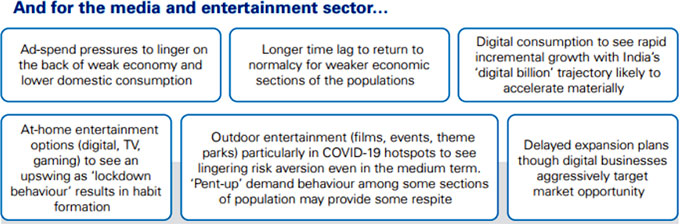
    Summing up, the KPMG report provides the following insights for the M&E sector:


    Source: KPMG Report “COVID 19: The many shades of a crisis”


    The above themes will play across the M&E value chain impacting supply chain, consumption and monetisation. KPMG apprehends that the gap between India and Bharat in consumption of various goods and services may widen due to the reverse migration from urban areas to rural areas as a result of lockdown and halt in all economic activities. Remote collaboration for creative ideation and scripting may last beyond COVID 19 altering the supply chain management of content creation permanently. Finally as far as monetisation is concerned, KPMG predicts longer timelines for ad spend recovery as the economy would continue to be under stress even after the virus is contained. The slowing down of the economy would have adverse impact on key advertisers in FMCG, auto, e-commerce etc. and they might take longer time to restore their ad spends to the level before the pandemic struck India.


  • Impact of Covid-19 on M&E: KPMG


    By A Correspondent


    Given the ongoing Covid-19 pandemic, KPMG has released a report titled “Covid-19: The many shades of a crisis- A media and entertainment sector perspective” which discusses the impact of Covid-19  in the media and entertainment industry.


    The report highlights that media consumption overtime has tended to be income inelastic, however the current environment could result in a dip in media consumption in the near term; and also foresees key trends across Television, Print media, Films, OTT platforms during Covid-19 along with the recovery time for the same.


    Furthermore, the report highlights that due to Covid-19, traditional media could face some challenges in the near to medium term, and there is likely to be a long-term upward shift in the integration of digital technologies into our everyday lives with media and entertainment being an immediate beneficiary.


    Speaking on the ongoing situation, Satya Easwaran, Partner and Leader – Markets Enablement, Technology, Media and Telecom (TMT), KPMG in India said: “The Covid-19 pandemic has resulted in a drastic cut in advertising expenditure across all media. However, with people being homebound, consumption of media and entertainment – and digital media in particular – has seen considerable growth. Post crisis, we anticipate an even greater integration of technology into our everyday lives with a marked digital progression of Indians across socio-economic classes. Monetisation however might remain a challenge in the near term.”


    Added Girish Menon, Partner and Leader – Media and Entertainment, KPMG in India said “The Covid-19 experience is likely to result in a long-term upward shift in the integration of digital technologies into our everyday lives, with India’s ‘digital billion’ trajectory likely to accelerate materially. We expect greater affinity to be seen for at-home entertainment with subscription models, cord-shaving and streaming to larger screens seeing exponential pick-up in the near to medium term. Outdoor entertainment options including – films, events, theme parks – particularly in Covid-19 hotspots could see lingering risk aversion even in the medium term. With monetisation, particularly ad-spend, under pressure, the focus for M&E companies in the near to medium term would be on cash management and profit protection with greater technology integration. Organisations might need to be risk focused and innovate existing business models and processes to survive and emerge stronger.”


    Below are the key highlights of the report:


    Insights into the crisis and its aftermath:

    • Ad-spend pressures to linger on the back of weak economy and lower domestic consumption

    • Longer time lag to return to normalcy for weaker economic sections of the populations

    • Digital consumption to see rapid incremental growth with India’s digital billion trajectory likely to accelerate materially

    • At-home entertainment options (digital, TV, gaming) to see an upswing as ‘lockdown behaviour’ results in habit formation

    • Outdoor entertainment (films, events, theme parks) particularly in Covid-19 hotspots to see lingering risk aversion even in the medium term. ‘Pent-up’ demand behaviour among some sections of population may provide some respite

    • Delayed expansion plans though digital businesses aggressively target market opportunity


    Impact on the Media and Entertainment sector:

    • Supply chain:

    ¤ Innovations in content pipeline: A focus on building a stronger content bank may result in working capital being locked up across the value chain, leading to higher cash flow requirements

    ¤ Innovations in delivery models: With outdoor entertainment and recreation facing challenges in the near term, innovative outreach and delivery models are likely to evolve

    ¤ Greater emphasis on predictive analytics: Companies could place an increasing amount of reliance on Artificial Intelligence (AI)/ Machine Learning (ML) to predict consumer behaviour in these uncertain times


    • Consumption:

    ¤ India vs. Bharat dichotomy could likely widen

    ¤ At-home consumption, particularly OTT and gaming, to see continued accelerated growth

    ¤ Outdoor media consumption: M&E segments such as films, events and theme parks are looking at a prolonged recovery cycle, owing to risk aversion towards social gatherings, particularly in COVID-19 affected cities and hotspots, which unfortunately includes some of the major cities

    ¤ While India’s media consumption remains upbeat during the lockdown, indulgent expenses around purchase of latest hardware, technology upgrades etc. could be postponed for a while

    • Monetisation:

    ¤ Longer timelines for ad spend recovery

    ¤ Penetration of subscription based digital models to accelerate: Digital subscription revenues could see an upswing post Covid-19 as habit formation in terms of OTT video consumption sets in

    ¤ Print will get a new lease of life

    ¤ Medium term downside risk for outdoor entertainment segments: Aversion to social gatherings in the medium term (particularly in major Covid-19 hotspots) could result in lower footfalls and ticket sales for films, events and theme parks

    ¤ M&E services build on domestic opportunities: There is likely to be a greater emphasis on domestic markets in the services space, particularly in the animation and VFX segments, as global pipelines come under severe pressure


    Framework to help companies work through the transition to normalcy:

    • Immediate focus for companies will be on value preservation and protection

    ¤ Protection of the workforce:Focus first on the physical and mental well-being of the workforce with a gradual reintegration process. Time for leadership to deliver clear messages on organizational priorities and provide a fair assessment of the impact of the crisis on their business to employees

    ¤ Stakeholder communication includes not just employees but also external parties including vendors, partners and customers

    ¤ Identify short-term cash flow challenges and enable cost levers for savings opportunities


    • Medium term objective will be value creation

    ¤ Agree and implement the recovery plan

    ¤ Incorporate learnings from the crisis to streamline processes and potentially provide better insulation from such shocks

    ¤ Devise tactical working capital projections in acknowledgement of the changed environment

    ¤ Invest in upskilling teams to adapt to the new normal


    • Long-term vision will be value realisation

    ¤ Carve-out of non-core businesses to unlock value

    ¤ Identify strategically aligned inorganic growth opportunities

    ¤ Develop deep and credible succession plans


  • KPMG and RAI undertake joint study to understand growth of private label space

    By A Correspondent


    With a view to understanding the private label space better, consulting firm KPMG and Retailers Association of India undertook a joint study to understand the growth and driving factors of the online private label space titled – The online private label growth paradigm. To identify the trends that are contributing to the growth of private labels in India, KPMG held discussions with various set of online and offline retailers with a pan India presence.


    Here are some of the key highlights of the study:

    Online private labels are expected to continue to be a driver for profitable growth for e-commerce marketplaces

    Growth of private labels between 2019 and 2022 is expected to grow at 1.3-1.6x faster than e-commerce platforms. It will continue to generate 1.8-2.0x higher margins than external brands

    Category focused platforms were relatively early to launch online private labels and currently have 25-40 per cent of sales contribution, compared to approximately 5-10 per cent for multi category platforms

    Category focused platforms recorded faster growth as compared to multi category platforms largely driven by private labels growing at approximately 1.2-2.5X relative to the platforms growth from 2016-2019

    Online private labels allow platforms to attract new consumers, improve consumer stickiness and thereby, increase market share. Big e-commerce players, across product categories, attribute greater than 50 per cent of their private label sales to repeat purchases

    Online private label purchases in categories such as apparel, grocery and cosmetics see repeat purchases exceeding about 60-65 per cent, indicating that having a strong private label strategy will be a good initiative

    Private label growth and their higher profitability translates to better valuations

    Private labels offer supply chain efficiencies and greater product customisation abilities that later translate into higher margins – for instance a leading grocery marketplace improved its category margins by launching premium labels in organic and superfood categories


    Commenting on the India findings, Harsha Razdan, Partner & Head, Consumer Markets and Internet Business, KPMG in India said: “With a gradual shift from unbranded to branded, online retailers are also launching their own private label brands, thus providing consumers a much wider choice of products and channels to choose from. Private labels have the potential to offer higher margins on account of supply chain efficiencies and better control over operations. Further, this could also lead to higher consumer stickiness, thus becoming a critical element of the overall business strategy. If one takes a long-term view, the journey of private labels gradually moving to brands will be shaping the future of retail.”


  • Industry Reax to Budget 2020-21


    A cross-section of the industry reacts to Nirmala Sitharaman’s maiden Budget 


    Girish Menon, Partner and Head, Media and Entertainment, KPMG in India

    Although there was no direct reference to the media and entertainment sector in Budget 2020, the focus on improving India’s digital connectivity bodes well for the sector. The Honourable Finance Minister’s announcement that an amount of INR 6,000 crores will be spent on BharatNet initiatives will see more citizens connected to the proposed pan-India FTTH network. Media and entertainment is increasingly becoming a digital medium and an enhancement of the underlying digital communications infrastructure will support more immersive experiences. Finally, the focus on building a vibrant start-up ecosystem with measures to improve access to funding and IP protection will help India emerge as a global hub for technological innovation.


    Rakesh Jariwala, Partner – International Tax Services, EY India

    Removal of exemption on sale, distribution and exhibition of cinematograph film will subject theatrical revenues to domestic withholding tax considerations and could pose working capital considerations for already funding constrained film industry. Amendment of source taxation rule to include advertising income relating to customer based in India while global consensus is being formed on digital taxation rules may result in short term pain for the foreign businesses which do not have access to a tax treaty. Reduction of withholding tax rate on technical services to 2% will provide relief on potential rate related disputes on production services. Reduction in import duty of news print should help the ailing print businesses. 


    Ashish Bhasin, CEO, APAC and Chairman, India – Dentsu Aegis Network:

    I think this is a good budget in some ways because it has attempted to put money in the hands of the middle class through rationalisation of tax rates as well as has concentrated on looking after the agricultural sector, including introduction of best practises like storage for producers and other measures. However, I do feel that the expectations from the budget were much more and it does feel like a bit of a missed opportunity.


    While it is good to see that the dividend distribution tax has been abolished, I expected more on the rationalisation of direct taxes, particularly the cess introduced over and above the tax rates.


    It is good to see efforts being made to encourage new-age skill development as well as helping the start-ups and what’s particularly interesting is the proposal to set up data centre farms all over the country. This will prepare India for the economy of tomorrow. It is also good to see attempts at simplification of taxation through digitisation but the proof of the pudding will lie in seeing its implementation on ground.


    It would be fair to say that at best it is a mixed budget and while there are some encouraging decisions, enough does not seem to have been done for the situation the economy is in.


    Karan Darda, Executive Director, Lokmat Media Group:

    We welcome the proposed reduction in custom duty on import of newsprint and light-weight coated paper. In recent years, newspaper industry has been facing many headwinds and the environment has overall been very challenging. 10% customs duty was introduced last year and that added to the burden. The reduction in customs duty would ease the burden and help the industry in this critical juncture. 


    Anand Bhadkamkar, CEO, Dentsu Aegis Network (DAN) India:

    The budget has provided relief to middle class with lower tax rates which is a welcome move, as it will provide more liquidity. On direct taxes, the abolition of DDT and introduction of a tax dispute resolution scheme is a welcome step alongside tax reliefs for startups.


    The budget is focusing on easing and simplification of compliance, with changes in corporate laws as well as in GST and direct taxes. However, I was expecting further simplification of cess and surcharges beyond tax rates across slabs.


    The proposals for development of road infrastructure, setting up data centre parks and skill development initiatives are welcome steps in addition to allocations for social welfare schemes.


    However, the expectations from the budget were high on the background of current economic slowdown, and as such seems to be short on matching those expectations, with no specific industry sector focused sops to provide stimulus. While the budget shows focus on long term growth and social development, overall in the current scenario it looks like a mixed budget, falling a bit short of market expectations of more corrective measures.


    Gautam Sinha, CEO – Times Internet:

    Budget 2020 is a promising step towards establishing India’s future as an enduring digital economy. The increased focus on improving data connectivity under Bharat Net, steps to boost the smartphone manufacturing industry and the Rs 8,000Cr allocation for the National Mission on Quantum Computing & Technology will help build better digital infrastructure to support this sector’s rapid growth. Finally, deferring tax on ESOPs for startups is also a major move that will help promising startups attract and retain talent that would fuel our burgeoning digital ecosystem.


    Redickaa Subrammanian, Co-founder and CEO, Resulticks:

    Digital disruption has transformed India’s business landscape and the announcement for building more data centre parks will further aid in laying a strong foundation for a digitally connected country. INR 8000 crore allotment for developing quantum technology is impressive, and this in tandem with the grassroots level skilling initiatives, make for a strong technology ecosystem. Engineering students will also gain real-world experience through the new internship programs, creating a digitally skilled talent pool equipped to work in a digital economy.


    As a fast-growing AI and ML based technology start-up, we welcome setting up of the investment clearance cell. The proposed revisions in the income tax structure should lead to increased consumer demand and provide an overall impetus for economic growth in India. The announcement made in Budget 2020 showcases the government’s support for India’s technological advancement and we are excited about the entrepreneurial spirit it promotes.”


    Prashan Agarwal, CEO – Gaana:

    We appreciate the efforts of the government to boost the digital ecosystem in the country. The increased focus on improving connectivity under the Bharat Net scheme and the emphasis on Artificial Intelligence will allow OTT players to offer bespoke and personalised solutions to consumers. Additionally, the impetus to the smartphone manufacturing industry will make internet consumption accessible to a wider section of Indian society that will expand the scope of revenues for OTT players. The allocation of Rs 8000 crore for setting up the National Mission on Quantum Computing and Technology will also boost the development of the industry by making resources cost-effective.


    Mitesh Shah, Head of Finance, BookMyShow: 

    At the onset, we would like to laud Government for growth driven budget. We welcome the progressive policies aimed at encouraging rural demand, changes in personal taxes spurring consumption and impetus to infrastructure development, measures aimed at bolstering growth and reverse slowdown. Additionally, taxation related on ESOPs as perquisite and removal of DDT are significant moves. However, the benefits of taxation relief on ESOP should be expanded to companies at various stage of growth.


    Compliance on e-commerce has been increased by mandating them to deduct TDS @1% on all goods and services sold on e-commerce platforms. This would be in addition to TCS under GST and this amendment might further increase the cost of compliance for e-Commerce companies. Government’s vision to build data centre parks, allocation towards quantum computing and its focus on using artificial intelligence in statistical and other government departments will take India’s growth story to the next level.


    Increase in compliance on e-commerce by mandating deduction of TDS @1% on all goods and services sold on e-commerce platforms. This would be in addition to TCS under GST and this amendment might further increase the cost of compliance for E-Commerce companies. Government’s vision and focus on investing in new age technologies to build data centre parks, allocation towards quantum computing and its focus on using artificial intelligence in statistical and other government departments will certainly give an impetus to ‘Digital India’.


    Kunal Bahl, CEO & Co-founder, Snapdeal:

    Thankful to the Hon’ble FM for accepting the start-up sector’s request for ESOP taxation reforms. Also, the higher time & turnover limits for carry forward of losses for start-ups will enable them to optimize growth decisions in formative years.


    Overall, Budget 2020 is a thoughtful weaving together of specific proposals to tackle varied issues. Measures to improve access to finance for MSMEs and reduced taxation for the middle-income segment are welcome steps. Boosting physical infrastructure, expanding digital connectivity and growing use of technology in government functioning are important building blocks for the long-term growth of the Indian economy.

     

  • Do loyalty programmes ensure brand loyalty?


    By A Correspondent


    Digital disruption and new generational influences are making customer loyalty tough to hold onto these days, but fresh thinking on loyalty programmes is key to winning and retaining customers, according to KPMG International’s The Truth about Customer Loyalty report.


    With the holidays nearing, KPMG’s  survey of over 18,000 consumers in 20 countries, with 1721 being from India explores the nature of customer loyalty and how some traditional loyalty programmes, long a mainstay of customer retention strategies, may not be keeping consumers brand-faithful.


    Said Harsha Razdan, Partner and Head, Consumer Markets and Internet Business, KPMG in India: “In India, brands and retailers are ready to run miles to acquire a customer. It becomes even more difficult to retain acquired consumers, unless there is a unique value proposition along with related benefits. The fact that over 55 per cent of consumers in India say they will buy from their favourite company even if it is cheaper and more convenient to buy from a rival company is further proof that loyalty endures. Loyal customers can be a reliable repeat source of revenue for retailers/brands.”


    “The study in India revealed that when a consumer is loyal to a brand, 93 per cent will recommend it to their family and friends. 47 per cent will remain loyal, even after a bad experience. This substantiates that retailers today will need to re-imagine and re-invent to continue to lure/excite the new digital tech-savvy consumer. They will need to invest in creating convenient loyalty platforms, educating consumers about the program uniqueness and get the consumer to experience the benefits that the program has to offer. These programmes should make the consumer feel special, wanted and proud of being associated with the retailer/brand. Retailers/brands should continue to engage with consumers while ensuring that consumer data and interests are protected,” added Razdan.


    What Indians feel:

    Of the over 18,000 respondents from 20 countries, 1721 were from India. The maximum number of respondents were millennials (in the 17-36 age group).

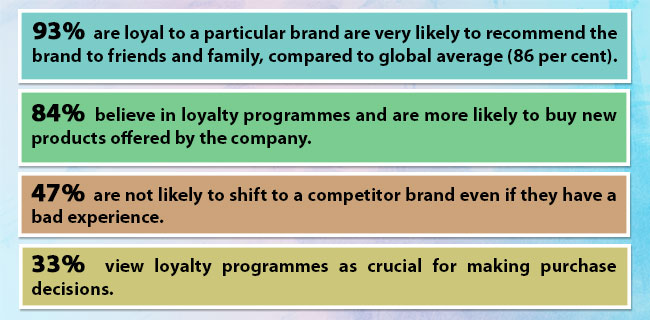
    — 93 per cent of the respondents who are loyal to a particular brand are very likely to recommend the brand to friends and family, compared to global average (86 per cent).

    — 84 per cent of the respondents in India believe in loyalty programs and are more likely to buy new products offered by the company

    — 47 per cent of the respondents are not likely to shift to a competitor brand even if they have a bad experience

    — 33 percent of the customers in India view loyalty programs as crucial for making purchase decisions


    What engenders brand loyalty today?

    Brand loyalty doesn’t only earn companies repeat business from their loyal customers–over 86 per cent of consumers globally, from Gen Z to the Silent Generation, say they would recommend a brand they loved to friends and family.

    In terms of earning customer loyalty, 59 per cent of the consumers surveyed globally said they are loyal to their favourite brand because of a personal connection compared to 74 per cent in India. 75 per cent consumers globally said their loyalty was driven by product quality compared to 81 per cent in India, 66 per cent consumers globally as compared to 74 per cent in India said their loyalty was driven by value for money and 57 per cent consumers globally as compared to 73 per cent in India said their loyalty was driven by customer service.

    Meanwhile, only 37 per cent globally see loyalty programs as an effective way to earn their loyalty. And 55 per cent of consumers who are enrolled in loyalty programmes internationally use them infrequently –a few times a month or less. 96 per cent of the millennials surveyed globally said companies need to find new ways to reward loyal customers altogether.


    Here is what KPMG recommends to improve customer loyalty programmes:

    Revitalise them.

    Around half of the surveyed consumers globally agree that companies should find new ways to reward loyal customers. This number stood at 97 per cent for India. Responsible personalisation, emotional connection and purpose-driven causes should be key considerations.


    Keep it simple.

    Make loyalty programmes easy to join and simple to use. Globally, 60 per cent agree loyalty programmes are too hard to join and/or earning rewards is a challenge. 80 per cent in Brazil and China feel that way, 76 per cent in India feel this way and as do nearly seven out of ten millennials globally. Lengthy registration processes, rules and conditions, technical difficulties with redeeming awards are all likely to turn customers away.


    Maintain relevance amid the noise.

    Retailers need to ensure their loyalty programmes stay relevant to customers. 49 per cent of loyalty programme members globally agree they belong to too many programmes. This is particularly the case for consumers in China (72 percent), Brazil (70 per cent) and India (61 per cent).  Too many programmes equate to too many apps, so it’s no surprise that customers forget their memberships, lose track of their points and perhaps decide that the rewards are not worth the effort.


    Promote awareness and familiarity.

    Regular communication to consumers through social channels, email or advertising can help programmes remain top of mind with consumers. More than one in three consumers globally who did not belong to any loyalty programmes globally said they were not aware of any. 17 per cent globally compared to 21 per cent in India have not joined a program. Lack of awareness (42 per cent) is one of main reasons stated by respondents in India for them not being part of any loyalty programme in India


  • KPMG-Eros Now OTT report maps consumption habits of Indian viewers

    By A Correspondent


    KPMG India and Eros Now launched the report, ‘Unravelling the digital video consumer: Looking through the viewer lens’, to check the consumption habits of Indian OTT viewers and their content preferences, across 16 Indian cities.


    Said Girish Menon, Partner and Head Media & Entertainment, KPMG in India,: “The online video consumer in India has evolved in a significant way in the last couple of years. With consumption now going mass and viewers spending close to 8.5 hours a week on online video, we see a homogenous pattern of consumption emerging cutting across age groups, income levels and professions. Our report also touches upon the future of this consumption evolution, and how online video could potentially disrupt traditional distribution in the coming years. This represents a large opportunity for platforms to tap into the ever expanding universe of digitally connected Indians.”


    Added Rishika Lulla Singh, Chief Executive Officer, Eros Digital: “India is one of the fastest growing entertainment and media market globally and is expected to keep that momentum. As data and digital infrastructure has become exceedingly accessible even in small cities of India, the market for OTT has widened enormously. At Eros Now, we strive to constantly engage the existing consumers and expand our reach by offering new and innovative services.”


    Key insights from the Indian online video consumer-survey include:

    :: The Indian OTT viewer spends more approximately 70 mins/day on online video platforms, with a consumption frequency of 12.5 times a week i.e. more than once a day. Viewers are also accessing ~2.5 platforms at a given time. While the customer sets are fairly heterogeneous, there is a trend of homogeneity that was observed in terms of consumption frequency and duration across age groups, income levels and genders.

    :: Indians continue to love their movies and movie related content; 30% of the respondents prefer watching movies on OTT platforms.

    :: Original content is fast emerging as an important category, with close to 10 per cent respondents alluding to preference for the same. This is significant given the limited supply on original content on platforms at present, as compared to library content.

    :: Long-form content is gaining traction, while short form content continues to remain relevant, especially to cater to the millennial audience.

    :: 30 per cent of the respondents prefer watching content in languages other than Hindi and English. The preference for content consumption is significant in the native languages across large parts of the country, with south India observed to be the most loyal to their native tongue.

    :: 87 per cent of the respondents consumed content on their mobile phones, with nearly 28 per cent of the respondents consuming content during the traditional office hours of 10 – 6pm. Online video in India is truly an ‘Anywhere Anytime’ phenomenon.

    :: Three out of 10 users are watching online video on telco platforms, outlining the importance of the medium in terms of distribution. Integrated telco billing is one of the factors that is likely to help drive VOD subscriptions in the future

    :: Freshness and uniqueness of content the key determining factors for installation and uninstallation of apps, as well as respondents subscribing to platforms; 87 per cent of the respondents install an app considering the quality of content


  • FDI in digital media could mean large fund inflows: KPMG

    By A Correspondent


    The Union Cabinet announced its policy for Foreign Direct Investment (FDI) in the digital media. Here’s goes the relevant part from a communique, titled ‘Digital Media’: The extant FDI policy provides for 49% FDI under approval route in Uplinking of ‘News & Current Affairs’ TV Channels. It has been decided to permit 26% FDI under government route for uploading/ streaming of News & Current Affairs through Digital Media, on the lines of print media.


    Said Himanshu Parekh, Partner and Head, International Tax, KPMG in India on changes to FDI norms in digital media: “The M&E industry grew by 13.3% in FY19 (as compared to FY 18) on the back of colossal growth of 43.4% in digital media segment*. This is despite the fact that while the FDI policy currently permits 49% foreign investment in Uplinking of News & Current Affairs TV Channels and 26% in print media sector, both through government approval route, it was silent on FDI in the digital media segment. The government has today approved the proposal to allow 26% FDI for uploading/ streaming of News & Current Affairs through digital media. This is a welcome move and should lead to larger FDI inflows in India in the already burgeoning digital media sector.”