Tag: INMA

  • Times of India bags INMA Global Innovation regional award

    By A Correspondent


    The Times of India group was among the seven companies rewarded for excellence in innovation by the International News Media Association (INMA), with social media curation company Storyful taking home worldwide first place in the Global Innovation Awards.


    The awards were presented on May 11 at the 85th Annual INMA World Congress held in New York City with nearly 300 media executives in attendance. The second annual INMA Global Innovation Award competition rewards media company programmes that encourage ideation and incubation, change the corporate culture, attract young talent, and incentivises innovation mindsets.


    “This year’s winners exemplify the breathtaking pace at which media companies are investing in innovation as a process that leads to more new products, more revenue, more efficiencies, a modern workforce, and better business outcomes,” said Earl J. Wilkinson, executive director and CEO of INMA. “That Storyful took home the global prize as a non-print, non-legacy media company shows that the ‘news media tent’ is expanding.”


    The seven regional winners are:

    Best in Africa: Independent News & Media, South Africa, for “Inspired by Change.”

    Best in Asia/Pacific: Fairfax Media, Australia, for “Brand Discover.”

    Best in Europe: Sanoma, Finland, for “Get Started.”

    Best in Latin America: El Colombiano, Colombia, for “ECOlab.”

    Best in North America: The New York Times, United States, for “Digital Innovation 2.0.”

    Best in South Asia: Times of India for “Rewarding Excellence in Media Company Innovation.”

    Global/At-Large: Storyful, Ireland/international, for “Innovation Is a Culture.”


    From the seven regional winners, the three-judge panel of innovation experts selected Storyful as the worldwide winner.


    Founded in 2010, Storyful is a social media news agency that curates relevant tweets, posts, and video from people in the center of news events worldwide. Storyful also provides social media dashboards, real-time discovery tools, feeds and analytics to customers. The company’s headquarters are in Dublin, with offices in New York and Hong Kong.With innovation already a part of its young culture, Storyful faced the challenge of scaling its efforts when acquired by News Corp. in late 2013. Integrating scale with culture, Storyful created a manifesto:


    Full-stack teams, no silos.

    Clear focus with teams focused on News, Video, and Discovery.

    Fail-fast mentality with two-week sprints and an adherence to the Agile methodology.

    Create time to collaborate: planning, research, UX design, and user engagement.

    Diversification of workforce to provide a more rounded approach to problem-solving and speed innovation.

    Be data-driven across all tools – from user loyalty to feature development, and more.

    Breed culture: maintain it and help new employees to assimilate through team activities and onboarding.


    With those principles, Storyful set out to build three new teams, re-build its core product, overhaul internal tools, and launch a new product into the market.


    Ultimately, judges focused on the processes behind Storyful’s objectives. They described Storyful as a company with a “super interesting innovation culture” integrated throughout the organisation, led by data-driven insights and full-stack teams. They lauded Storyful as a “strong start-up on its own” that has “leveraged new corporate ownership’s resources without bogging down.”


    Regional Winners

    Colombiano, Colombia: With creativity as its strategic weapon, El Colombiano created ECOlab, an internal media lab to launch and maintain business units, research and implement new business models, develop new activities to grow the business, diversify its portfolio, transform creativity into corporate culture, and be systematic agents of change. ECOlab has led to a Web site redesign, a redesign of neighbourhood newspapers, and created new magazines and projects while providing employees borrowed from departments new skill sets.


    Fairfax Media, Australia: Brand Discover is Fairfax’s response to bring incremental revenue and to create new product streams that leverage its content. Since launch, the programme has achieved more than A$2 million in revenue. The Digital Innovation Services team is tasked with developing new advertising products around rich media and content marketing.


    Independent News & Media, South Africa: Embracing change on many fronts, the company shifted from a regional to a national structure, created an editors’ forum, rewarded staff ideas through pitch sessions, digitally trained teams, sought new talent to bring Digital Natives into the storytelling process, making editorial and sales departments compatible, and pushed 360—degree custom content solutions.


    The New York Times, United States: Reaching 910,000 paid digital subscribers was spurred by the development of new editorial and advertiser solutions. A wide array of new products with refined features aims to elevate the reader experience and provide a deeper emotional connection to the Times, which aims to consistently drive its most engaging content to grow audiences and deepen advertiser relationships through exclusive paid posts. Products to emerge include NYT Now, a cooking app, Paid Posts, and Times Premier.


    Sanoma, Finland: SanomaLab is an accelerator designed to develop new internal ventures, create open innovation programmes, accelerate cultural change to reach business goals, and identify “superstar” talent. More than 1,700 employees have been trained to use the lean methodology. The slogan for all its product activities is: “Can we find a repeatable and scalable business model?”


    The Times of India: Its systematic innovation approach has implemented 85+ breakthrough performances in the past three years. The Times’ innovation-focused strategy aims at execution speed, interactive innovations with young readers in mind, culture and revenue as key drivers in the process. It involves teams across all levels, leading to an ongoing process of ideation and incubation. Its reviewing system tests reader ideas before being scaled.


     

  • INMA to host 8th Annual Conference in New Delhi

    By A Correspondent


    The International News Media Association (INMA) will host its 8th Annual South Asia Conference November 12-13 at Eros Hotel, Nehru Place, New Delhi.


    The conference will be held under the theme: “Print: Transform, Diversify, Grow” specifically for news media companies in India, Bangladesh, Sri Lanka and Pakistan, and will bring together more than 200 delegates from the sub-continent. The conference is a fast-paced tour de force of ideas and innovations to grow newspaper advertising, circulation, brand and revenue by addressing key current issues in the print + digital ecology of the South Asia market.


    More than 25 speakers, several partners, press and 200+ delegates from newspapers across India, Pakistan, Bangladesh, Europe and the United States will be attending this conference.


    INMA is the only industry association that is able to pull together South Asia’s top publishers and specifically executives charged with growing advertising, circulation and brand. There will be excellent opportunities to network and share the “INMA conversation” among this exclusive fraternity of the world’s most innovative newspaper executives.


    The International News Media Association (INMA) is the world’s leading provider of global best practices and marketing ideas. It provides its members thought leadership and practical ideas to grow audience, advertising, brand and profit. Currently INMA has nearly 6,000 members in 82+ countries world-wide, which include several members from Indian and now Bangladesh and Pakistan newspapers.


  • BCCL wins INMA Global Innovation Awards

    By A Correspondent


    Bennett, Coleman and Co Ltd was among the four regional winners in the International News Media Association (INMA) Global Innovation Awards announced in Dallas,USA. The competition rewards excellence in media company innovation programmes. A global winner will be announced on May 13 at the INMA World Congress in San Francisco.


    The other regional Global Innovation Awards recipients were Gannett, US; Fairfax Media, Australia and MittMedia, Sweden.


    The Best in South Asia accolade went to BCCL for its entry on “Transforming Print Media Sales Culture Through Technology.” The sales culture transformation programme looked at ending silo selling, more efficient pricing, driving agility and creating a climate of accountability, and data-driven selling. The programme included intense effort at changing the internal culture to one that encourages efficiency, agility, and accountability.


    From these four regional winners, a global award recipient will be unveiled at the closing dinner of the INMA World Congress May 13 in San Francisco. Regional winners’ innovation programmes will be presented at the World Congress and awards formally presented.


    The INMA Global Innovation Awards are designed to shine a spotlight on the fast-emerging structured innovation programmes of media companies seeking new foundations in transformational times.


    “With this new competition, INMA wants to reward the people, programmes, and processes behind the emerging innovation culture in the media industry – the foundations upon which novel ideas are being launched at a rapid rate,” said Earl J Wilkinson, executive director and CEO of INMA. “We want to reward media companies that are mastering the art of innovating routinely.”


  • Print-Digital Bhai-Bhai!


    By Ananya Saha


    Print readership is declining the world over. And digital subscribers are rising. Does this mean that the digital medium would lead to closing down of print editions? Not according to the speakers and attendees at that The Digital Innovation Summit 2012 by INMA.


    Yasmin Namini

    While Newsweek made a smart move by announcing its move to the web-only space, the news print industry is taking it slow and steady. Yasmin Namini, Senior VP – Marketing and Circulation and GM, Reader Applications, The New York Times pointed out how NYT has been gaining readers with their innovative paid digital content, such as, repeated payment gateways screen and 10-articles-free-per-month-limit after which subscription is necessary. NT registered 56.6 lakh subscribers till Q3 of 2012. She said that NYT has been using cross-bundling approach to optimise profitability.


    Mark Challinor

    Mark Challinor, Director of Mobile Platforms, Telegraph Media Group,Londonwas upbeat about the usage of personal mobile devices and iPads. He said, “There are more iPhones sold in the world (4.6 seconds) than babies born in the world (4.2 seconds). This gives us a clear idea of the future. Today’s 2-5-year-olds learn to operate the iPhone and iPad much before they learn to tie shoelaces.” He supported the fact that remains important, and the future of newspapers depends on reinvention of news industry.


    Indian newspapers too are smart enough to invest in their digital properties to receive huge dividends in the future. Earl J Wilkinson, Executive Director and CEO, INMA shared smart bets forIndia, “Make consumer pay more, now and create digital company outside your current company, in case the existing structures do not support digitalisation and be willing to cannibalize yourself.” He also cautioned against making digital an excuse to stop investing in print.


    vasant-gokhale

    Vasant Gokhale, Head, Mobile Services, ABP Pvt Ltd shared the mobile strategy that his company had adapted for the non-resident Bengalis. With an aspiration to reach out to wider Bengali audience settled out of East of India, Ananda Bazaar Patrika started its paid digital content three months ago targeting only non-resident Bengalis. The standard service of $5 per month and exclusive packages were launched to create a subscriber base around Durga Puja. Mr Gokhale shared “We have been growing 30% month-on-month, without spending a penny on marketing. The growing base is the result of our unique Bengali content and offering.”


    Bharat Gupta

    Bharat Gupta, Executive President – Marketing, Jagran Prakashan Ltd said, “With our unique content mix, out Hindi website has been gaining more traffic. We find Facebook very helpful in engaging our users, targeting new demographic areas and making headlines of the print publication viral.” He added that the main focus for his publication on social media was “not to gather the ‘likes’ rather get spoken about on social media.” Puneet Gupt, VP and Head of TOI.com shared how The Times of India digital story has seen growth thanks to engagement, rewards and response to consumer tastes.


    Grzegorz Piechota

    While Grzegorz Piechota, News Editor, Gazeta Wyborcza, Poland shared how the future of journalism and communities in digital age depends on campaigning and bringing the society together through causes; Marcelo Benez, Advertising Director of Folha de S Paulo, Brazil talked about where digital solution fit in the multi-media advertising mix. According to him, digital and print will co-exist in the future and help with the growth of each other. The group recently launched a magazine exclusively for Tablets, called Fohla 10 that can be consumed through various digital devices.


    Pit Gottschalk

    Mr Benez noted, “Of the total advertising pie in the country, television still claims the maximum share of 64.8%, newspaper follows with 11.7% and internet gets 5.2% of this ad pie.” Thus, to get maximum benefit, he advocated that a news company should be able to deliver their content on all platforms. He also said that the news company should engage advertisers not only through content but multi-platform special projects as well. Concurring with his thoughts, Pit Gottschalk, Director – Content Management, Axel Springer,Germany, said that news companies need to integrate digital as much as in their companies.


    Talking about his brand, Bild, Mr Gottschalk said, “Our digitisation strategy focussed on our three strengths: content, classifieds and marketing. In 2004, we defined our core strategy and created portfolio of market leaders in various geographies corresponding with our core strengths.” He further added that Bild used the classic newspaper strategies to monetise, and “we have reach 47.49 million readers everyday from 12 million few years back.” Bild’s goal of generating 50% of all income digitally has been reached, according to Mr Gottschalk.


    The one-day conference ended on high note with speakers agreeing coherently on the fact that opportunity to gain advertisers and readers will arise from print and digital integration. While it might be a long-term strategy for India given the fact that cover price of printed newspapers is so less but this is just the right time to get digital.


    Imaging : Rafiq


  • @INMA: Thriving in a digital world

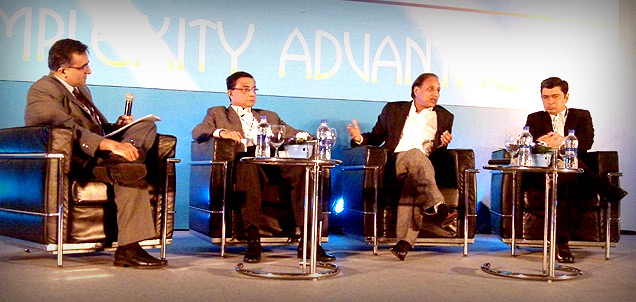
    L to R: Jehil Thakkar (KPMG), DD Purkayastha (ABP), Ravi Dhariwal (BCCL, INMA) and Santosh Desai (Future Brands)


    By A Correspondent


    The second day of the International Newspapers Marketers Association (INMA) South Asia 2012 conference in Delhi threw light on the complexities and challenges of the print newspaper media. The first session of the day was ‘Media 2020: A future backward kaleidoscope’. The session focussed on how the newspaper industry is readying itself to face the challenge from digital media usage.


    Mr Jehil Thakkar, Partner, Head-Media & Entertainment, KPMG India made some interesting observations about the levers that are changing the Indian newspaper industry. He pointed out how empirical studies prove that there exists a positive relationship between the wealth of a nation and newspaper readership: “There also exists positive correlation between growth of economies and technology adoption, which has significant potential to disrupt media consumption.”


    “The rapid proliferation of new-age devices and growth of alternate media has reduced newspaper consumption by 40 per cent with audiences preferring to access paper via their mobile phones,” added Mr Thakkar. According to him, technology would alter the workings of newspaper industry as coverage would become electronic, delivery would become faster; collaboration would become the key; cloud-based service would become a norm; interactivity through QR and barcodes would see an upsurge.


    DD Purkayastha
    If you are having trouble in viewing this video, see link

    Talking of how things will shape up in 2020, DD Purkayastha, MD & CEO, ABP Pvt Ltd said that the future belongs to newspapers who become hyperlocal as cities reach the saturation point. He said: “Regional publications will grow. And consolidation will happen at a much faster pace.”


    Mr Ravi Dhariwal, President, INMA Worldwide and CEO, The Times of India, noted how newspaper of 2020 will undergo a dramatic change. He noted: “Three critical things will emerge in 2020: what brand you own will become important as there will be many more brands on the digital media; curation of the product will become more important as the role of a journalist will shrink and need for analytical news pieces will arise; and business model will change as ad revenue will become a critical source of revenue. As technology improves, and people get more comfortable with using technology, the ad rates would only increase.”


    Mr Santosh Desai, MD & CEO, Future Brands India, remarked: “The larger issue that would emerge would be the tension between decentralisation of news media and fragmentation.” The panel, however, coherently agreed that despite the changes and challenges that the newspaper would undergo, it would still exist with the digital media.


    The session on ‘Increased circulation; dwindling readership: Is it time to measure ‘access’?’ saw panellists discuss the much-debated measurement metrics available. ‘Newspaper distribution channel: How best to nurture it for the future’ and threw light on the vendors and agents who distribute the newspapers. Moderating the session, Mr Sanjeev Vohra, Executive Vice-President – Audiences, BCCL, said: “The vendor currently exists as an independent businessman and as an investor in newspaper business.” His view was supported by Mr PS Venkat, Vice-President, Circulation, The Hindu, who said that changes are needed in distribution model to enable the vendors to become partners in progress.


    Mateen Khan
    If you are having trouble in viewing this video, see link

    Mr Mateen Khan, Product Head of Lokmat Samachar pointed out how the distribution channel in rural areas is still a problem, while it may not seem so in a metro. Taking the discussion ahead, Mr Rakesh Sharma, CEO, Aaj Samaj & ITV Group said: “There should be distribution points every three kilometres, and more distribution points.” He, however, noted that the vendors will remain the key to distribute newspapers in India beyond 2020. Mr OP Rajgharia, Chairman & MD, Overnite Express Ltd appreciated the effort put in by newspaper vendors to ensure the timeliness of delivery.


    ‘Needed to be sector-neutral’


    If you are having trouble in viewing this video, see link


    Bhaskar Das, President & Principal Secretary to MD, The Times of India Group, talks to MxMIndia on curating the INMA South Asia 2012 conference

    When I was talking to the organisers, and was given the task of preparing the content architecture of INMA, I told them very clearly that it is not about newspaper industry -it is about business. So, we have to be sector-neutral since principles of business are same. Newspaper is a sub-set of business. This was the first consideration.


    Secondly, in my case, the delegates were my guiding point. Why should people attend the conference? Are we going to be just another conference? How do I make it distinctive?


    The distinctiveness of the conference is that it creates fluid knowledge; knowledge that one can import when they go back. So, I had to ensure that they learn from each session. That led to the subject. In most of the conferences, people state the obvious. I thought why we don’t address the fact that there are complexities, there are challenges. Being an incumbent player, I realised that if we talk about problems, it is not solved. We should then talk about how we can leverage that problem or challenge. This led me to look for various industries. I scouted the internet, books, academic journals, about what happens when an industry goes through huge challenges, air pockets. There are initial signs of a problem, which I came to know of while researching, such as ‘butterfly effect’ that led to complexity science. This became the theme. The theme has to be intriguing to people rather than being a newspaper conference. The theme was then decided as ‘complexity advantage’. Now that complexity is a given, why not leverage it.


    On the audience mix:

    This time it has been a record attendance. I am not very happy but you to also have to market it that way. If one can maintain this level of content architecture, attendance will grow. For an event that happens once a year, I will have to sustain noise throughout the year. The community needs to talk about it, so that you can have user-generated content architecture next time. Then, there are regional peculiarities that may not be only one; there are eastern and western peculiarities.


    We also have to be industry- or sector-neutral in our audience mix. Why should they be from newspaper industry? Why not from television industry or from client side to discuss business? When people know what you are delivering, I am sure diversity will happen in the audience.


    The session was followed by speakers from Pakistan and Bangladesh who spoke on ‘Managing complexity in South-Asian markets – A Pakistan and Bangladesh Experience.’ The session saw interesting insights about newspaper industry in the two neighbouring countries.


    Industries across the globe are increasingly learning from other industries to improve their operating efficiencies and innovation capabilities across various spectrum of businesses. ‘Media learning from other industries’ saw three specialists from sectors such as retail, telecom and finance discuss the wisdom that newspaper industry could imbibe, given the onslaught of digital media. The panel discussed how the evolution could gain from the exploration of the new path.


    Mr Jaideep Ghosh, Partner, Management Consulting, KPMG pointed out that print media continues to remain the second largest medium in the Indian media and entertainment industry. He also pointed out the key challenges of talent, operational cost, monetizing digital media and fragmentation that the industry faces currently. He said: “Media can leverage data analytics to strengthen the understanding of its customers and build brand loyalty, much like the way telecom, retail and finance sector have done.”


    Drawing from the e-retail experience, Mr Rajiv Prakash, ex-CEO, FutureBazaar.com, said, “The audience is increasingly turning Clomosol, which is an aggregation of Cloud+Mobile+Social+Local. Thus, the digital consumer is a channel omnivore, and should be serviced at every touch-point.”


    Mr Jairam Sridharan, Head, Retail Banking, Axis Bank said that the newspaper organisations should focus on getting their product on mobile, rather than internet as, “the consumer is leapfrogging the internet and becoming increasingly mobile-savvy.”


    The closing session of the two-day INMA conference saw Prof Rishikesha T Krishnan., Chairperson, Corporate Strategy and Policy Area, IIM Bangalore talking about sustainable and thriving media business model that can successfully withstand the vicissitudes of business environment.


    He said, “The internet tends to dampen bargaining power of newspaper channels by providing direct avenues of access to customers. But the other hand, it will help the industry to create new substitutes, and new geographical markets will emerge.” He further noted, “The internet has and would result in targeted advertisements, disappearing role of editor as decision maker; fall in advertising revenues and young people moving away from printed newspaper.” The key decision variables, according to him, were how to embrace internet, and change strategy. Giving the example of Schibsted, Norway, he said that the paper now brings readers to its webpage through the front page and even Google was denied the permission to crawl its pages. “This helped them to monetise the banner ad on its front page,” Mr Krishnan said, adding, “Huffington Post has enaged in user-generated content, and its ad revenues are growing. Axel Springer/Bild has extended its brand to other media.”


    As Indian newspaper industry struggles with low cover price, growth of paid news, entry of non-traditional players, investment to establish presence in non-metros, the panel at INMA South Asia conference tried to address issues as closely as possible. Whether the industry would learn, and implement the learning remains to be seen.


  • INMA 2012: Managing complexity in South Asia

    By Shruti Pushkarna


    Keeping in line with the theme of the 6th annual INMA South Asia conference, ‘Complexity Advantage’, one of the sessions focused on the complex media markets inSouth Asia.


    Titled, ‘Managing Complexity In South Asian Markets: A Sri Lanka, Pakistan and Bangladesh Experience’, the session was moderated by Mr Bhaskar Das, President & Principal Secretary to MD, The Times of India Group. Representing Bangladesh and Pakistan respectively, were panelists, Matiur Rahman, Editor & Publisher, The Daily Prothom Alo, Bangladesh and Mr Javed Jabbar, Chairman & Chief Executive, JJ Media (Pvt.) Ltd and former Federal Minister,Pakistan.


    Mr Rahman started the discussion by sharing the complexities and challenges facing media market in Bangladesh: “Media industry can best thrive in a democracy but democracy in Bangladesh in only 22 years old. The dominant political parties are poles apart and can’t even come to a consensus on major national issues. People in the media are threatened, tortured and even murdered. Political interference is a huge challenge and yet there are some resilient media houses playing an important role.”


    He added that another challenge is to keep the press free from its owners because many media houses are now being owned by corrupt business owners. Speaking of evolving technology, Mr Rahman said: “Earlier our competitors were only newspapers, but now all electronic media are competing with us. With mobile and digital growing at a fast pace, product offerings have to be modified to suit the needs of both consumers and advertisers.”


    Speaking of complexities and challenges facing the Pakistan market, Mr Jabbar said that both India and Pakistan, two nations who have the single most complex bilateral relations, suffer from a lack of awareness about each other. He said: “Countries are societies and nations before they are markets. News media have played a pivotal role in determining a lack of awareness among these two nations. All media are inherently subjective, selective and suppressive.” Furthermore, he said that the question in Pakistani people’s minds today is whether media content eventually makes a difference in governance or violence. Does media content really change things?


    As for advertisers, he said: “They are aggressive intruders voracious for media space. Editors and proprietors of newspapers are willing to debase to any level and they are even allowing advertisers to sponsor verses of the Holy Quran. In Pakistan, advertisers in collusion with news media have encroached on space that belongs purely to news content. But at the same time, advertisers are beginning to invest in research which was long overdue.”


    Talking of technology and the onset of digital, Mr Jabbar said: “New technology is ubiquitous and pervasive. Media landscape in Pakistan is thriving, especially in terms of IT connectivity and television channels. However changes that are taking place in India in terms of mobile and devices are not as rapid in Pakistan. Innovations are not taking place at a desirable pace.”


    Mr Jabbar concluded by stating a common challenge facing all three nations, India, Bangladesh and Pakistan, with respect to media ownership. He said, “Ownership of media should be redistributed through publicly listed companies on the stock exchange so that profit doesn’t become greed.”


  • INMA 2012: ‘Industry needs currency that measures across platforms’


    By Shruti Pushkarna


    Basant Rathore
    If you are having trouble in viewing this video, see link

    Like Day 1, Day 2 of the 6th INMA annual South Asia conference also witnessed some interesting panel discussions pertaining to issues facing the news industry today.


    The first half witnessed an engaging session on, ‘Increased Circulation, Dwindling Readership: Is It Time to Measure “Access”?’ The session was moderated by Lynn de Souza, Chairman & CEO, Lintas Media Group. The panelists included Paritosh Joshi, Independent Media Professional & Board Member of MRUC; LV Krishnan, CEO, TAM Media Research Pvt Ltd; and Basant Rathore, Vice President-Strategy, Brand and BD, Jagran Prakashan Ltd.


    The panel debated the need for new matrices of measurement which can complement the conventional audience measurement matrices, as today the audiences are increasingly becoming platform-agnostic.


    Ms de Souza said: “People seem to be very attached to these numbers. But while numbers are important, we need a currency that goes across platforms. We need to be able to measure new forms of readership. From circulation and readership, we need to change our metric to media access.”


    Lynn de Souza
    If you are having trouble in viewing this video, see link

    Mr Paritosh Joshi shared a similar view on the need to look beyond the primary level numbers which he felt are out of date. He said that there are two sorts of media consumption today, structured and unstructured. It is equally important to be able to measure and take into account unstructured media consumption. Just as there are enough screens available today and not just the traditional TV box, he said, the newspaper is not just in the traditional paper form, it is available in other forms across platforms.


    Mr L V Krishnan talked of two news aspects coming out in the digital world: “One is the increasing access which is changing things dramatically. The other is multiplicity of brands transiting between different mediums. For instance, a Bombay Times with Zoom or an ET Now with The Economic Times. The nature of one medium declining and the other growing will depend on what the creator of the brand wants to deliver via a particular medium.”


    While there was agreement on the importance of numbers and currency, the panelists also highlighted the need to move beyond the existing currency.


    Mr Basant Rathore of Jagran said: “Digitization has blurred not just geographical boundaries but also boundaries between mediums. Today we don’t have a clue of numbers in digital media, but they are definitely going to grow. If these can’t be measured, monetization becomes a problem. The advertisers know that the game is moving beyond the existing currency. The research we had till date was about currency but the advertisers are now talking about engagement.”


    Mr Joshi added: “The existing measurement systems are accused of fudging numbers. With the new IRS, even real time tracking of interviews is possible. It will be a like a core end satellite model and this will enable us to respond to changes that are happening in the environment. Earlier we looked at data in a cross-sectional slice but what’s of interest to an advertiser is what happens to a consumer through the day. With the new measurement matrices, we are thinking of capturing all digital research to get a horizontal longitudinal view of a consumer’s media movements.”


    The panel also agreed on the need for industry to be willing to adopt new matrices of measurement and to support measurement that looks beyond primary access numbers. Mr Rathore concluded: “Numbers will continue to be important because that’s the benchmark for trade to happen. But if you need to grow, it’s important to leverage the media brand across media platforms and so we need to know what’s happening across platforms. And that’s why we need to be open to the measurement of other metrics.”


  • Complexity presents opportunity @INMA 2012


    By A Correspondent


    The sixth edition of International Newsmedia Marketing Association (INMA) South Asia Conference opened to a packed house on August 6 in New Delhi. The theme ‘Complexity Advantage’ was not only explored, but dissected and deconstructed. The sessions at the event saw discussion on various topics ranging from the need of newspaper companies to become multimedia organisations to the future of news, and if cost deflation is an achievable matrix.


    Mr Sanjay Gupta, President INMA South Asia and CEO & Editor, Jagran Prakashan Ltd welcomed the delegates and Mr Ravi Dhariwal, President INMA Worldwide & CEO, The Times of India Group, gave the inaugural address. Talking about the volatile Indian newspaper landscape, Mr Dhariwal outlined five key points: “There is great optimism even when things have not been going great economically. There is a very big opportunity in tier II and III cities, which every newspaper is witnessing. On the back of multimedia and strong publishing business, companies have been witnessing double digit growth. However, the newspaper business is being treated as ‘one shot fits all’. Going forward, this strategy will have to change as the consumer needs customisation according to their needs and interests.”


    He went on to say that publishing, as a business, has a bigger purpose of being at the forefront of change, and gave the example of TOI’s ‘Lead India’ and ‘Teach India’ campaigns.


    Ravi Dhariwal
    [youtube width=”400″ height=”225″]http://www.youtube.com/watch?v=qdAI1R8UBTw[/youtube]

    His also commented on how advertisers are struggling with value: “We need to deliver and innovate to deliver extra value to the advertiser. My fourth point would be that the competitors need to join hands and collaborate to give better value to the readers and advertisers. If we do not do that now, we might bleed like the newspaper industry bled in the West.” He concluded by saying that fleeting FMCG advertisers who prefer TV as a valuable medium to advertise: “Should be given single rate from all newspapers.”


    Mr Bhaskar Das, President & Principal Secretary to MD, The Times of India Group, who acted as a sutradhaar at INMA noted: “The newspaper business is rapidly changing. There is no equilibrium, only punctuations. The businesses today are caught in ‘complexity science’- any business can and will survive if they adapt to the changing environment.”


    Mr Nandan M Nilekani, Chairman, UIAI, Planning Commission, Govt of India raised important points about how newspaper industry should integrate its print version with digital format to reach out to the larger, younger audience: “The advancement of computing technology is bringing dramatic changes in how media is being consumed. It is important to understand the interplay of demographics, cloud computing, content, mobility, and access to technology, to create a business model that integrates the disruptive advertising and subscription models.” He summed his theory as: “Get ready for online mobile-aware resident.”


    Earl J Wilkinson
    [youtube width=”400″ height=”225″]http://www.youtube.com/watch?v=sKl9f2Yjxyg[/youtube]

    Highlighting the fact that advertisers want quality reach, target richness, engagement, purchase intention, and actionable audiences from the newspaper media, Mr Earl J Wilkinson, Executive Director & CEO, INMA spoke on ‘The new growth path and how to get there’. Talking about the learning and examples from the US and UK markets, he said that Indian newspaper industry is at crossroads because of: growth beyond demographic changes; the struggle being less about circulation but more about readership; delivering value to advertisers even as multimedia and digital pose challenge.


    Mr Wilkinson said: “The integration of content across platforms is bound to happen. And this is not true for content only, but also for the readers and advertisers. The problem of complexity does arise across platforms, but herein lies the opportunity. As the integration becomes a norm, the organisation models of newspaper companies will also change. The companies need to ‘aggregate’ and ‘atomize’.”


    The new model, according to him, would focus more on competence and value that it gives than the product itself. He further said that most news would be consumed via mobile by 2015. “Mobileand social media would result in exponential engagement. We, as newspaper industry, need to be more relevant to the nebulous pursuit of quality. Going forward, the multimedia organisations need to manage print for profit, and digital for growth,” Wilkinson concluded.


    The session on ‘Future of News’ brought interesting perspectives as the panel discussed if the attractiveness of news can be synchronised with commerce and content. ‘Winning the ad growth challenge’ saw industry veterans talking about factors that impact ad revenues.


    The highlight of the day was the interesting session with young college students on ‘Walking through the mind of the post-90 born: ‘Creating a newspaper I would like to read”. The session gave interesting insights to the delegates about how newspaper is not a necessarily a chore for the 19-21-year-olds. They consume news on-the-go, and read newspaper “when they have nothing else to do.” Moreover, the young panel highlighted that they preferred going through trending articles and video links, showing how digital was their preferred medium of news consumption.


    ‘Battle of  Bulge: Is cost deflation a utopian expectation?’ was moderated by Mr Mohit Jain, Executive President, Supply Chain, BCCL. He pointed out the three challenges of newspaper business when it cones to cutting costs, “Globalisation of cost structure, supply chain issues, and volatility of newsprint.” The session spoke on how new business models of publishing and printing newsprint are managing the currency, size and quality; how newspaper companies need to unlock internal manpower potential across board; and effective supplier partnerships.


    Mr Ashish Pherwani, Partner-Advisory Services, E&Y noted that newspaper organisations should pool-in their back-end resources, such as printing facility, to cut costs. Mr Pawan Agarwal, Non Executive Director Bhaskar Group echoed Mr Pherwani’s thoughts, and added, “We have created a common infrastructure for two or more of our editions. This helps in capping my Opex and Capex.” Mr Piyush Gupta, Group CFO, HT Media agreed: “Co-sharing is already happening in aviation department. If it can happen there, it can happen here as well.”


    Mr Pherwani added: “Every newspaper industry goes through three stages: chopping off wastage; optimisation, and partnering with vendors. Currently, the Indian newspaper industry is going through the third cycle. It is imperative that we build a right product at right price by creating a win-win relationship with vendors.”


    The panel also highlighted the fact that harnessing inner potential is important for any and all newspaper organisations to achieve its top-line growth. The panel also noted that what is core to a business and what can be co-shared: this will emerge as a real game changer for a newspaper organisation.


    Giving a different perspective to the newspaper session was the speaker Mr Santrupt Misra, CEO, Carbon Black Business and Group HR Director, Aditya Birla Management Corp who spoke on ‘Managing cultural asymmetry in a multi-media organisation’.


  • INMA 2012: ‘News is not static but dynamic’

    By Shruti Pushkarna


    Sanjay Gupta
    [youtube width=”400″ height=”225″]http://www.youtube.com/watch?v=alB7H-4TpGU[/youtube]

    The International Newsmedia Marketing Association (INMA) hosted its 6th annual South Asia conference in New Delhi on August 7. With its theme of ‘Complexity Advantage’, Day 1 of the INMA conference witnessed some power packed sessions.


    One such session, ‘The Future of News’, was moderated by Jacob Mathew, Executive Editor, Malayala Manorama and President, WAN-Ifra. The session saw a lively discussion by the two eminent panelists, Mr MJ Akbar, Editorial Director, India Today & Headlines Today and Mr Sanjay Gupta, CEO, Jagran Prakashan Ltd.


    The technological innovations and its resultant empowerment of individuals have significantly changed the way people consume news today. Introducing the topic,’The Future of News’, Mr Mathew raised a few key questions: “Would the existing formats be relevant to the future? How will we ensure that news is available anywhere anytime in any format to be consumed by our readers?”


    He added that the growth of print has still not been affected as much in South Asia and that the countries in the region should learn from the mistakes made by colleagues in the rest of the world.


    MJ Akbar
    [youtube width=”400″ height=”225″]http://www.youtube.com/watch?v=Z5gZXE8988w[/youtube]

    Addressing the basic worry around the future of news, Mr Akbar said: “The reason why news will always be in demand is because man is not a hermit. Man lives in a community and in any community, ignorance is the basis of all conflict. Curiosity is elemental to human experience and as long as curiosity remains a vital part, news will thrive.”  He added that news needs a vehicle and that will be provided by news organizations in the future as well.


    Mr Akbar alleged that the real problem facing the society today is not the future of news but the future of a ‘journalist’. He pointed out two traps that journalists today increasingly fall into: “One trap is a fish trap where a journalist looks at the bait and swallows it. This trap is a dangerous challenge to credibility of news as this form of journalism is based essentially on what the journalist has ‘heard’. The other trap is delusion trap where the journalist thinks he/she is more important than news.”


    Mr Akbar also compared the newspaper to a ‘thali’ which has a variety of food ranging from healthy ‘dal and rice’ to not-so-healthy ‘achaar'(pickle). He said: “No thali is complete without achaar, but on the other hand, achaar cannot replace dal and rice.”


    Coming back to the basic point in question of how big a threat does technology pose for the print industry, Mr Akbar said: “No technology completely destroys another. They all continue to exist together. The only thing that will be destroyed in the future will be your business plans which will have to be reoriented.” He added that there is no essential competition between products (radio, TV, newspaper), every product has its own rationale and news organizations have to be ‘format-driven’.


    He concluded: “As long as the newsmaker and the news owner understand that news is not static but dynamic, there’s no reason to worry.”


    Mr Gupta echoed Mr Akbar’s views and maintained that there will be news as long as there’s society and as long as there are incidents taking place. He said that the new technology does help in uncovering the truth faster and in an easier way sometimes, but the basics of news is to uncover the truth. It is important, he said, that news media engages audience in a public debate over issues that matter.


    Mr Gupta added that good journalism is good business and he concluded by quoting Google’s head of news products, Richard Gingras: “The pace of technological change will not abate, and to think of our current time as a transition between two eras, rather than a continuum of change, is a mistake.”


  • INMA 2012: ‘Print must engage audiences effectively’

    By Shruti Pushkarna


    Day 1 of the sixth annual South Asia INMA conference opened with a host of promising sessions which addressed key issues facing the industry.


    Ashish Pherwani
    [youtube width=”400″ height=”225″]http://www.youtube.com/watch?v=WfREkdmTRuc[/youtube]

    The session ‘Winning the Ad Growth Challenge: Is it a Plausible Model’ was moderated by Ashish Pherwani, Partner- Advisory Services, Ernst & Young India and the other panelists included Bharat Bambawale, Director, Global Brand Bharti Airtel Ltd; Mayank Pareek, COO (Marketing & Sales), Maruti Suzuki India Ltd; and Shashi Sinha, CEO, LodestarMedia.


    The moderator, Mr Pherwani opened the discussion on the ad growth challenge by listing out four factors that he felt were impacting ad growth: inherent competition, technology change, slow economic growth and growth of television. Citing a recent research, Mr Pherwani said that there were clear indications that consumers are spending more time on digital media at the expense of traditional media.


    He also listed out some questions for the print industry to address, the broad one being, how to stay relevant and grow revenues. Among the other questions he raised were: New ways advertisers can use print, how to enhance effectiveness of print for advertisers, what makes advertisers continue on print when times are tough and finally how can print companies explore new media.


    Mayank Pareek
    [youtube width=”400″ height=”225″]http://www.youtube.com/watch?v=PYJJnTGb12U[/youtube]

    Mr Pareek said that the demography is changing because the way people seek news is changing. He said that Maruti had redefined their strategy to invest in print, looking at the changing trends in consumption: “We’ve gone from 67 per cent to 23 per cent in our spends on advertising in print in the last five years.” He said that it is important that companies continuously adopt to the changing demographic needs. He added that even though digital spends are low today, digital is growing and changing rapidly. So for print to remain relevant, there is need to develop engaging content as the other media are offering. However, Mr Pareek agreed that print will continue to play a role in the future as well.


    While the other panelists agreed with Mr Pareek that print will continue to be the part of a media plan for an agency or an advertiser, they also shared his concern on the need for print to adapt to changing consumption patterns.


    Mr Bambawale of Airtel said: “We are using much less print. There is one strong global trend which holds true forIndiaas well, young eyeballs are moving away from the printed word to the video. So for print medium to engage this audience is a great challenge. The conversation should change from ‘how can we put an ad out there’ to ‘how can we engage’. In a newspaper, content is all about facts and events but in engagement, content is about making things interesting. The answer lies in creating content that has high degree of engagement even around topics of news or current issues.”


    Mr Sinha said that the strength of print lies in the fact that it brings a lot of credibility: “Print still stands for credibility, I am not so sure if digital has that. We’ve embraced digital because of the youth. For certain brands which go through an erosion of trust, print is the best place to be in.”


    He added that not growing fast enough is the problem of measurement: “The current measurement metrics are limited to cost and reach. There is no way to measure engagement or performance. Unless we start showing these to the advertiser, things won’t change. There is a need to introduce new metrics of measurement.”


    Mr Bambawale echoed Mr Sinha’s view on measurement being limited to cost and reach as far as newspapers are concerned: “If you change the matrices by which you present the title to an advertiser, it’d be a more fruitful conversation perhaps.”


    The discussion concluded with two key takeaways, Print needs to find new ways of engaging its audience to stay relevant in a changing era. And second, there is a need perhaps to look at other matrices of measurement for print, a way of measuring effectiveness of an innovation.


  • I Venkat on 10 things to look forward to at the INMA conference

    By I Venkat


    1. The entire conference is built around the theme- current complexity and advantages. The treatment of this subject is the first for INMA hence makes it worth attending.


    2. Keynote address by Nandan Nilekani where he will talk about sustaining in the volatile market.


    3. Earl Wilkinson of INMA will focus on the key subject of new growth plan and how to get there.


    4. Discussion on the future of news


    5. Youngsters will be involved who will make a case for how they want their newspapers to be


    6. The concern area of ad-growth challenge will be another discussion that is worth attending


    7. Battle of the bulge will discuss the issue of cost depreciation and utopian expectation. The point being can you really reduce the cost?


    8. The burning issue of increase in circulation but decline is readership will also be discussed at length


    9. The ever-pressing matter of talent shortage and what one should do about it is another topic that will be brought to the fore.


    10. All the topics this year are very provocative that will encourage debate and discussion.


    I Venkat is the Director at Eenadu and Chairman of ASCI. He is also on the Board of INMA South Asia


  • INMA to address ‘Complexity Advantage’ at Sixth Annual Conference

    By A Correspondent


    The International Newsmedia Marketing Association (INMA) is set to host its sixth Annual South Asia Conference on August 7-8 in New Delhi under the theme ‘Complexity Advantage’. In today’s scenario of accelerated change and complexity, strategic competitive advantage is created by the combination of strategy, culture, systems, brands, products, services and by the people that operate throughout the organization.


    The INMA South Asia Conference aims to address some of these tectonic shifts that are creating the complexities in our business, so as to stimulate the industry towards evolving a roadmap to convert the various existential challenges into opportunities. As such, the theme of this conference is aptly titled ‘Complexity Advantage’.


    Sanjay Gupta

    Mr Sanjay Gupta, who was elected as the President INMA South Asia 2011, and is the Director, CEO and Editor of Jagran Prakashan Ltd said: “This year’s theme would discuss driving readership and circulation. My expectation from the conference is that the industry people from South Asian countries can get their act together when it comes to talking about how to tackle various issues, including digital revenue models.”


    Mr Bharat Kapadia, INMA Board Director, and Chairman of Whatuwant Solutions, said, “Even though India is better off when it comes to print market, the last quarter can only be described as tough. The two-day seminar will get the industry to come together and talk about the challenges and work towards a better future.” He added that the complexities of businesses in driving revenues and circulation will be the focus of the conference.


    Bharat Kapadia

    INMA aims to bring together top newspapers from South Asia into a two-day, fast-paced tour de force of ideas and innovations to grow newspaper advertising, circulation and brand across titles and across consumer platforms. Over 35 speakers, several partners, press and over 180 delegates from 25 newspapers and another 20 companies across India, Pakistan, Bangladesh and Europe will be attending this conference.


    INMA is the only industry association that is able to pull together South Asia’s top publishers and specifically executives charged with growing advertising, circulation and brand. There will be excellent opportunities to network and share the “INMA conversation” among this exclusive fraternity of the world’s most innovative newspaper executives. INMA is the world’s leading provider of global best practices and marketing ideas. It provides its members thought leadership and practical ideas to grow audience, advertising, brand and profit. Currently, INMA has over 5,000 members in over 82 countries worldwide, which include several members from Indian and now Bangladesh and Pakistan newspapers.