Tag: Hindustan Times

  • Speaking of Which | I Mean To Say

    By Vidya Heble


    Speaking of Which regulars may know that the Hindustan Times is my daily of choice. It’s not perfect but it’s good. Among the high points associated with it is the Sunday edition – one, for Ashish Shakya’s side-splitting column, and two, for Brunch.


    Brunch is in demand in my building; because of some foul-up with coupons, HT doesn’t come to the other family residence, which is in the same building as mine. They read other newspapers but HT Brunch gets shared between me and my nephew. Update: The coupon problem was solved, probably even as this was being posted, and HT arrives at the door of the other family house again.


    One reading quirk I have is that of starting magazines from the back page and reading them backwards, as it were. Apparently it’s not uncommon, and it may be a sign of a gifted person. Some would say “special”, but I digress. The fact is that the back of the magazine has the interesting little tasty bits, like the last page with fun stuff on it, etc. It just progresses from there.


    The Brunch of February 3 similarly ended up being opened from the back page, after I had looked at the front cover and then the back cover. This issue is the Readers’ Special with contributions by, well, readers. Readers aren’t writers (though I have to say some writers aren’t writers either), so I wouldn’t expect them to know the ins and outs of, um, writing. But the staff of the publication should. Nay, must. That’s what they get paid for, innit?


    So I read about this lawyer who ponders why people love books. The intro to his piece said, “Don’t scorn at those who read Twilight just because you’ve read Ulysses.” After I had retrieved my mind from the edges of space to which it had retreated, trying to assimilate Twilight and Ulysses in the same breath, I wondered whether I should write to Brunch. Because, as I expect and hope many of you will have noted, one does not say “scorn at”. One says “scorned”, or “heaped scorn upon”. Or “scoffed at”, which I am guessing is what was meant here, going by the general tone and content of the piece. Want a tip to remember it? “Hell hath no fury like a woman scorned.” No “at”.


    Still, I thought I’d give it a rest, stop being a whiner and move on, and I turned the page. There was a media professional talking about how he had to perforce go on holidays with his parents when he was growing up. “Holidaying with parents has hardly ever been an option,” said the intro (and the copy said it too, varying the tense). When I first read the intro I thought this was a guy yearning to go on holidays with his parents and not being able to. Which is what it means, in the form it is in. But what the story says is that holidaying with his parents was not optional. This is the phrase to use when you mean that it is compulsory and there is no opting out. (Any of you remember those “optional” papers back in college?)


    Two of those in a row couldn’t be ignored. Here are people, educated and articulate, who are read by lots of other people who will then take these people’s words as given… This, this is why there is an onus of responsibility on publications to get it right, from facts to usage. Because people emulate, and imitate, and copy-paste. Because this is how mistakes get perpetuated.


    Fine, the sky won’t fall if a word is misused or a meaning is unclear. But letting something slide when you know it is wrong – that’s the first step to bypassing all rules. Even the ones you like. That way leads to anarchy.


  • Speaking of Which | So Suo Me

    By Vidya Heble


    Now and then I dip into other newspapers and every time I think I have indeed made the right choice with my Hindustan Times subscription. It’s not perfect, but no newspaper can be (ok maybe the New York Times but we don’t know for sure, do we?) and HT is probably as good as it can get. Mistakes are few and far between, and often excusable as what I call “genuine typos”.


    Now and then HT surprises one with a zinger of the nice kind, such as the other day when they described an upscale neighbourhood as “tony”. An unusual word to use but I’m glad they did; people who don’t know what it means will either get the drift, or (one hopes) look it up and thus be educated as well as edified.


    Then I turned a page.


    In a report about something to do with courts, there was the phrase “suo motto”. Even typing it makes me laugh; it evoked a hearty chuckle when I read it. Actually the phrase suo moto is one of the topics on the Speaking of Which list, because it usually gets printed as “suo motu”, which may be amusing to those of us who know Hindi, but is also incorrect. That is, as far as I know. Apparently a Wikipedia entry gives the definition for “suo motu”, but the only instances I can find of its use are on sub-continent news sites. I still think suo moto – which exists in Latin definition lists – is the right phrase, and anyone who can back it up with a proper Latin dictionary or the equivalent will get a box of chocolates with no compulsion to share it with me.


    Literally translated, suo moto means “on its own motion.” The term generally refers to a situation wherein a judge acts without request by either party to the action before the court. Perhaps if the judge made a quip while doing so, it could well be suo motto.


  • Speaking of Which | Drawing the Line

    If I could manage without reading any newspapers at all, I would happily pick that option. But I can’t yet afford to live in a cocoon and, let’s face it, newspapers do give us the lowdown on the news that we may have sampled on the internet the previous day. I subscribe to the best option around, the Hindustan Times, and sometimes I browse other newspapers.


    But I seriously wonder if I can take it much longer. There has recently been a steady stream of language-related atrocities, and this is in the very limited news reading that I do. It started with Mumbai Mirror which reported various details surrounding the death of Asha Bhosle’s daughter. It also mentioned Ashaji’s sister “Lala” Mangeshkar. On the front page. Once I had stopped groaning I realized that it isn’t totally wrong, as someone in my family pointed out – she does sing “La la la la la…”


    But that one could have been what we call a “genuine typo”. Then came a report in Hindustan Times about the kidnapping of a boy, where the ransom note was written on a piece of “fullscape” paper. This was obvious an error of ignorance, because the term is actually “foolscap”, referring to the size of the typical “long book” that students use. I suppose a simple search for the term (even the wrong term) coupled with “paper size” would have cleared it up. That is, if the reporter or the sub-editor wanted to ensure it was correct. “Fullscape” is an unusual word. Why not look it up to make sure it’s correct?


    More serious than that, a few days later in HT, was a report blurbed on the front page and carried in full on an inside page, which left me much alarmed. It talked about the India-China border, referring to it all along as the “MacMohan Line”. (Mac Mohan is a Hindi film villain-sidekick actor!) I find it really hard to believe that no one, at all, on the desk and especially on the front page, knew that it is the McMahon Line. All right, assuming that the average age on the average desk is 24 and that the average range of knowledge considers the 1980s as ‘history’, still… what about looking it up? If they cared enough to look it up. Or cared at all.


    Why care? Why do a job well when you can get away with doing it slipshod? Because we are in the profession of disseminating information, that’s why. We should not be allowed to get away with doing it badly. Our job is not only to entertain (did I hear a gasp?) but chiefly to inform. And information needs to be correct. In my hierarchy of getting things right, facts are at the top. Then comes spelling and grammar. The McMahon boo-boo was an error of both fact and spelling. I don’t expect journalists to know everything. But I do expect them to look it up. In an era when search and reference tools are handier and more accessible than I have ever known them to be, there is no excuse for getting it wrong, at least on the front page. Besides, how else are we ourselves to learn anything new if we don’t find out?


    This is not a case for perfection. In a business where everything moves fast, and is getting increasingly so with stepped-up technology by the day, it’s not possible to dot every i and cross every t. But “MacMohan Line” is beyond the pale. It was considered important enough for the front page. It is very much an important fact (the India-China border, after all). Was it not important enough to get it right?


    PS: In despair, I turned to food. Reading about it, that is. BBC Good Food has been my refuge from the world, and I enjoy sinking into the luscious photographs and excellently presented recipes and articles. But the October issue brought great disappointment. For one, the brand Woh Hup was spelled Who Hup. Yes, the electronic spell checker “corrects” it, though the human eye should have been on the lookout for this particular word. Leaving that behind, later in the same issue I also came across “exhorbitantly” – a damning error if there was any. This is understandable and even forgivable if it appears in a high-frequency publication such as a daily, where a spell-check is sometimes overlooked in the hurry of meeting the daily deadline. But Good Food is a monthly and there is enough time to check everything. I know, I’ve worked in one and done it. Good Food is a publication of quality, not a two-bit magazine from which nothing great can be expected. It’s priced high enough that everything should be obsessively checked before it goes to print. And remember, a spell-check is only as good as the person carrying it out.


  • Ranjona Banerji: Why HT scores in Mumbai

    By Ranjona Banerji


    For Mumbai, The Times of India has to be the primary English newspaper. But seven years ago, a very serious challenge was mounted by the Hindustan Times and DNA. For at least five of those seven years, DNA was well ahead of Hindustan Times in circulation and readership and for a while, even had the Old Lady of Boribunder worried. But since then, Hindustan Times has overtaken DNA and left it behind as a third contender. The difference between the two papers is not much in terms of numbers – a few thousand copies, not hundred thousands – but it represents how much DNA has lost, its recent rise in IRS calculations notwithstanding. I’m not counting Mumbai Mirror in this race since it is not a standalone newspaper.


    So far it has seemed that DNA’s loss was HT’s gain – through no major effort of its own. But lately, HT’s efforts to make a niche for itself seem to be paying off. Unable to compete with the TOI for blanket coverage of city news – and severely hampered by the no-poaching pact between their managements – HT had specialised in packaging and focused campaigns. Now it seems to be taking a surer route – re-introducing the city to its readers.


    Monday’s newspaper has an excellent exploration of changing trends in the Girgaum area by senior journalist Smruti Koppikar. It’s good to see Ayaz Memon’s insightful and incisive column on “So Bo” (how I hate that phrase!) back in HT, shifted to Monday’s city pages from its earlier Sunday slot. HT Cafe is clearly trying to be less PR-driven than its competitors and ruffling a few feathers with its stories. And HT sports section – although this has little to do with Mumbai – is one of the better ones.


    That leaves HT’s edit page, which for my money is too skewed towards India’s TV stars and has far too little analysis or informed opinion – in my humble opinion!


    There are many ways for a newspaper to gain ground and many of those have to do with circulation, branding and management. But for editors, you have to grab the hearts and minds and HT Mumbai seems to be working that out for itself after seven years.


    **


    Mohd Junaid Ansari asks in what passes for the humour column on The Times of India’s edit page: “Aren’t we all a little bit in love with Hina Rabbani”. This takes off from the gossip that Pakistan foreign minister is involved in a love affair with the Pakistan president’s son and putative heir, Bilawal Bhutto Zardari.


    Attractive as Rabbani is, I would contend that only men and lesbians are likely to be in love with Rabanni. Even accounting for female foeticide, dowry deaths and accounting for same-sex selections, roughly half the human race might prefer to not to be in love with a woman. Some might even pick Bilawal over Rabani. We do count you know, even in a male-dominated world!


    **


    Arvind Kejriwal and Prashant Bhushan and other members of the new un-named political party and what’s left of India Against Corruption are bound to be disappointed with the media’s reaction to their allegations against Congress president Sonia Gandhi’s son-in-law Robert Vadra.


    Although TV has given the story playtime, newspapers have been tepid. The main reason is the allegations are unsubstantiated and it requires some work to find out just how the connections between Vadra and DLF work. It looks as if Kejriwal and friends just threw a pebble into the pond to see how many ripples it would create.


    Now instead of taking it further, the anti-corruption crusader and politician is encouraging people in Delhi to break the law.


    Ranjona Banerji is a senior journalist and commentator based in Mumbai. She is also Contributing Editor, MxMIndia


  • Because print is magic…


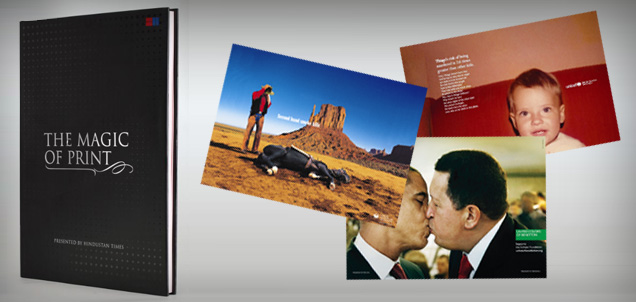
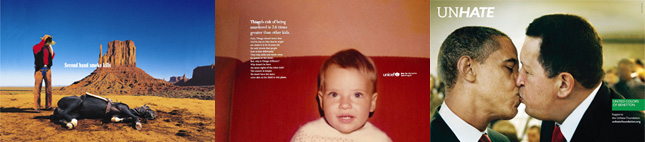
    What’s the best way to celebrate print advertising? Print the best of them, and celebrate. Recently, the Dainik Bhaskar group made one such effort (MxMIndia had carried a comprehensive extract), and now HT Media is launching a coffee table book on print advertising titled “The Magic of Print”. The hardbound volume features contributions from prominent Indian advertising experts like R Balki, Piyush Pandey and Alyque Padamsee. The book has best-in-class print ads from recent decades – not just from India, but across the world, as well as tips on how to create great print creatives.


    The content has been put together by Rajan Bhalla, Head Corporate Marketing & Magazines, HT Media and John Thangaraj, Vice President, Planning at Lowe Lintas.


    “The Magic of Print” will be unveiled at an event this evening (September 14) and MxMIndia brings you exclusive pre-release extracts from the book. Enjoy.


    The book is not for sale, but if you wish to receive a copy, please mail us your request at editor@mxmindia.com with the subject HT PRINT MAGIC. Note that mails will be auto-forwarded so please do put HT PRINT MAGIC in the subject line.


    Alyque Padamsee
    Alyque Padamsee

    A good press ad is all about the power of implication. What you imply is what your audience hears… The biggest advantage of print over a tv commercial is in its believability. Even today, people who read something believe it more than when they see something.


    Piyush Pandey
    Piyush Pandey

    The principals of great advertising have been written about for decades and nothing has really changed. It all begins with a good idea. Clean, simple and something that engages the reader… At the end of the day, print is a fantastic medium, that allows for great creativity. It is for clients and agencies to use it creatively to drive home their message.


    R Balakrishnan/Balki
    R Balakrishnan/Balki

    Print to me is the most interactive medium. It’s easy doing a smart print advertisement but it is very difficult to do a good print advertisement.


    ‘Not a eulogy… a proof of life’
    By Rajiv Verma


    Advertising today is much deeper and more sophisticated than it was even a few years ago. Viral marketing, 360-degree presence, product placement and interactive campaigns are only a few of the new tools in the arsenal of equipment available to marketers. In the face of this new technology and media, the printed ad may seem almost quaint and outdated; a candle in the age of the electric bulb. One may wonder if it is time to close the chapter on this era and become nostalgic about the printed ads which punctuated our youths. How the Amul girl made the simple meal of bread and butter ‘Utterly Butterly Delicious!’ and Raymond gave us the feeling of being ‘The complete man’.


    This book, however, is not a eulogy. On the contrary, this is a counterargument, a proof of life. In collecting some of the best-in-class print advertising, which has graced the pages of newspapers over the past decades, we hope to demonstrate the continuing vivacity and relevance of this medium. These ads have aged well. They continue to evoke the same interest, laughter, and (more importantly) the same temptation and urgency as the first time they appeared on paper. They identify our most basic and most intimately held hopes and aspirations. They exemplify the curious concomitance of commercial and creative instincts which are the soul of this art. In a strange way, they continue to stand out from the wash and whirlwind of more modern advertising media, which now permeates life.


    I hope you enjoy this collection of advertising at its finest. I hope it brings back some memories. Above all, I hope that upon reading through it, you come to the same conclusion I did: that the printed ad continues to have a role in this digital world; that the craft of copywriting can still be as effective now as it was a decade ago. Or five decades ago. Or ten. I firmly believe that print should not be an afterthought in even the most modern marketing effort, and I can offer no better evidence than the work assembled here.


    Rajiv Verma is CEO, HT Media Limited. The text above appeared as a Foreword to the book


    Click on the image for larger view
  • Digital Literacy conclave by HT and Intel

    By A Correspondent


    With one of the key issues for India being how to integrate its citizens into an increasingly digital economy, Hindustan Times brought together a panel of experts from the government, private sector and non-profits at Digital Literacy conclave to discuss the topic ‘Digital Literacy – Keeping India Ahead in the Information Age’.


    Moderating the discussion at the conclave, Gautam Chikermane, Executive Editor (Business), Hindustan Times said, “Digital literacy is an essential but unexplored component of economic development and citizen empowerment in the 21st century. With this conclave, we hope to build the foundations upon which this idea can be built.”


    Shantanu Bhanja, Vice President Marketing, HT Media Ltd, on the objective of the conclave said, “The need of the hour is to make our country and its people abreast with the digitization that the world is undergoing today. As a newspaper working in the field of education and literary, this conclave is a great platform to bring all influencers and players in the ICT ecosystem together to drive the urgency of making India Digitally Literate and to overcome the digital divide.”


    Speaking at the conclave, Debjani Ghosh, Managing Director, Sales & Marketing Group, Intel South Asia said, “One of the biggest concerns facing us today is the lack of user awareness about what technology can do to help their lives. If used effectively, technology can play a huge role in driving personal growth, be it in developing job skills or providing easy access to quality education, healthcare and critical government services. Unfortunately a lot of Indian consumers are still not aware of how they can benefit from technology. Not only does this limit growth, but will significantly increase the problem of haves and have-nots in India. Digital literacy is essential along with technology access, broadband and local content for improving national competitiveness. We are happy that the entire ecosystem is coming together to put in place a Digital Literacy mission. The sustained focus by all of us on digital literacy awareness, education and training will help India take a lead in the global digital economy and help us maintain our competitiveness and also shape a technologically empowered society.”


    Panelists on the forum included Sachin Pilot, Minister of State Communications & Information Technology, Govt. of India, Debjani Ghosh, Managing Director, Sales & Marketing Group, Intel South Asia, Sanjay Kapoor, CEO, Airtel India & South Asia, Osama Manzar, Founder & Director, Digital Empowerment Foundation and Rajendra S Pawar, Chairman & Co-Founder, NIIT Group.


  • New name, look for HT’s Brunch Quarterly

    By A Correspondent


    HT Media Limited (HTML) has unveiled the new avatar of its magazine Brunch Quarterly.  Having completed a year, Brunch Quarterly has been renamed Brunch Q. The magazine will take on a new and improved format with each issue created around a special theme. Brunch Q seeks to help readers in their ‘Quest for the Good Life!’


    Poonam Saxena, Editor, Brunch Q, commented on the revamp, “With the Brunch Quarterly completing one successful year of publication the time was right to give our growing reader base something more punchy and exciting.  The revamped magazine hits the stands with an eclectic collection of stories and features – the equivalent of an unputdownable book.  There’s Aamir (Khan) and Sunny Leone like never before, plus a special Wellness section and a guide to portable gadgets. We are planning to continue this new format in the following issues with a wide variety of interesting and engaging content making each issue of Brunch Q a collector’s special.”


    The 140-pager Brunch Q will retail at newsstands for Rs 100. The first issue under this new format, August-October 2012, has a special segment on wellness covering spas, tips from celebrity dietitians and trainers, a story on organic and healthier alternatives to everyday food items plus a feature on Yoga.


    The revamped magazine comes in a larger format (22.5wX29.5h) and the paper and production quality has also been kept on par with the best international magazines.


    Rajan Bhalla, Head – Corporate Marketing and Magazines, HT Media said, “We decided to give Brunch Quartely a makeover for the benefit of our readers. With over 31.53* Lakh readers who enjoy HT Brunch every Sunday, the demand for Brunch Q is high among the targeted SEC A & A+ segments and it is most popular among the 25 -45-year age bracket. We wanted to give our readers, who are progressive, smart and well read, a sharper, wittier and more exciting experience. We have improved the design and added new content complemented with international print quality. We are certain that Brunch Q will be embraced by our readers.”


    Approximately 1.25 lakh copies of Brunch Q will be circulated on newsstands each quarter, across the country. The magazine will be heavily promoted in HT Media Group properties such as Hindustan Times, Fever 104 FM and Mint. The Brunch Weekly, circulated with Hindustan Times on the weekend, however, will remain same.


  • Is news media ownership a cause for worry?


    By Shruti Pushkarna


    Hardly had the news of the acquisition of English news channel NewsX by ITV Media Group and Hindi news channel Live India by Prosperity Agro filterd in, there were murmurs on whether it was vital for the government to impose entry barriers for the news media. ITV of course has been in the news for around five years and Live India already had a sizeable stake by a property developer HDIL.


    As part of MxM Mondays, we spoke to a cross-section of news media practitioners to offer their views on the issue.


    This issue of media ownership has been debated on in the past, and more so recently, because of the entry of corporate groups into the news media. Earlier this year we saw two big corporates enter the media domain, when Reliance Industries bought a stake in Raghav Behl-led Network18 and Aditya Birla Group invested in the Aroon Purie-led Living Media India.


    While big business owning media is not a new phenomenon, there are numerous instance of politicians owning and controlling sections of the media, especially in Southern India.


    Hence the question arises: Is it a cause for worry when people with non-media interests start owning the mass news media?


    Here are a cross-section of views from captains of the industry (in alphabetical order of their last names):


    Tariq Ansari, Chairman and Managing Director, Next Mediaworks Ltd

    Tariq Ansari

    The worry is not around who owns the media but whether they act in a way that is consistent with journalistic standards of integrity and fair play. We seem to have forgotten simple journalistic conventions like a declaration of interest from the owner of the publication/channel on stories in which there is a substantial commercial interest.


    Media, much like steel or fertilisers or communications, will eventually belong to those who have the means and desire to invest in it. The point about it being the preserve of a few is inexplicable. Nobody is stopping anyone from raising the capital to start a newspaper/magazine/TV station/radio station/website. We live in a free country. Anyone who has the ability to own media should be able to do so, without limitation. Clearly my preference would be that criminals or those with clear vested interest should not own media, but I am not sure if the law of the land can prevent this from happening.


    Vinod Mehta

    Vinod Mehta, Former Editor-in-Chief, Outlook magazine

    I am worried. Media diversity is very important for freedom of the press. I don’t want Media in the hands of a few owners. It should be open to all.


    And here’s what MxMIndia’s regular columnists say:
     

    Ranjona Banerji, senior journalist, columnist and Contributing Editor, MxMIndia

    Media ownership is a worry to the extent that journalists are not able to withstand corporate pressure. For instance, the Birlas started Hindustan Times and the Tatas has a stake in The Statesman (to name just two) and the battle between marketing and editorial is as old as the profession. The problem comes when senior editors capitulate and reader interest is surrendered or sacrificed. I would turn the spotlight back on journalists: are we fighting the good fight?

    _______________________________


    Mediaah/Pradyuman Maheshwari, editor-in-chief, MxMIndia:

    Many years back when I asked a leading industrialist why he was keen on starting a news channel he replied with the famed Deewar dialogue (some alcohol in the system did the trick): Aaj mere paas buildingey hai, gaadi hai, bank balance hai, but even then these guys owning newspapers and channels are ruling the world. We were in the late 1990s, and journalists and news media owners were indeed much sought after. That may have waned over the years, but the desire to own news media stays. What hasn’t changed is that the intent of owning the news media goes far beyond returns on investments.


    When the British ruled India, it was the desire to mobilize public opinion that led to several national leaders and even businessmen to embrace news. Post-Independence, with the birth of a new economy, it was a mix of nationalistic sentiment and also to use it as an ally in a tightly controlled business environment. The ’60s and ’70s saw the media taking off with magazines like the Illustrated Weekly of India, later India Today and several others in regional languages. The imposition of the Emergency got people to realize the importance of the news media as the liberalization of the economy and and the airwaves ensured that there is no looking back.


    Being a democracy, there are no entry barriers to the media. And rightly so. However, when a few years back a few real estate and assorted players jumped into news television there were representations to the information and broadcasting ministry that there ought to be tighter controls.


    The current murmurs are being heard because NewsX has been acquired by businessman Kartikeya Sharma. ITV, his media company, also runs the newspaper Aaj Samaj and regional and Hindi news network India News. And the reason for the concern: it was feared that being the brother of Manu Sharma who has been convicted in the Jessica Lallmurder case, he could misuse his position to influence the executive and the judiciary. Well, the Supreme Court upheld its sentence of life imprisonment in 2010, so evidently he didn’t achieve much. To be fair to Sharma, a senior editorial and business executive who has worked with him, told me that he saw no interference on content, especially on the Manu Sharma front.


    Clearly, the money power of rich businessmen and politicians cannot bring in readers or viewers, as the case may be or make a success of the media enterprise. In the late’80s, the Ambanis acquired Commerce Weekly and converted it into a business daily. They also acquired The Sunday Observer that was once edited by Vinod Mehta and was exceedingly popular.  The Ambani indulgence in the media failed despite hiring top journalists and publishing executives. They could only use the papers to fight a few minor battles, and even those without much success.


    Mehta worked and fell out with industrialists Vijaypat Singhani and L M Thapar as both found news too hot to handle and counter-productive to their primary businesses (and revenues). One had assumed he would meet the same fate when Rajan Raheja, a then-emerging industrialist with some interests in real estate, set up the Outlook magazine group. Mehta has led many battles with the mighty and powerful in his magazine and both Raheja and Mehta have survived each other.


    Save the Outlook example which is a good indicator of business interests and independent journalism co-existing, clearly big money is not enough to drive consumption of news media. My worry though lies elsewhere:

    1. Lack of transparency in the ownership of media.

    2. Creation of a monopolistic scenario with business groups investing in multiple and similar vehicles

    3. Level playing field for competition in case of vertical and/or horizontal cross-ownership, and

    4. Diversification of media companies  into entities beyond news


    1 & 2. Transparency requirements in media ownership are critical. When the government announced recently that a certain conglomerate doesn’t not have interests in the media, is it really the case, or is that what is on paper and hence deemed correct? While doubts have been raised about how the acquisition of a sizeable chunk of Network 18 via an independent trust would impact the editorial independence of the group, the real worry is the rumoured interests of the group in other media ventures too.


    Could we have a situation that a genre of channels or newspapers or the media entities in particular region of the country be owned – directly or indirectly – by one group? How do we tackle a monopolistic scenario such as this?


    3. The PR head of a radio station in Delhi once complained that she could never hope to get her press release into the two main English dailies in the city because both had their own FM stations. So, while the most inane event from the group’s radio station gets covered, the lady’s FM frequency never got a mention even for a big activity. So rampant is this blacking out of a rival group’s activities that it’s now considered standard practice. In many countries there are strict rules for horizontal and vertical cross-ownership. While the TRAI has suggested restrictions in vertical ownership (a TV channel can’t fully own a DTH or cable platform etc), horizontal ownership is fine (so a TV channel can also run a newspaper, radio station etc).


    4. The last of my worry areas can be a bigger concern, and, if misused, even graver than big business or a political party getting into the media. Many news media groups have invested in sectors outside of news and doubts have been expressed if there is any connect between the relationships with governments via the news media and the winning of such contracts.


    Even though the government at the Centre is weak, and we can be sure it will flex its muscles often enough in the run-up to various elections until 2014, I don’t see any immediate solution to the problem. But what can play a deterrent for those who abuse the media will be public opinion via social media.


    Sevanti Ninan, Editor, thehoot.org and Columnist, Mint

    Sevanti Ninan

    Yes, it is a cause for worry when people with vested interests start owning the mass media because political ownership of the media is increasing, and there are no transparency requirements on media ownership.


    Readers and viewers are unable to discern ownership-related biases. There is also a renewed trend of corporate investment in media increasing. Media companies are supposed to file ownership details with the registrar of companies, but one, it is not properly done, and two it is very difficult for lay people to access the correct and latest data.


    On the issue of media being a preserve of only a certain groups, even now it is fairly widely owned.


    Maheshwar Peri, Chairman, Pathfinder Publishing India Pvt ltd

    Maheshwar Peri

    In my opinion there is no cause for worry. I think, increasingly, the cause for worry comes from a few industrialists who’ve gotten into media. But if you go back to the flag bearers of Indian journalism in the 1980s, Indian Express was owned by RNG, an industrial group. So, to say that ownership by industrialists would hurt media is a slightly wrong way of looking at it.


    There is definitely a cause for worry when people get into media for reasons other than running it as a professional empire. If you look at some of the politicians who’ve come into media or political parties that are launching their own channels, that’s a cause for worry because they have a reason to dish out news which suit their needs and opinions.


    So there is a problem when people in public office get into media, but it’s not so much of a problem if industrialists or venture capitalists or any others moneybag get into it because they want to make it a commercially viable operation. And they know they can make it commercially viable only when the reader/viewer respects them. In case of politicians, they are not interested in making it commercially viable; they just want to ensure that their point of view finds a space in the public domain.


    I think unless a reader or consumer respects you, you won’t be able to sell beyond a point. So all of us, whether or not owned by corporates, are always trying to ensure that we give unbiased and credible information so that the reader continues to respect us as well as the advertiser continues to invest in us.


    And what makes one think that they have a better opinion about media than a fruit vendor? I don’t think there can be a classification of who has a better opinion about certain things in this country – we are a democracy. So the worse thing is to say that ‘these’ kind of people can get into media and ‘those’ kind cannot.


    Tarun Tejpal, Editor-in-Chief, Tehelka magazine

    Tarun Tejpal

    To some extent, there is cause to worry about media ownership. We have to air, discuss and examine issues of monopolies, cross media ownerships, and of cross business ownerships. And to try and build in some structural safeguards that both help ensure the financial viability of honest, robust media, and deter media owners from using their media instruments for unfair advantage in their other businesses.


    Theoretically, it (media) should be open to all. But we must build in safeguards that minimize the misuse of public discourse and public instruments of media. This is not easy, but a discussion must start on this issue at all levels.


    Paranjoy Guha Thakurta, Senior Journalist

    Paranjoy Guha Thakurta

    The growing corporatization of the Indian media is manifest in the manner in which large industrial conglomerates are acquiring direct and indirect interest in media groups. There is also a growing convergence between creators/producers of media content and those who distribute/disseminate the content.


    In India’s unique ‘mediascape’, it is often contended that the proliferation of publications, radio stations, television channels, and internet websites is a sure-fire guarantor for plurality, diversity, and consumer choice. There were over 82,000 publications registered with the Registrar of Newspapers. There are over 250 FM radio stations in the country. Despite these impressive numbers of publications, radio stations and television channels, the mass media in India is possibly dominated by less than a hundred large groups or conglomerates, which exercise considerable influence on what is read, heard, and watched.


    One example will illustrate this contention. Delhi is the only urban area in the world with 16 English daily newspapers; the top three publications, the Times of India, the Hindustan Times, and the Economic Times, would account for over three-fourths of the total market for all English dailies.


    However, what is unacceptable is media barons using news outlets as tools to further their business interests. In this country, as in the world over, large media corporations are clearly playing a bigger role in the political economy that they report on. Though a free media is fundamental to the existence of a liberal democracy, concerns about the accountability and transparency of media companies remain. For instance, the RIL deal has enabled Network 18, Eenadu, and the merged group to expand its offerings to benefit its stakeholders and its advertising target audiences. What remains to be seen is whether clear boundaries can be etched between the boardroom and the newsroom.


    There’s absolutely no doubt about the fact that if it’s truly going to be a responsive media, then the media should reflect the views, the interests, the aspirations of a larger section of population as possible. The problem with much of our media is that they are too busy trying to ‘reach’ consumers to potential advertisers than providing information to citizens.


    Next Week:

    Why do we all like to damn TAM?

    The Sectoral Innovation Council recommendations last week said that there was need for an alternative to TAM, short for the media research company formed by a jv of two international research biggies: Nielsen and Kantar. This is a view that has been expressed several times over the years.


    One of the main peeves against TAM is the number of Peoplemeter boxes present to collect data. Can 8000+ boxes effectively poll a populace of 1.2 billion, is what many broadcasters keep asking in public. In private though, not many are ready to pay up by increasing their subscription fee to enable the installation of more boxes across the country.


    Also, what’s happening to BARC, the joint industry body that was to provide an alternative?


    MxMIndia will speak to a cross-section of the industry to get answers. Meanwhile, if you have a view, email it to us at editor@mxmindia.com with the subject ‘MxM Mondays #2’


  • Ranjona Banerji: Why TV anchors must not write on edit pages

    By Ranjona Banerji


    I now understand the pain of being a TV journalist. There is no avenue within the medium to become a pontificator. For print journalists, it’s easy. You work a few years as a reporter-correspondent-sub-editor and then some boss type person decides you have some writing skills that can be further explored or some pages fall short of stories and some boss type person makes you write a quick news analysis or you are a boss type person and decide (or someone tells you) that the world wants to know what you think. And you know how angry print journalists can get if their “columns” are stopped, if you read the excerpts of Kuldip Nayar’s memoirs. The reader then believes that these columnists and analysts are experts.


    But what can a TV journalist do? Having spend years running from pillar to post saying “I am standing at the gate waiting for something to happen” interspersed with many in facts and of courses – “I am of course standing at the gate in fact” – does someone say to him or her, here’s half an hour of TV time as a reward for so much standing, now say what you want?


    No, instead you become a prime time anchor and you have to ask other people what they think. And some of those people, in fact, of course, have to be print journalists who have now become analysts and columnists. Talk about rubbing salt in it.


    The result is that you yourself don’t know what to think. If you have ever read any columns by famous Indian TV anchors (I think Rajdeep Sardesai and Sagorika Ghose of CNN-IBN and Barkha Dutt of NDTV, all have columns in Hindustan Times, which has reduced the effectiveness of its edit page by half) you will know what I mean. Half the time they plug their own channels and shows and the rest of the time they sort of sum up what’s happening. There’s very little original thought there except some anodyne comment. No provocation, no incisive comment, no contrarian viewpoints. This comes from years of TV panel discussions where you have to listen to other people. Print journalists are terribly egoistical and after a few years stop listening to other people and only like other people to listen to them. This gives them a great advantage as pontificators.


    (I must here advise newspaper editors to end this new trend of giving columns to journalists with little or no experience because they are even less readable than TV anchors. Youth may be attractive but it has its limitations.)


    What is the solution for famous TV anchors? Instead of bothering to write which they can’t, they should get their back on usual suspect panellists. Call them to their studios and make them question the anchor. The anchor will then hold forth while the panellists listen. However, the anchor is not allowed to ask questions…


    This way, we might find out if they can actually think. India wants to know.


    Ranjona Banerji is a senior journalist, commentator and Contributing Editor, MxMIndia. The views expressed here are her own. Twitter: @ranjona


  • The Half-Year That Was


    By A Correspondent


    It’s July 2 today, and the first six months of the year have passed. While the slowdown has impacted spends in a major way, most of the 182 days from Jan to June have been eventful. On the positive side: new television channels, new agencies – media and creative, consolidation, people and account movements, government issues, digitization, awards… the list could go on. And on the negative: a channel being shut, pink slips, pay cuts, appraisals deferred, digitization delayed… the list could go on here too.


    We have already embarked on the second half of the year, but as we do that, here’s a quick look at how industry captains review the half-year. We present you the half-yearly review in two parts… the first today and the second mid-week… on Wednesday.


    As you would gather, there is much gloom in the industry, though no despair. Not yet.


    ADSPENDS:


    Nagesh Alai, President, Advertising Agencies Association of India (AAAI) & Executive Director, India Operations, Draftfcb Ulka Group

    Nagesh Alai

    If I were to summarize the indications of the economy, then one has seen softness beginning last November and December leading to a situation of downturn. The macro-economic indications like rupee falling, impact in production and fall in demands have also reflected in the consumer behaviour in a negative way. The last quarter of 2011-12 (Jan-March) has seen a fall in GDP to 5.3 per cent. All this have impacted the manufactures as well as service providers, with the mood being that of postponing a decision. While some would have thought that the situation would not impact FMCG, but that one has seen a resistance from that sector too.


    So in terms of advertising, the impact being in terms of ad outlays and remuneration; while the latter has been up for constant negotiation and any further would only impact the quality of service being provided, it’s the latter that is being hit now. I think this year one would see a growth of maximum 10-12 per cent as compared to 14-15 per cent in the past. While print and TV still comprise 80 per cent of the spends, but advertisers are looking at newer mediums, where the spends is not high and get better mileage for monies being spent.


    I personally believe that even if government were to take corrective measures, one will only begin to see the recovery by mid-2013. The mood can be aptly summarized as being that of cautious approach.


    PRINT:


    Narendra Kumar Alambara, COO, Thanthi Group

    Narendra Kumar Alambara

    In terms of the regional publications, I would say that the past six months have been good and bad. If one looks at readership and circulation, the regional dailies have seen an increase vis-à-vis the English language publications. However, there is a need to be bold and unconventional when it comes to regional publications, both by those selling this space and advertisers themselves. In today’s time when every paisa has to be accounted for in terms of returns, I think regional publications would have been an excellent answer to have targeted reach because of the value they provides for the money and reach.


    However, we have failed to do that. Today when most media houses are not restricted to being uni-dimensional and have different platforms for advertisers be it television, print, digital and even regional newspapers and channels under their umbrella; I think the solution lies in integrating various offerings, including the regional to get a better value and growth.


    Krishna Prasad, Editor-Outlook

    It’s difficult to put a number as yet on the kind of growth that has been witnessed, but you will always see print being challenged by television and other mediums. As far as the past six months are concerned, I would say the growth of print has been at par. By this I mean that even though most advertisers have huge monies, they are shying away from advertising with this medium. This is somewhat similar to what was observed during 2008, where companies didn’t have any reason to opt for cost-cutting, but were up for it. Many advertisers are seeing this downturn as a reason to go easy with their spending and not be too extravagant.


    Most newspapers today, especially in Delhi like Delhi Times, Hindustan Times and others appear chunky in their appearance, which gives you a sense that all is well but that may not necessarily be the case. Most of them are actually going slow with their spending and are trying to play it safe. I expect things to look better from October onwards – around the festival period. So largely, the growth of media will be dominated by how the economy transforms itself; it’s not operating in a vacuum. That’s the best case scenario.


    But the worst case scenario is that it may take a little bit longer for things to get better; perhaps with the elections coming up soon, with the country seeing a new Finance Minister and the markets going topsy-turvy, the print industry may still take some time to stabilise itself.


    RADIO:

     

    Prashant Panday

    Prashant Panday, CEO, Radio Mirchi

    The radio industry has been hit just as hard as any other segment. Maybe a little less than print and a little more than TV. The economic slow-down and the policy freeze has made advertisers a little wary. They are not exactly cutting spends, but they are demanding more from broadcasters. A broadcaster can either cut prices or offer more for the same. In some sectors, the advertising cut has been more severe like telecom, real estate and so on. But there are other segments that have done better – like core retail, and even auto.


    Given the economic conditions, and the lack of new frequencies, radio has done as well as it possible can.

     

    Rabe T Iyer

    Rabe T Iyer, Business Head, BIG FM

    The last financial year was alright, but the last three months have been pretty flat. The reason for that is because categories like BSFI, Auto and some of the campaigns of the usual summer categories were a bit slow. Nevertheless, we expect the next three to six months to be a good run. This is because people ultimately want to keep their goods moving, and hence the next three to six months are going to be good. The last three months were flat for the industry because the dollar exchange hit the sentiments and some categories which were expected to fire up in the month of May-June have taken some more time, mainly because of the overall economy conditions and the sentiments attached to it, and also because of the fluctuating dollar prices. This has directly impacted the ad spends, not just on radio, but across the portfolio on media brands.
     

    Ashit Kukian

    Ashit Kukian, COO, Radio City

    The last six months has been very good for the radio industry. One of the reasons I would say is because the core advertising categories in radio namely: Telecom, FMCG, and Entertainment channels to name a few, had increased their advertising spends on radio.


    DIGITAL:


    Chhaya Balachandran Aiyer, CEO and MD, BCWebWise

    Chhaya Balachandran Aiyer

    More and more brands are getting ready to seriously look at digital media and those who have been using it already, are increasing their spends. Digital is expected to deliver more cost-effectively. Amazingly, even production charges of films are expected to be cheaper, if they are being produced by digital agencies. It would help if brands which see real value in digital and see it delivering, also realize that results won’t come if they tighten their purse strings so much. Fortunately, there are a few clients who have realized the quality v/s quantity value and are waking up to the real digital age and extending their budgets.



    Rajiv Hiranandani

    Rajiv Hiranandani, Co-founder and Executive Director, Altruist, Mobile2win

    I think the mobile industry has underperformed in last six months, as per the overall outlook was supposed to be, in terms of number of handsets sold and amount of value-added services (VAS) consumed. Mobile industry has seen its slowest growth, and this has been also because of the negative outlook in the economy. Some of the reasons have been people waiting for better handsets models, the overall mood of economy not being good, and mobile VAS seeing a lot of restrictions in terms of TRAI guidelines.


    OOH:


    Noomi Mehta, Chairman and Managing Director, Selvel One Group

    Noomi Mehta

    The last six months have not been good for the out-of-home (OOH) industry. The month of June, however, has seen a significant improvement, which is perhaps because the IPL campaigns in the months of April and May have fructified. Otherwise, I believe, the industry figures have been down. The markets, by and large, seem to be in a depressed state, along with the economy. Going forward, one of the basic steps needed to improve the industry’s performance is the need for a common currency for measurement. OOH is part and parcel of the country’s economy, and hence it will also be subject to the same pressures as the economy.


    Image: Rafiq

     

  • Ranjona Banerji: TV lacks training to cover live events

    Ranjona Banerji

    By Ranjona Banerji


    The fire which engulfed and destroyed large portions of Maharashtra’s most important government building on Thursday afternoon dominated news broadcasts and the newspapers on Friday – hardly surprisingly. TV channels switched from whatever they were covering – mainly the unseemly drama over India’s tennis stars and the Olympics to concentrate on the fire in Mumbai.


    It’s self-evident that TV is the best medium to cover live events. However, this is where lack of training – both anchors and reporters – gets exposed. Having shown viewers the fire over and over again – which really points to the camerapersons being able to locate the targets – TV reporters then appear to be at a loss. Instead of hundred several of them “standing by” at various locations around an incident, news channels might be better served if they trained some reporters to collect information while others dealt with on-camera duties. This way, viewers would get some news instead of having to hear: “The fire is still raging and as you can see people are waiting anxiously and if my cameraperson could show you…” over and over again.


    This is an aside: Instead of concentrating on emulating some fancy foreign accent, reporters who appear on English channels might spend more time on their grammar. A young girl on Times Now kept talking about the “backside of the building.” Backside however refers to the derriere, posterior, bottom, buttocks, bum – that is, the rear end of humans. She could have just said “back of the building”. This would not have been so jarring – or amusing – if she had not acquired an ambivalent pseudo-foreign accent.


    * * *


    Incidentally, local channels usually win at times like this and Times Now, being the only major English news channel located in Mumbai had the clear upper hand.


    * * *


    And the same can be said of The Times of India. For the past four years now, Mumbai’s largest English newspaper has been flexing its muscle when it comes to local coverage. With the Mantralaya fire, they covered just about every angle. Since they have employed a large proportion of the city’s reporters, they also benefited from the expertise their staff has picked up in other papers!


    In order, Mid-Day comes next and the tabloid newspaper has done a comprehensive and detailed job, then the Indian Express and finally, Hindustan Times. It is at moments like this that Hindustan Times seems to pay the price for concentrating more on packaging than substance. The Times of India has dispensed with packaging to provide material and this seems to be a winning strategy. Undoubtedly, a commendable achievement for a “product” from a group which is also responsible for some of the worst practices in the media today?


    “Sabotage” asked the Economic Times in a boxed item on their front page, thus emphasising the suspicions that almost everyone has about this fire.


    * * *


    Eminent heart specialist Ramakant Panda’s defence of the medical fraternity (obviously still feeling hurt by Aamir Khan’s Satyamev Jayate) on Times of India’s edit page was not just weak, it was quite funny. Imagine using the incredible service provided by Prakash and Mandakini Amte to the tribals as an example of how great doctors are. If other doctors bothered to even do half of what the Amtes have managed for years, our healthcare to the poor would not be so despicable. Most doctors in Maharashtra however refuse to do their rural stint since it severely cuts into the ka-ching of big city cash registers. Please.


    * * *


    This is just a personal note. My rage against biased coverage of the tennis fiasco led one young (am assuming young from the way it was written and the handle Poopsonurface) person to call me a “Calcutta partisan presswalla”. Amused as I am, I must humbly declare that I have never worked in Calcutta or Kolkata in my career which spans almost 30 years. Other than Mumbai, the only other place I have worked in is Ahmedabad. As to his or her’s other suggestion that I “get a life”, I have taken that under advisement!


  • IRS 2012Q1: English readership throws up usual pattern

    By A Correspondent


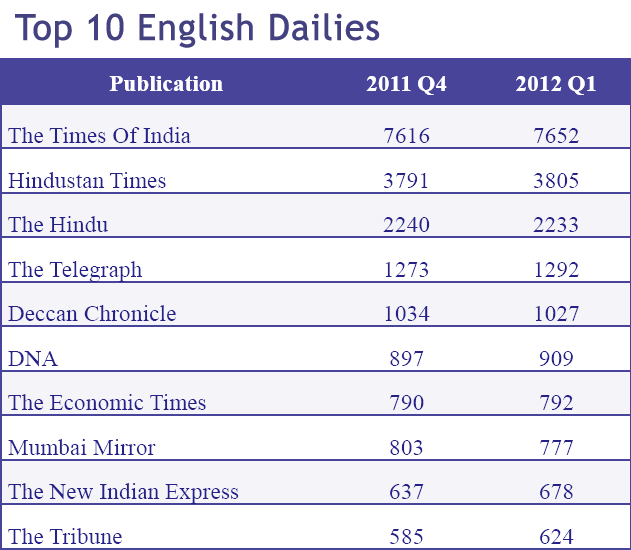
    A favourite with the urban zones and also with the advertisers, English dailies and magazines have shown an average readership trend in 2012Q1. Leading the list yet again for the dailies is Times of India that has recorded an AIR of 7,652 as against 7,616. Hindustan Times is next with an AIR of 3,805. The Hindu has seen a gradual decline with an AIR of 2,233 and occupies the third spot. The Telegraph comes fourth with an AIR of 1,292 while Deccan Chronicle is fifth with an AIR 1,027. DNA has shown a slight growth recording an AIR of 909 as against 897 it recorded in 2011Q4. The Economic Times follows with an AIR of 792 followed by Mumbai Mirror at 777. The New Indian Express is ninth with an AIR of 678 while The Tribune rounds off the list with an AIR of 624.


    (AIR numbers; all figures in ‘000)


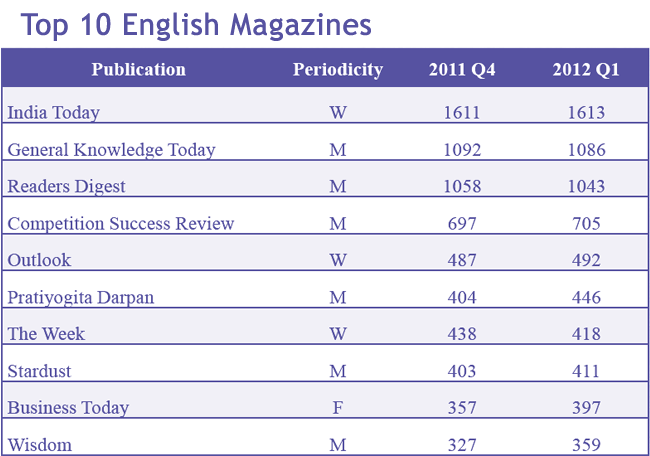
    The trend for magazines is somewhat similar to that delivered by dailies. India Today, retaining its top spot, has shown a small hike with an AIR of 1,613. General Knowledge Today is second on the list with an AIR of 1,086. The going is downhill for Readers Digest that posted an AIR of 1,043. Competition Success Review is next on the list having posted an AIR of 705. Outlook follows next showing growth with an AIR of 492. Pratiyogita Darpan is next with an AIR of 446. The Week follows with an AIR of 418 while Stardust is next with an AIR of 411. Business Today is ninth on the list with an AIR of 397 while Wisdom ends the list with an AIR of 359.


    (AIR numbers; all figures in ‘000)