Tag: Hindustan Times

  • Freaking News: Tendulkar upstages the budget extravaganza

    By Ranjona Banerji


    Pranab Mukherjee owes a big debt to Sachin Tendulkar. By the time Saturday morning dawned, the newspapers it seemed were far more excited about the century of centuries than they were about fisccons, indirect taxation and how do you solve a problem like Mamata.


    The Times of India, Uttarakhand, had “Sachin, Thanks a Ton” as its lead headline and story. The budget was tucked below the fold. The Hindu went with convention and the budget, “Dr Pranab’s bitter medicine” but there was Sachin’s “century of centuries just below the fold. The Hindustan Times (Delhi) put Sachin as a banner on top of the budget – “God of All Things” and then said, “Reforms on Rewind”.


    The Times of India’s Mumbai edition put Sachin at the top and the bottom. There was the banner “Tondulkar goes where no one ever has or ever will”, then a graphicked-up finance minister with the headline, “Face it. Life’s got a lot more taxing” and then “Thanks a ton, Sachin” at the bottom. DNA, Mumbai went with “Budget bores, Sachin scores” which about put the matter in perspective.


    As far as headlines go, I would say Hindustan Times has won, DNA has come second, Times has tried too hard and Hindu not at all.


    Interestingly, Hindustan Times, Mumbai’s Sachin banner read “Man of the Century” which perhaps proves that HT thinks that either no one in Mumbai will get the Arundhati Roy reference in the “God of All Things” or that people in Mumbai can’t do maths (man of 100 centuries, surely?) or that the Mumbai edition just felt it had to be different from Delhi. Now that’s a legitimate desire, surely?


    Even The Economic Times could not ignore Sachin and tied the two together into one headline, “On Budget Day, Sachin scores”. The Vodafone tax case also got a cricket reference “Vodafone may have to face Pranab’s Doosra”.


    Thus the nation’s fascination with cricket and Tendulkar managed to upstage the annual extravaganza that newspapers go through every year.


    * * *


    In fact, Saturday must have been a news editor’s nightmare, trying to decide which story was bigger. After all, we’ve spent almost a year going on and on about Tendulkar’s 100th century and couldn’t give it second place even if it arrived on budget day.


    As for what the newspapers said about the budget, it was more of the same – some people liked it and some didn’t. More than likely: all will be forgotten as Mamata Banerjee plays out some new drama and Akhilesh Yadav loses some of his sheen. Pranab Mukherjee will probably have the last laugh.
     

  • Freaking News: It’s business as usual after the election euphoria

    By Ranjona Banerji


    Of course the media was to blame for the Bahujan Samaj Party’s loss in UP’s assembly elections. Sure, the Samajwadi Party, Congress and BJP were also involved but the media certainly played a role in the rout of Mayawati. Thankfully – perhaps – the former chief minister of UP did not blame the people, as Prakash Karat, chief dictator of the CPM did, after the Left managed to lose West Bengal to Mamata Banerjee.


    After the results were declared, TV land went into a sort of decline. Having expended this enormous amount of energy on getting the results out to the people in the usual frenzied fashion, the day after was a probably inevitable anti-climax. The arrival of Holi did not help either, because everyone went into holiday mood which for most TV channels means showing a stream of Hindi film songs (no point asking) and other fillers.


    Life was not different for newspapers as Holi meant holidays on different days across India. Was this a conspiracy by the Election Commission? If I were Mayawati or Salman Khurshid, I would certainly think so.


    The Times of India’s early edition for Dehra Dun on March 7 (more on the perils of being stuck with a mofussil edition coming soon) headlined the results as ‘UP has spoken, no Rahul Maya’, with the ‘sp’ of spoken in red. Other puns were also in evidence (Sonrise for Akhilesh and Bad Heir Day for Rahul Gandhi). The Hindustan Times went for ‘Akhilesh Pradesh’, DNA Mumbai had a bit of fun with ‘Rahul knocked down by cycle’.


    * * *


    Newspaper editorials summed up the results quite cogently. The Hindu argued that just depending on anti-incumbency isn’t enough; parties have to make more effort that expecting the other person to lose. The Times of India emphasised the fact that the Indian voter knows when someone is trying to take them for a ride and rather than traditional promises, deliverance and governance are the keys. Several commentators also pointed out that corruption at the Centre had an impact on local polls, which is bad news for the UPA and Anna Hazare, his team and Baba Ramdev had a little chuckle here. No one missed the fact that the regional parties had trumped the big two in UP either. The forthcoming perils for the UPA and the BJP have both been underlined.


    As expected, it takes print to make sense of anything and TV would do well to develop some expertise and analytical skills of its own.


    * * *


    By the time the euphoria died down, it was business as usual and the Samajwadi Party was up to its usual tricks which TV jumped on with alacrity – a young boy killed, journalists under siege, houses burnt. An IPS officer was killed in Madhya Pradesh, apparently by the mining mafia, several people in Mumbai were hospitalised by poisonous Holi colours and BS Yeddurappa wants his job back!


  • [MxM Journalism Review] Why must TV news depend on print eds for analyses

    By Ranjona Banerji


    Where would TV journalists be without their colleagues in print? (I thought I’d say cousins but then that would make me related to TVwallahs too so…) Every time there’s some big issue to discuss (which in TV land is every day), out come a whole array of print seniors (and sometimes not so seniors).


    During the election coverage on Tuesday we had Shekhar Gupta, Vinod Mehta, Neerja Chowdhury, Manini Chatterjee, Siddharth Vardarajan, Vandita Mishra, Hartosh Singh Bal… and many more worthies.


    I’m thrilled for my friends and colleagues in print who I see on TV all the while at other times – Ayaz Memon, Sidharth Bhatia, Anil Dharker, Arati Jerath… At any time you are likely to see Dileep Padgaonkar, Bachi Karkaria, Tavleen Singh giving their considered opinion on this and that. The list is endless and I apologise to anyone I have left out. I don’t mean it. But it makes me wonder about our esteemed TV anchors and editors. Do they trust their own judgement so little that they cannot carry a programme by themselves? Have they not managed to hone their opinion creating abilities? And if that’s true, what have they been doing for all these years in TV?


    TV wallahs often feel that print journalists are too critical of them. But when they do nothing to change those perceptions and instead feed them by calling print journalists as experts all the while? How often do you see print journalists on BBC and CNN?
    My advice to TV wallahs is: have a little faith in yourselves.


    Having said that, I then remember the columns which Rajdeep Sardesai, Sagorika Ghosh and Barkha Dutt write for Hindustan Times (since few other print publications condescend to give them a platform and rightly so) and I really wonder at myself!


  • IRS 2011Q4: Not much change in rankings but dailies witness significant growth

    By A Correspondent


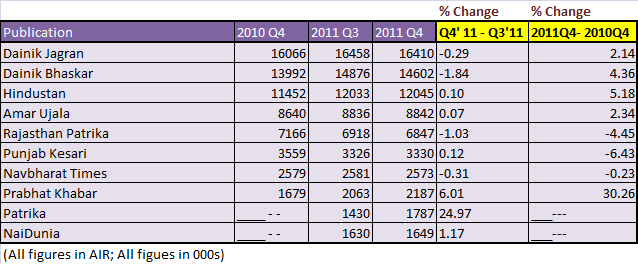
    Top 10 Hindi Dailies:

    IRS Q4, 2010 v/s IRS Q4, 2011

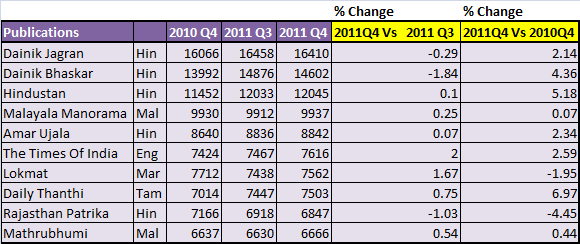
    There is not much of a difference in the rankings of the Top 10 Hindi Dailies. Dainik Jagran, Dainik Bhaskar,Hindustan, Amar Ujala and Rajasthan Patrika continue as the Top 5 Hindi Dailies. When compared to IRS 2010 Q4, IRS 2011 Q4 reveals the Top 4 Hindi Dailies, namely Dainik Jagran, Dainik Bhaskar,Hindustanand Amar Ujala have further strengthened their readership.


    A look at percentage change from Q4, 2010 to Q4, 2011 finds that Dainik Jagran has witnessed a growth of 2.14 per cent, Dainik Bhaskar grew by 4.36 per cent,Hindustanby 5.18 per cent while Amar Ujala grew by 2.34 per cent. The only Hindi daily to have witnessed double digit growth is Prabhat Khabar with a whopping 30.26 per cent growth in Q4, 2011 as against Q4, 2010. A total of five Hindi dailies have witnessed growth Quarter on Quarter.


    Q3, 2011 Vs Q4, 2011

    But the results for IRS Q4, 2011 Vs Q3, 2011 have a slightly different story to tell. The top two most read Hindi dailies – Dainik Jagran and Dainik Bhaskar – have witnessed a decline in Average Issue Readership (AIR), the decline is however marginal. Besides Dainik Jagran and Dainik Bhaskar, the Hindi dailies to have recorded growth in Q4, 2011 v/s Q3, 2011 are Hindustan, Amar Ujala, Punjab Kesari and Prabhat Khabar.


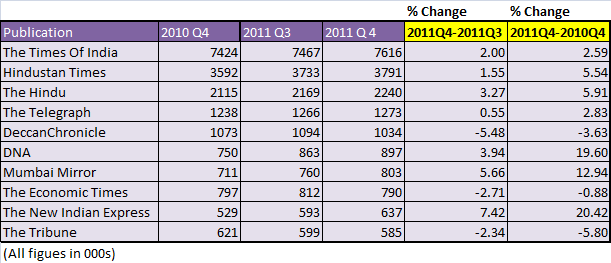
    Top 10 English Dailies:

    IRS Q4, 2010 Vs IRS Q4, 2011:

    The English dailies have performed exceedingly well in Q4, 2011. Seven out of the Top 10 English dailies have registered growth in their AIR. While DNA, Mumbai Mirror and The New Indian Express have registered growth in double digits, the top four English Dailies: The Times of India, Hindustan Times, The Hindu and The Telegraph have also witnessed growth quarter on quarter.


    IRS Q4, 2011 Vs Q3, 2011:

    The results for Q4, 2011 in comparison to the previous quarter also highlight the growth for most of the top Ten English dailies.


    Top 10 Language Dailies:

    IRS Q4, 2010 Vs IRS Q4, 2011:

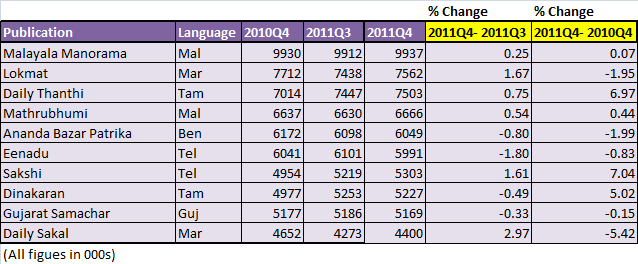
    The Q4, 2011 results as compared to the Q4, 2010 results have shown mixed reactions for Language dailies as only five publications witnessed growth since Q4, 2010 to Q4, 2011. Malayala Manorama continues to be the number one publication among the Language Dailies. According to IRS Q4, 2011 v/s Q4, 2010 findings, the Malayalam daily grew 0.07 per cent.


    Ranked second is Marathi daily, Lokmat which saw a decline of 1.95 per cent. The other Language dailies to have registered growth in their AIR are Daily Thanthi, Mathrubhumi, Sakshi and Dinakaran.


    Unlike the top two dailies, Daily Thanthi, ranked as third Language daily, grew by 6.97 per cent in IRS Q4, 2011 when compared to IRS Q4, 2010.


    It has been observed that the Malayalam dailies – Malayala Manorama and Mathrubhumi and the Tamil dailies – Daily Thanthi and Dinakaran have recorded growth in their AIR. Malayalam, Marathi, Tamil, Telugu, Gujarati and Bengali are some of the popular language dailies to have found a place in the Top 10 Language dailies.


    IRS Q4, 2011 v/s Q3, 2011:

    The top four Language dailies: Malayala Manorama, Lokmat, Daily Thanthi and Mathrubhumi have registered growth in their AIR numbers in IRS Q4, 2011 v/s IRS Q3, 2011. Besides the top four language dailies, Sakshi, the Telugu daily and Daily Sakal, the Marathi daily have also witnessed growth in their readership numbers.


    AIR or Average Issue Readership is defined as the readers of an average issue of a publication i.e. the estimated number of those who have read or looked at any issue of the publication within a specified time interval, which is equal to the periodicity of the publication (excluding the day of the interview). This is the preferred currency of media agencies across the country though often publications quote Total Readership (TR) when their AIR numbers are not impressive. MxMIndia only uses AIR in its IRS reportage.

  • IRS Q4 2011: Dailies flourish Year-on-Year


    The fourth quarter results of 2011 for the Indian Readership Survey were published on Monday and a quick look at comparing the numbers of IRS Q4 2011 versus Q4 2010 data, eight of the Top 10 publications – Dainik Jagran, Dainik Bhaskar, Hindustan, Malayala Manorama, Amar Ujala, The Times of India, Daily Thanthi and Mathrubhumi ­- have grown in their AIR (Average Issue Readership) Year-on-Year (YoY). Tamil daily Daily Thanthi and Marathi Daily Lokmat and Hindi Daily and the second most popular newspaper, Dainik Bhaskar  have registered the highest growths in AIR.


    When we compare Q3 2011 V/s Q4 2011, Dainik Jagran, Dainik Bhaskar and Rajasthan Patrika witnessed a slight decline in their readership. Dainik Jagran, Dainik Bhaskar, Hindustan, Malayala Manorama and Amar Ujala have retained their spots as the top five publications.


    After looking at the numbers, MxMIndia spoke to some of the publications for their views on the IRS Q4 2011 Topline numbers. Mr Rahul Kansal, Chief Marketing Officer, Times of India Group said: “Overall, I am quite happy with results, we have done pretty well in most of the markets including Delhi, Mumbai and Chennai, where we have seen very good growth.”


    However, Mr Rajiv Verma, CEO of HT Media Ltd, is disappointed with the IRS numbers but said in a statement, he will continue with investments in various markets. “While Hindustan Times has for long been No 1 in Delhi and No 2 in Mumbai, and Hindustan and Mint have consolidated their positions in their respective markets, as a group we are disappointed that these IRS numbers don’t reflect the full picture of our growth, and the reality of our investments and our efforts in the various markets across the country. However, we will continue to invest in various markets, to meet the needs of our readers and our advertisers, and will hope that the readership growth will be fully captured going forward.”


    Mr Sanjeev Kotnala, Vice President, Dainik Bhaskar Group said: “The IRS figures justify our focus on the urban, non-metro cities. Dainik Bhaskar is the only Gujarati newspaper to have a readership of more than 10 lakh in cities like Jaipur and Ahmedabad. If you see the figures for only the urban, non-metro cities, then you will realise that Dainik Bhaskar dominates the list. As far as the overall figures are concerned, we feel that it is a minor fluctuation, nothing major as far as our own perspective is concerned.”


    Speaking on trends from IRS Q4 findings, Mr Gautam Dalal, Vice President, Marketing, DNA said: “We observe that within Mumbai there is an increase in the overlap of English dailies readership – for every two readers there are three dailies being read. Mumbai, therefore, is seeing more penetration of English dailies and the trend of reading multiple newspapers is on the rise. Having such a high overlap percentage is a positive sign.”


    “In Mumbai we have had the highest number of growth for DNA, and these numbers are a testimony to our stand of having a high level of copy supported by the cutting edge editorial and by a focused market programme,” he added.


  • Freaking News: Mamata Banerjee, media’s favourite whipping girl

    By Ranjona Banerji


    This was an unexpected find: I had assumed (and from past experience) that the Hindustan Times would be strongest in local coverage amongst the national dailies in the national capital, given that New Delhi is (or was) its stronghold. But while HT does score on nitty-gritty local happenings, its biggest rival, The Times of India, is still going strong as far as blanket coverage of all news is concerned.


    This should be troubling for Hindustan Times because although it has the advantages of first choice as far as old-timers are concerned and its long history with the capital, its rival appears to be hitting where it hurts the most – with content. TOI and HT have been running neck and neck in Delhi for years, with both claiming ownership of the city at different times but conventional wisdom usually gave HT the edge. Now, I wonder.


    * * *


    James Murdoch has had to step down from the chairmanship of News International UK and is now being called a “shadow man with no role in the empire” (Sydney Morning Herald). This is of course the outcome of the phone-hacking scandal involving not just the defunct News of the World but other titles in the Murdoch stable of newspapers. Whether Junior’s moving aside is going to change company policy is another matter. Just as paid news and Medianet and its variations remain giant ogres for the Indian media to deal with, the dodgy practices of News Corp’s newspapers and journalists are the core problems. Removing James may not therefore be enough. As we have seen over the past year, the connections between the Murdoch empire and subsequent governments in the UK run deep and the favour system appears to have corrupted everyone, even the once highly-admired Scotland Yard.


    * * *


    The Mamata Banerjee government in West Bengal finds itself under greater media scrutiny with every passing day. The tendency of the chief minister to blame every event on the previous Left government and turn every criticism into a conspiracy theory has only made matters worse. Perhaps she needs some better media advisers and spin doctors? Right now, she’s the media’s favourite whipping boy (girl) and unfortunately for her, she, her ministers and her party only make matters worse every time they open their mouths!


  • Freaking News: How the media covered 10 years of Gujarat riots

    By Ranjona Banerji


    Interesting to see that Hindustan Times has gone for all out coverage of 10 years of the devastating riots in Gujarat, while The Times of India has played it down. This is particularly intriguing because at the time, TOI quite beat all other papers when it came to covering the Godhra train attack and the subsequent riots. Disclosure: I was deputy resident editor of the Ahmedabad edition of The Times of India at the time.


    Of course, it must also be pointed out that Hindustan Times does not have an edition in Gujarat, only a bureau and as Sujata Anandan, political editor for HT, then Mumbai bureau chief, pointed out in a related piece, she had to send people from Mumbai to cover the terrible events. It is possible however that the Delhi edition of TOI has not picked up the relevant stories, which is even odder because 10 years ago it was TOI Mumbai which shied away from riot-related stories and opinions. Apparently the resident editor at the time did not think it was relevant.


    On Tuesday, in the Hindustan Times, Harsh Mander, former IAS officer now social worker who works with Gujarat riot victims, hopes that there will be, well, hope soon. The day before Ashok Malik had asked whether it is time to forgive and forget. I wonder about that and our ability in India to behave as justice is an on and off system which we press when it suits us.


    Television, in particular CNN-IBN and NDTV, did focus on the riots and their aftermath: after all both their main faces Rajdeep Sardesai and Barkha Dutt did cover the riots extensively, perhaps for the same channel at the time, my memory fails me here. As a print journalist however, the strident hysteria of TV reporters and anchors, especially at such critical times, can often be more of a hindrance than help and so it was 10 years ago in Gujarat. Provocative people may make for good television but sometimes it can lead to irresponsible journalism.


    * * *


    Having spent a few days in Delhi, or more correctly Gurgaon, it is fascinating to see how crime dominates the papers. Is this because crime dominates events here or because local journalists look out for it?


    * * *


    On TV land on Monday night, Arvind Kejriwal’s remarks about Parliament being full of robbers, rapists and murderers got some play (see what I mean about TV promoting people just to create good television?). Karan Thapar on CNN-IBN wanted to know whether everyone agreed with Kejriwal and the Election Commission’s intent to tweak existing laws to bar people accused of severe crimes for contesting elections, within a certain time limit.


    The normally rambunctious Chandam Mitra of the BJP, normally quick to have hysterics was abnormally quiet as he hummed and hawed and said a debate was necessary and suppose the accused was later proven to be innocent? (Incidentally, this problem of later being proved innocent never bothers the BJP where Muslims accused of terrorism as concerned!).  An activist pointed out that the proposal was seven years old and surely that was enough time to debate the matter.


    Prashant Bhushan, who defended Kejriwal, said a few innocent people suffering was a small price to pay to keep criminals out.


    The Times of India, in its second editorial, slammed Kejriwal and Team Anna for swinging their “bludgeon in all directions while assuming partisan and authoritarian overtones”, which can only lead to the movement floundering.


    * * *


    On NDTV, Congress leader Renuka Chowdhury got into a made-for-TV fight with an anti-nuclear activist. This was more interesting than the issue itself – foreign-funded NGOs – which got nowhere.

  • HT revamps Sunday supplement Brunch

    By A Correspondent


    HT Media Limited (HTML) unveiled the new avatar of Brunch Weekly on February 19. Brunch is the popular weekly lifestyle and entertainment magazine from Hindustan Times launched in 2003. It is currently circulated complimentary with HT and select editions of Mint on Sunday, and is the largest read English lifestyle magazine in India with a circulation of 13.1 lakh and growing.


    Poonam Saxena, Editor of Brunch Weekly, commented on the launch: “Brunch has an unmatched reach and a large bank of extremely loyal readers who have enjoyed the magazine over the last eight years. It was time to give our readers something new, something unexpected and something fresh. Readers will be delighted with what they find on their doorstep every Sunday morning. It is the same magazine we all fell in love with all those years ago, but with an exciting new look and feel, and more entertaining and interactive content. Brunch just made Sundays better!”


    The brand promises its readers “The Good Life” week after week with gripping content that covers various lifestyle and entertainment-related genres. The revamped Brunch includes several new features including weekly contests and feature series, celebrity columns, and stories with web codes that can be scanned for exclusive supplemental content. The lineup of Brunch columnists includes Vir Sanghvi, Rajiv Makhni, Seema Goswami, Shikha Sharma and Sanjoy Narayan.


    Rajan Bhalla, Head – Corporate Marketing & Magazines, added, “We decided to give Brunch a makeover for the benefit of our readers. More than three million people across the country read Brunch because we give them an exemplary reading experience. Brunch is a Sunday ritual for them; something they eagerly look forward to. We wanted to give our readers a clutter-free, sharp, witty, entertaining, and interactive start to their Sundays. All the favourites are still there, we have simply upped the ante on the design and content. The new, arresting masthead and crisp and clear pages give Brunch a contemporary edge. We are certain readers will love Brunch’s new style.”


  • Hindustan Times begins campaign for Noida

    By Akash Raha


    Hindustan Times has renewed its Noida focus with increased local coverage for residents of Noida and Greater Noida. The Noida Special, which greeted residents on February 20, will start off with a special series on what Noida should be proud of, followed by a survey on Noida specific civic issues on February 24. The Noida Special reinforces HT’s commitment to local readers.


    Speaking about the Noida initiative, Shantanu Bhanja, VP Marketing, HT Media Ltd, said, “Noida is today a world-class city. It has top-notch educational institutes, leading MNCs, a thriving film city and outstanding infrastructure . Hindustan Times’ increased Noida focus bears testimony to the growth the city has witnessed. Our Noida-focused approach, in which we will take up news stories and issues that matter to the resident of Noida, will benefit both readers and advertisers.”


    As part of this effort, Hindustan Times has also launched its Noida First initiative, aiming to help Noida truly embody its promise of a ‘City of Hope’. Apart from its superb infrastructure, Noida is an education and corporate hub and is also home to affluent HNIs who’ve chosen to live in this bustling metropolis. The editorial team at HT has lined up a series of articles that will explore the various facets of Noida. In addition, the paper has planned cultural events across the city in the month of March.


    “Hindustan Times has been the voice of Delhi for the last 87 years. With the city’s expansion into Gurgaon and Noida, we’ve gone hyper-local and tried to give our readers a flavour of the entire national capital region. The renewed focus on Noida is a step towards helping the city realize its potential,” said Sanjoy Narayan, Editor-in-Chief, Hindustan Times.


  • Journos should learn a lesson from Mumbai’s voter turnout

    By Ranjona Banerji


    So, as cynical journalists had assumed, a quarter of the way into Anna Hazare’s movement last year, this great upsurge of feeling for the country by young India was something of a hoax. When it came down to it – exercising your franchise, the biggest right and responsibility in a democracy – Mumbai has been found wanting. Hindustan Times’ headline puts it most succinctly: “Typical. Apathetic. Mumbai”.


    Newspapers also concentrated on rich and young Mumbai, both of which failed to show up. The Indian Express didn’t hold back taking about Mumbai sticking to its normal habit, “with voter disinterest in a handful of plush areas dragging down overall voter percentages”.


    As The Times of India points out, “The tony neighbourhoods of Colaba, Churchgate and Cuffe Parade repeated their past record with a measly turnout of 34 per cent, the lowest in the city.”


    The various reasons given for this voter apathy have been the chance for a long vacation, confusion over voter lists and general disorganisation. One woman is quoted about complaining that it took hour half an hour to vote – obviously too big a price to pay.


    As Mid-Day says in its editorial, “It is all very well to tweet about how this city is going to the dogs, create a Facebook page on how the roads are pathetic or organise candlelight marches to protest against terror attacks. The proof of the pudding is always in the eating. On that count, Mumbai is starving itself.”


    The Hindustan Times also went straight for the jugular – young people who are all aware and concerned in cyberspace but cannot translate that fervour into real life. (Aside to Election Commission: how about online voting for our youth who can’t be bothered to walk to a polling booth?)


    * * *


    On TV on Friday morning, the focus, for me, had to be on the Hindi and Marathi channels since the English channels were not unnaturally concerned with other news – Amitabh Bachchan’s operation, a fleeting glimpse of Aishwariya Rai carrying a baby bundle, the killing of two Indian fishermen by an Italian ship and something to do with Salma Hayek, which I didn’t bother to find out about.


    Sahara Mumbai, Sahara Samay and Star News suspended their precious stones and astrological forecast sections to provide trends, results and analysis of the elections in Maharashtra.


    * * *


    Perhaps in Mumbai’s voting pattern there is a lesson for journalists not to be too taken up with marketing hype about young India and to get carried away with what is said on social media. You have to keep track of everything but need not believe everything you hear and see on the Internet.


    Also, it is important to consider that India is not a society or a nation under threat or on the verge of civil war (whatever TV may tell you every night). We have no need for a social revolution like the Middle East for instance. Therefore, passion in cyberspace will not necessarily translate into anything at all in real life.


  • HT Media Limited launches HT Mini for people on the move

    By Akash Raha


    HT Media Limited (HTML) launched a new product from its stables on January 14 called HT Mini. HT Mini, half the size of a tabloid, is designed exclusively for people on the move and will have daily editions from Monday to Saturday. During the launch period, it will be available in select areas of Delhi-NCR and will be sampled heavily outside Metro stations.


    HT Mini has been designed keeping in mind the needs of people on the move. The size (smaller than an A4) makes it perfectly suited to be read in a crowded Metro. It packs 24 pages of light, snippety content ranging from the top news stories to city news, sports, entertainment and lifestyle. It. Currently the newspaper is being circulated free of cost.


    The Outdoor campaign is being handled by Mudra Max while Lowe Lintas is doing the creatives. The campaign has been in full swing since January 16, and radio spots too are being used to push HT Mini further. The campaign also includes engagement building measures, such as ongoing ‘character of the day’, with the target audience, the metro commuters.


    Shantanu Bhanja, Vice President – Marketing, HTML said: “The needs of people on the move are quite different from those reading the newspaper at home. They want something to pass time while traveling which they are able to pick up on their regular route, and hence their need is for something portable, conveniently-sized, with light, entertaining content. With the introduction of the Delhi Metro in the last decade, such travelers have grown exponentially. According to our research, over 60 per cent of Metro travelers would like to spend their commute reading something, but nothing was readily available to fit their requirements. We have customized HT Mini to cater to such people. We are very excited about the launch of HT Mini and are certain it will address a major need in our readers’ lives.”


    Vasantha Angamuthu, HT special projects editor, said: “HT Mini is a reflection of HT Media’s practice of keeping the consumer at the heart of all our initiatives. The words ‘daily commute’ conjure up images of crowded trains, cramped spaces and the drudgeries of repetition. Until now, there was nothing to look forward to on Metro rides but the launch of HT Mini is sure to inject some fun and entertainment into the daily commute.”


  • HT celebrates Capital’s 100th bday with conclave & campaigns

    By Akash Raha

    Hindustan Times, the top English daily in New Delhi, has been celebrating the 100th Birthday of New Delhi under the banner of ‘I Love Delhi’ throughout 2011 and is getting ready for a high point on December 15 – which is the day the foundation stone of New Delhi was laid and which paved the way for the metropolis to develop.

    Shantanu Bhanja, Vice President – Marketing, Hindustan Times, has said, “I Love Delhi is a continuing initiative for Hindustan Times since it encapsulates our feelings for this beautiful city perfectly. Every year, we have a theme for the initiative and this year, what else could it be except the Centenary of the Capital. We have done a series of events already and hope to bring it to a grand closure now.”

    Hindustan Times is organizing the New Delhi 100 Conclave (on December 15,), inviting Delhi’s most prominent citizens to share their vision of Delhi over the next 100 years. On the occasion, Delhi Chief Minister Sheila Dikshit will release a coffee-table book that puts together Hindustan Times’ entire coverage of New Delhi 100 over the last year.

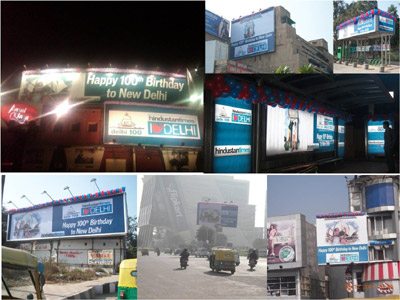
    Hindustan Times has a large outdoor campaign around Delhi-NCR on currently. In the campaign’s innovation, most sites have been decorated with red and blue balloons, wishing Delhi on its 100th birthday. The balloons give the city a festive and colourful look.

    Hindustan Times kicked off the celebrations for New Delhi’s 100th birthday on January 1, 2011 with an editorial series around various aspects of the evolution of the city. Chronicling how the political, cultural, social and architectural landscapes of the city have changed through the decades, this series was done at regular intervals throughout the year. One of the highlights of this series was the 100 Icons of Delhi – a listing of 100 buildings and institutions that define New Delhi as we know it today.

    In addition to the editorial features, Hindustan Times carried out several initiatives to increase reader engagement throughout the year under the Delhi 100 platform.