Tag: Hindi GEC

  • Anupama: The Rare Hindi GEC Success Story


    By Shailesh Kapoor


    Shailesh KapoorAmid all that’s wrong with the Hindi GEC category (and readers to this column will know that I have a long list), there is an occasional spark that brings some joy. After being the most-loved Hindi GEC character on Ormax Characters India Loves for 39 consecutive months (from July 2018), Jethalal from Sony Sab’s Taarak Mehta Ka Ooltah Chashmah passed on the top rank to Anupama, the titular character from Star Plus’ 2020 launch.


    Anupama, an adaptation of the Bangla show Sreemoyee on the same network, has been a runaway hit, achieving the unthinkable 4% rating mark in urban Hindi-speaking markets in recent months. In a category where a 2% rating is now considered an achievement (though Netflix’s Dhamaka tells you that you lose your job as a new anchor at 70% ratings, which is available live!), Anupama’s numbers have been exceptional. An average Anupama episode doesn’t rate much less than an IPL game, for example. And while IPL airs only 45 days a year, the show has managed to sustain this for several months, six days a week.


    With its multitude of well-etched characters, Anupama is one of the few well-written Hindi GEC shows currently on air. The storytelling is in broad strokes, but the characters and the conflicts are consistently engaging, and there’s enough entertainment on offer too in what is essentially a high-voltage drama of late.


    The casting and the performances are a notch above the operating level of the Hindi GEC category too. And the lead actress Rupali Ganguly has made the character very much her own, layering the portrayal with mannerisms that can possibly not be written on paper. It’s easy to guess that the show’s creative development process has managed to break away from the daily soap assembly line rut.


    If an OTT show would have even been half as good as Anupama, the press and the internet would have gone ballistic singing its praises. But GEC content earns no such respect in recent years. Not that the channels, including Star Plus, have anyone else to blame but themselves. They continue to diss their own category on air, an inexplicable thing to do. “Don’t act like a daily soap mother-in-law” and “There’s always a daily soap running in your house” are just two examples of dialogues (translated from Hindi) that you will hear in some of the top HGEC shows, including Anupama. When a category decides it can write a joke on itself, and the joke does not even come across as a joke but is taken in all seriousness by the audience, you know there’s a lot wrong at so many levels.


    Nevertheless, Anupama deserves even more love. It’s that rare sensible show that can potentially change some people’s perception about Hindi serials, only if it reached them. But the more important question is: Can there be more like it, or is Anupama a one-off? If there’s enough talent in the Hindi fiction television industry to pull off a show as interesting as Anupama, why are other shows so drab in comparison?


  • Ormax Characters India Loves goes regional

    By Our Staff


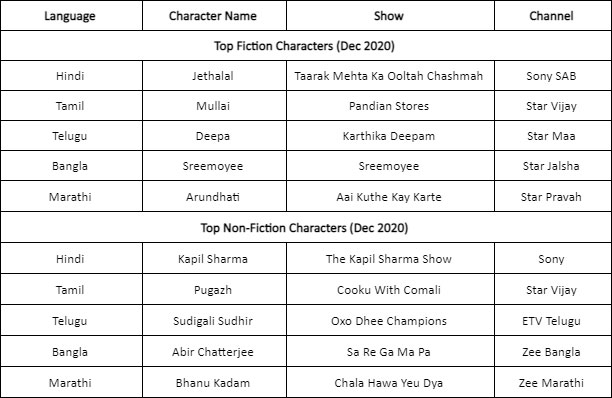
    Media insights and consulting firm Ormax Media has announced its focus on regional language markets in India. As a first step in this direction, it has announced the launch of its syndicated monthly GEC character popularity tracking tool Ormax Characters India Loves (OCIL) in four regional markets – Tamil, Telugu, Bangla and Marathi. OCIL has been tracking character popularity in the Hindi GEC category since 2010 and is used widely by all channels in the category.


    Commenting on Ormax Media’s regional focus, Shailesh Kapoor, Founder & CEO – Ormax Media said: “In recent years, India’s regional story has been a compelling one. Be it television, theatrical or now streaming, regional content has been attracting the audience’s and the advertiser’s attention alike. 2021 will see Ormax Media launch several offerings targeted at key regional markets. The launch of OCIL in four languages is only a first step in this direction.”


    The top fiction & non-fiction characters in December 2020 across the five languages are:


    Added Keerat Grewal, Partner – Ormax Media: “Characters are the cornerstone of storytelling. Character affinity ensures program loyalty, in turn helping shows to have long runs on television. Since 2010, Ormax Characters India Loves has helped leading Hindi GECs build a deep understanding of what makes Hindi GEC characters work. With the expansion into four regional languages, we hope that many other channels will now be able to benefit from similar understanding”.


  • Indian Streaming Content: Boom or Bubble?


    By Shailesh Kapoor


    Shailesh Kapoor

    In a tough year for businesses in general, the growth of the streaming business in India has stood out as the big story of 2020. Last week, Disney+ reported that out of its 73.7 million paid subscribers worldwide, 18.3 million are from their Indian service Disney+ Hotstar. Even if one assumes that a fraction of this number will unsubscribe now that IPL is over, this is a staggering number, nonetheless. India is a market known for its reluctance to pay for content.

    The current SVOD (Subscription Video on Demand) consumer base is India is estimated at about 30-35 million people, and the average number of services subscribed to at about two, leading to an estimate of 60-70 million active paid subscriptions. Considering that every subscription is used by about three people on an average, that’s about 200 million (20 crore) SVOD consumers in India, a healthy number by any yardstick.

    An equally big growth story is emerging on the AVOD (Advertising Video on Demand) front. Catch-up television has been at the forefront of AVOD consumption in India for a few years now. But this year has seen original content springing up too, with MX Player, the leading AVOD platform, clocking huge numbers for its shows, especially Aashram, two seasons of which were released within a short period of time.

    And then, there’s film content too, which has got a major surge because of an extended period of theatres being closed and no major new releases announced even after they have re-opened. If we just consider national content (Hindi and Made-in-India English shows or films), the number of shows and films launched in 2020 have been upward of 200 already. The year may end at a number close to 250. If production had not been halted because of the lockdown, we may have seen a triple century being hit. And this does not include many low-profile YouTube shows that form a secondary content ecosystem online. In the streaming category, International content gets sizeable traction too. Add to that the activity at the regional front (Bangla platform Hoichoi and Telugu platform Aha have done very well), and it’s a buzzing category indeed.

    Now that’s a lot of content! In comparison, the Hindi GEC category launches about 80-100 new shows every year, and about a similar number of Hindi films release theatrically with at least some marketing push behind them.

    But how many of these 200 shows and films have actually done well? India does not have organised viewership measurement on the streaming category yet, and it may take some time before that happens. Platforms, understandably, are reluctant to share figures. We, at Ormax, are working on statistical estimate models to estimate viewership of shows (and a Top 5 list is released every week on Film Companion since September). But while we wait for that data to be built over a year, another yardstick for which more data is available is the likeability of the content itself. Of those who watched the show or the film, how many liked it enough to recommend it to someone they know?

    This data has been built at Ormax since the start of the streaming originals in 2015. Measured on a percentage (0-100) scale, Advocacy (likeability) of 60% of more suggests a positive response, while that of 70% or more indicates that the content has truly broken out. Only 27% of shows or films launched in 2020 met the 60+ benchmark. And only 12% crossed 70. These numbers are at par with TV and films content in India over the last 2-3 years.

    But the difference is when you can calculate the absolute number of shows or films that were “not liked” (below 60). That’s 150! Yes, let that sink in. 150 Indian streaming originals and films launched in 2020, in Hindi or English, received response that ranged to lukewarm acceptance to outright rejection.

    Production houses are enjoying this phase, when there is a lot of demand for content from the streaming platforms, and a lot of work is being commissioned. But the question that should be asked sooner than later is: Are the streaming platforms becoming a dumping ground for mediocre content? Content that would not have found its way in any other medium, such as television or theatrical?

    For every Scam 1992 or Mirzapur, there are half a dozen other shows that just don’t get any traction. All streaming platforms, without exception, take pride in the data that they own, and guard it jealously too. Why, then, should the success rate be a paltry 27% only?

    It is certain that 2021 will see a further surge in content production for the streaming category, especially because more films will be made with the intent of releasing directly on OTT. One hopes the strike rate improves too. Because content quality is as much a measure of success as anything else, especially if one has an eye on the long-term sustainable growth, which is needed to ensure 2020 doesn’t become just a bubble year.


  • Post-Covid Challenges: Hindi GECs will be Tested


    By Shailesh Kapoor


    The pandemic is still all around us. Fatigued from a long, early lockdown, and facing dire economic consequences, India has begun to open up slowly. But we are nowhere close to “normal”. Not even close to the “new normal”, an oft-bandied phrase that means different things to different people.


    The entertainment sector is preparing to take small steps towards normalcy. Shooting of TV serials has started in some markets, and others will follow in July perhaps. It will not be the usually bustling, chaotic shoots that we are so used to. With limited resources at hand, the frills and the overheads will be cut out. This may pave way for cost-saving ideas in the long run. But that’s another topic for another day.


    There’s a lot of talk of how post-Covid media consumption in India (and the world) will look like. I wrote about prevailing “lockdown myths” in May, expressing my view that fundamental change in habits is not as easy as many are suggesting. But much as habits won’t change, the lockdown has created a break in them, which allows for disruption, offering opportunities in particular for weaker TV channels to come back stronger than before, and challenge the leaders. Of course, that is easier said than done, especially in categories like Hindi GEC, which have their own share of problems.


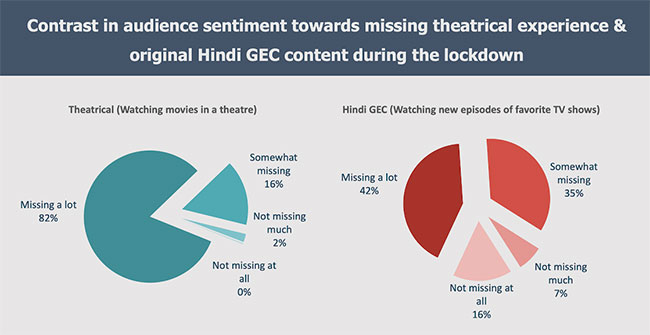
    When Ormax Media released the findings of its research (see chart above) stating that the Hindi GEC audience are missing original episodes of their favourite serials a lot less than they should, the reactions from those involved ranged from scepticism to outright denial. Unfortunately, one can’t even say the reactions were surprising.


    Using ratings to predict audience sentiment has been an age-old fallacy in the TV industry. We saw that back in 2006-2008, when the growing audience resentment towards the ‘K-serials’ was met with a standard “but they rate so well” response. It took the launch of Colors in 2008 to prove that a sentiment just needs a good catalyst to convert into behaviour.


    Even though news and movies have made inroads into primetime family viewing during the lockdown (as indeed over the last 3-4 years too), it is safe to say that GEC content will remain the staple primetime diet of a very large section of the universe. But what the chart above tells us is that a sizeable proportion of this large section is not giving the Hindi GEC category (the results will be different and significantly better for regional GEC categories) the love it should get. The relationship between Hindi GEC content and the viewer is now less emotional and more ephemeral in nature.


    Some say this could be simply a function of the times that we live in, where attention spans have gotten shorter, distractions have increased, and concepts like loyalty and appointment viewership are things of the past. But there are multiple reasons to disagree with that line of thinking. For one, the regional categories are faring much better. Secondly, if distraction and clutter was the driving force, it should have reflected in a geographic skew. But that’s not the case. The metros, the mini-metros and the small-towns all perform equally poorly on the question asked for the chart above.


    Will there be post-Covid viewership attrition for Hindi GECs? A drop of more than 5-10% compared to pre-Covid times is unlikely in the near future. But the ground cannot be more fertile for one of the top players to sow the seeds of long-pending category evolution.


    Streaming will not take away TV audience. But certain TV channels and genres have enough other competition on TV itself to contend with anyway.


  • The Big OTT Growth Story: Chapter 2


    This is the second in a series of columns by Shailesh Kapoor on the OTT Growth Story in India. Click here for Chapter 1.


    By Shailesh Kapoor


    It’s raining OTT show launches. Over the last few weeks, about two-three major and another five-six minor OTT shows have been launching every week. At this rate, the number of OTT shows that launch in 2019 will be higher than the Hindi GEC shows launched over a five-year period (2015-19). And you may not be wrong in believing that this is just the start, and things can only get more exciting from here.

    While the launch rate has accelerated significantly in 2019, it has been accompanied by a parallel improvement in the quality of content too. Till last year, among the many OTT shows that launched, only a couple would pass muster on quality. Most of the shows that won audience appreciation were from the TVF stable. ‘Quantity over quality’ seemed to be the OTT mantra.

    While that mantra continues to hold true for the second line of OTT players in 2019, there has been a significant jump in the quality of the top shows in 2019. If we look at the Ormax Advocacy Score (a measure out of 100 on how well-appreciated a show was among the audience who watched it), 2019 has some strong candidates in the reckoning.

    November 2018’s launch Mirzapur (Amazon Prime Video) continued to get audience appreciation early this year. Then came the deliciously compelling Delhi Crime (Netflix), which continues to grow its audience base till date, six months since it launched in March.

    The big success of the year, however, is a somewhat low-profile show Kota Factory (TVF). Presented in Black & White, this funny and insightful series on the student life in the education hub Kota has received widespread acclaim from young audiences, become the third-most liked Indian OTT show till date on the Ormax Advocacy scale, after Sacred Games (Season 1) and TVF Pitchers.

    Another potential top-end show dropped last night: Amazon Prime Video’s The Family Man. The unusually-textured spy thriller cum family drama stands apart from the dark and gritty world that shows like Sacred Games and Mirzapur espouse.

    However, all good things come with a word of caution. Almost 80% of OTT shows that have launched still have an Advocacy Score below 50, symptomatic of active audience dislike, even rejection. Many of these have been actively promoted by the respective platforms, indicating that the platform sensed good potential in them. So, even though the top-end has become stronger, the success rate may still be a mere 15-20%, or even lesser. Quantity may still be prevailing over quality after all.

    The Top 10 Hindi films of 2019 based on audience advocacy (word-of-mouth) average at a staggering Advocacy Score of 73. The equivalent number for the OTT category in 2019 is only 60, which is only a notch higher than the Hindi GEC category average of the year. And the Hindi GEC category has not exactly been in the pink of its health in recent times.

    A long tail of flop shows will continue to be churned out in a category where everyone wants a share of the pie. 2019 has been good so far in providing a strong top layer of quality content. This layer now needs to expand from three to four shows to 10-15 shows a year. And 2020 may just be the year to achieve that.


  • Sony Sab: An Unusual Success Story


    By Shailesh Kapoor


    Even as the Hindi GEC category struggles to recover its lost glory inch by inch over the last year-and-a-half, there’s a special little story unfolding on the side. Sab TV (or Sony Sab, as it’s officially called) has grown almost 40 per cent in the last one year, to now emerge as the No. 2 Hindi GEC in the Pay TV segment in Urban HSM in the pre-KBC period. The channel has seen an upward surge in the months of July and August this year, overtaking more seasoned players like Zee TV and Colors, and competing well with the network flagship Sony Entertainment Television, which has big-ticket material like KBC on its side for 13 weeks now.


    The channel is by far the No. 1 channel on TSV (time spent by viewer), being about 30 per cent ahead of the category leader Star Plus on this engagement measure week-on-week. Star Plus is the leader on viewership, because of its significant Reach advantage over Sab, symptomatic of the former’s wider appeal vis-à-vis the latter.


    A deeper look at Sab’s viewership numbers can be fascinating. The channel’s Gujarat viewership is almost five times its UP viewership. The Mumbai to Delhi ratio is almost 2. Evidently, the channel manages to do much better in the Western markets, which have a higher proportion of Gujarati population in their viewer universe.


    This, of course, is attributable to the flagship show Taarak Mehta Ka Ooltah Chashmah (TMKOC). Now on air for more than 11 years, TMKOC contributes a staggering 83 per cent to the channel’s viewership. 58 per cent of the channel’s programming time is allotted to the show, across various original, repeat and rerun airings.


    The show has wallpaper-level presence on the channel. Sab benefits hugely from the non-prime time performance of TMKOC. Compared to Star Plus, which gets 51% of its viewership from the 7-11pm prime time, Sab gets only 30% of its viewership from it, thus relying heavily on the afternoon time band, where repeats of TMKOC do ratings that some of the big Hindi GEC shows will be happy to achieve in their original telecast in the prime time.


    Yes, Sab is a one-show channel. It has struggled to find a second big hit anywhere close to TMKOC’s stature. And it’s been 11 years now. There is a reasonably-robust second line of shows, led by Aladdin currently. But the stature of TMKOC dwarfs everything else Sab puts out.


    Breaking down the success of TMKOC is a matter of another detailed piece. But it can be briefly mentioned that the show goes well beyond being just another comedy show, and manages to integrate culture, values and family, eventually delivering a wholesome family entertainer, a genre which very few Hindi GEC shows can claim to have a foot in.


    How long can TMKOC remain at its peak? A conservative answer would be ‘at least another 10 years’. Its protagonist Jethalal, played by Dilip Joshi, has been the most-popular Hindi GEC character in India for years now, as per Ormax Characters India Loves. Character bonding ensures longevity, and TMKOC has very strong legs on that count.


    Sab went through an elaborate brand refresh (Hindi GEC’s category when-in-doubt activity) recently. The new proposition ‘Khushiyon Wali Feeling’ strikes the right chord, relying to SAB’s positivity and light-hearted charm as its differentiators in a melodramatic category.


    But currently, all the branding is just scenery for a channel that runs on the towering presence of a giant. If there was a second TMKOC, and that’s easier said than done, Sab will be the biggest Hindi pay channel by some distance. If that happens, it will be some success story to tell!


  • Hindi GECs: Mixing It Up… Finally!


    By Shailesh Kapoor


    While all eyes this year have been on the OTT/ digital space, the Hindi GEC category too is silently, but surely, going through a shift this year. One doesn’t need to look much beyond the evolution of the programming mix on the category to understand this.


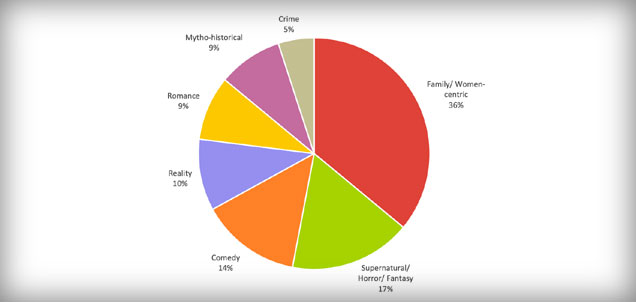
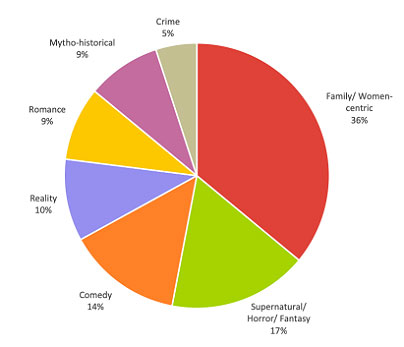
    After the launch of eight new shows currently in pre-launch promotional stage, the genre mix of the category, based on 64 primetime shows across the seven Hindi GECs targeting Urban HSM, will look something like the following:


    The family/ women-centric + romance combination, which has traditionally dominated the category since 2000, controlling at least 65-70% of the programming mix, and peaking at 80%+ at times, now stands at a modest 45%. The ‘alternative’ genres are no longer alternatives, with 55% contribution to the programming mix as a collective. This is the healthiest the Hindi GEC category’s programming mix has looked in a long time.


    This change, evidently, is a result of the distress the category has faced over the last two-three years. With category share (as a percentage of total TV viewership) dropping consistently, Hindi GECs were left with little choice but to question if conventional family dramas and love stories are the path to sustained viewership. The rise of the alternative has been evident through shows like Naagin, Kaun Banega Crorepati, Comedy Nights With Kapil/ The Kapil Sharma Show and the ilk putting up solid numbers over time, even as conventional family dramas failed to make an impact, barring a select few.


    This shift makes 2018 the best year for Hindi GECs in recent times. While we are still five weeks of data away from doing an annual analysis, it is safe to say that there has been no further attrition in the category’s share this year. While that’s a good start, a lot more needs to be done. After all, two years of damage needs to be undone.


    The sinking ship in this mix is still the family drama genre. Most shows that are doing well in this set are pre-2015 launches. Very little that has launched since then has managed to survive more than a few months. More importantly, it is this 36% (amounting to 23 shows out of 64) that brings a perception of mediocrity and lack of innovation to the genre in the viewers’ minds. This year’s launch Kullfi Kumarr Bajewala provided an exception, emerging as a fresh yet relevant show in this mix. But as it moves ahead and enters its second year, it will have to face similar challenges as other family dramas too, those related to viewer fatigue coming from a long-running show.


    The ‘overdose’ of supernatural, fantasy and horror shows in the category is a popular topic in the media, with Naagin being the flagbearer, albeit not in a flattering way. But if 11 shows (17% of the mix) can deliver more category freshness and entertainment than 23 conventional dramas, why should that be a problem of overdose?


    I’m glad there would be something to write about in the traditional end-of-the-year Hindi GEC round-up in this column. The last two years have been too inert to write much. This year is better. Can 2019 then be the year when some of the glory, from the pre-2012 days, is won back?


  • In Week 50, Colors is No 2 Hindi GEC

    By our Research Associate


    It’s a game of yo-yo at the top.


    So, last week, Zee was No 2 and Colors has marched ahead in Week 50 of the calendar year.


    Star Plus is still the numero uno Hindi GEC. All of this is as per TAM ratings revealed to us, not directly by TAM which has been restrained by the powers that be to give the media get a first-hand update on weekly ratings. Instead we have to get it from our friends who share the info. It’s reliable but, then, we haven’t got it from TAM.


    The following are the numbers:

    Star Plus              579 {561} (548)

    Colors                   449 {456} (479)

    Zee TV                  439 {480} (449)

    Life OK                 313 {325} (334)

    SAB                        291 {260} (269)

    Sony                       267 {241} (239)


    Figures in brace brackets indicate viewership numbers for last week {Week 49} and in regular brackets for the previous week (Week 48).


  • Life OK will be #1 Hindi GEC in 18 months: Ajit Thakur


    When the media heard Ajit Thakur was returning to the country to join Star India and relaunch its second Hindi GEC, it didn’t require Star bosses to tell us that it wasn’t just a flanking strategy. As General Manager and Business Head of the channel, he was sure to make it formidable force. Although the start may have been slow for Life OK, there appears to have been a method to the growth, says Mr Thakur in this extended interview with MxMIndia. As it happens, today (December 18) is when Life OK completes two years of existence. And on the eve of this milestone, Mr Thakur told us he wants Life OK to be the No 1 Hindi general entertainment channels in a year-and-a-half. May sound ambitious, but look what’s happened at Multi Screen Media with Sab TV consistently ahead of Sony! There are of course many content plans up his sleeve, and a refresh and brand-push is also on the anvil. Excerpts from the interview:


    Two years on, how has the Life OK journey been?

    I think it’s been a rollercoaster in the truest sense of the word. Because we’ve had as many downs as ups. For me, that’s been the joy of it. We said we’ll aim to make a place for ourselves without following the code of conduct of GECs – target the woman, do soaps and pitch these women protagonists – as the only way to grow a GEC channel. We didn’t do any of the three. So the good thing is 14% market share, 2 years later without following the three GEC codes. I’m very satisfied. And the bonus has been we’ve broken even.


    At the time of Life OK’s launch, we spoke with Sanjay Gupta and some others on the one reason why your predecessor Star One didn’t work was the attention given to it, or rather the lack of it. It was always Star Plus that was getting primary attention. Obviously your personal existence here has, kind of, changed that. Would you say the primary channel’s got more prominence even now?

    I think the big difference that has happened from Star One to Life OK is that the flanker strategy has changed to a full-blown challenger strategy. And that’s important in many ways than one, but to answer your question directly, the way it works right now is that Life OK is seen as sometimes the best, sometimes a star, sometimes as the younger sibling who wants a lot more attention in all forms.


    So everything – from internally emotionally blackmailing to whatever it takes for us to get attention, we do that. And the great thing is that the attention has been coming both in terms of softer aspects as well in terms of harder ones. Which was in terms of investment that we needed. And we’ve got it. And to the extent that now, every time I’ve met Uday in the last six months, after we’ve kind of, managed to establish: there’s only one thing he says. So when are you beating Star Plus? And that is unheard in the corridors of the Star network in the last few years. That’s the only question he asks me. And I think for that we had to make sure we put our feet firmly on the ground… which we have done in the last six months.


    Did this change happen mid-course in these two years or was it there from the very beginning?

    I think in terms of the intention and investment, it was there right from when I joined in August of 2011. That’s the reason why they wanted pretty much a separate management to the extent that we were told to run out of an independent office.


    I’ll tell you what the last 12 months has seen. And it is linked to a couple of things that happened in the universe. As we were going into digitization and LC1, there was a lot of uncertainty of what’s going to happen. By then we already had 10% marketshare. We were doing fine and all that stuff. But what it gave us in that entire churn of both LC1 and digitization and metros first and the next tier towns was that suddenly the share of the Top 3 channels in terms of absolute numbers was declining and from the lower three, two channels, one of which was Life OK was clearly growing and then six months back, we broke away from the pack. And as that has happened, it’s given us the third reason which is a tangible proof of saying that yes, it can be a good long-running GEC to saying oh, we have a serious chance at becoming No 1.


    For a long period after launch, you were not among the Top 5

    Yes, we were No 6.


    So, it took it’s time?

    Yes.


    And in the past, we’ve had GECs which turned No 1 in a year!?

    Yes.


    As mediawatchers, one wasn’t very sure whether Star India was walking the talk on making Life OK strong enough to be the No. 1?

    I’ll give you very clear answers on this. I could substantiate the numbers but because of reasons of confidentiality, I won’t. But I’ll give you a very clear answer on this. Because nobody has asked me this question so directly. There are three things.


    First and foremost, among the many channels that have launched in broadly the GEC or Hindi category, there’s been only one before us that has sustained for a good run. And all credit to that launch.


    But when we started, we said we’ll fund ourselves. So we’re not going to lose a lot of the company’s money in the first 3 years to see where we land to get that marketshare. And I’m very, very proud of that fact that we broke even at the end of our first full year of operations. At the end of June last year, we were breaking even. This year, we will turn profitable. And that nobody can claim including the one channel we’re talking about.


    There are many who’ve come, not wanting to be called GEC. And some have come and said they’ll be GECs. One has succeeded long-term, yes, full credit to them and become No 1 overnight, like you said. But nobody’s broken even or turned profitable within the first two years of operations which is important because in today’s market, as we’re getting into digitization and more and more fragmentation, the quick win doesn’t equal to sustainable, profitable growth. Today somebody can create a No 1 GEC at three times programming investments and not make money and somebody can be a No 3 GEC at 1.5x programming investments and make money. Which one would you choose? I would go for the latter.


    Hmmm.

    These are two different channels among the current Top 5 where the 3x and 1.5x is very relevant and say we’re at 1x of investment. But the 1.5x may not be a No 1 but significantly more profitable than the 3x. So that is important. Right? And then comes the third factor, which is where I think may be we are wrong, but we won’t change it. Which is that the kind of genres and programming strategy we’ve taken on, there are two things that are happening. One, there’s a faster burn in our stories. So when you pick up a show which is a family drama but rooted in domestic violence and you want to treat it like a thriller. Today, what did we come and do?


    Our first hit which was ‘Saubhaagyavati Bhava’ was treated like a thriller, not a regular kitchen soap. We exhaust our stories much faster. Second is that there’s a certain kind of viewership that is happening in middle India where there’s familiarity with the ‘Saas-Bahu’ type of shows. I have nothing against dramas, I have a predominance of dramas set in the kitchen. Right? The familiarity of that means that anything new that you want to push, either you manage to get it right but you exhaust the story fast, you don’t get noticed at all. It has happened to every two of our three launches. Because the DNA of the show is so different that you just don’t land it there. This is not for me. And for whatever it’s worth, the dominant viewer in the household on weekdays is still the housewife. The dominant viewer, I’m not saying the exclusive viewer. And that changes on the weekend. Which is why our programming changes so much.


    So every time we leave a show which you know is a sure takeoff point because it’s set in the kitchen, we have a little moment of ‘we should’ve done it’. But we haven’t done it. And we’re happy for that because now when we go back and talk about it, they’re very clear that amongst the Top 3 there’s nobody who offers them variety. There are other people who offer them variety but not the Top 3. And Life OK is definitely one of those channels that offers them the variety where there’s something for everybody in the family to watch, including kids. We have a very conscious kids strategy. At 8 pm, our next launch, ‘Hatim’ is purely designed for kids. But enough of a narrative like any of the good animations from Hollywood. Adults can watch it.


    Was the intent of Life OK being a Star Plus killer in existence from the very beginning or did it change as you moved on?

    I won’t use the word killer but I would say a serious challenger to the No 1 position. It was there right from the beginning. Both in terms of investment and intent. What the last 12 months or 6 months in particular have done is that it has given a tangible proof of that we can achieve it.


    I was telling you the three things that make us stand out is One, turning profitable, having sustained a two-year run and looking to continue consolidate, which has been the case with one more channel, but, I think no one has turned profitable so quickly. Second is that, in two years now, it seems like the journey is only 25% done. So we know the plan ahead. So we know where we want to go. And, third, and most important is that we’ve still not given into the temptation of doing the same.


    Given that there’s a Star Plus already wouldn’t it have been better for Star India to offer a channel with a similar content strategy so that advertisers can be given a better packaged deal?

    If the corporate strategy was to bring in Life OK to fill in the gaps or get whatever is left after Star Plus, we would’ve continued to be a flanker channel and we wouldn’t have been where we are today. What we’ve been told is chart your own destiny, find a space for yourself that’s distinct from Star Plus but still big enough to challenge it and cross it. So we’ve never had a brief of saying what is the best way to monetize the two channels together? If that was the brief, we would’ve remained an 80 GRP channel and at 8% share and it would still have made a lot of sense for the corporate.


    Has LC1 helped you or been a shot in the arm for you?

    What has helped us a network is that we have been aware of the power of the smaller markets much before the others and without giving details we’ve gone and activated that for all three channels… for Star Plus, Star World and Life OK. And that we did before the measurement came in. I think too often in the industry we’ve been guilty of chasing the measurement matrix to market and plan content. And I think every time somebody does that you’re always behind the trend. So we’ve taken the leap of faith and I can tell you that we’ve just gone town by town, village by village and taken the message of the network with a very unique programme that we’ve created. So much so that now there are some clients who now want to come on board on that programme. Saying hey listen, we went there and we saw a poster of Nayi Soch and Life OK Mahotsav… what have you guys done?


    So, being aware to the smaller market did help. Did digitization help? I don’t think it helped Life OK. All it did was it made an even playing field for everybody for content to finally win.


    When you started out, you had this huge digital thing. Your name was Life Ok. The fonts used in your identity were cool. You had a Madhuri Dixit as the ‘sutradhaar’ So it had a fairly urban as against a middle India feel. Did you at that point of time feel there was a bit of a disconnect?

    When I say middle India, I mean middle class India. For me that exists as much in Mumbai as in Moradabad. So for me that was never a disconnect. Over time, as the content has been consumed differently, without any intentional push, some markets have become stronger than others. So our first market that became strong was completely intentional, which was UP and Delhi. But after that an MP nad Punjab came to us much faster than Mumbai and people started saying you’re more small town India than big town India! But digitization happened and now in Mumbai we’re growing as fast as any other market.


    What about the all-important Gujarat market.

    There are so many people are competing for it, I’d rather leave it for now. The only way to cater to Gujarat is to create content for them. Unfortunately in two years I haven’t found a single show which is set in Gujarat which I’ve liked.


    In a city like Mumbai you don’t find Gujarati content?

    I found a lot of Gujarati content which is set in the kitchen. But by definition we won’t do it. So, in April we’ll do our first content targeting them and which is a musical. I can’t tell you anymore.


    We’ve had a situation where you’ve had a flanking channel which is become the No 1 in the network. You’ve been yoyo-ing with that channel – Sab TV – for a while in terms of the ratings. When can we expect a Life OK displacing Star Plus to be the No 1?

    You know I wish I knew the answer. But jokes aside, I’d give ourselves 18 months to make it happen.


    To be the No 1 Hindi GEC in the country?

    Yes. I mean, you can’t have a longer timeline then that! So I’d give ourselves 18 months.


    You have a background of having achieved a fair bit of success at Sony

    Yes, but the glass was half full. I would’ve loved to finish that. Not a fair comment to say on a LifeOK interview but family came first and I wanted to move to Singapore so all that happened. But I must tell you, I’m a big fan of what Sab TV does and that I can say officially.


    It’s a channel which stands out for me. I’m very happy for them. My personal attachment is to Sony because I’ve worked there. But for us, our destiny is not there, because nobody is trying to target the whole family. And we’re trying to make this big statement that we must in the Indian context allow the family to come together and watch TV. And not divide them and make them watch their programs.


    And by doing that if we can come to 14% and No 4, we’ll have to work much harder, but we can become 24% and No 1. And that’s what we want to do. But we’ll do it by keeping the family together.


    In terms of programming hours, is it going to change? You’ve done your share of reality shows. Not a good share but some reality shows. You’ve not had too much success with them.

    Yes, I’ll tell you on reality shows and then I’ll come back and answer in terms of programming hours. That’s why I told you that every two of the three new ideas we do, fail. And I enjoy our failures because there’s so much to learn from each one of them. On reality shows my brief to the team is don’t bring me a singing-and-dancing idea. We’ve tried a show about making people find love, which is ‘Bachelorette’ or a show about finding talent beyond just adults which was ‘Kids: Hindustan ke Hunarbaaz’ or ‘Saavdhaan’ it’s fiction, non-fiction, it’s about crime or we did ‘Come Dine with Me’..


    Did you think ‘Mahadev’ would be such a success?

    No, not at all. No clue. We had no clue.


    But you kind of put many eggs in a basket.

    On three shows.


    You also had a whole concert around Mahadev?

    Because he was a unifying hero. I have this big thing that all content must unify. So we’d think who’s the one hero who unifies? But our highest investment was on ‘Saubhaagyavati Bhava’. The second was ‘Meri Maa’ which failed. Sach ka Saamna Bhrashtachar ke khilaf: failed! Because nobody wants to see a show on voyeurism around corruption.


    Are you looking at Sach ka Saamna again?

    Yes, we’re trying to find the right take on it. Then the last one was Mahadev. Mahadev was a No 4 at that time. And by the way Mahadev didn’t take off till four months of launch. It was kind of hovering. Saubhaagyavati Bhava became a big hit. A show we didn’t promote at all called ‘Main Lakshmi tere aangan ki’ became our second big hit. A simple thing about a girl’s choices between money and love.


    So tell me, now that you’ve mentioned about the 18-month window …

    I just made it up.. but, yes, that’s it.


    … which is just a year-and-a-half away. What are the specifics you’ve thought of for what you’ve to achieve over the next one year?

    Obviously I can’t talk about specific plans but I’ll tell you things that are a part of the DNA of the team. So the first specific and it’s an important one is that we’ll continue to be modest. The problem with some of our predecessors who’ve had a good start and failed is that at some stage you start thinking that you know it all. This audience is evolving fast. The market is fast-changing. With digitization we don’t know how many more dynamics will come into it.


    An integral part of that modesty is knowing that we’ll still continue to fail more often than we’l; succeed. If we don’t keep failing, we won’t do the next thing better. This thing that we’ll have zero failure rate doesn’t exist in my dictionary.


    The second thing is that I think we’ve to take our content play to the next level. For a number of reasons. So, with advertisers now, we’re full. Our inventory is full even in the leanest months now. Because they can see the efficiency with which Life OK delivers for them. We are going to do a big award show for which we’re going to make a formal announcement around Christmas.


    Is it the Screen Awards?

    I wouldn’t confirm it right now, but the reason I’m telling you this is so that you understand there’s a method to the madness. One is about humility and continue to learn from failures. Second is about creating impact. In fact on reach in some weeks, we’re No 2 if you’ve been tracking it in the last few months. That message to advertisers has completely gone through. That Life OK has some impact properties which are not regular ‘Saas-Bahu’ shows, they also know that. But now we want to give them the impact properties as big as any channel. The only difference is that for us impact doesn’t equal to the next big dance or singing show. After the award show, we’re going to open up from March to June with impact in fiction. And there you’ll see the method to madness.


    Hmmm….

    If you realize after launch, we’ve been lying low on the brand. There’s no point going and saying this is the brand that’s gonna change your life! Until enough people are watching it. So come Quarter 1 next year, by the end of it, on the impact of the changes and stuff we’re doing in ficiton and the award show, we’re going to refresh the brand and this time we’re going to say what we want to say. A brand that wants to go more with entertainment, a brand that wants to keep the foundation.


    Have you started working on that already?

    Yes, we’re ready with it but we won’t launch it yet. Because we want to launch it along with our content.


    With the award show or later?

    First quarter, we don’t know the timing yet, but between January and March.
     

  • Star Plus stays at #1. Colors, Zee follow. Life OK at #4

    By A Correspondent


    In the Week #45 ratings, Star Plus stayed on as numero uno Hindi GEC, followed by Colors and Zee. Life OK went past Sab which was at #4 last week. Sony is #5 this week.


    The following were the numbers for Week 45 in terms of GVTs with the numbers in brackets being those for Week 44.


    Star Plus 536270 (486066)

    Colors 486423 (463778)

    Zee TV  428610 (434987)

    Life OK  344624 (323897)

    Sony 341054 (299964)

    SAB  310534 (337099)

    Star Utsav 89355 (90202)

    Zee Anmol 41776 (50827)

    Sahara One  31549 (31647)


    Interestingly, Comedy Night with Kapil on Sunday scored 7357 TVTs compared to 6631 the previous week.


    Note: Television measurement firm TAM does not share ratings with the media. What we have carried here is on the basis of a friendly pass-on by a subscriber. While we believe these are correct as they are from a reliable source, we would recommend our readers to reverify the numbers first-hand with TAM/an authentic source.


  • Hindi GEC yo-yo continues. Star leads in Week 52

    By A Correspondent


    There have been some interesting changes in rankings in Week 52 of the TAM ratings just out for Hindi GECs. Colors is the new #2 and SAB is now ahead of Life OK.


    According to Week 52, GRPs of the Hindi General Entertainment Channels, Star Plus continues its steady run at 245 (231) points. Colors is #2 this week with 238 (223) points with Zee and Sony at 198 each. SAB is at 157 (143) galloping ahead of Life OK which is at 110 (144). Last week, Zee was at 226 and Sony at 192.


    Please note that the information has not been supplied and verified by TAM Media. However our source is reasonably reliable.


  • Hindi GEC yo-yo continues. Star leads in Week 51

    By A Correspondent


    According to Week 51 GRPs of the Hindi General Entertainment Channels, Star Plus is steady at 231 points and manages to take a lead over Zee and Colors. Zee stands at 226 GRPs, up from 191 in Week 50. After reigning the GRP chart with 239 GRPs last week, Colors was now placed with 223 GRPs.


    Sony also lost a few GRPs in Week 51 as it secured 192 GRPs from 201 in Week 50 even as Life OK overtook SAB by a point at 144 GRPs. However, SAB rose three points to 143 GRPs from 140. Sahara gained a point (23 in Week 50) and stands at 24 GRPs in Week 51.


    Please note that the information has not been supplied and verified by TAM Media. However our source is reasonably reliable.