Tag: Hindi GEC

  • MxM Mondays | Is there a crisis of ideas in Hindi GECs?


    By Ananya Saha and Meghna Sharma


    From ‘Buniyaad’ to ‘Bade Achhe Lagte Hain’, from ‘Mahabharat’ to ‘Satyamev Jayate’, Hindi entertainment has come a long way. In the channels’ bid to outdo each other in the TVR race, content can take a back seat. Can lavish sets, repeat telecasts, and infinite numbers of episodes help the GECs to win the race? Is the audience ready to lap up the same themes and content?


    The theme for this week’s MxM Mondays is ‘Is there a crisis of ideas in Hindi GEC?’. MxM spoke to a crosssection of industry veterans to find out.


    Ajay Kakar, Chief Marketing Officer – Financial Services, Aditya Birla Group

    Today, there appears to be a herd mentality when it comes to programming on GEC channels. What we have always noted in Bollywood seems to now reflect on TV too: the ‘success formula’ syndrome.


    If one kind of serial or format succeeds, there appears to be a rush, across channels, to try and follow and replicate that seeming formula, be it the trend of reality programmes, dance shows, talent hunt or even soaps.


    This apparent commoditisation makes decision-taking more difficult, as a marketer, when you are screening the market for opportunities.


    Anamika Mehta, COO, Lodestar UM

    In many ways, yes. We continue to see the same content and programming repackaged and marketed differently. While a couple of fresh initiatives have been undertaken over time, probably the fact they have been literally a handful is reflective of crisis of ideas. So there have been soaps and ore soaps with some twists right from the ‘K’ days to some with a social tack to comedy to the global reality formats customised to Indian flavour and culture. Given the fickle Indian viewer, and the fact that a GEC talks to the lowest denominator; the challenge is to bust existing myths and formula. And experiment large for success.


    Anita Nayyar, CEO, India and Southeast Asia, Havas Media

    When Colors was launched it brought a set of fresh content and then both Zee and Star followed it. It was a refreshing change because everyone was fed-up with the saas-bahu sagas. And as for the reality shows, most GECs are following safe genre which has worked well with the viewers. One must realise that programming costs are high and when a programme doesn’t work, it affects the channel. Therefore, a channel has to be very careful about what it puts out in front of the viewers. So, a time-tested genre is what most of them opt for, unless and until a broadcaster is very confident about a format and willing to take the risk.


    Indian viewers in general prefer only certain genres – serials, Bollywood related shows, reality shows (where they can related to the lesser known aam adami) and movies. Therefore, channels too prefer to revolve around these genres. For a channel viewership is important because only that will bring in the revenues.


    Himanka Das, senior vice president – West, Carat Media India

    Well, I won’t call it crisis, it has definitely become dynamic. Considering the dynamic nature of viewership patterns, viewers do not watch channels by appointment viewing but they watch programmes by appointment viewing. Having said that, it also reflects the way a broadcaster changes programming strategy within a span of 13 weeks most often, though very few of them that go for a longer period. In the term ‘GEC’, the word entertainment has significant relevance to viewers; so long as content entertains the audience, that becomes the longevity of a programme. In that regard, broadcasters do realise the competitive nature of business and are constantly trying new formats and topics in relevant time bands to keep eyeballs going.


    Jahnavi Pal, TV analyst and columnist

    If one surfs through different Hindi GECs today, he/she will find the same clichéd concepts and sometimes even titles. Today the trend is to name a serial after an old Hindi song! Broadcasters feel that is what viewers want, but to be frank it’s not true. No one is ready to take a risk. They follow each other or ride on a previous show’s success. For example, if a show XYZ was a success then others will have shows which are loosely based on it. However, there are some who are ready to take a chance; take Star Plus for instance, which showcased a revolutionary show – Satyamev Jayate. Agreed, it’s not a primetime soap opera, but a GEC did take a risk in showcasing a show like that on a Sunday morning. There are other shows like ‘Kuch toh log kahenge’ and ‘Bade achhe lagte hain’, which started off very well but somehow now have lost their plot and have become diluted. Therefore, it wouldn’t be correct to say that there is a dearth of ideas because there are plenty of them, it’s the willingness of a channel to take risk is more crucial to take the industry forward.


    Nikhil Sinha, producer, Triangle Film Company

    There is scarcity of fresh ideas on GECs. Right now, the trend is about following each other; if one idea works for a channel then others too will start making projects on similar lines. New concepts are considered risk-taking propositions. However, one shouldn’t be surprised if one channel took the risk to experiment and it becomes a hit, others too will follow suit. I feel that GECs should try out new concepts as audiences are maturing too. However, what will click can’t be guaranteed in advance. Having said that, I also know that consensus between business and entertainment is also very important.


    Sajal Mukherjee, Media veteran

    All channels are trying their level best to create distinct content and appeal to specific audiences. Star Plus, which is the number one channel, dominates the scene when it comes to well-produced programmes, and all the other channels like Zee, Sony and Colors try to emulate the same formula. The shows on every channel go on and on, and they try to stretch the same content without changing the format, over a very long period of time.


    It is actually a vicious circle. Each serial has three important parts: content producer, advertiser and viewer. If the channel produces a good show, but it gets no advertisers, because of no or less viewership, the content producer has to balance the budget of the show. If there is no money, the production values also go down.


    The channels need to experiment more. KBC has had a good run, and still enjoys dedicated viewership. Satyamev Jayate was appreciated. It is only a question of stretching the innovation. Every channel’s focus is to get the viewership, and advertisers. Once they start making money, then they produce better shows. But it is important that every ‘me too’ channel tries to create different programming.


    Saurabh Srivastava, Producer, Panglossean Entertainment (of ‘Phir Subah Hogi’)

    I do not agree that Hindi GECs are facing a crisis of ideas. We, the producers, brainstorm every day to come out with new ideas. At the end of the day, it is just a competition. There are so many Hindi entertainment channels, we try hard to make our shows distinctive and different from all other shows. We work very hard on every show. It is definitely quite hard, but we have to keep trying.


    Shailesh Kapoor, CEO – Ormax Media

    There is definitely no dearth of ideas in GECs. The GEC category inIndiais only about 20 years old, and has constantly evolved in terms of new ideas, formats, stories and genres. Having said that, the culture of daily shows has stretched the GEC content machinery over the last 12 years. The pressure to deliver episodes round the clock means that the creative teams spend less time on ideation and development, and more on execution. This, in turn, leads to an under-exploitation of the potential. Channels and production houses should focus on creating a robust pipeline of strong ideas, which can be tapped when the requirement arises. This would ensure that the creative abilities of the teams, both channel and production, are utilised to their potential. Focus on content development, as against just content production, will ensure that better, bigger ideas see the light of the day more often than what’s happening currently.


    Sukesh Motwani, head – fiction programming, Zee TV
    I wouldn’t say that there is a crisis of ideas in Hindi GECs; on the contrary they are doing their best to entertain their audiences. However, I do think that broadcasters will have to decide and show confidence about how much they are willing to experiment with. Zee has always believed in going a step forward and has taken bold steps. For instance, right now we have a paranormal show called Fear Files and earlier we showcased Jhansi ki Rani, a historic saga about a female protagonist. Who had ever thought of it before?! Even our other shows like Choti si Zindagi and Karol Bagh have been different in their approach.


    Today, channels are focused on genres like thriller, crime, family drama; but we have to answer the bigger question – are GECs ready to get into genres like dark comedy, science fiction or a violent tale? There is an on-going debate regarding this because most GECs cater to family audiences. So one does have to take this into account. Therefore, for me, the bigger question is, how many genres are GECs open to?


  • So why did Turner stop Imagine(ing)?


    By Team MxMIndia


    Just when the Hindi general entertainment space was getting interesting with the top 3-4 players all coming within sneezing distance of each other in the numbers game, the industry was jolted by news of the closure of Imagine, which given its pedigree, was launched with much fanfare not many moons ago. From shock to sadness and even rage (at least on the social media) admirers and naysayers were seen on an overdrive trying to piece the chain of events that had led to the downfall of the channel that was seeing red for some time now.


    This was in stark contrast to the kind of emotions that were flying thick and fast exactly a year ago, when Turner General Entertainment was merged into its parent company Turner Broadcasting System Asia Pacific, Inc. The emotions then were almost similar to what the channel heads were going through when they flagged off the channel more than four years ago, making it one of the most loud and admirable launches of the time. While anticipation and expectations were riding high on the faces of each and every member of the team at launch, the same was the scenario during the merger exercise last year as the company was probably taking a last shot in reviving the fortunes of the network to see themselves battle against the competent lot at the top. But all that was not to be as tribes from the world of media and outside woke up to the news of the channel shutting down yesterday.


    Siddharth Jain

    Replying to questions put forth by MxM India (read interview),  Siddharth Jain, Managing Director- South Asia, Turner International India Private Limited put it out right and straight as he said: “This is a carefully considered business decision based on performance of the channel. We invested substantially and put all possible resources behind Imagine TV throughout. As in any other business, the investments were directly linked to reaching a certain performance benchmark. However, in the two years Imagine did not grow or perform as per expectations and as a result, Turner made the carefully-considered decision to cease operations of the channel.”


    Mr Jain is probably being modest in quoting that the channel did not perform as per expectations in the past two years, but the writing was on the wall in the first three months of 2011 itself, when the channel failed to get the viewers and advertisers excited with its most expensive property that cost the company in excess of Rs50 crore to produce. ‘Zor ka Jhatka’, hosted by Shah Rukh Khan, failed to get the desired ratings and didn’t do much to push the channel in the top league as was expected. In fact, in an interaction with the media before the show went live, an exuberant Sameer Nair had vouched that the show along with a few others would catapult Imagine among the top 3 in the Hindi GEC space. Wishful as he was, that was not to be. Its failure forced the thinktank at Turner to come up with steps to plug the loopholes, even if it meant changing its course altogether.


    Sameer Nair

    Thus in April 2011, Turner announced the merger of Turner General Entertainment into its parent company Turner Broadcasting System Asia Pacific, Inc. This was followed by the formation of a special committee comprising various Turner officials such as Monica Tata and others along with officials from Turner General Entertainment Network including Sameer Nair and Harsh Rohatgi with the intention of charting out a long-term course for the channel. This move was even vindicated by Steve Marcopoto, President, Turner Broadcasting System Asia Pacific (TBSAP), who went on to explain the need for such a proposal, which was to assess its performance and chart a long-term course for Imagine. But just when the merger was announced, Sameer Nair did the unthinkable by announcing his decision to exit the company.


    In an interaction with MxMIndia Editor-at-Large Anil Thakraney, Sameer Nair was quite upfront about the reason for his decision to move on: “I was used to operating independently. After Turner took over, one had to integrate into the Turner system. And this made me just a department head. And so I left.”


    Expressing concern towards the chain of events that led to the closure of the channel he said, “I am quite shocked and disappointed to hear that they’ve decided to shut the channel down. They (Turner) seemed to be quite gung ho about Imagine, and I thought they were going full steam ahead. There is a lot of investment and a number of jobs at stake.”


    Mr Nair’s exit from Imagine was followed by a few other key exits and the network’s failure to find a suitable replacement. Even attempts to vow the audiences by launching a slew of reality and mythological shows didn’t do much for the channel as it still figured in the #6/7 slot amongst its peers in the space.


    In fact, even as recently as 2-3 months ago, the channel was going all out with its promotional activities as it announced the launch of new shows. But that too has been brought to a halt as Mr Jain explained: “We cease all business operations of Imagine TV. The closure is a complicated process as we are ensuring fulfillment of all our business commitments to advertisers, distributors, production houses and other partners.”


    The news came as a rude shock to producers, some of whom were in the midst of production schedule (see story: Rude Shock for Producers & Performers). Rajan Shahi who had launched ‘Jamuna Paar’ on Imagine just a little over a month ago, refused to comment on it saying “it would be too premature”. Other producers like Siddharth Tewary, the Sagars who had ‘Chandragupta Maurya’ and ‘Dwarkadheesh’ aired during primetime were incommunicado as they grappled with the sudden turn of events.


    JD Majethia

    JD Majethia who had launched two shows, ‘Jassuben Jayantilal Ki Joint Family’ and ‘Ek Packet Umeed’ four years ago said: “It’s sad and shocking. It was a channel which with the entry of Vikas Behl at the helm of things looked poised for bigger things, a turnaround but that was not to be. It’s a huge setback for producers and for those who work on a per day basis. A daily show means a minimum of 100 people associated with it in various capacities and with Imagine closing down, it spells doom for them. All that talent and labour goes down the drain. It’s a loss of about Rs200 crores worth of yearly business for Imagine and the industry on the whole.”


    Veteran producer Dheeraj Kumar of Creative Eye Productions said: “It was an overnight decision but it could have been done a bit smoothly. I am hopeful that Turner with its huge umbrella of channels would give us a chance of providing content to them. I am optimistic.”


    Programming propaganda

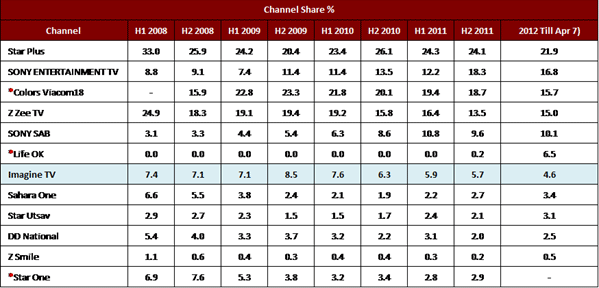
    Ever the one to influence viewers and attract the attention of the advertisers too, content was one of the biggest setbacks for the channel, going by the buzz emanating from experts. While the start for the Imagine was glorious, as it did manage to attract sizeable channel share (see chart below) and even break into the 150+ GRP mark at some point, it was an experience that was shortlived. The maximum channel share that the channel attained was 8.5 in H2 2009.


    Source: TAM Media Research / TG: CS 4+ yrs / Market: HSM / Period: H1 (Jan-Jun) & H2 (Jul-Dec) 2008, 2009, 2010, 2011 till April 7, 2012


    Mohit Joshi
    Divya Radhakrishnan
    Karthik Lakshminarayan
    Pankaj Krishna

    Explaining the implications, Mohit Joshi, Managing Director, MPG said, “The General Entertainment domain is very competitive and each channel is constantly improving content and production. The viewer has many options today and hence has become more ruthless with the channel choice. In spite of a great start, Imagine lost it mid-way. In an attempt to gain viewership and numbers, it resorted to telecasting shows like Rakhi Ka Swayamvar, Rakhi Ka Insaaf and so on. Though these shows could have given a short-term boost in numbers, in the long run, viewers didn’t find the content appealing enough. Also these shows dented the channel image by giving it a ‘sleazy’ tag – which is not acceptable in the GEC domain.”


    Divya Radhakrishnan, Founder, Helios Media, said, “GEC is a highly competitive segment and the cost of running a GEC is very high. Imagine had reached a level of stagnation especially in the last six months, however shutting down was not expected.”


    Karthik Lakshminarayan, COO, Crest, said: “Imagine had the brand heritage of NDTV and Turner. I think it was sheer bad luck that they eluded that one show which could give them success like Kyunki did for Star, Saat Phere did for Zee, Ballika Vadhu for Colors and Bade Acche Lagte Hain is doing now for Sony. For a GEC to break even it takes 4-5 years so one needs to stay invested for a long period to see the returns, hence the move is a surprise.” In fact, he has a surprising statement to make: “Their overnight decision has caught us unawares and our media plan needs a quick revision. We had spots to go on air on the channel as we talk. I think now those spots are up for grabs and may the best player win.”


    Blame customer pull, not distribution!

    There are primarily two ways of impacting Channel Trials – namely Consumer Pull led by content affinity, and Broadcaster Push led by Distribution initiatives, explains Mr Pankaj Krishna, Founder and Managing Director, Chrome Data Analytics & Media (see Analysis: How Imagine lost due to consumer pull, not distribution. “Going by Chrome OTS numbers (Opportunity To See – percentage of households that have access to a channel) – Imagine TV has clearly been in the league of the top GECs with an OTS of 95% across HSM.”


    According to Mr Krishna, “consumer pull clubbed with Strategic Distribution Planning has a huge impact on the overall performance of a channel”. “Over the years, Imagine lost out on factors contributing to the former.”


    Staff shocked

    It was Terrible Thursday for the staff at Imagine. They had no clue of the closure, even as they had faced yet another week of dismal ratings from TAM. Said Jain on the fate of the staff: “Turner will retain some employees for a transition period and some others are being offered permanent roles within other Turner channels to fill current vacancies. For the other Imagine employees getting impacted, Turner has set up an HR outplacement service which will provide advice on how to write a better CV, interviewing techniques and other job hunting skills. We will also introduce the employees to recruitment consultants, HR professionals from other media organizations and facilitate their new job search. Our focus is to ensure the closure is executed in a fair and appropriate manner for all of them and in full compliance with all legal requirements, employment terms and company policies. We will use our best endeavours to make this as smooth a transition as possible for them.”


    There has been much dismay in the brodcast fraternity too. Colors CEO Raj Nayak in fact made a clarion call to the industry via Twitter: “To all my friends in the TV business. Let’s try & accommodate our friends from Imagine wherever we have vacancies in our system.”


    Way ahead

    The move does spell a warning for other broadcast majors to sit up and take notice. Let’s not forget examples of a few channels that had to shut shop midway including Star One, Zee Next, 9x and Real for lack of vision and programming blunder.


    Ashish Pherwani

    As Ashish Pherwani of E&Y writes in his analysis for MxMIndia (when is it right for a channel to pull the plug): “Over the last decade or so, most unsuccessful channels which have tried ‘overhauls’ and ‘makeovers’ that have failed to achieve their objectives within six to eight months, have eventually shut down their operations.” According to him, for a channel to succeed, “the only asset it has is viewership. Channels which operate without a robust management team, a unique market position, and a defined target audience, won’t be able to garner sustained and loyal viewership. If channel management is able to make these three aspects fit seamlessly together, chances are the channel will succeed as a business, else, it would make business sense to pull the plug!”


    Turner may probably pay heed to Pherwani’s suggestions if it ever were to take another swipe at launching a Hindi general enterainment cahnnel  channel. Going by its past track record where it teamed up with Alva Brothers to launch Real and proceeded by acquiring Imagine from NDTV, chances are that the network may already be on the prowl hunting for its next prospect. Until then, the network seems content to bask in the laurels of its sister channels that have been showing good growth in the genres they operate in.


    Written by Johnson Napier with inputs from Anil Thakraney, Ashish Pherwani, Pankaj Krishna, Kshama Rao, Tuhina Anand and Robin Thomas


  • Indian adspends to see +8.7% growth in 2012: MPA study

    By A Correspondent


    Media ad sales will grow by 8.7 per cent in net terms this year, against the background of a slowing economy (~7 per cent real GDP growth versus historical range of 8-9 per cent) and the high first half of 2011 base last year resulting from the Cricket World Cup (which happens once in four years) plus an extended IPL season according to Media Partners Asia.


    The growth will be primarily driven by MNCs investing inIndiaand stronger MCG sector, and there could be upward revisions made in the second half of 2012. The outlook for advertising growth across key categories is mixed.


    Some of the highlights are:

    • FMCG 

    Media buyers expect robust growth from the FMCG sector, which is the largest advertising category, contributing 30-35 per cent to total ad spend. MNCs are expected to report robust numbers, while a few large MNC accounts (with annual ad budgets in the region of Rs2-3 billion) are looking to increase spends by 50-70 per cent for the coming year. Domestic FMCG companies are expected to see only marginal growth as the profits of these companies have deteriorated due to rising input costs.


    • Auto 

    Traditional companies such as Maruti and Hyundai have reduced their spends; but global car manufacturers investing inIndiaare driving the overall growth for the sector. As suggested in the recently held Auto Expo 2012, the sector will benefit this year from new launches in the two-wheeler and utility vehicle segments in subsequent quarters.


    • Life insurance

    The forecast is for a steady growth, a prevailing trend seen in this category since 2008. A reversal of interest rates will be the underlying factor influencing consumption and ad spend across sectors. The rising interest rate cycle seems to have peaked out. After raising interest rates by 13 times since March 2010, RBI (Reserve Bank ofIndia) may shift its approach towards the country’s monetary policy. Inflation is likely to fall considering the high base last year, and in order to bring the country’s economic growth back on track, the RBI is likely to reduce interest rates gradually in 2012. This will encourage investments and spending, in turn benefiting the ad market.

    Consumption demand has held up reasonably well though rural demand may be a concern, highlighted by a recent slowdown in sales of two wheelers and durables.


    Other key factors that will have an impact on the ad marker include:

    • Competition in Hindi GEC

    Competitive intensity in the Hindi GEC space is nothing new, though new competition is accelerating amongst second-tier channels. There has been a change in the pecking order of top three Hindi GECs, with Sony climbing up to the No. 2 spot while incumbent Zee TV has now slipped to No 4. Based on discussions with some of the major media buyers, the genre currently has limited supply of inventory, which should keep ad rates healthy.


    • Digitalization to create new niches

    Before the first phase of digitalization is implemented in June 2012 (it may be delayed to December 2012), broadcasters are already rolling out new niche channels in various genres like action and comedy. This will attract advertisers who are willing to target and segment their audience, not just from demographic but also psychographic parameters.


    • FDI in single-brand retail

    Opening up of FDI in single-brand retail (precursor to opening up multi-brand retail) will benefit regional print companies.


    • State elections

    In the near to medium term, print media will benefit from the upcoming closely contested elections to be held in five states: Uttar Pradesh, Uttarakhand, Punjab,Goaand Manipur.


  • Life OK’s gr8 start with 87 GRPs (report + analysis by Stratagem)

    By Rishi Vora


    While it may be still early days to declare Star India’s new channel Life OK as a success story in the Hindi GEC market, there is no doubt that it has delivered on the network’s goal No 1, which was to make an impact on the industry.


    The primary objective, as cited by a few industry observers, is to compete with the Sony and SAB TV combo, so that Star as a network could have a commanding position in a market which is now seen as hyper-competitive.


    So Life OK has clocked 87 GRPs in its first week, surpassing Colors’ 81 GRP launch back in July 2008. It may be recalled that Colors had left no stone unturned for the launch. The strategy was to start with the big-ticket show Khatron Ke Khiladi (with film star Akshay Kumar in a way giving a solid push to the channel), aggressive marketing, fiction shows, mythology, so on and so forth.


    One may argue that Colors was launched as the flagship channel of a joint venture company of two broadcast majors – Viacom and Network 18. Life OK in that sense is Star India’s second offering in the Hindi GEC sector. But, that has very little to do with what the channel has achieved in the first week as Star officials say that the idea is to compete with every channel in the market, it doesn’t matter if it means competing with elder sibling and No 1 channel Star Plus.


    An interesting observation: Imagine and 9x were launched in the same year (2008) and registered 55 and 21 GRPs respectively. Both the channels gradually grew in GRP terms, but as the market became competitive, the going for both channels became tough. While Imagine is still around (currently placed at No 7 with 67 GRPs), 9x may be on air, but even though it has been acquired by Zee, it has failed to create an impact . Of course there are several reasons attached to why the channel tasted early success and witnessed one of the most dramatic and talked-about downfalls.


    As for Life OK, its success at this stage can be attributed to the following: A sensible approach to launch the channel with a unique philosophy, marketing blitzkrieg (it is reported that Star India made an investment upwards of Rs 700 crore to launch the channel. The campaign, which is in full swing now, saw a three-day roadblock across Star India’s network, an outdoor plan reaching 100 towns, a week-long digital engagement programme which included an eight-hour-long concert, and of course getting Madhuri Dixit as the Sutradhar (storyteller). Plus, the fact that the channel did not bank on one particular show to deliver, and rather offered viewers a package of differentiated programming, the strategy to cut down on advertising inventory – all these factors put together have produced rich dividends.


    Official comments from the senior members of Star India and Life OK could not be obtained at the time of this report. However, industry observers believe that Life OK has what it takes to be a serious contender in the Hindi GEC market.


    Ashish Bhasin, Chairman India and CEO South East Asia, Aegis Media, observed, “Life OK as a channel has great potential.  However, the true test of a channel is after it has settled down for a few months. It is sometimes easy to get content for a short period but sustaining it on an on-going basis becomes a challenge. Ultimately, in my view, content drives the fate of any channel. If Life OK is able to sustain good quality content on an on-going basis for two or three years, it can definitely become a serious player. On the other hand, if the quality of the content starts to drop after the initial launch, then it’ll have a struggle ahead for itself.”


    Havas Media CEO – India and South Asia Anita Nayyar said, “With the kind of marketing backup and hype, the opening seems good and certainly a hike from the Star One deliveries. However, two-three weeks of sampling will continue and the actual stability will start setting in after a few weeks. Coming from the Star Network, the programming quality is very good.”


    On whether it will pose a challenge to the top players – Star Plus, Sony, Colors and Zee, she said, “It will be a strong competition in the GEC category for the No 3, 4 and 5 slots. Not sure about whether it will be another success story as big as Colors, as it had the advantage of differentiated content on the social platform when it launched. The content is interesting and should help stabilise around 60-70 GRPs from here.”


    In an earlier interview to MxM India, Star India COO Sanjay Gupta had mentioned that the No 4 position in the GEC line-up (currently held by Zee) would be a first good milestone to look at. In week 52, Zee is at 208 GRPs. Though he did not put a timeframe, going by what experts have to say, the channel will need to pick up on its early momentum and get there by bringing differentiated content – something Colors did very successfully.


    While Imagine has slipped to No 7 position and SAB is at No 5 with 122 GRPs, it looks like a serious battle from here on.


    An analysis by Stratagem Media Pvt Ltd on the launch of Life OK.Background 

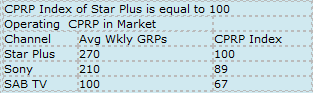
    It is a jungle out there in the media business. If you win the battle, you still have to worry about losing the war. Recently the Star Network launched another GEC called Life OK. Probably in the wake of competition from the Sony and SAB TV combo.The table 1, below depicts that the Sony and SAB combo was just about edging out Star Plus from the top GEC position, especially if it came at a more attractive rate (CPRP), as estimated in the table below.So, the not-so-hidden agenda of the Star network for Life OK would be to combine it with Star Plus and thereby fend against the Sony + SAB offensive, but without devaluing their trump card (i.e. Star Plus itself). Therefore, how would the new channel Life OK have to price itself, to overcome the Sony + SAB threat?


    Stratagem Media has undertaken a simple exercise to answer this question, for different levels of performance of Life OK.


    Objective of the exercise: To derive the CPRP Index of Life Ok @ different level of GRPs, if the CPRP of Star Plus is 100?


    Methodology: If the CPRP of Star Plus is 100, then what should the CPRP of Life OK be, if they have to match the CPRP of the Sony + SAB combo at different GRP ratios between the 2 channels.


    In the exercise below, the ratio of GRPs purchased between Life OK and Star Plus is assumed to improve in favour of Life OK, as its performance improves.


    *At these CPRPs, the Star Plus and Life OK combo will be as cost-effective as SET and SAB combo.