Tag: GroupM

  • GroupM integrates ITV & Kinetic under Ajay Mehta

    By A Correspondent


    GroupM has announced that Ajay Mehta will Managing Director of Cinema (ITV) and OOH (Kinetic). Prior to this Mehta was MD of ITV. Mehta will also be joining the GroupM India Executive Committee (ExCo).


    Speaking on the development, Prasanth Kumar – CEO, GroupM South Asia said: “We are fortunate to be the leaders in both cinema and OOH practices and our goal and vision is to make it stronger and bolder. Our belief in OOH and Cinema related solutions for brands continue to be strong and while we are going through tough times, it is important to prepare as well as strengthen our offering. Ajay in his leadership role will focus on integrating the teams and prioritise focus on larger returns for clients and brands, shaping solutions that would provide an edge for our clients by collaborating with multi avenues like digital, technology and other media opportunities. I am confident his entrepreneurial skills and collaborative nature will help and lead the teams to larger strength.”


    Added Mehta:  “I am very excited with this opportunity. The coming together of the two businesses is a huge opportunity for us to create new strengths and to be valued partners for our clients by delivering result -oriented solutions for them. I look forward to working with the two teams and to contribute to the growth of the business.”


    All the ITV teams along with the Kinetic leadership team will report to Mehta while he will continue to be based out of Gurugram and will report into GroupM CEO Prasanth Kumar.


  • Anita Kotwani joins Carat India as CEO

    By A Correspondent


    Carat India, the flagship media agency from the house of Dentsu Aegis Network (DAN), has roped in Anita Kotwani as its chief executive officer (CEO). 


    Kotwani was until recently at Mindshare India where she held the position of Senior Vice President, New Business and Client Lead, The Walt Disney Business. In a career spanning more than two decades, 16 of which have been with Mindshare, Kotwani has been instrumental in leading client relationships for brands such as the ABG, Kellogg, ICICI Group, Facebook, Byju and The Walt Disney Company amongst others, for the West zone. Additionally, she has also helped build diversified offerings across data, digital and content, driving exponential growth for Mindshare India over the last two years.

    Kartik Iyer
    Kartik Iyer

    She will report to Kartik Iyer, President Media Brands and Amplifi and will be responsible for the agency’s strategic progress and business growth, nationally. She will also focus on developing and leading significant tools and capabilities within Carat to help deliver enhanced integrated solutions to clients. Speaking on her appointment, Iyer said: “I am delighted to have Anita Kotwani join our team at Dentsu Aegis Network India. In her new role, Anita will help futureproof Carat India as the agency gets ready to take on the new opportunities that the changing market dynamics has to offer.” 


    Anand Bhadkamkar
    Anand Bhadkamkar

    Added Anand Bhadkamkar, CEO, DAN India: “Anita is an industry veteran. She is known for her dedication and diligence and has worked across multiple categories including consumer durables, financial services, FMCG and other MNC brands. I wish her all the luck as she charts fresh new path for Carat India, beginning now,” 


    Elaborating on her mandate, Kotwani said: “Carat was the world’s first media agency to form with the belief that media has the power to transform businesses and this holds true even in today’s times. It is indeed Redefining Media. With DAN’s unique operating model under its single P&L structure, one can draw on the capabilities of its sister companies – including that of its dedicated OOH, Digital, Performance, Marketing Effectiveness and Creative agencies, to access world class specialisms and create bespoke teams to meet client specific needs. There is scale, specialisation and integration at the core, and with my expertise in leading client relationships and growing diversified offerings, I am super excited to lead the Carat brand for India.”

  • SMBs: Transforming Businesses, Transforming Advertising


    By Brian Wieser


    We review key trends related to small and medium-sized businesses (SMBs) during the pandemic. The shifts these marketers are taking to survive now and, ultimately, thrive in the future are a window into the business transformations larger businesses will also take, if they haven’t done so already.


    Small businesses have been hit hard during the pandemic.

    It has often been said that small businesses are the lifeblood of an economy. While the reality is that small businesses have generally been losing share of economic activity to larger ones over time, they retain a significant amount of importance. In the United States, small businesses – defined here as companies with fewer than 500 employees – account for approximately 40% of total payrolls and 47% of total employment, according to our analysis of U.S. Census Bureau data.

    With the pandemic disproportionately hurting small business because of their relative lack of capital, policies designed to help ensure they are positioned to quickly recover are particularly critical in preventing long-term disruption to the economy. In the United States and countries around the world, hundreds of billions of dollars of loans have been authorized specifically to address this issue. Whether or not policies will be successfully administered or sufficient in scale remains an open question.


    Companies with less than $50 million in revenue average $10k in ad spending, account for greater than 20% of total ad spend and a greater share of digital and print.

    How small businesses fare is not only important for the general economy; it is important for the health of the advertising industry and marketers as well.  According to our analysis of 2014 data from the IRS in the United States, the most recent year data was available, companies with less than $5 million in annual revenue—and average spending on advertising amounting to $5,000 annually—accounted for 10% of total ad spending. Companies with less than $50 million in revenue, where average ad spend was $10,000 on average accounted for 21% of economy-wide ad spending. Our guess is that that share likely rose in subsequent years.

    Most importantly, these companies accounted for substantially higher shares of spending on print and digital media given the relatively low price points at which advertising can be purchased in most instances. Their presence matters to larger advertisers because the capacity of many of their media channels to thrive is at least in part also dependent upon the health of smaller businesses.


    The ongoing economic driven downturn appeared ready to pulverize the media owners that small businesses depend on, but their spending may not have declined by as much as we might have expected. 

    However, something somewhat unexpected happened during April: they evidently did not cut their spending by as much as we might have expected. Data provided during Facebook’s recent earnings results indicating “approximately flat” trends during the first three weeks of April represented an approximate reduction of around -20% to -25% from the pace of growth observed during the first couple of months of the year. Spending trends were similar between large and small advertisers alike.

    By contrast, other digital media owners whose revenue bases are more heavily skewed away from small businesses, appear to have experienced more significant rates of deceleration or decline.  While depth and breadth of data and targeting capabilities undoubtedly helps to capture a large share of performance-advertising budgets from marketers of all types sizes, it is hard to ignore that Facebook is a primary seller of media for many small businesses (along with Google, which also saw a similar pace of deceleration during March at least).  To the extent that small businesses make up a larger share of Facebook’s revenues than other digital media owners, we have at least one indication that small business have been disproportionately resilient as advertisers during the pandemic, at least on digital media.


    The expansion of e-commerce activities by small businesses reflected in Shopify data probably helps to explain this trend.   

    E-commerce has plainly expanded at an accelerating clip around the world. For example, Amazon’s online stores saw growth of +25% during the first quarter, ahead of the fourth quarter’s +15% pace. Comments from most of the world’s largest marketers have generally reinforced this view in comments on their own e-commerce sales. Was it also true that the same trends occurred for small businesses?

    Anecdotally, most people can probably describe a favorite local store that closed but who made their products available for sale online in some form. And, as it turns out, data from Shopify – whose customer base is heavily skewed toward small businesses – supports this notion. While smaller than Amazon – whose total global GMV (including its own sales and marketplace sales) was well above $300 billion last year – Shopify’s base of GMV last year of $61 billion is primarily small businesses.

    During the first quarter of 2020, Shopify GMV accelerated to grow by +46%. While GMV through point-of-sale channels using Shopify declined by -71% between March 13 and April 24 relative to the comparable six-week period immediately prior, retail merchants managed to replace 94% of lost point-of-sale GMV with online sales over the same period. A range of other notable statistics provided by the company provide additional snapshots of the transition in commercial activity during the six weeks following the middle of March, illustrating some of the changes in the economy since that time, including:

    • New stores created on the Shopify platform grew 62% between March 13, 2020 and April 24, 2020 compared to the prior six weeks.

    • The number of consumers estimated to have made a purchase for the first time from any Shopify merchant grew 8% between March 13, 2020 and April 24, 2020, compared to the six-week period immediately prior.

    • Over the same period, the number of consumers estimated to have purchased from Shopify merchants they’d never shopped at before grew by 45% compared to the six-week period immediately prior.


    Small businesses finding ways to survive via e-commerce will change their media skew and illustrate business transformation at a small scale.

    Our takeaway from all of these data points and observations is that small businesses are generally going to get hurt much harder than others during the current environment, and larger businesses will probably take shares in every given sector. At the same time, though, smaller businesses that have been able to find ways to adapt to a digital-first orientation by virtue of necessity are positioning themselves to thrive for the economic recovery that will eventually follow.

    And while many of the familiar commercial activities that took place before this year will return as if a pandemic never occurred, it seems hard to image we won’t see a permanent shift for others. The coffee roaster who newly discovered shipping beans in bulk to consumers directly, or the yarn store that found the benefits of a strong online presence outweigh the costs of maintaining a retail environment may very well continue doing so well after social restrictions have been eliminated. These simple illustrations of “business transformation” will inevitably lead to an increased emphasis on digital marketing to support the e-commerce activity that will drive growth in small business sales.


    Implications follow from these takeaways for marketers and media owners alike.

    Marketers who depend even in part on small businesses for distribution of products will need to increasingly adapt their own commercial activities to reflect this shift of orientation. Similarly, media owners who historically depended on small businesses will also need to evolve to reflect the evolving needs of the marketers they work with as well. Otherwise they will lose a more significant share of revenue than they already have.

    Small businesses are not likely to be the lifeblood of the economy in the near-term, but the bigger picture transformations the most successful ones will go through are illustrations of changes that large brands will be well-served to emulate, if they haven’t already done so themselves. The implications that follow for the media owners that large brands generally work with are far from clear, in part because larger media owners still have time to adapt their own offerings to anticipate changes that will become more pronounced for their customer base over time.


    Brian Wieser is Global President, Business Intelligence, GroupM. Republished from https://www.groupm.com/smbs-transforming-businesses-transforming-advertising/

     

  • As Society Changes, Will Your Marketing Plan Change Too?


    By Brian Wieser


    KEY TAKEAWAYS

    We review changes relevant to marketers that will occur as the coronavirus crisis evolves. We specifically consider new ways consumers will spend time, how they will change media consumption and how B2B marketing will evolve.

    In assessing the behavioral changes following from the current crisis that will impact marketing, we must lay out our assumptions regarding the path forward for the virus and societies around the world alongside our expectations for the evolution of the economy.

    In general, we can assume that while containment efforts will generally be successful in most countries and that the phase of the crisis involving country-wide formal lockdowns will come to an end, risks of further outbreaks will persist until a vaccine is both discovered and widely distributed.  As a result, while there will be a gradual and at least partial resumption of many pre-crisis behaviors over the course of the next year, a complete return of old social patterns will not occur any time soon.  Because of the sudden shut-down and related disruptions in economic activity, we can also assume the economy is likely weak for the foreseeable future, with a disproportionate impact on workers in retail and hospitality sectors who tend to be lower income.  Any concentration of negative outcomes among certain groups of people could exacerbate existing trends, which could play out in public policies related to populism, global trade and taxation among other issues.

    For all of these reasons, it is reasonable to assume that some behaviours will permanently shift because of the time people will have had to get used to new patterns and because of the new products and services that will evolve to meet changing needs between now and then.   From here, with an eye toward identifying the behavioural changes from societies under lockdown, the changes that will follow as society gradually opens up and the changes that will follow once a vaccine is widely distributed, are worth noting.

    Following from these assumptions, in the remainder of this note we consider three general groups of behaviours relevant to marketers, including ways consumers will spend their time and money, how their media consumption patterns will change and how work – which impacts B2B marketing in particular – will evolve over time.


    HOW WILL THE WAYS IN WHICH CONSUMERS SPEND TIME CHANGE?

    Behaviour Description
    Spending on being at-home vs. away-from-home Consumers will alter their mix of spending where choices involve avoiding leaving the home or not and could involve trade-offs of services for products. While some people may initially look to reconnect with distant family, most will presumably spend less on vacations. Consumers may choose to spend more on home improvement or expensive home-based products (backyard jungle gyms or staycations, for examples).
    Physical proximity to large vs. small numbers of other people Going to see live sports or live events won’t be an option if venues are closed and large crowds are not allowed to congregate; however, even going out to large venues – such as clubs, bars and restaurants or sports-related environments – may be out-of-favour even where it is allowed. Socialising may become home-based or more focused on smaller groups.People could become less focused on conspicuous consumption of certain luxury goods, but could consume different ones, such as wines or lipsticks especially where they are objectively superior or personally preferred products.
    Changes in time allocations beyond media Home-based hobbies will expand.
    Other social preferences Owning your “space” takes on new importance. “Rental economy” companies such as Zipcar, VRBO, WeWork will require a mix of reinvention and repositioning or may be negatively impacted.  Additionally, many companies are realising that more physical space is not necessary to accomplish their business goals, which may have additional consequences at a social level
    E-Commerce purchasing habits E-Commerce growth accelerates, especially within certain categories and for certain people where penetration rates were previously low (groceries, older people).


    HOW WILL MEDIA CONSUMPTION CHANGE?

    Behaviour Description
    Video consumption More at-home video-based entertainment will be consumed, although there is risk of screen “fatigue” prompting consumers to look for different types of media exposure.With Hollywood/professional content production in question, more potential for viral content (virtually produced).

    AVOD probably becomes bigger because of appealing value proposition.

    Outdoor advertising consumption There will be fewer opportunities to reach consumers with OOH ad products until normal social patterns return, although advertising could very well be more impactful if there is less clutter.Different places may become differently valuable: for example, pharmacies or places where essential workers travel may become much more valuable on a relative basis
    Event marketing Event marketing falls off or needs to get reinvented.Virtual / home-based experiences explode in importance.
    Audio consumption Audio platform consumption patterns will change and to the extent that audio associated with commuting, it will probably fall.  On the other hand, some of these providers will evolve to produce content that is more desirable to consumers while at home.  To illustrate: consider that if podcasts were primarily consumed by commuters, can they evolve to be consumed by people at home?
    Digital media consumption Breadth of users of platforms might expand along with depth; niche digital platforms probably widen their audiences if more free time causes more people to experiment.Video game usage explodes.
    Other activities New activities could redefine media (gardening, cooking, DIY) and could have new media assets attached to them.

    HOW WILL B2B MARKETING CHANGE?

    Behaviour Description
    Influencing sales / senior decision-makers and managing ongoing relationships Sales and service involves fewer in-person meetings. More is accomplished via webinars, digital platforms, white papers.  Historical relationships may be worth more than before.Senior managers / influencers / decision-makers may spend more or less time managing than before, which alters how they prioritise their time.  Those managers will likely spend more time interacting with distributed teams, and degree to which those teams influence decisions may also change.

    Sales efforts could become more objective (less subject to casual lobbying by salespeople or internal constituents).

    B2B vs. B2C orientation / disintermediation B2B businesses looking to avoid retail disruption in the future will invest more in B2C / DTC wherever possible.

    Opportunities to disrupt supply chains (i.e. movie studios “breaking” the windows) will emerge.


    Societal changes seem highly likely to occur as a consequence of the current crisis, and consumers will change the ways they interact with people and brands for the foreseeable future.  While many behaviours will revert to historical patterns once a vaccine is discovered and distributed, there will be many that will become permanent.  Brands have opportunities in the interim to find new ways to become relevant or maintain relevance.  They will also be able to find new ways to be tangibly helpful as consumers adapt to the new behaviours they will adopt.  Planning for those opportunities now will help brands drive growth in the future as economies eventually and inevitably improve.


    Brian Wieser is Global President, Business Intelligence, GroupM. Republished from https://www.groupm.com/changes-following-the-crisis/


  • Managing Through Crisis


    By Brian Wieser


    Key takeaways
    With difficult times in most of the world, marketers everywhere are revisiting their budgets. Marketers have opportunities to become more holistic, focus on better (rather than worse) metrics, improve how they manage for contingencies and set the stage for future growth.

    With the apex of the spread of the coronavirus around the world still weeks away, marketers are facing highly uncertain times. Most countries are, therefore, now taking actions to mitigate the human and economic impact as much as possible. While there are some “green shoots” of economic activity in areas hit early on, such as China, decline is almost certain to occur in most parts of the world this year.

    Industry practitioners generally recognise that any brand or company should avoid cutting their marketing budget. Brands that invest through a downturn should be better positioned to capitalise on an eventual economic rebound in the near-term, and brands that sustain their presence in consumers’ lives are maintaining relationships that should persist in commercial terms in the long run.

    Unfortunately, the present reality is that marketers – meaning anyone who is responsible for sales of any given product or service – will often lack ultimate control of the current situation, as the current phase of the crisis will more likely see CEOs and CFOs looking for aggressive actions.  At the same time, CEOs and CFOs may also be more open to new, and potentially radical, ways of managing their businesses, making them more open-minded than they might be under different circumstances. Subsequently, while marketers may feel as if they have less control over their budgets on one hand, they are potentially in a powerful position to advocate for change in pursuit of near-term efficiencies and longer-term growth. In some cases, marketing organisations may benefit from redesign. In many cases, the ways in which budgets are managed can be improved and, in other cases, there are opportunities to deepen relationships with customers by re-imagining supply chains, customer experiences and broader direct-to-consumer propositions in order to make the most of the current environment.


    Four considerations related to such opportunities follow:
    •  Revisit the manner in which budgets are set in order to optimize “forests” rather than “trees”
    •  Focus on contribution margins and generally review financial metrics used to judge success
    •  Always have a best alternative to a negotiated agreement (BATNA)
    •  Prioritise resources towards growth opportunities


    Optimise forests, not trees. As we have written previously, marketers often have hard lines around budgets to make sure individual components of budgets are managed as cost-efficiently as possible. However, if the marketer is optimising costs of individual media choices and looking to reduce spending everywhere rather than optimising an entire marketing budget, substantial sums of money may be wasted.

    To draw an analogy with financial markets, it is as if most marketers allocate budgets with an eye to picking the cheapest stocks rather than determining whether they should be shifting resources across asset classes (fixed income, commodities, real estate, currencies, etc.). Better yet, whether they should be shifting resources toward decision-making tools, data and advisory services to better determine financial strategy, timing, asset allocation and individual security selection.

    The greater the flexibility a marketer has with respect to how it allocates resources on all aspects of its marketing spending, the better it can direct those resources.

    In more tangible terms: marketers may be better off not focusing on unit costs or spending with a given media owner if they can focus on a campaign’s media costs for a given level of unit quality. They should not focus on a campaign’s media costs if they can focus on its entire costs, including production costs, services and data for a campaign’s given level of media, production, services and data quality.


    Focus on contribution margins, and more generally reassess whether financial metrics used to determine success are the right ones. In many businesses, companies “manage to the margin” and focus on the absolute profit margin that a brand and product might yield. However, in companies that are focused on margins, it may be better to focus on contribution margins, which refers to the incremental operating income/profit generated or lost from an incremental dollar of revenue gained or lost. Wherever possible, marketers should focus on products and countries that generate the highest contribution margins, either limiting the losses or investing against growth of high contribution margin products. Focusing marketing resources of products with high contribution margins will ensure that company-wide margins fare better than when marketers focus on products with higher and generally stable margins.

    More generally, marketers need to ensure that the financial metrics they are judged on are consistent with the best ways to manage their businesses. For example, as brands look for new ways to establish direct-to-consumer relationships, they face the challenge of focusing internal stakeholders on new metrics, such as lifetime value of the customer rather than near-term profitability. In all cases, marketers can benefit from reviewing whether the metrics they use to drive their businesses produce optimal business choices.


    Ensure BATNAs are in place. Lastly, marketers should generally work to ensure that there is a back-up plan for any plan or campaign idea because having a best alternative to a negotiated agreement will provide a marketer with a credible ability to walk away from a negotiation. This means that a marketer will be better positioned to secure favourable terms or pricing from a given media owner when they pursue their preferred plan. But at the same time, if circumstances change – as we have seen with the postponement of the Olympics and cancellation of many events – a marketer who has developed an alternative plan may be better positioned to execute on that alternative if circumstances evolve out of their control.


    Prioritise growth, even in a downturn, and even if it requires new investments. Even in declining economies, new products and services emerge. Unfortunately, most companies retrench at exactly the time they can capitalise on consumers’ interests in considering new approaches to meeting their own needs. Every company with a product to sell or an idea under development should ask themselves where they would invest resources today if they could. If internal resources are not available, capital markets are generally available to provide companies with capital and liquidity where needed.

    Companies are often concerned about a perceived short-term orientation among analysts and investors, but we might argue that they are only oriented around the short-term if they are not given a persuasive reason to focus on the long-term. Companies such as Amazon, Netflix and Salesforce.com are examples of companies whose CEOs essentially never waver from their long-term focus and have built businesses centered on that. Analysts and investors have generally taken similarly long-term views in assessing these companies. They are generally willing to do so for others, as long as the company’s focus is unwavering in its time horizon.

    Each of these opportunities have pros and cons to consider. Inventing new approaches to managing budgets can be politically challenging and may require new working processes but doing so allows a brand owner to make more efficient choices in the near-term. Emphasising new financial metrics – such as contribution margins – over others may also involve internal political issues, but the benefits can be very real. Establishing BATNAs can require additional work, but optionality can open up new and better ideas and provide helpful contingency plans. Focusing on growth requires a proverbial capacity to change the engines on a plane while it is still flying but doing so helps position a company favourably for the long-term. The best opportunities to pursue will always be company-specific.

    While simpler times are unquestionably less stressful for marketers at an individual level, the complexity and uncertainty of the current era presents the opportunity for significant change.  Much of this change will be negative, although around that change, marketers can always look for opportunities to make their situation as positive as possible.


    Brian Wieser is Global President, Business Intelligence, GroupM. Republished from https://www.groupm.com/news/managing-through-crisis

  • Do consumers really trust digital marketing?


    By A Correspondent


    New research released by media services network GroupM offers interesting insights for marketers about consumer attitudes toward digital marketing. Consumer Trust in Digital Marketing, which surveyed nearly 14,000 consumers in 23 countries including India, uncovers consumers’ concerns with digital marketing and suggests important considerations for marketing on digital platforms:


    • On average, two times more consumers say TV ads provide a more positive impression of brands than common digital formats.
    • 6 in 10 consumers say they are less inclined to use a product if their data is used for any purpose.
    • 56 percent of consumers want more control over their data.
    • 64 percent of consumers would have a negative opinion of a brand next to inappropriate content.


    Against the backdrop of newsworthy security and privacy issues across the globe, the research revealed that consumers react more positively to television advertising and that more than one-third of consumers (37 percent) feel digital ads are too intrusive. With this, marketers need to focus on using the right digital platforms to reach consumers, to be transparent about how data is gathered and used, and to think holistically about the many media venues where they can build consumer relationships.


    “With pervasive reports of data security and privacy missteps, consumers are increasingly wary of information gathering about them as they move online,” said Christian Juhl, Global CEO of GroupM. “Media has evolved dramatically and it’s crucial the industry work collaboratively to make advertising work better for people around the world. As marketers, it’s our responsibility to ensure that we are using consumer information responsibly and transparently.”


    GroupM’s analysis of the survey findings pointed to important paths for creating more dialogue and trust with consumers:


    BUILDING TRUST THROUGH PLATFORMS

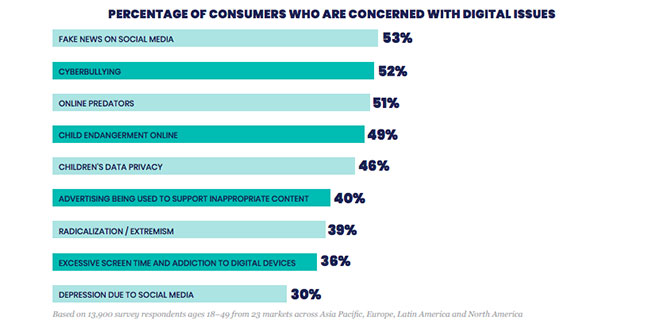
    GroupM found that, among consumers with digital marketing concerns, top challenges include fake news on social media, cyberbullying and online predators. Seventy-five percent of consumers believe it is a digital platform’s responsibility to stop inappropriate content from appearing. In order to secure consumer trust in their brands, marketers should continue to consider whether the online advertising platforms they are using are appropriate for the type of brand content they’re creating. Additionally, they should ensure they’re setting parameters around ad placements that build marketing effectiveness and protect brand value.


    BUILDING TRUST WITH DATA

    Data privacy remains a significant concern for consumers globally, with sixty-one percent of those surveyed indicating they would be less willing to buy or use a product or service if companies use their personal data. Correspondingly, consumers are looking to protect themselves. GroupM’s research shows that changing privacy settings and deleting cookies and browser history – areas informing digital advertising – are on the rise. If companies wish to continue using consumers’ data, marketers may need to offer incentives and communicate the benefits more convincingly. Being transparent about consumer data usage, with clear frameworks aligned through a whole organisation, will help foster a new relationship of trust in the digital marketing process.


    BUILDING TRUST BEYOND TRADITIONAL ADVERTISING

    According to GroupM’s findings, consumers are receiving more communication from brands than desired. Marketers should work to optimize the customer experience by tailoring the frequency and the types of messages. With consumers spending more time online, marketers should place even greater emphasis on communications tactics such as working with micro- and nano-influencers, which may help mitigate digital advertising fatigue. To support growing interest among brands, GroupM has introduced INCA, an influencer marketing solution in select markets. This helps marketers to be confident in accurate, verified and measurement-based influencer marketing outcomes.


    GroupM’s report also highlights interesting findings on the appreciation consumers have for different types of brand communications and points to, in some cases, big differences of opinion across markets. For example, an average of 59 percent of consumers globally appreciate receiving discounts and offers, but only 20 percent appreciate invitations to complete satisfaction surveys. Seventy-five percent of consumers in New Zealand said they would be less willing to buy or use a product or service if companies used their personal data, whereas only 38 percent of consumers in Indonesia said the same.


    “To make digital advertising work better for everyone, we must listen to what consumers are saying and refine our strategies accordingly,” said Chris Myers, report author and Regional Director, GroupM APAC. “Marketers should not pull back on digital advertising; on the contrary, they should push forward in ways that respect consumers’ evolving relationship with digital media.”


  • Indian sports sponsorship crosses Rs 9000 crore benchmark, notes GroupM’s ESP Properties

    By A Correspondent


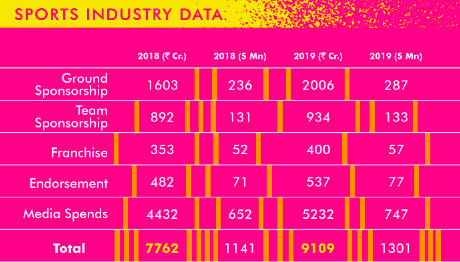
    ESP Properties, the entertainment and sports division of GroupM India, released the 2020 report on sports sponsorship in India. Overall growth in sports sponsorship at a healthy 17 per cent where the sports sponsorship Industry crossed the INR 9000 crore mark in 2019.



     

    The 2019 was the year for cricket and dominated the sports advertising sector unanimously. IPL and ICC World Cup gave a push in both, on-ground sponsorship and media spends. On-ground sponsorship grew by 25 per cent, for the first time, crossing INR 2000 crore mark. Overall industry upsurge was INR 1347 crore of which INR 800 crore was contributed by media spends alone growing at 18 per cent.


    Said Vinit Karnik – Business Head, ESP Properties: “Indian sports industry is on an upward trajectory breaking new grounds year-on-year. While cricket proved its dominance in 2019, overall the last 5 years the industry has doubled its size. If we look further, we can see a strong CAGR of 12.8 per cent in the business of sports over the last 10 years, making it one of the strong pillars of the Indian economy. With the sports industry growing at 17 per cent in 2019, the momentum on sports with added thrust from the government provides a holistic opportunity for the sector. Initiatives like Khelo India and Fit India movement are drivers towards making India a truly sporting nation.”


    Added Prasanth Kumar, CEO of GroupM South Asia: “Over the last decade, we have witnessed the growth of sports leagues and their gaining popularity across the country. The sports industry has been growing and has witnessed a significant upward shift in the overall ad spends. The passion and excitement that’s involved in this platform have only strengthened. We see more and diverse audience indulging with this platform. Many innovations and leverage of assets in this space are powerful opportunities. As we are unfolding another decade, we see this space to be providing powerful thrust for greater brand stories.”


    The non-cricketing space was dominated by women athletes. Badminton queen P V Sindhu was the leading non-cricketing athlete in 2019 in terms of brand endorsements. While Sindhu added four brands to her portfolio, the most notable one among them was her tie-up with VISA that made her the first Indian athlete to endorse the financial services brand.


  • Coronavirus Scare: Considerations for Marketers


    By Brian Wieser

    The outbreak of Coronavirus in countries around the world is a widening tragedy. Many aspects of life and business will be altered in many countries around the world with the possibility of a recession realistic for many countries, at least on a short-term basis. Shifts in media consumption and other behaviours are important to monitor, and marketers need to be mindful of opportunities to service consumers that may follow along with the media owners they buy from and the societies in which they operate.

    Coronavirus is a widening tragedy. The widening spread of Coronavirus is first and foremost a human tragedy given the lives that have been and likely will be lost. It is secondarily a potentially pivotal societal matter given the implications that appear to have followed so far in China, especially with respect to their engagement with technology (i.e. e-commerce, streaming services, etc.). It may also have political consequences which could play out in different countries around the world. There will also be tangible economic consequences for much of the world to contemplate and manage through. This leads to significant considerations for every marketer and media owner to consider as they look to manage their businesses in the near-term.

    China may show us the path forward. As a starting point, it is important to continue to emphasize all of the uncertainties about how widely and rapidly the virus will spread and how specifically people, groups of people and governments will and will not react. Now that the spread is slowing in China and gradual signs of a resumption of normalcy are resuming, we do have a sense of how this could play out elsewhere.

    With restricted movements in heavily impacted regions, closures of offices, factories and stores alongside cancellations of environments where public gatherings took place, everyday life was severely impacted. Travel was curtailed. Public hygiene practices were altered. Professionals worked from home where they could, and families stayed home as well. They consumed more media and refrained from going out to shop. Marketers often cut spending because of uncertainties around consumers buying products, if those products could even be made available: e-commerce-based delivery was often challenged because of limited availability of drivers and supply chain issues that impacted all forms of manufacturing and retail sales. From Alibaba we heard in mid-February that “some of our businesses that rely on physical means of production on supply side would even show negative revenue growth for the (current) quarter such as China retail marketplace and local consumer services”. This translated into a ~-30%+ change in growth rate relative to the growth that was observed during the fourth quarter of 2019.

    But as the pace of new infections began to decelerate, stores and factories began to re-open. As we heard during the last week of February from Baidu “in the past 2 weeks, however, business activities have started to pick up as people returned to work. At Baidu, our employees are gradually returning to the office applying strict safety measures. We assume businesses across China will do the same in that our marketing services will pick up at a faster pace into quarter end.” With all of the appropriate caveats around the uncertainties of the situation, the company guided towards a change in ad revenue growth that was roughly 20% different vs. the growth rate observed during the fourth quarter, similar to guidance provided by Weibo two days earlier. In short, there appears to be a basis for optimism around a resumption of normalcy – or at least a “new normal” – in the coming months.

    Unfortunately, much of the rest of the world is only now going through what China has gone through over the prior two months. This means that we likely have yet to see the worst play out.

    Many aspects of life and business will be altered in many countries around the world. As we have seen in China we would expect to see less travel, less manufacturing, reduced retail sales and cancellations of many forms of public entertainment. Media consumption at home will likely rise as will e-commerce sales, although because so much of the world relies so heavily on China to manufacture finished goods or components of goods, supply chains will likely be compromised.

    Other elements of society will face new spotlights: For example, the quality and variation of health care within countries will be amplified, which could lead to changes on that front. The contribution of economic activity to environmental conditions may be another dimension that faces scrutiny, especially in countries where activities leading to immediately tangible volumes of pollution are curtailed.

    The possibility of a recession is realistic for many countries, at least on a short-term basis. More generally, there is a realistic chance that countries which were otherwise growing are pushed into recessions because of reduced economic activity. Some countries have deeper integration with the global economy than others and are therefore more exposed to restrictions on cross-border activity and supply chain disruptions. Consumers in different countries may take a more or less conservative approach to spending than in others, although these tendencies will largely be impacted by their ability to buy (and receive) products. And at the same time, governments of different countries may take different approaches to stimulating their economies.

    In the near-term, how much a recession may impact advertising spending in any given country is difficult to anticipate – not least because economic activity is not tangibly correlated with ad spending in every country – although it is highly likely that the impact will be negative, with growth in some countries softening, others going flat and others declining. While it is far too early to anticipate outcomes with any precision, the implied double-digit declines in ad spending within China for the first quarter could play out elsewhere, with reduced declines in subsequent quarters and an eventual reversion back to growth as we have seen following other recessions. Of course, marketers able to avoid making cuts will generally fare better given what will likely be relatively favorable pricing and reduced competition for consumer attention. Longer-term brand-building will benefit from a sustained media presence, albeit with appropriately modified messaging.

    Ad spending might fall, but it also may shift. Given the absence of near-term sales to be realized, advertiser willingness to spend may fall despite higher audience levels for some media (which, as we have noted previously are not generally correlated with ad spending within media). However, if the volume of available budgets for spending on advertising weakens in any given country, it is difficult to anticipate which specific media will be most impacted. It does seem safe to say that the aforementioned supply chain issues with China – and the timing with which Chinese manufacturing returns back to normal – will disproportionately impact global media owners whose ad revenues depend on Chinese manufacturers. Traditional television could fare relatively better because of the likely improvements in audience levels, while outdoor advertising may be worse off with lower levels of foot traffic in many places. At the same, time we emphasize that spending on paid media will not necessarily correlate with spending by marketers on services, such as those provided by agencies.

    The Olympics may still go forward, but also illustrate the importance in making back-up plans. One tangible issue which will be top of mind for many marketers will relate to the upcoming Olympic games. While the games are still moving forward at the present time, because so many marketers build substantial campaigns centered around the Olympics, it will be particularly critical for those marketers to establish potential back-up plans in the event the Olympics do not occur. This point dovetails with a broader point we have also made previously: as a general rule, marketers should generally try to prepare credible alternatives as they develop any given marketing strategy. Towards those ends, the identification of alternative options may prove to be a useful planning exercise which could lead to new ideas for significant campaigns to be used in the future if the Olympics do move forward as intended.

    Shifts in media consumption and other behaviors are important to monitor, and marketers need to be mindful of opportunities that may follow. It is important to note that just because aggregated shifts are likely to occur, it does not mean that individual marketers should necessarily alter their media strategies. Marketers need to be mindful of long-time horizons during crises and make decisions on this basis. We emphasize that marketers should continually assess the relevance of a given medium for a given marketing strategy and creative message. They can also continually look for ways to add value to the consumers they service, the media owners they buy from and the societies in which they operate. A crisis such as this one will have many unfortunate consequences, but the changes in behaviors that will follow from it could create new opportunities for marketers to engage with all relevant stakeholders. If the choices they make resonate while the world works through the current environment, they and the world will hopefully come through it better positioned to thrive in the future.


    Brian Wieser is Global President, Business Intelligence GroupM. Republished from https://www.groupm.com/news/coronavirus-considerations-marketers

  • Path forward for incumbent brands given Direct-to-Consumer biz


    By Brian Wieser


    Direct-to-consumer (DTC) businesses have generally been viewed as a disruptive force in the economy in recent years. For some period of time, they caused a degree of fear for incumbent companies in the packaged goods and apparel sectors and presented opportunity for many media owners who saw a new source of spending on advertising.

    However, in the past few weeks news of the demise of Brandless, Edgewell terminating its agreement to acquire Harry’s in the face of FTC opposition, a weaker-than-expected IPO for Casper and other factors have suggested a reversal of these trends may be underway.  The reality of DTC is simultaneously not quite so negative in terms of underlying trends, muted at a competitive level and critical in terms of how these companies will influence the long-term evolution of large brands. 

    To start with, it is important to attempt to define what we mean by DTC companies.  Narrowly defined, we think of a DTC company as one which:
    •  Primarily manufactures (or contracts to manufacture) its own brands
    •  Primarily sells through a self-branded e-commerce site with physical retail or third-party e-commerce as secondary channels or for showroom purposes
    •  Is not primarily an operator of a marketplace
    •  Is not primarily a provider of services
    •  Was founded at some point in the past ~ten years
    •  Is not a multi-level marketer
    •  Is not a business unit of a larger company

    Using our narrow definition of DTC allows us to better understand the degree to which upstarts are impacting larger incumbent brands within any given category. Our narrow definition is arguably a particularly relevant one for manufacturers as it allows us to focus on the companies attempting to disrupt the business models of many of the world’s largest brand-focused marketers, taking share of consumer spending along the way.  For the purposes of this analysis, we put aside the important issues related to working with different third-party retail channels such as broadly-focused e-commerce retail, niche e-commerce retailers and marketplaces.  Learning how to optimise new channels is a separate set of challenges when compared with competing with new brands and new ways of selling to consumers.

    There are relatively few large independent DTC brands.  And, with this definition, there are relatively few companies with any size. Using a threshold of 300 employees at the end of 2018 or 2019 as tracked by LinkedIn (whose data is roughly consistent with actual employment figures where those numbers are available), we can only identify 18 companies that meet this criteria. We also crudely estimate that each of these companies had approximately $100 million or more in revenue either during 2018 or 2019, $7 billion in total during 2019, and, combined, approximately 13,000 employees. If we added in the several dozen companies that have more than 100 employees and meet the above criteria, we would possibly identify a similar number of people and amount of revenue. Perhaps there are scores or hundreds of other companies that meet this criteria with fewer than one hundred employees, but they would only add a similar amount of revenue in aggregate.

    To note: the data set we used to identify companies here tends to skew toward North America and western Europe and may not be comprehensive at a global level.

    Growth is still relatively strong, but consistently decelerating. Looking only at our large (300+ employee) cohort and taking a mix of actual revenues (for public companies) stated in various articles about some of the private companies and our own estimates, we can crudely estimate growth that has generally slowed as these companies have matured. Specifically, we can calculate +22% growth in 2019, which followed on +32% growth in 2018 and +41% growth in 2017. Of course, this is relatively rapid growth when compared to companies with conventional business models, but the absolute scale is small.

    Total spending on advertising by DTC companies, narrowly defined, is probably in the single digits of billions of dollars. With five companies among the group now publicly traded – Hello Fresh, Peloton, Blue Apron, Casper and Purple – we can see, or reasonably estimate, that advertising as a percentage of revenue is relatively high, as much as one third of revenue at Casper and closer to 20% for Peloton and Hello Fresh. Blue Apron is just under 10%. It is difficult to quantify how much the “average” company spends on paid media, but perhaps the 20% figure is appropriate to assume. If so, the large group of companies only spent around $1.4 billion during 2019. Adding in the next two tiers (of 100-300 employees and <100 employees), perhaps we get to $4 billion to $5 billion in total spending on paid media from DTC companies. If it were true that the DTC sector was in trouble, the impact from a collapse in this spending on media owners would be relatively modest given the media industry (and digital advertising sub-sector) is measured in hundreds of billions of dollars. More realistically, growth across the group will simply continue to decelerate.

    The emergence of DTC is still going to have a big impact on the broader marketing industry. The bigger impact from DTC relates to how this group of companies has shown larger companies a path forward for business transformation and innovation.  In many instances, large companies are already doing so through internal initiatives or via acquisition.  Business processes embraced by these mostly small businesses are important for large ones to explore, including their entrepreneurial approaches to “growth hacking,” the establishment of first-party data assets, the focus from many of them on customer acquisition costs and lifetime value as well as the establishment of subscription-based revenue models. All these capabilities will be increasingly important for all kinds of businesses to increasingly embrace on an ongoing basis in years ahead.


    Brian Wieser is Global President, Business Intelligence GroupM. Republished from https://www.groupm.com/news/dtc-businesses-still-showing-path-forward-incumbent-brands

  • GroupM’s Inca makes its India debut

    By A Correspondent


    GroupM has announced the India rollout of its influencer marketing solution, Inca. Inca will connect brands to a wide network of publishers and influencers.


    Prasanth Kumar

    Said Prasanth Kumar, CEO, GroupM South Asia: “Influencer marketing is now a key element of the marketing mix, and brands today need to take advantage of potential associations and collaborations. Inca is the ideal tool to facilitate safe brand engagement across platforms. We are confident that this tool is the most effective method for Indian brands to reach their audiences with the precise impact they demand.”


    Ratan Singh Rathore

    Added Ratan Singh Rathore, Business Head of Inca India: ”The tastes and behaviours of Indian customers are changing rapidly as they consume content in a multi-platform, multi-device, data-cheap environment. In this fragmented media landscape, marketers are seeking innovative, relevant and brand-safe advertising solutions. The authenticity of influencer marketing makes it stand out as a highly effective brand solution. Inca’s AI driven content discovery technology, provides the quantitative intelligence to select and optimize influencers, predict outcomes and deliver efficient and effective workflow management. Inca helps clients develop user-generated or branded publisher content, which engages consumers and keeps them loyal to brands.”


  • Shaping Success of Marketing Organisations


    By Brian Wieser


    The marketing function is critical for all companies. It helps them understand what their consumers want and how to balance those desires with what their company can produce. However, not every company positions marketing in the same way.  To assess how marketing is organised in the wild, we recently studied 25 of the world’s largest advertisers to identify reporting lines as a proxy for these companies’ general organising principles. We note that even the firmest of corporate structures have fluid elements, with informal relationships commonly influencing actions.  Further, those personal networks can evolve with great frequency. In some instances, the position in the hierarchy of a senior full-time marketer may not be meaningful if a company has a thoroughly marketing-driven culture. In some companies, the CEOs may, for practical purposes, lead marketing.


    With this noted, among our group of 25 companies, we spotted that seven have individuals with marketing oversight who appear to report directly to their CEO, while two maintain concurrent business unit responsibilities.  In another seven instances, the company’s senior marketer has responsibilities covering multiple brands and reports either one or two levels below the CEO. In three cases, that individual appears to directly report to a primary brand leader, while in the other four, the individual reports to a centrally oriented corporate executive. In 11 of the 25, senior marketers operate primarily at the business unit level instead of the parent company. Finally, six companies have a senior marketer with global responsibilities for marketing within their business unit; the other five operate under regional management, sometimes overseeing multiple brands concurrently.


    The Direct-report approach.  Marketers who report directly into parent company CEOs are perhaps best placed to balance a portfolio-wide understanding of what their customers want with what their company can produce (given all the likely choices competitors and supply chain partners may make). This may be offset by the risks of removal from where actual business is conducted.  Towards those ends, marketers in these circumstances need to balance field intelligence across their companies with big picture, long-term thinking that they can lead. There can also be challenges coordinating potentially diverging interests of marketing functions across business units.


    The Indirect-CEO report (with a senior executive leading a central marketing organisation).   Placing a senior marketer in a central corporate organism can lead to standardised processes, drive costs down and realise economies of scale in fields such as data management. They can also help encourage the application of best practices across the enterprise.  If business trends are relatively stable and marketing does not present obvious advantages in driving growth, or where marketing savvy is thoroughly embedded throughout a company, such a structure could be beneficial.  On the other hand, marketing may be hard-pressed to truly lead growth if it is buried organisationally. Further, if centralisation exists to reduce costs, operating divisions may face constraints on finding their own pathways to growth.


    Brand-centric marketing leadership (Global).  Brand-centric marketing leadership (global) In some respects, direct marketing oversight by a brand manager or business unit CEO can be ideal, at least if the brand owner has complete control over their P&L and authority to make long-term investment choices. However, when brands exist in such a structure, one might question why the brand is not a stand-alone business rather than one among a portfolio. Of course, one reason portfolios of brands exist together is because their owners believe they can balance cost efficiencies, long-term financial planning and access to capital with some level of brand empowerment to maximise any return on internal investments. Doing this well can be challenging, although not impossible.


    Regional brand, business unit or brand portfolio-centred marketing leadership.  Organising at a regional level may be best when regional P&L management is optimal for an industry – perhaps because channel partners or product portfolios are unique to different geographies – and probably helps to meaningfully control costs.  The downside to this approach is that (as with the indirect-CEO-reporting structure), marketing is not optimally positioned to drive growth for global brands. Furthermore, such organisations may be particularly complicated to manage given the matrixed reporting lines that likely exist in these situations.


    Ultimately, companies possess a wide range of corporate structures, and there are pros and cons to every approach. As a general rule, all companies need marketing leadership to drive a business forward, but that leadership can take many shapes. CEOs or brand managers may be marketers at heart, and such capabilities will serve their organisations well. But if they are not, the better their businesses are tied to marketing functions, the more consumer-focused those businesses will be and, therefore, the more likely they will benefit from superior long-term outcomes.


    Brian Wieser is Global President, Business Intelligence GroupM. Republished from https://www.groupm.com/news/gradual-shift-age-gender-audiences This article originally appeared in Blink Magazine, Published by Mediacom


  • Well-Pitched Delivery!


    By Indrani Sen


    As per the Pitch Madison Advertising Report, in 2020 adspends in India are predicted to grow by 10.4%, while GroupM’s This Year Next Year predicts that in 2020 the same will grow by 10.9%. This rate of growth is the only aspect on which both the reports have shown some similarity.
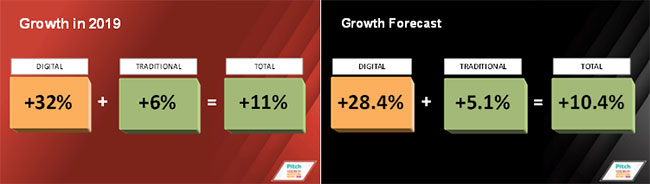
    Even while commenting on the growth rate, GroupM sounded buoyant by comparing it with the 5.1% growth rate of global ad spends in 2020 and ignoring the Indian ground realities while Madison described the growth rate as “muted” expecting the economy to bounce back only in the second half of 2020.

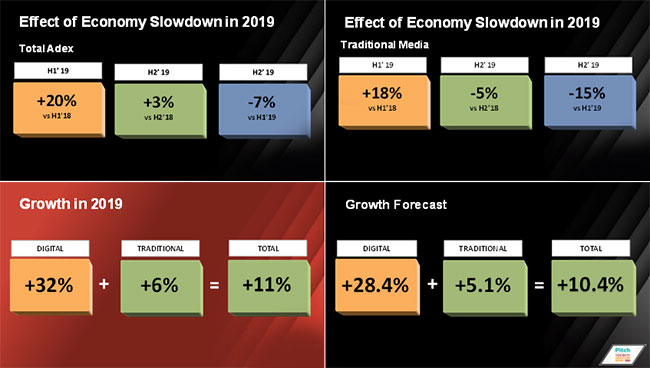
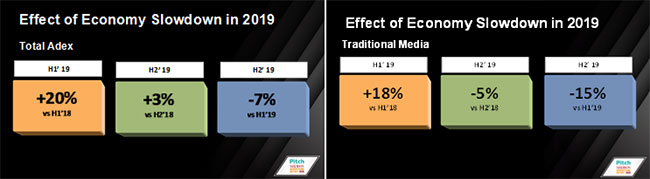
    PMAR 2020 is more firmly rooted in the Indian media and market scenario and has presented an excellent analysis of the ups and downs faced by the traditional media industry in 2019 and its consequences. In his presentation, Sam Balsara made an interesting observation by dividing 2019 in two halves and showing how AdEx grew very well during the first half riding on IPL, World Cup and Lok Sabha Elections, but collapsed during the second half due to economic slowdown. Balsara also showed how the traditional media suffered heavily during the second half of 2019, when compared to second half of 2018, there was a de-growth in second half of 2019.

    Balsara presented  charts showing that the Digital media grew by 32% in 2019 and projected a growth rate of 28.4% in 2020 as against traditional media which grew by 6% in 2019 and is expected to grow by 5.1% in 2020.

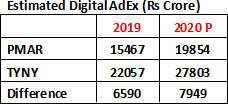
    He commented in his presentation that: “We also expect a wide variation of growth rates across mediums ranging from a low of 2% for Press, 5% for Radio, 6% for Outdoor, 7% for TV, to 20% for Cinema and 28% for Digital.” In 2020 TV will continue to enjoy the largest share of the advertising pie at 36% and Print may be demoted to number 3 with Digital securing a march over it. As of now, PMAR predicts 26.6% share for Digital and 27.4% share for Print in 2020. PMAR and TYNY also projects different estimates for the size of the traditional media, with TYNY estimating a value of TV AdEx almost 10000 crore higher than the value estimated by PMAR.

    The growth rates for Digital media estimated by TYNY is 28% in 2019 and 26% in 2020. Both the reports predict Digital as the main growth driver of Indian Adex in 2020, but there is again a significant differences between the estimated sizes of Digital AdEx.

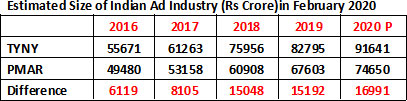
    GroupM has revised their estimate for total AdEx upwards for both 2018 and 2019 while Madison revised their estimate for total AdEx downwards for 2019 due to economic slowdown and various headwinds faced by the traditional media industry. As a result of these revisions made by the two agencies, estimated sizes of Indian Ad Industry by TYNY are now 15000+ crore higher than the sizes estimated by PMAR, a difference which is not only difficult to reconcile, but also creates confusion in the market place.

    By now, we have learned to live with different sizes of the Indian Ad Industry estimated by different agencies. PMAR estimates are most acceptable by the industry at large due to its ability to link the market realities with their statistics supported by analysis of trends in Ad Spends as well as in depth analysis of individual media. Balsara also adds an icing on his presentation every year through advice to advertisers which are considered to be extremely useful and this year he has excelled himself on that score.


    Indrani Sen is a veteran advertising and media agency practitioner. She is now also an academician. Her views here are personal