Tag: GroupM

  • So how do the GroupM & Madison forecasts compare?


    By Indrani Sen


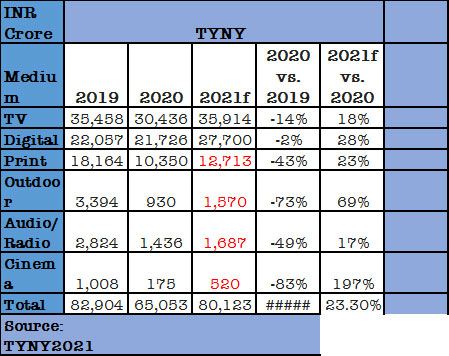
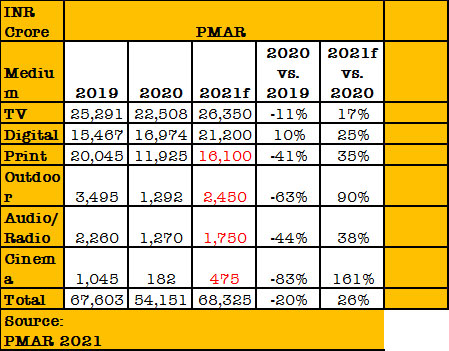
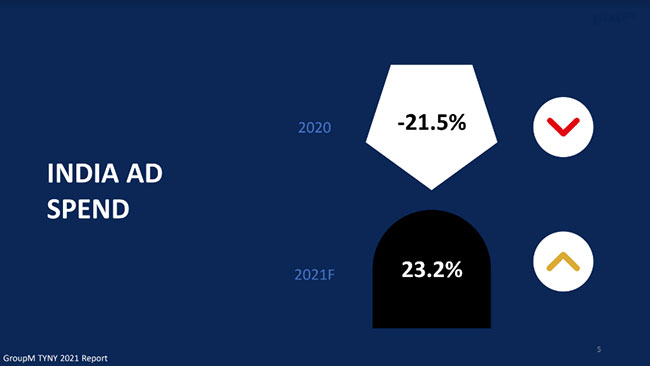
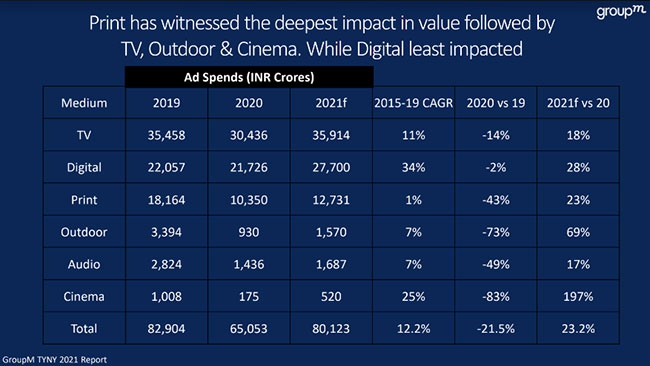
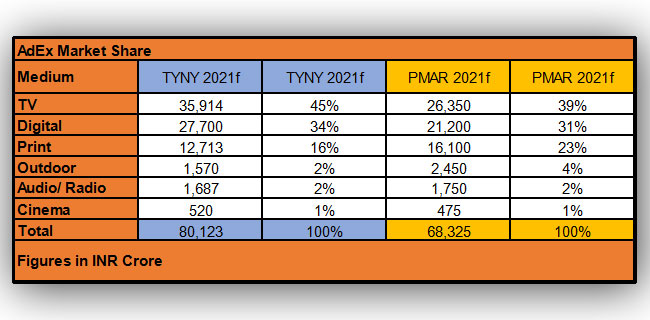
    Like every year, last week we saw the release of both This Year Next Year 2021 (TYNY2021) by GroupM and Pitch Madison Advertising Report 2021 (PMAR2021) by Madison Media. Both agreed that the pandemic year 2020 was a disastrous one for the Indian Media and Advertising Industry, when the overall AdEx dropped by 20% (PMAR2021) to 21.5% (TYNY2021) from the 2019 level. Both have predicted better days in 2021 with the overall AdEx growing by 23.3% (TYNY2021) to 26% (PMAR2021).  According to PMAR2021, the predicted AdEx INR 68,325 crore in 2021 will touch the AdEx INR 67,603 crore in 2019. According to TYNY2021, the forecast for 2021 is INR 80,123 crore, which falls short by 3.35% from the AdEx in 2019 which was INR 82,904 crore.


    In spite of the huge gap in the overall AdEx estimates by the two agencies, it is relieving to find that the trends predicted by both of them are similar. The gap in the estimated size of the Indian AdEx between the two reports has been existing over many years and the Media and Advertising Industry has learned to live with the differences. TYNY2021 has estimated both TV and Digital AdEx at much higher levels than PMAR2021. On the other hand, PMAR2021 has estimated Print AdEx at a much higher level than TYNY2021. The following two tables show the details of the two reports by medium for making easy comparisons.


    According to PMAR2021, the pandemic year 2020 will go down in the history of Indian Media and Advertising as the year when Digital overtook Print and became #2 in terms of market share of overall AdEx. However, TYNY2019 showed Digital as the #2 and Print in the #3 positions in terms of market share. In 2020, GroupM estimated a 2% degrowth in Digital from 2019 level, while Madison Media estimated a 10% growth in Digital over 2019 level. Both the reports show Print AdEx in 2021 would be below the 2019 levels, while Digital AdEx would be crossing the 2019 levels in 2021. So, we can now conclude that Digital has the second highest market share in overall AdEx and it is unlikely that Print would be able to regain that position in 2021 or later.


    TV which holds the #1 position in Indian AdEx in both the reports, had degrowth of 11% (PMAR2021) to 14% (TYNY2021) last year, but is expected to grow at higher rate 17% (PMAR2021) to 18% (TYNY2021) in 2021 and touch or cross the 2019 AdEx levels.


    Both the reports show the huge loss which was suffered by the other traditional media, Outdoor, Radio and Cinema during 2020.  In spite of the overall growth of AdEx predicted for 2021, these three media would be far below their 2019 benchmarks. The combined market share of these three media continues to be less than 10% in both the reports. A difference in reporting between TYNY and PMAR has been noticed this year regarding Radio. While PMAR2021 has reported only on Radio, TYNY2021 has changed the nomenclature to Audio. It is however not very clear what other audio component apart from Radio has been included under that definition.


    It is encouraging to find from the two reports that the worst effect of pandemic is over; Media and Advertising industry is on the path of recovery; the process of digitisation has been accelerated; we are expecting a robust GDP growth and globally India will continue to be the second-fastest growing AdEx market among the top ten countries in 2021. At the same time, it is also frightening that the economic effects of Covid-19 have manged to wipe off two years of overall AdEx growth (2020 & 2021) and many media-owners and some media agencies still have to fight battles for survival.


  • Trends That Will Influence Adland


    Courtesy GroupM


    As part of  the ‘This Year Next Year’ report presentation on Monday, GroupM captains presented a report on trends impacting the Indian advertising industry.


    Said Karthik Nagarajan, Chief Content Officer, Wavemaker India: “It has been an interesting year for digital marketers as the nation-wide lockdown brought about exponential growth in certain trends which were already on the up – whether immersive experiences like gaming, the rise of audio or influencer marketing. People have started gaining interest in localized content and now OTT – audio or video, has become a major part of their entertainment. We are also moving towards an era of fragmented social media, where creators will take precedence over communities. Also, with the consumer becoming more conscious by the day, we will see empathy becoming a constant thread in brand communications.”


    Sharing some light on the trends, Bharat Khatri, Country Head, Xaxis India added: “Brands are aggressively looking at deploying new tools, data & cloud infrastructures which has resulted in the acceleration of digital transformation post Covid-19. With the increase in demand for different platforms, creativity and localized content, the advertisers have plenty of opportunities to reach consumers through engaging via different audio/video formats & achieve real outcomes in a device agnostic world. In short, the brands are continuously looking out for new ways to reach out to connect with their consumers and make the relationship stronger. We also see that Gen Z has been making a lot of their decision basis social media platforms and this coincides with the rise in new age ecommerce platforms.”


    Here are the 10 trends:


    1) From Carefree To Conscious – The Great Shift In Consumer Behaviour

    • During the lockdown, there was a 42% growth in searches to know “what’s normal” forbody stats like BP, body temperature and blood sugar

    • Browsing content on healthy cooking went up by100%

    • All this point to a marked change in what the user is seeking, towards self-preservation and wellness

    • Thisis also further accentuated by over 52% rise in content consumption on pets and a 70% increase in searches related to Yoga

    • This behaviour change will also imply how they look at Brands and consumption at large – Consumers are also more likely to embrace brands who showcase empathy and care aboutthe larger world /environment

    • This is presenting an opportunity tobrand

    :: Back of the pack = front of thepack

    :: Highlighting goodness in every possibleway


    2) Everything Is Becoming Hyperlocal

    • What is happening in your immediate surroundings – whether town or district istaking precedence over what is happening in the country or the World

    • Oneof the biggest indicators of this is the surge in regional language news & content during the lockdown

    • We are seeing similar trends in digital consumption as well in terms of the rise of more regional news and content consumption– in platforms like Daily Hunt and share

    • This also is happening simultaneously as our capability to sharp shoot communication has increased– for example, our ability to do Pincode-level targeting, thanks to multi-faceted data


    points on the audience or targeting based on distribution pattern or market share in specific locations.

    • There’s saying that- Every 15-20 km, the language, dialect, music, food, … everything changes in India

    • Brand owners have opportunity to leverage this and drive precision @scale


    3) Driving Up The Subscription Bandwagon

    • 2021 would “once-in-for-all” smash the adage that “Indians don’t pay for content” and drive up thesubscription game for Sports and other forms of quality original  It’s creating a direct 2 consumer opportunity.

    • Thereare many OTT player who has achieved their subscribers target 12- 18 month ahead of  This is not limited to live sports and premium video content – there’s the start of a similar trend in news, audio content and premium domain-specific content in small ways.

    • Platformslike Substack helping talented Journalist reach direct to their readers and monetize their content.

    • 2021 is also going to be an interesting year for sports – 2020’s loss, in terms of sports events, is 2021’s gain. Global sporting events like Euro 2020 and Tokyo 2020 are due to happen this year. Add to this, local favourites i.e., IPL 2021 (within 6 months of its previous edition) and ICC T20 (which would be hosted in India) and you’ve quite a field day for Indian sports fans and broadcastersalike! an Indian Sports Fan as s/he would be battling questions on what to subscribe, when to subscribe, how long to subscribe, where to watch and many such conundrums

    • Interesting time ahead for content industry and distributionplatforms


    4) Gaming & Esports Growth – More Than Time Pass

    The next generation of entertainment is immersion and engagement while gaming will be a natural winner there

    • 5G

    • VR

    • Gaming

    Gaming will become not just about time spent but also a cultural destination. The nature of this entertainment is not a lean back but a more immersive one. Music concerts and other experiences will also be activated on esports platforms. A handful of businesses can talk positively about 2020 and COVID- 19… One such benefactor is gaming and esports. In peak lockdown during Apr’20, there was an 11% increase in users per week and has seen a rise in the number of gamers where 66% of new gamers are females and 56% of new gamers are above the age of 45. Now gaming as an industry has evolved in multiple ways too. Most companies in this industry are looking to create platforms that will be central to an individual’s life where activities, like shopping, socializing, events (especially esports) can all be done in virtual and interactive ways. During the lockdown, esports live-stream viewership grew by 61% and 66% in week 1 and 2, respectively. These are great signs, considering that despite the majority of the on- ground esports events getting pushed in 2020, the gaming fans have held their own. With 2020 contributing immensely to gaming habit formation; for 2021 to be the year of esports, organizers need to focus on building career opportunities starting with improved prize money pool.


    5) Platforms Will Become Creator Led Than Community-Led

    The entry barrier for social platforms used to be the network effect. a.k.a how many of my friends/people are there on the network. As we move towards an ecosystem where people join platforms more for the experience and creators on it, this barrier will be lowered significantly. We are possibly looking at 4-5 different platforms with a 100 Million plus user base, not far from now


    Influencer content for brand building will sustain but a majority of categories will move towards a performance mindset for advocacy. Newer platforms, driven by creators already have seamless commerce features built-in. This will spur content-to-commerce in a big way in 2021. The journey from platform-based advocacy to an integrated strategy for brands will now scale to include commerce as well. This will also bring in more industry guidelines on influencers disclosing brand partnerships.


    6) Immersive audio becomes a cultural movement. Finds a loyal audience across age demographics

    As we predicted last year, audio has truly made its comeback in style. Platforms like Clubhouse are seeing great traction and audience for podcasts has grown manifold in India in 2020 and the MAUs are already where social media was a few years back. The IAB has just released technical guidelines for podcast measurement in the US. In India, standards and guidelines will emerge and be solidified, as we are reaching critical mass. Given the proven efficacy of audio on brand recall, this will be extremely critical for brands looking to make cultural interventions.


    7) Digital Transformation – ROI To Opportunity Cost

    Leaders are aggressively deploying new tools, data & cloud infrastructures, the digital transformation process got accelerated post-Covid. This will help create new age “Marketing Digital Infrastructure “and replace old tech which was becoming a barrier to fast-track digital transformation. Advancing towards a P3PC (post-third-party cookies) has accelerated the long-term data strategies plan to own the consumer where brands have already started to deploy CDPs (Customer Data Platforms) to transition from segment audience data approach to individual consumer profiles. The industry will continue to see this trend in both advertiser & publisher ecosystem on putting more focus towards 1st party data activation powered with contextual targeting.


    8) Streaming Wars- In a Device Agnostic World

    2020 pandemic turned out to be an opportunity in crisis for OTT industry in India. Connected TV is simply becoming the new TV. It is the way large segments of consumers will access premium content. As we see by its current use for reach extension, CTV is a medium through which mass brand messaging can continue going forward. The fact that it is more targetable and measurable than ‘old TV’ enables marketers to elevate and personalize their messaging when appropriate. So, it can be the best of both worlds. Growth in SVoD may sound bad news for advertising, as largely SVoD platforms are ad-free. But in India, the home- grown broadcaster & independent OTTs at an early stage only has adopted hybrid multi-tiered monetization model by giving the audience the choice of both free, ad-supported content & premium subscription offering. This is giving advertisers plenty of opportunities to reach consumers through engaging video formats & achieve real outcomes in a device-agnostic world. In 2021, this advertising channel will continue to have a lion share in programmatic spends & will also bring incremental budgets from the traditional/linear TV pie. With increased spends, we will also see advertisers adapting to more evolved, efficient & effective programmatic buying methods like PMPs (Private Market Place) to get a unified consumer view & thus maximizing the ROI from video spends.


    9) Connected Commerce- The Customer-Convenience Imperative

    E-commerce platforms have become an indispensable digital channel to reach target audiences and influence sales. Marketers will need to think like DTC brands – embracing emerging technologies, customer service obsession and adaptive messaging to get closer to their consumers. DTC brands have excelled at creating 1:1 relationship with their consumers since they have closed-loop measurement within their customer journeys. Shoppable Ads are on the rise as Genz are deciding on social media videos. These new media formats play an important role in cultivating better outcomes overall for an advertiser. In 2021, we will see a big shift of spends happening from current market-leading DSPs especially in display channel towards the new age e-commerce DSPs like Amazon, Flipkart, Paytm. Categories, where spend shift, is quite inevitable are FMCG, BFSI, Grocery, Apparels, Health & Personal care, as ecomm DSPs offer end to end marketing funnel solutions with efficient ROAS.


    10) Bringing Creativity Back Into Digital Advertising

    The industry is recognizing that creativity is the first step to grabbing attention and enhancing the influence, and media buying should aim to match advertising messages with real consumer behaviours, not just attributes. Brands need to embrace AI to boost personalization at scale. It is like feeding an algorithm with historical & real-time data and then letting AI perform analysis, build & serve the user hyper-personalized message. Traditional personalized creative tools were built for targeting customer personas or profiles, where each profile used to represent a category of consumers, however, in case of AI personalization tools it is like engaging with each customer as an individual profile. With increased social commerce share, AI-based hyper-personalization engines will be the need of the hour, as it will improve both ROI & customer experience.

  • Achche Din… GroupM forecasts 23.2% in CY2021

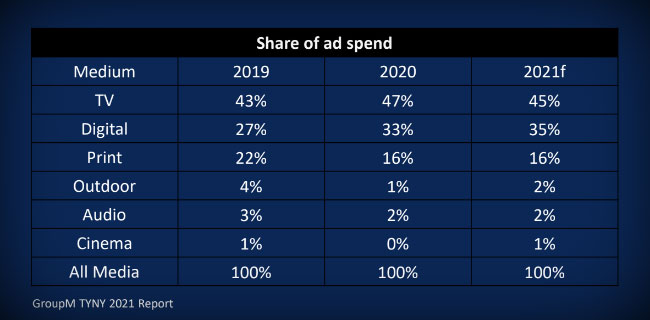
    GroupM share of adspend


    By Our Staff


    GroupM India has announced its advertising expenditure (AdEx) forecasts for 2021. As per the GroupM futures report ‘This Year, Next Year’ (TYNY) 2021, India will see a major ad recovery in 2021 given the downfall of ad spends in 2020 due to the pandemic.


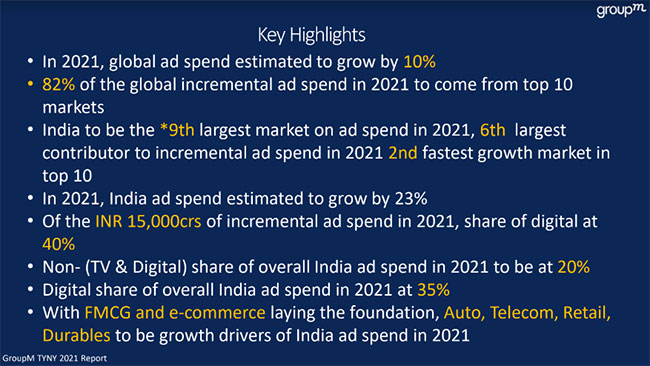
    TYNY forecasts India’s advertising investment to reach an estimated Rs. 80,123 crores this year. This represents an estimated growth of 23.2%, for the calendar year 2021. India is the 2nd fastest growing market in the top 10 countries and will be the 6th largest contributor to incremental ad spends in 2021 globally. While India was ranked 9th in the global ad spend rank in 2019, it dropped to 10 in 2020 and is likely to regain its 9th rank this year.


    Prasanth Kumar, CEO - GroupM South Asia
    Prasanth Kumar

    Commenting on the TYNY 2021 report, Prasanth Kumar, CEO – GroupM South Asia said, “2020 was an unprecedented year. The pandemic impacted across sectors and it, therefore, affected the media investments too. As we are aware, the year that went by had a mixture of lockdowns, many restricted market momentum and overall threw a challenge and impacted multi-industry economies. The ad industry too had its challenges and 2020 witnessed a steep drop in the overall media investments. However, we have witnessed a month-on-month upturn in the industry starting Q3 last year and we are quite optimistic about the revival that 2021 will see. With the gradual easement of the lockdown backed by seasonal spends and big-ticket events like IPL, we expect 2021 to continue to build on that momentum. While the global ad spends are estimated to see a rise of 10% in 2021, digital is expected to take 67% of ad spends. With the help of technology, marketers have adapted to pandemic-proof ways by constantly innovating, staying relevant and offering digitally charged solutions to brands.”


    Digital was the only medium to witness a gain of USD 27bn globally in 2020. Digital as a media vehicle will continue to skyrocket due to the increase in digital dependency and changing consumer patterns.


    Tushar Vyas, GroupM
    Tushar Vyas

    Added Tushar Vyas, President – Growth and Transformation, GroupM South Asia: “2021 will see 90% incremental ad spends on digital globally. The massive switch to digital reliance over the past 1 year has been a major driver for this shift. Brands have been forced to think big and different to transform their businesses, match the newer expectations and overcome the challenges faced. The post-pandemic era will continue to see this upsurge in digital demands. The crisis has brought about a sea change in mindset, adoption, and role of technology in doing business. Brands are seen renewing their business models and are constantly ideating to find better ways to connect with the consumer on a digital tangent.”


    Ashwin Padmanabhan
    Ashwin Padmanabhan

    While Covid-19 resulted in an overall slowdown in the global economy, Indian adspends will continue to see a month-on-month recovery considering the overall media landscape. Said Ashwin Padmanabhan, President – Partnerships and Trading of GroupM India: “Based on a strong foundation built on the back of FMCG and e-commerce, 2021 is expected to see growth across sectors like auto, telecom, consumer durable, retail and education. Manufacturing, which was severely impacted by the pandemic, is now stabilising and moving toward a positive outlook enabled by automation, technology and supply chain optimisation. 2020 has accelerated the adoption of agile, cost-effective business models, which will help brands and marketers offer better products, services and experiences to consumers.”


    Sidharth Parashar, President - Investments and Pricing, GroupM India
    Sidharth Parashar

    Added Sidharth Parashar, President-Investments and Pricing of GroupM India: “Along with digital, television saw a spike in consumption during the lockdown. With acceptance on the subscription bandwagon increasing, OTT will continue to witness a constructive growth and is likely to develop with more players attracting users by investing in content. Print & Radio expected to be backed by local advertisers and certain categories with marketeers leveraging the brand solutions that these media offer. We expect OOH and cinema to see double-digit growth after a difficult year. Given the uncertainty and cautiously spending consumer, brands are realising the importance of being present wherever consumers are. Hence along with continued relevance of television & other mass media, we will witness advertisers leveraging relevant platforms to reach out to its audience.”


    GroupM TYNY Key Highlights

  • The Insurrection & The Media


    By Brian Wieser


    Key takeaways from this week’s note:

    • Twitter’s permanent suspension of U.S. President Donald Trump’s account in the aftermath of this week’s insurrection in Washington, D.C. is an important and necessary action. Beyond helping to limit real damage to people and society, it will help to improve the platform as an environment for brands.


    Unfortunately, this was the most newsworthy issue of the past week. The Donald Trump-inspired insurrection and related fatalities in Washington D.C. on Wednesday was an unfortunately unsurprising consequence of many years of extremist rhetoric and misinformation.

    While the individuals who originally conveyed knowingly false information certainly bear the bulk of the blame, they would not have been as likely to succeed if they did not have some means of amplification.


    Over the past decade, in many countries around the world, misinformation has been widely shared and violence has been directly encouraged or organized by individuals using social media platforms. There are signs of changes to limit related content, but more still needs to be done. Historically, platforms often tolerated incendiary content and, in many cases, they amplified it. Efforts intended to address negative consequences have broadly been insufficient.

    News on Friday that Twitter would permanently suspend U.S. President Donald Trump’s personal account, along with separate reports that Apple and Google are threatening to ban Parler from their app stores, was a significant illustration of an enhanced focus on addressing the problems that have followed.

    On the other hand, for however many actions platforms take, problematic activities will likely continue to originate on social media because small percentages of lesser-known users can still equal millions of individuals or more than enough people to inflict significant harm to societies.

    What will catalyze the platforms to pursue more impactful changes?


    Sufficient force probably won’t come from consumers, who don’t generally pay for access to social media in the first place. Consumers have not significantly altered their reliance on these platforms and don’t seem likely to change their habits in meaningful ways any time soon. Social media’s underlying algorithms are undoubtedly effective at contributing to usage even among consumers bothered by what they know about the problematic content on the platforms.

    But why is this?

    Is it because consumers don’t consider the possibility that their activities and consumption patterns may partially enable the presence of conspiracies consumed by others?

    Or because they know platforms broaden the availability of hate-inspiring content but accept this reality as a trade-off to access the content they believe they need?

    Or perhaps because they typically only see their feeds and generally agree with what they see and determine that the problems are due to other users?

    Whatever the underlying reason, consumers are not likely to force platforms to take comprehensive actions.


    How about advertisers? Not likely here, either. Advertising collectively enables the good and the bad associated with social media, as there is virtually no other revenue stream for these media owners.

    Advertisers’ historical efforts to force platforms to eliminate the bad, however well-intentioned, have proven to be insufficient because even very large groups of budget-holders are far too fragmented to make much of an impact on companies with millions of individual customers.

    The vast majority of marketers have generally decided that, if audiences are using these platforms, it’s reasonable to try to reach consumers where they are regardless of any indirect or long-term consequences that may follow. If users don’t abandon the platforms and don’t attach negative considerations to sponsoring brands, it’s hard to imagine noticeable spending changes.

    Of course, brands still need to consider long-term implications.

    In the same way they can be connected to positive societal outcomes associated with the media owners they support; they can also be connected to negative social consequences enabled or encouraged by those same companies. At a minimum, marketers can ensure they limit the degree to which their brands are attached directly to problematic content on short notice with rapidly implemented “circuit-breaker” processes to pause spending or enhance content filters at sensitive times.


    Government may offer one partial solution to the problem. In a potentially ironic coda to the Trump era, the events in D.C. could contribute to increased interest among legislators in repealing Section 230 of the Communications Decency Act, as this would potentially expose platforms to financial consequences if they are deemed to have enabled or failed to prevent harm.

    Ensuring that platforms hosting or amplifying content that brings harm to individuals bear some financial or other legal consequences would likely deter much of the problematic activity on those platforms.


    These platforms need to take even more responsibility, too. They could choose to make changes themselves, if only out of the self-interest of preferring to operate in a society driven by fact and with less civil strife. Certainly, we can view Twitter’s actions on the Trump account through this light.

    More generally, if they want to continue to ensure they provide an environment for everyone to share content, they could choose to host problematic content without supporting the mass distribution or sharing of that content.

    Perhaps they could formally authorize only a select number of people—again, as determined manually by the platform itself—to benefit from automatically amplified content. Such solutions would undoubtedly be costly, although not necessarily prohibitively so, and probably would reduce usage.


    Perceived costs would not be as severe as the platforms (and investors) think they are. They likely deter change, but we would argue they shouldn’t. Platforms tend to believe that reduced usage levels would lead to reduced advertising revenue, based on the flawed premise that a change in supply directly causes a change in demand for a medium.

    Although this can be true in very broad strokes—a medium with 10x more or 10x less consumption will undoubtedly see an impact on total spending—within most realistic ranges, spending on a platform would be unchanged if usage falls.

    Of course, there could be an impact on the share of advertising inventory a given media owner has to sell within the medium; this would have a revenue impact for any given company. The impact, however, would likely be modest.

    More importantly, lost consumption from reduced amplification of incendiary content could be partially offset by increased consumption by consumers who have been bothered enough by what happens on the platforms to stay away from them. This is especially true for individuals who have been trolled or who hear hateful content directed to them.

    Brands that want to minimize their exposure to toxic content might also feel more favorably disposed toward media owners who don’t tolerate it and allocate relatively more money to those media owners as a result.

    In the case of Twitter specifically, we would expect that a reduction in incendiary content will make the platform more favorable to its advertiser base, given their larger-brand skew.

    Of course, social media platforms aren’t the only media companies transmitting the misinformation or incendiary content that is so damaging to societies. Content supported by advertising and consumers’ subscription fees on radio, television and streaming services plays a significant role.

    Over many years, every packager of incendiary content could more aggressively attempt to limit its production and distribution. At least they should because the aggressively oriented elements of modern society are unfortunately unlikely to back down on their own any time soon. Responsible citizens, social media companies and companies of all kinds should do everything they can to avoid enabling them.


    Brian Wieser is Global President, Business Intelligence, GroupM. Republished from https://www.groupm.com/global-marketing-monitor-weekly-market-trends-jan-9-2021/

  • Purplle appoints Essence as integrated media AOR

    By A Correspondent


    Essence, GroupM’s data and measurement-driven media agency, announced that it has been awarded integrated media agency of record duties for beauty and personal care ecommerce platform Purplle in India. Led out of Mumbai, Essence’s mandate will include strategy, analytics, media planning, media activation and content innovation for Purplle’s brand marketing campaigns offline and online.


    Said Manish Taneja, Co-Founder and CEO, Purplle: “As a key player in the online beauty and wellness segment, it is essential to connect effectively with the burgeoning consumer base in the ever-evolving beauty landscape. Essence’s expertise in the media ecosystem will help us reach the right set of audiences, and engage with them through both new age and traditional mediums. This strategic partnership will help drive the next phase of transformation and growth for Purplle,”


    Added Atrayee Chakraborty, Vice President, Media Planning, India, Essence: “The team at Purplle has been building an impressive online space and shopping destination for beauty and wellness needs. With our new partnership, we are looking forward to helping Purplle further scale its efforts and accelerate its business growth. Leveraging Essence’s expertise in data, analytics and measurement, as well as experience with fast-growing, technology-driven direct-to-consumer brands, we are excited to create even more valuable experiences for Purplle’s existing and future customers,”


  • Wavemaker retains media duties of Perfetti Van Melle

    By A Correspondent


    Wavemaker India has announced that it has retained media duties for Perfetti Van Melle. The GroupM agency has also been entrusted with integrated media duties for Perfetti Van Melle India.


    Wavemaker India has been Perfetti’s media agency on records since 2006 in India. The multi-agency pitch saw participation from other leading agencies. The account will continue to be handled out of Gurugram office.


    Commenting on the association, Rohit Kapoor, Director Marketing,Perfetti Van Melle India said: “Wavemaker team has been a trusted partner for nearly 14 years now and we are delighted that our partnership will start its third innings after a well-contested integrated media pitch process. Wavemaker has over the years played a significant role in our success and we hope this innings will be an equally good one for both of us.”


    Speaking on the retention, Ajay Gupte, CEO – South Asia, Wavemaker added: “We are extremely thrilled to renew our relationship with Perfetti Van Melle. It is a matter of great pride to win additional mandate of integrated media and continue the traditional media mandate. I am confident with our new operating system, newer models in analytics, e-commerce and media we will be able to unlock growth and drive further efficiency to the brand”.


    In addition, Wavemaker has been appointed by the sweets giant to handle the account in other main markets US, China, Netherlands – as well as in the UK, MENA, Belgium, Turkey and Indonesia – after a series of local pitches held throughout 2020. Wavemaker now handles 85% of Perfetti Van Melle’s global media spend.


  • Mamaearth mandates Essence for integrated media

    By A Correspondent


    Essence, a global data and measurement-driven media agency that is part of GroupM, has announced that it has been selected as the integrated media agency for personal care brand Mamaearth in India. Managed out of Essence’s Delhi office, the agency will be responsible for media planning and activation for Mamaearth’s brand building and awareness campaigns.


    Said Varun Alagh, Co-Founder and CEO, Mamaearth: “As a digital-first brand, we are constantly connecting with millennials on a product and brand philosophy level. With ever-evolving consumers and the way they consume content, it is important to be present across new age media platforms to be able to speak to them. Our partnership with Essence will help us achieve this goal by identifying the right media mix and expedite the next phase of our growth journey,”


    Added Yoginder Jain, Vice President, Client Services, India, Essence: “In a market where there is increasing consumer consciousness towards personal health, the environment and cleaner living, brands with the right purpose are set to win. Mamaearth has created a distinct space for itself and is perfectly placed to ride this growing opportunity. Our team at Essence is delighted to help scale Mamaearth’s business with our pioneering approach to data and analytics. We strive to make brands valuable to the world and are looking forward to delivering this for Mamaearth.”


  • Ajit Varghese joins ShareChat as Chief Commercial Officer

    By A Correspondent


    ShareChat, the social media platform in Indic languages, has announced the appointment of Ajit Varghese as its Chief Commercial Officer.


    Prior to joining ShareChat, Varghese was Global President at GroupM;s Wavemaker and worked with industry giants like  Vodafone, L’Oreal, Huawei, IKEA, Paramount Pictures, Chanel, Xerox, Netflix, Chevron, Beiersdorf, and Tiffany.


    Known to be an exceedingly passionate leader, at ShareChat, Varghese will expandi and  strengthen the platform’s revenue efforts, and building a robust monetisation approach with strategic content partnership. He will also spearhead its marketing functions, to be inclined towards brand elevation, aligned with business centricity. He will be reporting into Farid Ahsan, COO and Co-founder at ShareChat.


    Welcoming  Varghese,  Ahsan said: “Brand marketing and monetisation is going to be the core focus of ShareChat and we will direct our efforts towards elevating the brand positioning through strategic communications approach. Ajit, with his leadership capabilities and expert knowledge of the media, marketing and advertising domain, will play a critical role in further building brand awareness, deepening relationships with our business stakeholders and driving ShareChat toward the next phase of growth. Having held many globally influential   roles across his 25+ years of experience, his expertise will help us build ShareChat for the future and it is a matter of great pride to have him on our leadership team.”


    Added Varghese: “Having previously worked and transformed several global organisations, it has always been a hidden desire to contribute towards transforming an Indian organisation to global repute. I believe ShareChat in the next few years will evolve as the default partner to every brand, homegrown and global, who intends to engage with the internet-first population. As the digital advertising landscape awaits the inclusion of over 400 million new internet users, mostly inclined towards native languages, ShareChat will stay at the forefront of unveiling a new digital era. This will be an exciting journey for me as I look forward towards contributing to ShareChat’s growth and building a win-win relationship with our community of users, partners and business stakeholders.”


    An alumnus of Xavier Institute of Management, Bhubaneswar, and a graduate in agriculture engineering from Orissa University of Agriculture and Technology, Varghese has worked across India, Singapore and London and in leadership in Wavemaker (WPP), Maxus (WPP) and  Madison World.


  • Global ad market to grow 12.3% in 2021: GroupM

    By A Correspondent


    Group M has updated its our 2021 outlook for the global advertising market from its June forecast of 8.2% to 12.3% growth.


    Here goes the report:

    Looking at the eight largest markets—the U.S., China, Japan, the U.K., Germany, France, South Korea and Canada—we expect seven of them to see declining growth of nearly 2% and worse in 2020. The exception is China where we expect a rate of growth in China at 6.2%. The good news, though, is we expect all these countries to show growth in 2021: 11.8% in the U.S., 15.6% in China, 12% in Japan, 12.4% in the U.K., 4.6% in Germany, 7.2% in France, 1.6% in South Korea and 15.1% in Canada.


    And  this is the overall forecast for the industry:

    Advertising weathered the storm relatively well and will end up declining by “only” 5.8% on an underlying basis (excluding-U.S. political advertising), a much better expectation than our June forecast of an 11.9% decline for 2020.

    The nature of the downturn and new consumer behaviors forced businesses to rapidly adapt to e-commerce models, and digital advertising benefitted.

    As such, we’ve updated our 2021 outlook for the global advertising market from our June forecast of 8.2% to 12.3% growth.

    Each of the top eight markets is expected to grow by nearly 2% and better in 2021.

    Understanding that context, here are the six key takeaways from This Year, Next Year: Global 2020 End-of-Year Forecast Report:


    Digital advertising is expected to grow by 8.2% during 2020, excluding U.S. political activity. This follows nearly a decade of double-digit growth, including the last six years, when it was better than 20% globally.

    Digital advertising for pure-play media owners like Amazon, Facebook, Google, etc., should be 61% of advertising in 2021. This share has doubled since 2015 when it was only 30.6%.

    By 2024, we estimate digital advertising will have a 66% share globally.

    Television advertising will decline by 15.1% excluding U.S. political advertising, before rebounding to grow 7.8% next year.

    Digital extensions and related media, including advertising associated with traditional media owners’ streaming activities (primarily on connected environments), will grow 7.8% this year and 23.2% next year.

    Outdoor advertising is estimated to decline by 31% during 2020, including digital out-of-home media. Next year should see a partial rebound, with 18% growth.

    Beyond 2021, we expect outdoor advertising to grow by low- or mid-single digits and generally lose share of total advertising; however, we do expect larger brands generally to allocate more of their budgets to the medium.

    Cinema is newly separated in our global forecast for markets where data could reasonably be estimated. The global sector likely generated less than $3 billion during 2019 and likely fell more than 75% during 2020 given the absence of major studio releases in most markets around the world.


    Print advertising, including newspapers and magazines, is expected to decline 5% for the year, a significant acceleration over the high-single-digit declines of recent years. However, those single-digital declines should resume following an economic recovery.


    Audio advertising is likely to decline by 24% during 2020 as advertisers disinvest, in part, because of the medium’s dependence on away-from-home activities, such as driving. Digital extensions, including streaming services from terrestrial stations and their digitally-oriented competitors and podcasts, still attract relatively small audiences of a few billion, but help make the broader medium more appealing to marketers.


  • Rural India likely to bounce back faster than urban: Kantar & GroupM’s Dialogue Factory

    By A Correspondent


    Insights and research major Kantar, along with GroupM’s experiential marketing unit- Dialogue Factory, have unveiled a Rural Covid Barometer Report. This report provides a provides a unique, fact-based perspective on consumer sentiments, their consumption choices and the behavioral changes brought about by the pandemic. This survey was conducted in 17 Indian states and deep dives into the lives of rural consumers and their adaptations post Covid, providing valuable inputs for any brand’s rural strategy.


    The lockdown amidst Covid has brought about varied changes in the lives and livelihoods of Rural India. Loss of income, socio-cultural norms, health and hygiene protocols and reverse migration are some key challenges faced by the rural population during the pandemic.


    The report highlights emergence of new trends which will necessitate changes in the way businesses and brands connect with rural consumers:


    :: Heightened focus on rural affluent consumers: The report suggests that with 1 in 3 rural adults being impacted by COVID-19, the rural economy is likely to take a hit. However, with fewer job losses and consequent reduction in the incomes of the affluent households, the overall impact on rural consumption pattern is likely to be muted in the future. This presents an opportunity for the businesses to sharply target their brands towards the upper end of the rural consumer spectrum

    :: Quest for balancing the budget: The rural Indian is walking the tight rope and is balancing the budget by cutting on “indulgence” categories like cold drinks, ready to eat snacks like chips etc. and diverting the savings towards hygiene products

    :: Digital adoption: Like their urban counterparts, rural Indians are increasingly relying on digital services for their day to day activities. With the pandemic accelerating digital adoption, there is a huge potential for businesses and brands to leverage mobile as a medium to reach rural consumers

    :: Focus on the future:  The pandemic has heightened the worries around health and safety. The study highlights that rural Indians are today more concerned about their future well-being; especially of the chief earners.  With a relatively weaker health infrastructure as compared to urban areas, the mindset of rural Indians is shifting towards financial planning. They are also considering buying health and other insurance products. This opens a large market for the BFSI segment.

    :: Last mile connectivity: With commute being restricted, the rural consumer is now increasingly shopping within the village for their FMCG needs. It is therefore imperative for the brands to focus on their distribution and last mile connectivity, since product availability in the local village stores will significantly impact brand choices of the rural shopper


    Dalveer Singh

    Said Dalveer Singh, Head of Experiential Marketing- APAC, Dialogue Factory: “Rural India has always had a higher degree of resilience which makes it more confident for a rapid recovery than the urban areas during these unprecedented times. This report; which is one of the biggest assessment of the impact of the pandemic on rural areas, speaks volumes on the new, defining values that are shaping rural India – resilience, planning for future, protection from falling sick and growing reliance on digital.”


    Puneet Avasthi

    Added Puneet Avasthi, Senior Executive Director, Insights Division, Kantar: “For businesses, we would recommend a regional prioritization. We believe that the Western India is likely to bounce back earliest. On the other hand, indications seem to suggest that rural South might take longer to recover as the impact of COVID 19 on employment has been more severe, which in turn has depressed the economic outlook of consumers in rural South. We see this as an opportunity for brands to deploy their resources across zones in a graded and phased manner”


    The report also assessed the impact of reverse migration. The study suggests that nearly 53 million migrant workers in India have returned to their villages. 80% of migrants who have returned to due to COVID come from 5 States. Commented Avasthi: “With 1 out of 3 rural migrants not planning to go back to urban India, we are likely to see a huge shift in rural consumption choices. This will also affect the availability of labor in urban India”


    The report also highlights a deep sense of optimism regarding India’s economic future; stemming from a healthy growth in the agricultural sector and near universal reach of targeted government programs (75% of all consumers claimed to have received at least one of the major government schemes for Rural India; 66% claimed to have received free rations under PM Garib Kalyan Yojana).

  • Spends decline of 4.4% in UK, 9% in US: GroupM TYNY


    By A Correspondent


    This is the time when various media agency networks release their annual forecasts. There’s GroupM, IPG Mediabrands and Zenith. And first off the block this year is GroupM. The reports are for the UK and US markets, but these are good indicators of what’s happening across the world.

    Given that the two media economies have a significant penetration of adspends in digital, normally what holds good for UK and US and many other digitally developed markets does not hold for India.

    But this year, things may change, and hence it becomes important for a careful study of the study.


    Chalo, let’s read what has been put up:


    The UK: A Decline of 4.4% for 2020

    It could have been worse. Nine months into the COVID-19 pandemic, the scale of its impact on the U.K. is relatively clear by now. Overall, our forecast predicts a decline of 4.4% for 2020, which is much improved over our prior expectation of a 12.5% decline that we forecasted in June. While the economy was historically weak as anticipated, marketers both large and small proved to be relatively resilient. ​

    One of the “bright spots” of advertising in 2020 has been in digital. We estimate that pure-play digital advertising will grow by 4.9% during 2020, following 2019’s 16% rate of growth. Next year should see additional growth of around 12%, tapering off toward 7% after 2021. While this year’s gains look strong in comparison to the rest of the industry, it reflects significant deceleration versus prior years.

    Additionally, e-commerce growth in the U.K. has seen accelerated growth—53%—economy-wide during the third quarter. We anticipate that e-commerce-related advertising will continue to experience rapid growth, rising around 50% this year and 66% next year, reaching £2.4 billion in media owner ad revenue by 2024.

    In television, for 2020, we estimate it will fall by 10%, the worst rate of decline since 2009, but better than we anticipated earlier this year. Our 2021 forecast now anticipates a 10% gain and a return to 2019 levels in 2022. Although streaming services receive much of the industry’s attention, traditional ad-supported television continues to do the bulk of the work supporting marketers’ brand-building efforts. SVOD is drawing consumption away from conventional TV, at least in line with the heightened levels of investment going into the new offerings from the media owners themselves. But legacy media owners’ platforms are finding ways to add value for their customers.

    Some other key takeaways:

    Print media, including newspapers, magazines and their digital extensions, will account for 7% of media owners’ ad revenue in 2020, down from 9% last year. We expect a decline of 23% this year, followed by a rebound of 13% in 2021.

    Out-of-home advertising is set for a decline of 45% in 2020; however, much of that loss should be regained next year, when we expect the medium to expand by 31%. Digital formats, which now represent around 60% of the medium’s activity, will continue growing next year and beyond.

    Cinema has been most heavily affected by the pandemic, with an estimated decline of 80% for 2020; however, we expect a strong rebound of 160% in 2021 as film studios seek to monetise their backlogs with a surge of highly anticipated launches. While this rebound may seem optimistic, we note that it only brings cinema back to 52% of pre-pandemic advertising spend.

    For 2020, we think audio will fall by 16%, and we expect growth of nearly 12% in 2021. The bigger question is what happens in the years beyond? The effectiveness of audio-based media has rarely been in doubt, though its appeal has been somewhat limited, as the medium commands only 2% of industry spending. Arguably, this presents opportunity for growth over time, especially as new digital formats emerge.

    For 2021 and beyond, Brexit uncertainty still weighs on the British economy. While the implications for media might not be obvious, the macroeconomic impact is potentially significant. At a minimum, our forecasts anticipate some degree of disruption to the economy in the early part of 2021 as adjustments are made; however, we think Brexit’s impact on the advertising market will be limited to a shift in spending away from the first quarter rather than meaningful full-year cuts. More generally, we continue to assume that “normal” activity will return by the second half of the year, which pre-supposes that Brexit will not cause ongoing problems and that an effective vaccine will be widely distributed across the population.


    **


    The US: Digital Advertising is the ‘Bright Spot’

    Despite a pace of economic decline that will produce the worst economy since the Great Depression, the ad market might end up falling by little more than we saw 2001. It will certainly be better than in 2008 during the fallout of the global financial crisis.

    And much like the overall economy, the advertising industry is experiencing a K-shaped recovery – the pandemic has seen rapid acceleration for e-commerce and advanced digital services and cratered industries like restaurants, bars, travel, entertainment and traditional retail.

    The bright side, though, is that the underlying rate of decline for advertising is not quite as bad as we thought it would be in our June forecast when we predicted a 13% decline. We think the decline will be closer to 9% because of the strength in digital advertising in particular or, more specifically, the unexpected pace at which digital’s small-business-skewed customer base expanded its spending.

    Digital advertising is the “bright spot” in an otherwise dark year for the industry. We estimate that pure-play digital advertising will grow by 5% during 2020 on an underlying (ex-political advertising) basis, following on 2019’s 17% rate of growth. During 2021, we estimate that digital advertising will account for 55% of all advertising we track. Political advertising has proved to be an important source of growth for digital media during 2020 as roughly 4% in total digital advertising was for political candidates and issues advertising, representing around 3% of the year’s gains.

    National TV advertising will see a decline of 7.9% during 2020 and rebound to grow by 6.6% during 2021 before returning to a flat or slightly declining longer-term trend. At this pace, national TV is faring better than every other category of media other than digital. Post 2Q, advertising has held up well because most of the dominant advertisers adapted their behaviors, at least on an aggregated basis, which translates to national TV ad spending at levels that resemble pre-pandemic levels.

    Underlying (ex-political) advertising for local TV will see a decline of 21% this year after a flat 2019 but, next year, we should see a 2.7% underlying gain. Revenue for political and issue advertising reached record levels by the end of November, with the hotly contested run-off elections for Georgia’s Senate seats still to come. If trends play out as expected, political and issue advertising on local broadcast and cable could reach approximately $7 billion for the year.

    Some other key takeaways:

    Print media is expected to decline 20% for magazine publishers and a 30% decline for newspaper publishers. It is our view that neither the magazine nor newspaper sectors will ever exceed $10 billion in ad revenue in their current forms, even including existing digital properties.

    OOH advertising, including its digital extensions, will decline by 31% during 2020 on an underlying (ex-political advertising) basis, following on 2019’s 10% rate of growth. Next year should see a partial rebound of 23% growth, which tapers off toward 5% in subsequent years.

    Cinema advertising is unlikely to see any meaningful rebound until traditional movie-going returns, and this will require studios to resume launching their major titles in theaters rather than via direct-to-consumer platforms. Even once the virus has receded, it seems unlikely studios will release as many titles in theaters as they did in pre-pandemic years, meaning admissions are likely to remain below 2019 levels for some time.

    Audio advertising, including its digital extensions, will fall by 27% during 2020 on an underlying (ex-political advertising) basis, following on 2019’s 2.1% rate of growth. Next year should see muted growth of around 6.6%, reflecting a weak local market for advertising and a first half that will probably be particularly negative for locally oriented media.

    Direct mail is estimated to generate around $13 billion in revenue during 2020, down 26% on an underlying basis but only 21% including political advertising. We expect to see a partial rebound next year for 17% growth, or 10% including political, before resuming single-digit declines.

    2021 and Beyond: Looking at 2021, an assumed second-half return to normalcy paired with the significant growth that followed the trough of 2Q this year leads to expectations for robust growth of 11.8% on an ex-political basis, or 6% including it. For subsequent years, we anticipate slightly higher growth than we previously forecast—now 5% in 2022 followed by 4% in 2023 and 2024—to reflect what we think will be an accelerated pace of investment in digital media by marketers of all sizes.


  • The Great Shift, Given Covid


    By Brian Wieser

    The Covid pandemic, as it has with nearly every other business around the world, has completely upended the way we perceive the limitations on ways business can be conducted, and the way marketers can interact with their audiences. The use of virtual sales channels and other digital transformation strategies have undergone remarkable acceleration.


    All of these changes have forced marketing to rapidly transform itself, all without the aid of any playbook or standard operating procedure.


    This publication serves as a guide for how Covid has shifted the landscape for four major sectors (Auto, CPG & E-comm, Telecom and Financial Services) and another (Entertainment) where the industry has gone through significant change and, as a result, we must alter the way we think of them as sources of inventory. Each section ends with some critical takeaways for marketers.


    Some key takeaways:

    :: Auto has rebounded from 40-45% declines at the low point in April to current levels of flat or better.

    > Car manufacturers have shifted to direct online relationships with consumers.

    > As a result, it will be vital for them to invest heavily in consumer insights to integrate new desired experience from customers in the buying process.


    :: CPG manufacturers experienced a significant transition in how their products are sold, leading to a 277% increase in retail sales via e-commerce channels for food & beverage and health & personal care companies in 2Q20.

    > Manufacturers relying primarily on third parties like Amazon or other online retailer.com-like sites will find tremendous opportunities in prioritising investments in DTC initiatives since consumers are more primed than ever to buy online.


    :: Telecommunications consumers have exponentially increased internet usage – telco has responded with faster, more robust broadband services to support working or schooling from home and streaming service growth to telehealth needs, e-commerce and contact tracing systems.

    > IoT connectivity is more favourable for mobile carriers because network improvements like 5G will enable wireless communications companies to offer today’s home-based services on a more equal footing.

    > Reliability, ease of use, access to additional services, etc., will become even more important as those get reinforced by ongoing consumer interactions.


    :: Financial Services has fared well during the pandemic, aided by liquidity from central banks from around the world paired with new government-backed loan programs and stimulus payments made to consumers.

    > Banks have served as a digital role model for other industries with more digitally focused services into their product portfolios, if only because most of what banks offer, including trustworthiness and perceptions of durability and, are mostly virtual.

    > Banks will need to sustain their investment in branding to reinforce trust, as well as heavy investment in data-related infrastructure


    :: Entertainment, particularly streaming services, soared in large part because spending on content packaged by streaming services has been growing much more rapidly than spending on content packaged by incumbents.

    > Going forward, studio owners will need to invest heavily in capabilities to aggregate and analyse data to understand consumers’ content and platform preferences, optimising assets accordingly.


    Brian Wieser is Global President, Business Intelligence, GroupM. Republished from https://www.groupm.com/the-great-shift/