Tag: GroupM

  • Nominees for Critics’ Choice Awards announced

    By Our Staff


    Motion Content Group of GroupM, in Collaboration with Film Critics Guild and Vistas Media Capital has come up the 4th edition of Critics’ Choice Awards to honour the talent in web series, short films and feature films.


    Said Anupama Chopra, Chairperson Film Critics Guild: “We are thrilled to announce the feature film nominees for the fourth edition of the Indian Critics’ Choice Awards.  Despite the challenges posed by the pandemic, the level of artistry and storytelling has not faltered. These awards are a celebration of that indomitable spirit of Indian cinema.”


    Added Prasanth Kumar, CEO – GroupM South Asia: “Despite the pandemic, 2021 witnessed incredible output with breakthrough performances. We at Critics’ Choice Awards believe that we truly are at the forefront in identifying and felicitating creators and their craft for the fabulous work put in. It is important to recognize talent and award them for their best efforts. We are delighted to present the nominations for the outstanding work done in 2021. We would like to thank filmmakers, directors, writers, and artists, who have worked extremely hard to give us compelling movies amid unprecedented competition.”


  • Indian ad industry nears 100k cr milestone


    By Indrani Sen


    Indrani SenLast week, both GroupM’s This Year Next Year (TYNY) and Madisons Media’s Pitch Madison Advertising Report (PMAR) got released and their basic findings have already been reported by all business and trade media. The general mood in the advertising industry is exuberant as both the reports have confirmed that AdEX zoomed in 2021, by 37% as per PMAR and by 26.5% as per TYNY in spite of the third wave of the pandemic. In 2021, India was the fastest growing market in the top 10 countries, ranking 9 globally and ranking 5 on incremental ad spend predicted for 2022.


    The current year also promises to be a good year for Indian ad industry with PMAR predicting 20% growth and TYNY predicting 22% growth in adspend in 2022 over 2021. However, this year the two reports raises a paradox, will the ad industry cross INR 100,000 crore milestone in 2022 as predicted by TYNY or touch 90,000 crore as predicted by PMAR? It seems that we will be celebrating the milestone of achieving INR 100,000 crore ad expenditure twice, once in 2022 by GroupM, its constituent agencies and clients and once again in 2023 by another large part of the industry who prefers to use PMAR.


    It is acceptable that two or more research studies done by different agencies may yield different estimates of adspends by media and as long as the trends are the same, all such estimates can be used by the industry. Indian media, advertisers and agencies have learned to live with different estimates for the industry size, growth rates as well as predictions from different sources including TYNY and PMAR. However, as the difference of almost INR 21,000 crore between the estimates for 2022 in the two reports is huge, it may be prudent to analyse the macro level statistics of PMAR and TYNY to find out the source of such huge difference.


    As digital, TV and print account for a total share of 94% to 96% of the total ad expenditure in both the reports, a review of the adspend across these three media will suffice for finding out the sources of the difference in estimates.


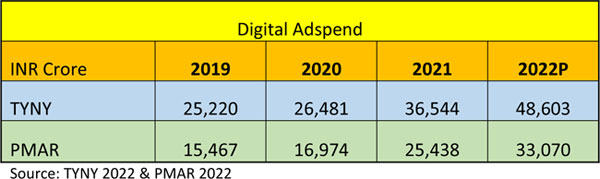
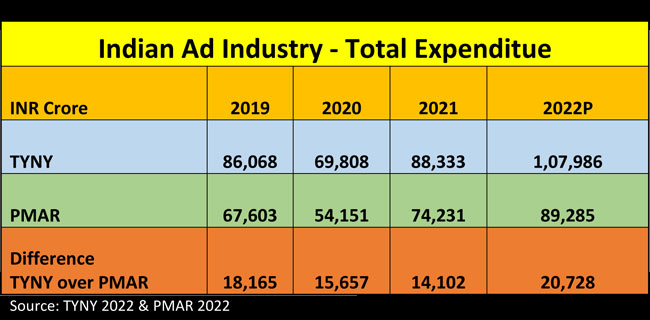
    Both GroupM and Madison Media have reported digital as the fastest growing media in 2021 and a continuity in the momentum of growth in 2022. In TYNY, digital adspends has equalled the TV adspends in 2021, where as in PMAR the digital adspends will equal or cross TV adspend in 2022.  Over the last three years, TYNY has been consistently reporting about INR 10,000 crore more in digital media ad spend than PMAR. In 2022 the ad spend in digital media is estimated to be INR 15,533 crore higher in TYNY than in PMAR.


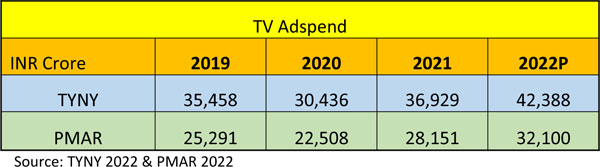
    Similarly, in case of TV adspend, the estimate by TYNY was higher than TYNY by INR 10,000 crore in 2019, which reduced to INR 8000 crore in 2020 and 2021. However, in the estimate for 2022, the same has again become higher by INR 10,000 crore. So, the estimates for digital and TV taken together account for a difference of INR 25000 crore between TYNY and PMAR in their predictions of 2022.


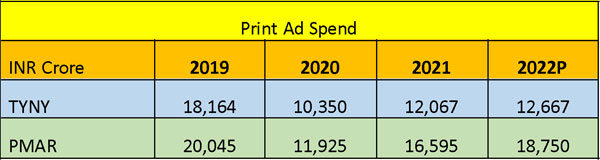
    When it comes to print adspend, the table is turned as PMAR has been consistently estimating higher spends in print than TYNY. In 2022, PMAR’s prediction for print ad spend is INR 6000 crore higher than that of TYNY. So, by combining print with digital and TV and other traditional media, the difference of INR 25000 crore gets reduced to INR 21000 crore.


    Source: TYNY 2022 & PMAR 2022


    It seems a bit unfair that TYNY has condemned print adspends in India to almost zero growth in 2022. As TYNY is done as a global report, has this estimate for Indian print ad spend been influenced by the global scenario where in most countries print ad spends have been steadily declining for years?


    I have written about the difference in the findings of TYNY and PMAR earlier in www.mxmindia.com. I know that we will never really get to know the reasons for such huge differences between the estimates of TYNY and PMAR, but it is becoming increasingly difficult to explain the reasons for the same to students of media management in a classroom as there is a danger that they may get confused and lose faith in media research.


    Read past commentary by Indrani Sen at:


    https://www.mxmindia.com/2021/02/so-how-do-the-groupm-madison-forecasts-compare/

    https://www.mxmindia.com/2020/02/a-roller-coaster-ride-of-adspends/

    https://www.mxmindia.com/2020/02/well-pitched-delivery/

    https://www.mxmindia.com/2019/02/indian-ad-industry-are-happy-times-really-here-again/

    https://www.mxmindia.com/2018/02/indrani-sen-mind-the-tv-adex-gap/

    https://www.mxmindia.com/2017/02/what-is-the-real-size-of-indian-ad-industry/

    https://www.mxmindia.com/2016/02/indrani-sen-boomtime-for-media-a-review-of-the-pitch-madison-advertising-report-2016/


  • GroupM forecast for 2022: 22.2% AdEx growth


    By Our Staff


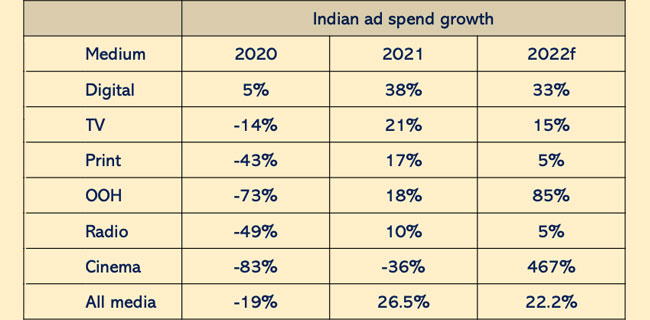
    WPP-owned media investment conglomerate GroupM has  announced its  advertising expenditure (AdEx) forecasts for 2022. As per the GroupM futures report ‘This Year, Next Year’ (TYNY) 2022, the adspends are estimated to reach 107,987crs in 2022. This represents the estimated growth of 22% for the calendar year 2022. India will be the fastest-growing market among the top 10 global markets and retains its 9th rank in 2022, as per the report. See GroupM TYNY2022 deck.


    Commenting on the TYNY 2022 report, Prasanth Kumar, CEO, GroupM South Asia said, “The pandemic has pushed the envelope towards digital and has hence topped the pie, with advertisers keen to explore more of it. Ecommerce and Telco will drive the economy, we also expect FMCG and auto to slowly catch up and contribute towards this growth.”


    Added Tushar Vyas, President – Growth and Transformation, GroupM South Asia: “With the pivot to digital by consumers and companies alike, digital emerges as the largest medium in 2022 with an estimated share of 45%.  Digital is estimated to grow by 33% in 2022. As digital capabilities enhance and connectivity becomes omnipresent, technology will further poise and change almost every sector of India’s economy.”


    Said Parthasarathy Mandayam, Chief Strategy Officer, GroupM South Asia: “With consumers gravitating towards themes like sustainability and sensitivity, brands are adapting rapidly, and media has the power to lead this change. Flexible, specialist and distributed teams are the order of the day and this trend will be further enhanced with the arrival of 5G. The emphasis on performance marketing has further accelerated and is at the very core of marketing. Intelligent & responsible leverage of first-party data will be critical for brands & marketers in driving this.”


    Said Atique Kazi, President – Data, Performance & Digital Products, GroupM India: “Marketers will have to bring together innovation, intelligence and integration in their strategy to win on Digital. In 2022; we will also see addressable TV coming to India in some scalable form and connected tv surge with smart TV sales and new fibre/broadband connections will be on the rise. Focusing on eCommerce, performance marketing, outcome-based media and addressable data is winning formula in 2022.”


    Added Sidharth Parashar, President – Investments & Pricing, GroupM India: “While digital is set to take the larger pie, we are expecting a noteworthy revival for OOH & cinema too after a tough period. Advertising on e-commerce, the rise of influencers and short format videos along with OTT has witnessed growth in 2021, which would continue in 2022.”


    Said Ashwin Padmanabhan, President – Partnerships & Trading, GroupM India: “The rapid digital transformation of companies, brands and the way they connect with consumers is reflected in the global advertising spends as well as the way even traditional media is expanding with their digital extensions. India in 2022 will see a rapid manifestation of these Global trends and thus fundamentally altering the media industry.”


  • Mindshare North wins several tech mandates

    By Our Staff


    Mindshare, GroupM’s flagship agency, has witnessed a great start to the new year. The North region has seen a number of wins across the new age consumer-internet and data-tech category.


    The recent wins Mindshare saw are apna.com – professional network site, Launch My Career – a data-tech driven online career guidance platform and WinZO – social gaming app.


    Said Ruchi Mathur, Senior Vice President – Client Leadership – Mindshare North & East India: “Several wins across a sector like consumer-internet and data-tech is a testament to the client’s trust in our work. Brands today are looking for a strategic partner who can co-create communication with smart data and tech to deliver efficient campaigns and brand messaging. Clients are increasingly opting for agencies who have the capability to deliver full- funnel solutions and we are fully capable of delivering on these requirements. We are proud to have won these accounts in these emerging categories and we are confident of delivering the best to the clients.”


    Added Parthasarathy Mandayam, CEO – Mindshare South Asia: “These wins contribute to our vision of growth. While Mindshare continues to deliver in the traditional media space, there is increased focus on performance, data, tech, content as well. It is a privilege to see our teams continue to work hard and adapt to these difficult times and an honor to have clients put their trust in us, this is what makes Mindshare. These wins show that the team’s hard work and our strategy is paying off.”


  • Parthasarathy ‘Maps’ Mandayam is CSO for GroupM South Asia & Amin Lakhani as CEO – Mindshare South Asia

    By Our Staff


    GroupM, the media investment group of WPP, has announced the appointment of Parthasarathy Mandayam (Maps) as Chief Strategy Officer – GroupM South Asia and Amin Lakhani as Chief Executive Officer – Mindshare South Asia, a position held until now by Maps.


    The role of GroupM Chief Strategy Officer will be to channel data, technology, consumer understanding to chart the growth and transformation agenda. Map’s appointment into the new role is part of the strategy that envisions doubling the focus with a significant shift on new-age technologies, products and offerings that require a transformation of both GroupM and client businesses. He will report to Prasanth ‘PK’ Kumar, CEO GroupM South Asia.


    Said Parthasarathy ‘Maps’ Mandayam: “I am extremely grateful to have such an amazing journey at GroupM. I think learning and change have always been a part of my career here. Furthermore, as our offerings become more specialised, we need to ensure synergy and seamless flow of expertise between the various players both internal, WPP and external to get the full benefits of both scale and specialisation. As I steer through this journey I will continue to push forward with the growth and transformation agenda to bring in significant synergies between new-age data, technology, consulting, products and offerings for our clients and internal stakeholders.”


    Added Lakhani: “We want to build on this existing momentum and drive Mindshare ‘Good Growth’ for our clients. New age data, technology, creativity, research, consulting, and products will play a major role in this journey. Our industry has always witnessed change. We’ve been at the centre of it and currently, the world is also witnessing this. Hence as marketers, we need to take charge and lead this journey for our clients and brands. I am excited for this next phase of my journey, and I would like to thank the team for believing in me.”


    Lakhani  will report to Prasanth Kumar, CEO GroupM South Asia and Helen McRae, CEO Mindshare Asia Pacific.


    Said McRae: “Both Maps and Amin are distinguished leaders who have brought energy, skill and leadership, to the Mindshare Group over the past few years in office. They have both led the agency with their invaluable expertise bringing immense value for our clients and internal teams. Mindshare’s achievements and client success journeys over the last few years narrate the business acumen of both Maps and Amin. I congratulate them both and wish them the very best for their new roles!”


    Added Prasanth ‘PK’ Kumar: “We have witnessed a significant consolidation of existing businesses, with deeper penetration of our new core offerings under their tutelage. Both have been instrumental in strengthening and reinvigorating the agency as it stands today. I have the utmost confidence in their expertise and know that both Maps and Amin will continue to drive innovation and further transformations in their future roles. I wish them the very best!”


  • Consumer Attitudes toward Technology


    By Our Staff

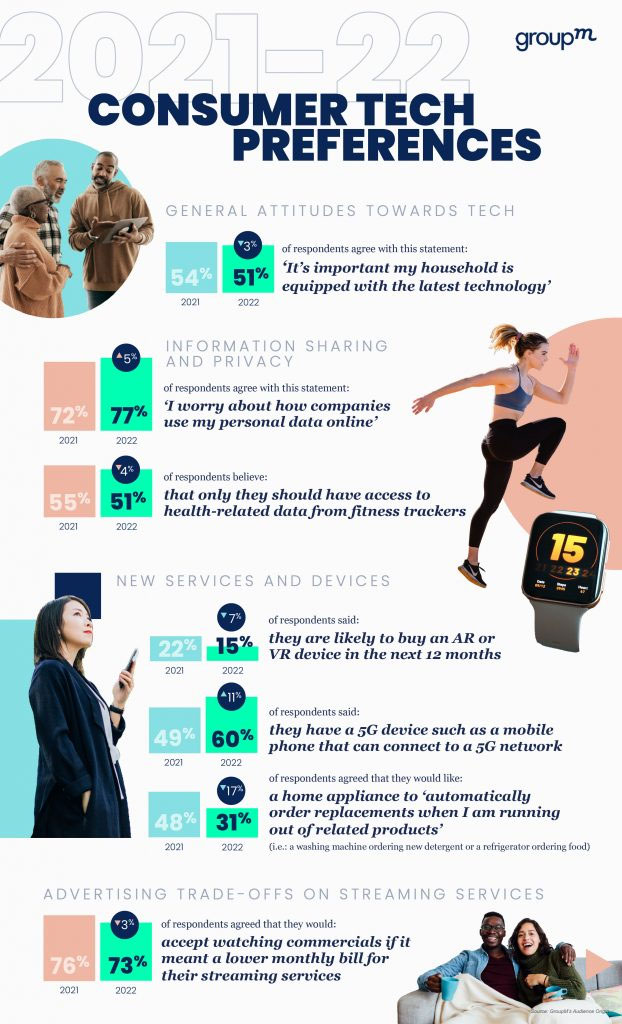
    GroupM, WPP’s media investment group, released its second annual survey on consumer attitudes toward technology in the U.S last week. The results reveal increased concern about sharing personal data, declining interest in buying the latest tech products sooner rather than later, and greater numbers of people confused by technology and its promises overall. Conducted by GroupM’s Audience Origin (formerly LivePanel) in December 2021, this proprietary research surveyed one thousand U.S. consumers on their attitudes toward technology across six general categories: attitudes toward technology, information sharing and privacy, virtual reality-based devices and services, smart appliances, mobile devices and digital services, such as visual search, streaming audio and streaming video.


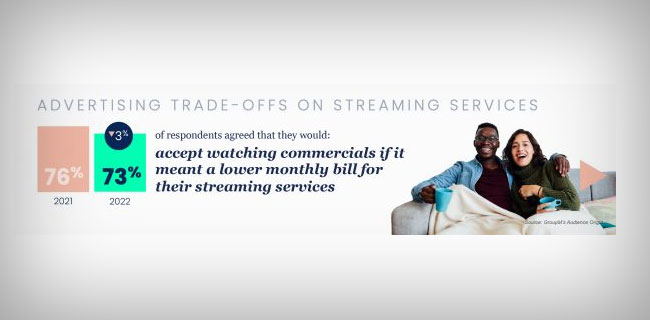
    Survey respondents indicated some material shifts in sentiments around privacy, with greater numbers of people concerned about the use of their data online, fewer willing to share data associated with health trackers or allow smart appliances to automatically refill consumables. Fewer households now believe it is important that they are equipped with the latest technology and greater numbers profess to being confused by new technologies – which we can see in responses to questions regarding VR and AR device access or 5G access – with more saying they will wait until technology becomes cheaper before purchasing devices. Of more direct importance for the advertising industry, a shrinking majority of respondents (73%) said that they would accept having to watch commercials in order to maintain a lower monthly bill for streaming video services versus 76% in last year’s survey.


    These trends reinforce the importance of data privacy to consumers and its implications for marketers—including the need to go above and beyond in securing consent from consumers when collecting or otherwise working with their data-to ensure that consumers experience real benefits from the use of that data and to always be mindful of how third-party data used in campaigns has been aggregated. The results also suggest that marketers could benefit from creating more clarity around how their technology products work and their practical benefits for consumers.


    Finally, the increasing willingness of consumers to pay to avoid advertising in streaming video services reflected in this survey strengthens GroupM’s instinct that, over time, advertising will become a diminishing feature in this channel. This highlights the challenges that marketers will increasingly face in using TV for reach and frequency-based goals in the future: it will be increasingly important for marketers to either more directly manage TV budgets alongside their spending on UGC-based platforms such as YouTube or to look at the use of TV differently, managing budgets for related campaigns more directly alongside those intended for sports, culture, music or other event sponsorships.


    Highlights of the research:

    1. General attitudes toward technology. 51% of respondents agree with this statement: “It’s important my household is equipped with the latest technology” versus 54% in our survey last year. 32% of the population somewhat or completely agreed that new technology “confuses me” in the new survey versus 28% last year. 73% agreed that they “wait until technology becomes cheaper before considering a purchase” versus 69% last year.

    2. Information sharing and privacy.77% of respondents strongly or somewhat agree with the statement “I worry about how companies use my personal data online” in our most recent survey, up from 72% in last year’s survey. 51% of respondents believe that only they should have access to health-related data from fitness trackers. The comparable figure was 55% in last year’s survey. As with last year, only a small share of the population believes that the company that made the device or software should have access (5.4% this year versus 6.9% last year).

    3. New services and devices: VR/AR, 5G and Smart Device-Based Consumables. Virtual or Augmented Reality: 32% of respondents claimed to own a VR or AR device in our most recent survey, with 15% claiming they are likely to buy such a device in the next 12 months. Consumer perceptions of what, exactly, such a device is may not be commonly shared, as last year 39% claimed to own one, with 22% planning to buy one. Looking at 5G devices, 60% of respondents said they have a 5G device such as a mobile phone that can connect to a 5G network, up from 49% last year. Among the 40% of the population without a 5G connected device, more than a third expect to acquire such a device this year. As with VR/AR, consumer understanding of 5G may not fully match the reality of the product, as third-party estimates of shipments of rates of 5G devices in the United States major U.S. carriers imply substantially lower figures. In the world of smart devices, 31% agreed that they would like a home appliance to “automatically order replacements when I am running out of related products” (i.e.: a washing machine ordering new detergent or a refrigerator ordering food). By contrast, the comparable figure was 48% last year. While it is possible the driver of this sentiment change is related to a lack of satisfaction with related products, we also note that this trend is coinciding with greater concerns around privacy illustrated above.

    4. Advertising trade-offs on streaming services. Asked, “If it meant a lower monthly bill for your streaming services, how likely would you accept having to watch commercials?” 73% agreed with this statement in our newest survey versus 76% last year. Access to ad-free or ad-lite subscription services remains high, consistent with data observed through public filings made by the operators of streaming services.


  • Priyanka Mehra to head Comvergence ops in South Asia

    By Our Staff


    Journalist-turned-communications and marketing professional Priyanka Mehra has joined Comvergence Worldwide as Regional Director – South Asia.


    An awardwinning professional, Mehra has worked for nearly two decades in journalism, content marketing, communications and later marketing services of an agency network. She was until a few months back Chief Marketing Officer at the Havas group, and before that with Creativeland Asia and Exchange4media. Said to be among the most connected journalists in advertising and marketing services, Comvergence will see her head all operations of the company in South Asia, which includes research and client relations.


    Founded in 2016 by Olivier Gauthier, Comvergence offers research data and rankings and varied support for advertising agencies and advertisers at the global, regional and country level. Gauthier incidentally was Partner and headed research and advertiser relations at Recma for nearly 14 years. In 2019, GroupM broke off its association with Recma and aligned with Comvergence. Comvergence has leapfrogged and most large network have aligned with but, and but its equity can be expected to grow with Mehra’s entry.


  • TV still accounts nearly half of large marketer budgets…


    By Our Staff


    Earlier this week, GroupM unveiled its global end-of-year forecast of adspends. The WPP advertising clongomerate also publishes its India-specific numbers, so we are not doing a detailed look right now, but here are highlights of the This Year Next Year study, and a special focus on television thereafter.


    Excerpted from the GroupM report:

    The overall industry forecast:

    • 2021 growth: 22.5% (excluding U.S. political advertising), an upward revision from June’s prediction of 19.2%.

    • 2022 growth: 9.7% (excluding U.S. political advertising), an upward revision from June’s prediction of 8.8%.

    • Many underlying trends appear to be disproportionately concentrated in the U.S., the U.K. and China, which together account for approximately 70% of all the industry’s growth, despite making up about 60% of the total market.

    • Looking at the top 10 advertising markets over the next five years, growth should get back to the mid- to high-single digits:

    ° France, Germany, Australia and the U.S. all poised to grow in a range of 4-5% annually, on average, over the next five years.

    ° India, the U.K., Brazil, Canada, Japan and China are forecast to grow between 6-8% annually, on average.


    Here are the major areas considered in detail as we reach the end of 2021:

    Digital advertising: likely end 2021 growing by 30.5%, up from June’s forecast of 26% growth.

    ° Digital advertising accounted for 64.4% of all advertising in 2021, up from 60.5% in 2020.

    ° Alphabet, Meta and Amazon account for 80-90% of the global total.

    • Television advertising:forecasted to grow by 11.7% in 2021, up from June’s estimate of 9.3%. Given 2020’s decline of 13.7%, the industry is not expected to return to 2019 levels until 2023.

    ° Subsequent years will be roughly flat—up 1-2% per year through 2026—for television advertising in most major markets around the world, as the largest advertisers continue to incrementally shift spending.

    ° Overall, Connected TV+ will account for about 10% of total TV advertising in 2022 ($17 billion of a total of $171 billion) and is expected to double by 2026.

    • Audio advertising: Expectations for audio are that it will grow 15.6% in 2021 and 6.4% in 2022. In subsequent years, we assume a reversion to historical trends: largely flat.

    OOH advertising: Outdoor advertising is expected to grow 17.1% in 2021 and 14.9% in 2022. In subsequent years, we assume a reversion to historical trends: mid-single digit growth.


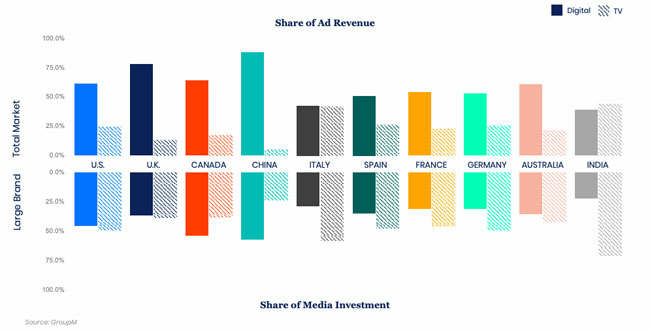
    Now, a superficial read of the data included in This Year, Next Year might leave one with the impression that because 64% of the world’s advertising revenue is generated by digital media and 21% goes to TV, that marketers are allocating 64% of their budgets to digital media and 21% to TV, on average. This would be a mistaken interpretation, because many advertisers—especially small ones and those whose businesses operate entirely online—often allocate all or nearly all of their budgets to digital media while large businesses typically allocate higher shares of their budgets to television.


    For smaller businesses, a high digital skew could occur because digital media’s precision targeting capabilities and automated sales platforms are uniquely capable of absorbing advertising budgets that are measured in hundreds or thousands of dollars. Larger advertisers that spend 100% of their budgets online might typically be doing so because their operations are entirely transactional or direct-to-consumer. For them, too, digital media platforms offer unique advantages connecting a budget for advertising with a tangible near-term outcome and the potential for active “growth hacking” strategies, which can work well, at least up to a certain scale.


    However, the world of media also includes businesses whose marketing goals are set around brand-building. They often do this by associating their products with top-tier video-based content or otherwise focusing on goals that are not most efficiently achieved through digital media. Further, for many, the combined use of different types of media can be synergistic in ways that are difficult to quantify. For example, we can reasonably assume that a strong brand should drive better performance of an e-commerce-focused advertising campaign versus the alternative of having a weak brand, although the factors that can drive a brand to accomplish this outcome can involve uncountable numbers of variables over many years or even decades


    Given our own focus as the world’s largest agency group, servicing larger brands primarily, we wanted to better assess the typical large advertiser media mix. To do this, we looked to GroupM’s own data to find useful illustrations of the ways in which different marketers allocate their budgets around the world. In studying these trends, we primarily focused on two dominant groupings of media, television and digital platforms, and then limited our analysis where possible to a subjectively defined group of large marketers on a like-for-like basis (meaning that we included only the same marketers in each period) within each of our Top 10 markets.


    The most accurate benchmark for large brands to consider is that in a typical large country during 2021, a large brand is allocating 47% of its advertising budget to television, including digital video extensions, and 35% to internet-based media, excluding those digital video extensions. For reference, in 2019, television typically accounted for 48%, while digital media typically accounted for 28%. These figures reflect wide gaps between the shares of revenue that media generates, with the difference driven by the wide range of brands that spend money in a given territory.


    For individual marketers, we recognize that this data may provide useful information about what other marketers are doing. However, the goal should not be to mimic them. Instead, we present this information to help spur questions about the right allocations for your brand. Well-developed media plans account for a marketer’s unique goals, apply some creativity to achieving those goals and consider what worked well for others who faced similar circumstances. It is our hope that the data presented here leads to the creation of more media plans that meet these criteria.

     

  • Essence report for unlocking social commerce potential

    By Our Staff


    GroupM agency Essence has unveiled its first social commerce report which investigates the rapidly growing trend of consumers buying products and services directly on social platforms.


    The report illustrates the significant opportunity brands have in social commerce, with three out of four people surveyed saying they are likely or highly likely to buy through social media in the future. Social commerce is forecast to account for 13% of total ecommerce sales in China this year.


    According to the Essence survey, 41% of respondents worldwide made purchases or intend to make purchases involving social platforms. While social media platforms have always provided an environment for buyers and sellers to interact, the survey demonstrates a shift towards organised commerce on platforms. Increasingly, social commerce enables discovery, browsing and purchasing to take place on one platform without the need to interact with any external websites or applications. Ultimately, it creates a seamless experience with fewer clicks and higher potential revenue and conversion rates.


    China, unsurprisingly, is the leader in social commerce, which is forecast to account for 13% of total ecommerce sales in 2021. According to the Essence survey, almost 80% of consumers in China purchased items on social media. Singapore, India and Indonesia followed with 50%, 49% and 48%, respectively.


    France, Germany and Japan showed the lowest purchasing intent via social platforms at 22%, 27% and 24%, respectively. But despite that low percentage, interest in social commerce is growing in Germany. Almost half (44%) of Gen Z customers in Germany indicated that they purchased or intend to purchase using social platforms.


    In most countries, the average transaction value on social commerce is higher than the average transaction value on ecommerce transactions. Respondents in Japan recorded the highest average transaction value, between JPY11,001 and JPY55,000 (USD96.74 to USD483.67) for social commerce, followed by the United States, which had an average transaction value between USD101 and USD200. China, on the other hand, had a lower average transaction value between CNY201 and CNY500 (USD31.48 to USD78.30).


    The higher value transactions look to be driven primarily by men (35%) and by millennials in the 25 to 44 age segment (72%). Both the male and the 25 to 44 age segments are skewed towards the purchase of higher value categories such as hardware, home cleaning, luxury and furniture.


    Social innovations have propelled the growth of virtual shopping. Live shopping and conversational commerce experiences increase the propensity to buy on social media. Four out of five respondents are likely to buy on social media if they have watched a livestream or participated in conversational commerce. Livestreaming has emerged as a major factor in luxury social ecommerce.


    While the use of livestreaming in ecommerce was primarily centred in the Asian market, it is now commonplace worldwide. Luxury brands including Hermès, Louis Vuitton and Burberry all launched their Fall or Winter 2021 shows by livestreaming worldwide. Brands such as L’Oréal are also driving growth in the luxury beauty segment, partly because social media enables the brand to interact with consumers, influencers, beauty advisers and salespeople on the same platform. These innovations and collaborations are driving sales of luxury items both online and offline.


    The research indicates that most consumers enjoy the livestream shopping experience, with almost half (43%) of respondents claiming to have enjoyed it and 39% of respondents highly enjoyed it. These statistics held up not only in China, but also in other markets where social commerce is still in its infancy. Globally, 85% of the respondents who watched shopping livestreams report that they are more likely to purchase via social media.


    Aniket Basu

    Said Aniket Basu, Senior Director, Technology and Ecommerce, at Essence: “We expect that the future of online shopping – and not just social commerce – will be discovery-driven. Customers tend to be exposed to new and innovative products as they browse more on social media or encounter algorithmically mediated recommendations from friends and family on social platforms. Ecommerce is maturing as a field, with social media giving brands and retailers new ways to reach audiences and new growth opportunities. In this environment, social commerce serves as a key future-proofing method for the next five years and beyond.”


  • Priti Murthy is now President, GroupM Services India

    Priti Murthy
    Priti Murthy

    By Our Staff


    GroupM India has announced the appointment of Priti Murthy as President, GroupM Services India. In her new role, Murthy would also be part of the GroupM India Executive Committee. She will lead the centre of delivery excellence that comprises biddable, non-biddable, analytics and reporting. She will work closely with agencies to understand their needs, incorporating best-in-class delivery metrics with ‘improvise and improve’ as the approach to continued excellence. Murthy, who was until recently CEO of OMD India, will report to Prasanth Kumar CEO, South Asia GroupM and Jon Thurlow, COO, Asia Pacific GroupM. GroupM Services India leadership team would report to Priti.

    Commenting on the new appointment, Prasanth Kumar – CEO South Asia GroupM said: “It is a homecoming for Priti and strengthening of GroupM India leadership team with yet another remarkable industry leader. Priti’s product mindset powered by a unique blend of experience in setting and executing an organization-wide vision will enrich the GroupM teams alike. As one of the most regarded women leaders in the industry, Priti also believes in GroupM’s future centric business approach and has always focused on building purpose-driven culture as a key leadership responsibility. I am confident that her people and solution focus will further strengthen the agency collaboration fuelling all GroupM agencies.”


    Added Priti Murthy – President GroupM Services India: “It is one of the best eras in the media industry, revival and rejuvenation being the focus. I am delighted to join GroupM, to walk the path to the future transformation of GroupM offerings in the marketplace and magnify the operational excellence that it is known for. With GroupM’s focus on creating the best in class and house of excellence, my role will be to bring in the right mix of talent, process and tech to ensure quality assurance and continuous improvement for biddable and non-biddable media for our partners and clients. I am looking forward to working with Prasanth and the entire ExCo in driving this focus.”

  • MMA, GroupM & Amazon advertising launch festive season playbook

    By Our Staff


    MMA, GroupM and Amazon Advertising have launched the ‘Decoding Consumer behavior and Winning the 2021 Festive Season Playbook, a handbook for marketers on expected consumer sentiment along with recommended strategies for Diwali this year.


    Said Tushar Vyas, President – Growth and Transformation, GroupM South Asia: “Digital influence in consumer journeys has increased significantly while the e-commerce adoption has accelerated in last 18 months. Hence, Digital is no more a support media platform but is core to media plans.  Ecommerce platforms offer brands the opportunity to hand-hold consumers across the purchase funnel by not only aiding in active/passive brand discovery but also in closing the loop by measuring performance objectively. This playbook contains several key insights and is a must-read for any marketer who is planning for the festive season.”


    Added Vijay Iyer, Director-Ad Sales, Amazon Advertising India: “Digital is a part of our lives now like never before and the influence is only increasing. Ecommerce portals act as gateways to this world that we are so quickly embracing and are playing a crucial role in brand and product discovery. For marketers, this presents an unprecedented opportunity – to be able to identify and leverage customer intent at an unprecedented scale. This playbook will help brands in not only sharpening their online strategy, but will redefine how they measure and drive business outcomes.”


    Moneka Khurana, Country Head, MMA India commented: “MMA is proud to have co-authored the white paper in collaboration with GroupM and Amazon Advertising to provide the much needed insights and guidance for the upcoming festive season for the ecosystem helping brands navigate the challenging times and drive optimal visibility and performance . 76%of marketers mentioned they will be allocating more spends for digital as compared to last year. Hence it’s key to understand omnichannel users better in the changing times as we continue to drive the narrative of shaping the future of marketing.”


  • Kantar-Dialogue Factory’s rural post-Covid economy scan

    By Our Staff


    Kantar, the leading evidence-based insights and consulting company, along with GroupM’s rural and experiential marketing unit- Dialogue Factory have unveiled the second edition of the Rural Covid Barometer Report. The report explores rural India’s concern about the impact of the second wave and how it has altered consumer behaviour and purchase patterns.


    Key highlights:

    Rural India is highly concerned about Covid situation in second wave. Concerns are higher amongst females (91%) as compared to males (85%) and within the higher age bands (55+-year-olds). These concerns are mostly driven by Covid’s impact on day-to-day life and functioning (most for 25-55 year old’s), fear of falling sick and overall need for financial planning. As a result, rural consumption and shopping patterns have witnessed a major shift.


    While consumers are concerned, most are also positive about economic recovery once the situation normalises. Nearly 3 in 4 rural households have received some form of assistance via Government of India schemes, thus providing the much-needed financial cushion to consumers.


    Rural consumers are saving 25% of their income. Southern India (except for Tamil Nadu) is saving more in comparison to other parts of the country. As expected, expenses are higher on personal care, hygiene and cleaning products while spends on indulgence and beauty products have been deprioritized.


    With respect to retail channels, consumers prefer local village shops for purchasing groceries (56%), personal hygiene (49%) and cleaning (45%) products. Even big-ticket items like consumer electronics (50%) and durables (46%) are preferred to be bought at these local shops.


    Digital trends:

    There has been an internet revolution in rural India, with online being the most consumed media after television.


    With respect to online content consumption, music/ audio (69%) leads the pack followed by news (49%) and gaming (33%).


    Usage of video / OTT apps are driven by YouTube at 87% (most in Rajasthan, AP/ Telangana, TN and Bihar) followed by Disney+ Hotstar at 30% (highest usage in UP, TN, Gujarat, Kerala).


    WhatsApp and Facebook are the most used social media/ messenger platforms at 87% (most in Rajasthan, AP / Telangana, Karnataka) and 66% (most in Odisha, UP, Gujarat and West Bengal) usage respectively.


    Phone Pe is the most used digital payments app with 19% rural consumers having used these services in the last six months. Usage of Phone Pe is driven by Karnataka at 46% followed by Rajasthan at 38%.


    Foresighting:

    Growth in the consumer durables and automotive (2-wheeler) sectors are likely to slowdown in next 6 months. However, the smartphone category is expected to see fast growth in the near future.


    Construction sector is also expected to see a bounce-back with consumers expected to spend on building a house/ undertake smaller construction work in the next 6 months.


    Dalveer Singh
    Dalveer Singh

    Commenting on the report, Dalveer Singh, Head of Experiential Marketing- APAC, GroupM Dialogue Factory said: “The pandemic has evolved the rural consumer’s decision-making process. They are watching their spending and prioritizing their buying patterns by the need of the hour. There is a positive acceptance of the vaccination. The upper- and middle-class rural Indians are being more proactive in financial planning to deal with covid constraints, which make these markets a significant place to introduce investment and savings products. To sum up, there is a deep sense of uplift on the subject of India’s economic future.”


    Puneet Avasthi
    Puneet Avasthi

    Added Puneet Avasthi, Senior Executive Director, Insights Division, Kantar: “With a highly concerned rural consumer, rural India is planning finances better and inclined towards a savings mindset. This offers a significant headroom for growth to savings and investment products such as insurance and even mutual funds. Additionally, we are witnessing a significant rise in digital payments as an important mode of transaction, this offers a robust platform for rural financial inclusion, as also for suitable hyperlocal promotions. With the change in consumption priorities in favor of health and hygiene products (a trend that has held since the first wave), FMCG marketers should leverage this trend for planning their innovation pipeline.”