Tag: GroupM South Asia

  • Consumers in a Connected World


    By Dyanne Coelho


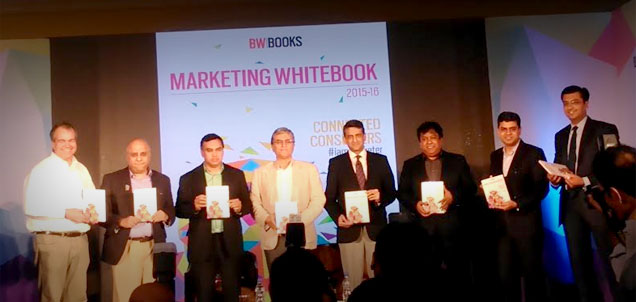
    Businessworld in association with Nielsen launched the 11th edition of the Businessworld Marketing Whitebook 2015-2016 with much ado including an impressive lineup of speakers. Key trends in the marketing space were touched upon through the sessions.


    John Burbank, President Strategic Initiatives, Nielsen set the tone for the release of the Marketing Whitebook with his insightful discussion on ‘Gearing up for a Consumer-First World.’ “I think the world is data-rich and analytics poor,” he said. The basic questions are the ones marketers need to be asking, he said. These include ‘How many are actually seeing my advertisement?’ and ‘How effective is my advertisement in delivering ROI?’ among others. Do not let the complexity of the amount of big data change these fundamental questions, he advised.


    ‘A Year of Cautious Optimism: What Lies Ahead for Business Leaders’ was the first topic of discussion. The panel included Devendra Chawla, Group President, Foods, Future Group, Rakshit Hargave, Managing Director, Nivea India and it was moderated by Gurbir Singh, Executive Editor, Businessworld. “A category comprising skincare and personal care is growing in single digits, the consumers are not opening their pockets,” Hargave pointed out, while Chawla said that food and FMCG products are not hit as badly as sectors like real estate and automobiles. High value purchases have been hit harder, he said.“Inflation, especially food inflation has eaten into the money supply of the family. The consumer is holding back,” Hargave mentioned. Chawla however highlighted that the beauty industry is actually growing 70-80 percent. To this Hargave, added that the pattern is no different for him. Beauty products in the men’s category are growing faster than those in the women’s category, he said.“Marketers ought to work on deriving more basic information, get more innovative, study different needs and tastes of consumers, etc in order to keep up with changing times,” Hargave said.


    Salil Kapoor, COO, Dish TV moderated the next session which dwelled on the topic of the ‘Emergence of New Media for an Impactful Connect with Consumer’. “By 2020, 50 billion devices around you are going to get connected, you have to be smart about who to reach out to,” Avinash Jhangiani, Managing Director, Digital and Mobility, Omnicom Media Group said. Shripad Kulkarni, CEO, Vizeum India opined that this newness is here to stay. “We see a very bright trend emerging of experimentation which leads to all kinds of advertising. It is moving towards a new metric of performance. This is a good thing,” he said. The topic of big data was discussed in the regard. Tarun Jha, Head of Marketing, Skoda India spoke that the automobile industry is highly dependent on big data. “We run lean ships, spend money wisely, have a very focused objective for every campaign and ensure that every penny is accounted for,” he said.


    Social listening has become a serious business, the panelists discussed in the session titled, ‘#iammarketer: The Realities of a Changing Consumer World’. “Socialisation allows us to build communities of like-minded people, build engagement, etc. This is where one gets insights from across categories and consumer behaviour,” Veetika Deoras, Head of Brand Marketing, Digital and Corporate Communications, Tata Capital said. While many marketers have evolved into digital, some are still experimenting, Ashutosh Gupta, Director Marketing Solutions, LinkedIn India said. “It’s not about social or digital, it’s more about the consumer journey,” he said. Sudeep Ghosh, VP Marketing at VIP Industries is of the belief that one should not follow the template. “Do digital if it works for you,” he said. Digital works differently for different brands and hence each needs to adapt depending on its needs, he added.


    Prashant Singh, MD, Nielsen India lead the discussion entitled, ‘The Rise of the Connected Consumer’. The panelists included Kamal Basu, Marketing and PR Head, Volkswagen India, Prashant Peres, Director Marketing – Chocolate, Mondelez India, Sameer Satpathy, CMO, Marico Ltd and Tarun Arora, COO and Director, Zydus Wellness Limited. The session revolved around how the need of the hour is not about focusing on advertising or broadcasting, but on using an integrated approach to have a full conversation and up brand value for consumers. “Legacy marketers are often apprehensive about the impact they can make through new media, there is a fear,” Peres said. Arora on the other hand argued that the line between online and offline is blurring as both need to use each other to build the brand. “Multi-channel purchase is going to happen and FMCG cannot sit back,” he said. From an automobile industry perspective, digital is the lifeline, Basu pointed out as most buyers do primary research online before they walk into a store. Satpathy however believes that it all depends on the task for the brand.


    CVL Srinivas, CEO, GroupM South Asia played moderator to an interesting discussion on ‘Decoding Diversity in India’ followed with presentations by Sachin Jain, President, Forevermark India and Samir Jain, MD, Bunge Ltd wherein each pointed out the growth of their brands and how they adapted their marketing strategy to different segments of India in order to target different sets of consumers.


    Earlier, Annurag Batra, Chairman and Editor in Chief, BW Businessworld (also Chairman and Editor-in-Chief of the Exchange4media group) delivered the opening address, gearing up the delegates for the rest of the event.

     

  • Facebook and GroupM host inaugural FMCG Forum

    By A Correspondent


    Facebook along with GroupM has introduced ‘Brand Bazaar’- the inaugural FMCG Forum in India. The goal for this forum was to rethink the possibilities of the digital medium for brands in the FMCG category, the largest contributor to the Indian advertising expenditure. The Brand Bazaar forum was held in Gurgaon and Mumbai.


    The forum was a mix of presentations and panel discussions by experts from Facebook, GroupM, creative advocates and brand custodians. After an introduction by Kirthiga Reddy, Managing Director, Facebook India and CVL Srinivas, CEO, GroupM South Asia, the event began with a keynote address by Ashutosh Srivastava, Chairman and CEO – APAC & Global Emerging Markets, Mindshare. He raised themes in his presentation- the usage of data to effectively target consumers via digital media and creating relevant content to capture the consumer online.


    Commenting on the FMCG Forum, Kirthiga Reddy, Managing Director, Facebook India said, “The FMCG community in India has always been at the forefront of marketing. Now, with the consumer shift to digital and mobile, the whole ecosystem is redefining marketing once again. This forum is the coming together of experts from across the spectrum — marketers, media & creative agencies, researchers, and publishers — to leverage the power of personalized marketing at scale to build brands and move products off shelves in a mobile-first world.”


    CVL Srinivas

    CVL Srinivas, CEO, GroupM South Asia said, “At GroupM we are constantly prepared to give brands an edge in an evolving advertising industry. The main reason to create an industry forum such as ‘Brand Bazaar’ is to talk about the most relevant aspects of advertising in the FMCG category- from investment and creativity in digital advertising, smart usage of data to target consumers or develop new channels of distribution for products. We found a partner in Facebook to work with us to address new ideas and concepts at this forum.”


    This was followed by a panel discussion on Return of Investment on Digital. The panel in Gurgaon comprised Gaurav Jeet Singh Head Media Services- South Asia, Hindustan Unilever Limited, Balendu Shrivastava, Facebook, Dolly Jha, Nielsen, Kartik Sharma, Managing Directory Maxus, South Asia, Uday Kagal, Milward Brown, and moderated by Sunder Muthuraman, Global Chief Strategy Officer, Gain Theory. The ROI on Digital session in Mumbai included panelists Priya Nair, Executive Director, Home Care, Hindustan Unilever Limited, T Gangadhar, Managing Director, MEC Global South Asia, with Balendu and Uday.


    The second panel discussion was on Creativity and Content in Digital Media. Moderated by AnantRangaswami, Editor, Storyboard- CNBC TV 18, the Gurgaon panel included RuchiraJaitley, Senior Director, Social Beverages, PepsiCo, Joy Poole, Facebook and Fergus O’ Hara, Facebook. The Mumbai panelists were SrinandanSundaram, VicePresident and Category Head for Skincare, Hindustan Unilever Limited, Kunal Jeswani, CEO, Ogilvy & Mather India and Abhijit Avasthi, former NCD at O&M.


    The forum also had speakers on E-Commerce: opening a new channel of distribution for FMCG companies. In Gurgaon this session was with I Srinivas Murthy, CMO of Snapdeal and in Mumbai with MihirMukadam, Vice President, Marketing at LocalBanya.com


  • Ravi Rao appointed Chief Client Officer, Mindshare MENA

    By A Correspondent


    Ravi Rao

    Mindshare has announced the new role of Ravi Rao, Leader (emeritus) of Mindshare, South Asia. He will be taking over as Chief Client Officer, Mindshare MENA effective May 1st, 2015 and will be based at the Dubai office.


    In his vast experience in the media industry, Ravi Rao joined Mindshare, South Asia in 2008 and took over as Leader for the market in 2012. Under his guidance, Mindshare remains the largest media and marketing agency in India. Asserting his familiarity with the MENA market, Ravi was earlier a part of JWT Dubai and the Mindshare MENA team during its inception in 1999. He also worked with OMD in the course of his time in Dubai.


    Ravi Rao is the Chairman of the Media Research Users Council (MRUC) and has represented Mindshare and GroupM on several industry platforms.


    On his move to Mindshare, MENA, Ravi Rao said, “I am excited to take this new role within the Mindshare family. The market has exhibited good growth over the past few years and I look forward to strengthening our position in the MENA region.”


    CVL Srinivas

    CVL Srinivas, CEO, GroupM South Asia, commenting on this transition, “Ravi helped consolidate Mindshare’s position in the market over the past few years. He has led the transformation efforts of the agency in the recent past. This has helped Mindshare create cutting edge products for its clients, grow its digital business and retain its leadership position. He has made a significant contribution to our network and the industry at large. We are confident that Ravi will continue to play a stellar role in building the Mindshare network and we wish him well in his new role.”


  • GroupM to set up unit under Mausami Kar for Airtel

    By A Correspondent


    GroupM has been tasked the media investment mandate for India’s leading telecom services company, Airtel. The mandate includes traditional and digital media. The business will be handled from the Gurgaon office under Team Airtel, a unit that is being set up under the leadership of Mausumi Kar – a senior GroupM resource who has over 15 years of media experience and has been part of GroupM for the past eight years.


    CVL Srinivas

    Commenting on the win, CVL Srinivas, CEO, GroupM South Asia said, “The GroupM network has been at the forefront of creating innovative media solutions for our clients. We have taken several initiatives in the recent past to make our agency brands and units a lot more in tune with tomorrow. The biggest challenge our clients face is managing the complexity of a very disruptive media landscape. Our network is delighted to be chosen by Airtel as its media partner.”


  • GroupM bags Airtel account, to set up independent unit; Milestone Brandcom bags Airtel’s Outdoor biz

    By Pritha Mitra Dasgupta [see update at the end of this story]


    GroupM has bagged Bharti Airtel’s media account excluding outdoor, replacing Madison as the media manager of India’s largest mobile carrier by revenue and subscribers after a decade.


    The size of Airtel’s media account is upwards of Rs 400 crore, say industry sources, with estimated spends of Rs 350 crore in above-the-line (ATL) advertising and Rs 50 crore on out-of-home (OOH) media.


    Milestone Brandcom, which is the outdoor unit of Dentsu Aegis Media, has won the outdoor mandate, said a top official at Airtel. The firm’s creative mandate is split between WPP agency J Walter Thompson, Dentsu Aegis Network agency Taproot and Cartwheel. In response to an email sent to Airtel, a company spokesperson said, “No comments.”


    CVL Srinivas

    CVL Srinivas, CEO of GroupM South Asia, said, “We are delighted with the Airtel win.” He said the group will set up a separate ‘team Airtel’ to manage the account. It will be like a parallel unit within the group.


    GroupM is in the process of promoting an internal talent to head the Airtel team, who will report to Srinivas.


    Madison has been handling Airtel’s main media account since 2005 and its outdoor duties since 2010. The shift in accounts is only for India.


    Top officials in know said Madison will continue to handle Airtel account in Sri Lanka.


    Officials said the biggest reason behind this shift is because Airtel is looking for a strong partner to help it strategise through this extremely dynamic category. This was especially considering the digital space, “in which Madison has completely missed the bus”, one of them said.


    Sam Balsara

    Sam Balsara, CMD at Madison World, said: “Nothing went wrong. You win some. You lose some. Fortunately we win more than we lose.” He said, “Whilst we are sorry to part with Airtel, its impact on total revenue of Madison Media would be very marginal.


    It was one of about a dozen large accounts of Madison Media, one of over 50 accounts of Madison Media and one of over 200 of Madison World.”


    Airtel had called for two separate pitches. In November last year it put its media mandate on the block including television, print, radio, cinema and digital. This year it called for a separate pitch for the outdoor mandate.


    Source:The Economic Times

    Copyright © 2015, Bennett, Coleman & Co. Ltd.

    All Rights Reserved, Licensed to republish


    [MxMIndia Correspondent adds:

    It is learnt that GroupM will set up an independent unit to take care of the Airtel account


  • Will out-of-form India dampen adspends on W’Cup?


    Much interest in the Cup, but only dampener is India’s form

    Some of the brands who are probably fence-sitters today are only wondering what the form of the India team will be


    By CVL Srinivas, CEO, GroupM South Asia


    We see a lot of interest in the World Cup this year. One of the reasons for this is that it is a once-in -four-years event. But I think there seems to be a lot of innovation coming in to the World Cup product. Whether it is in terms of the number of languages it is going to be telecast in, or the kind of programming and advertising innovations that are available, and the fact that a lot of viewership is going to be on digital and there is also going to be a lot of interplay between digital and TV even when someone is watching the match on TV makes it very interesting for brands, for advertisers, for agencies to come up interesting campaign ideas and innovations. So there is definitely a lot of interest in the World Cup.


    The only dampener at the moment is India’s form. I only hope that picks up. This does have an impact on advertising to an extent. While overall the sentiment is still positive towards the World Cup. I think all the big sponsorship has been lined up. A lot of brands are also excited with the innovation possibilities on the World Cup, therefore they have also come in. I think some of the brands who are probably fence-sitters today are only wondering what the form of the India team will be, and whether they would be able to afford the scale of investment required, so if actually all goes well and India perform well in the first few matches, it could be a complete sell-out.


    It is the biggest aggregation of consumers possible

    The cricket format allows frequent short breaks making it apt for advertisers to be present creating impact and high brand recall.


    By Vivek Sharma, CMO, Pidilite Industries Ltd


    Cricket is a not just a sport in India, but is in fact a religion, which no one can refute. Not only is the ICC Cricket World Cup the premier flagship tournament of the ICC that comes only once in four years, this year India are the defending Champions, which means higher level of engagement from audiences in India and Indian diaspora. Given this context, the ICC Cricket World Cup 2015 is the right opportunity for our brands to reach out to a large consumer base.


    Furthermore, with large number of TV viewers in the country watching the last edition of the World Cup, it is the biggest aggregation of consumers possible. This year, the ICC Cricket World Cup will be broadcast in six different languages making it even larger. The cricket format allows frequent short breaks making it apt for advertisers to be present creating impact and high brand recall. Viewers will get an opportunity to see two of our new TVCs for Fevikwik and Dr. Fixit during this World Cup. Thus we believe that the ICC Cricket World Cup 2015 will be an ideal platform for us to create both awareness and connect for the brands with our end consumer across the key target regions.


    The unpredictable format of the ODI game makes it more exciting and keeps audience engaged, overall we believe that the ICC World Cup will prove once again to be a win-win situation for all advertisers. Pidilite has supported the game of cricket for long time and will continue to support our boys and the spirit of sportsmanship.


    Has the magic diminished?

    One great match, one killer performance, one massive win, one boost of hardcore patriotism and heroics, and Indian blood will get to pump again.


    By Prathap Suthan


    The fact is that the boys in blue, are now more black and blue. Considering that they been blown to the outback in Australia. They seem to be unfocussed. As though there’s a sort of ennui in the team. A lackadaisical attitude.


    Nowhere close to what they were when they won the Cup last time around. Worse, very much contrary to the advertising that’s going around featuring the team, they seem to be determined to do everything to give the Cup back.


    As a viewer, currently I just don’t feel being inspired to watch. I am all but looking forward to the World Cup. Somehow I am as listless as the team itself. I have no hope, no faith, no conviction in the team.


    The problem is that this listlessness is contagious. It comes from the team and affects all of us. All viewers and advertisers. Unfortunately, the team’s motivation, and the team’s resolve, and the team’s body language etc. have all been in the dumps. They haven’t been able to fire any adrenaline back to us.


    More importantly, there’s been an overdose of cricket. As a nation we are up to our gills with this game, and sadly, the plentitude is boring. Don’t forget there’s IPL soon after, and there’s just no end to this. I suppose the specialness of the game has waned and much like everything that’s profuse, even the magic of cricket has diminished.


    From an advertising perspective, I think regardless of our team, this is great and rich advertising opportunity for brands. In terms of the numbers, million would watch even if India isn’t playing.


    This is a game that doesn’t need to be explained to the masses. All of us know the game. And all of us are experts. Including large numbers of our women.


    I certainly would advise clients to be part of this. I am sensing a lot of clients are timid and tepid about spending money on this tournament. It is not a bad place to be in, even if we aren’t playing. At some level, we appreciate good cricket and we are fans of the game.


    However, everything might change. One great match, one killer performance, one massive win, one boost of hardcore patriotism and heroics, and Indian blood will get to pump again. All it takes is the return of victory and passion into the team, and the wind will fill our sails again.


    And at that time, it would be a scramble for slots and spots. Best to hope for a miracle, and be part of this tournament early.


    At the end of the day, none of us are anti-cricket, or anti-blue, or anti-anything. As a nation, this is one of the very limited areas of physical excellence that we have the ability and talent to win and dominate. We are poor losers. And poorer patriots.


    We are fickle as a nation, and especially when there’s no heart in the team, we give up on the team as quickly as we rally behind them.


    Prathap Suthan is Managing Partner and Chief Creative Officer at Bang In The Middle


    IPL is any day a better bet for brands!

    World Cup 2015 is unpredictable. Not for which team would win but for marketers, brands and the media


    By Sanjeev Kotnala


    The Indian Premier League or Cricket World Cup is a choice or problem for a few brands. You either have money to splurge on both tournaments or you don’t. Those who have money either have a campaign to run or they don’t. And brands with money and campaign, it is only the rate and ROI issue. ROI can never be guaranteed and remains a gamble. So, if you have the money and a campaign and need to advertise during these times you may want need to look at it differently.


    World Cup 2015 is unpredictable. Not for which team would win but for marketers, brands and the media. Success here depends on audience interest, viewership, viewer’s empathy and apathy towards the team. Oh yes, the die-hard will watch anything, but the deciders are the real consumers; the fringe audience that makes the numbers advertiser look at. Match timings are big spoiler for them. We can expect non-India matches to be completely blanketed. Unfortunately, such matches form a large percentage of the tournament. The main sponsor get these ineffective buys as a package helping them show lower ER.  Non-sponsor brands try avoiding them but are served as no-option as channel has to square off the investment.

    IF (a capital, bold IF) India plays well in the 1st final (India Vs. Pak) it could change the whole game. We as a nation are currently feeling low entering WC15 after a series of losses. Cricket is suffering from lack of empathy and viewers apathy.


    On these qualitative counts itself IPL outscores WC-15 with a high percentage of your real TG hooked on to every match.


    Srini or No-Srini, 12 or 8 teams, ball-tampering or fixed matches nothing changes the ground rule; IPL is a festival, a mela, a tamasha we all enjoy with a spicy tadka of regionalisation. IPL demands less of your time, give you much to discuss and is much more fun. It is realignment of interest, supports and stars. The audience loves this cut-throat high intensity not giving an inch of attitude. They smile, so can the channel and the advertisers. The patriotic feeling is understated or completely dead and that makes team losing a bit more manageable for the viewer.


    I firmly believe that even a low WC-15 performance by the Indian team will fail to dampen the IPL spirit. Good or near decent show will help IPL. In gambling terms, with IPL you hold the royal run. IPL is always a new beginning. With auctions, there is always a new team under every banner. It has a clearly differentiated taste and flavour.


    On the other hand, the hard focus on TV impact in these tournaments creates blinkers and brands end up underutilising or missing opportunities with other media. Radio and hoarding are good bets. In WC, by the time newspapers share the result of a match, the audience would be watching the next day’s match.  But if you want to add regionalised tadka in IPL making it exciting for your brand, go talk to your print guy and be pleasantly surprised with the ideas they have.


    Sanjeev Kotnala is Head Catalyst at Intradia and believes the best way forward for an organisation is to enhance the potential of  internal teams instead of depending on external resources. He is a management- marketing-media consultant and also conducts specialised workshops in the area of ‘Harvesting and Liberating Ideas’ and Innovation.  To contact email netkot@yahoo.com or tweet at s_kotnala visit www.intradia.in  www.sanjeevkotnala.com. The views expressed here are his own.


  • Adspends to increase 12.6% in 2015: GroupM


    A Correspondent


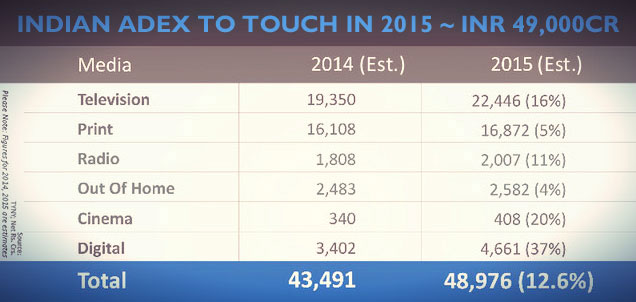
    Leading media marketing services conglomerate GroupM released its biannual advertising expenditure futures report This Year Next Year (TYNY), forecasting India’s advertising investment to reach an estimated Rs 48,977 crore in 2015. This represents a growth of 12.6% for the calendar year 2015 over the corresponding period in 2014.


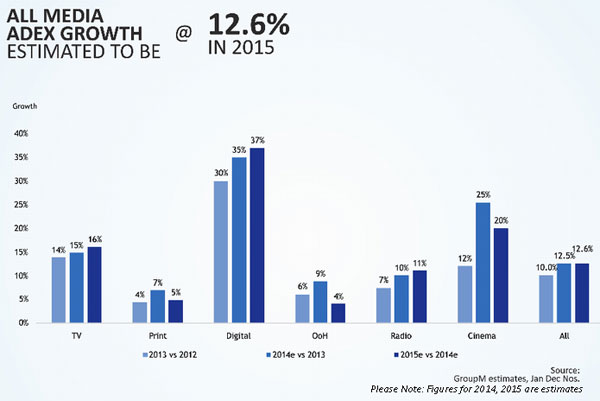
    As per GroupM the adspending was Rs 43,490 crore for the calendar year 2014, an increase by 12.5% over 2013. This growth was attributed to the heavy adspending due to the General and State Elections and industry categories like ecommerce and telecom.The FMCG sector, which contributes to nearly a third of the AdEx, had a steady year, growing broadly in line with the industry average.


    CVL Srinivas

    Said CVL Srinivas, CEO, GroupM South Asia, “With a new government coming to power, the negative sentiment has lifted but there is still some bit of caution amongst advertisers.We continue to operate in the same zone as last year at an overall level. Digital, TV and Cinema are expected to be the high growth media channels. We are seeing a lot more confidence amongst local businesses to invest in brand building than before. This is a positive sign for the industry. Penetration of smartphones coupled with the popularity of online video is making FMCG spend more on digital. Another trend is the emergence of categories like e-commerce and the increased competition in telecom both of which are aiding the growth of traditional media channels including Print and TV apart from digita.l”


    E-commerce is expected to lead the charge in 2015 in terms of ad spend growth although from a relatively smaller base than more established categories, according to GroupM’s forecast. There is increased competition in this sector and no dearth of funding. FMCG, Auto and Telecom are expected to do better than the previous year. More multinational entrants under single brand retail are likely to add to ADEX spending in the retail category. The recent rate cuts by the Reserve Bank of India will stimulate the banking sector, reactions of which are evident on a buoyant stock market. This year will possibly see a number of IPOs as there is a sense of stability in policy and investors are willing to take more risks. The market will also see higher spends from the Central Government as they showcase their new initiatives.


    Prasanth Kumar

    Added Prasanth Kumar, Managing Partner, Central Trading Group, GroupM South Asia and CEO-designate Mindshare South Asia: “Over the last few years, Indian media has been in a state of change. The next three to five years will be about embracing technology, which will allow both advertisers and media owners to customize distribution to a premium niche audience with very nominal margin of error. In 2015, programmatic buying will see an impetus, as all media in the future will see automation, backed by smart data and analytics.”


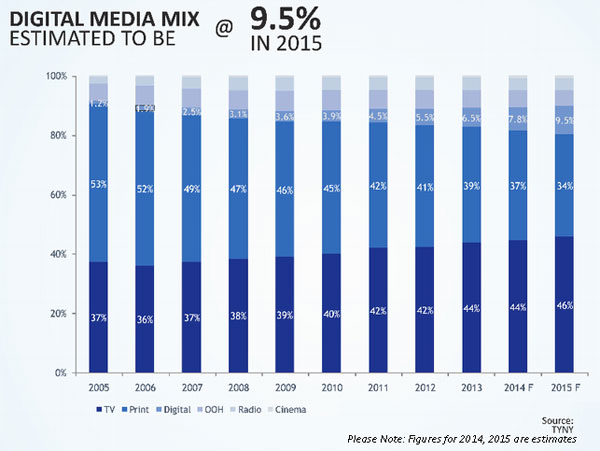
    As per GroupM’s in-depth research of the Indian media industry, digital media continues to show the maximum growth with 37% in 2015. Digital has been growing at an average rate of 35% over the last two of years. This year within digital media Video, Mobile and Social will be the biggest growth drivers.


    Television shows a higher growth percentage in 2015 compared to last year with 16 percent. TV channels will especially be bullish with cross media integration via their own digital platforms. The big ticket event this year is the ICC Cricket World Cup in February and March, with scope for programming and advertising innovation during the tournament.


    Even with pressures on advertising revenues, the print medium shows an increase by 5.2% as against the 2014 estimate of 7.6%; however print magazines continue to be on the decline, as several are looking at digital delivery mechanisms.


    The surprise element in the media mix has been cinema advertising which finally closed 2014 with a 25% increase. This year too, GroupM estimates this media category to grow at 20%, as multiplex chains consolidate, leading to a more organised and accountable environment. With technology fuelling exhibition and distribution, especially in smaller towns, consumers will get a better viewing experience.


  • Structure, Talent and Innovation are action points for PK at Mindshare, says GMan. Exclusive to MxM

    Gowthaman Ragothaman

    Given that both CVL Srinivas, CEO GroupM South Asia and Prasanth ‘PK’ Kumar, Managing Partner, Central Trading Group, GroupM South Asia and CEO-designate Mindshare South Asia were busy with the presentation of the ‘This Year Next Year’ report, they preferred to not speak on the latter’s appointment to the top job. But since PK will also report into Gowthaman Ragothaman (better known as GMan), COO of Mindshare Asia Pacific, Pradyuman Maheshwari spoke to GMan in Singapore and requested him to respond to a few questions via email.


    It’s been three years since you moved out from direct responsibility of South Asia. From a regional perspective, what are the broad challenges facing the India office?

    We have to treat India/South Asia as a region. No other market/office in the world has so many offices. We have Mumbai, Delhi, Bangalore, Kolkata, Chennai, Lahore, Dhaka and Colombo. While all other markets are structured for a “one office leadership”, as we have expanded and grown across offices, our “speed to market” was significantly tested in the last few years – this is an internal dynamic. As an industry, I realised, when I moved out into the region, India is very inclusive and try to do/invent all things inside when a lot of best practice can be just replicated or brought into the country. I also realised that the talent drain from India to the region, has sort of depleted some good quality talent in the country. So Structure, Talent and Innovation – are the three broad challenges.


    Prasanth Kumar is a seasoned GroupM hand. What are the specific targets you have for him?

    Pretty much the above 3 points. And you will see some of these happening quite fast and quick.


    In your statement on PK’s appointment, you speak about getting leadership talent from within the group. But, don’t you think that for achieving something out-of-the-box or hat ke, as they say in India, you need to bring in talent from the outside?

    Totally agree with you. We continue to diversify out talent pool at all levels – and the constant churn in the industry helps us to manage this, especially when you flip it as an opportunity instead of a problem. Almost all the recruitments we have made in Mindshare in the past 2-3 years are external talent. And at the same time, if you look at the challenges that I have mentioned in the first point, our considered view is to groom local talent to leadership positions as they come with tremendous insights of the organisational issues. It is  a considered choice…but not necessarily a permanent choice for all the times.


  • It’s PK as the new Mindshare South Asia boss!


    By A Correspondent


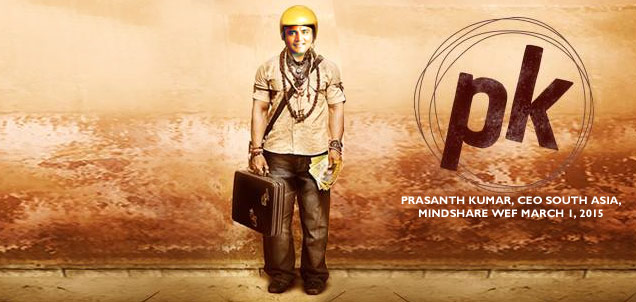
    The poster of the Aamir Khan film PK was the first thing that came to our minds when one of the A&M media’s favourite sources alerted us of the winds of change that were blowing across the GroupM South Asia headquarters in North Mumbai.


    Expectedly, the otherwise very responsive dramatis personae clammed up. Calls and text messages received no reply. Whatsapp messages got those two blue ticks, but not even the ‘typing’ indicator in response. But while we were sure of the news, we couldn’t carry it without a confirmation. So it waited from Wednesday to Thursday to the weekend.


    There were also other things that were also grabbing our attention.


    Prasanth Kumar
    Ravi Rao

    And then on Sunday evening, our inbox alert beeped. The message curiously asked us to embargo the news till 9pm. The news confirmed our earlier info: Leading media agency network Mindshare has appointed Prasanth Kumar as CEO, South Asia. He will take charge with effect from March 1, 2015. Ravi Rao, who is currently CEO, will be transitioning into a new role within GroupM, the details of which are to be announced soon.


    So where’s Ravi Rao going? Back to the Gulf, we were told. If not within the fold, outside of it. The communiqué says he will transition to a new role within GroupM, but which clearly means negotiations are still on.


    CVL Srinivas
    Gowthaman Ragothaman

    Kumar or PK, as he’s known in the fraternity, is currently Head of WPP-owned GroupM’s Central Trading Group and a member of the South Asia Executive Committee. As Mindshare South Asia leader, he will report into CVL Srinivas, CEO GroupM South Asia and Gowthaman Ragothaman, COO of Mindshare Asia Pacific. And who takes over from him, we asked the GroupM spokesperson. There are no names yet, but last year Jai Lala and Sidharth Parashar were elevated in the CTG team.


    Meanwhile, this is what Srinivas on the announcement: “Prasanth was a unanimous choice for this role.  In the past 10 years, he has played a stellar role in ensuring GroupM’s scale is leveraged to maximise value for our clients. I’d like to thank Ravi Rao for his contribution and wish him the very best in his new role within the network.”


    And here’s what Ragothaman (better known as GMan) commented on the change: “Ravi has done a fantastic job in growing our business in India in the last three years. India is at the inflexion point on digital, content, analytics, e-commerce and measurement and in Prasanth we have a seasoned veteran to lead Mindshare to the next level. And I am particularly happy that we continue to groom and grow talent from our larger GroupM ecosystem with diverse talent and experience to leadership positions, which speaks highly about our talent in the market place. In the past 10 years Prasanth Kumar has done a tremendous job scaling up GroupM’s CTG practice in South Asia, and developing strategic partnerships for GroupM that contribute to the successes of all GroupM agencies.”


    Big Story image inspired by poster of the Raj Kumar Hirani film PK. Imaging by Rafiq, Poster courtesy: PK, the film, poster


  • GroupM appoints Vandana Tilwani as Head – Talent Acquisition & Performance

    By A Correspondent


    GroupM has announced the appointment of Vandana Tilwani as Head – Talent Acquisition and Performance, India. Vandana will report in to Gaurav Hirey, Chief Talent Officer, GroupM South Asia, and is based out of the Mumbai office.


    Prior to joining GroupM Vandana Tilwani was heading the HR function at Condé Nast, India. She has worked with leading companies such as Wipro, Ugam Solutions, Sitel India, WNS Global Service, Hilton Mumbai and Condé Nast India.


    With over 17 years of experience Vandana has worked in the BPO/KPO, media-publishing, service & hospitality industry as HR Generalist, she has extensive experience in Talent acquisition, employee relations, compensation & benefits, performance management and organizational development.


    Speaking on the new appointment in the team, Gaurav Hirey said, “As we leap into a challenging and exciting media environment, GroupM is making a large investments in what matters most, our people. The talent function takes a new direction at GroupM in 2015. We are delighted to welcome Vandana on board, who, brings with her a wealth of not just domain knowledge on human resourcing, but functions in the media industry as well. Coupled with her appreciation for the changes technology brings to this function, we look forward to building a strong acquisition and performance team at GroupM.”


  • GroupM’s Grand Diwali Mela draws huge response

    By A Correspondent


    The Grand Diwali Mela organised by GroupM in association with Google, Amazon.in, LINE, Games2Win and Hungama.com met with a huge response with over 55 lakh visitors patronising the event. The ‘Grand Diwali Mela’ saw very high engagement with users, who spent time getting product samples @ Re.1, enjoying movies and videos, playing games and greeting each other via the LINE messenger. The number of visits on the virtual mela as well as time spent surpasses any offline brand activation initiative organised during the festival in India.


    The event received an overwhelming response with over 55 lakh visitors, the majority of which came from mobile phones with over 45 per cent women visitors. On October 24th, Diwali day, the mela received over 4.6 lakh visitors. In all mela visitors spent over 125,000 hours browsing various brand and entertainment stalls in the mela besides which many more hours were spent on partner sites – Amazon.in, Games2win and Hungama.com.


    The ‘Grand Diwali Mela’ emerged as the largest online sampling platform for brands. Over 150,000 samples were shipped across India, with 70 per cent samples going to Tier 2 and Tier 3 towns. The samples ranged from skincare and household products relevant to both men and women. To celebrate the partnership LINE Messenger came out with a set of special edition stickers for the ‘Grand Diwali Mela’.


    CVL Srinivas
    Rajan Anandan

    On the success of the Grand Diwali Mela, CVL Srinivas, CEO, GroupM South Asia said, “We are excited about the success of the first Grand Diwali Mela. We were able to create a great platform for consumers to come and sample products and interact with brands. It is also heartening to see the reach of the virtual mela was not restricted to the metros but filtered down to smaller towns where the digital penetration is growing exponentially. We also have seen a distinct spike in access via mobile phones, a clear indicator that India is opening up readily to mobile data and communication.”


    Rajan Anandan, VP & Managing Director of Google India, said “I would like to congratulate GroupM and all the participating partners for the success of the first Grand Diwali Mela. The fact that majority of the users experienced the mela from their mobile phones goes onto show the growing importance of mobile devices in India. With over 150,000 samples being tested on the platform, the initiative is likely to open up newer ways of engaging buyers online for brands and marketers on the mobile phones. Online brand activation during festivals is a brand new territory and I am confident that we will be able to scale this further next year.”


  • HDFC Bank is India’s Most Valuable Brand


    By A Correspondent


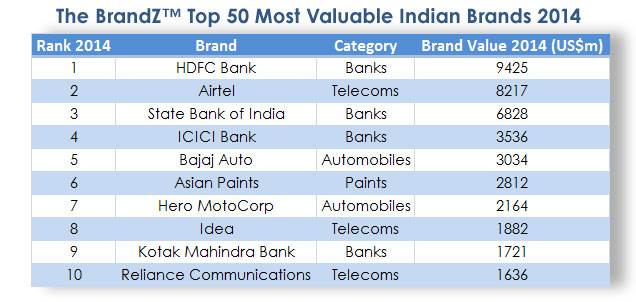
    The combined Brand Value of all the brands in the inaugural BrandZ Top 50 Most Valuable Indian Brands ranking is almost $70bn BrandZ. HDFC Bank is India’s most valuable brand with a value of $9.4bn. Carried out by marketing and brand consultancy Millward Brown in conjunction with WPP, the valuation is the only one in India that takes into account consumers’ opinion of brands to calculate the contribution that product brands make to business success.


    The BrandZâ„¢ India study shows that India’s unrestricted ‘right to play’ for businesses has nurtured great diversity amongst brands in the ranking. The Top 50 come from 13 different categories. Seventeen are multinational corporations (MNCs), 26 are private Indian brands and seven are state-owned brands. This indicates that India is an open, fertile market for building valuable brands, irrespective of age, origin, structure, category, ownership or even price range.


    HDFC Bank, the No 1 brand, has a network in more than 2,100 cities. It is popular with its 28 million customers for launching mobile apps designed to make banking easier, and running literacy, education and skills training programmes in rural areas. The No 2 brand, Airtel, is the fourth largest mobile operator in the world with nearly 300 million customers, while India’s largest commercial bank, State Bank of India, is at No 3 in the ranking.


    Services businesses (Banking, Telecoms and Insurance), which are the nerve centre of today’s Indian economy, are prominent in the ranking. Seven of the Top 10 brands, and 30% of the Top 50 brands, come from the service sector. Financial services stand out, with the 12 banks and insurers in the ranking holding the largest proportion (37%) of total Brand Value. Analysis shows these brands have built value by successfully achieving scale – both in geographical reach and the diversity of their offerings. Telecoms, Personal Care, and the Food and Dairy sectors also feature strongly in the Top 50. The data shows that these brands – along with the other FMCG brands in the ranking – excel at connecting with Indian consumers.


    The average Brand Contribution (a measure of the impact brand alone has on value) of the Top 5 brands is far higher than the overall average of the Top 50, illustrating the positive impact that building a strong brand has on the financial valuation of the brand. These brands create powerful connections by being meaningful to consumers, and differentiating themselves from others.


    Key findings highlighted in the BrandZ Top 50 Most Valuable Indian Brands include:

    :: Being meaningful and different builds value – India’s most valuable brands are highly relevant to consumers and differentiate themselves through service, new offerings and brand experiences. One such example is personal care brand Colgate (No 28) – even after 70 years in India the brand has successfully remained relevant and continues to differentiate itself from the competition.


    :: India has evolved into a brand powerhouse – India’s Top 50 most valuable brands have as much Brand Power (consumers’ predisposition to choose that brand over another) as the global Top 50, and are ahead of the other emerging economies.


    :: Private sector players and multinational corporations dominate – together these contribute around 85% of total brand value. They have succeeded by nurturing a strong relationship with Indian consumers.


    :: Megabrands lead the game – like other fast growing economies, India is dominated by a handful of big brands or companies that own stables of brands: the Top 5 account for 45% of the ranking’s total value. Their tremendous scale and ability to cater to a wide spectrum of the population has translated into financial gains.


    :: ‘Balanced brands’ is the mantra – brands that are able to build both strong connections with consumers and business scale that leads to the creation of financial value are contenders for entering or rising up the BrandZ ranking. Three out of the Top 5 Indian brands demonstrate this balance.


    :: Consumer technology is ‘the category waiting to happen’ – there are currently no homegrown consumer technology brands in the Top 50, but this category is on the verge of emergence. The presence of Indians working in the sector globally is high, and consumer-facing technology brands founded by young entrepreneurs have already started to gain ground.


    :: ‘Indianizing’ products and services is important – the many successful international brands in the ranking have taken the time to understand Indian needs and tastes and adapt to them. Noodles, food seasoning, soup and sauce brand Maggi (No.18), personal care brand Colgate (No.28) and beverage brand Horlicks (No.20) are masters at this – and are thought of as Indian brands by most consumers as a result.


    :: Old and new sit side by side – living with one foot in the ancient world and one in the modern makes consumers equally receptive to heritage brands (Bajaj Auto, No.5, established 1945) and new brands (Airtel, No. 2, established 1995). More than a quarter of the Top 50 brands were created after the economic liberalization in 1991 while Dabur, No.22, was established 130 years ago.


    Said Prasun Basu, Millward Brown’s Managing Director – South Asia: The stronger the relationship a brand can build with consumers in its category, and the more it can leverage that to build scale, the more sustainable and profitable it becomes. All of the Top 50 brands are reputable, successful engines of growth for the future of India. Any global manufacturer that makes the effort to understand the diversity of the Indian consumer’s needs, tastes and aspirations, and which can build a proposition that is both meaningful and appropriately differentiated, will succeed in building a strong brand.”


    Added David Roth, CEO of The Store, WPP: “With the second highest number of social networking users in the world, and the third highest number of users of mobile devices, developing an e-commerce strategy that focuses on social and mobile platforms is essential for brands in this region.”


    Said CVL Srinivas, CEO GroupM – South Asia, “We are already seeing the impact of the purchasing power of the internet and mobile users in India, with the exponential growth of e-commerce companies in the space of travel, e-tailing, ticketing and many main line brands increasing their brand building budgets to digital media in multiples.”


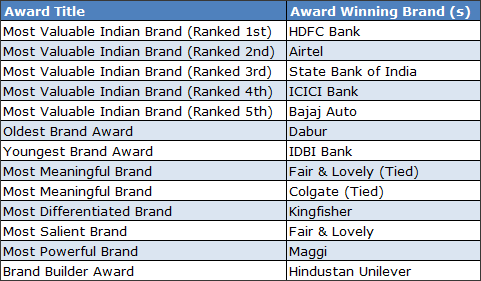
    In addition to the rankings, special awards were also presented to brands among the Top 50 under the following categories.


    Millward Brown BrandZ India Awards 2014

    A copy of the BrandZ™ Top 50 Most Valuable Indian Brands 2014 report can be downloaded at www.brandz.com