Tag: GroupM South Asia

  • AdEx to grow 12.6% in 2020: GroupM


    By A Correspondent


    Adspends in India will grow 12.6% in the year 2020, a slight increase from the 12.4% in the year 2019. This was part of the global ‘This Year Next Year’ report released by GroupM at a global level. It may be noted that GroupM presents its India-specific numbers every year in early February, which can hence be expected two months from now.


    According to the numbers released, for India, the growth in television will be 11.1%, whereas for radio it will be 8%. The growth forecast numbers for newspapers and magazines are 1% and -10% respectively. While the growth for outdoor and cinema is pegged at 8.1%, that for internet will be 26.3%.

     

    Prasanth Kumar

    Said Prasanth Kumar, CEO, GroupM South Asia: In 2020, India faces challenges and uncertainties across sectors, just like other markets. However, this also brings opportunities for brands to innovate. This will be propelled by greater use of technology and better content across media.”


    Meanwhile, here’s the rest of the report:


    The global economy has weakened in 2019 and will remain similarly soft in 2020. By our calculations, based on Refinitiv data, the gross domestic product (GDP) of the countries we track in “This Year, Next Year” is growing by only +2.6% this year in real (inflation-adjusted) terms.


    Growth in 2020 is expected to be similar (+2.5%), with only slightly faster growth (+2.8%) in 2021 and beyond. For reference, +2.5% would be the slowest pace of growth in any non-recession / non-recovery year over the past two decades. In nominal terms (including inflation), 2019 growth for these countries is expected to be +4.9%, down from growth of +5.8% in 2018 and +5.7% in 2017. 2020 looks somewhat similar to 2019, and marginal improvements follow in subsequent years.


    Nominal growth rates are important to track because they are the most directly comparable figures to those with which marketers and media owners work in determining their own financial plans.


    Personal consumption expenditures are holding up better. One factor that has probably helped sustain marketing growth so far this year is growth in personal consumption expenditures (PCE). As consumer spending represents more than half of all economic activity, PCE can be more important to monitor than GDP. Global growth in nominal PCE is holding up as well in 2019 as it did in 2018 at +5.5% in both years. Growth is expected to slow, but only modestly in the years ahead. Of course, changes in inflation levels diminish these figures, with expectations for real (inflation-adjusted) PCE growth at incrementally slower levels each year over the next five years.


    Industrial production often correlates more tightly with advertising growth trends. Industrial production (IP) figures are another key set of metrics to monitor, as IP often correlates better with advertising activity than either GDP or PCE (manufacturers generally only make things for sale if they are planning to spend money on advertising them). Weighted against GDP in the markets captured here, we see pronounced weakness in 2019 and 2020 (+1.2% and +1.5%, respectively) relative to 2017 and 2018 levels (+3.5% and +3.1%, respectively). Recovery toward slightly higher levels is anticipated for 2021 and beyond.

    Trade and other factors are key sources of uncertainty. As the Organisation for Economic Co-operation and Development (OECD) has pointed out, slowing global trade is clearly dragging on economic activity, and seemingly heightened geopolitical uncertainties are similarly unhelpful. All of this would worsen if the U.S. experienced a recession, although the U.S. economy has remained resilient, likely aided in part by low interest rates and corporate tax reductions, alongside a federal deficit of nearly $1 trillion during the most recent fiscal year. This was equivalent to more than a quarter of all government expenditures and nearly 5% of the overall economy, or more than double its recent trough in 2015.


    Mean and median growth rates may tell different stories. We note the difference between mean and median growth rates, with larger economies expected to perform relatively better than smaller ones in the years ahead.


    Global Advertising Growth Summary


    In this environment, deceleration in advertising growth should be generally unsurprising. Global advertising, excluding U.S. political advertising (large enough to distort global growth rates by +/-1% each year), expanded by +5.7% in constant currency terms during 2018, capping the third year of better than +5% growth and the best year of the current economic cycle. However, 2019 appears set to grow nearly a percentage point slower at +4.8%, and growth is expected to slow by another percentage point in 2020 and 2021. We forecast +3.9% growth next year and +3.1% growth the following year. Growth is expected to range between +3–4% through 2024. Although much worse than recent years, we note that this would amount to a similar pace of growth to what was observed during 2012–2014. We estimate that the total global advertising market during 2020 will amount to $628 billion as we define advertising here, but would likely approach $700 billion on a broader definition that includes spending on direct mail and directories around the world.


    Notably, a substantial share of global advertising is now accounted for by digital-first brands that are endemic to the internet. Based upon their securities filings, we can see that Alibaba, Alphabet, Amazon, Booking.com, eBay, Facebook, IAC, JD.com, Netflix and Uber are each now $1 billion+ advertisers, accounting for $36 billion in spending during 2018, up by a quarter over 2017 levels; growth in 2019 was presumably very similar. Adding a couple dozen companies from the next tier of comparable marketers would easily add tens of billions of dollars of additional activity. Combined, this small group of companies accounts for a majority of the world’s growth in spending on advertising. To the extent that these companies tend to take shares of consumer spending from others and do not directly cause the global economy to expand, at some point their growth converges with global averages, resulting in slowing growth in spending as well.


    The median growth rate has exhibited sharper deceleration in 2019 than the mean. For the countries we have tracked with consistent data back to 1999, the median growth rate in 2018 was +5.2%. It is expected that 2019 will be +2.1%, followed by +2.7% growth in 2020, with generally slower growth than the weighted average. The difference between the mean and median highlights that growth is driven by a small number of large countries and that the typical small country is experiencing worse growth trends, bringing down the worldwide average. By contrast, median country growth was typically well above the mean as recently as 2013, reflecting a period where much of global advertising growth was driven by smaller countries. This maps to the aforementioned global economic trends.


    The U.S. remains the largest global advertising market, with $246 billion in advertising as we define it here, and growing above global averages. With nearly 40% of the world’s total and a still-robust advertising market in 2020 and beyond (at +4–5% growth excluding directories, direct mail and political advertising), the U.S. is helping raise global averages. Our forecasts anticipate a slowing economy as well as the gradual maturation of the digital brands that have driven so much recent growth. On the basis described here, normalized U.S. advertising should slow from +7.6% in 2019 to +5.0% in 2020, +3.4% in 2021, and similar levels in subsequent years.


    China’s $90 billion media market is maturing and beginning to slow, but is still more than two times the size of the number-three market, Japan. After many years of rapid growth, China is now solidly the world’s clear number-two market for advertising, with 16% of total media-owner ad revenue, nearly matching the country’s 17% share of global GDP. However, macroeconomic concerns—including issues referenced above and a general maturation of the Chinese advertising market—are weighing on growth


    this year and beyond. We forecast growth of only +3.7% in 2019 and +1.4% in 2020. Similarly, low levels of growth are anticipated in subsequent years despite faster levels of economic expansion for the overall Chinese economy. Japan remains a solid number three, with 7% of global advertising ($41 billion in 2020) and 6% of GDP, but growth is expected to be tepid there as well; +1.7% growth in 2019 is expected to be followed by +1.8% in 2020, and closer to +1% in subsequent years.


    The U.K. is still growing at a remarkably fast pace. Among larger advertising economies, the U.K. and the U.S. stand out for their healthy growth expectations. For the U.K., it is a feat made more remarkable given how much uncertainty has persisted over the past three years since the Brexit referendum. Five years ago, the U.K. was essentially tied with Germany as the number-four market for global advertising, but since that time the U.K. has grown by +44% while Germany has only expanded by 7%. The factors driving the U.K. are likely similar to those that have helped make the U.S. a strong market, including a substantial presence of digital brand spending as well as the expanding availability of ad inventory (in digital environments, primarily), which help make it possible for smaller marketers to use media. Although we do expect growth to taper off from the high-single-digit levels we have observed since 2014, solid mid-singles (+6.7% in 2020 and +5.5% in subsequent years) are now expected.


    Germany and France are growing at below-global average rates; so is much of the rest of Europe. Brazil should be above average, while India is the world leader among larger media markets. Germany and France have certainly underperformed U.K. and U.S. levels of advertising growth in recent years, but remain in the number-five and number-six positions for now. France appears set to grow at a slightly faster pace than Germany, with a +2.8% five-year compound annual growth rate (CAGR) through 2024 for France versus a +1.6% CAGR for Germany. By 2024, Germany should still be the fifth-largest advertising market, but France will likely be overtaken in importance by both India and Brazil, currently number six and number seven, respectively. Brazil should grow at a solid +4–5% level through 2024 after a soft 2019 (we believe the ad market there grew by only +3.3% in 2019), but India should continue to be stellar, maintaining double-digit growth rates (we estimate +12–13% each year from 2020 to 2024, similar to 2019 levels). Of course, inflation is an issue for both of these countries, negating much of Brazil’s growth. However, in India the effect will only mean that real growth is in high-single digits rather than low doubles.


    Canada and Australia are similarly sized markets, but they are growing in different directions. Canada and Australia round out the world’s $10 billion+ ad markets in 2019, with Canada expected to grow slightly faster over the next five years and growth likely largely tied to the health of its southern neighbor. Australia’s trends will likely differ, as we see at the present time with that country’s economy soft and facing a real risk of recession for the first time in decades. The Australian ad market was likely only stable in 2019 versus 2018 and probably grows only slightly in 2020, for a +2.0% gain expected next year. By contrast, Canada is expected to grow +5.0% in 2019, and should slow toward a high 3%+ growth level next year and in subsequent years. Overall around the world, 14 territories are expected to decline during 2019, with Italy the largest among them: We anticipate Italy will fall by -0.4%. Other large markets among this group include Mexico and Switzerland, which are expected to decline by -4.6% and -8.0%, respectively. Next year, fewer markets are expected to decline, with Switzerland the most significant among them


     

  • GroupM India elevates Sidharth Parashar & Ashwin Padmanabhan

    By A Correspondetn


    Sidharth Parashar
    Ashwin Padmanabhan

    GroupM India, the media investment group of WPP, has announced the appointment of Sidharth Parashar as President – Investments and Pricing, GroupM India and Ashwin Padmanabhan as President – Partnerships and Trading, GroupM India. As part of this elevation, both Parashar and Padmanabhan will join the GroupM Executive Committee.


    Said Prasanth Kumar, CEO of GroupM South Asia: “The elevation of both Sidharth and Ashwin is a testament of GroupM’s continued investment in its talent which has helped build a strong leadership pipeline, creating leaders to take our business into the future. In this ever-evolving integrated media ecosystem, we understand the importance of having leaders across key client focus areas like media investments and trading. Both Sidharth and Ashwin are astute leaders and I am confident that they will continue to drive client delight and expand GroupM’s reach across platforms.”


    Prasanth Kumar

    Both Parashar and Padmanabhan have been leading GroupM’s pricing-investment and partnerships trading practices over the years and they will take over their respective new roles effective this month (November 2019). Parashar has been with GroupM for over 15 years and Padmanabhan joined GroupM from Reliance Broadcast Network where, as the COO he led the network’s Radio and Television business. Both Parashar and Padmanabhan will continue to be based out of the GroupM’s Gurugram office and will report to Prasanth Kumar, CEO GroupM South Asia.


  • m/Six bags media mandate of Emami

    By A Correspondent


    m/SIX, a unit of GroupM, has bagged the AoR media mandate of key Emami Group businesses such as Emami Ltd, Emami  Agrotech Ltd, and Emami Cement Ltd. The account will be handled by the agency’s Mumbai and Kolkata offices and the scope entails the television buying and implementation responsibilities.


    Harsh Agarwal

    Said Harsh Agarwal, Director – Emami Limited: “We are happy to have m/SIX on board and look forward to the value-add they promise to bring to servicing of the mandate.  We are confident that with the very dynamic and fast changing media scenario, m/SIX with their global presence and wide experience and expertise will be able to develop a robust strategy for our media buying to add impetus to all our marketing initiatives.”


    Prasanth Kumar

    Added Prasanth Kumar, CEO GroupM South Asia: “It’s a great win for m/SIX and we are excited and delighted to partner with Emami. Emami Limited, Emami Agrotech and Emami Cement are great brands and these wins are the testament of great efforts and solutions that the team brings on to the table for our clients.” He added, “These wins motivate us and we will continue to work with our partners to deliver the best.”


  • GroupM & Lifesight launch online-to-offline attribution playbook

    By A Correspondent


    GroupM India and Lifesight, a Bengaluru-based location intelligence platform and data company, have co-created a playbook answering key questions advertising clients have on online to offline attribution and outlining ways in which marketers can use intelligence on consumers’ online behaviors to impact offline sales. This, claims a communique, is the first-of-its-kind attribution study in India with examining the conversion of online ads into offline sales.


    Said Tushar Vyas, President – Growth and Transformation, GroupM South Asia: “The importance of omnichannel strategies has grown exponentially, and the lines between online and offline have begun to blur. Given that the consumer journey between online and offline is becoming seamless, it is critical to have the right technology to manage location data and location-based attribution models to provide better insights to clients. For a marketer to understand what’s working in their campaigns, it is important to attribute the right conversion to its apt source. At GroupM, we understand the constant need to create, invent and reinvent the right measurement frameworks to help our clients address their business problems.”


    In 300+ campaigns run through Lifesight, with over 200 brands, there were some interesting insights discovered:


    1} The average costs to drive in consumer footfall is the most for Consumer Durables and the Auto sector and the least for Quick Service Restaurants (QSR) and Fashion.

    2} Offline attribution works best for Auto and QSR since most people would visit a physical store

    3} The Retail sector takes the least time (2-3 days) to drive a walk-in from exposure. On average, it takes approximately 6-9 days across verticals to drive store walk-ins

    4} 70% of the initial walk-ins to physical stores happens within the first 8 exposures. Retail takes the least number of exposures while fashion requires the most.


    Added Tobin Thomas, Co-founder and CEO of Lifesight: “Marketers today have unlimited options for building, targeting, and delivering a campaign. But even with all these options, one question remains- is my advertising working? With a large number of channels to choose from, it’s imperative to understand how each campaign component performed comparatively. As a result, location attribution has emerged as a powerful solution to stitch together channel, audience, and platform signals to understand reactions to online advertising in the real world.


    “Lifesight is leading efforts to take campaign success metrics beyond the click. We are excited that leading a marketing powerhouse like GroupM have joined us at the forefront of online-to-offline attribution.” Tobin Added


  • Prasanth Kumar takes over as GroupM CEO

    By A Correspondent


    GroupM Asia Pacific announced the elevation of GroupM South Asia COO, Prasanth Kumar, to CEO. Sam Singh is leaving the GroupM CEO role in a little over a year after taking charge. While Singh will leave GroupM at the end of June. PK, as Prasanth Kumar is better known, will take up the CEO role with immediate effect.


    Said Mark Patterson, CEO, GroupM Asia Pacific: “PK has performed to the highest levels for 15 years in GroupM and agency leadership roles. He is uniquely and perfectly positioned to take on the CEO role, working closely with myself and CVL Srinivas (our WPP Country Manager), our local leadership team, clients and media partners. We have ambitious plans to continue to leading growth in the market as we help our clients fulfil their ambitions. It’s an exciting time for India, and the region and the future is bright. PK has been very much a part of our success to date and will be in the years to come in his new role. I’d like to thank Sam for his hard work and leadership and wish him all the best in his new role. No doubt, we will work closely with him and his new team in the future.”


    Added Srinivas: “PK has contributed immensely to the success of GroupM in India and South Asia through the various roles he has enjoyed since joining us back in 2004. His passion for the business, never say die attitude and a strong commitment to our clients and partners have earned him a great deal of respect across the board. I have enjoyed working with him and am excited to see him lead GroupM South Asia. I’d like to thank Sam for his leadership and wish him the very best”.


    Said Sam Singh: “Heartiest congratulations to PK on his promotion. It has been an absolute privilege working with GroupM this last one year. The friends that I have made, are friends for life. First hand I’ve seen the excellence and passion that the GroupM people bring to work every day; and the bonds that they have with their clients and the passion for their brands. I wish GroupM all the success. To ensure a smooth transition, PK and I will be closely working together.”


    And this is what PK said on his new role: “I am humbled at the opportunity to take on the CEO role for GroupM in one of the most dynamic and fastest-growing markets in the world. When it comes to advertising and media, India has made its mark on the global stage and success with our consumers is of vital importance to some of the world’s biggest advertisers.  It’s been thrilling to be with GroupM as we’ve led the way and there is much more to come”


  • GroupM forecasts 14% adspends growth


    By A Correspondent


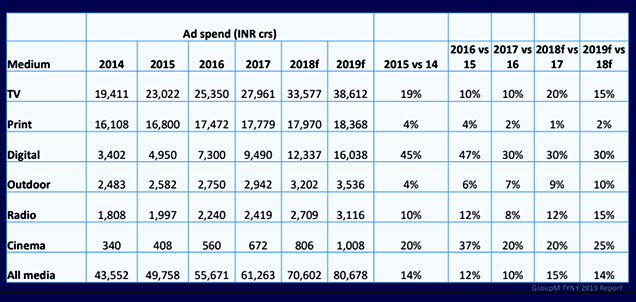
    GroupM, the media investment group of WPP, announced its advertising expenditure (AdEx) forecasts for India for the year 2019.  As per the ‘This Year, Next Year’ (TYNY) 2019 report, India tops the list as the fastest growing major ad market in the world. TYNY forecasts India’s advertising investment to reach an estimated Rs. 80,678 crores this year. This represents strong estimated growth of 14%, for the calendar year 2019 (approx 2x of the GDP growth).


    India will be the third highest contributor to the incremental ad spends, only behind China and USA and the tenth fastest growing country with respect to ad spends across the globe.


    The Cricket World Cup and Elections in 2019 are expected to boost adspends. FMCG, Auto, Retail, e-commerce, Tech/Telecom are expected to contribute to 2/3rd of the AdEx. According to GroupM, the special events of the year (World Cup Cricket and Elections) will add around 3 per cent to the 11 per cent organic growth forecast for the year.


    Speaking on the TYNY 2019 report, Sam Singh, CEO – GroupM South Asia said: “While we are estimating the global advertising expenditure to grow at 3.6%, India would be witnessing the fastest growth at 14% and reach an estimated Rs.80,578 crores. This would be approximately 2x of the estimated GDP growth in India. This also makes India the third largest adex growth to the worldwide ad spends. We expect sustained and stable media investment growth across categories in India”


    This year 37% of incremental ad pends will go towards digital advertising including mobile. The scale at which we are witnessing this digital transformation, GroupM estimates the Digital Adex to continue to grow by 30% in 2019 to Rs. 16,038 crores.


    Added Prasanth Kumar, Chief Operating Officer – GroupM South Asia: “Indian adspends CAGR between 2014-2018 is at 13% and 2019 expected to witness a higher growth. India is unique among key markets and will witness growth in all media segments and not just digital. Offline media is poised to continue to grow and will contribute to being around 80% of ad spends in 2019.”


    Television will continue to grow at a steady pace. This year, the growth rate for TV is estimated to be 15%.


    Print is estimated to grow by 2.2% and the share of print to all media is expected to be at 23%. While it is expected for both English and regional languages to grow, regional will see slightly higher growth. Vernacular will continue to thrive on both TV and print.


    This year radio is expected to grow at 15% which is higher than the last couple of years. Cinema will grow at 25% in 2019, as 2018 saw more titles winning audience at the box office. In 2019 GroupM expects cinema to shift from title-based advertising to continued advertising through the year. Lower tax on cinema tickets is expected to drive more footfalls to theatres.


    GroupM also presented some of the biggest trends that will shape the media Industry in India in 2019. The trends presented were around emerging technology, data, content creation and distribution put the consumer at the center and underline the theme of digital driving the change across all formats of media. The trends touched upon the TRAI tariff order implementation as well its potential impact of increasing original programming and investments on content across broadcaster networks.


    Said Tushar Vyas, President Growth and Transformation – GroupM South Asia: “With the surge of technology, better insights and relevant engagement across different platforms, we are expecting marketers to build superior consumer connections for brands. 2019 will witness a faster growth in digital and we are expecting digital to be at 20% media mix. As we are witnessing one in every three Indians digitally connected, we can expect the convergence of data, digital and content to deliver seamless and powerful solutions to brands as well as constantly adding inventive practices into the market.”  ESP Properties head Vinit Karnik also spoke on the occasion.


    TYNY 2019 Media Handout

  • On R-Day eve, GroupM rejigs top deck


    By A Correspondent


    Okay, the Republic Day reference was just for effect. It’s just a coincidence. Also, the news has been doing the rounds for a bit.


    After announcing a new CEO in Sameer ‘Sam’ Singh last year, GroupM South Asia has announced a significant restructuring in its leadership. Effective immediately, Prasanth Kumar (PK) is named Chief Operating Officer, South Asia, and Tushar Vyas is named President Growth and Transformation, South Asia. Both are new roles in the organisation, notes a commuique.


    Meanwhile, Parthasarathy Mandayam (Maps) is named Mindshare’s CEO for South Asia and Amin Lakhani is named Mindshare’s Chief Operating Officer in South Asia.


    Now here’s what the communique adds:


    As Chief Operating Officer, PK will be responsible for operational excellence, i.e. ensuring client expectations are reliably met by continuously improving processes ensuring clients are successful today. He will guide and lead the teams across OpCos, Trading and Specialised Units to execute the same more consistently and reliably to drive client delight while fortifying partnerships.


    Most recently as Mindshare’s CEO, PK oversaw Mindshare’s rapid expansion in the market, bringing it to a market-leading position and winning numerous global awards. During his tenure, he developed a record for the most number of new business wins by a single market and created a tradition of external accolades, including a Glass Lion at Cannes, a Grand Prix at WARC and an average of over 250 external awards per year. Mindshare India was also recognized globally as #2 in the Gunn report. Prior to Mindshare, he led the GroupM Central Trading Group across South Asia and championed exciting partnerships in digital and traditional media.


    Tushar Vyas will take over the role of President Growth and Transformation. In his new role, Tushar will drive digital transformation and focus on building GroupM wide capability focusing on Digital, Data, Analytics, and Content, and working across GroupM to ensure our clients are ahead of the curve for tomorrow.


    Before taking over his current role of the Chief Strategy Officer at GroupM, Tushar launched the Digital Media Agency business unit (Interaction) for GroupM India and built a 600+ member team by expanding services in areas like content, search, programmatic buying, mobile, digital activation, social insight and digital analytics. Today, GroupM’s digital media practice is the largest digital media solution provider with more than 500+ active clients. Under his leadership, the digital practice was a regular at all the major digital and media awards. He was also part of SureWaves start-up team focused on Media technology.


    Speaking on the new appointments, Sam Singh, CEO, GroupM South Asia said: “PK and Tushar are passionate leaders with high integrity and proven ability to envision and deliver successful outcomes in a challenging environment. As we become a more data-centric organization, there is a need to drive transformation and build future capabilities with a focus on Digital, Data, Analytics, and Content. We must work across GroupM to drive organizational transformation and operational excellence. The new team structure is another step in this direction.”


    He added, “I am also sad to announce that Lakshmi Narasimhan, our Chief Growth Officer for GroupM South Asia, has decided to step down from his current role effective January 31, 2019, to pursue personal interests. I thank him for his contributions over the years and wish him all the best. We will miss him as we continue to build upon his hard work and passion. Lakshmi was instrumental in building our strong trading community with solid practices”.


    Parthasarathy Mandayam (Maps) will take over the role of Chief Executive Officer(CEO) of Mindshare, South Asia effective February 1, 2019. Maps takes on the role from PK, who will be moving to his new role within GroupM.


    Maps has spent 10+ years with Mindshare in various leadership roles – Data, Insights, Analytics, Strategy, Client Leadership and Business Unit leadership. He will report into Sam Singh, CEO GroupM, South Asia, Prasanth Kumar – COO – GroupM South Asia and Amrita Randhawa, CEO Mindshare Asia Pacific.


    Going forward, Amin Lakhani will take on the role of Chief Operating Officer (COO) for Mindshare South Asia.


    Lakhani has over 20 years’ experience in various roles in Mindshare and GroupM and is currently leading Client leadership at Mindshare. He will continue to be based out of Mumbai.


    Talking on the latest developments, Prasanth Kumar, the new GroupM COO, said: “Our industry is an ever-mutating one, so we have to also continue to evolve and adapt. With Maps and Amin now at the helm of Mindshare, we have leaders with a proven track record of consistently achieving clients’ business goals. They will continue cultivating client relationships at the highest level and delivering great results.”


    With investment in data, technology, and diverse talent, GroupM aims to shape the future and transform business challenges into opportunities for clients.


  • Homelane.com appoints GroupM & Famous, unveils new brand identity

    By A Correspondent


    Online home interiors provider HomeLane has appointed Famous Innovations and media agency GroupM to launch the first ever brand campaign with digital as the lead medium while using other mass communication mediums.


    Said Tanuj Choudhry, Chief Business Officer of HomeLane.com: “The goal of going into the market with the brand campaign is to create a relatable brand identity for potential consumers. With GroupM and Famous Innovations are our partners, we are excited to launch the brand across India’s Top 5 cities and make HomeLane the go-to player for home interiors”.


    Meanwhile, HomeLane has also announced a new tagline as part of its rebranding exercise – Interiors Made Easy.


    Said Sam Singh, CEO of GroupM South Asia: “We, at GroupM, are very excited to partner with the Homelane team in their growth and expansion plans. We are geared to create cutting edge solutions and customise our existing  array of products to pair up with Homelane’s futuristic outlook”


    Commenting on the partnership, Raj Kamble, Founder & CCO of Famous Innovations added: “HomeLane is a brand with tremendous potential and we are excited to have joined hands with them at this defining stage in their journey. Setting up a new home is a once-in-a-lifetime momentous occasion for most people, and by promising personalisation, affordability and convenience, HomeLane is solving a crucial problem for consumers. The brand team is a passionate, ambitious and dynamic one, and we saw great synergies in both our company cultures. We look forward to the days to come.”


  • Navin Khemka replaces Debraj Tripathy asi CEO of MediaCom

    By A Correspondent


    Navin Khemka

    MediaCom has announced the appointment of Navin Khemka as CEO of its South Asia operations effective July 16, 2018. Khemka takes on the role from Debraj Tripathy who will be leaving the organisation to explore new opportunities outside the group. He will be based in Delhi (Gurugram) and report into incoming GroupM South Asia CEO Sam Singh and Mark Heap, CEO Mediacom Asia


    Debraj Tripathy

    Tripathy joined MediaCom in 2011 and under his leadership, MediaCom India has been among the fastest growing and most awarded agencies in South Asia. In recent years, MediaCom India was recognised amongst the Top 10 agencies in the Gunn Media 100 Agency Report, named Agency of the Year at the Festival of Media Asia, and delivered many award-winning campaigns recognised as amongst the best in the world, including Ariel’s “Dads Share the Load”, Gillette’s “Bachelor of Shaving”, and Wrigley’s “Doublemint #Startsomethingfresh”.


    Khemka is currently Managing Partner (North & East) and New Business Development Lead for GroupM’s Wavemaker India. He has over 20 years’ experience, working with brands such as Perfetti Van Melle, Hero, Pernod Ricard, PayTM, Nokia, Samsung, Reckitt Benckiser etc. A MICA alumnus, Navin has played a stellar role in growing Maxus and later Wavemaker in New Delhi with his client centric approach. He joined GroupM to lead the New Delhi branch of Maxus in 2014. He has previously worked in Zenith Optimedia, Cheil and Mudra.


    Said Srinivas who also presently holds charge as CEO GroupM South Asia: “WPP and GroupM are making many investments into areas that will further enhance our market-leading capabilities in India and South Asia. We are excited to see Navin take on this role. With his experience and energy, we are sure he will take MediaCom to even further heights by leveraging all that our group has to offer, for the benefit of our clients. Debraj has done a terrific job leading MediaCom. He has been a fantastic colleague and a very admired leader.”


    Added Heap: “The search for a new leader has been an exciting one as there is no shortage of strong talent in India. We considered many candidates from within and outside the group and unanimously knew that Navin was the choice. Alongside our successes in India in recent years, MediaCom globally have built up tremendous positive momentum, winning more new business than any other agency in 2017 and being awarded the current Global Agency of the Year awards by Festival of Media, Campaign and Adweek. In Navin, we have a leader with stellar raw talent and a real thirst for growth, who can capitalise on the enabling assets of the MediaCom global network and the strength of GroupM and WPP India. I’m really looking forward to working with him to lead us boldly to a new level of success for our staff and our clients.”


    Said Khemka, CEO, MediaCom South Asia said “I am excited to continue my GroupM journey with MediaCom. Given MediaCom’s dominant global position and aggressive plans am confident we will able to drive growth and lead the agency to the next level. The future is promising with the dynamic media landscape in India and the challenge will be to lead this change by driving relevance and effective ROI for our brands, including several blue-chip clients.”


  • GroupM India’s transformation journey is a case study at IMD Biz School, Switzerland

    By A Correspondent


    Leading management institute IMD Business School, Lausanne in Switzerland has created a case study on the digital transformation journey of GroupM India..The case study is authored by Prof Anand Narasimhan and Transformation Project Manager Ivy Buche.


    Commenting on the case study, CVL Srinivas, Country Manager WPP India and CEO, GroupM South Asia said: “It is an honour to be recognized by the world of academia and become a part of the IMD curriculum. In late 2012, the advertising and communications industry was challenged by digital disruption. As our business underwent metamorphosis, a critical part of the journey is taking the human capital into confidence and preparing them to work in a future-ready organisation. Along with the technology aspects of transformation, at GroupM India we successfully leveraged the talent dimension in implementing digital transformation. The case study will help other companies navigate their own transformation initiatives in a dynamic market.”


    Added Prof Narasimhan: “I have taught the GroupM India case to different audiences. What is striking for our participants is the care and diligence that GroupM paid to the human dimension of digital transformation – the need to incorporate millennial voices and the imperative to train talented individuals to beef up their technology skills. GroupM India provides a great example for other companies to use digital disruption as an opportunity rather than a threat.”


  • Wavemaker and Ogilvy launch Effectiveness Lab in India

    By A Correspondent


    Wavemaker has partnered with Ogilvy to create an Effectiveness Lab in India. This collaboration between the two WPP agencies will develop data-validated points of view on creating effective communications across consumer interaction platforms.


    Branded content is the first space the Effectiveness Lab will explore, probing how consumers respond to different content strategies, creative approaches and formats.


    As marketers increase spends on the creation and deployment of content, it is crucial to bring intelligence to what drives effectiveness in the content space.


    Said CVL Srinivas, Country Manager, WPP India and CEO, GroupM South Asia said: “At WPP, our focus is to provide Horizontality across our agencies and create a seamless structure to provide effective solutions. While we have a wide range of services on offer, the focus of our agencies is on creating efficient solutions to help our brand partners strengthen their engagement with the audience. Launching the Effectiveness Lab as a combined initiative by Wavemaker and Ogilvy is a great example of


    Added Kartik Sharma, Managing Director, South Asia -Wavemaker: “At Wavemaker, we connect media, content and technology to drive growth for clients and we understand how effective marketing can be.  By being able to better understand how content moves consumers to action along their purchase journeys, we’ll be able to help our clients to make informed decisions on how and when to create engaging content and therefore drive growth for them across their consumer journeys.”


    Said KunalJeswani, CEO, Ogilvy India: “The Effectiveness Lab will bring the best minds at Ogilvy and Wavemaker together to throw light on creative effectiveness across new age platforms. With digital communications across multiple platforms becoming core to any integrated campaign strategy, the industry needs new thinking on effectiveness. Ogilvy has always stood for Great Work That Works. The more informed we are, the better we will get at delivering creative effectiveness.”


  • GroupM forecasts AdEx to grow 13% in 2018


    By Rohit A


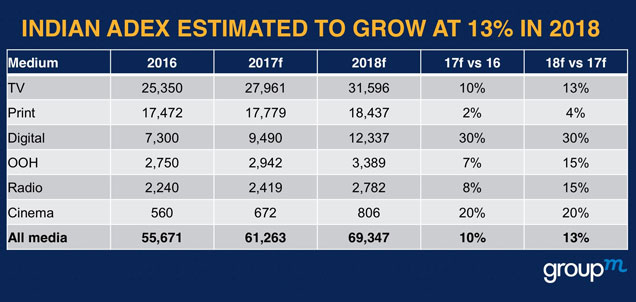
    GroupM, in its annual marketing forecast, predicts 13% growth (vs 10% in 2017) in India advertising expenditure (AdEx). The Indian AdEx in 2018 is estimated to be at INR 69,346 crore ($10.8 billion) compared to INR 61,263 crore ($9.6 billion) in 2017, as per This Year, Next Year (“TYNY”) report released by GroupM.

    As per economic experts, India is well poised with growth outlook of between 7.3% to 7.8% in 2018, giving India the fastest growing economy tag among developing countries. With demonetisation behind us and GST having implemented, a recovery in consumer demand and private investment is expected.

    “As consumer sentiment stabilizes and spending increases, we estimate 2018 to be a relatively better year from an ad spend perspective. Growth in digital media will continue to outstrip other media but unlike most markets”said CVL Srinivas, Country Manager, WPP India and CEO, GroupM South Asia.

    Between 2015 and 2017, Indian AdExgrew at a CAGR of 11% (expenditure of $9.4 billion in 2017 vs $7.7 billion in 2015), compared to World Ad spend, which grew at a CAGR of 3.5% in 2015-17.


    Digital continues its dominance

    While digital share of India AdEx is estimated to be ~18% in 2018 (vs 15.5% in 2017), however this space is expected to grow at a rate of 30% YoY (followed by cinema’s estimated growth of 20%). Digital witnessed the same growth rate in 2017 too.

    In 2018, AdEx in digital is estimated to be at INR 12,337 crore ($1.9 billion) compared to INR 9,490 crore ($1.5 billion) in 2017.

    GroupM estimates, Video advertising on digital is estimated to grow at 54%, as bandwidth improves and data and mobility device become more economical for the consumer.

    As digital becomes 18% of the overall advertising spends in India, measurement and transparency become paramount. Last year, GroupM globally led the conversation on measurement and transparency in digital media, and released viewability standards that are higher than those stipulated by the Media Rating Council in the US. In India too, GroupM is working with industry bodies, brands and publishers to adhere to a standard viewability index that would become integral to the digital ecosystem. Along with viewability, GroupM also held knowledge and training workshops for client teams, on mitigating ad fraud and assuring brand safety.


    Traditional media role in India

    Given diversity in India, Television continues to be the largest medium, with its contribution remaining ~ 45% share in 2018 (same as 2017) and will see a growth of 13% YoY. AdEx in TV is estimated to be at INR 31,596 crore ($4.9 billion) in 2018, compared to INR 27,961 crore ($4.4 billion) in 2017.

    Parliamentary elections in H1 2019 will stimulate advertising from the back half of 2018, says GroupM. Print will see a slight uptick in 2018 from the elections, with key markets in demand. The growth rate for newspapers is estimated at 4.2% with English papers growing slightly slower than Hindi and regional languages. However, print share of AdEx is expected to decrease from 29% in 2017 to 26.6% in 2018.

    Other media such as OOH will continue having a share of 4.9% in overall AdEx and is expected to witness a good traction of 15% growth from premium transit sites (vs 7% growth in 2017).


    Radio with a share of 4% in overall AdEx, is expected to grow at 15% in 2018 (vs 8% growth in 2017). This growth is predominantly due to the launch of new radio stations across the country


    Cinema will continue to grow at 20% in 2018, as the infrastructure investment made last year will attract a larger audience to theatres for a blockbuster experience. The share of Cinema although continues to be approx 1.2% of overall AdEx.


    Digital continues its dominance

    While digital share of India AdEx is estimated to be ~18% in 2018 (vs 15.5% in 2017), however this space is expected to grow at a rate of 30% YoY (followed by cinema’s estimated growth of 20%). Digital witnessed the same growth rate in 2017 too.


    Gamechangers

    As per GroupM, 3Vs will be the key drivers for consumption in 2018 – Video, Voice and Vernacular.

    Voice can have large impact on Indian consumers specially when voice enabled products can accept instructions in regional languages. Currently, the disruption is only at a high-level (Amazon Alexa, Google Assistant, Apple Siri) and it will be interesting to see how Indian consumer and developers adapts to this new change.

    Esports will be a game changer in the sports space, says GroupM. The Olympic Council of Asia recently announced that it will include esports in the 2018 Asian Games and make it a medal sport in 2022.


    Indian ranking in Global AdEx

    India is among the top 5 global contributors of incremental AdEx in 2018 and has a share of 5% (vs 4.7% in 2015).

    India is set to become 10th largest adspends market in 2018 compared to 11th largest in 2017.


    Summary:

    :: The overall India AdEx in 2018 will grow by 13% (vs 10% in 2017)

    :: Digital will lead the growth with a 30% growth rate (~$1.9 Billion ad investment expected in 2018)

    :: Things to look out for – Consumption of video contents; platforms having Voice connectivity; regional contents; e-sports participation; OTT content

    :: India is a unique market where all media have headroom to grow.

    :: India is the fastest growing ad market in APAC and among the fastest  growing markets in the world (amongst Top 5 contributors of incremental AdEx in 2018).


    About TYNY:

    This Year, Next Year (“TYNY”) is part of GroupM’s media and marketing forecasting series drawn from data supplied by holding company WPP’s worldwide resources in advertising, public relations, market research, and specialist communications. The TYNY report is the most comprehensive understanding of the estimated media spends by advertisers in the current year. It also highlights some of the industry sectors that will have a major effect on advertising spends across media.

    TYNY 2018 PC presentation HANDOUT- 13218 – MM