Tag: Goafest

  • Goafest 2012: Innovation is the magic of ideas: Tim Love

    By A Correspondent


    Tim Love, CEO, APIMA, Vice Chairman, Omnicom Group talked about how the world we live in today has become interdependent especially because of technology during his address on ‘The Magic of Ideas – Our Language Impediment’. He was of the opinions that one thing the financial crises have taught us is that we are all inter-dependent.


    Mr Love spoke about how “Digital is not a channel but, the air we breathe and communicate with each other,” giving the example ofIndiabeing the fourth largest internet user population despite its internet penetration being merely 8 per cent. He also talked about how language is a technology and how we have underestimated the effect language has on human misunderstanding.


    Besides talking about the importance of verbal communications, Mr Love also spoke about the importance of nonverbal communications. He said that just as verbal or spoken communications, nonverbal communications like sign language, although universal, differs from culture to culture; but no matter what the stream of communication, technology will always flow through.


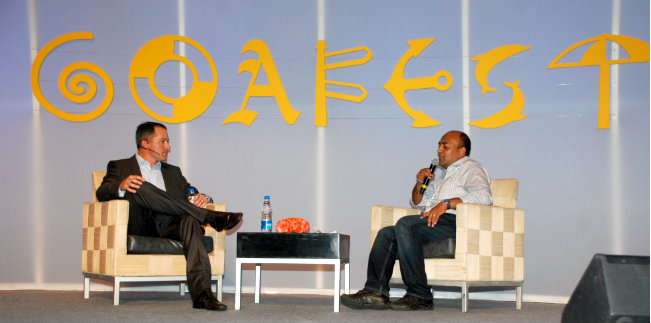
    During the Q&A session moderated by Ms Kainaz Guzdar of P&G, when asked to give a few suggestions or advertisers and marketers on how to come with great ideas on language impediment, Mr Love explained that one must be more cognisant in languages, and show some sensitivity to different languages verbal or nonverbal. He added that ideas are best communicated from individual to individual. He also pointed out that one needs to be careful with languages in different cultures, as it could have different meanings in different cultures, and how we have always minimised the importance of language.


  • Goafest 2012: Net better RoI with online video ads: Lucas Watson

    By A Correspondent


    In just six years since its launch, YouTube has garnered over 8 million users and billions of videos have been uploaded on the site. At Goafest, YouTube demonstrated how consumers can be used to build a brand by conducting a flash mob. Mr Lucas Watson, Global Vice President, YouTube further added to the brand’s insight by sharing his views on how ‘Magical Ideas Come When You Harness the Power of many People’.


    Mr Watson put across his point when he cited how Lady Gaga has built up her brand through a passionate group of fans who have played a vital role in building the Lady Gaga brand. Mr Watson explained that nowadays it has become very easy and inexpensive to build a brand by starting a video advertising campaign online, thanks to the Internet. He said that a brand need not be big to come online and start a video campaign, all it needs is to gain the trust of its consumers. “Start a video advertising campaign online, and you will be surprised to find how people are passionate about participating with the brand they love. The magic of YouTube is available for all as it allows everyone to participate. Besides online video advertising allows a brand to run its advertisement in a cost efficient manner, delivering better RoIs.”


    During the Q&A session moderated by Mr N Rajaram of Airtel, when Mr Watson explained his views on the rapidly changing role of advertising agencies: “Being creative and coming up with new ideas is a skill which not everyone has. So we need creative directors to nurture young talent to build brands. Unlike television, where consumers have a dedicated time slot to watch their favourite programme, in the online world it is the consumers who decide when to watch what and for how long.”


    Talking about if there is scope for co-existence between television and online video, Mr Watson said that there is no win-win situation but, there will be either winners or losers. “Like many industries even we are going through a transformation scenario. There are brands which are afraid to disrupt their way of functioning and there are brands which are keen to reach their consumers in newer forms of media platforms and thus rapidly build their brands. Therefore, I believe there could be some co-existence but, there will also be winners and losers.”


  • Goafest 2012: ‘Need for old & wise to guide youth’

    By A Correspondent


    Keeping in line with the theme, ‘Ideas that impact the full circle’, a panel discussion moderated by Anuradha Sengupta, Features Editor, CNBC TV18 and including panelists like Tim Love, CEO, APIMA, Vice Chairman, Omnicom Group; Jonathan Mildenhall, VP, Global Advertising Strategy and Creative Excellence, Coca-Cola; Jayant Murty, Director of Strategy, Media and Integrated Marketing, Asia Pacific Region, Intel Corp and Jean-Yves Naouri, COO, Publicis Group discussed the need to present their agencies differently; the loss of long-term relations between the clients and the agencies and the need for multiple agencies to build a brand.


    Tim Love observed that advertising is actually an education and noted that while the advertising industry is all about ideas and thus need young rebellious minds, there is also a need for the old and the wise to guide and direct the youth.


    Jean-Yves Naouri, on the other hand, insisted that creative agencies are here to respond to business and gain the trust, mind and presence in their client’s life. “Keep the dialogue between brand and consumer alive. Engage consumers as there will be people who will be inspired by the brands and this is what matters the most.”


    Speaking on the agency-client relationship, Jonathan Mildenhall said that it is easy to maintain one relationship better that ten different ones, and therefore he would reluctantly look outside his roster agencies for creativity. However, he felt that brands may scout for multiple creative agencies if they find the need for specialist agencies that could help them reach out to their clients more effectively. He was also quick to point that although digital is showing robust growth in India, it needs to boost its creativity in this space. “Majority of UK spends on digital, however the internet reality is bigger than the creative ambition in India.”


    Click here to view all Goafest 2012 stories

  • Ads must be rational: Prof John Philip Jones

    By A Correspondent


    The internet would be the third largest medium in the world by 2020 after television and direct mail, said Professor John Philip Jones, Author and Brand Guru at the last day of Goafest 2012.


    The last day, which saw another good and powerful line up of speakers at Goafest 2012, commenced with Professor Jones talking about ‘Adding Drive to Magical Ideas’ and about the need for brands to use right strategies and right data to make advertising more effective.


    Interestingly, Professor Jones was of the opinion that like in India, even the US did not make the best use of internet advertising. However, he felt that the medium would continue to grow in both parts of the world.


    In the Q&A session moderated by Mr Rajesh Jejurikar, President, Zee Entertainment, Professor Jones said that while it is good for advertisements to have emotional contents, there has to be some elements of rationality in the advertisement to make it more effective to reach out to the consumers.


    Mr Simon Wardle, Chief Strategy Offer, Octagon spoke on ‘Passion Drivers and the Magic of Why’, citing the example of passion for sports which varies from country to country, for instance, the passion for cricket in India and the passion for football in another.  He said that in order to understand the consumers’ passion, brands will have to think like the consumer. He gave the example of ‘Mars’, a chocolate bar that didn’t change the colour of its wrapper since the 1930s, but during the Football World Cup a few years ago, it ran a campaign and tweaked the wrapper giving hope to its consumers that their country would win the World Cup after many years. He also said that it is not the sport that the consumer is loyal to, but the team and brands must understand this.


    Mr Rishad Tobaccowalla, Chief Strategy and Innovation Officer, Vivaki spoke on the future of creativity and the different mediums available today. He highlighted the abundance of opportunities in creativity within mobile itself, be through sound, picture, or even video. He was of the view that the real test of a brand is when consumers remember a brand for its creative, even after a period of time.


    Click here to view all Goafest 2012 stories


  • @Media Abby: Mindshare bags Grand Prix; MEC, Lodestar sparkle too

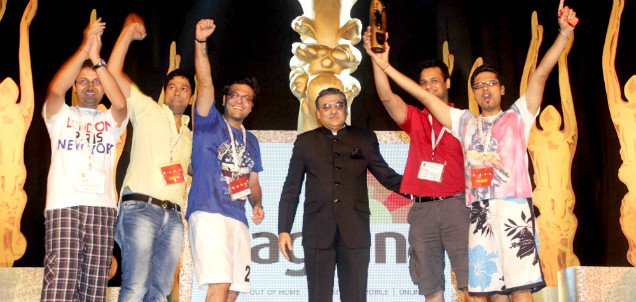
    The Grand Prix-winning Mindshare team with Jury Chair Ashish Bhasin


    By a Correspondent


    Having put an embargo on declaring the results of the Abby Awards before the event was to be staged, the Goafest Awards committee rewarded the patience of the media by calling in a press conference to declare the results much before it was made known to the audience at large. But the criterion to release it after 10pm remained -a diktat which was honoured wholeheartedly by all.


    In keeping with its attempt to play up the awards in as simple a way as possible, the committee was generous in stating that there was no big winner for the Media Abbys – a decision which was left for the media to decide. The reason was simple. For the first time the organisers had introduced a Grand Prix in the Media Abby awards and didn’t want that award to deter the attention from the other noteworthy winners. The points too were not awarded against individual metals, leaving it open for the media to decide the winner for the night.


    So if one went with Grand Prix as the criterion for the award, it was Mindshare that emerged as the No 1 agency having bagged the only single Grand Prix at the Media Abby. But then there were no points allotted for the individual metals leading to no clear winner at the top. The total count for Mindshare read: 1 GP, 1 Gold, 2 Silvers and 2 Bronzes (total metals 6).


    If one went by the gold count, it was MEC that emerged at the top, bagging 2 Golds, 1 Silver and 1 Bronze. Lodestar was next having bagged a total of 6 metals (the same as Mindshare) leading by 1 Gold, 2 Silvers, and 3 Bronzes. Madison Media Infinity was next as it bagged 1 Gold, 1 Silver and 1 Bronze followed by Starcom bagging just 1 Gold. Maxus follows with 2 Silvers and 3 Bronzes. (full table below)


    The Grand Prix was bagged by Mindshare for Surf Excel in the Best Use of Branded Content, which also won the gold in the same category. The GP was chosen from amongst the Gold winners. Other Gold winners include MEC that won two including one for Reliance 3G in Best Use of TV and the other for Best Use of Newspapers and Magazines. Lodestar UM won a Gold in Pro Bono Marketing for Bombay Psychiatric Society.


    Ashish Bhasin, chairperson of Media Abby said that the attempt this year was to reward the hard work put in by agencies, and therefore the Grand Prix. There were 16-17 per cent more entries from 31 agencies that were received this year, totalling 628 – last year the number was 530. It involved the efforts of more than 61 juries in putting this act together.


    Reacting on the agency’s win, Nandini Dias of Lodestar UM said: “I think we have performed very well this year. The total number of awards this year is only 27, which I guess is quite a small number. But within that we have won 6 awards, which is amongst the highest this year. So all in all, we are very pleased with our performance.”


    Also staged at the same night were awards from three verticals in the Creative Awards category including Design, Digital & Interactive and Direct. While the other categories would be announced on day 3, these three awards were awarded on day two itself. Ogilvy emerged the big winner as it won the Grand Prix for Fox Crime in the category – Online Integrated Campaign. DDB Mudra, BBDO, Leo Burnett were the other notable winners across the three categories.


    In all there are 101 awards that were given out in the Creative Abby awards on Friday night. An ecstatic Shashi Sinha said that the Creative Abbys were different this year as they received a record 4,250 entries as against 3,600-odd last year but what was remarkable was the participation of agencies from South Asia including Pakistan, Sri Lanka and Bangladesh. In fact the big winner tonight from South Asia was Grant McCann Erickson that won two Silvers across two separate categories.


    The awards were validated by research firm KPMG who have been doing it for two years now.


    Photograph: Shailesh Mule/Fotocorp


    Click here to view all Goafest 2012 stories


  • Special to MxM: Day 1 Comment by Shashi Sinha

    By Shashi Sinha


    Continuing with its drive to provide excellence – whether through speakers or evolution of fresh ideas, Friday began on an equally good note. I was very impressed to see so many participants at various sessions where marketers like Jonathan of Coca-Cola, Lucas Watson of YouTube presented their sessions. The hall was full and it was nice to see youngsters coming in and spending time to listen to the speakers. Unfortunately I couldn’t attend a few sessions as I was busy with the media announcing the awards.


    The awards night was equally interesting, especially for the creative awards for three categories – direct, digital and design — were presented. Also the big awards were for Media Awards and we had a Grand Prix for the first time. I am extremely delighted that our fraternity is getting recognized. The entries were of very good quality and I was there, judging and watching it. So I can say that the Grand Prix has a great winner and it has also won multiple Golds across categories. I think it’s a superb and a world class entry.


    Interactive is a new category and we opened up from 8 sub categories to 17 and that’s a big high. The other big high for me was the Sri Lankan agency Grant McCann winning against Indian agencies. So though we have created a separate category for best of South Asia, they are winning against Indian agencies and I think that’s a great thing.


    Also, I think digital as a category was very interesting but some entries were very average and if you see the winners you will realise that you will realise that the media agencies are winning in creatives and creative agencies are winning in media; also there are digital specialists winning in a big way. So this whole thing of democratization that we have been talking about is happening. As we fine-tune the digital category, you’ll see it in the results – you’ll see it becoming more democratized.


    On the awards, I am very delighted as we are giving almost 300+ metals out of which 100 were given last evening and 200+ will be given today. You will notice a host of agencies winning and this is what gives us pride. We already had informed about 167 agencies from India participating at the awards and we expect a huge success today as well.


    From the speakers’ point of view, everybody is looking forward to John Philip Jones. I am delighted that he has accepted our invitation as he is considered a guru for media people in terms of investments. There will be a host of other good speakers there too like Hemant Bakshi of HUL. Also, the night will culminate with the Creative Abby where some real big winners will be announced. I am especially happy for Integrated as a category as it is a hard category and has some very good entries.


    Shashi Sinha is CEO, Lodestar UM. He is also President of the Advertising Club Bombay and Chairperson of the Goafest Awards Governing Council.


    Click here to view all Goafest 2012 stories


  • Mobile is medium not just to connect, but to engage & inform: N Rajaram

    How would you rate the outcome of your session with You Tube’s Lucas Watson? What is the future you foresee for the medium of digital?

    What came through, very interestingly, was the role of video in digital. Traditionally, we have all been talking about search and text-based online marketing but what we have now seen is the power of video, as video is all about sight, sound and motion. It has been found to be a compelling medium for people to stay connected and be persuaded.


    What is the role that mobile will essay as we move forward?

    Clearly for us mobile is going to be one of the key drivers for adoption of internet in the country. I don’t think fixed line is going to expand its base in the country, and this actually happens everywhere. With the advent of smartphones and with the kind of mobile technology available we will soon see a lot of people across the country accessing internet for the first time on the phone and that’s an opportunity for us to explore. So we must look at the phone not just as a medium to connect but also as a medium to engage and a medium for information.


    Do you think advertising on mobile lacks creativity?

    I think a large challenge is the availability of devices, as less than 10 per cent of the people in this country own smartphones, and therefore the capability that exists today are not rich. The kind of creativity that you see on mobile tends to be more text and base level media stuff and is not as rich as you would expect. But as we begin to look at more advanced smartphones coming in, the opportunity will increase.


    With the coming of 4G, what is Airtel’s gameplan for the medium?

    I wouldn’t like to comment anything on that at this point in time.


    Click here to view all Goafest 2012 stories


  • Day 1 @ the Dome: ‘Innovation is the magic of Ideas’


    By A Correspondent


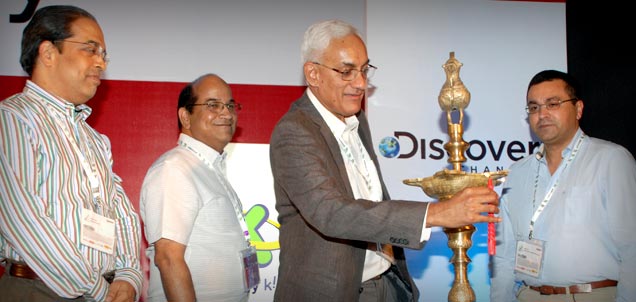
    Goafest 2012 kicked off with the lighting of the lamp by the industry dignitaries, Mr Arvind Sharma, Chairman Goafest 2012; Mr Nagesh Alai, President, AAAI; Mr Shashi Sinha and Mr Ambi Parmeswaran, ED and CEO, Mumbai Draftfcb Ulka Advertising. Mr Sharma said that he was thrilled as Goafest 2012 over 3,000 participants, including representatives from Sri Lanka and Bangladesh.


    Mr Parmeswaran said that he was ecstatic about the event this year as there was a restructuring of knowledge sessions. Mr Sinha observed that with more metals and more categories at the awards than last year, more participants, representatives from foreign countries, exciting prices for the audience, Goafest 2012 is aiming to give participants an experience with qualitative improvement every year. And unlike previous years, presentations by speakers were followed by the Q&A sessions moderated by industry veterans.


    The first session, ‘Magical Ideas Come when You Harness the Power of Many People’, commenced with a flash mob from YouTube, taking everyone by surprise and perhaps sending a message that it was one way of using consumers to building your brand.


    Mr Lucas Watson, Global Vice President, YouTube spoke about how passionate consumers can help one build brands and how online videos can help even startups spread awareness and the reach needed in a very cost effective and efficient way. “Just get started online, you don’t have to be a big brand, all you have to do is gain trust among your consumers and you will be surprised how passionate people are to participate in the brands they love. The magic of YouTube is available for all to see, as it allows everyone to participate and that too in a cost efficient manner.”


    The first session was moderated by Mr N Rajaram of Airtel. When asked about the scope of co-existence between television and online videos, Mr Watson said: “Like many industries, we too are going through a transformation. There are brands which are afraid to disrupt their current mode of functioning and there are brands who want to try new and better ways of reaching out to their consumers. So I believe there will be some co-existence, nevertheless there will be winners and losers as well.”


    Gerson da Cunha, stage and film actor, social worker and author dedicated Ad Katha, a book that tracks the history of Indian advertising to the late Bal Mundkur, founder of Ulka. Mr da Cunha gave the audience a glimpse of the Indian advertising right since it started through the present day advertising. He also pointed out that advertising bloomed in India from print media and that in 1991 it even opened doors to the global economy.


    Mr Jonathan Mildenhall, Vice President, Global Advertising Strategy and Content Excellence, Coca-Cola spoke on the use of creativity and content and how Coca-Cola moved from creative excellence to content excellence. He also explained that there is a need to encourage consumers to express their stories and how a brand must move to dynamic storytelling. “A brands story must show that it’s committed to make world a better place. There is a need to converse and not just listen to our consumers but to create inspiration and provocation.”


    In the session moderated by Sanjay Behl, CEO, Reliance Digital, when asked about a marketer’s role in the future and the consequences of negative conversation on a brand, Mr Mildenhall said: “Brands have to be a lot more transparent, if you inspire good conversation, it manages itself and I believe good eventually wins over evil. Brands, therefore, need to rethink the creative story they are telling their consumers. A 30 second media spot is valuable and it should be a gateway for brands to reach higher grounds.”


    Mr Tim Love, CEO, APIMA and Vice Chairman, Omnicom Group spoke about ‘The Magic of Ideas- Our Language Impediment’. He was of the view that innovation is the magic of ideas and that language is a technology. Mr Love also pointed out that as internet penetrates further in India, language communication will be going to new heights.


    The session (all of them held at what’s called the ‘Dome’) on Language Impediment was moderated by Kainaz Guzdar of P&G. When asked for his suggestions on how marketers and advertisers can come up with great ideas on language impediments, Mr Love said that they will have to be more cognizant in language and respect the sensitivity of various people. He also said that ideas are best when communication is from one individual to another.


    Mr Charles Wright, MD of Wolff Olins shared his insights about how consultancies are equally important to creating and building brands. He spoke about how by combining rigour with magic, one can solve complex business problems and how a Wolff Olins experience of branding may be completely different from an advertising agency’s experience despite working on the same product or brand. “In order to build brands that succeed, it is important that one understands what is important to the customers. We are all living in a world of perception but branding is all about changing the way people behave, and simply making promises is not important but, delivering on those promises is far more important.” He added: “Design, as a language, can help change people from hating a particular brand to making them like the brand and then probably even love that brand.”

    Click here to view all Goafest 2012 stories


  • Digital is tomorrow and we’ve to be ready for it: Piyush Pandey

    Since three of the Creative Abby categories were awarded on Friday night, Piyush Pandey and his team in black were in attendance and celebrating as they walked away with several honours. A quick chat with Big Man:


    How did you find the awards show hosted Friday night?

    I think it was a fantastic awards night where the media had a lot of innovative ideas and a lot of good things came out, which should be an inspiration to the youngsters, especially from the digital and design verticals. Also, I am very proud of the work my team is doing, particularly Fox Crime – they have swept the show by winning the Grand Prix so I am a very happy man. The key is: digital is tomorrow and we have to be ready today for tomorrow.


    One of the big things to happen this year is the addition of Grand Prix in the Media Abby. What are your thoughts behind the inclusion?

    I think there should always be a Grand Prix. We must always recognize the best work that is done. I am not a believer that Grand Prix is a world record that was broken in 1982, which we just work for this year. Personally, I believe there should be Grand Prix every time, but then juries are subjective and they will have their own point of view but I would always give a Grand Prix, no matter where in the world I judge. I have done that everywhere and I will continue to do it.


    The emphasis this year was on getting young marketers at the event…

    I think India is a very young country – the marketers are young, the advertising agencies are young, the youth is such a huge composition of our population, so let’s all try and be a little young and I think that’s what is important.


    A message you would want to relay…

    I think I can give only one message where advertising is concerned. Always celebrate your success, don’t be indulgent in terms of creating hype but celebrate your successes. If you don’t enjoy the day how will you enjoy the next day.


    Click here to view all Goafest 2012 stories


  • Abby should be Indian in approach: Nandini Dias

    Nandini Dias, COO, Lodestar UM speaks to MxM India on being the agency to bag the highest number of awards at Media Abby and what the Goafest committee needs to do for the future. Excerpts:


    How would you rate Lodestar UM’s performance this year at the Abbys?

    I think we have performed very well this year. The total number of awards is only 27, which I guess is quite a small number. But within that we have won 6 awards, which is amongst the highest this year.


    Your opinion on the inaugural Grand Prix being constituted?

    Grand Prix has been a regular award in all the other advertising festivals, so it is a good thing that it has come here. We had all agreed in the pre-juding session that it has to be made a part of the awards and it has begun from this year. So I am glad about the outcome.


    Inclusion of South Asian countries at Abbys

    I am not sure about their participation. I think this is an Indian award and there are enough of other global awards, so I am not sure whether the vision is to make Abbys as big as other global awards like Cannes. But if that is the vision, then why just South Asia – there can be many other countries. I think we should continue these awards as Indian awards and not otherwise.


    Comparisons between Goafest and Cannes…

    The awards, I guess, could be better conducted and done in cooler times. It is too hot and for people like me who hail from here, this is a tough time to be here. Frankly, if India wants to do it global, then it can do anything as it is as good a style as anything else in the world. I have no doubt about the capability or the ability of the people concerned, but the question is: do you want another award that is international, global and fighting or do you want to make it an Indian award. So that’s a different division altogether.


    Click here to view all Goafest 2012 stories


  • Ad Conclave Takeout #1: Technology is the new tool for creativity!


    By Robin Thomas


    ‘Ideas that impact the full circle’ is the theme for Goafest Advertising Conclave 2012, expected to be attended by over 3,000 members of the media, advertising and marketing fraternity from not just India, but various south Asian countries as well. Yes, this year’s edition of Goafest is billed as the biggest ever in the history of the event and will include delegates from Sri Lanka, Pakistan, and Bangladesh.


    The Goafest Advertising Conclave 2012 held on Thursday highlighted the fact that the next few years are going to be transformational as far as creativity in the industry is concerned. We live in an era where young people are growing up in a digital era, they spend more time on social network and brands are targeting their consumers on social networking sites. India is restless and what the country needs is not traditional creativity, but radical creativity. Technology is the new tool for creativity and India must immerse into it.


    Tim Love, CEO, APIMA, Vice Chairman, Omnicom Group spoke about how the world has become not only interconnected but also inter-dependent due to digitization and globalisation. He was also quick to point out living in an era of digitization, there is plenty of information available, but there is a need to know how to use that data effectively.


    Jonathan Mildenhall, VP, Global Advertising Strategy and Creative Excellence, Coca-Cola pointed out that there are two types of creativity – traditional creativity and radical creativity. What India needs today is not traditional creativity but, radical creativity. “We need to develop ideas and hence we need to integrate technology with creatives. We need to move away from 30 minute television storytelling to dynamic storytelling,” he clarified.


    Mr Mildenhall also explained that brand stories must add values and significance to the consumers’ life. The stories must engage the consumers and make them feel connected to the brand. “We need bigger creative thinking in our heart and we need online dialogue as well as engagement with our consumers. Nevertheless, we need to iterate our content and not replicate them.”


    While speaking on ‘Building brands in an era of multiple degrees of freedom’, Jayant Murty, Director of Strategy, Media and Integrated Marketing, Asia Pacific Region, Intel Corp  observed that most often brands bribe their consumers to get involved, but they fail to understand that the consumers do not want to be bribed. He added that brands must be remarkable and different. “Immerse in technology because technology is the new tool to creativity and find partners that understand the use of technology,” he further added.


    Keeping in line with the theme of ‘Ideas That Impact The Full Circle’, a panel discussion moderated by Anuradha Sengupta, Features Editor, CNBC TV18 and including panellists Tim Love of Omnicom Group, Jonathan Mildenhall of Coca-Cola, Jayant Murty of Intel Corp and Jean-Yves Naouri, COO, Publicis Group focussed on the need to present their agencies differently; the loss of long-term relation between the clients and the agencies and the need for multiple agencies to build a brand.


    Mr Love observed that advertising is actually an education, also noting that while the advertising industry is all about ideas and thus the need for young rebellious minds, there is also a need for the old and the wise to guide and direct the youth.


    Mr Jean-Yves Naouri, on the other hand, highlighted that creative agencies are here to respond to business and gain the trust, mind and presence in their client’s life. “Keep the dialogue between brand and consumer alive. Engage consumers as there will be people who will be inspired b the brands and this is what matters the most,” he counselled.


    Speaking on the agency-client relationship, Mr Mildenhall said that it is easy to maintain one relationship better that ten different ones, and therefore he would reluctantly look outside his roster agencies for creativity. However, he felt that brands may scout for multiple creative agencies if they find the need for specialist agencies that could help them reach out to their clients more effectively. He was also quick to point that although digital is showing robust growth inIndia, it needs to boost its creativity in this space. “Majority of the UK spends on digital, however the internet reality is bigger than the creative ambition inIndia.”


    KV Sridhar aka Pops, NCD, Leo Burnett talked about how advertisements look in a world of censorship. He was of the view that though advertising is a serious subject, it is nothing less than entertainment. Therefore, if one puts restrictions on advertisements, it may lose its enjoyment. Pops highlighted that there are two types of people in advertising, the ones that care and the ones that don’t care and therefore the industry must be sensitive to the sentiment of various people. He also said that while the industry should be governed by creativity and not regulations, there is also a need to keep a check of the contents as it is in our hands.


    Industry expectations are high, especially after the conclave on Thursday as was summed up by a variety of delegates. Said Niloufer Dundh, Head- Integrated Media, Hungama Digital Media Entertainment Pvt Ltd: “The advertising conclave was fabulous. Great speaker line-up and the points raised finally focused on digital. The international speakers don’t treat digital as an extra or add-on; it is part of their communication strategy. Jonathan Mildenhall’s speech on Global Advertising Strategy and Creative Excellence was awesome!”


    Another delegate who did not wish to be named said he was looking forward to getting the ”real” lessons from marketers. “I am glad Goafest is giving us this opportunity.” But, he said, the only problem is the “awful” heat. Now you can’t get all things in the world your way, can you?


    Click here to view all Goafest 2012 stories
     

  • Idea is to make Goafest evolutionary than revolutionary: Arvind Sharma

    It takes quite an effort to put up an event of Goafest’s scale where delegates assemble to exchange and co-share ideas that have evolved over a period of time. As the first day of the festival kicked off with the Advertising Conclave, MxMIndia spoke to Arvind Sharma, festival Chairman, to gather his perspective on the start and expectations from the rest of the event.


    On Ad Conclave being evolutionary

    We are only half way through and there are still two days to go. From what I have heard, the start has been brilliant so far. There are more than 3,000 delegates expected, the quality of entries have gone up and the speaker line-up is exceptional. So all in all, it should be a magical Goafest.


    The idea is never to make it different; the idea behind festivals like this is to make it evolutionary, than revolutionary. That’s because about 2,500 people came here last year and they expressed their liking towards what we had put up for them. So it would be irresponsible on our part to do something different. How we can make the event more relevant to the industry in the coming years, how we can add pieces, how we can add streams of participants like clients, and so on… all of these things are evolutionary. I think it needs to remain the same 90 per cent and 10 per cent, you say, how can I make it more attractive and relevant to the delegates?


    On ideas taking centrestage

    The media environment is changing and the consumer is changing. There are infinite number of conversations happening and they will continue to happen. But if they happen in private drawing rooms, you wouldn’t know about them, but now they happen in public. So, if two of you are chatting the whole world can see you chat.


    And that creates anxieties and it creates opportunities. The speakers presented their take on how to deal with it, have stories that are linked to the brand, allow stories to evolve, and to curate the best thing that is done. The most powerful way is if you use these ideas in creative, unorthodox combinations and make people the centrepiece of everything that you do.


    Future belongs to digital

    I think client spends and advertising agencies’ attention and commitment have been lagging behind, where the consumers already are. We need to believe and commit to the medium of digital. So if you are not embracing digital, you would be doing disservice to your brand. Nobody disagrees on the importance that the medium bears but we need to have conversations and invite people to come and share their ideas and aspirations around the medium and that is what we intend to do at Goafest this year.


    Click here to view all Goafest 2012 stories

    Click here to view all Goafest 2012 stories