Tag: EY

  • EY launches unifying AI platform

    By Our Staff


    The EY organisation (EY) has announced the launch of a new and fully integrated marketing campaign entitled ‘The Face of the Future’. Through this campaign, EY wishes to promote its recently launched unifying artificial intelligence (AI) platform, EY.ai, highlighting the need to put humans at the centre of the AI transformation to help deliver on the exponential value the technology provides.


    Said Nicola Morini-Bianzino, EY Global Chief Technology Officer: “Building confidence in AI requires a holistic and people-centred approach. As global leaders, organisations and entire industries contemplate the transformative capabilities of AI, we are helping EY clients face the future with confidence by emphasising this exact approach to AI-enabled business transformation. This campaign reflects the power of EY people, augmented and empowered by AI, in driving the change to build a better working world.”


    Added John Rudaizky, EY Global Brand & Experiences Leader: ‘The Face of the Future’ is not only an extension of the EY long-standing commitment to AI innovation but underlines the organisation’s belief that people must be augmented by technology, not in service of it. EY aspires to build a brand that is synonymous with leading on AI and this campaign will serve to show EY clients, people and communities alike how we are doing just that – by placing people at the centre of AI to create exponential value.”


  • 2022 Priorities for CMOs


    By Our Staff


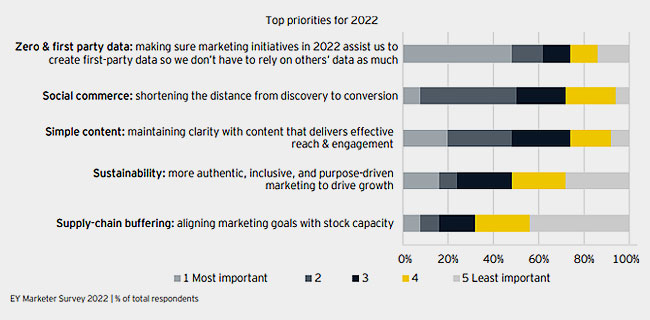
    In the EY-FICCI report for 2022 which was released with much fanfare on Monday, we found an interesting two-pager on the Priorities for Chief Marketing Officers for the year 2022. The entire EY-FICCI 2022 M&E report is available at https://assets.ey.com/content/dam/ey-sites/ey-com/en_in/topics/media-and-entertainment/2022/ey-ficci-m-and-e-report-tuning-into-consumer.pdf and the content below is on Pages 251 and 252


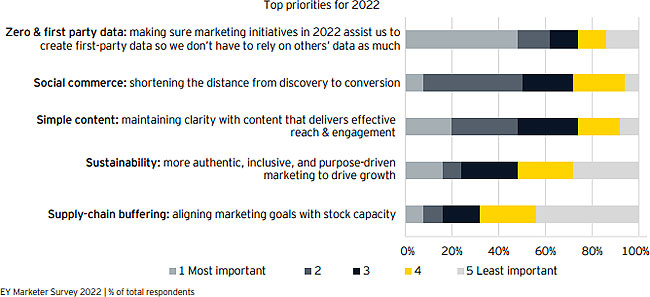
    Zero and first-party data is by far the most important priority for 2022


    • Most Important amongst marketer priorities for 2022 was creating zero and I irst-party data to enable efficient targeting of consumers, particularly given the challenges posed by cookie-less advertising and data privacy regulations

    :: Suggestion 1: Create a fair value exchange for your consumers

    :: Suggestion 2: Step up interactivity and gamification


    • Social Commerce has become an effective way to reduce the time between discovery and conversion and marketers need to understand its nuances and implement social sales channels for their brands at scale

    :: Suggestion 1: Create automatic bot check-outs

    :: Suggestion 2: Maximise role of influencers, tracking their Rol


    • Interestingly, many respondents identified effective content (and its ability to build reach and engagement) as a key priority for 2021

    :: Suggestion 1: Make content purposeful and personalised, based not on what people are searching for, but why

    :: Suggestion 2: Challenge yourself to think about the way stories are being presented [voice, video, visual via mobile and social], while keeping the art of storytelling alive [the heart of the message]


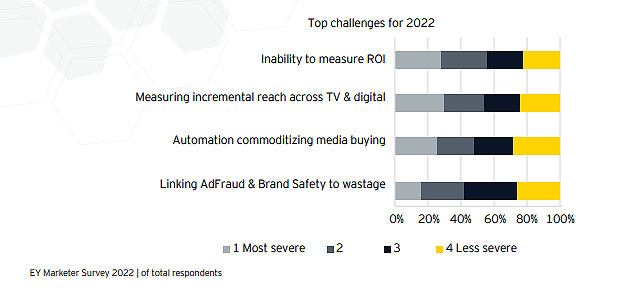
    Inability to measure ROI continues to be most severe challenge for marketers


    • Despite the overload of data generated by digital media, respondents identified measurement of marketing Rol as their number one challenge for 2022

    :: Suggestion 1: Build SMART (specific, measurable, achievable, relevant, time-bound) objectives to justify investments in full-funnel marketing, linked to clear KPls and use evolved attribution models

    :: Suggestion 2: Designate independent, objective owners of the Rol tracking technologies and processes


    • The lack of a common metric across TV and digital campaigns has most markets evaluating their campaign performances separately, and this led to concerns on the genuine incremental reach provided by digital to TV campaigns:

    :: Suggestion 1: Invest in modeling that provides directional guidance on investment strategies

    :: Suggestion 2: Build ways to collect deterministic data sets (actual households or individuals associated with an ad exposure) as a reliable way to control frequency


    Over 70% of respondents had ad fraud management in their top 3 challenges for 2022; yet the problem of linking adfraud and brand safety to wastage is seen as least severe amongst marketer problems. In there, lies an opportunity that must be addressed by the industry at large

    :: Suggestion 1: Continuously detect and protect against fraudulent traffic; boosting standards of measuring digital effectiveness

    :: Suggestion 2: Certify platforms that can demonstrate a proven ability to prevent fraud

  • Newspaper Industry in India after the Second Wave of the Pandemic


    By Indrani Sen


    Indrani SenThe Indian newspaper industry faced an unprecedented crisis last year after the National Lockdown was declared at a very short notice. Circulation fell drastically when many subscribers, particularly housing societies, shut their doors for the newspaper delivery persons for the fear of the contagious virus being carried by the newspapers or the delivery folk, leading to change is consumption pattern of newspapers. Lack of local transport also prevented the distributors and hawkers from reporting for work. This was followed by withdrawal of commercial advertising as advertisers were worried about a fall in circulation and readership and were themselves affected by choking of distribution pipelines and economic slowdown leading to loss in their sales. The FICCI EY Report on Indian M&E industry 2021 showed that ad revenue of Print came down from INR 206 billion in 2019 to INR 122 billion in 2020.


    After the National Lockdown was lifted in 2020, the newspaper industry tried its best to recover their lost grounds. As per the same FICCI EY report, it will take Print four to five years to regain the pre-Covid ad revenues level. However, the industry seemed to be recovering well during the first quarter of 2021 as TAM AdEx data for Jan-Mar 21 showed that 1350 new brands advertised on print during that period.  When compared with Jan-Mar 20, the quarter also showed 9% increase in ad space mostly from Hindi and other language newspapers. Similarly, April-May 2021 recorded better results compared to April-May 2020.


    As per TAM AdEx analysis in May 2021, when the second wave of the Covid-19 was at his peak, there was an average 58% growth in ad space per publication as compared to May 2020. However, all was not well as compared to February 2021 and March 2021, the ad space in Print saw a drop of 42% and 29% in April 2021 and May 2021 respectively. As the phased process of unlocking has begun, the newspaper publishers expect that both the ad volume and value would pick up by August 2021 and grow further during the festive season of 2021.


    It appears that newspapers were better prepared to handle the second wave of the pandemic in 2021 and the lockdowns imposed by various state governments across the country. Along with the process of gradual unlocking, the newspapers now are looking forward to recovering their lost grounds. The credibility of the printed word, the vaccination drive, revival of the corporate sector and good rain forecasts are the other factors which are expected to contribute to the overall growth of the newspaper industry in 2021. The Print industry has appealed to the government for a stimulus package and an increase in FDI in 2021. The government has not responded so far, but the industry is still hopeful of getting, some positive response though no relief was announced in terms of waiving the import duties on newsprint by the finance minister in her 2021 Union Budget.


    The newsprint prices, which saw a decline in the international market (below $300/metric tonne) in 2020, have started going up from the beginning of the calendar year 2021. The price was $670/tonne-$700/ tonne in April-May. The industry expects it to go up further. It appears that quite a few paper mills which used to export newsprint to India and other countries, either shut down their business or migrated to the businesses of producing brown papers and craft papers during last year when their business was hit due to the global pandemic.


    As India is far from being self-reliant in newsprint production, our newspaper industry, struggling to recover from the effects of the pandemic, has been hit further by this demand supply imbalance of newsprints in the international market. Many newspapers are increasing the use of indigenous newsprints to balance out their cost of productions.  However, most newspaper owners feel that this crisis of newsprint prices is not going to last for a long term and expect the international market to stabilise before our festive season in the third quarter of 2021.


    To sum up, the newspaper industry in India seems to be set on the path of recovery after a severe decline of both circulation revenue and advertising revenue in 2020. In recent times, during the second wave of the pandemic, the industry was not much affected and would have been in a better financial position if they were not hit by the crisis of newsprint prices. It is expected that by end of the calendar year 2021, their overall performance may be better than predicted earlier by media analysts.

  • Mera Non-Metro India Mahaan


    Given the economic disruption caused by the Covid-19 pandemic, non-metro markets are likely to recover faster than metro markets, an EY survey finds. The report titled ‘Will non-metro markets propel India’s recovery’, reveals a higher percentage of respondents from non-metro markets expect to spend more than before on several categories compared to metro markets indicating that when the lockdown ends, green shoots of recovery would probably sprout faster from the non-metro markets.


    The survey covered a varied demographic mix of more than 4,000 respondents (2,000 each from metro and non-metro markets) to understand the potential impact of the pandemic from the consumer sentiment perspective. It covered key aspects linked to the current and expected attitudes, behaviors and spending trends of consumers as they adapt to the new reality.


    Ashish Pherwani

    Said Ashish Pherwani, Partner and Media & Entertainment Leader, EY India: “The Covid-19 pandemic has radically shifted our way of life. However, despite uncertain and challenging conditions, our research shows that non-metros express a higher degree of resiliency and a resolve to bounce back quicker compared to metros. We may see long-term and even permanent changes in consumption patterns”.


    The survey results reveal that the pandemic and the ensuing social distancing measures put in place have led to fundamental changes in how Indians are consuming media, necessities, luxury products education and travel.


    Some of the key insights from the survey include:

    :: Health, hygiene and online services will continue to grow


    While COVID-19 has impacted overall consumption, categories like heath products, household products, hygiene products, vitamins and supplements and online services (gaming, home entertainment, online education, online banking) are expected to benefit.

    :: Non-metro market recovery is excepted to be faster than metro recovery


    Categories like consumer goods, travel, entertainment, automobiles and white goods are all expected to see increased and faster recovery of demand from non-metro markets post the lockdowns.

    :: Increase in digital adoption


    Digital trials increased significantly during the lockdown period.  However adoption was higher for metros vis-à-vis non-metros.  Some of the obstacles stated by non-metro respondents included lack of technological knowledge, absence of smart phones and fewer language interfaces.

    :: Newspapers remain the most trusted medium


    The impact of coronavirus has unfolded at a dynamic rate, causing a sense of urgency to absorb information, increasing the consumption of news coverage at unprecedented levels. Newspapers continue to remain the most trusted news source. 42% respondents in non-metro markets spend more than 20 mins in reading a newspaper compared to 36% in metros.


  • A SWOT Analysis for M&E given Covid-19: EY


    Excerpted from an EY (Ernst & Young) report:

    The Media & Entertainment sector is facing unprecedented challenges from the spread of Covid-19. Rapid changes in consumer behaviour and consumption, stoppages in content production, cancellation of live events and sports, and cuts in advertising spend, are impacting companies across the ecosystem. Media agencies, many of which were grappling with operational volatility, are struggling to maintain media spend as marketers manage risks and reduce spend rapidly. Publishers and media companies are benefitting from some marketers seeing the opportunity but face advertising revenue losses. Film and TV producers are under pressure to mitigate impact from delayed release schedules, theatre closures, and production stoppages.


    Companies are currently focused on enterprise resiliency and triaging revenue, but will likely need to turn to rapid cost reduction as business models settle into new norms as business models are not on solid foundation. Bright spots across the industry include digital pure-plays (such as video gaming) and other virtualised production capabilities.


    Accelerated consumer shift to digital journeys

    :: Enhance technology and infrastructure to support digital journeys including streaming and commerce

    :: Ensure digital sales and service models are as effective as traditional journeys

    :: Consider moving


    Marketers cut ad spend and demand agile response times

    :: Accelerate efforts around ad ops and creative production support to enhance responsiveness to marketer needs

    :: Proactively conduct brand sentiment analysis and consumer research to offer stronger insights

    :: Consider incentives or package bundles to maintain or motivate ad spend, including entertainment or escapism content


    Rapid transition to virtualized working environments

    :: Leverage collaborative software to maintain productivity and connection with vendors and clients (e.g. Microsoft Teams)

    :: Accelerate efforts around self service and inside/virtualized sales • Develop models for virtualized customer service rapidly, including potential for augmented reality


    Disruption or cancellation of content production and launch

    :: Revisit programming schedules to extract value out of back catalogue

    :: Accelerate releases to enhance consumer engagement

    :: Identify partners with virtualized content production capabilities


    And here’s a SWOT analysis as presented in the EY report:


    Strengths

    :: M&E is categorised as “essential services” and permitted to continue operation (except theatres and events)

    :: Need for escapism, news and knowledge increases in times of trouble – demand for content expected to remain high


    Weaknesses

    :: Inability to produce content (physical presence critical)

    :: High dependence on advertising for revenues

    :: Inability to connect with and sell to large number of advertisers and SMEs (traditional media)


    Opportunities

    :: Consolidation – Financially stronger brands consolidating weaker brands

    :: Sharing resources between competitors (co-ompetition)

    :: Back-office to the world

    :: Re-invention of sales through platforms to reach SMEs

    :: Direct to consumer and digital community creation

    :: UGC and Create-from-Home services

    :: WFH and manpower optimisation

    :: Better monetisation of library content


    Teihreats

    • Stressed balance sheets for smaller players, increasing credit days due to liquidity squeeze
    • Supply chain disruptions – Print distribution
    • Continuity risk – one positive case in a studio can derail content production
    • Increased piracy of content
    • Ad revenue from sectors like travel, hospitality, services will contract in the medium / long term
    • Reduced willingness to spend more on subscription products can impact price increases


  • View on the Budget from Utkarsh Sanghvi, EY

    Here’s a view on the interim Budget from Utkarsh Sanghvi – Partner, Indirect Tax, Media & Entertainment, EY India: “The Government has already set up a Film Facilitation Office (FFO) for enabling a single window clearance for foreign film companies shooting in India. It is a welcome measure for Indian Films to take benefit of FFO.  Most of the permissions required from Central and State Government agencies are expected to be received from a single online application.

    From January 2019, GST rate on film tickets costing less than Rs 100 was reduced to 12% from 18% and tickets costing more than Rs 100 was reduced to 18% from 28%.  The art and cultural champion services sector was positively recognised by GST Council by reclassifying the entertainment service from luxury and sin bracket of taxation to standard rate schedule.”

  • Digital to unlock US$1tn digital economy by 2022


    By A Correspondent


    The proliferation of mobile connectivity has a significant impact on the socio-economic fabric of the county and mobile broadband has empowered millions of Indians. Today, India consumes 2,360 petabytes every month, making it the largest mobile data market globally. On an average, consumers spend four hours daily on their smartphones. By 2022, smartphone users are expected to increase 2.2X to 650 million, elevating average data usage by 5.1X to 18 GB per month. During 2017-22, broadband connections are expected to grow by 25% to reach approximately 90% of Indians[1].


    Digitalisation has uplifted the life of a common man in India by enabling on-the-go access to host of e-services, increasing affordability and accessibility (e.g. ride sharing), and move to a cashless economy (e.g. mobile payments). It is empowering a farmer with right information at the right time, enabling ways to increase crop yields and get wider access to market produce. People are able to pay bills, book tickets, order pizza or call a cab within seconds.


    Internet of Things (IoT) has the potential to address some of the basic challenges in India. IoT is expected to fundamental impact the way we live and work, reducing waste, improving health and delivering major social and environmental benefits in sectors such as agriculture (e.g. sensors for measuring soil humidity), automotive and transportation (e.g. fleet management), healthcare (e.g. remote patient monitoring), power and utilities (e.g. smart meters). In an accelerated growth scenario, IoT has the potential to reach 2 billion connections and revenues of US$11.1 billion by 2022[2].


    The advent of 5G is expected to support newer applications/use cases, imbibe innovative business models and usher in cross-industry collaboration. By 2022, India is likely to transition to a Gigabit society where citizens and businesses will equally benefit from widespread fast-broadband, reliable performance delivered by robust future-proof fixed and mobile technologies. By 2022, India’s digital economy is expected to grow to US$1 trillion and lead to creation of 10 million jobs[3].


    Prashant Singhal, Emerging Markets TMT Leader, EY, said, “India can lead the Fourth Industrial revolution. The real opportunity is to look beyond technology, and find ways to give the greatest number of people the ability to positively impact their families, organisations and communities. At the back of this, India has the potential to unlock a trillion dollar digital economy by 2022 and add up to 10 million jobs.”


  • Rise of the Second Screen


    By A Correspondent


    One of the key trends seen in 2017 and 2018 has been the increased use of second screen interactivity by broadcasters as a means to engage more with their television audiences.


    Leading consulting firm Ernst & Young (EY) has published a report that delves deeper into this phenomenon, and provides case studies of how broadcasters and brands are using the 2nd screen along with television to enable a richer and more engaging customer experience.


    According to the report, 30 percent of the time spent on the mobile device is on entertainment. Its a natural extension that television uses the second screen, be it mobile, tablet or laptop, to provide its audiences the ability to interact more with television content, stories and celebrities.


    As broadcasters compete for advertising with new media companies who can provide millions of profiled audiences, interactivity helps broadcasters with generating viewer data, understanding consumption patterns and most importantly, increasing time spent on television, notes the report.


    Here’s more from the EY report. First the case studies and then looking at what makes it work and the future of the Second Screen:


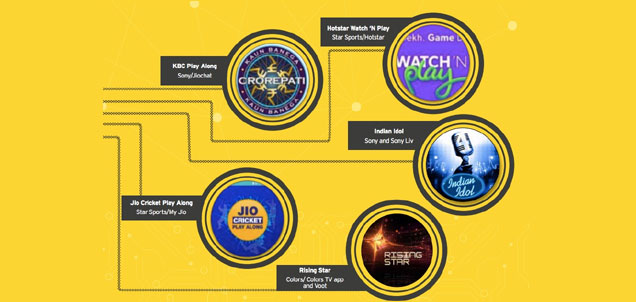
    KBC Play-Along

    Jio along with SET developed a play-along game for the ninth season of KBC. The idea of the app was to engage viewers so they could not only watch the show but also play along and answer the questions shown on TV, testing their knowledge against the TV contestant and scoring points.


    Hotstar Watch’N Play

    IPL 2018 was the 11th season of the highly popular T20 cricket league. This season Star decided to simulcast IPL on TV and Hotstar and introduce an interactive play-along app on Hotstar. 202 million viewers watched the matches on Hotstar.


    Jio Cricket Play-Along

    Jio decided to have a play along game for live cricket matches of IPL 11 broadcast on TV. While some played to win prizes, others played for the sheer excitement that came along.


    Colors Rising Star

    Colors Rising Star is a show adapted from the international format “Rising Star” and ran its second season in 2018. It was an engaging experience for viewers as they were able to see the results of their votes on a real-time basis.


    Sony Indian Idol

    In its tenth season, Indian idol has taken fan engagement to the next level with the Indian Idol Sing Along experience. SET has enabled millions of users to not only vote for their favourite Indian idol contestants, but also to sing along with them, in partnership with Smule. The best ‘Sing-Along’ performance of the week is featured on the show, giving the users their moment of fame on national television.


    So why does interactivity work? Interactivity enables broadcasters to further fulfil their core objectives of providing escapism, knowledge and social acceptance to their audiences.


    Social Acceptance: Second screen engagement can be used as a tool for social communication, by allowing users to share their scores, opinions, leaderboard, level-ups.


    Lean Forward: With reality shows only selecting a handful of contestants to play on each show, the second screen offers viewers the experience of participating on the show from the comfort of their homes.


    Immersive Experience: The TV audience’s expeirence is enhanced, they are playing the game/ performing alongside their favourite contestants and in front of the show host or judges. This is a far more intimate form of escapism.


    Future of interactivity: Second screen interactivity will not only help broadcasters understand their viewers better through the additional data that could be collected, but also help keep viewers more engaged helping drive the ratings for shows. We see broadcasters and other content owners partnering with tech/ telco companies to create some ‘never seen before’ experience for the viewers. If used wisely, second screen has the power to create its very own loyal viewers who can continue to engage even after the end of the show. It is no longer a just cost element but it has the potential to generate revenue and cut marketing costs as can be seen in the proactive engagement platform diagram alongside, which can help brands connect directly with the TV audiences. Second screen interactivity combined with an effective loyalty program will have the potential to reap never before seen benefits. The second screen revolution has begun and results are there to be seen. Broadcasters have benefited, platform operators have benefitted and advertisers have benefited, too. But the viewers are the real winners. Interactivity to become more prevalent not just across game shows and sports but across genres such as music, fiction and film.


  • Opportunities & Threats in M&E: EY


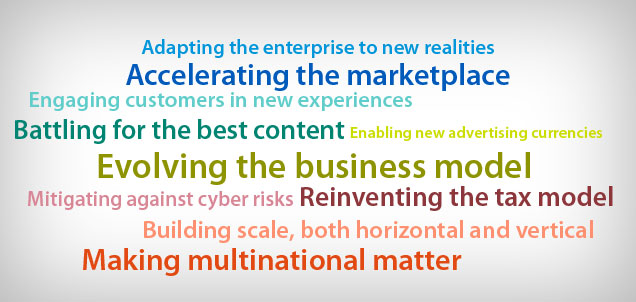
    Ernst & Young’s Global Media & Entertainment Sector has identified and assessed the Top 10 areas of upside and risk for the industry. The firm asked two questions; What are the most significant growth opportunities for media and entertainment companies today? What are the most significant risks or threats that they face? Here are the takeaways, in brief.


    Evolving the business model

    As the pace of disruption accelerates, Media & Entertainment companies must rapidly revamp product and service offerings, distribution frameworks and pricing/ monetisation strategies to meet shifting customer expectations.


    Adapting the enterprise to new realities

    Media & Entertainment companies require a new level of operational excellence — the type of performance improvement and strategic expense reduction that delivers short term results and long term efficiencies.


    Enabling new advertising currencies

    As advertisers gain a keener understanding of their target consumers, new currencies, which blur the lines between linear and digital media are emerging, even as audience measurement across platforms continues to challenge the industry.


    Engaging customers in new experiences

    Just a few years ago, consumers were delighted to be able to stream a movie or TV show on multiple devices. Now, consumers expect personalized experiences across their daily lives.


    Mitigating against cyber risks

    Every click, view and download results in massive amounts of data being created every day. This data offers Media & Entertainment companies a real competitive advantage, however, the same data is a magnet for cyber-criminals.


    Battling for the best content

    Ever-rising investment in content is tipping the scales of corporate performance both ways — translating into either strong growth or painful margin pressures.


    Building scale, both horizontal and vertical

    Media & Entertainment executives see inorganic routes as the fastest way to fill gaps in their portfolios, re-set their strategic positioning in the industry and future proof their business models.


    Accelerating the marketplace

    As new technologies accelerate how supply and demand intersect, the dynamics of media marketplaces — for both consumers and advertisers — are becoming super fluid, placing new pressures on all parts of the ecosystem to move more quickly.


    Reinventing the tax model

    US tax reform represents the biggest change in taxation for over thirty years and yet it is really an inflection point in what has become a much wider conversation about the future of the tax function.


    Making multinational matter

    Finding the optimal business model, strategy and ownership structure to achieve success in international markets requires nuance and flexibility.


  • Solving the M&E Puzzle


    By A Correspondent


    At the recently held INMA South Asia Conference, Ashish Pherwani, Partner, Advisory Services, Media & Entertainment, E & Y LLP, spoke on how media companies should balance the pressures of running a profitable media business in the present while creating a business for the future
     

    This is a summary of what he spoke:

    At a global level,  newspaper ad revenue levels have been stabilised, as newspapers build digital models around some very strong communities; eg – NYT cooking app, Bild auto, etc. In India, the growth in news is 7%. It’s 4% lower than the other media. In many other developed countries, the primary source of news is TV or digital, hence the role of the newspaper is  changing to giving more opinion, analysis and width of coverage. According to a Reuters survey from across 26 countries and 50,000 respondents, younger audiences consume news online and through social media, and people above the age of 55 years also first receive news digitally rather than print. There is a possibility that print media will be dead in the next 10 years; digital deflation poses as a real threat. The solution? Organisations will have to grow reach exponentially (eg: Times of India and its width of offerings; creating the right brands for customer will be key), improve monetisation (via ad sales, ad network partnerships, syndication, transactions, subscription and monetisation of archives) and bring in cost efficiency via partnerships. All in all, the news organisation of the future will be focussed on building communities that are monetisable with news trading, curation-strategies, templated and AI-led efficiencies.


    And this was his presentation

    http://www.inma.org/Modules/Event/2017SouthAsia/Presentations/AshishPherwani-Southasia2017.pdf


  • M&E to touch $34.8bn by 2021: EY


    By A Correspondent


    The Indian Media and Entertainment industry is expected to touch USD 34.8 billion, witnessing a CAGR of 11.8% over 2016-21, according to a report titled ’Digital inflection point: Indian media and entertainment’, released at the FICCI-IIFA Global Business Forum in New York.


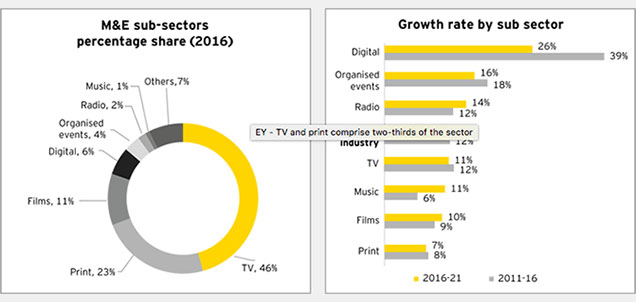
    Amongst the sub-sectors in the Media and Entertainment industry, Digital (which includes Digital advertising, advertising on mobile, OTT, etc.) is expected to register the highest growth at 26% CAGR in the 2016-2021 period. This is followed by organized sector (expected to grow at 16% CAGR), Radio (at 14% CAGR), TV (at 11% CAGR), Music (11% CAGR), films (at 10% CAGR) and Print (at 7% CAGR) respectively in the same period.


    Commenting on the report, Ashish Pherwani, Partner – Advisory, Media and Entertainment, EY said: “The Indian M&E sector is at a digital crossroads today. Every segment of the industry, including print, TV, radio, film, experiential marketing and OTT, is being impacted by digitisation, and is showing growth, consolidation and innovation. It presents an excellent opportunity for companies looking at establishing and expanding their presence in the country, and making the most of the India digital growth story”


    Added Leena Jaisani, Assistant Secretary General – FICCI: “India is home to one of the most vibrant, dynamic and differentiated M&E markets in the world. The Indian M&E industry has adapted and innovated its offerings to cater to the huge and varied demand in each segment of the industry, be it Films, Broadcast, Digital, Animation, Print or Live Events. The government has been imperative in boosting growth, investment opportunities & facilitating ease of doing business in the industry with initiatives such as single window clearance, favorable tax incentives, policies & regulations in place. Today definitely is the time to invest in Indian Media & Entertainment Industry.”


    According to the report, currently, television continues to dominate the M&E sector, with the segment accounting for 46% of the sector’s revenue share in 2016. Television, print (23%) and film (11%) segments together accounted for ~80% market share in 2016.Digital (6%), organized events (4%), Radio (2%), music (1%), and other segments (7%) constitute the other 20%.


    In 2016, total advertising spend across all segments in Indiastood at USD 8.18 billion which is estimated to reach USD 16.7billion in 2020.Print media and TV together accounted for 76.2% of the totalrevenue from advertising in 2016. Mobile advertising hasemerged as the third largest advertising medium in India afterTV and print, notes the report.


    The report also predicts the subscription market – pegged at USD 9.3 billion in 2016 – will grow to USD 15 billion by 2020.


    The report can be accessed at ey.com/in/InvestInMandE


  • Free TV viewership to touch 46mnby 2020: EY


    By A Correspondent


    Free TV viewership in India is set to register exponential growth, reaching 46m households by 2020, according to a report titled ‘India’s Free TV – A game changing opportunity’ published by consulting major EY (Ernst & Young). This will be in addition to consumption of content on mobile DTT handsets.The increase in the number of FTA channels has also led to asignificant rise in viewership for genres such as Hindi GEC, Hindi movies and, primarily, the Hindi news genre, in which FTA channels command 81% of the total viewership.


    Commenting on this, Ashish Pherwani, Partner – Advisory, Media and Entertainment, EY said: “Free television is increasingly becoming a viable option for channels looking to capture the base-of-pyramid audiences in urban and non-urban areas. With a large subscriber base, it also opens up new avenues of advertising for marketers looking to get reach in some of the fastest growing markets in the country. The change in customer behaviour will also have a significant impact on FTA and pay TV channel uptake, and corresponding spends on subscription income.”


    Currently, rural TV viewers contribute to 52% of the overall viewership.However, it is estimated to contribute 74% of the total viewershipon DD Free Dish.


    The report outlines four key factors which will drive the uptake of free television:

    1. Digitisation of cable TV distribution – DAS IV

    The mandatory move towards digitization will require consumers, particularly those in DAS III and IV markets, to opt for more expensive cable TV options, DTH or free TV options such as terrestrial TV or Free Dish. EY expects the price conscious customers may opt for free television services in the immediate term.


    2. The proposed new tariff order

    The new tariff order will make customers choose between the options to either pay more to receive pay channels oftheir choice or decide that free television would be a betteroption, given the quantum of quality content on it. This will help further drive subscriptions from price conscious consumers for Free TV.


    3. The fast growth of DD Free Dish

    DD Free Dish bouquet is set to increase to over 250 channels, featuring quality content, also including sports being available on its spectrum. This makesthe Free Dish bouquet a formidable competition to pay bouquets.


    4. DTT on mobile infrastructure

    Another important development relating to mobile television is theemergence of digital terrestrial distribution. Since this is a broadcasttechnology, the key implication will be that consumers whosemobile handsets have the required antenna would not berequired to pay any bandwidth charges. Consequently, once themobile handset ecosystem matures, DTT could also provide astrong addition to free television services.


    The report also notes the implications of growth in free television for broadcasters and distribution companies in the near future, which include:


    Broadcasters:

    :: Pricing of channels, particularly those that are not leaders in their genres, and determination of whether channels should move to FTA
    :: Number of channels to include in base and base+ packs of distributors
    :: Carriage fee considerations
    :: Creation of free television products and differentiation of free and paid television products
    :: Competition from Free Dish offerings to broadcasters’ pay channels
    :: Increasing audience reach from a DTT perspective


    Distributors:

    :: Creating packages for various customer segments, while at the same time convincing customers to pay more for fewer channels
    :: Ensuring channels from all broadcasters are present in each popular package
    :: Placement of channels in and within appropriate packages
    :: Prevention of subscriber migration to free television


    The report ends with providing some ideas which Free TV operators can consider.


    The report can be accessed at ey.com/in/FTA Opportunity