Tag: EY

  • GST and its impact on advertising: EY


    With GST just around the corner, most media companies are trying to understand the impact it will have on advertising budgets. EY has done a detailed analysis to understand how GST will impact advertising across industries. While sectors like FMCG and Consumer Durables show a positive impact on advertising spends, EY anticipates a negative impact on sectors like eCommerce and Banking and Financial Services. Sectors like Real Estate, Telecom and Insurance are not expected to have any significant impact. Over to the EY presentation for more…


    GST How it will impact advertising budgets_june2017


  • The EY Report on FM Radio


    The INR21bn FM radio industry continues to hold a unique niche in the Indian media landscape. It is an effective reminder medium that can be localized at a city-level, provides free experiences for audiences and can easily reach all consumer strata.


    While the industry experienced an INR0.4bn— INR0.5bn dent in 2016 following demonetization, with on-ground activations hit particularly hard, the sector is expected to bounce back by Q2 20171. Buoyed by the continued operationalization of new Phase-III stations, the industry is projected to grow ~15% annually till 2020 — faster than other traditional mediums such as TV and print.


    Radio has finally been unshackled, and can now fulfil more of its potential. The need of the hour on the revenue side is maximization of sales efforts through ad sales analytics, account planning, customer segmentation and automation, as well as better sales reporting. In order to bring forward break-even, radio companies need to look at costs aggressively and dispassionately, covering networking, automation, robotics and improved expense controls. As the industry enters its next phase of growth, we explore several key trends in this space.


    The Phase-III auctions flattened the radio landscape, but future reserve prices will need rationalization
    India’s radio market today is top-heavy, and the country’s A+ and A category cities* comprised over two-thirds of total industry revenues in FY16. However, the FM landscape is flattening, with 140 frequencies in B, C, D and “Other” category markets sold in the industry’s Phase-III auctions 4. With nearly a hundred of these stations yet to be operationalized at the end of March 2017— including in 28 virgin markets such as Dehradun, Hubli-Dharwad and Salem — the medium’s reach is set to deepen significantly.


    However, to continue radio’s expansion into smaller towns, reserve prices will need to be rationalized in future auctions. Reserve prices for a fresh radio city have traditionally been set as the highest bid received in the prior auction for the same city category and region. But as this categorization is based on population — without factoring in paying capacity — the market potential of similar category cities can differ. Moreover, amplification of bid prices because of scarcity of frequencies can result in cities with similar revenue potential receiving different bids. It is also time to re-evaluate the possibility of reduction of inter-frequency separation so as to increase the number of frequencies available in larger A+ and A markets. However, doing that now could be seen as unfair to existing bidders, and would require a mechanism to equalize license fees.


    The effect of the current price-setting mechanism was seen in the second batch of the Phase-III auctions. High reserve prices elicited muted interest from operators, and 200 frequencies went unsold, including in B category cities such as Vijayawada and Asansol and C category cities such as Trichy and Mangalore. Meanwhile, one frequency in Muzaffarpur was sold for INR43.5mn, while three stations in the same city were sold for INR1.5mn apiece in the first batch. To prevent such scenarios, the Telecom Regulatory Authority of India recently proposed a mechanism to set reserve prices by taking into account variables such as GSDP per capita and local stations’ revenue, while de-linking reserve prices from prior auction bids. Going forward, such a framework could rekindle operator interest and help spread radio across the country.


    Content differentiation is on the rise — particularly in the largest cities
    The Phase-III auctions are having a unique effect on content in category A+ and A cities. Once all frequencies are operationalized, each of the 13 markets in these categories will have at least 6 stations — up from just 5 such cities before the auctions. To carve out a niche in a crowded market and create separate brands for second stations in the same city, networks are making a concerted effort to differentiate offerings. This is occurring across both genres as well as languages:

    • Radio Mirchi launched a romance-themed second brand Mirchi Love to complement its existing contemporary hits radio stations.
    • Retro-themed second brands were launched by Radio Fever (Radio Nasha, centered on music from the 1970s-90s) and Red FM (Redtro, centered on content from the 1990s).
    • Big FM re-launched its Delhi station, ensuring its positioning was more “mood and tempo-led” and more in-line with “on-the-fly” consumption, relative to its Mumbai counterpart 7.
    • Radio One converted its Bangalore station to an international format


    Radio is now able to offer relevant ad bouquets to brands
    India’s radio industry today is fairly consolidated, due to cost economies of scale and higher entry barriers relative to mediums such as print or digital. As a result, ~90% of revenues and ~80% of frequencies were held by the top 10 networks in FY16. This consolidation, coupled with the expansion of radio to over 400 stations in 114 towns, means that a single network can now offer an advertiser significant reach and create a viable alternative to TV or print. Large national networks (e.g. Radio Mirchi, Red FM, Big FM, My FM, Radio City and Fever FM) and strong regional players in the South (e.g. Hello FM, Radio Mango and Club FM) are increasingly able to offer brands wide-ranging bouquets targeting listeners in metros, tier II/III cities or specific regional clusters. We believe this will have a positive effect on the radio segment’s share of ad revenues in the medium term.


    Networks are complementing on-air offerings with multi-media campaigns and events
    With customers consuming more media non-linearly, advertisers have begun focusing on integrated multi-media solutions to reinforce messaging and raise brand visibility across platforms. Most major radio networks have an in-built advantage here, as they are able to leverage the print, TV or digital arms of their parent media groups. For instance, Radio Mirchi (Times Group) carried a Hero Cycles campaign during the odd-even rationing plan in Delhi across its print properties 10. Meanwhile on the digital front, Radio City (Jagran Prakshan Ltd.) launched an interactive mobile app for its program Love Guru 11.


    Advertisers have also been attracted to the physical touchpoints offered by experiential solutions and events. To meet this demand, radio networks have launched various properties in recent years:
    • Indigo FM (Jupiter Capital Ltd.) launched the international-themed “Indigo & Blues” jazz festival.
    • Big FM (RBNL/Zee Media Corp.) created the arm-wrestling property “BIG Panjaa League.”
    • Fever FM (HT Media) launched the “Entertainment Ka Baap Awards” celebrating radio.
    • My FM (DB Corp.) created the “Jiyo DilSe Awards” for recognizing individuals who are bettering society.
    • Radio City created the televised “Freedom Awards” for independent music.


    Events are showing strong growth potential, with major operators recording higher revenue growth for this category relative to on-air advertising. The appeal of on-ground visibility for brands means events and activations will continue to form an important revenue stream for the radio industry, and can grow to contribute up to 20%–30% of revenues for national networks.


    The industry needs effective account management and reporting to realize its next phase of growth
    Radio has traditionally been the focus for large corporate advertisers, who aim to buy coverage across the country. As a result, national corporates account for up to 75% of revenues for some major networks today. But this mix is changing. First, as consumption increases in smaller towns, local businesses are maturing in tandem and foraying into radio advertising for the first time. Second, as more frequencies become operational within a state and city, the value of selling a single geography to local advertisers rises. Finally, with marketers emphasizing ROI more than ever, the efficacy of localized messages over national communication is also driving the popularity of local campaigns. For these reasons, the share of national corporates to the revenue pie is falling. Radio City, for instance, has increased its share of revenue from local advertisers to ~50% today, up from ~25% when it was launched.


    With radio reaching more towns and local clients, a strong feet-on-the-street presence becomes crucial for reach and perception. These local sales representatives can also help teach new clients how to create effective plans. This is important, as the high churn rate of local advertisers in prior years has partly been due to operators failing to invest this time working with clients, and instead accepting any level of business they give.


    In order to scale effectively, account management also needs to be supported with robust systems. In terms of organization, clear value propositions can be developed by segregating accounts into geographies or categories (e.g. focus accounts, industry verticals and SMEs). In terms of technology, this can mean recording client information in an opportunity management system to streamline pitch processes, inputting sales in a centralized MIS to track KPIs, or arming representatives with mobile dashboards to enable decision-making. To boost productivity in this fashion, Big FM for instance deployed the tool CRM Next, which allows the network to measure client relationships and sales inputs.


    Radio networks have become more cost conscious
    The radio business is characterized by low variable costs but high fixed costs and one-time fees. Existing stations can incur significant migration fees, with Phase-III migration fees for B and C category cities such as Coimbatore, Patna and Chandigarh exceeding INR150mn 18. Meanwhile, aside from auction fees, new stations can require an initial capital investment of INR30mn— INR50mn in B and C category cities (if stations are not networked). But once stations recoup these investments and break even, 65%—80% of additional revenues accrue to the bottom line 19,20. As this breakeven proved elusive or occurred too late for many stations under Phase-II, the industry has become increasingly cost-conscious. This was reflected in the Phase-III auctions, in which nearly 240 frequencies went unsold in the first and second batches as networks became more judicious in entering markets.


    Profitability is also expected to improve under the 15-year Phase-III regime due to the networking of channels. Networking is now permitted across a broadcaster’s entire network, not just in C and D category cities as under Phase-II. This allows networked stations to share infrastructure with larger stations, and if content is reused, much of the INR10mn—INR15mn studio cost can be saved19. These networked channels are also able to realize sizeable operating efficiencies via lower overheads, payroll, marketing expenses etc. To leverage these cost savings, radio networks are employing a hub-and-spoke model, wherein smaller cities in a state or region are networked to the operator’s major market. As networks continue to expand, there is significant scope for shared services to help manage this scale-up and streamline processes involving RO entry, billing systems and digitized content management. Robotics process automation can also bring in significant savings, in addition to increasing accuracy and reducing time.


    Social listening is emerging as an alternative form of measurement
    Given the industry’s expansion into smaller towns and alternative genres, accurate radio measurement is imperative for networks looking to showcase their reach to advertisers. However, measurement of Indian radio listenership remains limited, with Radio Audience Measurement (RAM) currently sampling 480—600 individuals apiece in four cities (Mumbai, Delhi, Bengaluru and Kolkata) 21. To create a more robust system, industry stakeholders have recommended widening the net to 15—20 cities and replacing the current diary-based methodology with a form of electronic measurement not reliant on recall.


    As the industry waits on an updated ratings system, many networks have turned to social media as an alternative form of measurement. Social listening can take various forms and has the capacity to measure ratings via the volume of online posts, key conversations taking place via word clouds, sentiment analysis via classification of replies, identification of high-profile influencers and demographic profiling of listeners.
    Such analysis can be done at a granular city-level, allowing networks to discern differences between their own stations, competitors and local consumer preferences. The resulting insights can then be used to modify content strategies, customize launch marketing and focus on the most effective engagement channels.


    Published with permission from EY. The report can also be viewed at link

     

  • Surat, Jaipur, others to drive consumption: EY


    By A Correspondent


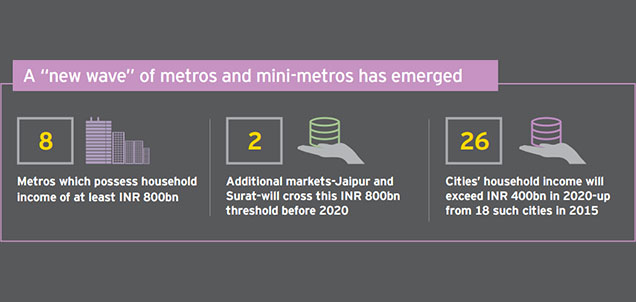
    India will see the rise of two new metros – Jaipur and Surat – by 2018, with a household income of over Rs 800bn by 2018, according to an EY report titled ‘India’s growth paradigm: How markets beyond metros have transformed’. These are projected to record real GDP growth of 8.7% and 10.3% respectively from 2015-20, relative to metros’ 8.3%. As a result, both cities will cross the Rs 800bn threshold within one to two years, with total consumption levels to reach 75%-80% of metros like Pune and Ahmedabad.


    The report identifies 42 new-wave markets, which are expected to grow at 8.9% as compared to the 8 metros that are expected to grow at 8.3% CAGR in the 2015-20 period.


    Said Ashish Pherwani, Media and Entertainment Advisory Leader: “Non-metro growth is out-stripping that of metros in India. There are clear cases of unmet demand in India’s Top 50 cities in certain sectors. This provides a huge opportunity for various sectors to both widen and deepen marketing strategies, and effectively tap into one of the world’s largest earning populations.”


    The report also notes the rise of eight new half-metros, with household income exceeding Rs 400bn by 2020. It also highlights 13 new-wave cities that represent a high-growth opportunity, but are largely untapped, according to the report. These include Patna, Raipur, Warangal, Gwalior, Dehradun, Allahabad, Rajkot, Vishakhapatnam, Jodhpur, Vijaywada, Ranchi, Kota and Jabalpur.


    Additionally, the top 23 untapped markets, as identified by the report, are all new-wave cities. These 23 markets represent 19% of metros’ household income-but only 12% of retail outlets 15% of telecom centres and 17% of malls, notes the report.


    The report further considers the potential of individual markets across each sector – FMCG, Retail, fashion and durables, Auto, Telecom and DTH, E-Commerce, Education, BFSI, and Real Estate. It delves into the expected ad spends across each sector, and highlights the top-10 untapped markets across each sector.


    The report can be downloaded at www.ey.com/in/urban-growth.


  • E&Y report on apps unravels amazing insights

    By A Correspondent


    With billions of devices expected to be connected in the coming years, media and entertainment companies are well-positioned to seize an early advantage as an enabler and receiver of IoT applications, according to the EY report ‘Internet of Things: Human-machine interactions that unlock possibilities’. The total potential for IoT in the M&E space is expansive — to create, deliver and tailor content for new platforms and to measure the context of media consumption using analytics.


    The increasing sophistication of IoT sensors makes it possible for devices to read, gauge and understand consumers at unprecedented levels. According to the report, the M&E industry is already using categories of sensors such as inertial, motion and image sensors used in animation, gaming, video images, camera stabilization, sports and 3D. This is opening up new, intimate entertainment experiences for consumers.


    One of the most anticipated benefits of IoT for marketers is its potential – through the use of sensors – to unlock data on a person’s habits, preferences and most significantly, the context in which media is being consumed. Better data analytics will also address deficiencies in the current measurement system for media consumption, such as avoiding the duplication of unique users across platforms, and enhance what marketers know about their audiences.


    Ashish Pherwani

    Ashish Pherwani, Partner and Head – Advisory, Media and Entertainment, EY says, “IoT is bringing a rapid disruption in the way content is distributed and consumed. The in-depth insights provided by smart devices is allowing M&E companies to respond to evolving customer needs and deliver personalized, contextually relevant entertainment experiences to consumers. Moreover, it is enabling them towards better targeting, thus boosting ad spends and subscription income via increased human-machine interactions.”


    If smart devices provide useful data to content providers that is perceived as non-intrusive and the resulting content experience correctly interprets consumers’ current readings (mood, need, intention) in real-time, and then quickly respond to those needs with relevant and targeted advertising, the implications for improved brand loyalty could be vast.


    For M&E companies to realize the full potential of IoT, they need to also consider the associated risks, including regulatory hurdles, legal precedents, intellectual property rights, lack of connectivity standards and lack of IoT scale to reach critical mass, the report finds. The biggest challenges are around privacy and cybersecurity. Protecting personal information is an issue that will become exponentially more difficult as IoT collects enormous amounts of data and connects more devices, software, machines and humans.


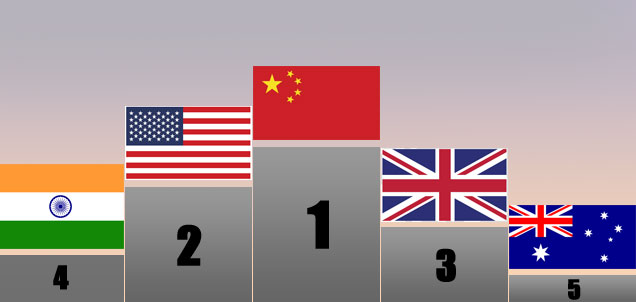
  • India #4 in EY’s Most Attractive Nations for M&E Investment


    By A Correspondent


    It’s India Shining in the world order. At least for the Media and Entertainment sector. According to consulting firm EY (eka Ernst & Young), India ranks fourth in the most attractive nations for investment. This coupled with the fact that espite the usual industry challenges and downside risks, the media and entertainment (M&E) sector has a high level of confidence in the global economy. EY recently survey senior executives from global M&E companies for the 13th Global Capital Confidence Barometer which was released on Monday.

    Specifically, this is what the EY report says on India:

    Even as the outlook for many emerging markets turns negative, investor sentiment toward India is seeing a significant recovery. The Indian Government’s pro-business stance and an increasingly promising economic outlook are fostering a more attractive investment landscape for inbound investment.

    Several government initiatives, including the digitisation of cable television, the Phase III auctions of FM radio spectrum and an increase in FDI limits, are expected to drive growth in traditional media. India is also the second largest internet market after China with over 300 million internet users. Although digital content consumption is currently tempered by low smartphone and broadband penetration, a surge in broadband adoption is expected with the rollout of 4G services and the government’s Digital India initiative.

    While the ubiquity of media consumption has not yet translated into significant industry revenue – by 2016, India’s online advertising market is forecast to be a little more than  US$1 billion, while the forecast for China is in excess of US$23 billion –  India is expected to become the third largest economy in the world by 2030 after the US and China.

    With a triple fold increase in GDP expected over the next 15 years, M&E industry revenues and their contribution to the GDP are expected to increase significantly.

    India has seen some big M&A deals in M&E in 2015. The key ones being:

    Deal Type

    Announced Total Value (USD Mn)

    Target Name

    Acquirer Name

    M&A

    417

    MAA Television Network Star India

    Pre-IPO

    273.4

    Videocon d2h Silver Eagle Acquisition Corp

    Private equity

    166.5

    Prime Focus – Reliance Mediaworks merger

    M&A

    110.8

    Reliance MediaWorks -BIG Cinemas Carnival Films

    M&A

    (Closure pending)

    78.1

    DT Cinemas PVR

    When asked their perspective on the state of the global economy, 81% of executives said it is improving, up from 52% one year ago. Executives surveyed maintained an overall positive attitude, indicating an improving level of confidence in corporate earnings (64%), short-term market stability (83%), credit availability (77%) and equity valuations (56%).


    Says John Harrison, Global Media & Entertainment, Transaction Advisory Services Leader at EY: “Media and entertainment executives are more confident about the global economy and key market indicators than 12 months ago. However, short-term headwinds, such as foreign currency volatility and earnings pressure from digital transformation are tempering enthusiasm. As the industry learns to better harness digital adoption and fully exploit the multiplatform distribution environment, companies are becoming more confident about expanding their offerings and making strategic acquisitions that will improve their competitive advantage.”


    When assessing economic risks to their businesses, executives indicated increased volatility in currencies to be the greatest, (36%), followed by slowing growth in key emerging markets (23%), the economic and political situation in the Eurozone (20%), increased global and regional political instability (14%) and timing and pace of interest rate rises in the US (7%).


    Executives surveyed overwhelmingly expect the global mergers and acquisitions market to remain strong in the year ahead, with 73% indicating it will improve (up from 49% last year), 24% saying it will remain stable and 3% saying that it will decline. When asked if they expect to actively pursue acquisitions in the next 12 months, 59% responded favorably, which is more than double from two years ago when only 25% indicated they were going to actively pursue acquisitions. While the number of M&E companies expecting to pursue an acquisition in the next 12 months is the highest it has been in two years, only 44% of respondents are optimistic about the likelihood of closing acquisitions. This is possibly a result of the perceived valuation differential between sellers and buyers increasing in the past six months.


    Target deal sizes are moving higher, with 22% of respondents indicating that their largest planned acquisition size in the next 12 months will be greater than US$250m. While a majority of acquisitions are expected in the US$250m or less area, the trend since last year is toward more substantial deal sizes.


    Confidence in corporate earnings is more measured, possibly a result of foreign currency volatility as well as structural challenges facing the M&E industry from digital transformation.


    Other key findings of the report include:

    • Digital continues to have the greatest impact on M&E companies’ core business and acquisition strategies.
    • Foreign exchange volatility is causing concern as a lot of costs are US-dominated and revenue is increasingly international.
    • Structural challenges related to digital adoption persist, which, along with foreign exchange fluctuations, is having a near-term impact on corporate earnings.
    • Respondents are most likely to invest in China, the US, the UK, India and Australia.
    • 58% of executives said that their company’s focus during the next 12 months will be cost reduction and operational efficiency, followed by growth at 28% and maintaining stability, 14%.
    • Strategic divestment and other potential portfolio actions are moving higher on the boardroom agenda as media and entertainment companies seek to optimize capital allocation to thrive within a fast-changing world


    The report is a survey of senior executives from large M&E companies around the world that gauges corporate confidence in the economy, identifies boardroom trends and provides insight into companies’ capital agenda.


  • Adding 2% or more of additional margin drives major bottomline results, say ad agencies: EY study

    By A Correspondent


    As high as 84% of agency respondents believe they could achieve margin improvement of at least 2% with more robust project and resource management processes, according to a recently concluded study by EY with global creative and digital advertising agencies, titled ‘What’s next in margin improvement?’.


    While 90% agencies have project managers, only 9% of those say that their project managers are formally trained in project management. Similarly, while 65% of agencies have resource managers, only 12% of those resource managers are trained in talent management or resource optimization. With the increased diversity of skills required, use of freelancers, crowd-sourced creative models and tech providers, there is an even higher demand for robust resource and project management.


    Additionally, the advertising business is seeing a fundamental change – from paying for people, clients are now paying for the output. The move away from the retainer model to project-based fees is also putting pressure on margins. The challenge is typically internal pertaining to poor infrastructure and managing talent. However, in this change of economic models, lies a sizable opportunity for agencies that have the capabilities to find value in such flexible arrangements, according to EY. Only 21% of respondents saw new economic models and performance-based fee structures as an opportunity.


    “The advertising industry is at a turning point in its cycle where the agencies will need to evolve their project and resource management skills in order to continue to be sustainable. Talent is their core asset and they should therefore have clear guidelines and processes, even for freelancers. Agencies will need to take into account the clients, employees and their self-growth when designing their strategy. A one-size-fits-all approach may not be profitable. They must be flexible depending on the complexity of projects and clients,” said Bharat Rajamani, Director and Solution Champion, Marketing and Advertising Risk Services, EY.


    The survey included inputs from nearly 50 agency executives from leading global agencies and represents combined revenues of approximately $58 billion.


  • Achche Din for M&E


    By Ajay Shah


    India is expected to become the third largest economy in the world by 2030 — after the US and China — and the GDP per capita is expected to grow from $1600 to $4,500 by 2030. As seen globally, an increase in the GDP per capita increases the proportion of the M&E industry’s contribution to the GDP. With a triple fold increase in GDP over the next 15 years, the M&E industry’s contribution to the GDP is expected to increase significantly. But this isn’t all. Here are eight reasons the country will be an attractive destination for M&E investments —


    1. Currently, the Indian M&E industry is growing at a CAGR of 13-14 per cent per year which is almost twice that of the global media industry. Despite the faster growth, advertising spends, which drive growth in M&E industry, as a percentage of GDP is 0.4 per cent, which is significantly lower than developed markets (0.7- 1 per cent). Over time, the M&E sector will witness increasing ad spends as a proportion of the GDP


    2. With over half a billion people under the age of 25, India is witnessing a rise in disposable incomes. Increasing income levels have also led to increasing spend on M&E, as evident from the fast growth of multiplexes  and the success of various sporting leagues in the last five years


    3. Compared to the most developed markets, India is a unique market with traditional media and digital media segments growing simultaneously. Traditional media is expected to continue on the growth trajectory because of the under-penetration of media segments in Tier II and III cities


    4. Several government initiatives, like the digitisation of Cable TV, Phase III auctions of FM spectrum and increase in FDI limits, will aid the growth of traditional media


    5. India is the second-largest internet market after China, with over 300 million internet users. Additionally, government thrust on the Digital India campaign will significantly increase internet penetration in the next decade, thus expanding the digital media opportunity


    6. The mobile subscriber base of 900 million users, sub-$100 smartphones, and one of the lowest data cost globally, is expected to drive a surge in mobile data traffic from 88 TB/Month in 2014, to 1,100 TB/Month by 2019


    7. With existing internet penetration lower than 25 per cent, India is already among the Top Five online video markets globally, in terms of viewership, and is expected to be the second largest market by 2017. As internet penetration increases, India will become one of the most important M&E markets


    8. Currently, investors are interested in TV distribution, cinema exhibition and digital media sub-segments, and we expect this trend to continue for the next few years


    Ajay Shah is Partner and Leader, Deal Advisory, Media and Entertainment at EY (Ernst & Young). Last week, EY released its 12th Media and Entertainment Capital Confidence Barometer


  • Events & Activation grows 15% annually fm 2011-12: EY-EEMA report


    The organized events industry has grown at 15% annually from INR2,800 crore in 2011-12 to INR4, 258 crore in 2014-15.


    Managed events remain the largest service offering, but, IPs (Intellectual Property) and digital events are growing at a faster rate than managed events. IPs continue to provide a disproportionately high share of revenues to their owners and activations are increasing in importance; however, managed events are beginning to get commoditized.


    Survey respondents have increased their staff strength from an average of 55 employees in 2011-12 to 84 employees in 2014-15, which has resulted in payroll costs increasing from 13% to 18% of total costs. EBIDTA margins are in the 10%-15% range.


    The key strengths of the industry remain the ability to get things done, ideation and efficiency, while there is a need for the industry to work on acquiring the right talent, managing costs, demonstrating ROI to marketers and increasing transparency in operations.


    Future trends

    The industry is expected to grow at 16%-17% to reach INR5, 779 crore in 2016-17, on the back of marketers increasing their below the line (including digital) spends to 21% of their total marketing spends. The growth will be led by personal events, MICE (meetings, incentives, conferences and exhibitions), activations and sports. Most survey respondents are expected to develop one to three IPs over the next few years.


    Non-metro markets are expected to increase in importance as marketers look to tier II and tier III cities for incremental growth. Digital events and activation is also expected to grow significantly on the back of smart phone penetration, internet availability and the cost efficiency of such campaigns for marketers.


    Margins are expected to decline from an average of 16% to 13% over the next two years, mainly due to a growth in overall costs by 12%, and more particularly in payroll costs by 15%, as companies expect to increase their average headcount from 84 to 104 employees.


    Mergers and acquisitions

    While the industry has reported very few M&A transactions over the last few years, there exists scope for consolidation. More than 50% of deal activity over the last few years has been inbound (foreign companies buying into India). However, deal values are usually sub-US$10 million. Valuations are driven by IPs owned, advertising agencies’ interest in activations and digital events and sports leagues.


    Tax implications

    Taxes continue to be a large cost for event companies in India. There are several challenges such as double taxation, taxation across multiple states and varying and inconsistent application of different taxes. The introduction of Goods and Services tax could have a significant impact on the industry in terms of rates and implementation across multi-state activities.


    Governance, risk and control

    The introduction of the new Companies Act, 2013 will result in a more comprehensive approach to governance, risk and control for events and activation companies. Key changes will be in internal financial controls, compliance with more than 60 acts and regulations, and implementing a vigil mechanism to identify undesirable activities.


    EEMA wishlist

    There is a need to grant industry status to the events and activation industry, enable single window clearances, manage withholding and other tax issues and enable skill development for the industry.


    Vision 20:20

    In order to succeed in the future, the industry needs to work towards the following initiatives:

    > Internal aspects: Improve the quality of talent through skill definition for various jobs, skill development, job security, compensation benchmarking and implementation of health and safety standards. The industry must build robust olicies, processes and information systems to manage business efficiently and safely, and implement technology and automation.


    > External aspects: The industry needs to work on its positioning to marketers, build an account focus and demonstrate returns more effectively. There is a need to improve the supply chain by developing quality vendors, implementing a system of vendor accreditation and improving overall risk management. The regulatory ecosystem needs to be made more conducive by simplifying taxation, permissions and copyright issues.


    > Strategic aspects: The industry must build more IPs focused on defined communities of interest to marketers, and embrace the opportunity provided by marketers’ increasing spends on digital media.