Tag: Ernst & Young

  • EY survey on music publishing industry

    By Our Staff


    EY, better known as Ernst & Young, has launched a report on the state of the music publishing industry in India titled ‘The music creator economy: The rise of music publishing in India.’


    The report estimates that India generates over 20,000 original songs annually, contributed by 40,000 music creators. Music directly or indirectly generates over INR12,000 crore in revenues each year.


    Commenting on the survey findings, Ashish Pherwani, EY India Media & Entertainment Leader, said: “Music is an important part of India’s media and entertainment sector and is an important contributor to India’s Soft Power. Both local and international labels have driven the music segment’s sound recording revenues for a long time. However, music publishing revenues remain much smaller, given the differing views on its applicability and litigation.”


    Around 500 music creators participated in the study which indicated that their financial income is unpredictable and often limited:

    1. 87% of respondents would have liked to make a living off their music alone, but only 60% were able to do so

    2. Working outside of the traditional employer-employee relationship, one-time payments (upfront fees), live performances and royalties were the primary sources of income for most creators

    3. A majority strongly believed that they needed to learn more about music production and monetization

    4. Only 56% of respondents had access to the equipment and infrastructure required to produce music

    5. 35% of respondents reinvested more than 50% of their earnings from music on equipment, gear, software, and other infrastructure required to create music


  • Mera Non-Metro India Mahaan


    Given the economic disruption caused by the Covid-19 pandemic, non-metro markets are likely to recover faster than metro markets, an EY survey finds. The report titled ‘Will non-metro markets propel India’s recovery’, reveals a higher percentage of respondents from non-metro markets expect to spend more than before on several categories compared to metro markets indicating that when the lockdown ends, green shoots of recovery would probably sprout faster from the non-metro markets.


    The survey covered a varied demographic mix of more than 4,000 respondents (2,000 each from metro and non-metro markets) to understand the potential impact of the pandemic from the consumer sentiment perspective. It covered key aspects linked to the current and expected attitudes, behaviors and spending trends of consumers as they adapt to the new reality.


    Ashish Pherwani

    Said Ashish Pherwani, Partner and Media & Entertainment Leader, EY India: “The Covid-19 pandemic has radically shifted our way of life. However, despite uncertain and challenging conditions, our research shows that non-metros express a higher degree of resiliency and a resolve to bounce back quicker compared to metros. We may see long-term and even permanent changes in consumption patterns”.


    The survey results reveal that the pandemic and the ensuing social distancing measures put in place have led to fundamental changes in how Indians are consuming media, necessities, luxury products education and travel.


    Some of the key insights from the survey include:

    :: Health, hygiene and online services will continue to grow


    While COVID-19 has impacted overall consumption, categories like heath products, household products, hygiene products, vitamins and supplements and online services (gaming, home entertainment, online education, online banking) are expected to benefit.

    :: Non-metro market recovery is excepted to be faster than metro recovery


    Categories like consumer goods, travel, entertainment, automobiles and white goods are all expected to see increased and faster recovery of demand from non-metro markets post the lockdowns.

    :: Increase in digital adoption


    Digital trials increased significantly during the lockdown period.  However adoption was higher for metros vis-à-vis non-metros.  Some of the obstacles stated by non-metro respondents included lack of technological knowledge, absence of smart phones and fewer language interfaces.

    :: Newspapers remain the most trusted medium


    The impact of coronavirus has unfolded at a dynamic rate, causing a sense of urgency to absorb information, increasing the consumption of news coverage at unprecedented levels. Newspapers continue to remain the most trusted news source. 42% respondents in non-metro markets spend more than 20 mins in reading a newspaper compared to 36% in metros.


  • A SWOT Analysis for M&E given Covid-19: EY


    Excerpted from an EY (Ernst & Young) report:

    The Media & Entertainment sector is facing unprecedented challenges from the spread of Covid-19. Rapid changes in consumer behaviour and consumption, stoppages in content production, cancellation of live events and sports, and cuts in advertising spend, are impacting companies across the ecosystem. Media agencies, many of which were grappling with operational volatility, are struggling to maintain media spend as marketers manage risks and reduce spend rapidly. Publishers and media companies are benefitting from some marketers seeing the opportunity but face advertising revenue losses. Film and TV producers are under pressure to mitigate impact from delayed release schedules, theatre closures, and production stoppages.


    Companies are currently focused on enterprise resiliency and triaging revenue, but will likely need to turn to rapid cost reduction as business models settle into new norms as business models are not on solid foundation. Bright spots across the industry include digital pure-plays (such as video gaming) and other virtualised production capabilities.


    Accelerated consumer shift to digital journeys

    :: Enhance technology and infrastructure to support digital journeys including streaming and commerce

    :: Ensure digital sales and service models are as effective as traditional journeys

    :: Consider moving


    Marketers cut ad spend and demand agile response times

    :: Accelerate efforts around ad ops and creative production support to enhance responsiveness to marketer needs

    :: Proactively conduct brand sentiment analysis and consumer research to offer stronger insights

    :: Consider incentives or package bundles to maintain or motivate ad spend, including entertainment or escapism content


    Rapid transition to virtualized working environments

    :: Leverage collaborative software to maintain productivity and connection with vendors and clients (e.g. Microsoft Teams)

    :: Accelerate efforts around self service and inside/virtualized sales • Develop models for virtualized customer service rapidly, including potential for augmented reality


    Disruption or cancellation of content production and launch

    :: Revisit programming schedules to extract value out of back catalogue

    :: Accelerate releases to enhance consumer engagement

    :: Identify partners with virtualized content production capabilities


    And here’s a SWOT analysis as presented in the EY report:


    Strengths

    :: M&E is categorised as “essential services” and permitted to continue operation (except theatres and events)

    :: Need for escapism, news and knowledge increases in times of trouble – demand for content expected to remain high


    Weaknesses

    :: Inability to produce content (physical presence critical)

    :: High dependence on advertising for revenues

    :: Inability to connect with and sell to large number of advertisers and SMEs (traditional media)


    Opportunities

    :: Consolidation – Financially stronger brands consolidating weaker brands

    :: Sharing resources between competitors (co-ompetition)

    :: Back-office to the world

    :: Re-invention of sales through platforms to reach SMEs

    :: Direct to consumer and digital community creation

    :: UGC and Create-from-Home services

    :: WFH and manpower optimisation

    :: Better monetisation of library content


    Teihreats

    • Stressed balance sheets for smaller players, increasing credit days due to liquidity squeeze
    • Supply chain disruptions – Print distribution
    • Continuity risk – one positive case in a studio can derail content production
    • Increased piracy of content
    • Ad revenue from sectors like travel, hospitality, services will contract in the medium / long term
    • Reduced willingness to spend more on subscription products can impact price increases


  • Reinvent! M&E execs underscore need to survive tech disruption


    By A Correspondent


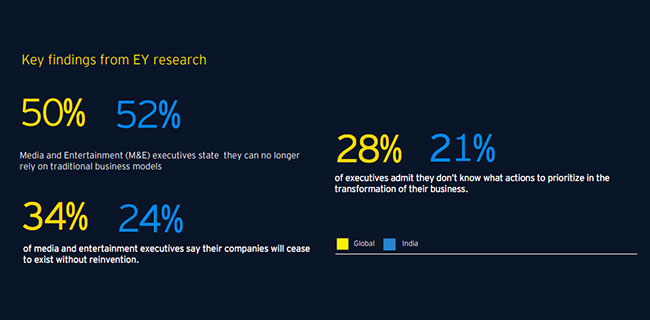
    Faced with multiple evolving and disruptive forces, 52% of executives say they can no longer rely on traditional business models if they are to remain future relevant, according to EY’s report titled, ‘How are media and entertainment businesses reinventing in an age of transformation?’. The report by EY (consulting firm Ernst & Young now refers itself as EY) analyses the views of leading media and entertainment companies and their executives to reveal catalysts, strategies and actions that are reshaping business transformation in a dynamic industry.


    The survey further highlights a sense of perplexity among M&E businesses, with 28% indicating the need to reinvigorate their business, without thorough knowledge of what aspects to prioritise. Due to a plethora of options available to invest in digital tools, one in five executives are unclear on how to prioritize their digital investments. The dilemma of whether to focus on content production for immediate gains as against building direct to customer and platform and data capabilities were cited as key points of contention.


    Said Ashish Pherwani, Partner, Media & Entertainment Leader, EY India: “With fast-paced transformations in business models and revenue streams, media and entertainment companies that otherwise are optimistic about change, are facing a challenge to determine a starting point. While there is no single path to reinvention, businesses are prioritizing direct to customer relationships, platformmatic ad sales and community subscription models, to wade through the waves of technological disruption.”


    The report states that one in two Indian executives felt the pressure to maximize short term results as a barrier to developing innovative business models which also reflected in the findings where just one in three Indian executives believe in upskilling of their existing workforce. 24% of Indian executives felt that their companies would cease to exist without innovation, demonstrating their confidence that traditional media will survive in the future.


    The survey also reveals three ambitions that M&E companies across subsectors are prioritizing above all else:

    :: Pursuing operational excellence and agility is the industry’s top transformation ambition

    Executives believe that simplification is the hallmark of the new operating model. 67% of the executives prioritise consolidation of internal segments to streamline the business, while 50% of executives identify de-layering management and increasing spans of control for remaining executives to be prominent.


    :: Rebooting innovation strategy and approach

    With 48% of executives feeling the pressure to maximize short-term results as a barrier to innovation, balancing sustained success against long-term vision requires a structured approach. 34% of executives see incubators within the core of the business, as a driver of innovation.


    :: Accelerating talent and skills development

    33% of the M&E executives cite upskilling of the existing workforce as the key to talent development highlights the growing imperative to foster continuous learning. To remain relevant, workers need to migrate up the value chain, reinventing themselves and continually improving their capabilities.


    For info: How are media and entertainment businesses reinventing in an age of transformation? is based on a survey of 350 global media and entertainment executives including 29 from India. It takes a representative view of companies by scale, geography and industry subsector. For each question and unless otherwise stated, executives were asked to select their top three responses from a predefined list of options. For example, a response of 50% means it was selected as one of the top three answers by half of respondents.

  • A Billion Opportunities


    By A Correspondent


    The world is keenly looking at the Indian media and entertainment (M&E) market given the potential of growth. There is of course fair reason: According to consulting firm EY (aka Ernst & Young), with a “population of more than a 1.3 billion people, India represents a massive market for media and entertainment (M&E) companies, with very positive growth fundamentals across virtually every type of media.”


    Said John Harrison, EY Global Media & Entertainment Leader: International expansion is critical for global media and entertainment (M&E) companies seeking to build scale, tap new audiences and enhance competitive positioning. Those looking to seize the upside of growth should set their sights on India. With more than a billion consumers and a favourable macro backdrop, India offers a massive opportunity across almost every type of media.


    In a report released globally in late June 2019 titled ‘How a billion screens can turn India into a media and entertainment powerhouse’, the EY M&E team has reflected on the state and potential of M&E in India. “India’s M&E market is strategically interesting to global players seeking to monetize content and capture growth upside, either as a participant via licensing or other commercial arrangements, or as an outright owner through an in-bound acquisition or organic investment approach. Advertising, the lifeline of India’s M&E industry, remains among the lowest in terms of spend as a percentage of GDP, signaling upside potential. In addition to a myriad of digital outlets, India has more than 850 TV channels and over 17,000 newspapers, making it one of the most diverse and vibrant media markets globally. The country is also at an inflection point in wireless broadband connectivity and infrastructure that, combined with its GDP growth and young demographics, offer new opportunities.”


    Click here for the full report


  • Getting ready for Generation Z…


    By John Nendick


    Is the customer best placed to understand what they want? Their point of reference often is defined by their experience and influenced by what they know, so how aware are they of everything that is possible?

    Today, the potential of media and entertainment (M&E) companies to understand their customers is greater than at any time in history. Successfully capturing insights from an array of sources and translating them into viable products, services and business models will go a long way in defining the leaders of today and the leaders of tomorrow.


    Generation Z is different from anything we’ve seen before. Much has been said about Millennials, but Generation Z is the first to be digitally native. They are the first to grow up using social media, mobile technology and mobile video. Given that YouTube was only founded in 2005, most Millennials remember a world without mobile video — most of Generation Z do not.


    Technology aside, Generation Z also has refreshingly different attitudes. They are more entrepreneurial; they grew up with search engines and like to discover content for themselves. They also like to be involved in the process, contribute to the solution and be more immersed in experiences.


    The step change for M&E companies from traditional business-to-business (B2B) models to direct consumer relationships is focusing attention on the need for more granular insight. Nowhere is this more apparent than in their efforts to understand the unique behaviors and preferences of Generation Z.


    Responding to changing consumption models means a rethink for M&E leaders about new business models and new investments. To better understand where investments are being made, EY conducted an analysis of two groups: today’s leading telecoms, technology and media companies, and the next generation of companies in those sectors.


    Some key findings include:

    Digital advertising has created a dilemma

    :: Digital advertising, a top-30 focus area of the industry, has lost as much as US$8 billion in revenues.

    :: Half of the loss derives from “nonhuman traffic” — fake advertising impressions that are neither generated by real advertisers nor received by actual consumers.

    :: The other half comes from a variety of factors, including ad blocking and content infringements, such as the sharing of passwords.


    Unicorns and decacorns are driving investments

    Our analysis focuses on 60 unicorns. These are the world’s most valuable, privately held companies founded in the past 10 years with a market valuation of US$1 billion or greater. Decacorns have a market valuation of US$10 billion or greater.


    Across telecoms, technology and media, the 60 represent US$143 billion in value and a broad mix of services, business models and subsectors. They are digital first and adept at scaling new service offerings and at accessing new distribution channels, customer and audience segments.


    Incumbents are responding, at least in part, by taking positions in unicorns and creating a tangled web of investments. Of those on our unicorn list, Vice Media has received two rounds of investment from Disney. NBCUniversal holds stakes in BuzzFeed and Vox Media. NBCUniversal’s parent, Comcast, which also has a stake in Vox Media, is an investor in wearable tech company Jawbone, neighbourhood social network Nextdoor and fantasy sports provider FanDuel.


    M&E executives are confident in the broader economy

    The rise of unicorns illustrates the relentless treadmill of disruption, and yet there is a newfound confidence among M&E executives about the economy and the wider investment climate.


    Eighty-one percent of M&E executives say the global economy is improving, compared with 52% who said that a year ago. In the year ahead, the global M&A market is forecast to remain buoyant, with 73% of executives indicating it will improve, up from 49% last year.


    The target areas for investment are a mix of emerging market powerhouses, such as China and India, and more mature media markets, such as the UK, Australia and the US.


    The Internet of Things (IoT) is coming of age. The connected home, connected car, connected store and wearables already are a reality that will only grow. By 2019, the number of connected cars in the US will almost triple to 60 million. Estimates vary, but 30 billion installed IoT units are forecast to be installed by 2020.


    For M&E companies, IoT offers huge potential. In its simplest form, IoT is the proliferation of sensors to capture vast and varied data about customers: their behaviours, emotions, sentiments, physical reactions and well-being. Yet, data is only part of the picture.


    Three ways M&E leaders can invest today for success tomorrow

    The next step is to make sense of it — to uncover what customers really want. And even then, it is the action it engenders that finally turns the data into a business model. In plain terms, technology and gadgets are not enough to capitalise on the IoT, but the timely, targeted and relevant delivery of content creates experiences that bring the IoT to life.


    1. Double down on data

    Generation Z is the most willing to surrender personal data, albeit on the assumption of a value exchange. M&E leaders will take advantage of this.

    They will take this data and, based on predictive insights with more targeted content and advertising, they will distill it into more tailored experiences.

    The competitive advantages available to those who gather data are increasingly apparent to cable operators such as Comcast. They know the set-top box, which was originally envisaged as a one-way distribution device, is really a treasure trove of data and insight about their subscribers.

    Comcast collects viewing data from almost 90% of its subscriber base, with more advanced set-top boxes collecting even richer information. By adding set-top-box data to existing customer relationship management information, web browsing histories and third-party data, Comcast builds a picture of its subscribers that is sufficiently granular to open up new revenue opportunities.

    Comcast can monetise it themselves through personalised advertising systems like their Adtag and Adcopy solutions, but it can also make data available to third parties, such as ratings agencies, content providers and advertisers.


    2. Tell stories and build experiences

    Storytelling is important to Generation Z. They care about seamless experiences and value engagement that builds into ongoing relationships rather than just transactions. M&E companies that understand this will utilise the array of connected devices to which customers have access, in an effort to tell integrated and connected narratives.

    In February 2016, Sky launched its Sky Q box in the UK. There are parallels with Comcast’s Xfinity.

    It is a new-generation set-top box that effectively operates as a Wi-Fi hub, bringing together multiple connected screens and devices throughout the home. Packed with 12 tuners, the new set-top box creates a connected home, enabling seamless transition from room to room and from device to device. It allows customers to control of all their connected devices, not just Sky devices, through one integrated experience.


    3. Look for partnerships (acquisitions)

    Their investments in unicorns illustrate M&E leaders’ understanding of the need for partnerships and acquisitions, which provide the fastest route to expanding capabilities, accessing new business models and achieving scale. Media and entertainment companies are reaching out to work with technology and telecommunications players, cybersecurity services, venue owners, automotive companies, health providers and appliance manufacturers.


    Summary

    The rise of Generation Z — now 25% of the US population — is forcing media and entertainment companies to rethink whether they know what their customers want. In response, companies can look to utilise data, tell stories and look for partnerships.


    John Nendick is Global Technology, Media & Entertainment and Telecommunications Deputy Sector Leader at EY. Repubished with permission from EY (Ernst & Young)




  • Rise of the Second Screen


    By A Correspondent


    One of the key trends seen in 2017 and 2018 has been the increased use of second screen interactivity by broadcasters as a means to engage more with their television audiences.


    Leading consulting firm Ernst & Young (EY) has published a report that delves deeper into this phenomenon, and provides case studies of how broadcasters and brands are using the 2nd screen along with television to enable a richer and more engaging customer experience.


    According to the report, 30 percent of the time spent on the mobile device is on entertainment. Its a natural extension that television uses the second screen, be it mobile, tablet or laptop, to provide its audiences the ability to interact more with television content, stories and celebrities.


    As broadcasters compete for advertising with new media companies who can provide millions of profiled audiences, interactivity helps broadcasters with generating viewer data, understanding consumption patterns and most importantly, increasing time spent on television, notes the report.


    Here’s more from the EY report. First the case studies and then looking at what makes it work and the future of the Second Screen:


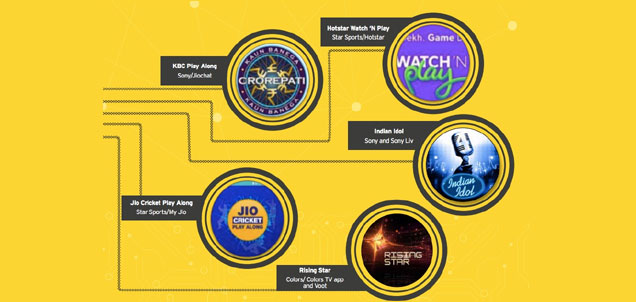
    KBC Play-Along

    Jio along with SET developed a play-along game for the ninth season of KBC. The idea of the app was to engage viewers so they could not only watch the show but also play along and answer the questions shown on TV, testing their knowledge against the TV contestant and scoring points.


    Hotstar Watch’N Play

    IPL 2018 was the 11th season of the highly popular T20 cricket league. This season Star decided to simulcast IPL on TV and Hotstar and introduce an interactive play-along app on Hotstar. 202 million viewers watched the matches on Hotstar.


    Jio Cricket Play-Along

    Jio decided to have a play along game for live cricket matches of IPL 11 broadcast on TV. While some played to win prizes, others played for the sheer excitement that came along.


    Colors Rising Star

    Colors Rising Star is a show adapted from the international format “Rising Star” and ran its second season in 2018. It was an engaging experience for viewers as they were able to see the results of their votes on a real-time basis.


    Sony Indian Idol

    In its tenth season, Indian idol has taken fan engagement to the next level with the Indian Idol Sing Along experience. SET has enabled millions of users to not only vote for their favourite Indian idol contestants, but also to sing along with them, in partnership with Smule. The best ‘Sing-Along’ performance of the week is featured on the show, giving the users their moment of fame on national television.


    So why does interactivity work? Interactivity enables broadcasters to further fulfil their core objectives of providing escapism, knowledge and social acceptance to their audiences.


    Social Acceptance: Second screen engagement can be used as a tool for social communication, by allowing users to share their scores, opinions, leaderboard, level-ups.


    Lean Forward: With reality shows only selecting a handful of contestants to play on each show, the second screen offers viewers the experience of participating on the show from the comfort of their homes.


    Immersive Experience: The TV audience’s expeirence is enhanced, they are playing the game/ performing alongside their favourite contestants and in front of the show host or judges. This is a far more intimate form of escapism.


    Future of interactivity: Second screen interactivity will not only help broadcasters understand their viewers better through the additional data that could be collected, but also help keep viewers more engaged helping drive the ratings for shows. We see broadcasters and other content owners partnering with tech/ telco companies to create some ‘never seen before’ experience for the viewers. If used wisely, second screen has the power to create its very own loyal viewers who can continue to engage even after the end of the show. It is no longer a just cost element but it has the potential to generate revenue and cut marketing costs as can be seen in the proactive engagement platform diagram alongside, which can help brands connect directly with the TV audiences. Second screen interactivity combined with an effective loyalty program will have the potential to reap never before seen benefits. The second screen revolution has begun and results are there to be seen. Broadcasters have benefited, platform operators have benefitted and advertisers have benefited, too. But the viewers are the real winners. Interactivity to become more prevalent not just across game shows and sports but across genres such as music, fiction and film.


  • M&A in M&E to improve


    By A Correspondent


    Consulting firm Ernst & Young (EY) has released the 18th edition of the Media & Entertainment Capital Confidence Barometer. The barometer provides a snapshot of M&E respondents’ findings, gauges corporate confidence in the economic outlook, and identifies boardroom trends and practices in the way companies manage their capital agenda.


    And here’s what the report notes:

    “Our research shows that media and entertainment executives are increasingly focused on acquisitions, supported by releasing capital via divestments. Their intentions are driven by confidence in business fundamentals and the near-term performance outlook along with a longer-term need to strategically position their portfolio for future growth. Some additional highlights from our report are provided below:


    :: All of the media and entertainment executives (100%) see the global economy in which they operate as stable or improving.

    :: Executives are highly confident in their current performance – 100% expect improving or stable corporate earnings in the sector.

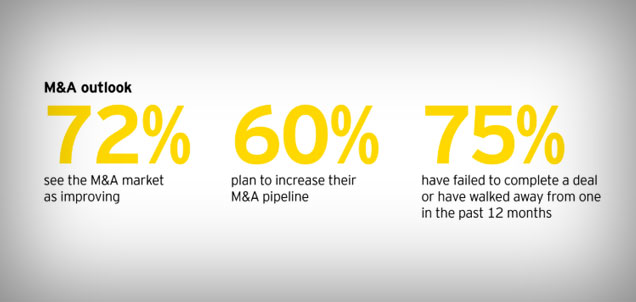
    :: Executives are positive about the M&A market, with 72% expecting it to improve in the next 12 months, up dramatically from 47% six months ago.

    :: Deal making competition (88%) has almost doubled in six months — mainly (67%) because of a surge in activity by private equity funds.

    :: Portfolio transformation is the top priority for boardrooms, with 73% of respondents identifying it as one of their top three concerns for the next six months.

    :: Divestitures will be a critical component of successful portfolio transformation – 74% say that their last portfolio review identified an asset to divest.


    Here is a link to the key highlights of the study.


  • Opportunities & Threats in M&E: EY


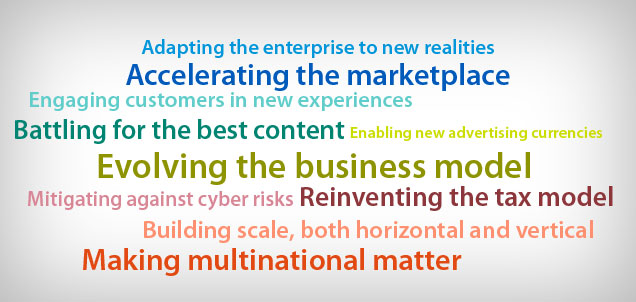
    Ernst & Young’s Global Media & Entertainment Sector has identified and assessed the Top 10 areas of upside and risk for the industry. The firm asked two questions; What are the most significant growth opportunities for media and entertainment companies today? What are the most significant risks or threats that they face? Here are the takeaways, in brief.


    Evolving the business model

    As the pace of disruption accelerates, Media & Entertainment companies must rapidly revamp product and service offerings, distribution frameworks and pricing/ monetisation strategies to meet shifting customer expectations.


    Adapting the enterprise to new realities

    Media & Entertainment companies require a new level of operational excellence — the type of performance improvement and strategic expense reduction that delivers short term results and long term efficiencies.


    Enabling new advertising currencies

    As advertisers gain a keener understanding of their target consumers, new currencies, which blur the lines between linear and digital media are emerging, even as audience measurement across platforms continues to challenge the industry.


    Engaging customers in new experiences

    Just a few years ago, consumers were delighted to be able to stream a movie or TV show on multiple devices. Now, consumers expect personalized experiences across their daily lives.


    Mitigating against cyber risks

    Every click, view and download results in massive amounts of data being created every day. This data offers Media & Entertainment companies a real competitive advantage, however, the same data is a magnet for cyber-criminals.


    Battling for the best content

    Ever-rising investment in content is tipping the scales of corporate performance both ways — translating into either strong growth or painful margin pressures.


    Building scale, both horizontal and vertical

    Media & Entertainment executives see inorganic routes as the fastest way to fill gaps in their portfolios, re-set their strategic positioning in the industry and future proof their business models.


    Accelerating the marketplace

    As new technologies accelerate how supply and demand intersect, the dynamics of media marketplaces — for both consumers and advertisers — are becoming super fluid, placing new pressures on all parts of the ecosystem to move more quickly.


    Reinventing the tax model

    US tax reform represents the biggest change in taxation for over thirty years and yet it is really an inflection point in what has become a much wider conversation about the future of the tax function.


    Making multinational matter

    Finding the optimal business model, strategy and ownership structure to achieve success in international markets requires nuance and flexibility.


  • Free TV viewership to touch 46mnby 2020: EY


    By A Correspondent


    Free TV viewership in India is set to register exponential growth, reaching 46m households by 2020, according to a report titled ‘India’s Free TV – A game changing opportunity’ published by consulting major EY (Ernst & Young). This will be in addition to consumption of content on mobile DTT handsets.The increase in the number of FTA channels has also led to asignificant rise in viewership for genres such as Hindi GEC, Hindi movies and, primarily, the Hindi news genre, in which FTA channels command 81% of the total viewership.


    Commenting on this, Ashish Pherwani, Partner – Advisory, Media and Entertainment, EY said: “Free television is increasingly becoming a viable option for channels looking to capture the base-of-pyramid audiences in urban and non-urban areas. With a large subscriber base, it also opens up new avenues of advertising for marketers looking to get reach in some of the fastest growing markets in the country. The change in customer behaviour will also have a significant impact on FTA and pay TV channel uptake, and corresponding spends on subscription income.”


    Currently, rural TV viewers contribute to 52% of the overall viewership.However, it is estimated to contribute 74% of the total viewershipon DD Free Dish.


    The report outlines four key factors which will drive the uptake of free television:

    1. Digitisation of cable TV distribution – DAS IV

    The mandatory move towards digitization will require consumers, particularly those in DAS III and IV markets, to opt for more expensive cable TV options, DTH or free TV options such as terrestrial TV or Free Dish. EY expects the price conscious customers may opt for free television services in the immediate term.


    2. The proposed new tariff order

    The new tariff order will make customers choose between the options to either pay more to receive pay channels oftheir choice or decide that free television would be a betteroption, given the quantum of quality content on it. This will help further drive subscriptions from price conscious consumers for Free TV.


    3. The fast growth of DD Free Dish

    DD Free Dish bouquet is set to increase to over 250 channels, featuring quality content, also including sports being available on its spectrum. This makesthe Free Dish bouquet a formidable competition to pay bouquets.


    4. DTT on mobile infrastructure

    Another important development relating to mobile television is theemergence of digital terrestrial distribution. Since this is a broadcasttechnology, the key implication will be that consumers whosemobile handsets have the required antenna would not berequired to pay any bandwidth charges. Consequently, once themobile handset ecosystem matures, DTT could also provide astrong addition to free television services.


    The report also notes the implications of growth in free television for broadcasters and distribution companies in the near future, which include:


    Broadcasters:

    :: Pricing of channels, particularly those that are not leaders in their genres, and determination of whether channels should move to FTA
    :: Number of channels to include in base and base+ packs of distributors
    :: Carriage fee considerations
    :: Creation of free television products and differentiation of free and paid television products
    :: Competition from Free Dish offerings to broadcasters’ pay channels
    :: Increasing audience reach from a DTT perspective


    Distributors:

    :: Creating packages for various customer segments, while at the same time convincing customers to pay more for fewer channels
    :: Ensuring channels from all broadcasters are present in each popular package
    :: Placement of channels in and within appropriate packages
    :: Prevention of subscriber migration to free television


    The report ends with providing some ideas which Free TV operators can consider.


    The report can be accessed at ey.com/in/FTA Opportunity


  • Surat, Jaipur, others to drive consumption: EY


    By A Correspondent


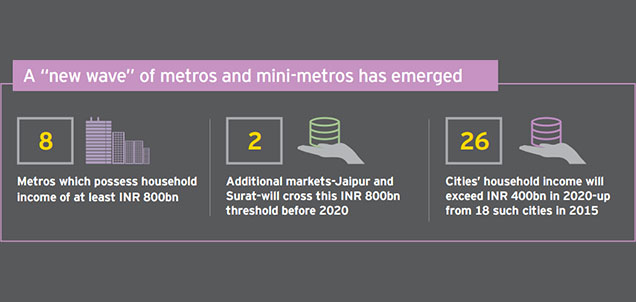
    India will see the rise of two new metros – Jaipur and Surat – by 2018, with a household income of over Rs 800bn by 2018, according to an EY report titled ‘India’s growth paradigm: How markets beyond metros have transformed’. These are projected to record real GDP growth of 8.7% and 10.3% respectively from 2015-20, relative to metros’ 8.3%. As a result, both cities will cross the Rs 800bn threshold within one to two years, with total consumption levels to reach 75%-80% of metros like Pune and Ahmedabad.


    The report identifies 42 new-wave markets, which are expected to grow at 8.9% as compared to the 8 metros that are expected to grow at 8.3% CAGR in the 2015-20 period.


    Said Ashish Pherwani, Media and Entertainment Advisory Leader: “Non-metro growth is out-stripping that of metros in India. There are clear cases of unmet demand in India’s Top 50 cities in certain sectors. This provides a huge opportunity for various sectors to both widen and deepen marketing strategies, and effectively tap into one of the world’s largest earning populations.”


    The report also notes the rise of eight new half-metros, with household income exceeding Rs 400bn by 2020. It also highlights 13 new-wave cities that represent a high-growth opportunity, but are largely untapped, according to the report. These include Patna, Raipur, Warangal, Gwalior, Dehradun, Allahabad, Rajkot, Vishakhapatnam, Jodhpur, Vijaywada, Ranchi, Kota and Jabalpur.


    Additionally, the top 23 untapped markets, as identified by the report, are all new-wave cities. These 23 markets represent 19% of metros’ household income-but only 12% of retail outlets 15% of telecom centres and 17% of malls, notes the report.


    The report further considers the potential of individual markets across each sector – FMCG, Retail, fashion and durables, Auto, Telecom and DTH, E-Commerce, Education, BFSI, and Real Estate. It delves into the expected ad spends across each sector, and highlights the top-10 untapped markets across each sector.


    The report can be downloaded at www.ey.com/in/urban-growth.


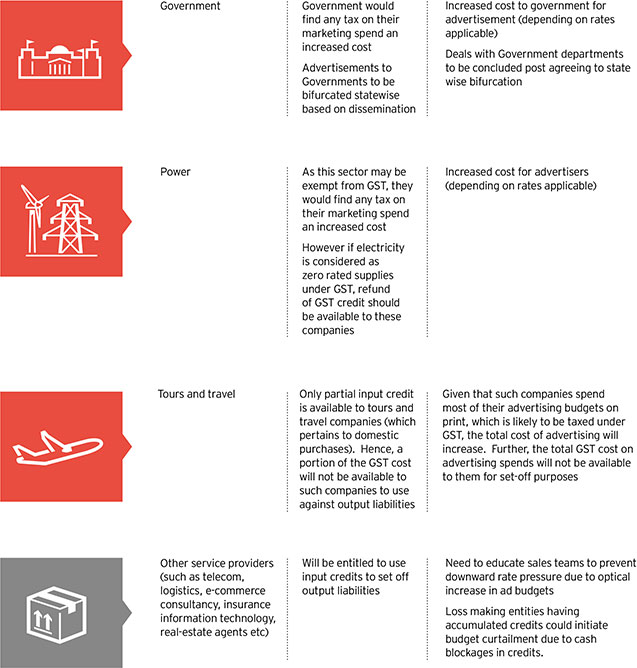
  • How will GST impact advertising?


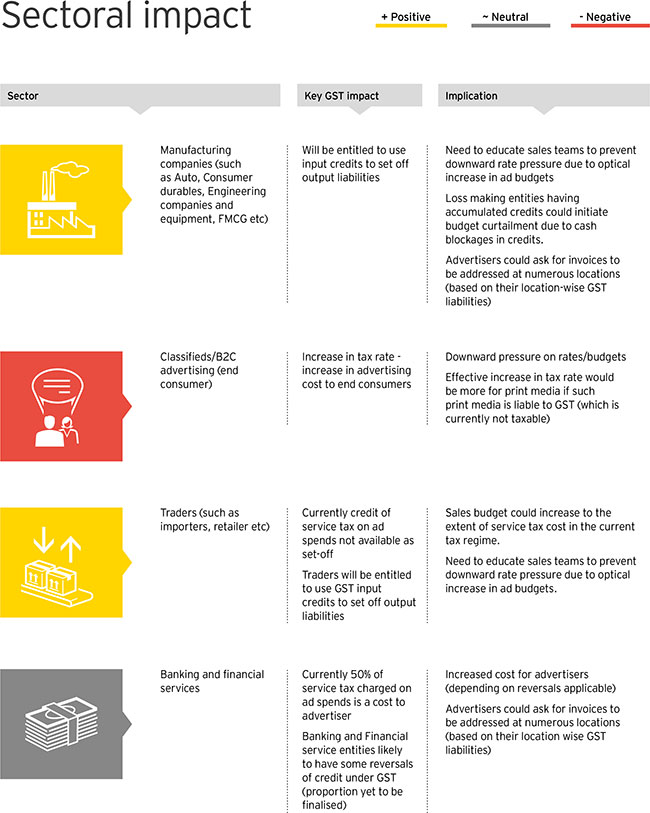
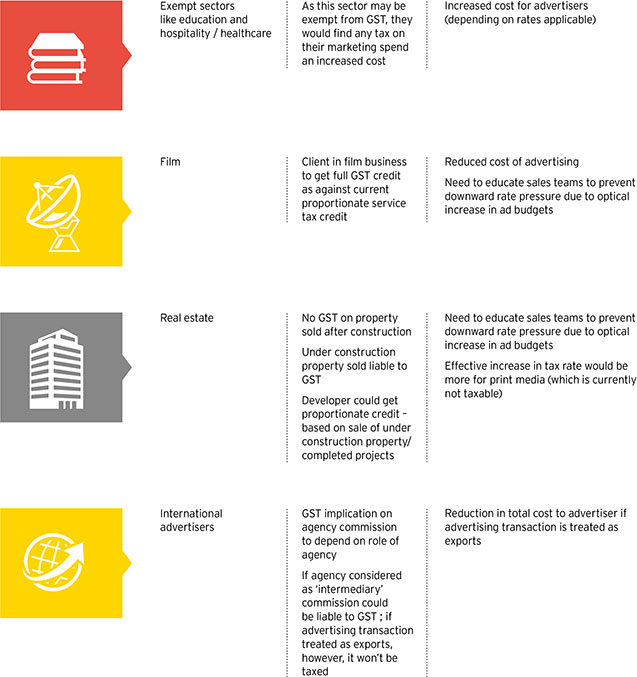
    GST is going to be here… soon. Ads are pushing for its acceptance. Here’s an EY (Ernst & Young) report on how it will impact the M&E sector (some parts have been modified given that it’s appearing in this form):

    Introduction: The levy of GST will have different impacts across sectors, and this could impact their ability to spend on advertising The objective of this report is to list down the possible impacts across different sectors. It can be used to update sales teams, and prepare them from questions from advertisers


    Disclaimer: Do note, that the law is yet to be finalized, and this document is based on the current reading of the law, and is subject to change. This has been prepared on a best effort basis. Please use discretion and take professional advice prior to taking decisions based on the points of view mentioned in this document.