Tag: DTH

  • Aidem to handle Dangal TV adsales

    By A Correspondent


    Media consulting, marketing and advertising sales company Aidem Ventures has been appointed as an advertising partner for Dangal TV, the regional channel reaching out to the core Hindi-speaking belt.


    Dangal TV is a 24-hour free-to-air entertainment channel offering a mix of movies and serials in Bhojpuri and Hindi. Dangal has established its availability across cable and leading DTH platforms including Dish TV, Videocon DTH, Airtel Digital TV and DD DTH.


    “Regional channels accounted for approximately 27 percent of total television viewership in 2012, which is proportionate to the advertising market share they commanded during the same period. Advertising interest in regional markets is strong and broadcasters see immense potential for revenues from local advertisers who are willing to pay a premium to reach their targeted audience. From our own experience with regional channels, we have come to realise that a staggering number of advertisers are seeing the benefits of developing localized communications strategies using sponsorships, promotions and integrated branded content around regional TV. It gives us immense pleasure to be associated with the market leader in the Bhojpuri genre and look forward to driving its vision.” said Vikas Khanchandani, Director, Aidem Ventures.


    “We at Dangal have a thorough understanding of the Hindi-speaking belt. That, along with ourhuge investment in acquiring Bhojpuri and Hindi content serves as a strong endorsement of our vision to create a new standard in the Bhojpuri entertainment space. We look forward to a continued association with Team Aidem to help us achieve better yield for the channel over the long term” said Manish Singhal, Chairman & Managing Director, Dangal TV.


    About Dangal TV


    Dangal TV is a 24-hours free-to-air entertainment channel that delivers content suited to the entertainment needs of the Hindi Speaking belt in India. Committed to offer a comprehensive viewing experience and cater to diverse demands of its viewers, Dangal TV offers a strong mix of movies & serials in Bhojpuri as well as in Hindi.


    About Aidem Ventures


    Aidem is India’s leading independent Advertising Sales Company and also offers consulting and marketing services. Aidem has a team of over 100+ trained professionals located across all major media markets in India. Aidem enjoys deep and valuable connections with over 3000 advertisers across India.


    Aidem is also the exclusive media representative for Mi Marathi, Live India, Sahara One, Sahara Filmy, Economist.com, GETIT, Eros Now, KBS World, Al Jazeera English (AJE) and other Al Jazeera channels, Clubbing TV, DanceTrippin, RCK TV, Jukebox, Lakshyya Entertainment, Get Punjabi, Jaya TV Network and Sri Lanka Premier League.


    Aidem, together with eBUS – a Group IMD Company, also offers a complete solution for digital distribution and management of Television Commercials (TVCs) to advertisers, agencies, media owners, content producers and broadcasters. This service is being used by almost all major broadcasting networks in India.


  • Kamal Haasan puts off Vishwaroopam launch, will not pull out from DTH release

    By Sangeetha Kandavel


    Rumours floating online suggested on Tuesday that actor Kamal Haasan would drop his controversial move to release ‘Vishwaroopam’ on DTH as well as postpone its theatrical release. As of Wednesday, with Haasan addressing the media, at least one of those rumours seemed to have come true.


    The South Indian star said he was postponing the launch of his magnum opus, reportedly made at a cost of Rs 95 crore, while at the same time insisting he wasn’t going back on his DTH plans.


    “I will announce Viswaroopam’s release date. I will decide,” said Haasan, answering in the negative when asked if he was pressurized into this decision.


    Haasan’s plan to launch his movie on the DTH platform had raised a storm, with a section of theatre owners threatening a boycott of the film. They fear DTH will eat into their business as also give rise to piracy. Haasan has been saying he signed up a sizeable number of theatres already.


    This correspondent tried to speak with industry people, including theatre owners and DTH service providers, but they weren’t available for a comment immediately. “I will give them both (DTH and theatre) equal status and come on the same day,” Kamal Haasan said at a meeting at his office in Chennai. It wasn’t clear if he meant that DTH and theatrical release would happen at the same time. Because, according to the original plan, the DTH release was supposed to happen the night before the theatrical release.


    “I will not leave my DTH partners. Movie will come on DTH. Friends have requested that premiere should happen on same day. Will think and take a decision as this is my product,” he noted. DTH players, including Sun DTH, Dish TV, Airtel DTH, and Reliance DTH, have decided to stop taking bookings for the pay-per-view show that was to be telecast on January 10.


    He has also cautioned that he would be filing cases against people who have threatened to block the movie or show it in clubs and bars. Kamal Haasan said, “I am doing a honest and legitimate trade. No one has the right to stop me from going ahead. I will take legal action on those who threaten me and who try to prevent me from doing this. Do not take my kindness for confusion.”


    The DTH release was priced at Rs 1,000 in a pay per view model. When asked whether the same pricing would be followed, the actor said he would look into that and take advice of industry peers.


    Source:The Economic Times

    Copyright © 2013, Bennett, Coleman & Co. Ltd. All Rights Reserved


    Photograph: Fotocorp


  • Star World to showcase Packed to the Rafters digitally ahead of TV launch next week

    By A Correspondent


    Star World is all set to air Packed to the Rafters for the first time in India. Packed to the Rafters’ is an Australian drama series which revolves around the story of the Rafter family, who are fighting different problems of life together.


    To make the show more relatable to the audience, Star World got Karan Johar as the face of its campaign. The channel launched a six week on-air campaign with him. And the channel has unleashed robust print, digital, DTH, cinema, radio and OOH campaign given the launch next week.


    In keeping with the growing importance of the digital platform, the channel will be hosting a Web Premiere across the Star World website (www.starworld.in/PTTR) and other social networking sites to give the viewers an experience of the show before it goes on air. Star World will be taking such initiatives up for key shows to create reach and buzz. The digital premiere will be held today (November 30) before its official launch on the channel on December 4.


    Subsequently, each of the episodes of the show will be available to be streamed and viewed on the Star World web and WAP platforms after it telecast on air. A tie-up with Vodafone will ensure viewers can catch up on the key moments of the show at their convenience.


    Commenting on the show, Rasika Tyagi, Senior VP, English Programming, Star India said, “From our Hindi and Regional GECs, one of the biggest learnings is that viewers seek life lessons from the daily soaps they watch. The issues faced by the Star World audience, the English speaking, urban Indian youth, is quite myriad and they don’t get to see shows which reflect their life on TV. Our audience will be able to resonate with the issues faced by the characters in Packed to the Rafters and emulate the way they resolve the conflicts.”


    Commenting on the digital catch-up service, Rasika Tyagi said, “When we go for consumer home visits, we get a reality check on how content is being viewed by the youth today. They want to watch a show at their convenience – anywhere, at any time. So, we as content providers have to gear up to share our content across platforms, on internet or on mobile.”


  • Only 59% (&not 87%) digitization achieved!


    By Pradyuman Maheshwari


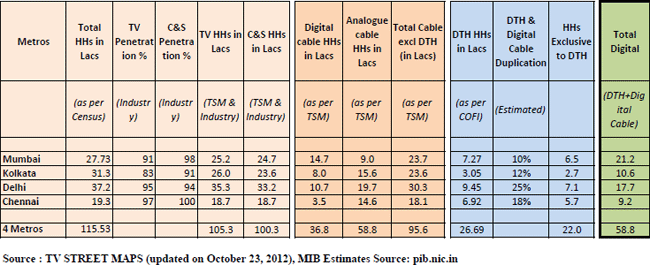
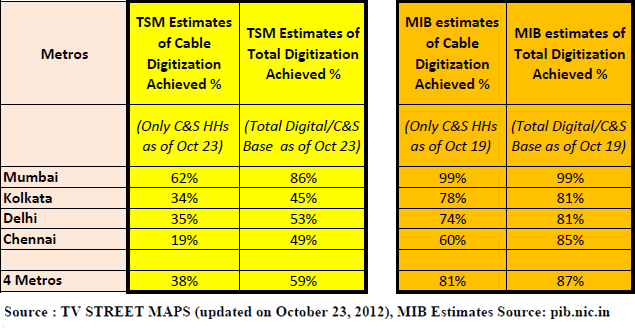
    Only 59 per cent of digitization has been achieved in the four metro as per the first ever independent survey of the extent of digitization in the four metros was conducted by Television Street Maps for MxMIndia. This number is in sharp variance to the claim made by the Ministry of Information and Broadcasting that 87% of the four metro was digitized.


    The figures for the four metros tell the story:


    For Cable & DTH:

    Mumbai: 86% (Govt: 99%)

    Delhi: 45% (81%)

    Kolkata: 53% (81%)

    Chennai: 49% (85%)

    The gap grows when you look at the achievement of digitization only in cable homes.


    Mumbai: 62% (Govt: 99%)

    Delhi: 34% (78%)

    Kolkata: 35% (74%)

    Chennai: 19% (60%)


    On Tuesday, we made a clarion call to the mandarins of the Ministry of Information and Broadcasting urging them to put an end of this charade of make-believe numbers of digitization.


    MxMIndia strongly believes that digitization is THE ONLY way in which the broadcast business can survive and thrive. For too long there has been much confusion amongst stakeholders. With half-baked regulations and guidelines, certain sections of the ecosystem were getting away with unethical practices.


    India has been among the most happening markets in the global broadcast business. Most of the world’s media superpowers are here. What was needed was some order in the business. Which digitization was going to bring in this, as it happened internationally. Unfortunately, the government has appeared to have missed  a trick in its attempt to execute this.


    The Sunset Date for the switch from analogue to digital transmission in the four metros was first fixed as June 30, 2012.  Then it was shifted at the last-minute to October 31.  When this writer mentioned that even that date looks tough to achieve, there were many in the industry who said that the momentum will build eventually.


    Although MxMIndia had been running a series starting 100 days to the June 30 deadline, we didn’t look at digitization in a big way until there 50 days left for November 1. But soon after interacting with all stakeholders, we figured that none of the numbers on the extent of digitization achieved that were being dished out could be believed.


    Jaldi 5 with Joydip Kapadia: Data based on ground-level info + professional & expert assumptions
     

    The government claimed an 87% achievement of digitization while the study conducted for MxMIndia by Television Street Maps showed this achievement to be only 59%. While this figure is for cable and DTH homes, that in cable homes alone is a low 38% as against the I&B ministry claim of 81%. MxMIndia spoke to Joydip Kapadia, Business Head, Television Street Maps on the issue:01. There is a huge variance between the TSM study figures of 59 per cent total digitization as against 87 per cent which the government is quoting. Why do you think do we have this huge difference between the two figures?

    I wouldn’t be in a position to comment on the numbers quoted in other studies. After all, whether its the authorities or TSM or other third parties releasing info about the ground, we all have to resort to diverse methodologies and assumptions. Sometimes the estimates of individual studies could vary due to the underlying assumptions considered. These assumptions work at multiple levels – each or all of these assumptions levels could influence the end result. For instance, differences in defining the areas within the city, definition of Digital TV (including or excluding DTH), total cable homes in a city extrapolated from census and other sources – are just some of the places where assumptions taken upstream within the analysis could produce variations in numbers coming out downstream – at the end of the analysis. All I can say is that our data is based on information obtained from the ground overlaid with our professional and expert assumptions.


    02. By your estimates how much do you see the 59 per cent grow to by October 31?

    It’s difficult to predict given the scale of the initiative and the number of players and variable involved. I wouldn’t like to hazard a guess.


    03. Would you see broadcasters lose out because of the delay (given more carriage fees, the delay in transparency, but then assured reach)

    We have actually not looked at these aspects so I wouldn’t like to say anything on that.


    04. Is there any one thing that you would like to see being done right if there’s a delay in the date and/or for the digitization for the rest of the country?

    We are not direct stakeholders in this and cannot offer any advice in this regard.


    05. 05. Do you think it would be prudent for the government to push the digitization date in the four metros by another three months?

    The math for all stakeholders comes down to what is the overall target to achieve vis-a-vis the seeding pace of the industry to reach that target. If that Math adds up then great, else the verdict would be to budget for greater time.


    It is then that we commissioned Television Street Maps (TSM),  India’s largest and widest channel distribution monitoring service covering over 1500 headends across  675+ cities/towns, to conduct this study. TSM placement monitoring data is provided on a weekly basis to its clients who include names such as Indiacast, One Alliance, Viacom18, MSM, Star, UTV, etc. Besides providing distribution monitoring for analogue and digital for Class-1 towns, TSM has recently started providing distribution monitoring for LC1 towns as well as Digital Track, a system to analyse Digital offerings of MSOs and DTH companies.


    Over the last two years, TSM has been tracking cable headends on a daily basis and reporting on a weekly level in almost a cable census style – covering every headend for the geographies it represents. While the data provided here are just the toplines we intend to provide detailed insights to our client on DAS. (see box: Jaldi 5 interview with TSM Business Head Joydip Kapadia: Data based on ground-level info + professional & expert assumptions ).


    Methodology of Data Capture:

    Over the last two years, TSM has been capturing TV channel distribution on a daily basis – the expanse of which is now a staggering 1500 headends across 675+ towns. This daily activity has been augmented since August 2012 for the four metros to capture the movement from analogue to digital at a more granular level. This augmentation/ expansion has been done using extensive ground intelligence and multiple verifications due to the criticality of the data. To ensure correctness of the data, more frequent scans were done in the last few days. The current release is for the ground situation as on October 23, 2012.


    The ground info on Analogue versus Digital has been layered with metro universes data collated from census and other third party sources to ultimately validate and put together the digital penetration data for the 4 metros.


    The sharp variance in the numbers as per the TSM survey and those put out by the government is reason for worry. But this is precisely what led MxMIndia to commissioning this study. No one really believes the numbers that are being put out by the government though MxMIndia, like other media, has been publishing these.


    MxM View

    MxMIndia recommends that the government act in a mature way on the issue. While a delay will mean a loss of face, it’s better to schedule for a time when 100 percent digitization is truly achieved. At the time of writing, we’ve heard of rumours that the government may well announce a delay by two months. We would urge the government to not look at December 31 as the Sunset Date. There is a fair amount of special programming on television planned on that day and the government would be well advised to look at a date like January 31.


    However, while doing so, it must get assurances from the governments in West Bengal and Tamil Nadu on compliance. The government must also meet all stakeholders to ensure that everyone is on the same page and is working towards the greater common good. It may be a good idea for it to appoint a full-time Officer on Special Duty for digitization. Either someone from its ranks, or pulled from the industry.


    A note of caution: there is a general election coming up in 2014, possibly earlier. Elections have been lost due to grave national issues and teary ones like onion prices. If there’s any mess-up with digitization, the government can ill-afford a crisis where the masses won’t get to watch their favourite shows on telly. Then, the cry will surely be: alag chahiye!


  • Digitization in Delhi crosses 66%, 99% in Mumbai: MIB

    By A Correspondent


    As per the data made available to the government by the multi system operators (MSO), the level of cable TV digitization in Delhi has increased to 66 percent. It has been reported by the six private DTH operators that 9.45 lakh households have got DTH connections in Delhi as onOctober 9, 2012. This implies that 19.94 lakh households have cable TV connections. Adding a provision of 20 percent to account for multiple TV homes and TV sets in offices etc., it is implied that about 23.93 lakh subscribers require set top boxes (STBs). As per the data made available by the MSOs, 15.88 lakh STBs have already been installed in Delhi.


    Taking into consideration that the fact that figures given by the ministry have been questioned, a press release from the ministry said, “During the initial stage of planning, the data was collated by the Ministry based on the information supplied by the MSOs. On perusal of the data, it was observed that there were grave discrepancies in data, particularly number of cable TV subscribers in four metro cities furnished by the MSOs.” The ministry has thus undertaken the exercise to base the data on Census of India 2011, released by Office of Registrar General & Census Commissioner, India, which gives authentic figures relating to households and TV penetration in Delhi, Mumbai, Kolkata and Chennai.


    The analysis of data received from four metro cities reveals that overall 77 percent of cable TV digitization has already been achieved. City-wise data shows that the achievement of cable digitization in Mumbai is 99 percent, followed by Kolkata (73 percent), Delhi (66 percent) and Chennai (59 percent). Taking into consideration the progress made by DTH in this sector, the level of digitization goes upto 84 percent in the four metros.


  • We want to be in the forefront when new media merges with traditional: Anuj Gandhi


    The writing was on the wall the day Anuj Gandhi joined Network 18 in March this year to oversee the group’s distribution and new business development. And the reason for this was the all-new relationship between Network 18-TV 18 and Reliance Industries forged a few months before his joining.


    Other than the providing of the much-needed funds and the consequent stake in one of India’s largest (and more powerful) media conglomerates, Reliance was also looking at making full use of the content produced and owned by the various Network18 and Television18 arms, especially for the Reliance 4G services.


    Also, in the post-digitization era, distribution becomes a key driver in the revenues of a broadcaster, especially for niche channels. And with various mobile devices becoming popular and wireless technology progressing rapidly from 2G to 4G even in India, the monetization potential for multimedia content leapfrogs.


    Enter IndiaCast, a joint venture of TV18 and Viacom18 to create India’s first multi-platform ‘Content Asset Monetization’ entity.


    IndiaCast Group CEO Anuj Gandhi is a veteran in the distribution and the affiliate sales front. An MBA from the SP Jain Insitute of Management, he has worked with Discovery Communications as Director – Affiliate Sales (1997-2002),  as President of SET Discovery (2002-07) and CEO of DEN Networks (2007-2010) and worked as an independent consultant for a little over a year. He has also worked with IndusInd Media in distribution (way back in 1994) and prior to that with Ranbaxy. Clearly, being an early leader in every aspect of the distribution business, Mr Gandhi is well-poised to monetize the wide variety of content that IndiaCast has in its basket.


    Hours after announcing IndiaCast, Anuj Gandhi spoke with MxMIndia, his first and until the time of publishing only detailed interview on the shape of things to come.


    So we see the the birth of a laaarge distribution company…

    IndiaCast is much larger than other traditional distribution companies because it entails monetizing content assets of all the groups – right now TV18 and Viacom18, and post-acquisition of Eenadu, but for all rights. It’s effectively all non ad-sales kind of monetization businesses. It will be online, traditional brick-and-mortar distribution businesses at a global level. So it is pretty huge.


    It’s just the beginning. My sense is that most people will do it because the lines are diffusing between various rights that people use in the market. It has already happened in the international market where a DTH guy blocks Over The Top (OTT) or IPTV rights from you and vice versa. So you will have technologies where OTT rights will sit on a box so the cable guy will come and tell you that I not only want to do cable rights but I also want OTT rights. Thus, with the passage of time, new media will get merged with traditional media and we want to be at the forefront of the revolution which will happen in the next few months/years.


    Any international tie-ups in the offing?

    We already have international updations in the US, UK and Dubai. Colors is being distributed there and going forward, we want to expand our portfolio. We plan to distribute more and more channels internationally. So it’s work-in-progress on that front.


    So what happens to Sun18 now that IndiaCast has been formed?

    Sun18 was an alliance that worked very well and will continue to do well. The deal at Sun18 was that we will distribute Sun and Disney channels in Hindi-Speaking Markets  (HSM) and they will distribute us in the South. So, the only change in the whole alliance is that instead of distributing in the whole of South, they will only do Tamil Nadu now. Otherwise everything stays the same, we still distribute them in the North and also Disney which is part of their network. With this, Sun18 North has kind of folded into IndiaCast.


    Is it a coincidence that IndiaCast happened days before the scheduled digitization in the metros or was it on the cards for a while?

    No it was in the pipeline and we were talking about it for a while now and we knew that we needed to get all our pieces in order.


    Any major challenges you see coming up in the future?

    I think the major challenge would be to get the deal right for digitization. Whether it happens in 25 or 90 days (as digitization in the four metros is likely to get delayed by a few months), this is a chance where the industry needs to correct itself; we all need to work in getting the ARPU situation right in this country. So the challenges are basically at the industry level. Also, on the global front, the challenge is to be able to do more channel launches in international markets and be seen as a serious player. Also, one more challenge will be about how new media unfolds in the country.


    With viewers being able to subscribe to channels a la carte, do you anticipate reach/visibility of channels to take a beating… for instance, what if a person just takes one or two channels a la carte?

    While there will be some percentage of the market that will opt for it because by law you have to offer it. Like when CAS started, everyone talked about a la carte and people taking only one or two channels, but it just doesn’t happen. It doesn’t happen anywhere in the world and it won’t happen inIndiatoo. There may be a few people who would want that but that would be a single-digit percentage for me. So I am not too worried about it. But what will happen is, as they say, the time spent on niche channels will go up with digitization as everybody will be getting the same quality of channels. But if you start picking and chasing packages, some channels will start suffering. Not everybody is going to take all Hindi news channels, for example. So if they are in the same package, then people may pick them but if they are placed differently then it may not be the case. So some impact will happen, but not in the short term.


    We see that IndiaCast will also represent Sun and Disney in HSMs. Any others on the anvil? Since UTV channels are now part of Disney, will they move too?

    Nothing right now, I think we already have too much on our table right now. If something happens tomorrow, we do not know but we are not looking at adding anything new as yet.


    As part of Network 18/Television 18 agreement with the Reliance Industries Ltd’s Independent Media Trust stake, there was also a plan of all Network 18/Television 18 content being syndicated to Reliance 4G? Will it be done via IndiaCast?

    I won’t be able to comment on this but as is known, all content monetization businesses lies with IndiaCast so the same businesses will be done with any 4G networks whether it is from Reliance or any other telco from the business.


    So going back to the earlier discussion, the arrangement with Sun18 stays…

    Yes, we have just changed the definition in terms of the three states in the south. Otherwise it remains where it was. So Sun18 continues to exist and holds up in IndiaCast. It won’t be called Sun18 anymore. There is no shareholding changing – Sun18 North is just folding up into IndiaCast.


    Do you see consolidation gaining prominence as we move ahead?

    I think it will happen for some time. What way and form – will now change as technology is becoming a critical part of our business. The traditional mergers may not happen as much but there has been a lot of M&A happening on the platform side which will also have an impact on broadcasting.


    With digitization happening, do you anticipate the revenue from non-advertising sources will actually be more than what comes from advertising?

    I cannot generalise it and will depend on channel to channel. But will certainly grow; I feel that it could be 50-50 at the network level. So niche channels will benefit more from subscription than ad sales but mass channels will still earn revenues from ad sales.


    So just as it holds true for the sales folk these days, do you see the distribution team also have much say in content in the future?

    I wish my bosses here say that distribution guy must have a say in content (laughs). But it’s not that now. Until now the interaction with the consumer was through various means and the stakeholders were too many in the value chain. Going forward, because it will be a box and be kind of a direct deal – so if I am going to an MSO, he can probably tell me area specific complaints – it will reach back to the content owners much faster and in much clearer terms than what is happening today. That is what is happening in international markets and it will start happening inIndiatoo. But we are a couple of years away from that.


    So we’ll soon have distribution heads becoming CEOs of networks…

    Touche.


  • Paritosh Joshi: Cable on steroids

    By Paritosh Joshi


    This week, Media Matrix comes to you live from Singapore (ok, so ignore the hyperbole).


    Just last week we were expressing disappointment about the direction in which digitization appears to be headed with cable not being able to hold its own against DTH. This week, we will look at what a topflight cable system can actually bring to the party.


    I give you StarHub.


    Before someone points out that StarHub is Singapore’s monopoly cable operator and reaches over 99 per cent of all Singapore households, let me say it myself. While this certainly bestows advantages, StarHub also has to contend with a natural cap on the number of households it can service – just over 5 lakh by the way, with nothing left to expand to. For comparison, just the Mumbai (suburban) district has over 17 lakh households, lots of room for a good cable service to deliver compelling services and grow.


    Here is what StarHub Interactive’s landing page looks like. Just five icons but with loads of stuff tucked away under each.


    As you drill down, all manner of options become available. You can check the winning ticket numbers for various lotteries. You can also buy them. Under Movie Ticketing, you can find out films/screens/showtimes and also buy tickets. Under Finance, you have access to all securities and currencies traded on a range of regional and global bourses. That isn’t all.  You can set up your own portfolio, complete with buy/sell triggers, reminders and even connect to your trading account to execute orders.


    It doesn’t take a lot of imagination to conceive of the endless range of possibilities such a service could deliver in India. Remember that vastly more consumers are familiar with the TV ‘UI’ – the good old remote – than with the user interfaces offered by browsers and apps.


    Also, each of these services will find participation interest from whole categories of vendors. Financial intermediaries wanting to develop retail interest in a wide range of saving, investment and insurance products will compete to be on the platform. Every personal and domestic service provider will crave for the customer base. Banks will offer payment gateway facilities to encourage use of credit and debit cards in a more secure environment than the open internet. The nascent Indian homeshopping industry would positively lap up the possibility of concluding transactions in real time. Each of these will be an income opportunity for the cable platform operator, providing an additional B2B revenue stream and accelerating amortization of capital investment in high quality digital infrastructure.


    But is the cable community listening?


    Post Script: Regulatory Overreach

    Those who have been involved with the Television industry long enough might recall Mr. Pradeep Baijal, Chairman- TRAI from 2003 to 2006 commenting to the effect that once the last mile to the consumer’s home became competitive, there would be no case left for tariff regulation and the TRAI would switch to forbearance as it was progressively doing in its primary, telecommunication domain.


    What has actually happened is quite the opposite. The Authority has got ever deeper into tariff regulation. Funnily enough, the entire thrust of the regulatory exercise is in the wrong place. We will deal with what is wrong with TRAI’s television tariff regulation strategy in a subsequent piece but does anyone else share this view? Please use that comment box below. I will be waiting to hear from you.


    Paritosh Joshi was until recently CEO, Star CJ. He has been a marketer, a mediaperson and been a key officebearer on industry bodies. He can reached via his Twitter handle @paritoshZero.

    Media Matrix appears every Thursday. Due to an oversight, we didn’t carry it yesterday… sorry!-Ed.


  • Tata Sky gears up for digitization with new ads

    By A Correspondent


    “Drop cable, upgrade to Tata Sky,” reads the latest ad of the direct-to-home (DTH) service provider, as the cut-throat rivalry between DTH players and cable operators intensifies in the countdown to the first phase of compulsory digitisation in the top four metros by June 30.


    “Your TV will continue to run on your inverter even during a power cut…isn’t this a reason enough to choose Tata Sky over cable,” said another advertisement, as the DTH major unleashes its third phase of print and out-of-home (OOH) ad blitzkrieg to lure millions of cable users in the top four cities to its services.


    Vikram Mehra, Chief Marketing Officer of Tata Sky, said the campaign is directed at educating consumers so that they can make an informed choice. “Our latest print campaign tells subscribers to do their homework before they buy a set-top box (STB) so that they chose Tata Sky and not just some dabba (box),” said Mehra. It’s not targeting any cable operator, he added.


    With over 9 million subscribers, Tata Sky is the second-largest DTH service provider in the country, after Dish TV.


    Last December, Lok Sabha passed the Cable Television Networks (Regulation)

    Amendment Bill, 2011, which makes it compulsory for cable companies to convert their analogue system to digital in a phased manner from June 2012.


    Consequently, in the first phase of digitisation, India’s top four metros – Delhi, Mumbai, Chennai and Kolkata – will have to replace all analog television networks with digital transmission from July 1, 2012.


    This means that all cable subscribers would need to get digital STBs in order to ensure that their TVs don’t go blank. By March next year, as many as 38 cities across the country would be brought into the digital fold.


    While phase 1 has around 10 million TV homes in the four metros, over 90 million analogue cable TV homes are estimated to convert to digital by the end of fourth phase in December 2014.


    Stakes are indeed high for DTH players who have a ready, captive base of millions of analogue cable TV customers, who just need to install a digital set top box in their homes.


    “DTH is expected to grow at a healthy CAGR of 20 per cent for the next 5-7 years,” said Abhishek Chauhan, Senior Consultant, ICT Practice, Frost & Sullivan, South Asia & Middle East. DTH contribution would increase to more than 30 per cent to overall the pay TV market, reducing the cable providers’ contribution to less than 65 per cent, he says. While the number of DTH households in the country is set to go up from 37 million in 2011 to 86 million by 2016, digital cable would see its subscriber base jump from a mere 6 million to 75 million, according to a recent FICCI-KPMG report.


    The number of cable and satellite (C&S) households is estimated to reach approximately 176 million by 2016, of which paid C&S households is estimated at 168 million, representing 89 per cent of total TV households. In 2011,146 million households in India had television sets; 119 million of which used cable or satellite services, says the report.


    While Tata Sky has been relentless in its campaign against cable, Dish TV has a different strategy. “Direct attack on cable operators is a short-lived approach,” said Salil Kapoor, Chief Operating Officer, Dish TV. Differentiated offerings and emotional connect with users is a sustainable strategy, he added. Dish TV has, in fact, tied up with neighbourhood operators to push its own set-top boxes and install connections.


    Meanwhile, Tata Sky has been running a campaign to shed its premium image and spread awareness about the impending digitisation and the value-added services that it offers.


    Perceptions on pricing in multiple television households, vacation time charges, relocation charges and prices about offerings are some of the issues that ‘Poochne mein kya jaata hain’ campaign started to address since last September. Created by O&M, the commercials urge consumers to ask while underlining the range of offerings.


    “Poochne mein kya jaata hai campaign was our way of telling customers that it’s possible to get a world-class service at an affordable price,” said Mr Mehra of Tata Sky. The latest campaign in this series informs one about the affordability of DTH services.


    Sonu & Cookie (characters from the last campaign), try to find items which are cheaper than Tata Sky. But every time they bring one to the shop, the shopkeeper surprises them by informing them that Tata Sky’s package is even cheaper.


    ‘Get the quality of DTH at the price of cable,’ says a print commercial of Den Networks, one of the largest multi-system operators having presence in a number of states, just a few months back. And a subsequent radio ad raised the pitch by mocking at DTH players – ‘DTH stands for Don’t Try at Home.’


    Tata Sky was quick to come up with a tit-for-tat print advertisement – “World-class digital box or any other dabba. What will you choose?”


    “Den has been the first cable TV MSO in India to launch a nationwide brand campaign, created by Bates,” said a Den Networks spokesperson, adding that different players will experiment with different types of messages and campaigns to attract subscribers.


    Digital cable has some inherent advantages such as weather-proof services that are not interrupted by rain, service through the local cable operator who is known to the household for years and is just a phone call away, to address any technical or service queries, the spokesperson says.


    While such kinds of advertisements may be attention-grabbing tactics, they also help consumers in making a better choice, say advertising and brand experts.


    “These are attention-grabbing tactics as consumers are in the process of making up their minds,” said Jehil Thakkar, Head, Media and Entertainment, KPMG. While now there is an opportunity for DTH players to acquire analogue subscribers from cable, the latter would obviously try its best to keep users under its fold, he added.


    Most advertising that we see around are intra-category fights, driven on the shoulders of brands such as Pepsi vs Coke, Rin vs Surf, Bajaj vs Hero. However, it’s the category versus category fight, for example GSM Vs CDMA, which is the game changer, say brand experts.


    In a fight like this, end consumers stand to gain, said Prathap Suthan, Chief Creative Officer of Bang in the Middle, an independent ad agency. “And this is exactly what is expected when it gets into a category versus category fight.”


    Tata Sky is clearly and visibly a better constructed and sustained brand among DTH players, feels Suthan. “When you stand for a category, and you represent a category (just as Tata Sky has done), other brands will look small or will be made to look small.”


    The other DTH brands, it seems, have sort of abdicated the position of category leadership to Tata Sky, he added.


    Source: The Economic Times
    Copyright © 2012, Bennett, Coleman & Co. Ltd. All Rights Reserved


  • So will Digitization mean more Revenues?


    By Ashish Pherwani & Devendra Parulekar


    It is estimated that India has 127 million C&S television homes, out of which around 32 million are DTH, 7 million digital cable and the balance 88 million analogue cable homes.  The first phase of digitization of analog TV broadcast, which covers the four metro cities – Delhi, Mumbai, Kolkata and Chennai – is mandated to be completed by June 2012, while the entire country is to be digitized by December 31, 2014 when analogue signals will be finally switched off completely.


    It is expected that the industry will need to invest around Rs75 billion in the process, and Phase I alone will need around Rs11 billion. This is based on the assumption that the cost of digitization per subscriber will be Rs1,500, out of which around Rs600 will be borne by the customer.


    The following present some of the key aspects of digitization:


    How does digital cable compare with DTH, the current digital distribution leader?

    Digital cable has the capacity to carry 1,000 Standard Definition (SD) channels and surpasses DTH, which can only carry 250-300 SD channels at present due to limited transponder availability. In terms of technology, digital cable is capable of having a “return path”, which is not possible in the case of DTH. This limits the latter’s scope to provide value-added services and dual play. Digital cable is able to provide a larger number of regional channels, and given the growth of the Indian media sector – fueled largely by regional content – this could be a significant advantage for it.


    However, in terms of customer connect, management capabilities and readiness, DTH players have a definite advantage, since while they have had B2C from the beginning, most Indian MSOs still have B2B. DTH players already have in place customer-centric systems and processes, including multi-lingual call centres and field engineer forces.  They understand the implications of running a B2C business, having already implemented subscriber management systems, customer relationship management systems, and so on.  Moreover, DTH players have already invested heavily on building their brands, using ambassadors such as Saif Ali Khan, Aamir Khan, Shah Rukh Khan and Abhishek Bacchan, thereby making DTH an aspirationally more desirable product.


    Due to the factors mentioned above, it is expected that there will be a churn of subscribers from cable operators to DTH, particularly in Phase I. While certain MSOs peg this churn at 15 per cent in favour of DTH, DTH players are more optimistic and expect to gain up to 40 per cent of MSOs’ customers. This churn will, however, largely depend up the readiness of MSOs to meet digitization deadlines and also take advantage of the marketing and sales efforts of MSO and DTH players.


    Another factor that needs to be considered is Headend in the Sky (HITS).  HITS operators may find it advantageous to assimilate smaller LCOs by becoming their technology service providers and providing them with content as well as SMS, CRM and billing services.  However, this could pose issues for MSOs, who are counting on aligning themselves with such LCOs.


    Evolution of the distribution system

    The distribution system comprises four key segments:

    • DTH companies
    • Large national multi-service operators (MSOs) – 5-6 players
    • Small MSOs with a regional presence – around 25 players
    • Small LCOs (local cable operators) – around 40,000 players


    Currently, national MSOs have interests in several smaller MSOs and LCOs. This is either in the form of investments or JV agreements.


    Going forward, the distribution system is expected to evolve, based on the ability of small players to scale up their operations. Today, the main role of an MSO is to buy content from broadcasters, decrypt it and distribute it to LCOs for last-mile distribution to customers. All customer-facing operations are performed by LCOs, which include billing, collection, repairs and maintenance.


    Once digital addressable systems are set up, some of the smaller MSOs or more competent LCOs may decide to provide all services to customers themselves. In this event, they may break away from their parent MSOs, and assisted by funding and systems setups, be in a position to manage their customer bases on their own, and thereby gain a large share of the total subscription revenue generated.


    Therefore, we expect that broadcasters may not only be dealing with the big 5 MSOs, but the big 50 MSOs as well in a short time, which would be a definite advantage for them.

    The depth of relationships of MSOs with their JV partners and the LCO community will be critical for a successful national roll-out.  It will determine which and how many LCOs team up with each MSO, as well as the share of revenue an MSO can expect to receive from LCOs.


    The entry of pure-play global cable operators such as Liberty and Comcast could result in consolidation of the industry.  The proposed change in FDI limits for all cable distribution to 74 per cent, and the sheer size of the Indian TV market, is sure to interest such global players. PE players have shown a significant interest as well, but appear to have taken a watch-and-wait approach to determine how phase I of the digitization process plays out before deciding on whom and how much they will fund.


    How will ARPUs move?

    Given the past as a benchmark, one likely scenario is that the base pack of free to air (FTA) channels is priced at around Rs100 plus taxes.  Earlier indications from TRAI indicated a rate of around Rs83 plus taxes, but given that several channels are expected to opt for FTA in the digital arena, this will probably increase.  The cost of this base pack is, therefore, expected to increase at an inflationary rate of around 8per cent every year.


    High growth rates of 10-15per cent are likely to be seen in tier 1 and tier 2 packages, which will comprise most of the popular pay channels, e.g., the GEC and sports channels, and be priced between Rs150 and Rs250 plus taxes.  Premium packages, priced at Rs300-500, and including packages that have a large number of niche and HD channels, will probably grow at 15-20per cent per annum.


    Compared to the current ARPU of Rs140 per subscriber, we expect that within two years, the average family cost per TV set will increase to Rs250, inclusive of taxes.  The important factor to note is that households with two or more TV sets (according to estimates as high as 20per cent or more in the four metros) are likely to opt for addressable digital systems, and thereby, increase the size of the industry significantly.


    Application of a price cap, either at per channel level or a package level, could prove detrimental to the roll-out of digitization.  The equilibrium brought about by market forces would ensure optimal price points from a customer perspective.


    The tax impact could be significant as well.  The so far largely untaxed 88 million analog subscribers will now be subject to taxation, and this is likely to result in an increased cost of Rs25-45 per subscriber per month.  In all probability, this cost (around Rs4,000 crore a year) will be transferred to customers by the industry, and therefore, ability to increase ARPUs may be impacted in the short term.  Therefore, the efficiency of the value chain will be critical in determining the actual incidence of taxes levied on LCOs, MSOs and broadcasters.  The cost incurred to digitize networks also needs to be considered in terms of a one-time write-off or by spreading its impact over several years.


    How will ARPUs be shared?

    Honestly, we don’t know.  Today, many LCOs retain up to 85per cent of the revenues they collect from their end customers due to under-declarations made by subscribers, and the balance is split between MSOs and broadcasters in a ratio of 1:2.


    Different MSOs are proposing different splits.  Some envisage an equal split between the broadcaster, MSO and LCOs.  Some expect LCOs to retain 50 per cent of the collection, even two or three years down the line (given that it would be difficult for them to give up their revenue share).  According to a recent news article, TRAI is considering a regulation whereby LCOs will retain 70 per cent of the collections.  Some sources indicated that MSOs may guarantee revenues for certain LCOs at their current take-home levels for a year or two.


    Eventually, once addressability sets in, the share of revenues is expected to be driven by services provided to the customer.  Broadcasters will get a share for the content they provide; MSOs for their buying efficiency and the technology support they provide;  LCOs a share that is proportionate to the last- mile and customer-facing activities they provide.  If we compare this to the telecom sector, 60-70 per cent of the revenues are retained by telcom, as compared to 90 per cent by MSOs and LCOs.  This percentage needs to come down to global levels, where less than 50 per cent is the share of the distributors.  But this will take time.


    How carriage fees are likely to move

    Every business has a cost of distribution, and media is no different.  The cost of carriage will remain, one way or the other, whether as a per subscriber technology, a provisioning cost, a fee to place a channel in a package or as one to position a channel within a genre.


    There is likely to be some reduction in carriage fees, since digitization will result in eradication of the artificial scarcity caused by the analogue infrastructure.  However, in the long term, carriage fees are expected to continue in one form or the other .


    In all probability, strong channels (and those that are included in much-demanded broadcaster bouquets) will end up paying a reduced carriage fee, and weaker ones will pay a higher amount.


    The role of TAM

    TAM is expected to continue being the leading provider of viewership measurement services inIndia, since no method or technology is currently planned in any large-scale STB implementation program or any other system to find out which person in a household is watching which part of which program.  It may be possible to determine how many subscribers have subscribed to a channel by aggregating data from leading MSOs, but that is not a measure of actual viewership.


    Alternative business models

    Broadcasters and distributors can now think about implementing channels by using innovative methods to share risks and rewards.  Some such methods could be:

    • Broadcasters selling channels to distributors to exploit these in the form of ad sales and subscription revenues
    • Re-packaging existing channels for local audiences of MSOs and larger LCOs
    • Creating channels based on dubbed content from popular channels, to be rolled out as regional language channels across larger MSOs
    • Broadcasters, etc., distributing specially packaged film or music channels on a revenue-sharing basis


    The recent recommendation made by TRAI to limit the total advertising time on pay channels to 6 minutes per hour and FTA channels to 12 minutes per hour could also have a significant impact on the number of channels that continue to “go pay,” should such recommendations become the law.  Such a rule would boost transparency in TV distribution, and given that advertisers would not be willing to pay twice for the same audience reach, would also push up per-channel prices significantly.


    Moreover, in addition to regular revenue streams, new ones would emerge for MSOs.  For example, Hathway has demonstrated that it can generate 10-15 per cent of its revenues through broadband, and this could become a service other operators can also begin providing. Video on demand, gaming and niche content could also be provided at local levels.


    In summary, although the timeline for digitization is aggressive, the ordinance is a concrete step toward enabling systematic growth in the industry and more equitable distribution of revenue across the distribution value chain. All stakeholders are expected to benefit from the digitization process – transparency generally ensures this. It is, therefore, in the best interest of the industry that all stakeholders ensure that this initiative is implemented in as speedy a manner as possible, and make sure that no political, regulatory or any other road-blocks interfere in the process.


    Ashish Pherwani is Associate Director, Ernst & Young & Devendra Parulekar is Partner, Ernst & Young

     

  • BIG Magic launches ‘100% UPwale / 100 % MPwale’ FOR UP & MP

    By A Correspondent


    After the success of the ‘Choose Your Set-Top-Box Wisely’ campaign, which aimed at increasing awareness and empowering consumers with adequate information to make the right choice while choosing their set top boxes and also enabling operators to build their brand equity in the metros, Reliance Broadcast Network is now taking the initiative into the Hindi Heartland of Uttar Pradesh (UP) and Madhya Pradesh (MP) with the second leg of this campaign.


    Built on a creative idea of “100% UPwale / 100% MPwale”, this campaign will also serve the purpose of driving awareness of impending digitization and empower consumers to make the right choice when choosing a DTH/ Set Top box.


    Additionally the campaign also provides operators a chance to build preference and equity for their own offerings.


    The campaign creative idea reflects the uniqueness of this region ranging from the chikan kurtas ofLucknow to Banarasi paan to the pedas ofMathura to praying at the Bade Ganpati ka Mandir, and the channel of the region - BIG Magic.


    The campaign will be rolled out across BIG Magic and the 11 radio stations of 92.7 BIG FM.


    With digitization set to revolutionize the television viewing experience, and operators gearing to undertake activities to build their brand equity and ensuring that they gain from the eminent shake-out, consumers also need to understand that the power to enhance their television viewing experience will now lie with them and this campaign aims at helping both operators and consumers alike.


    Reliance Broadcast Network’s BIG Magic, which has only just completed a year of launch, has already become the leading channel of the region with its exciting content and programs.


    It will be a six week campaign spread across television, radio, OOH, print and digital, will be one of the largest initiatives in the regional space by any broadcaster.


    Reliance Broadcast Network Limited is a multi-media entertainment conglomerate with play across radio, television, intellectual properties and out of home. It is part of the Reliance Group and specializes in creating and executing integrated media solutions for brands. It houses the following verticals: 92.7 BIG FM, BIG CBS- a joint venture with CBS Studios International which has launched four channels, BIG CBS Prime, BIG CBS Love, BIG CBS Spark and Spark Punjabi. Added to this
    robust bouquet, the Company also distributes Bloomberg UTV, India’s premier business news channel.


  • MSM hits the ball hard for Six

    By Rishi Vora


    It’s been about two years since it was first heard that Multi Screen Media Pvt Ltd (MSM) will launch a sports channel. The wait is finally over as the channel was launched on April 7. This is MSM’s sixth channel – one of the reasons why the network chose ‘Six’ as its brand name.


    The TG for Six is skewed slightly towards the younger lot of sports fanatics and the first phase of the content plan is to  make most of the Indian Premier League’s five editions and evoke special interest among fans to watch non-cricketing sports such as mixed martial arts, basketball, badminton and football. Its main property, to begin with, is Ultimate Fighting Championship (UFC), a martial arts contest that has more than 30 events globally. The next season of IPL will be aired on Six.


    The channel will reach out to 80 million homes on DTH and analog platforms in India with a reach of 20 million in phase 1.


    Six is being promoted heavily on network channels and the on-air biggest cricketing property, IPL. Quite surprisingly, the channel has not gone for a 360-degree marketing blitzkrieg – the usual strategy adopted to support the launch. It is learnt that outdoor and radio will subsequently follow promotions on TV.


    If one looks at the sports broadcast arena as is currently placed, it makes an interesting read. Neo Sports and Ten Sports are facing a tough time sustaining business. And, of course, the fact that IPL was running on a sticky wicket as far as sponsors are concerned, tells the story – that advertisers feel there’s no point investing big monies where the returns are not very good. Plus, the recent development of Star winning the BCCI rights… something which MSM was eyeing to provide that much required impetus for the new channel, is a sure-shot big miss of opportunity.


    “We have the IPL and as we move along, we hope to acquire more rights,” said NP Singh, Network COO. He confessed that the BCCI rights was an opportunity missed, however, he also said: “It was in our long term interest to launch a sports channel. We had been talking about it, so it wouldn’t have made sense to further delay the launch just because we did not win the rights to broadcast Indian cricket.”


    According to a senior media planner who wished anonymity, the launch of Six has happened at a time where it may not be easy for the channel to make a mark. “Cricket is the only sport India loves. Besides IPL, Six doesn’t have much to offer. Also, there isn’t much left as far as rights are concerned, so the channel will really have to do well on non-cricketing sports, which is a big challenge in a country like India.”


    Ms Basabdatta Chowdhury, CEO, Platinum Media is of the opinion that though the channel might face many roadblocks, in the end it’ll be a sustainable business. “I think there is space for one more sports channel. It depends on what kind of content they bring to the channel. Football is quite popular in some sections of the country and they will look to target them. Similarly, other sports which have their specific audiences in the country. If the channel does well in targeting these niche sections, it’ll sustain. And of course, they have the IPL and the New Zealand board for cricket lovers.”


    Mr Anwesh Bose, Senior Vice President, DDB Mudra Max offers a similar view: “MSM has made very good profits this year and that would give them muscle to gain rights from other cricket boards around the world, they already have the New Zealand Cricket rights. In addition, there is football and a few other sports to look forward to. With the new channel, new vistas would open for Sony and given their past successes, they can surely make a profitable venture out of the sports channel.”


    He further added: “They still have five years of IPL left and they will make good use of it.”


    Overall, there are mixed reactions on the prospects of MSM’s new channel, Six. One major worrying factor is that there aren’t many rights left to be acquired, and those which are, are available at exorbitant prices, making sports broadcast a challenging business.


    As the Network’s COO mentioned, every time they’ll (channel execs) step out to get the much important rights, the attempt will be to go for a six.


    Time will tell how well they hit the ball.


  • I&B ministry puts up charter for media growth

    By A Correspondent


    The Ministry of Information & Broadcasting has uploaded the Citizen/Client’s Charter on its website. The vision of the Citizen/Client’s Charter is to create an enabling environment for the media and entertainment sector, with appropriate policy framework, to help it grow at a sustainable annual growth rate of above 12 per cent and, in the process, take the benefits of the emerging technologies to disseminate information on the Government’s policies, programmes and its achievement, and facilitate value based wholesome entertainment for the people of India.


    The Mission of the Charter is to effectively disseminate information on the policies, programmes and achievements of Government while ensuring free flow of information to the public and safeguarding freedom of the press and media in general.


    The charter also aims to promote, facilitate and develop the Broadcasting Industry in India and strengthen the Public Service Broadcaster. It also hopes to promote and develop good and value based content for healthy entertainment of people of all ages and create a policy framework for achieving this.


    Some other key points in the charter’s agenda are

    • Universal digitalization for broadcasting by 2017.
    • Expansion of FM Radio network to all cities with a population of one lakh and above by 2014.
    • To restore, digitalize, preserve and enhance public access to the archival wealth of films, video and audio resources.
    • Digital conversion of Indian Films by 2017.
    • Human Resource Development and setting up of the Centres if Excellence for Media and Entertainment sectors.


    The charter outlines all the major services rendered by the Ministry to the citizens along with the procedure and the stipulated timelines. Some of the subject covered are: Issue of licence for providing DTH services to prospective licensee; issue of License to Multi System Operators; setting up of teleports by TV Channels for uplinking/ downlinking; issue of permission for uplinking/ downlinking of TV channels uplinked from India.


    The Charter also highlights the evaluation criteria, performance and service standards for each of the services identified.