Tag: DTH

  • World Cup Cricket: Digital Streaming vs DTH


    With apologies to none at all


    By Vikas Mehta


    Vikas MehtaFinally, home after two weeks on the road. Watching World Cup Cricket streaming on the mobile or laptop was fun. But I am a traditionalist. Give me large screen TV and a DTH connection and you have me hooked. You may say that I can watch streaming on my large screen at home also. True. But my streaming experience has been mostly imperfect. I may be watching streaming on 5G or on broadband but the fluctuation in internet speed is imminent and hardly a day went by while watching World Cup streaming when the quality of video did not deteriorate or I did not face buffering. DTH at least lets me watch all the action without any drop in picture quality or interruption. My wife though was quick to point out that DTH also faces interruption, when it rains or when the electricity supply is interrupted. At least 5G or even broadband with a mini-UPS assures no disruption due to power cut. Well, that’s India for you. So many permutations, so many pros and cons.


    But I digress. Today, I am going to talk about what advertising I encountered on DTH and how it was different than on digital streaming.


    The first observation I had was that digital streaming was always a ball slower than on DTH. The reason I found out was technical. But it definitely is a bummer, specially during close matches. Not that there have been many in this World Cup, but I would hate to be watching matches like Pakistan vs South Africa or Australia vs New Zealand on streaming and my daughter telling me the result before I know it!!!


    The second obvious observation was the sheer number of advertisers on DTH vs digital streaming. And that was a surprise to me. Disney + Hotstar is streaming the matches free on mobile through its app and I would have imagined that this in turn will get them more advertisers. And the overall audience for streaming has been good. The India vs New Zealand match for example got over 4 crore viewers, more than the India vs Pakistan match. So, what explains the less number of advertisers on streaming?


    The answer I think may lie in the type of viewership that DTH vs digital streaming offer. If I may take the liberty of slotting the type of audience by the media channel, though this is purely hypothetical and I have no data to back it up, but do hear me out.


    During my travels, I noticed that mostly it is the GenZ which was comfortable watching the matches on mobile screens. Definitely because it was free but more importantly because matches on mobile could be watched anywhere. GenZ could watch it in her/his university, while travelling by public transport or at home in her/his own cocoon with earphones plugged on. There is a sense of individuality and privacy while watching the matches on mobile, something which GenZ craves for.


    Laptop or maybe tablet screens is the preferred choice for the millenium. Specially during working days. The Disney + Hotstar window would be minimised, volume muted but catching the action  every few minutes is the norm. I witnessed this even during a presentation!


    DTH is a family pastime at home or for the retired people. The millennials with their friends, or spouses or even parents watch the action late evening at home. The exception here again is the GenZ. They value their privacy. But they multitask while watching the matches. Multitask in terms of chatting about the matches with friends, exchanging instant memes, all the while maybe doing their college or school tasks.


    And I think advertisers have observed the same. And most of the advertisers are targeting the family or the millennial. No wonder, auto brands like Skoda and Mahindra are active on DTH but absent on streaming. GenZ is not whom auto brands are targeting. And they catch the millennials in the evening on DTH. That’s also the reason I do not recall seeing any Dream 11 ad on TV but discovered that it is a broadcast sponsor on digital streaming. Mostly, it’s the tech-saavy GenZ and to some extent the millennial who are the TG for gaming apps like Dream 11. Not necessarily a family type or retired person.


    I guess that’s what public sector banks like SBI, PNB etc were thinking with their presence on DTH. So too was Fogg as it has had a family personality as opposed to Axe which is more individual, seductive. No wonder Axe is on streaming. But I was surprised to see that Axis Bank was advertising for its app on DTH. Maybe streaming would have been a better choice for the same.


    The presence of health brands like Herbalife or Emami Herbal Kesh on streaming again was a no-brainer, since such health products are preferred more by millennials and GenZ to some extent.


    And the best example of media segmentation and targeting came from Hero. It has used DTH for its festival offers on motorcycles under the sub-brand Hero GIFT (Great Indian Festival of Trust). Targeting the family and maybe more small-town buyer who is middle-aged and not into technology but wants an affordable mode of personal transport. DTH and cable are the perfect media to catch this person. Whereas for their EV scooter Vida, digital streaming is the targeted medium.


    But then what explains the presence of a new brand of EV, Eblu Feo on DTH and cable broadcast? And it seems to be targeting independent women as Neena Gupta is the brand endorser. Your guess is as good as mine but I think it wants to announce its presence nationally on a medium which gives it a wider reach and also depth of reach. Digital streaming maybe is restricted on those parameters.


    I was also impressed with the use of digital streaming by Whisper. Targeting young women who want the best protection for themselves, Whisper is alluding to the reality that these women are also avid cricket fans. Something that has been reinforced by the presence of Pantene, another P&G brand on digital streaming. As an aside, it sems that P&G is making a big play on cricket and that too through digital streaming. The first two weeks matches on streaming were dominated by an overwhelming presence of Tide and truth be told, the one ad being repeated ad nauseam had started to grate. Will Tide or Pantene make a comeback or some other P&G brand will come in the later stages on streaming?


    Very few brands, I can recall only Phone Pe and Bookings.com, who were present on both DTH and digital streaming. The reason again is simple. They are targeting very wide instead of narrow focusing. They are still selling their categories and brand building is incidental.


    But the most significant presence for me on DTH has unfortunately been the presence of surrogate brands. The various brands of Pan Masala posing as silver-coated elaichi or whatever and also liquor brands under dubious categories like water or experience or playing cards. Interestingly, none of these brands are on digital streaming. What does it tell us? That there is hope. That the advertisers know that targeting GenZ may get them into trouble. That the younger generation is more into healthy products and doesn’t care too hoots about such ads. That the same younger generation is maybe more ethical and frowns upon such surrogates. Or very simply it is the family man who is into these vices? Whatever the reason, the divide is stark.


    Join me next time as some new campaigns unfold in the final phase of the World Cup. Let’s see if some new observations are going to unfold.


     

  • TV Industry Needs a Better Household Establishment Survey


    By Indrani Sen


    Indrani SenAs per the latest Performance Indicator Report (PIR) released by the Telecom Regulatory Authority of India (TRAI), subscription to the private DTH service continues to decline. A comparison between Q4 2021 and Q1 2022 shows a collective loss of 1.6 million paid active subscribers to DTH. It seems the various marketing initiatives introduced by the private DTH operators in 2021 have failed to arrest the slow and steady decline of the subscribers.
     

    The same TRAI report shows that the cumulative active pay subscriber base of the top 13 cable and HITS platforms rose Marginally from 4.58 crore to 4.59 crore in Q12022, while the subscriptions to some other smaller MSOs declined. On the whole, it can be said that there is a stagnation in the subscriptions to cable TVs.


    The dark horse in the arena of DTH operators is the DD Free Dish. According to various reports available, increase in number of channels available through DD Free Dish between 2017 and 2021 as well as addition of better-quality channels has doubled its subscribers from 22 million in 2017 to 43 million in 2022. Different Government sources have been claiming that DD Free Dish is the largest Dish operator in India covering more than 25% of the TV viewing households. The growth of users of DD Free Dish presents a totally different picture from the slow decline seen in the private DTH subscriptions. However, we have no clue regarding who are the users of DD Free Dish or what is their demographic profile. We often assume that the use of DD Free Dish is prevalent in the lower income groups in small towns or rural areas, but the actual penetration of DD Free Dish may be quite different from our assumptions.


    We need to take into account three additional factors for a complete understanding of the source of TV viewing in India. First is the rapid growth of the OTT market in India; the second is the growth of smart TV sets and the third is the partnership of the telecom operators with the OTT players which are providing the TV viewers with alternative platforms for viewing TV content.


    According to the Ormax OTT Audience Report 2021, the Indian OTT space has 353 million users and 96 million active paid subscribers. Most of the TV content is available today through various OTT platforms promoted by the TV Channels. The growth of internet and introduction of smart TV sets have eliminated the need for separate subscriptions to the TV content through Dish operators or Cable TV operators. So, the decline in direct subscription to TV through DTH or cable TV needs to be reviewed along with the growth in OTT subscription and smart TV sets by households.


    Today, all telecom operators offer free access to more than one OTT platforms along with their pre-paid and post-paid services. A typical telco-OTT partnership is an ideal example of a symbiotic relationship which allows both parties to benefit. The strategy enables the telecom operator to ensures customer retention and adoption and the OTT players to enlarge the viewership of their content.


    However, when we try to get an overview of TV viewership in India, we find that we do not have a complete understanding of the source of TV viewing. It is high time that research organisations provide the Media & Entertainment Industry with a Household Establishment Survey which indicates the type of TV subscription along with the ownership of TV, so that the users of the data get a clarity on the total picture. We have come a long way from the time when such household establishment surveys used to provide information on B&W and colour TV sets. We now need to know about the platform used for viewing TV contents, the type of TV set owned by the households as well as the type of subscriptions made by the household. Both BARC and MRUC should plan for household establishment surveys accordingly.


  • The Silent Coup by Prasar Bharati


    By Indrani Sen


    In February 2019, post TRAI’s NTO, big broadcasters had pulled out their Hindi mass entertainment channels from DD Free Dish which subsequently led to loss of viewership, weekly GRPs and ad revenue for those channels. The four big broadcasters, who submitted fresh bid invitation for vacant MPEG-2 slots by Prasar Bharati and won the e-auction held on June 2, 2020, must be sighing in relief now after getting five channels back on DD Free Dish. With effect from June 10, 2020, DD Dish TV subscribers would be able to view Star Utsav, Sony Pal, Zee Anmol, Colors Rishtey and Zee Anmol Cinema. It is definitely a win-win proposition for viewers as well as the channel owners in the post Covid-19 scenario.


    Considering that these channels were earlier earning on an average 100 times more that the average carriage fee of Rs 6 to 8 crore paid per annum to DD Free Dish and most of them lost 50% + of their ad revenue after pulling out from DD Free Dish, it is no wonder that they have all boarded back the DD Free Dish Band wagon at the first available opportunity. The five channels are in dire need of restoring their ad revenues in the post-Lockdown stage and cannot do without the viewership numbers which DD’s free-to-air platform promises to add. It is a silent coup by Prasar Bharati for making DD Free Dish an essential part for the survival and growth of these private channels.


    In most of the statistical analyses of subscribers of DTH providers, DD Free Dish is not included which makes the advertising and media Industry forget about its existence. While Doordarshan does not have the built in mechanism to measure the growth of DD Free Dish connections, estimates available from government sources as well as private consultancy firms unanimously agree that DD Free Dish is the leading DTH service provider in India.


    On June 23, 2019 at a programme to launch distribution of DD Free Dish TV set top boxes in Kashmir, Union Minister for Information and Broadcasting Prakash Javadekar claimed that (https://www.indiantelevision.com/dth/dth-operator/dd-free-dish-has-35-crore-subscribers-prakash-javadekar-190623) Doordarshan was the biggest DTH service provider in India with 3.5 crore (35 million) subscribers of DD Free Dish.  He further claimed that there are total 5.5 crore (55 million) DTH connections in India. The 2019 FICCI-EY report estimated 30 million subscribers for DD Free Dish and predicted that it would cross the 50 million mark in near future.


    It is evident from the activity related to DD Free Dish on various private e-commerce sites that their business is doing well. From the sale of DD Free Dish set-top boxes on Amazon (https://www.amazon.in/STC-DD-free-Dish-Set-Top/dp/B07FNKDGGC ) to installation of DD Free antenna on Indiamart (https://www.indiamart.com/proddetail/d-d-free-dish-antenna-installation-5874029873.html) to sale of remote  on Flipkart (https://www.flipkart.com/mase-remote-dd-free-dish-controller/p/itmfdcbspgtjqmgg) , e-commerce sites are doing brisk business due to the popularity of the DD Free Dish.


    DD Free Dish is available in Ku-Band on GSAT-15 (at 93.5°E). It has been upgraded from time to time. The number of channels available increased from 80 to 104 in 2019, of which 26 channels are reserved for Doordarshan. Currently 104 SDTV channels along with 40 radio channels of AIR are available to the subscribers. DD Free Dish has been the greatest contribution which Prasar Bharati has made to broadcasting in India since the satellite TV’s invasion from the sky and privatisation of TV channels. If the set top box for DD Free Dish can be made technically enabled to receive WiFi signals then a new vista of media consumption will open to the vast audiences belonging to  “Bharat”.


  • Digitisation Dhamaka in 3 years


    By Megha Mandavia


    Rating agency Crisil said the next two phases of digitisation of television distribution that is expected to extend until 2018 fiscal end would be best so far for all stakeholders in the industry.


    DTH and MSOs to gain Rs 4,800 crore after investing Rs 22,000 crore

    Government and broadcasters to gain Rs 10,000 crore sans investments


    Excert from the executive summary of the CRISIL report:

    The next two phases of digitisation of television (TV) distribution, which we foresee extending all the way to fiscal 2018-end, should be the best so far for all the stakeholders.


    CRISIL analysis shows stakeholders would benefit by Rs 14,800 crore:

    > Of this, direct-to-home (DTH) operators are expected to garner as much as Rs 3,300 crore

    > Multi-system operators (MSOs) are expected to receive Rs 1,500 crore

    > Broadcasters are estimated to receive Rs 3,900 crore

    >Incremental tax revenues of Rs 6,100 crores are estimated to accrue to the government, thanks to increased disclosure of revenues by local cable operators (LCOs) and increase in overall subscription base. Of this, around 80% will accrue to the central government through licence fee and service tax, and the rest to state governments through entertainment tax


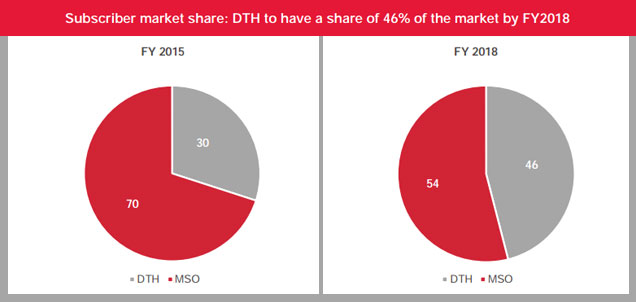
    CRISIL estimates that given their already stretched balance sheets and high capital expenditure (Capex) requirement in these phases, MSOs will be able to garner only 45% of the incremental digital market in the next two phases of digitisation. The balance will go to DTH service providers. This is in contrast to the previous two phases of digitisation wherein MSOs garnered 67% of incremental digital market together with LCOs.


    DTH’s upper hand in ‘cable-dark’ and sparsely populated regions will aid its market growth. And while incremental revenues will be on similar lines for both, profit share will be significantly more for DTH firms as they have complete access to subscription revenues unlike MSOs, which share a large part of their revenues with LCOs. While MSOs will continue to benefit from carriage revenues from broadcasters, CRISIL believes they are unlikely to receive incremental carriage revenues after digitisation.


    The only catch for the DTH operators is that they need to invest around Rs 13,700 crore over the implementation period. For MSOs, capital expenditure (capex) need is around Rs 8,300 crore. The capex requirements will be insignificant after the digitisation phase.


    LCOs, who had hitherto been disclosing only an estimated 20% of their analog subscription base, are the only stakeholders who will lose in this phase of digitisation.


    CRISIL believes the increase in overall market share and higher profits combined with promoter backing to part-fund the capex will benefit the credit profile of DTH operators. On the other hand, MSOs will have to increase their revenue share with LCOs to nearly 60% to prevent deterioration in their credit profile.


    Furthermore, while easing of foreign direct investment (FDI) norms will support fund raising plans for both DTH and MSO operators, the ability of MSOs to attract FDI funding will remain contingent on  improving their revenue share with LCOs.


    Direct-to-home (DTH) operators are expected to garner as much as Rs 3,300 crore, multi-system operators (MSO) Rs 1,500 crore, broadcasters Rs 3,900 crore and government Rs. 6100 crore in taxes, according to Crisil.


    “CRISIL estimates that given their already stretched balance sheets and high capital expenditure (capex) requirement in these phases, MSOs will be able to garner only 45% of the incremental digital market in the next two phases of digitisation. The balance will go to DTH service providers,” the report said.


    This is in contrast to the previous two phases of digitisation wherein MSOs garnered 67% of incremental digital market together with local cable distributors (LCOs), it added.


    Crisil said DTH’s upper hand in ‘cable-dark’ and sparsely populated regions will aid its market growth. “While incremental revenues will be on similar lines for both, profit share will be significantly more for DTH firms as they have complete access to subscription revenues unlike MSOs, which share a large part of their revenues with LCOs,” it added.


    The Indian television industry is the second largest television market of the world, after China, with television penetration in the country exceeding 165 million households in 2014, according to ICRA.


    Source:The Economic Times

    Copyright © 2015, Bennett, Coleman & Co. Ltd. All Rights Reserved

    Licensed to republish


  • Big Magic Bihar & Jharkhand inks DTH deal with Dish

    By A Correspondent


    As part of its distribution-strengthening strategy, Big Magic Bihar and Jharkhand, the regional entertainment channel from the Reliance Broadcast Network stable, has inked a distribution deal with Dish TV. Available on the base pack, this move adds 8 million million Dish TV subscribers to the channel’s reach as it reaches out to a larger diaspora across India.


    “We are a leading player in the regional market and have delivered excellent performance. We see a huge opportunity in catering to a larger diaspora and our endeavor is to reach our content mix to the discerning audiences spread across the length and breadth of India. Dish TV is a perfect partner to begin the exercise with, from here-on we will increase footprint through strengthened distribution across platforms,” the channel said in a statement.


    Big Magic Bihar and Jharkhand is currently available on Hathway, Incable, Manthan, Digicable, GTPL, Siti Cable, Maurya, DEN and other independent operators.


  • I&B ministry asks DTH operators to pay Rs 2,000 crore

    By Vijaya Rathore


    The information and broadcasting ministry has asked six DTH operators, including market leaders Tata Sky and Dish TV, to pay over Rs 2,000 crore, which the ministry said they collectively owe to the government in lieu of the licence fee.


    The ministry sent demand notices on Friday to Tata Sky, Dish TV, Sun Direct, Airtel Digital TV, Reliance Digital TV and Videocon D2H, asking them to pay up the sum within 15 days. This followed a ministry-ordered independent audit of the accounts of the six operators.


    “The ministry has given 15 days to all the operators to make the payment,” a person familiar with the development said. The calculation has been made on the basis of the gross revenue of each operator.


    The time period for calculating the arrears is from the day the licences were issued to each of them. “The I&B ministry sought the opinion of the law ministry before sending out the notices,” this person said.


    The issue relating to licence fee payment has been going on between the ministry and the operators for a few years now. The Telecom Disputes Settlement and Appellate Tribunal (TDSAT) had in an 2010 order said that DTH operators should pay 10% of their adjusted gross revenue as licence fee.


    The ministry had taken the matter to the Supreme Court where the case is pending.


    Source:The Economic Times

    Copyright © 2014, Bennett, Coleman & Co. Ltd. All Rights Reserved

    Licensed to republish


  • Now SOL with Tata Sky karaoke

    By a correspondent


    Having added another first to its name by launching a video-based karaoke service, DTH player Tata Sky has unveiled a series of ad campaigns explaining the concept of the newly launched service. Tata Sky’s karaoke service captures audience’s attention immediately with people singing out loudly off-beat songs. The service seeks to offer subscribers a world of options for singing and entertainment within their homes.


    While one of the ad films demonstrates a bunch of youngsters parting in their room, the other ad film demonstrates the whole family having some fun with karaoke singing. The ads showcase people from different age groups and different situations enjoying singing with Tata Sky karaoke. The message of ‘You don’t have to be a great singer to have fun, at least the lyrics will be right with Tata Sky Karaoke’ (Kum se kum lyrics toh sahi honge) is humorously scripted in both the ads. The ads capture the key features of Karaoke with identifiable situations of lives, bringing a smile to our face inevitably.


    Vikram Mehra

    Vikram Mehra, Chief Commercial Officer, Tata Sky said, “The love for singing and dancing is epitomized by Bollywood movies. Karaoke may be a new activity for a large part of India, but singing as an entertaining and collective activity was never an alien concept. Be it a family function or a night out with friends, singing our favorite Hindi songs in loud chorus adds tremendously to the fun factor of any evening. Capitalizing on this sentiment, the Karaoke ads capture the simplicity of tuning into the service any time of the day for non-stop entertainment.”


    Abhijit Avasthi

    Abhijit Avasthi, creative director, Ogilvy & Mather film stated, “Karaoke had to be pitched as a social activity in the realm of enjoyment. While the product was revolutionary we wanted people to see it as on obvious relevant product which seamlessly fits into, rather enhances an already existing moment in their life. Essentially, all we had to do was to let people know the key features of Karaoke that will make fun moments over singing, even more fun.”


  • FICCI-KPMG study indicates M&E sector bucking the slowdown trend


    (L-R) Jehil Thakkar, Uday Shankar, Ramesh Sippy

    By a correspondent


    While 2013 may have been a slowdown year for most sectors, an opposite trend was observed for the Indian Media & Entertainment (M&E) industry that registered growth of approximately 12 per cent, according to the FICCI-KPMG report.


    Overall growth remained muted, noted the study that was caused largely by the slowdown of the Indian economy. The economic slowdown impacted advertising revenue dependent sectors such as TV and print the depreciation in the rupee also affected print, cable and DTH companies adversely but helped export oriented sectors such as animation and VFX to some degree. At the same time, this was countered by the impact of continued digitization of media products and services, and growth in regional media.


    Digitization of cable saw progress of television industry moving in the right direction, with the mandatory Digital Access System (DAS) rollout almost complete in Phase II cities. The impact was felt to the extent that carriage fees saw a reduction of 15-20 per cent overall, however the anticipated increase in ARPUs and subscription revenues for broadcasters and MSOs (Multi System Operators) is expected to be realized only over the next 2-3 years. Other key highlights in 2013 were the inclusion of LC1 (less than class I) markets in TV ratings, the 12 minute advertising cap ruling and the shift from TRP to TVT ratings.


    The study also noted that the film industry recorded a double digit growth, albeit slower than in 2012, with multiple movies scoring big on box office collections. Approximately 90-95 per cent movie screens are now digitized in the country, with a shift in focus to tier II and III cities. Going forward, multiplex growth is expected to slow down, in line with the overall delays and future expectations for retail sector and commercial real estate development, impacting box office growth in the short term


    The print sector too continued to buck the global slowdown trend. The sector grew at a CAGR of 8.5 per cent this year to reach INR 243 billion. Regional markets performed exceedingly well on the back of steady advertiser spends, state election impact and new launches. However, with the validity of IRS data called into question by the industry majors, the sector in the short term suffers from the lack of a robust measurement system, critical for decisions on media planning and allocations.


    The total internet user base in India grew to approximately 214 million by end of the year with almost 130 million going online using mobile devices. Mobile Internet users dominated the total internet user base capturing an overall share of 61 percent. Digital media advertising in India grew faster than any other advertising category. Streaming and download services continued to see growth in the music industry, with the growth in mobiles, in particular smartphones, contributing significantly to increased consumption of music ‘on-the-go’. However, with the continued decline in physical sales, compounded by the significant fall in ringback tone revenues (following the backlash of TRAI guidelines issues in 2012), the sector saw an overall fall in size by 10 per cent in 2013. Going forward, digital revenues are expected to drive growth in the sector. Further, the vibrant live events sector is expected to continue its role as a catalyst for driving growth in artists’ fan-base, and public performance royalties.


    Uday Shankar, Chairman, FICCI M&E committee said, “2013 has been an extraordinary year for the media and entertainment sector – a year of challenges and significant change which saw the industry dealing with a host of issues. Television saw the implementation of the 10+2 advertising cap and significant progress in seeding of set top boxes in DAS 1 and II – setting the stage of revenue growth and expansion in genres. The film sector continued to mature on the back of multiplex expansion and a wide variety of content. Radio and print continue to defy global trends and await positive regulatory intervention that will take these sectors to greater heights. I am certain that the insights and findings from this report will provide a comprehensive and useful lens for all of us in the industry.”


    According to Jehil Thakkar, Head of Media and Entertainment, KPMG in India, “2013 was a year in which many parts of the M&E industry paused and took stock. Focus shifted from top line growth to bottom line growth with companies focusing on operations and efficiency. Inspite of a very challenging macro environment, the industry grew 12 per cent, a far better performance than many other industries. The structural changes taking place in the industry – especially in television and digital, continued to take the industry down the path of fulfilling its potential.”


    This year, the report highlights opportunities that could come from tapping international markets such as the US and Middle East, with a special feature on opportunities in South Africa and Nigeria.


    Going forward, there is need for continued positive regulatory intervention, such as implementation of Phase III for the radio sector. In an increasingly digitized media world, the ability to create compelling and targeted content across multiple channels, will be the bedrock for creating differentiation in a cluttered market, the report observed.


  • Neo to distribute sport channels through in-house route

    By a correspondent


    Neo Sports Broadcast Pvt Ltd has decided to do away with its cable distribution agreement with MSMD and rather distribute their channels through its in-house team. From April 1, 2014, One Alliance, MSMD’s distribution arm will cease to distribute the Neo Sports and Neo Prime channels respectively to the cable and HITS operators.


    A statement issued from the office read thus: “Neo shares a fantastic relationship with DTH operators and other digital platforms and are confident that it will be able to build a similarly robust relationship with cable and HITS companies across the country. The dawn of addressability is a great opportunity for all of us; we are confident that we will be able to forge an equally robust and healthy relationship with cable companies as we start selling channels directly though our team.”


    Neo has continued to distribute its channels through its in-house team to DTH and other digital distribution platforms even as it gave away its cable distribution rights to MSMD in 2010. Neo Prime and Neo Sports are currently available on all leading DTH platforms and also across all leading networks nationally and regionally.


    Dilip Sharan, EVP, Distribution Platforms said that it is a step in the right direction to further build business keeping in mind the emerging digital landscape. “The suggestive Regulatory approach combined with digitalization clearly points that future distribution deals will be dictated by the relevant content that is made available to various audiences and the ability to work with the platforms keeping in mind the business issues and not entirely on the strength of the channels size in the bouquet, a prevalent practice in the analogue era. Our cable distribution deal with MSMD made better commercial sense in the analogue environment.”


    Adding further he said, “Our dealing with the DTH operators has reinforced this line of thinking that standalone channels can make for a business case as much and as efficiently in a digital environment provided it can offer very relevant content that has significant traction in various category of sport; is attractively priced and above all, there is strong intent to engage with its business partner in building a mutually supportive business environment.”


    In 2014-2015, Neo will be showcasing some of the biggest sporting events including French Open, Fed Cup, Davis Cup, Sultan Azlan Shah Cup, Bundesliga, US PGA etc.


  • TRAI seeks views on issue of new DTH licences

    By A Correspondent


    The Telecom Regulatory Authority of India (TRAI) has today released a supplementary consultation paper on Issues related to New DTH Licences.


    Earlier, in response to the Ministry of Information and Broadcasting (MIB) reference to the Authority, dated September 3, 2013, TRAI had issued a consultation paper on Issue/Extension of DTH Licences on October 1, 2013, seeking comments/ views of the stakeholders. The key issues discussed in the consultation paper pertained to the entry fee, bank guarantee and period of licence. Subsequently, during the consultation process, industry stakeholders requested the Authority that it would be in the interest of the sector that a comprehensive review of the existing DTH licence conditions be taken up. Accordingly, this supplementary consultation paper has been released wherein, amongst others, the issue of ‘control’, licence fee, migration fee and interoperability of DTH set-top-boxes have been discussed.


    As part of the consultative process, this supplementary consultation paper has been uploaded on the TRAI website (trai.gov.in), seeking comments/view of the stakeholders. Stakeholders have been requested to offer their views/comments latest by November 25, 2013.


  • TRAI releases consultation paper on issue/extension of DTH licence

    By A Correspondent


    Following, the Ministry of Information and Broadcasting’s reference to the Telecom Regulatory Authority of India (TRAI) seeking recommendations on certain terms and conditions for extension of DTH licence on expiry of the 10 years licence period, the regulator has issued a consultation paper. The key issues discussed in this consultation paper pertain to the entry fee, bank guarantee and period of licence.


    As part of the consultative process, the consultation paper has been uploaded on the TRAI website, seeking comments/ views of the stakeholders. Stakeholders have been requested to offer their views/comments latest by October 15, 2013. The comments may be sent, preferably in electronic form to: Wasi Ahmad, Advisor (B&CS), Telecom Regulatory Authority of India, Mahanagar Doorsanchar Bhawan, Jawahar Lal Nehru Marg, New Delhi 110002; on the e-mail address advbcs@trai.gov.in/ traicable@yahoo.co.in. Comments received will be posted on the website of TRAI. Full text of the consultation paper is available on TRAI’s website: www.trai.gov.in.


  • Tata Sky gets Mohanlal for Onam

    By A Correspondent


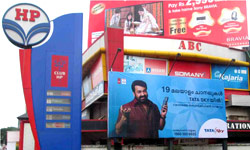
    Tata Sky roped in southern superstar Mohanlal as its brand ambassador for Kerala for the Onam festive season. Ads of posters of the DTH service were seen across the state. The Lulu Mall in Kochi had a 35 feet poster of the superstar. Ditto with petrol pumps and highways giving out the message of Tata Sky now offering 19 Malayalam channels along with a special offer for the festive season.
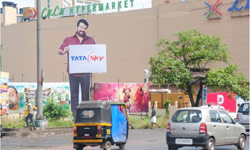


    Tata Sky and Mohanlal received adulations even on Social media by their followers on Twitter, Facebook and similar forum, reports a communique adding that the marketing campaign has been the biggest ever for Tata Sky in South India since its launch.