Tag: Deepa Gahlot

  • Reviewing the Reviews: Yamla Pagla Deewana 2 exasperates all around

    Yamla Pagla Deewana 2


    Key Cast: Dharmendra, Sunny Deol, Bobby Deol

    Directed By: Sangeeth Sivan

    Written By: Jasvinder Bath

    Produced By: YPD Films and Sunny Sounds


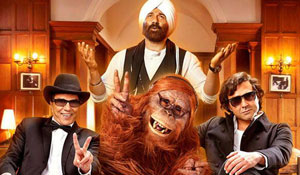
    The exasperation was evident in every review. The waste of the Deol pater et fils combined stardom for a movie as stupid as Yamla Pagla Deewana 2, which actually had some feeling nostalgic for the original, since Part 2 had even less merit. A filmmaker should worry if the best thing about his film is a man in a monkey suit. It takes a kind of talent to make a film so bad and the promote it proudly as if it were the best thing ever made, and then complain that the Deols never got their due because they are not good at marketing themselves.


    If a critic was kind – Dharmendra has the power to invoke nostalgia – the film got 2.5 stars, otherwise 1.5 was the standard.


    Shubhra Gupta of the Indian Express commented, “The Yamla Pagla Deewana gang is back with a sequel, with more of the same. Papa Bear Dharmendra doing his senior conman act, Sonny Bear Sunny doing the good guy with macho muscles and soft heart, and Baby Bear Bobby doing what Bobby does. A plot that should shame a wafer by its thinness. Random characters popping in and out. And the only thing one can say in its favour is that it is not as terrible as the first.”


    Sudhish Kamath of The Hindu ranted, “Yamla Pagla Deewana seems like a script that could have been written by that drunken monkey from the film in sheer defiance of art. We know that the Deols can be really funny. If the first part was somewhat passable, it was because it packaged Dharmendra nostalgia and the feel-good factor of the casting. Here, the idea of manufacturing nostalgia involves Dharam singing ‘Yeh Dosti’ with a monkey. It instantly makes us sad to see a veteran actor of his calibre reduced to this caricature of a man he used to be. So when Johnny Lever does a Don spoof in the same film, we realize that the joke is not on Sholay but on Dharmendra, just like the joke was not on Don but on Johnny Lever.”


    Anupama Chopra of The Hindustan Times was scathing. “Even the collective charm of the Deols can’t make this drivel palatable. It’s exhausting, loud and so cheerfully moronic that it hurts.”


    Saibal Chatterjee of NDTV.com panned the film saying, “Those that have been through the first round of the Yamla Pagla Deewana shock treatment might be forgiven for thinking that it couldn’t get any worse. Think again. The sequel is double the pain. It scrapes the very bottom of the barrel. Yamla Pagla Deewana 2 is much worse than brain-numbing. The screenplay jumbles up a few songs, some action scenes and a string of vapid comic gags and then dumps it all into a messy mix that makes about as much sense as Garam Dharam’s pow-wows with the mute ape. You’ve got to be yamla, pagla or deewana, preferably all three, to grasp what is going on.”


    Sukanya Verma of rediff.com all but gnashed her teeth in rage. “Calling Yamla Pagla Deewana 2 a joke would amount to a compliment. And I am in no mood to extend such courtesy. The purported comedy with a little less than half a dozen Deols on board – Dharmendra, sons Sunny and Bobby, daughter-in-law Lynda (it’s her story) and grandson Karan (as assistant director) is a 155-minute long giant bore. It’s not like the first one in the series was paradigmatic of Deol togetherness but at least it had *some* storyline and camaraderie. Also, the humour, which mocks their individual images or takes light-hearted digs at the Santa-Banta/Canada milieu provided the Sameer Karnik version genuine hilarity. But the sequel, directed by Sangeeth Sivan, is unimaginably insipid and tedious. And no orangutan, dragon, unicorn or dinosaur can rescue a mess like this.”


    Shubha Shetty-Saha of Mid-day was relatively mild. “This string of a script, tried to be accessorized by largely heard-before gags and two orangutans, doesn’t really work. The Deols, Dharmendra especially, are endearing as usual. But they or to some extent even the director, Sangeeth Sivan couldn’t do much with the clear lack of thrill or funnies in the script.”


    Tushar Joshi of DNA wrote, “The Deols madeYamla Pagla Deewana watchable because we bought their tomfoolery and goofiness that seemed enjoyable and natural. But the second part is laced with so many ridiculous moments, dialogues, sketchy characters and unflattering camera angles that you hope the family has a better hold of the franchise the next time around.”


    Rajeev Masand of IBNLive.com was not too harsh. “Directed by Sangeeth Sivan, ‘Yamla Pagla Deewana 2’ isn’t all bad, but at 2 hours and 35 minutes it’s overlong and repetitive, and doesn’t offer anything particularly original or inventive in terms of comedy. It’s a pity the jokes run out faster than your popcorn does.”

     

  • Reviewing the Reviews: Yeh Jawani Hai Deewani

    Yeh Jawani Hai Deewani

    Key Cast: Ranbir Kapoor, Deepika Padukone, Aditya Roy Kapur, Kalki Koechlin

    Written & Directed By: Ayan Mukherji

    Produced By: Hiroo Yash Johar, Karan Johar


    After quite a while comes a movie that gets critics divided – what is called “mixed reviews”. The film got ratings ranging from 2 to 4, which is a wide span, and had some loving it, and some blah-ing it with a ‘so what’s new?’


    It is a Dharma production, so it is lavishly funded with production values that say gleam. Ayan Mukerji’s second after the universally liked Wake Up Sid is more Bollywood romcom formula than the earlier one, but performances, music and dialogue (by newbie Hussain Dalal) lift it up several notches. The target audience of teens have already given it a big thumbs up, and Ranbir Kapoor has got his Big Opener.


    Rajeev Masand of IBNlive grumbled, “It’s a pity the treatment has a been-there-seen-that feel to it because there are some modern ideas hidden underneath all that fluff. Part of what makes Yeh Jawaani Hai Deewani warm and fuzzy is the friendship that Bunny and his die-hard buddies Aditi and Avi share, despite their shifting dynamics over eight years. Mukerji understands and nicely puts across the bittersweet qualities that friendships go through, and more often than once I found myself misty-eyed. Even love is viewed rather practically by the four key characters here – it’s nice if you’ve found someone, but it needn’t be the end of the world if you’re not in a relationship. It’s refreshing also that Mukerji doesn’t tie up all the loose ends in the movie; not everyone gets the perfect happy ending.”


    Sukanya Verma of rediff.com loved it. “‘You can’t have it all. You will miss out on some things. So why not enjoy what’s in hand?’ recommends Naina enjoying the gorgeous view from a vantage point of a grand fort, just few minutes short of witnessing a breathtaking sunset. Bunny, the recipient of her suggestion, reluctantly agrees. They have a good evening. Director Ayan Mukerji’s second endeavour, Yeh Jawaani Hai Deewani works exactly like this scene from the movie. You know that content smile you return with after spending time in fond company over effortless laughter and magical connections? That.”


    The same site’s other critic Raja Sen was not as impressed. “For this is a very good-looking film. It is a film with almost exclusively pretty people, each primped up and glossed and shot at their most flattering, and every time Pritam’s songs burst through the speakers, Ayan Mukerji’s film gallops into gear like the run-rate when the bowler has a towel tucked into his pants. There’s a zingy energy to the uptempo proceedings, the lead actors are at their most electrifying, and the sheer, heady enthusiasm is deliriously grand. Even the greatest heroine in all the land merrily shakes her caboose. It’s huge fun. What should have been a breeze turns into a pained plod, and while things still look all glossy, the songless part of the movie – the story, we dare say? – remains dismally predictable and awfully contrived, eventually becoming quite a bore. When the songs aren’t playing, however, this is a daftly childish film, one where most actors act half their age and the narrative stumbles forward inanely and gracelessly.”


    Shubhra Gupta of the Indian Express was lukewarm too, “It’s been a few minutes since I stepped out of Yeh Jawaani Hai Deewani, and I’m finding it hard to remember what I’ve just seen. This is not the sort of amnesia that you have to force yourself into after a bad, blah film. This is because I’ve seen this brand new film, and its characters so many, many times before. Yeh Jawaani Hai Deewani is a been-here, seen-this, much-too-long glossy creature, and not much else.”


    Sanjukta Sharma of Live Mint commented, “Ayan Mukerji’s Yeh Jawaani Hai Deewani runs on an unmistakable, foolproof formula: The story is secondary; the song, dance, costumes and stars are supreme. When executed cleverly and with good actors, this formula blurs the difference between trash and art. We, unapologetic Bollywood lovers, willingly suspend disbelief and surrender, let Bollywood transport us from the dull funk of life.”


    Saibal Chatterjee of NDTV wrote, “Yeh Jawaani Hai Deewani is a bright, breezy and brassy film designed for easy consumption. What it certainly is not is ballsy. For all the big ideas about life and the dilemmas of youth that it tosses up in the air over a runtime that’s 20 minutes shy of three hours, it always opts to play safe, vacillating between thoughts of rebellion and acts of conformity. The characters spout familiar platitudes to each other: live your dream, get a life and move on, stop pitying yourself and learn to love thyself…We have seen and heard it all before.”


    Shubha Shetty-Saha of Mid-day was not upbeat either. “At two hours and 40 minutes, the movie is a tad too long but while the snail-walk pace irks at places, it works on other occasions. What really bothers is the cliches that the filmmaker indulges in at times. To cite one instance, why does a ‘good’ girl in a Hindi film always have to prove her worthiness by burning the gas stove and cooking parathas for an entire army of strangers even when she is supposed to be holidaying? The characters are no novelty, they have been seen umpteen times earlier. But it is the treatment that makes it ‘alag’ and the credit must go to the director with a mature, sorted head on his young shoulders. Watch this at least once. It feels like a slow dive into the depths of emotions, at times fulfilling and at times uncomfortable.”


    Karan Anshuman of Mumbai Mirror was disappointed too. “The film itself doesn’t move ahead except for a time jump between the halves. It stays within the quadrangle of its leads and the characters in their orbits. Often there is more to the philosophy of the film than what meets the eye, but it is often masked or nullified by booming Bollywood elements. It is only in the second half that a plot kicks in and the real conflict finally takes shape about 15 minutes from the end. It’s too late to touch you in a way it could’ve.”


  • Reviewing the Reviews: Kinder critics give Ishkq In Paris 2 stars

    By Deepa Gahlot


    It’s hard to accept failure in the film industry, and any attempt to fight it is judged more harshly if done by an actress. Male stars can have any number of ‘comebacks’ but it is much tougher for an actress in her thirties.


    Predictably, Ishkq In Paris became a bash Preity Zinta dart board, and she, kind of, asked for it, as producer, writer and lead star of a film that would perhaps have suited her a decade ago.


    The kinder critics gave it two stars, but most went with 1 or 1.5.  Preity Zinta needs a spine of steel to survive reactions to this train-wreck of a movie.


    Says Karan Anshuman of Mumbai Mirror, “It is a lamentable moment for Priety Zinta, now in her twilight years as a lead actress in an ageist, unkind industry, that she has to choose a path of safety and ends up with a movie that needs a Salman Khan item. This film could’ve been so much more honest, real, gritty even. That would’ve been a worthy, valiant last stand. Meg Ryan – you could say she was Zinta’s Hollywood equivalent – tried such a thing in one of her last films, In the Cut.


    Zinta exclaims (more than once) “I love Bollywood”. It’s a plea really. Bollywood doesn’t seem to love her back anymore. And if the circus no longer has a spot to accommodate your act, by all means set up on the fringe, outside. But don’t show people what they’re going into the tent to see anyway. Be bold, change the act.”


    Nandini Ramnath of Live Mint is equally scathing, “Preity Zinta’s career started skidding off the rails in the mid-2000s, and she has struggled to get back on track since. Ishkq in Paris , which she has produced, co-written and starred in, is an attempt to gift herself the leading role that nobody wants to give her any more. Zinta’s trademark bubbliness has gone a bit flat, her late-30s body has filled out, and parts of her face look different, but she remains the liveliest presence in Ishkq in Paris. Her enthusiasm at being back in front of the camera is not curbed by her co-star, who struggles visibly to generate the spark and presence needed to boost his leading man credentials.”


    Raja Sen of rediff.com missed the PZ of Dil Se and commented, “ Tragically, she seems almost determined not to act. She straddles the line between French and Hindi clumsily, speaking in a bit of a supervillain accent.  Her eyes sparkle with the eagerness of a jumpy squirrel, even when they shouldn’t. (Really, should anybody’s?) There is a bit too much enthusiasm, too much bounce to her character, who shrugs all the time and nods rapidly and constantly, like a big Preity bobble-head.


    Without a cricketer in embracing range, Zinta doesn’t seem to know what to do with herself.”


    Aniruddha Guha of Time Out wrote,  “Prem Raj, who made his debut as filmmaker with the dumb Main Aur Mrs Khanna, gets dumber with his second film. For the first hour, the film follows the two protagonists over a night in Paris, as they party, dine, drink and talk. You may want to utter the words Before Sunrise, but that would be blasphemy. The couple here aren’t half as likable, the dialogues aren’t one-fourth as witty and the direction not even in the vicinity of what Richard Linklater achieved. This is merely a set-up – a gimmick, rather – one that goes nowhere.”


    Shubhra Gupta of Indian Express quipped, “A girl and a guy meet cute on a train going to Paris, spend a night wandering about the city, and come out on the other side with a status that’s complicated. This one line brief has resulted in so many engaging love stories, that I went in a tad hopeful. This was, after all, Paris and Preity, a city with magic and a girl with sparkle. Who knew what that combo may yield? Sadly, Ishkq In Paris comes off mostly derivative, and wholly predictable.”


    Rajeev Masand of IBNlive.com called it misguided. “Ishkq in Paris is the sort of film that inspires its director and its leading man to assume aliases so they might escape responsibility for subjecting us to this travesty they’ve committed to the screen. Leading lady Preity Zinta, unfortunately, is too well known to hide behind a fake name.”


  • Reviewing the Reviews: Aurangzeb

    Aurangzeb

    Key Cast: Arjun Kapoor, Sasha Agha

    Written & Directed By: Atul Sabharwal

    Produced By: Aditya Chopra


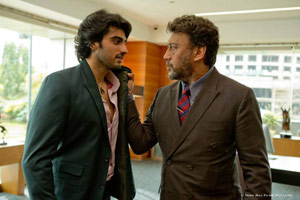
    This film from the Yashraj Films stable seems to have been made to give post-Ishaqzaade Arjun Kapoor something worthwhile to do – a double role so early in his career, though he was incapable of creating two distinct characters.


    Atul Sabharwal made his film debut with an eighties style melodrama, updated with current references to the real estate driven growth of a hamlet Gurgaon into a city of malls and highrises. But after setting up an intriguing premise the script tied itself up in knots. The film got an average of 2.5 stars, but the reviews were not scathing – most felt underwhelmed. Opening day reports said response of the audience was “lukewarm.”


    Sukanya Verma of rediff.com enjoyed the film. “Deeply derivative of the traditional Hindi film narrative where blood-ties gain precedence over individual turbulence, Aurangzeb works even in its inept form. Because, one, Sabharwal constructs a compelling, intricate conspiracy of deceit and motive around predominantly grey characters, where chances are anyone can turn a volte face, for better or worse. And because Aurangzeb’s momentum is steady and swift, the loopholes are skilfully minimised even if only temporarily. So, sure, you do wonder about the loosely established relationships, convenient set-ups and undisclosed footage of significant reactions, but much later.”


    Shubhra Gupta of The Indian Express commented, “Somewhere in the too-complicated strands of Aurangzeb is a film struggling to cohere. This is what we have: too many subplots with threads hanging, criss-crossing a main plot that is over baked and undercooked….The trouble with Aurangzeb is not that it isn’t ambitious. It is, and that’s good. Because after a long time there’s a film which invites you to work on unraveling the threads. But right from its too-crowded epilogue, where information about the characters comes flying out at you, to its curiously impact-less lead player who sparks to life on occasion, to its long-drawn scenes where sometimes you feel the lines are being said only for effect and not because they have organically grown out of the conversation, Aurangzeb is trying for too much. This makes the film dense and uneven: some parts have power, the others are inert.”


    Karan Anshuman of Mumbai Mirror praised it, but expressed reservations. “And while the movie succeeds at a thematic level, it falters with the details. Critical plot points are weakly executed. The crisis upfront that forces a Don-like potentially dangerous exchange of twins separated in their youth (I say these words without irony) is justified almost offhandedly – to restore a dead man’s honour. In the climax too, equations change faster than you can say “traitor” because a mobile phone voice message mistakenly records a critical exchange leading to murder. Feeble, for a story with such ambition.”


    Nandini Ramnath of The Mint wrote, “The title is supposed to work as a metaphor, in the same way as the Hollywood film Chinatown (1974) and Shanghai (2012) are about abstract ideas (falsehood and aspiration respectively) rather than actual places. Aurangzeb is about inheritance, and it initially seems that Sabharwal might be able to bring new ideas to the cliche that blood is thicker than water. His movie is spilling over with characters that conform to the popular stereotype of Mughal emperor Aurangzeb – a ruthless and power-hungry maniac whose path to the throne is littered with the bodies of family members and acquaintances. The battleground is transported into a boardroom, and a bottomed-out war chest becomes a loss-making balance sheet. This is a movie that aspires to be about the mini-empires that exist within – and often work against – the Indian republic, but it scuttles its own ambitions midway through. It becomes yet another movie about twins separated by circumstance and brought together by Hindi cinema.”


    Anuj Kumar of The Hindu was appreciative too. “The intricacies of land grabbing and the manipulations that go with it are deftly handled. Atul is talking about an India where only two types of people hold sway: the politicians with power or the corporations with money, and everybody wants to pick a side. But the way conscience spirals in the second half, you start feeling even for the villains of the piece. In the 1970s and ’80s, melodrama was not such a bad word because it emanated from reasons that demanded unbridled commotion. Here you feel such turmoil all over again. Even before you begin to find a loophole, Atul addresses it and comes up with logic. It may not be convincing all the time but you go home with a feeling of watching an honest effort.”


    Shubha Shetty Saha of Mid-day was quite critical. “Story offers no novelty. In fact, at one point the story reminded me of an innocent story called Do Phool, which had Neetu Kapoor play twins, one left with the mother and the other with the father. Well, this is just to emphasise how old the story line is. But a better treatment, a more sharply edited film and this story could have been turned into a thrilling fare. But unfortunately, the movie moves at such a meandering and self-indulgent pace that after a point you stop caring if it moves forward or sideways.”


  • Reviewing the Reviews: Shootout At Wadala

    Shootout At Wadala

    Key Cast: John Abraham, Anil Kapoor, Kangna Ranaut, Manoj Bajpai, Sonu Sood

    Directed By: Sanjay Gupta

    Written By: Sanjay Gupta, Hussain Zaidi

    Produced By: Sanjay Gupta, Anuradha Gupta, Ekta Kapoor, Shobha Kapoor


    Filmmakers like Sanjay Gupta do not grow up and give up their laddish fascination for gangsters. It allows them to attract crowds, shoot with a kind of macho swagger and also pretend it’s all real.


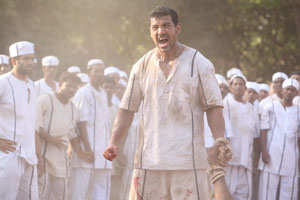
    Shootout At Wadala is supposedly a fact-fiction khichdi on the life gangster Manya Surve, whose planned killing put the word encounter into the cop and media lexicon. Which means, Gupta can drop unexciting facts (like John Abraham bearing no resemblance to Surve) and add as much fiction as he likes (Surve was not framed by a cop). Plus three item numbers and loads of violence.


    Most critics pointed to gangster fatigue – there have been just too many films of the same kind. So this one got mostly 2.5, some 3 and a couple of fawning 4 stars too.


    Rajeev Masand of ibnlive.com commented “…while the story is rooted in Manya Surve’s journey from an innocent, bright college student to one of the city’s most powerful mafia dons, Shootout at Wadala is a potpourri of stomach-churning slashing and shooting, writhing item girls, and lewd dialogue. In fact, Gupta infuses so much violence and sex into this tale that it hits the G-Spot – and by this, I mean, gratuitous. The director has no qualms pandering to the lowest common denominator; inserting item songs at will, peppering his actors’ lines with cusswords, filming bump-and-grind lovemaking sequences, and even throwing in a titillatingly-shot rape scene.”


    Shubhra Gupta of the Indian Expess, wrote, “Why would I want to watch yet another retro-gangster flick? Because I’m a sucker for gritty gangsters and sharp cops. Because I like the bang-bang stuff, when done well. And because there’s nothing as cool as retro, in the right hands. Shootout At Wadala gives us a bunch of gangsters and cops, all trying very hard for coolth. It has action, some of it explosive, but not madly new. What stops it from becoming the film that it could have is an avalanche of dialogue, the sort of smart-alecky lines that sounded so right in the 70s. In 2013, they seem like a tired device to hang an entire film on. And the fact that this genre is now feeling the weight of having been trod upon too often.”

    Sanjukta Sharma of The Mint was left cold. “Some things do not change. Director Sanjay Gupta’s every action sequence is shot in slow motion. Every entry of a new character is in slow motion. Bits of the three item numbers in the film-yes, three-are in slow motion. A loose, directionless script and insipid dialogues (Manya and his men are often engaged in long conversations about the female anatomy) take their toll half an hour into the film. Abraham tries very hard to play a brooding, ruthless gangster but the character does not engage. The bad writing, of course, does not help. Bajpai is predictably good in his dialogue-baazi; so is Sood. As far as borrowed scenes go, Shootout at Wadala has the most unimaginative copy of a scene previously borrowed or alluded to by film-makers: the assassination of Sonny Corleone at the toll plaza.”


    Karan Anshuman of Mumbai Mirror wrote, “So you have no grand design save for a feeble attempt to stick to the plot of Hussain Zaidi’s Dongri to Dubai, the book SaW is based on; a haphazard story with too many elements and no focus (John Abraham vanishes for long periods and Sonu Sood gets an incongruous amount of footage); and a film that ultimately says nothing (though you might learn a curse or two). The actual shootout – the only bit that commands your attention – is perhaps five minutes long and comes at the very end of a protracted 2.5 hours.”


    Shakti Shetty of Mid-day commented, “There has been no dearth of gangster films in Hindi cinema. But it’s one of those genres that never goes out of fashion. The underworld and the legends related to it make for an interesting yarn provided the novelty is maintained. However, Shootout at Wadala takes the middle path by trying to strike a balance between recorded history and fictionalised events. In the process, it showcases personalities on both sides of the law belonging to a bloody era. In retrospect, there are moments when it manages brilliantly and there are instances where it falls flat.”
    Mathures Paul of The Telegraph sneered, “The wannabe baap of Mumbai, Manya Surve (John Abraham), is all huff-puff and no brains. But a thali of guns, profanity and sleaze cannot go all wrong, especially when more than a 1,000 rounds of ammo are wasted, spaced out by three item numbers and a few sex-bench push-ups.”


  • Reviewing the Reviews: Aashiqui 2

    Aashiqui 2

    Key Cast: Aditya Roy Kapoor, Shraddha Kapoor

    Directed By: Mohit Suri

    Written By: Shagufta Rafiqui

    Produced By: Bhushan Kumar, Mukesh Bhatt, Krishan Kumar


    Mahesh Bhatt’s 1990 film Aashiqui was a hit mainly because of its music. But when Aashiqui 2 comes out 23 years later, there is a feeling of nostalgia among so many critics. And the sense that the new film does not measure up to the original. Even if it did, it would still be loud, melodramatic and outdated.


    Most reviewers settled for 2.5 stars, except for a bunch of RJs who, for some reason, have raved about it.


    Surprisingly, so many named Abhimaan and Rockstar as ‘inspirations’ but hardly anyone picked the real one, A Star is Born!


    Shubhra Gupta of Indian Express wrote, “Aashiqui number 2 has similarities with the first: the Bhatts are co-producers along with Bhushan Kumar (son of the slain T series magnate Gulshan, who was responsible for the phenomenal success of the original’s music, still bouncing about in playlists). Music leads from the front again. But this time around, it is not as distinctive, and that’s because the Bhatts may have become victims of their own created template of sufi-soft-pop-cum-rock. No single song of the new Aashiqui leaps out at you. And this, along with a story that starts with some lift and then dips makes the new film a messy meander.”


    Karan Anshuman of Mumbai Mirror found some merit in it, but commented, “It’s a pity that a few weak moments of stupidity preempt in sacrifice for quality drama. That and the fact that they seem to be living on separate continents while the makers pass it off as one city. Pepper the scenes with some poor dialogue and what should’ve be a satisfying, sentimental date film turns out less than what you’d have hoped for.”


    Anupama Chopra of the Hindustan Times was disappointed too. “The film, however, never becomes more than the sum of its parts. Aashiqui 2 falls into that lukewarm category of ‘I didn’t mind it,’ which is not the same as ‘I liked it.’ It could have been so much more.”


    Sanjukta Sharma of The Mint was scathing. “Shagufta Rafique’s script and dialogues are dead from the word go. Some of the most insufferable moments are about how heinous alcohol is – the writer even suggests hitting the gym and ‘following a diet’ are the best panacea for alcoholism. Odd platitudes like that fill the script.”


    The Times of India’s Madhureeta Mukherjee gave it 3.5 stars, but didn’t sound too enthused. “Suri’s musical love story doesn’t bear much semblance to the original Aashiqui; instead it finds its own rhythm. He pitches the story with old-world romance, high-drama and well-crafted heart-breaking moments. Aarohi’s character is endearing and Rahul stays ‘bottled’ (like ‘Devdas’ with a cause), with sudden outbursts. The story slows down in parts and the climax might seem unreal to many, but maybe a ‘fix’ for die-hard aashiqs.”


    Upperstall’s Mr Care nailed it: “Besides being one of the most slipshod, inarticulate, and senseless films in recent memory,Aashiqui 2 is also nothing like the film of which it is touted as a sequel to. A mashup of Rockstar and Abhimaan, it tries embarrassingly to achieve the intensity of the former and the tenderness of the latter. It fails on both counts and more, and begs the question of what was the point of the whole film.”


  • Reviewing the Reviews: Ek Thi Daayan

    Ek Thi Daayan

    Key Cast: Emraan Hashmi, Konkona Sen Sharma, Kalki Koechlin, Huma Qureishi

    Directed By: Kannan Iyer

    Written By: Mukul Sharma, Vishal Bharadwaj

    Produced By: Ekta Kapoor, Shobha Kapoor, Vishal Bharadwaj, Rekha Bharadwaj


    After the retrospectively cult-ish Ramsey Brothers, Ram Gopal Varma and Vikram Bhatt have appropriated the horror genre in Hindi films, made up of shlock effects and mumbo jumbo.


    That’s why, when the combined intelligence of Vishal Bhardwaj and Mukul Sharma, plus Ektaa Kapoor as co-producer, worked together on Ek Thi Daayan, something totally different was expected.  Directed by Kannan Iyer, the film is marginally different from the usual bhoot-pret fare Bollywood churns out, but most critics were disappointed because it did not break the mould.  The film got mostly 2.5 stars, and some 3s. And a rap on the knuckles for the awful climax.


    Anupama Chopra of Hindustan Times was riveted by the first half… “And then, the curse of the second half struck like a gale-force. Kalki Koechlin, playing Lisa Dutt, makes an entry. She’s an interesting actor but the film doesn’t know what to do with her. The pace slackens, the plot unravels and Kannan’s assured grip on the material loosens. By the climax, Ek Thi Daayan descends into Vikram Bhatt territory – the plot doesn’t stay true even to its own logic. It’s cheesy and simply too silly to scare. Which is a real bummer because until then, I was having a lot of fun. Ek Thi Daayan had the potential to be an A-grade horror film but it’s an opportunity lost. However, I would love to see Diana get her own film and I’m very curious about what Kannan will do next.”


    Rajeev Masand of IBNLive commented, “But alas, the film reveals its chinks in the final act when it arrives at an underwhelming climax involving such clichés as child sacrifice and particularly a human-versus-evil forces face-off that seems straight out of a bad Vikram Bhatt movie, complete with laughable special effects. The “big twist” is easy to predict, and the film’s message so pat, you can’t help rolling your eyes the moment it’s delivered.”


    Shubhra Gupta of the Indian Express analysed, “The best supernatural movies are rooted in the real. Because that’s where the dark things live. Because that’s where the fears are. A benevolent glance switching to sudden, startling malevolence. An empty room with murderous corners. An eyeball turning dense black. Ek Thi Daayan starts so well that you are riveted. Just about everything in the first half, with its well-calibrated chills, is just as it should be. The second half is unravel time, and you are then left grasping at thin air. Quite appropriate, in a film about magic and apparitions, and witches, and, yes, daayans. The sharp slide wants to make you ask, what just happened here, did a black cat cross the path of the film?”


    Raja Sen of rediff.com wrote, “This is the sort of creep-fest which is better creating an uneasy buildup than at actually scaring the pants off you, and perhaps it should have stayed goosepimply instead of going for the jugular.  Ek Thi Daayan isn’t a truly scary film – though it will provoke nightmares in the young, and I strongly recommend all parents keep their children away from this one.  As if losing confidence in the narrative, the film tries to do too much in the second half – with suddenly oscillating variations in tone and mood – but thanks to performances and craft, it chugs along well enough. An ominous character called Lisa is introduced quite inventively into the story, and the film appears to hit the next level when that wonderful Yaaram song takes on a different meaning.  Alas, it is here that things start to go aground. Clues point so determinedly in one particular direction that they convince us the film must take the other route, merely for twist’s sake, and the climax unforgivably descends into B-movie territory. Suddenly there is too much malarkey and, worse yet, too much talking about malarkey.  A lot of which makes absolutely no sense. A film that started off smartly restrained sadly ends up cacophonic and, frankly, more than a little silly. By the time the actual end comes around, it’s hard to care.”


    Sanjukta Sharma of The Mint rightly commented, “The problem is not the other-worldliness of the witches, but the fact that their world is so boring. In storytelling and plot, Ek Thi Daayan has no inventiveness. The background sound is over-punctuative, comprising a familiar amalgamation of bangs, creaks and jangles. Iyer is almost desperate in his attempt to ensure his audience does not miss the exact moment of horror. Most of the time, these build-ups don’t end in a big surprise and jolting out of chairs.”


    Saibal Chatterjee of NDTV was not too hostile: “Ek This Daayan is passable fare as a scary movie – the dark, spooky mood is sustained with the aid of dark, shadowy interiors and an effective and unobtrusive background score.  It might have helped had the film not been given to quite as much thematic obfuscation.  Is it intriguing enough to sustain audience interest over two hours and a bit? Most certainly. Is it a true spine-chiller? Only occasionally.  The riveting parts of Ek Thi Daayan are far outnumbered by the limp moments. Yet it is worth a watch owing to the idiosyncratic treatment of a done-to-death genre.”


    Meena Iyer of the Times of India was one of the few 3.5 stars, but that’s standard. “Kannan Iyer makes an impressive debut… and kudos to Ekta Kapoor and Vishal Bharadwaj for allowing him to bring his daayan to life without compromises. This film doesn’t play to the galleries nor is it one of those brain-dead movies that Bollywood churns out as assembly line. Note: You may not like the film if transcendental stuff doesn’t move you.”


  • Reviewing the Reviews: Chashme Baddoor

    Chashme Baddoor 

    Key Cast: Ali Zafar, Siddharth, Taapsee Pannu, Divyendu Sharma, Rishi Kapoor, Lilette Dubey & Anupam Kher

    Directed by: David Dhawan


    Last week, when the new Himmatwala came out, the question on everybody’s lips was: why remake a bad film.  This week, with Chashme Buddoor, it’s why remake a good film?


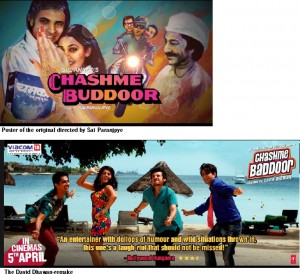
    Then, in a wicked move, a restored print of Sai Paranjpye’s 1981 Chashme Buddoor was released at the same time as David Dhawan’s Chashme Baddoor, and as can be expected the latter took a battering from critics, most of whom had refreshed their memories of the original.


    Sukanya Verma of rediff.com, sounded outraged. “Paranjpye’s film is a master class in deft writing, the manner in which she seamlessly combines buddy humour and young romance while noting the minute but colourful details that add zing to day-to-day life and casual conversations. Her artistry lies in making all those extensive inputs appear so deceptively simple.  When a director has access to this much imagination, he ought to show a lot more responsibility than Dhawan does. Loud in sight, sound and sense, this Chashme Battering is an assault to the original with its line-up of gaudy aesthetics (think Rohit Shetty’s All The Best), actors hamming to the hilt in boxers and ghastly, GHASTLY writing.”


    Sanjukta Sharma of The Mint hated it too. “In Dhawan’s version, the jokes are loud and facile, and piercing in the bad literal way. Characters and performances are accordingly doltish. Remember Dhawan’s early 1990s’ films like Raja Babu and Coolie No. 1? Chashme Baddoor has the exact template-mindlessness and regressive humour as motives for mass appeal-but set in an India where there are malls. The characters are as sexist as those Govinda staples; the writing uses stereotypes only for insipid jokes. The production value is abysmally low-cinematography, costumes, choreography and even some locations are eyesores.”


    Shubhra Gupta of the Indian Express, wrote, “Dhawan’s film is a series of forced contrivances, not a story that grows out of a place and time. His characters don’t feel like they are good friends who live together. They feel like they have just come together for the shot. Neither do they mesh well, nor do they work Individually as well as they should: Ali Zafar’s laid back tone is all too familiar, Divyendu is not half as funny as he was in his debut, Pyaar Ka Punchnama, and the very energetic Siddharth contorts himself a bit too much. Taapsee is the only one who feels real, and stays likeable despite the occasional fumble with lines.”


    Rajeev Masand of IBNLive says that he didn’t find the film unbearable, but, “Like a battering ram, David Dhawan’s puerile and frenzied remake, Chashme Baddoor, shatters and mauls your memories of Sai Paranjpye’s charming original. Light-hearted humour and innocent romance makes way for sexist jokes and cheesy puns and the merits of keeping things simple are lost in the cacophony of screechy performances.”


    Karan Anshuman of Mumbai Mirror, reviewed the old and the new films side by side, and obviously found the Dhawan film sorely lacking. “Dhawan pays tribute to his own work in the form of the lead pair dancing to “Dekha Hai Pehli Baar’ fromSaajan and “What is Your Mobile Number” from yet another Karisma Kapoor-Govinda starrer. Add to it some wholesale in-film advertising and entirely expected garish production design and voila, the pitiable representative of the modern day comedy.”


    Janhavi Samant of Mid-Day commented, “Everyone’s hamming it in this film; even the most senior and most accomplished ones in the cast. They are all talking and emoting wildly like overwound-up toys. One youth keeps quoting SMS-forward shayari, another one takes his rape scene auditions too seriously, a grandma (even if it is a tad difficult to believe Bharti Acharekar as Anupam Kher’s mother!) who keeps slapping her son every two dialogues, a father-and-uncle twin squabbling jodi who are called Chikku and Santra, and a heroine who keeps saying, “Dum hai boss,” for very dum-less things that the hero does.”


    And then, there’s the TOI’s Srijana Mitra Das going against the tide, giving it 3.5 stars and raving, “The answer’s yes – love can be remade and so can a lovely film like 1981’s Chashme Buddoor (CB). This version’s as different as paapri chaat from a dhokla. But it retains the original’s madness, masti and movie-mania.”


  • Reviewing the Reviews: Himmatwala

    Himmatwala

    Key Cast: Ajay Devgn, Tamannaah, Paresh Rawal, Mahesh Manjrekar

    Directed By: Sajid Khan

    Produced By: Vashu Bhagnani, Siddharth Roy Kapur


    Sajid Khan shouts from the rooftops that he doesn’t care about critics; the feeling is mutual. This time the arrogant director with an enviable and entirely undeserving row of hits, took a bit of a fall this time. His remake of the eighties hit has got uniformly bad reviews, mostly one or 1.5 stars.


    Everybody has wondered why anyone should even want to remake THAT film. And then, do nothing to it – neither tribute, nor spoof.


    Shubhra Gupta of the Indian Express asked the right questions. “At the end of two excruciating hours, the questions I had carried into the theatre remained unanswered. Why remake Himmatwala, which wasn’t exactly scintillating cinema in the first place? What were the studios, producers, directors and stars thinking? And last, but not, as they say, the least, when, oh when will Bollywood’s blind love affair with the 80s masala movies get over?”


    Rajeev Masand of IBNLive wrote, “It must take a special kind of skill to remake a mediocre film like 1983’s Himmatwala without even marginally improving on it. Director Sajid Khan’s pot pourri of excessive melodrama, puerile humor, cartoonish action, and garish songs plods on for two-and-a-half hours with little concern for your bladder or your mental health.”


    Sukanya Verma of rediff.com saw some tiny measure of merit in it. She commented, “Expectedly, it’s all very over-the-top but here’s the thing. The 1983 one established Jeetendra as a professional, an engineer, a man of purpose striving to bring change within a terribly feudal set-up while engaging a personal vendetta. It didn’t always work but the script fuelled his heroism. Devgn, on the other hand, loiters about doing nothing and relies purely on physical might to make an impact. For a man who brags about having so much faith in oneself, he sure wears a lot of stones on his fingers.”


    Madhureeta Mukherjee of the Times of India, usually kind, ranted, “Hark back to taaki taaki and tap dance to tathaiyya as the (r)awful 80s are re-awakened from their garish grave and served re-heated; as old wine in an old bottle. Vintage? Not truly. Just as we thought Jeetendra’s white shoes and coloured wigs were laid to rest in filmi museums, Sajid Khan dips into his cookie jar of movies, masti and ‘naus-talgia’ for yet another peek into the petty-past.”


    Saibal Chatterjee of NDTV quipped, “Director Sajid Khan may lack the courage to take risks but he is a very optimistic man indeed. He believes what worked in 1983 will click in 2013 too. Come to think of it, he might actually be right. Sad! Having been at the receiving end of the mindless excesses of the loud and laboured comedies that he specializes in, we know exactly what to expect from his latest foray into the terrain of tastelessness – zilch. And that is such a huge advantage for a filmmaker. If you, in the manner of the director, accept that unalloyed bunkum can be legitimately passed off, and gleefully lapped up, as cinematic entertainment, you might even come away pleased as punch with Himmatwala. The film lacks punch, but it loses no opportunity to pun on the word and the act.”


    Karan Anshuman of Mumbai Mirror questioned Sajid Khan’s motives. “Even though somewhere on the poster it might say “the 80s are back”, the real tagline of Himmatwala is “A Sajid Khan Entertainer”. It seems even Khan has relented that his piece of work does not deserve to be called a film. Here is his secret, coded message of what to expect in Himmatwala and what he means by when he says he will “entertain”.


  • Do journalists need to be qualified?


    By Ananya Saha and Meghna Sharma


    Press Council Chairman Justice Markandey Katju recently issued a press note that said, “Since the media has an important influence on the lives of the people, the time has now come when some qualification should be prescribed by law”. Justice Katju announced a committee mandated to “consider all aspects of the matter” and submit a report to him “suggesting the qualifications a person should have before he can be allowed to enter the profession of journalism”.


    The committee constituted by him, in addition to its mandate of recommending qualifications for journalists, will also recommend in what manner the Press Council can supervise and regulate the functioning of the institutions and departments of journalism in India so that high standards of imparting knowledge in journalism are maintained.


    MxMIndia spoke to senior journalists, academics and industry observers for their views on this (in alphabetical order of their last names).


    Prof Chandan Chatterjee, Director, Symbiosis Institute of Media & Communication

    The role of education in building a foundation for thinking as well as building an worldview is well-accepted. More so for professions that have an ability to shape the thinking and beliefs of a society


    Journalists are the scribes and opinion leaders of modern society and culture which can impact a nation’s destiny, or the adoption of a new way of doing things. Hence, journalists ought to have capabilities and skills of recording facts and events and also analyse and interpret their observations.


    The role of upgrading curriculum of post-graduate Journalism courses, to reflect the current trends and thinking becomes equally important. And, like most other professions, journalists too need to be re-skilled and upgraded in their specific areas, periodically.


    After all, every point of view has two sides. It takes a balanced and educated mind to get the breadth and depth of issues involved. Else, we will have to learn with just one point of view!


    Deepa Gahlot, Film Critic

    To be a journalist or a film critic one needs to have certain attributes – ability to write and passion for the medium. If one has aptitude for it then qualification only adds to it. Therefore, both training and education go hand-in-hand.


    Today, a lot of newspapers carry articles written by people who have nothing to do with journalism too. Having said that, I do believe that a degree will only help the person. Also, it depends on an organization, what are they looking for – someone with good skills but no degree or someone with a degree and good skills.


    I won’t say that Katju’s recommendations are harsh because even if one is passionate about law but he/she still can’t practice without a law degree, why not for journalism?


    Arati Jerath, Senior Journalist

    I think journalists need qualifications, which are not necessarily taught in journalism school. A good journalist should have the nose for news especially in a war or terrorist situation, extract right information, should be a sensitive human being when reporting on a rape case or terrorist attack. It cannot be taught in any institution. These are the values that they imbibe from their parents, schools, colleagues, mentors.


    Most media houses are very professional and hire talent based on their requirements. If the new hire does not perform, irrespective of their qualification, they are let go. A journalist needs to be a good reader, researcher but mostly, they learn on the job outside of the formalized structure.


    The Press Council’s role is of being an ombudsman and a watchdog in case media oversteps. Frankly, the council is trying to impose professional qualification on a person who wants to become a journalist.


    Chandramohan Puppala, Senior Journalist

    This is debatable. Yes, the basic qualification is necessary but not necessarily in journalism; it could be any basic qualification that would equip a person to make them capable of understanding situations or aspects. In my career, I have hired many new people as journalists who are far more knowledgeable and equipped than journalists who have spent years in journalism or have earned degrees in journalism. It is important, however, that a crime-beat reporter has orientation towards the subject. A reporter who covers economy will be more equipped if he has a degree in economics but it is not necessary that if they have a degree, they will turn out to be a good journalists!


    There are, in any case, very few specialized beats; journalists are all-rounders, and that happens over a period of time: during school, on field, the right sources, and is not dependent on a single qualification.


    Prof Dr Kiran Thakur, Journalist-turned media teacher
    Justice Markandey Katju’s plan to prescribe qualifications for journalists is absurd and Utopian. By his logic, politicians should be qualified in political science and NGO founders should be trained in social work. If he wants legal beat reporters to be law graduates, war correspondents will have to be trained in military science if not in warfare, health reporters in medicine, farm journalists in agriculture and so on.


    He will do well to realize that qualifications for reporters and sub-editors alone would not suffice. The owners of media houses, print and electronic, should also possess qualifications. The owners should be trained particularly in media ethics and their social responsibility. Justice Katju should recall the fate of the report of the Press Council committee on paid news. The representatives of owners in the Council opposed the committee and its recommendations.


    I do not understand why the PCI should be burdened with responsibilities to supervise and regulate media schools. There are bodies in the university system to look into these aspects. Let them discharge these responsibilities with efficiency. In the meantime, Justice Katju should find ways how the PCI can function effectively.


    Paranjoy Guha Thakurta, Independent Journalist and Educator
    The idea is ridiculous. It is like saying that if you want to become a politician, one must have a BA or a MA degree. The issue of lowering standards of journalism, values or journalism ethics becoming less important or declining quality is very separate. Mr Vinod Mehta himself said that he flunked his graduation exam, and look at him today. Pritish Nandy flunked his exams, and they were not even studying journalism, and look at them today. There is no dearth of examples of journalists who have succeeded without degrees much as journalists with degrees such as Dr Chandan Mitra. The ability to communicate, write or express articulately is nothing to do with a qualification in journalism.


    The Press Council should be concerned much more about its own role and duties than all of this.


  • Reviewing the Reviews: Saheb Biwi Aur Gangster Returns

    Saheb Biwi Aur Gangster Returns
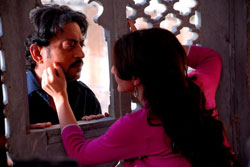
    Key Cast: Jimmy Sheirgill, Mahie Gill, Irrfan Khan, Soha Ali Khan

    Directed By: Tigmanshu Dhulia

    Written By: Tigmanshu Dhulia, Sanjay Chauhan

    Produced By: Tigmanshu Dhulia, Rahul Mittra, Nitin Tej Ahuja


    From wild 4-star enthusiasm to mild 3-star disappointment, reviews of Saheb Biwi Aur Gangster Returns seem to have been more on the positive side. Almost all critics found it losing steam mid-way, deplored the item number, but admired the dialogue and adored Irrfan.


    Tigmanshu Dhulia is an interesting, original filmaker, who came into his own mid-career with Paan Singh Tomar and the original Saheb Biwi Aur Gangster, which was a clever retake on the Guru Dutt-Abrar Alvi classic. Part two is all his own


    Anupama Chopra of Hindustan Times wrote, “But you can have too much of a good thing. Saheb Biwi aur Gangster Returns just becomes more and more overwrought and, eventually, unconvincing. The plot contortions stop feeling organic and start to feel forced, as though Tigmanshu were simply moving pawns on a chessboard. The film’s length starts to weigh on you; an unnecessary item song doesn’t help. By the end, I was no longer enthralled by the many twists. I was exhausted. Which is a shame, because there is much to be enjoyed here.”


    Rajeev Masand of IBNLive commented, “With Saheb Biwi Aur Gangster Returns, director Tigmanshu Dhulia delivers another earthy cocktail of power games, bedroom politics, and palace intrigue. Only the stakes are higher in this sequel; the love is tainted from the start, and there’s even vengeance thrown in for good measure. Indeed the film is gripping for the most part, if you’re willing to overlook some convoluted stretches.”


    Raja Sen of rediff.com gushed, “The new film is much sharper, more assured, and, unencumbered by a classic to stand beside, a far better film. Like the crooners aware of which guests to keep away from the tipple and the aides who wait till the master’s lips touch drink before letting their own, it is clear Tigmanshu Dhulia knows what he’s doing. It has, in fact, never been clearer. Which itself is worth drinking to. Besides, how could one resist a film where even drawers opening and closing sound like guns being cocked?”


    Karan Anshuman of The Mumbai Mirror was very impressed too: “Sequels. Always tricky. Rare is the second instalment that surpasses the original. And Bollywood has a particularly dismal record. So expectations were strictly under check for Tigmanshu Dhulia’s grammatically suspect Saheb Biwi aur Gangster Returns. But it’s the director who returns with aplomb. Keeping much of the original’s spirit intact, even surpassing it in many ways. It is not critical to recall or have seen the prequel. The story does continue, but the reward for a viewer who encounters these characters and the setting for the first time will perhaps be even greater.”


    Madhureeta Mukherjee of the Times of India commented, “Tigmanshu Dhulia has created an intriguing world with rajas fighting for their kingship; politicians watching porn, gangsters sleeping with the enemy, and women unapologetic about adultery in the ballroom and bedroom. The setting and story is vibrant, dramatic, dark and humourous at the same time. Once again, he scores with his characters – intelligently sketched, with dichotomous layers – dark, brooding, loving and lustful. The editing and the screenplay in the second half lose steam, and the item number (courtesy Mughda Godse) punctures the pace. The climax passively surrenders without the satiating feel of bittersweet revenge.”


    Saibal Chatterjee found much to commend it for. “Flush with vibrant colours and cinematic flourishes, Saheb Biwi Aur Gangster Returns is a riveting and buoyant film that, despite being nearly two and a half hours long, manages to keep the viewer interested in the strange, strange ways of men and women bent upon pressing the self-destruct button. The dramatic narrative core of the film is suffused with a delirious quality that is both delightful and disorienting. The film has many wonderfully written sequences followed by stray moments that aren’t that convincing. But the dialogues, penned by director and scriptwriter Tigmanshu Dhulia himself, are never less than sparkling.”


    Shubhra Gupta quite rightly pointed out, “The ‘return’ is a better film, but it stops short of being excellent. The smooth build-up in the first half leads to a confused, too-crowded second, which lets the film, and us, down. But while the going is good, it is all most gripping.”


  • Reviewing the Reviews: The Attacks of 26/11

    The Attacks of 26/11

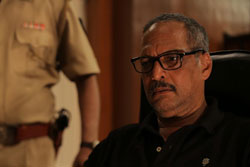
    Key Cast: Nana Patekar, Sanjeev Jaiswal

    Directed By: Ram Gopal Varma and Rommel Rodrigues

    Produced By: Parag Sanghvi


    Ram Gopal Varma did it again – aimed too high and crashed. He has his devotees who started the buzz that The Attacks of 26/11 would be his return to form, after hilarious misadvenures like Department. But RGV crashed and burned spectacularly again, with a film so insensitive and gruesome that it hurts to watch.


    Incidentally, only Karan Anshuman of the Mirror got it right – Nana Patekar plays Hassan Gafoor, not Rakesh Maria, and the commission for which he deposed was indeed the Pradhan Commission. Take a bow, Karan!


    Most critics stayed with 2 stars; even the usually generous Times of India could not manage a 3 on this one.


    Wrote Madhureeta Mukherjee, “It’s evidently researched; yet, we’re left as observers, watching the rampage rip the soul of the city. While the thought is poignant, the horror isn’t palpable throughout and the execution doesn’t cut as deep as the actual tragedy. No hard steel of emotion ripping into your gut stemming from cinematic brilliance.”


    Sanjukta Sharma of The Mint commented, “To take a surreal, unforgettably, mind-boggling event like the attacks on Mumbai on 26 November 2008, and turn it into a movie of dramatic power is, in one sense, pure exploitation and titillation. In another sense, it is a realization of the story’s limitless dramatic potential. Perhaps both these factors are at work in this film that begins as an act of remarkable ambition and ends as a wishy-washy and tacky work. Truth be told, it was impossible to not feel the surge of fellow feeling and soaring heart rates in the audience when Varma shows Kasab and his gang shooting down human beings with their AK-47s with impunity. Five years on, it is too soon, and Varma knows it. The immediate reaction on reliving it aside, the thin storyline lapses into banality.”


    Shubhra Gupta of the Indian Express correctly analyzed the voyeuristic tendency of the film. “Varma loses the advantage by slipping into familiar treads. People being killed, and limbs being turned into bloody colanders on screen need to be treated, in this kind of a film which demands respect because it claims veracity, with respect. Here the director sheds restraint, and becomes a voyeur, and turns us into voyeurs too. Adults being butchered are bad enough, but children, and babies? You do not show me multiple close-ups of tots about to be shot. No, no, no. And then we are treated to long treatises on religious edicts and what’s good and bad, which are just plain tedious. It had the potential to be both smart procedural, and spiffy action, but ’26/11′ sinks somewhere in the middle.


    Rajeev Masand of IBNLive was left cold too. “It’s not often that you go into a movie knowing exactly what to expect, but The Attacks of 26/11 is that rare exception. The plot and the end of this movie are no secret because the 2008 terrorist attacks on Mumbai, and the way the horror unfolded on the night of November 26, is still fresh in public memory. Unfortunately, in the hands of director Ramgopal Varma, these unprecedented events are portrayed in a one-dimensional, jingoistic, and almost hysterical tone. The Attacks of 26/11 often resembles a tacky B-movie. Even if there’s a voyeuristic fascination in observing how 10 men managed to lay siege to a city like Mumbai, this film is so lacking in genuine emotion and original perspective that despite the carnage, you’re hardly moved.”


    Karan Anshuman of Mumbai Mirror was scathing. “To begin with, the film is less about 26/11 and more a biopic on Ajmal Kasab’s life after he got onto the boat that brought him here. The screenplay completely skips two out of three days of the attack, which invalidates the idea that you’re watching a movie relevant to 26/11 and is relentlessly focused on Kasab. Instead of giving us valiant moments of the real champions of the hour, the NSG, revealing to us how they save the day and take out eight of ten terrorists one at a time, we’re limited to witnessing Kasab’s participation, capture, and conviction for his role in the massacre. A biopic would’ve been fine if that was RGV’s intention to begin with and if he visually delved into Kasab’s past and reasons. But that’s not what the film is about. In fact, so much more information has been unearthed since, but the writers ignore all of it.”


    Mumbai-based critics could, perhaps, not delink emotions from the film – they had experienced what the city and its people went through. How does a writer in another city see it? Sudhish Kamath of The Hindu writes, “The Attacks of 26/11 is probably the most definitive modern Ram Gopal Varma film. It’s the epitome of inconsistency. Of crassness. Of insensitivity. Of horror. Of atheism. Of audacity. Of voyeurism. And it also has momentary flashes of brilliance. And understatement. The good, the bad and the ugly – all at the same time…. You could argue that the filmmaker wants you to see this as a horror film (listen to the score for proof) because there is simply no other explanation for what happened – a bunch of men on a killing spree, staging one massacre after another in crowded landmarks of the city, leaving the police and public helpless. Only that this helplessness is shown with an almost sadistic glee and gratuitous detail that the terrorists may actually be pleased with this depiction.”