Tag: BARC India

  • BARC makes Media Workstation (BMW) online certification test free

    By A Correspondent


    After having successfully launched BARC India Media Workstation (BMW) online certification test for the benefit of over 5,000 media professionals on the BMW platform, BARC India has now decided to make the test free for all its BMW subscribers across broadcasters, media agencies and advertisers.


    BARC India had launched the test on July 20,, 2016, based on industry feedback on the need for a standardised testing and certification tool that would enable professionals as well as employers/organisations to evaluate their media proficiency.


    BMW is a specialised software application specially designed to analyse media and advertising audience results, and subscribers are regularly trained so that they may make productive use of the application.


    BMW online certification test was launched with an aim to provide a standard for skill measurement and certification of professionals engaged in TV viewership measurement, research & analytics, media planning and sales & marketing. By making the certification free, BARC India aims at attracting more media professionals to appear for the test.


    This free certification initiative for BARC India’s BMW subscribers will not only benefit BMW users by improving their employability quotient, but will also help an organization appraise the skill level of their employees with the help of a pan-industry measurement standard.


    Partho Dasgupta

    “We are pleased with the response we received from the industry when we launched the certification test. While the certification test was initially launched as a pay service, we have now made it free for all our subscribers. This has been done to encourage more professionals to take the test and benefit from it,” said Partho Dasgupta, CEO, BARC India.


  • BARC India to host sessions at Zee MELT 2016

    By A Correspondent


    After a successful first edition of Zee MELT, Kyoorius is gearing for the second edition of the event. The two day event will be held on 26-27 August, 2016 at Pullman and Novotel, Aerocity, New Delhi.


    MELT 2016 is a festival of creativity and innovation at the convergence of advertising, digital, media, marketing and emerging technology. It will see a host of sessions, workshops, conferences, expo area and more across several parallel sessions for different audiences based on four pillars – Learning, Networking, Showcase and Celebration.


    Of the host of sessions, BARC India, the media measurement company in India will be hosting sessions on two trending topics: ‘Understanding Viewability In Today’s Digital Era’ and ‘Role of Big Data Sets In Driving Ad Effectiveness’.


    The session on ‘Understanding Viewability In Today’s Digital Era’ will focus on understanding the current global standard metrics being used in digital measurement with respect to Ad effectiveness, Ad viewability and Digital ROI. The speaker lineup includes: Brian Murphy, VP, Product Management, Integral Ad Science; Paul Goode, SVP, Strategic Partnerships, comScore; Guy Barbier, Business Lead of India, Moat and Partho Dasgupta, CEO, BARC India.


    The second session named ‘Role of Big Data Sets in Driving Ad Effectiveness’ will look at the new tool named ‘Big Data’ being used by broadcasters, agencies and advertisers to understand their audiences better. The session which will have Bjoern Kroog, Global Head POS Analytics and Integrated Market Intelligence, GfK; Sukanyya Misra, Senior Vice President, Mastercard Advisors Shared Services, India and Romil Ramgarhia, Chief Business Officer, BARC India, aims at understanding its importance in arriving at marketing decisions backed by big data.


    “While Ad Viewability and Big Data are currently the two most talked about topics, the understanding on them are still limited. Through the sessions, we are aiming at informing and educating audiences on their importance and also give a world view,” said Partho Dasgupta, CEO, BARC India.


  • BARC launches online certification for its measurement tool

    By A Correspondent


    BARC India has launched the BARC India Media Workstation (BMW) Online Certification starting July 20.


    The BMW Online Certification will provide a standard for skill measurement and certification of professionals engaged in TV viewership measurement, research and analytics, media planning and sales & marketing, as well as students keen to pursue a career in these fields.


    BMW (short for BARC Media Workstation) is a specialised software application specially designed to analyse media and advertising audience results, and subscribers are regularly trained so that they may make productive use of the application. BARC India now encourages BMW users to add the benefits of certification to their profile.


    Partho Dasgupta

    “The certification programme will not only benefit BMW users  by improving their employability quotient, but will also help an organisation appraise the skill level of their employees with the help of a pan-industry measurement standard. Students of media and Marketing courses would also benefit by taking these courses and be market-ready” said Partho Dasgupta, CEO BARC India.


  • Government, leave BARC alone!


    By A Correspondent


    The all-important inauguration of FICCI-Frames 2016 on Wednesday was marred by a sweeping statement by telecom minister Ravi Shankar Prasad. Minister Prasad is known to have strong views on measurement in the past too.


    Understandable. He has been I&B Minister in the past, and coincidentally his sister Anuradha Prasad runs BAG Films which runs the channels News TV and E24.


    Prasad said he wasn’t happy with the performance of TAM in the past and the alternative right now.  We really don’t know why he said that. It’s not that people have not had issues with BARC data. People have had, and the BARC team has cleared the air, and also corrected things if and when needed. One can be sure that BARC Chairman Punit Goenka must have faced some opposition within the Zee group when his channels didn’t fare too well in the first weeks of data releasing. But did he delay the release of the numbers? He didn’t.


    Evidently the telecom minister doesn’t agree with the I&B minister who is reported to be happy with the performance of BARC.


    We asked BARC CEO Partho Dasgupta for a comment on the minister’s statement. And this is what he said:


    “We believe the Hon’ble Minister expressed a view on improvements and changes in TV audience measurement in India with the launch of BARC India’s services.


    BARC India strictly follows government guidelines on the matter. We have expanded the coverage – with a doubling of sample homes to 20000 within the first year of launch, and inclusion of rural India for the first time ever. We have plans for expanding the panel as per government guidelines too.


    We are a Joint Industry Body and the number of meters are guided by Industry’s affordability and statistical needs. The number is as agreed by all stakeholders of the industry. Industry has welcomed and accepted BARC India data’s robustness and fidelity.”


    Frankly, we don’t think BARC must toe the government line. That it is following the guidelines is a bonus. The government has no role in television audience measurement.  Remember, the measurement is done for the benefit of a channel’s content and business teams to understand its viewers and more importantly by advertisers and media agencies who invest loads of advertising $$$s. If the broadcasters and advertisers don’t have a problem, why should the government poke its nose?


  • It’s final: TAM India to exit TV viewership from Feb 29. BARC India & TAM complete jv


    By A Correspondent


    The much-awaited joint venture between BARC and TAM India has been announced with with the formation of the meter management company. This new entity which will be called Meterology Data Pvt Ltd. (MDL) will commence its operations in the next couple of weeks as TAM India exits TV viewership measurement business effective February 29, 2016. As a part of the new system, all TAM India meters will be re-deployed in panel homes selected by BARC India’s sample design. This JV will help BARC India in growing its sample size. It may be recalled that MxMIndia was the first media entity to report on the BARC TAM deal.


    In MDL, BARC India will have full management control with a 51% stake, while TAM India – which includes Nielsen and Kantar – will have a 49% stake.


    Up to this point, BARC and TAM India, both have been generating and reporting TV viewership data individually to the Industry. Now, with the completion of this JV, BARC India will be the single provider of TV Viewership data.


    MDL’s role will be to run and manage the meter operations and supplying raw data to BARC India. TV Viewership data will be computed and disseminated through BMW (BARC India Media Workstation). MDL will manage the panel households and will also be responsible for future TV panel expansions.


    The Spot Monitoring and Channel Monitoring data will be exclusively sold by BARC India to Broadcasters, Agencies, Advertisers and others.


    Meanwhile, TAM India will continue providing to the market the following services: AdEx services of TV, Print & Radio AdEx, Daily & Weekly Sales Index Reports, Bollywood & Music Monitoring Dashboards; Audience Measurement in Radio (RAM); Sports Sponsorship ROI Measurement (TAM Sports) and PR Measurement data & Audit services (Eikona) to its valuable clients.


    “The Industry was eagerly waiting for this merger to be completed from the time we announced it in August last year. We are happy to state that the Joint Venture Company is complete and all set to kick-off operations,” said BARC India CEO Partho Dasgupta.


    “We will work closely with BARC to ensure a good outcome for the industry and our joint clients. We have worked productively with BARC to get here and under the circumstances, have agreed a good way forward for everyone concerned” added Kantar CEO Eric Salama.


    “We are happy to collaborate with BARC India. The coming together of BARC India and TAM India has only strengthened the Indian broadcast industry, as they will now be getting viewership trends from a larger panel size,” informed Nielsen MD Prashant Singh.


    TAM Media Research CEO LV Krishnan said “I am very happy to see that the JV has finally taken shape. What is even more heartening is that TAM India’s current 12,000 meters, which was built and constructed tirelessly over the last fifteen years will get combined to give BARC India a larger and robust TV panel sample base for the Industry. We will do our best in providing our expertise to MDL. Meanwhile, TAM India will continue focusing its efforts towards value adding the Industry through constant enhancements of its existing businesses.”


  • BARC gets media-neutral-ready. Rat’000 to be called Impressions’000

    Some eight months after it launched its TV Ratings service (on April 29, 2015, to be precise), the Broadcast Audience Research Council (BARC) has rechristened its popular viewership measurement metric Rat’000 as Impressions’000.


    Going forward (that’s with effect from today, Thursday, January 14 when data for Week1/2016 is released) the current Rat’000s will be referred to as Impressions ‘000s. “Users of BARC India data may note that the new terminology does not imply any change in the way television viewership is measured. Nor will the introduction of Impressions’000 have any impact on past data BARC India has released so far,” notes a communique. BARC India would also like to inform its subscribers that the metric Rat% will continue to be used as it is, and will see no change.


    The decision to usher under this new terminology in the new year has been taken to avoid confusion in the marketplace  and as BARC India gears up for its digital measurement initiative. “We are preparing for the future. When we get into digital measurement, viewership will be measured in Impressions and in order to maintain uniformity and avoid confusion we decided to rename Ratings ‘000s to Impressions ‘000s,” said Partho Dasgupta, CEO, BARC India.


  • BARC’s watermarking technology achieves new milestone

    By A Correspondent


    Broadcast Audience Research Council (BARC) India has achieved a significant milestone within the very first year of its operations: the subscriber base of TV channels who have signed up for its Watermarking Technology has crossed the 400 mark. If one takes into account the various language feeds of channels, that number actually climbs to 457, as BARC India is watermarking 28 language feeds separately.


    BARC India started rolling out viewership data in end-April with 277 channels signing up for its Watermarking Technology: and in the short span of last 8 months, it has witnessed a rapid acceleration of broadcasters adopting the technology, which is the starting point for BARC India’s future-proof audience measurement system.


    The technology has been adopted by not just broadcasters with an all-India market, but also by regional broadcasters across the spectrum. Of the 429 channels that have adopted the watermarking technology, 195 are ‘All India’ channels and HSM (Hindi Speaking Market) channels.


    131 channels are from the South comprising markets of Tamil Nadu & Puducherry (42), Andhra Pradesh & Telangana (39), Karnataka (27) and Kerala (23).


    Of the other key TV markets in India, 18 channels are of West Bengal and 17 of Maharashtra & Goa.


    BARC India contracted Kantar Media’s team (previously part of Civolution) to supply the watermarking technology that underpins the world’s largest audience measurement system.


    “We are happy to have partnered with BARC India to deploy our watermarking technology. With so many new ways of distributing and consuming TV and video content, Kantar Media’s solutions enable BARC India to detect content wherever and whenever it’s consumed,” said Jean Michel Masson, Global Director of Watermarking Solutions, Kantar Media.


    Partho Dasgupta

    “We have been able to cross the 400 channel mark in a short span since our launch. This is an achievement and the team at BARC India has done a great job to achieve this target. I am thankful to Civolution and Cineom for their support and technology,” added Partho Dasgupta, CEO, BARC India.


  • Zee Anmol is the new #3 Hindi GEC as BARC goes rural

    On Friday, the Broadcast Audience Research Council (BARC) India released the much awaited rural India. Data for Week 41 was released today for October 10 to 16, 2015 and the combined numbers for rural and urban were presented among the toplines.  BARC India, a joint industry body comprising the broadcasters, media agencies and advertisers, started rolling out ratings from April, 2015, and the release of rural numbers has been hailed as a significant achievement, even as there was a section of influential broadcasters who were trying to get it delayed.


    With the release of the All India data, BARC India has expanded its reach to 153.5 million TV households, representing All India and all modes of signal. Of this 77.5 million are urban TV households and 76 million are rural TV households. BARC India will now be reporting Megacities, 10-75 lakh towns, less than 10 lakh urban areas and rural.


    The BARC India survey shows that lesser time is spent on TV in rural areas. Two in five rural audiences fall in the NCCS AB category, rural India gives younger audiences in the age group of 15-40 years. Last but not the least, with rural India’s ‘Early to bed and Early to rise’ philosophy, the conventional definition of prime time for channels may change.


    Highlights of BARC India Week 41 (October 10-16) ratings:

    • Star Plus maintains its leadership with 804214 Rat (000s) followed by Colors at 708747 Rat (000s).
    • Zee Anmol jumps to number 3 with 609189 Rat (000s).
    • DD National registered an Average Time Spent (ATS) of 53 Min 39 Sec highest among Hindi GECs.
    • Rishtey is amongst top 10 Hindi GECs with 270072 Rat (000s).
    • In the news genre, Times Now maintains its leadership with 560 Rat (000s) followed by CNN IBN at 233 Rat (000s).
    • Sports sees major spike in ratings. Star Sports 1 holds number 1 position with 162592 Rat (000s) on the back of Paytm ODI Trophy 2015- India vs South Africa.
    • Star Gold becomes No 1 Hindi Movie channel with 486374 Rat (000s) with the premier of Bajrangi Bhaijaan.
    • Aaj Tak is number one in Hindi News genre with 72067 Rat (000s).
    • Sun TV with 1092231 Rat (000s) topped the Tamil GEC genre. It also becomes the No 1 channel on All India basis ahead of Star Plus and Colors.
    • ETV Telugu maintains No 1 position in Telugu GEC market with 424252 Rat (000s).
    • Colors Kannada maintains its ranking order in the Kannada GEC space with 211268 Rat (000s).
    • Zee Marathi with 116598 Rat (000s) leads the Marathi GEC genre.
    • In the Malayalam GEC genre, Asianet topped the chart with 413385 Rat (000s).
    •  Star Jalsha tops Bengali GEC space with 241463 Rat (000s).
    • Discovery Channel stays ahead of competition with 6433 Rat (000s).
    • Kids genre sees spike in ratings, Nick is the number one kids channel with 97227 Rat (000s).
    •  MTV is the No 1 Youth channel with 14219 Rat (000s).
    • ET Now tops the English Business news genre with 484 Rat (000s).
    • Movies Now maintains its leadership in English Movies genre with 3200 Rat (000s) followed by Sony Pix at 1893 Rat (000s).
    • Zee Café maintains its leadership in English Entertainment genre with 103 Rat (000s).


    “I am delighted to present to the Broadcast and Advertising industry the All India Ratings. We have been able to give to the country a view of “What India Watches” as promised,” said BARC India CEO Partho Dasgupta.


  • Naysayers silenced. BARC to go rural from next week

    By A Correspondent


    Stability is a bad word to use in the Broadcast Audience Research Council (BARC) office. You may well get barked at. As one top media agency honcho discovered at an event when s/he tried to raise it with a BARC official.


    The decision to publish rural ratings didn’t happen with ease, we are told. There was at least one influential player who aggressively opposed it. There were some others who simply wondered: Shouldn’t we wait for the ratings to settle down?


    The Board members were convinced on Tuesday evening that all will be well. The #1 channel will not tumble and turn #5. Yes, some free-to-air re-run channels will gain a bit, but, heck, if that’s what India watches, what can BARC do about it. A presentation was made in a Board meeting, and the decision was taken.


    With this, BARC India, which currently reports about 55 million households representing C&S universe of 1 Lac+, will expand its reach to 153.5 million TV households, representing All India and all modes of signal. Of this 77.5 million are urban TV households and 76 million are rural TV households.


    BARC India, which had recently announced a joint venture with TAM Media to form a meter management company, is working on the dynamics of it and will soon announce its integration plan.


    “With the board giving us the go ahead to release the rural data, one will see ‘What India Watches’” said BARC India CEO Partho Dasgupta.


    According to an analyst, the big beneficiaries of this would be broadcasters who have worked on their reach to the hinterland, and have traditionally been strong. The dynamics are dramatically different for urban and rural India. Among these channels, Zee TV will be a big gainer, we are told as will be the free-to-air re-run channels of the key networks. Doordarshan officials are also reported to be jubilant about the rural numbers coming in, as that, they feel, will help highlight their popularity vis-à-vis others.


  • Rural ratings delayed, but are broadcasters rural-ready?


    Rural Ratings Delayed, But Are Broadcasters Rural-Ready?By Shailesh Kapoor


    The delay in the release of the rural ratings has been a topic of chatter in the broadcasting corridors over the last fortnight. Since a definitive date was announced, the delay has led to speculations, even rumors, including some that are imaginative and absurd in equal measure.


    Over the last year, since it became evident that rural ratings will be a part of their lives sooner than later, broadcasters have spent considerable resources in becoming “rural-ready”. The main area of focus has understandably been distribution. The other emphasis has been on consumer research. Having studied LC1 consumers extensively over the last few years, rural research is not entirely alien territory for broadcasters.


    But is that all that’s there to being rural-ready? Distribution is an enabler and consumer research is an input into programming and marketing. Hence, unless the rural-readiness reflects in content and brand strategies, it is not in place in real terms.


    That raises the pertinent question: Has anything changed on-air? Besides some of the GECs extending their primetime to ensure an early start (5pm/ 6pm), no other visible change reflects rural-readiness on-air. If anything, some changes have been a bit “anti-rural” in nature. A sizeable proportion of new launches over the last year are urban-skewed in their theme and treatment. It is evident they will lack rural traction.


    Stereotyping problems have continued, such as assumption that non-fiction viewers would rather read English than Hindi. Presentation language, as a result, continue to be inconsistent on-air, not just for GECs but even for movie channels. Liberal usage of English mars comprehension of several shows, including some fiction ones, even in the urban centers, and this has not changed either.


    The approach seems to be that of ‘be ready and then wait-and-watch’. The first ratings, whenever they are out, will mean a shift of gears. With channel and programme level data available to act upon, and the weekly clock ticking by, it would be time to act on high priority. All the rural research reports, from studies conducted in late 2014 and early 2015, will then come in handy.


    The genres that are likely to be least impacted from a content perspective are news and kids. Though both of them may lose overall TV viewing share in rural, like most other non-GEC genres, their rural content profile is likely to be similar to the bigger urban centers. A few other genres, especially infotainment and music, will have to take decisionson whether they want to invest resources in the rural markets at all.


    All this shall unfold when the rural ratings are released. Till then, the question of why they did not release on schedule, and what the new date is, will continue to keep us busy.


    So what’s delaying BARC’s rural ratings?By A Correspondent


    The much-awaited release of rural ratings data from Broadcast Audience Research Council (BARC), the joint industry body mandated by broadcasters, advertisers and advertising agencies to measure television audiences looks likely to be delayed.


    According to sources, broadcasters body Indian Broadcasting Foundation of which Star India CEO Uday Shankar is President, has written to the BARC board asking for the rural data to be delayed.  The reason:  there is need to let the current the data stabilise given some complaints of volatility. BARC started releasing its data from end-April 2015.


    BARC was scheduled to release the rural data by end-September and conducted road shows across major centres (Disclosure: MxMIndia had partnered the promotion of these roadshows).


    However, according to industry grapevine, there is more to the delay than the reason to stabilise. Sources have told MxMIndia that certain members of the ecosystem are dismayed with the delay and have questioned whether a leading channel whose ratings have been put to test by competition is behind the effort to delay the rural release.


    According to information we have received, Doordarshan officials are unhappy with the delay, and it is felt that if BARC pushes the release of rural data indefinitely, the I&B ministry may also step in.


    The BARC Board is scheduled to meet next week and will possibly deliberate on the issue.


  • Eurodata TV integrate BARC India nos

    By A correspondent


    BARC India (Broadcast Audience Research Council) and Médiamétrie announced the integration of Indian TV audiences into the Eurodata TV Worldwide service.


    In October 2015, Eurodata TV Worldwide, the world leader in the commercialisation of overseas TV audiences, will integrate the television audiences of BARC India into its services. Eurodata TV already covers more than 100 countries and 6,300 channels in five continents.


    Indian television market audiences will also enrich NoTa (News On The Air), Eurodata TV’s new international programme monitoring service launched in 1997. India represents a strategic territory for international audiovisual market stakeholders thanks to a population of 1.2 billion inhabitants, an average age of 27 years, its economic dynamism (3rd GDP in the world, 7.2 per cent of growth in 2014), and the size of its television market with 153.5 million households equipped with TVs as on March 2015.


    With this partnership, Eurodata TV will provide daily data (with a weekly reporting lag) for its customers about programming, content and programme audiences in India by target group: producers, distributors, broadcasters, rights managers, sponsors, etc. For example, on 18 September 2015, 114 million Indians watched television between 7 pm and 11 pm. And, BARC will be able to compare the data for its television market with that from countries already covered by Eurodata.


    “Thanks to this agreement, Médiamétrie will offer its international customers a more in- depth analysis of the Indian television market, which is one of the leading markets in the world” declared Laurent Battais, Executive Director of Eurodata TV Worldwide. “BARC will be able to benefit from our international sales force and offer the Indian market visibility in five continents.”


    Partho Dasgupta, CEO of BARC India said, “There is a lot of demand for Indian audience data globally and this tie-up will satisfy that demand. We are very happy to partner with Eurodata TV as our reseller for the rest of world which will help us grow in reach and popularity. I am certain that with the immense experience of Eurodata TV the relationship will be mutually beneficial.”


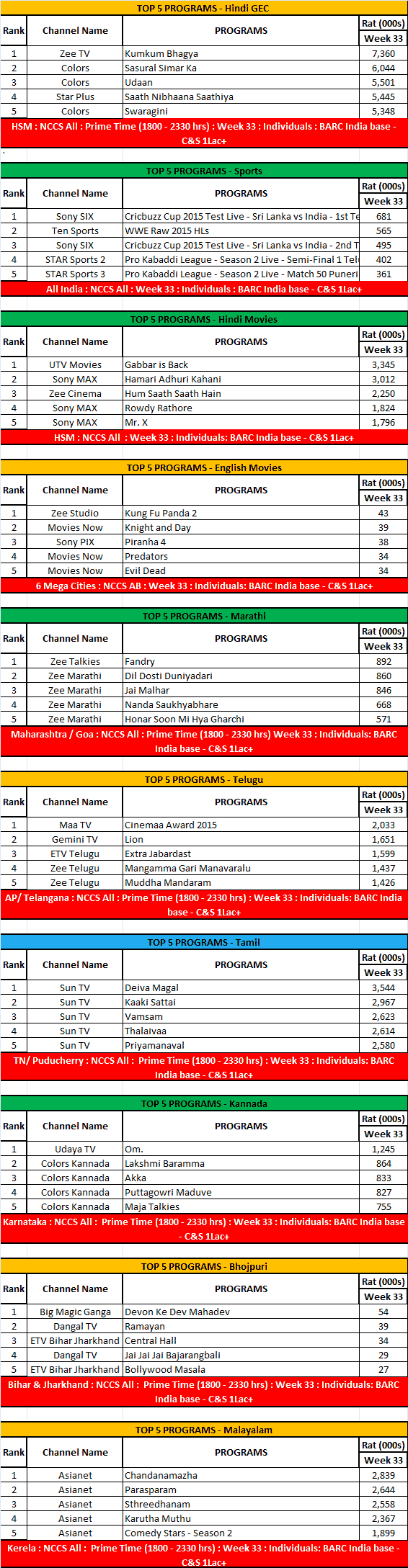
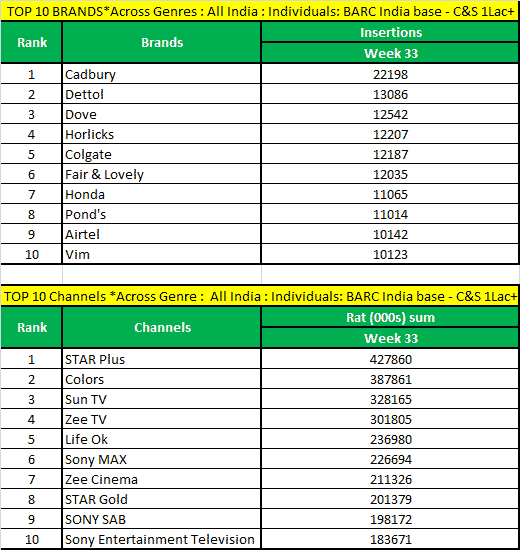
  • BARC Week 33 Data: August 15 to 21, 2015

    Okay, so after the first one or two weeks of BARC data, we are now bringing you the lowdown on all channels, as provided by the BARC, the joint industry body of key broadcast stakeholders for audience measurement.

    We were reluctant initially to provide this as it’s topline data and is available on the BARC website and even via tweets. However, given a request from some channels and our readers, we are presenting these.

    In the coming weeks, we hope to be able to provide more information.

    Please note that the source is BARC, so it’s official. And we are publishing it as is, there’s no human intervention. You may, if you’d like, also visit Barcindia.co.in to reconfirm the numbers. We would also advise subscribing to the data, if you aren’t doing so already, because it’s only then that you can actually appreciate the viewership data.