Tag: Ashish Pherwani

  • 10 Trends that will Drive TV Tomorrow


    Global leader in assurance, tax, transaction and advisory services Ernst & Young LLP or EY, as it’s now known, presented a report at the TV.NXT conference being held in Mumbai and organised by leading industry publication afaqs. Presenting an extract from the report presented by senior EY professionals  Devendra Parulekar and Ashish Pherwani


    The Indian television industry is undergoing a seismic shift. The pace of technological change is accelerating so quickly that finding the right balance between addressing today’s daily operational challenges and planning for the next big thing can be a struggle. Many executives are so focussed on the critical issues that they need to address today that looking forward is nearly impossible. And yet, looking forward is what executives need to do if they want to innovate, prosper and survive.


    Here are ten emerging trends that we see as having the biggest impact on the future of television in India

    1. Unbundling of content will drive new revenue models

    Trend:

    As seen in both music and books, with the advent of good-quality broadband and increasing per-capita income, TV content will get unbundled. There will be a shift from channel loyalty and TV loyalty to program loyalty and device disloyalty


    Implications:

    1. Need for sachet pricing models -Pricing by episode, series, day, etc willbe required

    2. Loss of traditional subscriptionrevenues
    3. Threat that high individual pricingcould be hampered by piracy


    2. Technology will enable omniplatform consumption

    Trend:

    Consumption will move from one location to many, as viewers’ desire to be entertained across locations will become possible with the aid of technology like wifi. They will consume content across various formats and devices.


    Implications:

    1. Content will need to move seamlessly across devices and locales; storytelling will need to evolve

    2. Measurement of viewership will be individualized, and be based on large volumes of actual data
    3. Increased adoption of digital supply chain to reduce cost and time


    3. “On-tap” content will lead to time-shifted bingeing

    Trend:

    As there is no need for immediacy of viewing (except in sports and breaking news), viewers will access most content at their ease, and indulge in binging (consuming many episodes at once).


    Implications:

    1. Digital asset management wouldneed to be strengthened to enable subscription revenues

    2. New pricing and packagingmodels would emerge
    3. Growth of Multi Channel Networks


    4. Increased materialism will move TV consumption from the living room to the bedroom

    Trend:

    Increased materialism and lower TV, broadband and PC costs will enable families to split their viewing patterns from the “common” or living room, to the “individual” or bedroom


    Implications:

    1. Lower share for GECs and increased importance of niche channels

    2. Ability for advertisers to target audiences one-on-one


    5. Increased broadband will result in increased piracy

    Trend:

    Broadband growth = Piracy growth. Specially when broadband rates reduce and come on par with cable rates.


    Implications:

    1. Need for industry-level initiatives to curb piracy

    2. Flexible & fair content pricing models


    6. Increased content cost will shift power to the content producer

    Trend:

    IP will begin to be co-owned by production houses, and not just broadcasters, as increasing content costs will result in increased risk sharing


    Implications:

    1. New models of content licensing

    2. Need for robust content use monitoring systems
    3. Premium artists start to share the risk


    7. Digitization will increase importance of niche channels

    Trend:

    India will digitize its distribution across Phases I to III, and increased collections from subscribers will trickle to broadcasters. Phase IV will remain a fragmented or HITS play, with LCOs retaining their last-mile relationships.


    Implications:

    1. Increased revenues for niche channels

    2. Fragmentation of the “GEC” into “sub- GECs” with focused target audiences
    3. Possibility of massive viewership measurement at the household level
    4. Marketing will need to support Phase III viewership support


    8. Transparency will lead to perviewer carriage models

    Trend:

    Carriage is a distribution cost and will be recognized as such, till such time as MSOs begin to collect a larger share of subscription revenues


    Implication:

    1. Per-viewer carriage models will come into being; split across 50 large and medium distributors


    9. Unicasting could lead to resultbased ad models

    Trend:

    Ad service will change to unicast models, targeting individual viewers, like the internet.


    Implications:

    1 Advertisers will begin to pay per ad served and viewed, and increased measurement will be the norm
    2. Value of a served customer vs. a mass customer will be determined
    3. Use of return path (where possible) to drive interactivity


    10. Social dynamics will lead to more real-time feedback

    Trend:

    Apart from viewership measurement, trends from social media like Facebook, Twitter, etc. will provide inputs to marketing, pricing and story-telling


    Implications:

    1. Need to implement social media crawlers and big data analytics
    2. Content supply chain needs to be flexible


    Published with permission from EY


  • No restrictions on news in print, TV or digital media, so why on radio?

    By A Correspondent


    The decision to allow All India Radio news on private FM has drawn mixed reactions.


    Here is the view of Ashish Pherwani, Partner & Radio Segment Champion, EY (eka Ernst & Young):

    “The regulator continues to restrict news on radio by restricting FM radio to broadcast only AIR bulletins, while no such restrictions are placed on print, TV or digital media.  News on radio (without curbs) could be used either in capsules to increase listener stickiness on existing channels, or through the launch of dedicated news channels which could open up a whole new genre of content.”


  • Newspapers, digital must co-exist for survival: INMA South Asia Confererence 2013.

    By A Correspondent


    Of the various newsmedia conferences organized in the country, the annual International News Media Association South Asia Conference is by far the most well-attended. Yes, there are newspaper groups which are conspicuous by their absence, and owners who have a fair say in decision-making aren’t all there, yet care is taken to not allow it to lose focus.


    Each conference is curated and this year saw longer panel discussions, shorter case studies (read: self-plugs) and a newer set of speakers with the theme being ‘Print: Thriving in the age of digital’ . There were more media agency honchos addressing delegates (CVL Srinivas, Anupriya Acharya and Lara Balsara) and a panel of editors saw some hard talk on newsroom integration*. There were frequent references to Amazon founder’s acquisition of Washington Post through the conference and how the new digital reality could not be ignored.


    Yes, there were a few sessions which saw more chatter than the others, and some of the captains gave Day 2 a miss, but that didn’t prevent some engaging talk over one-and-a-half days.


    Arunabh Das Sharma

    On Day 1, the registration started over lunch with an address by Jagran group CEO and President, INMA South Asia Division. Mukund Mohan, the scheduled conference moderator who is Managing Director, Microsoft Ventures in Asia, wasn’t present so Arunabh Das Sharma, President, BCCL and INMA South Asia Board of Directors was moderator.


    So what was the main takeaway from the conference? In keeping with the times, let’s put this in less than 140 characters: Newspapers and Digital will co-exist. Concentrate on just one, and you’ll perish. Short video clips are the future and revenue-friendly.


    Earl J Wilkinson

    This was very eloquently presented by Earl J Wilkinson, CEO and executive director, INMA, who ensures INMA is on top of engagement with the industry and in thought leadership. Storytelling is vital, he stressed in this co-existence of the digital and printed forms.


    Mr Wilkinson of course knows that the takeaways are important in meets like these where there are a fair number of people in attendance are company-sponsored and don’t really care much about the content.


    Lara Balsara

    But the quote of the conference came from Lara Balsara, Executive Director, Madison World. She said: “Print is like the Sun. It keeps rising in the East and declining in the West.”  The young Ms Balsara words are sure to be used in many sales presentations in the coming months.


    In fact one senior adsales honcho told us in private that he will use this the next time a Madison buyer tries to beat him on price, saying television is more effective than print.


    Ashish Pherwani

    While each session was critical to the theme, the CEOs’ panel moderated by Ashish Pherwani of Ernst & Young was the highlight. The topic was: ‘Why is Publishing Continuing to Thrive in South Asia?’ It also gave that vital glimpse of what the industry leaders — Ravi Dhariwal, CEO, BCCL; DD Purkayastha, MD & CEO, Ananda Bazar Patrika group; Jacob Mathew, executive editor, Malayala Manorama; Pawan Agarwal, non-executive director, Dainik Bhaskar Group and Mr Sanjay Gupta of Jagran — are thinking and the directions their respective organizations may be taking in the next few years:


    Ravi Dhariwal

    According to Mr Dhariwal, newspapers are an extraordinarily good value consumer product and there is much emphasis on habit-forming. There is a fair deal of innovation happening here and the sector sees stiff competition, the battles being tougher than what are waged by a Pepsi or Hindustan Unilever.


    Mr Purkayastha raised the issue of innovation and asserted that the digital media penetration is much lesser in South Asia than the West. Regional publications were customizing with relevant content and there was a strong growth in advertising. The ABP CEO and MD added that there is a lot more potential for growth. Newspapers are very adaptive of the times and have been diversifying into other segments like television, radio, OOH etc.


    Mr Mathew stressed on the quality of journalism and said the demand of news was being met by newspapers. The hyperlocal coverage had helped build communities and the form of the newspaper offered a range of ads that can’t be executed on digtal.


    Mr Agarwal threw some points not stated by the others. He said that in Tier 2 and 3 towns, the commuting time wasn’t very high and hence the window of opportunities for newspapers is high as people step out for work only at around 9-9.30am. Print are a fantastic platform for retail advertisers and a day’s paper is cheaper than a cup of tea,  he added.


    Sanjay Gupta

    Mr Gupta underscored the vital role of print in news media and its credibility since television news is just 20 years’ old. There is much headroom with newspapers and the editorial operations are managed at a low cost.


    The next edition of INMA South Asia Conference will also be held around this time next year in Delhi.


    *MxMIndia unofficially supported the INMA South Asia Conference 2013


  • Jobs in Media: Slow & Unsteady


    By Johnson Napier


    With news of employees being given the pink slip occupying news space almost frequently, the going has been getting tough for many in the Media & Entertainment sector. While experts and analysts had predicted a recovery a few quarters ago, the situation seems to be almost static or on the downfall in some cases.


    When MxMIndia had spoken to experts almost a year ago, the opinion seemed divided on the prospects of a recovery. Whether the situation has changed and whether jobs will be hard to come by at this juncture is anybody’s guess. We speak to the job experts to assess the situation…


    Abha Kapoor, Executive Director, K&J Search Consultants

    The turbulent economic environment that is marred by tight liquidity, slow economic growth, the devaluing rupee and rising inflation has impacted advertising revenues. Subscription revenues are far below their potential as the benefits of digitization are yet to kick in. With margins under pressure many media companies are in consolidation mode whereby they are rationalizing marketing, distribution, programming and people costs. The hiring sentiment is therefore subdued. In fact, hiring is happening mainly at junior and mid levels with almost no movement at senior levels. This ensures that costs are low and fresh young talent comes in. Contractual/consultant hiring is also on the upswing. Specialist professionals are being pulled in for specific projects and not on payroll basis thereby controlling the fixed costs, in an extremely dynamic industry scenario.


    Also, the M&E sector has been overvalued and over leveraged in the past and hence in the current scenario, funding to this sector is further constrained. Therefore new initiatives/expansion plans with the exception of digital/new media have slowed down or are on hold which means – fewer start-ups and fewer replacement requirements as professionals hold on to their jobs!”


    Ashish Pherwani, Partner, Media & Entertainment, Ernst & Young LLP

    The first quarter of FY13-14 has seen some good results from companies, whether television, print or radio, and there has certainly been both ad volume and (a slight) rate growth. The new reality is that one can expect a tough working environment till the next elections. There are several positives for the media industry today such as increased revenues from DAS, rising cover prices of newspapers, the (always) imminent Phase III of radio licensing, and rising box-office collections of films on the one side, but this is being countered by a weakening rupee which is pushing up prices, falling stock markets and investor confidence, slowdown in some industrial sectors like auto, etc. It’s a precarious balance, and the winners will be those who can optimise costs, deliver audiences, and demonstrate that delivery.


    Pankaj Raj, Director, Search Value Consultants Pvt Ltd

    The M&E sector is poised to double in size by 2017. With a surge in digitization and a future forward election year approaching, the sector is poised to see sustainable growth.

    It’s easier today for global media organisations to dig deep in the market. They have understood localisation of content and strategy is the biggest leverage in the market.

    To produce this for the consuming millions, it is necessary to tap into relevant talent which now upgrades itself as fast as technology.

    The job market in the M&E has been slow in the last few quarters but there is still a lot opportunity for people having three specific competencies


    1) Ability to work and deliver in chaos and difficult situations

    2) People who have a genuine consumer and customer connect

    3) Can reinvent themselves with changing times and situations and regulations. What got me here is not going to take me further.


    Another trend we are picking up is the opening up of relatively unheard of sectors in the media space - digital, digitised distribution, VFX, online video, films finally seeing a level of corporatisation, the opportunities are still aplenty for the right people. One needs people with new skills to run these domains and hence this opens up parallel industries of training, creativity and new age leadership modes.


    Lastly, the sector seems to be open to the “non-media” talent like never before. There are many examples of people who joined the sector from consumer facings business backgrounds and have made a success of themselves.


    Sarabjeet Sachar, Founder & CEO, Aspiration

    The media sector is in a bad shape at the moment with the advertising revenues plummeting by significant levels. With reducing value of rupee, rising inflation etc traditional mediums like newspaper, television, radio, out of home etc are either in a static state or have gone down. If one were to see the hiring trends taking place right now, it is taking place in the digital and mobile domains. It will probably take a long time for a recovery to happen; I presume it will take even longer after the elections are over. If an economy like US takes about five years, we may take double of that to return to normalcy.


    From the business perceptive, the only domains where there is action being witnessed is experiential marketing and digital and mobile. Also, hiring is taking place at the junior level while at the middle and senior level there is hardly anything being witnessed.


  • Does editorial content need an eye in the sky?


    By Ananya Saha


    Recently, The New York Times set up a news analytics team with the aim of establishing a better understanding of how editorial content is consumed – to know if the content being created is actually working, and if they’re publishing the news the right way, and where and how can they fix the gaps.


    With more and more people consuming and sharing news in real time, do media houses in India too need analytics team to make data-driven decisions? Would it help the editorial decisions? Do Indian media houses need it yet? While Sriram Kilambi of Bloomberg preferred to not comment since Bloomberg is considering it, the industry thinks it is the right time to employ data analytics for editorial decisions.


    Mitrajit Bhattacharya, President-Publisher, Chitralekha Group

    Different media houses have their own methods of assessing the efficacy/ response to their content. We religiously go through the traditional letters and emails from our readers. The feedback is very sharp on new media like Facebook. Based on continuous feedback from our readers we decide to make changes in our edit mix. It’s a continuous process though. Use of analytics is always welcome. It just makes the feedback process bias-free and scientific.


    Niteen Bhagwat, Executive Director & CEO – Asterii Analytics

    The data analytics and its role in news and journalism was the tipping point in US market after the Obama election campaign. Nate Silver, an analyst had predicted that Obama would win even when expert commentators had predicted that Romney might win. However, Silver’s prediction was right since he based his theory on data available. He made an editorial comment based on marketplace. Now, that was the tipping point. There is a lot of data around that can be used. Even the US papers moved to data-based journalism from opinion-based journalism.


    There are three kinds of journalists in a news room: traditional, social media or digital-friendly journalists, and quant or quantitative-oriented journalists. Quant journalists are the ones who can make sense of huge amount of data. Now, whether it is journalism, corporate communication or PR, we will need people in all three buckets or people who have all three qualities.


    The second point is, NYT is one of the 100 publications that have a metered payment gateway. And it has registered more subscription revenue than advertising revenue. This makes the publications enjoy more freedom when it comes to content. With data analytics in place, one can understand the online reading habit – can know the demography, or which part of the publication is being consumed more, which will allow more tailor-made content.


    Shantanu Bhanja, VP (Marketing), HT Media Ltd

    Yes, for sure. While the editorial judgment is paramount, analytics are valued inputs to that judgment. Our analytics team helps us give the editors a pulse of the consumer, as well as feedback on our news offerings in real time as well as over periods of time. The final editorial decisions are taken solely by the editorial team. However, an analytics team provides the reader interface. We carry out various studies, both online and offline some continuous (with different periodicity) and some as and when the need arises.


    Projit Chakrabarti, Head – Marketing Services, NDTV Limited

    Well certainly for genres of news that fall into the category of ‘information’ or ‘news you can use’; with more and more 360-degree targeting to the consumer  becoming increasingly relevant, data and analytics will drive the dissemination of certain kinds of news and information. It will most certainly help from a contextual and utilitarian point of view but may be not so much from an editorial point of view. Indian media houses definitely need it.


    Ashish Pherwani, Partner, Advisory Services, Ernst & Young

    At the end of the day, a media house (whether TV, print, radio, website, whatever) provides audiences to advertisers.  With the growth of digital distribution channels and the proliferation of lower-cost hardware options, audiences are changing the manner in which they consume content.  Hence, media houses now not only need to provide their content to their audiences in the manner and format of their choice, but also keep using analytics to understand changing audience preferences, to better cater to them.


    Analytics will also enable better sales efficiency – enabling ad sales teams to sell in a more targeted manner. And of course, editorial teams, to understand what type of content do their audiences prefer, at what time and how it must be packaged. Hence, analytics leads to (1) better serving the audience and (2) better monetization of the audience.


  • MxM Mondays: Is magazine readership sliding?


    By Ananya Saha


    As magazine publishers are set to meet for the Indian Magazine Congress in Mumbai on February 14 and 15, the indifferent numbers posted by the latest findings of the Indian Readership Survey continue to mar what appears to be business as usual. According to the IRS 2012 Q3 figures, magazine readership is on the decline barring a few magazines that have gained AIR.


    Even as the Indian print industry continues to see new launches, the readership of magazines is sliding (including regional language, Hindi and English magazines), as recorded by the IRS. MxMIndia spoke to a cross-section of industry veterans about the Indian magazine industry, and the shape of things to come. In alphabetical order of their last names:


    Suresh Balakrishna, CEO, BPN

    Newspapers and television have taken over the space which was once occupied by magazines. Therefore, general news/interest magazines readership is on a decline. However, niche magazines which cater to a small but specific audience are doing well and will continue to do well. Even as we speak niche magazines on jewellery, garments, travel etc are being launched. And advertisers are interested in putting their money on them as they are leisure magazines and will get their message across to their target audience. Hence, the future of niche magazines is bright although other magazines will have to take a hit


    Mitrajit Bhattacharya, Publisher & President, Chitralekha Group

    A survey like IRS hardly does justice to a highly complex category like magazines. Magazines are heterogeneous in nature with skewed distribution, which is missed by a huge survey like IRS; or in simple words, IRS is not even designed to capture readership of magazines (particularly special interest or niche ones). There are concerns about certain genres of magazines facing difficulties in retaining loyalty among its audiences, but there is surely traction in the specialized space. How else can you justify launch of so many new titles every year? IRS is not a good measurement tool. It is a one-size-fits-all omnibus survey with no focus on skewed distribution of magazines.


    The industry is reorienting, specialised genres are doing great even if some traditional genres are threatened. Also the digital formats are doing well for all big magazine brands. I see further traction in this. Digital will complement the print formats in a great way and magazines will lead the space for their superior content and presentation.


    Varghese Chandy, Chief General Manager, Marketing Advertising Sales, Malayala Manorama

    The quarterly result or six-month readership data will not establish if readership is declining or not. The readership is dropping compared to a few years ago. What we need to understand is that the way a magazine is consumed or read is getting different. It is changing because online versions are available. The time will come that when you talk of magazine readership, you will actually have to add the online and offline (print) readership of the magazine, including tablets and mobile. That is what one should look at in the long run, whether you are able to retain readership through all possible formats. Unfortunately, we are not in position to capture this readership currently.


    The way readership is captured in India for the magazine is very newspaper-oriented. For the newspaper, the readership is concentrated is the catchment area that is near printing or publication centres. Magazines, on the other hand, are dispersed widely, and in most cases, nationally. Even the language magazines are dispersed beyond one geographical state where the language is read. Thus, the sample pickup for magazine and newspaper cannot be the same because of the wide dispersion. The present readership survey, and this is something all of us have been saying for some time, is not actually geared to capture the readership of the magazines; particularly the niche magazines and magazines that have specialized readership.


    That is why you see readership drop even in cases of English and general interest magazines. Some readership figures and drops should be seen as rationalization of numbers. There used to be a time when the readership of one copy was seen as 10 or 15, which is out of the question. Some of this rationalization is definitely happening.


    We need a much larger sample base for a magazine-focused readership survey.


    Ashish Pherwani, Partner, Advisory Services, M&E, Ernst & Young

    To measure the readership of magazines, a standard measure is used by IRS. It does not capture the online readership of magazines. Also, one needs to understand that readership is one of the ways that a magazine reaches the readers. The magazine is a brand that you (readers) believe in. The brand can reach their targeted audience via television, internet, tablet, event etc. Take the example of Femina: the brand is larger than a magazine and the database of customers that Femina is connected with is much bigger than its magazine readership. It is connected to readers via Facebook, social media, its website, events, and what not.


    IRS is the only currency, so it needs to be used. It does not measure the brand value. IRS is just one part of the brand and publishers need to take cognizance of that.


    Tarun Rai, CEO, World Wide Media and President, AIM

    Declining readership of magazines is a myth. Magazines like all media are going through dynamic changes. Yes, there are some genres of magazines which may be witnessing some decline but most others should actually be showing an increase. Our circulation numbers are going up. So many new magazines are being launched. That wouldn’t be the case if readership was going down.


    There are issues with the retail infrastructure of magazines. Getting our magazines to our readers is not easy and is expensive. However, our concern is more fair measurement. In its current form the IRS does not capture the reality of magazine readership. We have been in discussions with them and hope we will be able to get to a satisfactory solution soon.


    Rather than a decline, we see an increase in magazine readership, going forward. There are two reasons for this. On the one hand, with increasing disposable incomes and more choices, people are looking for quality content and expert advice which only magazines offer. On the other hand, digital devices are enabling magazines to take their content to a much larger number of people. And digital technology also allows magazine editors to enhance the reading experience. I believe that lifestyle and special interest magazines are the sunrise sector of Indian media.


  • FM radio will generate Rs 14bn in coming year: E&Y report

    By A Correspondent


    India’s private FM radio segment is expected to generate revenue of around Rs 14 billion in 2012–13. With 245 private FM stations operating in 86 cities, the sector has been growing at a CAGR of 14 percent annually. Furthermore, the sector is expected to grow to INR 23 billion, at a CAGR of 18 percent, within three years of Phase III being rolled out, according to ‘Poised for Growth: FM radio in India’, the latest study by CII and Ernst & Young. The sector accounts for around 4 percent of the country’s total ad industry. Globally, radio’s average share of the total ad industry is between 5 percent and 10 percent.


    According to IRS 2012 Q2 data, radio has an estimated audience of 158 million people (out of which FM radio accounts for 106 million), as compared to 563 million in the TV segment and 352 million in the print sector. Advertising revenues comprise more than 85-90 percent of the total revenue generated by FM radio companies; non-FCT sales can contribute up to 20 percent of a radio company’s total revenue today.


    Ashish Pherwani

    Ashish Pherwani, Partner, Ernst & Young said, “The report is a compilation of the views of 23 industry stakeholders including radio companies, regulators, music labels, etc. It highlights the need for a speedy implementation of Phase III, which can grow the radio industry from INR14 bn to INR23 bn in three years, subject to enabling networking and cost management, development of a measurement metric which supports the industry, and ensuring license fee prices during Phase III auctions are not irrational. The report also highlights operational, tax and technology implications of the industry.”


    Current state of the industry

    Radio is not considered a primary advertising medium due to its limited number of stations. While larger cities are mostly covered by it, advertisers interested in regional ad campaigns prefer using regional print (which can enable them to reach several more cities and towns than radio currently can) or regional TV, which has grown significantly since 2005. Therefore, radio is only used as a back-up medium for most ad campaigns. However, with the implementation of Phase III, with 839 frequencies being made available for auction, radio is expected to provide advertisers with a much deeper reach.


    More than 50 percent of FM radio consumption is in homes, followed by people listening in transit (on mobile phones and in-car listening) and out-of-home listening at restaurants, offices, shops and so forth. Around 25 percent of total radio listenership is now on mobile phones, fuelled by handset manufacturers that have made FM radio a standard feature in most of their models. Some radio companies claimed that their research indicates that mobile phone listenership in metros comprises more than 75 percent of their total listenership.


    The study highlights the fact that the key challenges faced by this industry today include limited inventory, inability to demonstrate ROI and slow recovery of ad effective rates (ERs). Therefore, the need of the hour is for radio industry is to collaborate and implement a measurement system that supports the growth of the industry.


    Phase III

    Phase III of FM radio licensing promises further growth opportunities for the Indian FM radio industry, since it covers 294 cities and 839 licenses.  However, only 52 of these licenses are in high revenue-generating category A+, A and B cities.


    They expect the share of local retail advertising to increase from current levels to more than 50 percent of the total revenues generated in the segment, and activations and other below-the-line marketing initiatives to play a more important role in generating revenues. The margins of radio stations are projected to decline in the short run, stabilize in three to five years and then rise. The growth in mobile and internet ad spends could, however, pose a threat to the rise of FM radio.


    Phase III is also likely to make the industry more conducive to M&A due to proposals such as reduction of the license lock-in period from 5-3 years, an increase in the license period from 10 to 15 years, significantly more networking between all the stations to enable cost optimization, ownership of multiple frequencies in a city and an increase in the foreign investment limit to 26 percent from the current 20 percent. The industry needs to push for parity with the FDI norms of other media segments such as broadcast TV.


    In the long term, significant growth for the private FM radio industry will only be possible if several thousand stations are operationalized, burden of high licence fees is removed by increasing the variable component and reducing fixed costs, and news dissemination is equated with other media.


  • The Anchor: 5 ways to make print more relevant for advertisers

    By Ashish Pherwani


    1. To make print more relevant for advertisers, we’ve got to have more interactions and more engagement through either digital or activations on radio or any other vehicle. There needs to be a level of engagement built into the print offerings of media companies. Advertisers are looking at some kind of measurement which is not just readership but a measurement of a deeper level of engagement.


    2. You have got to make print more relevant to the reader, and therefore the one-size-fix-all newspapers being generated today may not be the answer and it may call for better segmentation and better understanding.


    3. Overall, the print companies need to realize that they are no longer B2B companies, that the main asset they hold is their relationship with their consumers and their readers. And therefore, they need to evolve into B2C companies, build databases with their customers as information and optimize that database for different advertisements.


    4. As youth moves away from its consumption of newspapers and moves towards different methods of consuming media, newspapers need to be able to figure out ways to retain those youth, either on some other medium or by giving them the kind of news that they want to read. Most publishers still believe in giving out news which they believe is relevant. Therefore giving youth-centric content is something that the industry needs to work on and youth is a category which most advertisers look forward to.


    5. Print companies need to proactively come to advertisers with innovations with products that resonate with their brands.


    Ashish Pherwani is Partner-Advisory Services, Ernst & Young India


  • Complexity presents opportunity @INMA 2012


    By A Correspondent


    The sixth edition of International Newsmedia Marketing Association (INMA) South Asia Conference opened to a packed house on August 6 in New Delhi. The theme ‘Complexity Advantage’ was not only explored, but dissected and deconstructed. The sessions at the event saw discussion on various topics ranging from the need of newspaper companies to become multimedia organisations to the future of news, and if cost deflation is an achievable matrix.


    Mr Sanjay Gupta, President INMA South Asia and CEO & Editor, Jagran Prakashan Ltd welcomed the delegates and Mr Ravi Dhariwal, President INMA Worldwide & CEO, The Times of India Group, gave the inaugural address. Talking about the volatile Indian newspaper landscape, Mr Dhariwal outlined five key points: “There is great optimism even when things have not been going great economically. There is a very big opportunity in tier II and III cities, which every newspaper is witnessing. On the back of multimedia and strong publishing business, companies have been witnessing double digit growth. However, the newspaper business is being treated as ‘one shot fits all’. Going forward, this strategy will have to change as the consumer needs customisation according to their needs and interests.”


    He went on to say that publishing, as a business, has a bigger purpose of being at the forefront of change, and gave the example of TOI’s ‘Lead India’ and ‘Teach India’ campaigns.


    Ravi Dhariwal
    [youtube width=”400″ height=”225″]http://www.youtube.com/watch?v=qdAI1R8UBTw[/youtube]

    His also commented on how advertisers are struggling with value: “We need to deliver and innovate to deliver extra value to the advertiser. My fourth point would be that the competitors need to join hands and collaborate to give better value to the readers and advertisers. If we do not do that now, we might bleed like the newspaper industry bled in the West.” He concluded by saying that fleeting FMCG advertisers who prefer TV as a valuable medium to advertise: “Should be given single rate from all newspapers.”


    Mr Bhaskar Das, President & Principal Secretary to MD, The Times of India Group, who acted as a sutradhaar at INMA noted: “The newspaper business is rapidly changing. There is no equilibrium, only punctuations. The businesses today are caught in ‘complexity science’- any business can and will survive if they adapt to the changing environment.”


    Mr Nandan M Nilekani, Chairman, UIAI, Planning Commission, Govt of India raised important points about how newspaper industry should integrate its print version with digital format to reach out to the larger, younger audience: “The advancement of computing technology is bringing dramatic changes in how media is being consumed. It is important to understand the interplay of demographics, cloud computing, content, mobility, and access to technology, to create a business model that integrates the disruptive advertising and subscription models.” He summed his theory as: “Get ready for online mobile-aware resident.”


    Earl J Wilkinson
    [youtube width=”400″ height=”225″]http://www.youtube.com/watch?v=sKl9f2Yjxyg[/youtube]

    Highlighting the fact that advertisers want quality reach, target richness, engagement, purchase intention, and actionable audiences from the newspaper media, Mr Earl J Wilkinson, Executive Director & CEO, INMA spoke on ‘The new growth path and how to get there’. Talking about the learning and examples from the US and UK markets, he said that Indian newspaper industry is at crossroads because of: growth beyond demographic changes; the struggle being less about circulation but more about readership; delivering value to advertisers even as multimedia and digital pose challenge.


    Mr Wilkinson said: “The integration of content across platforms is bound to happen. And this is not true for content only, but also for the readers and advertisers. The problem of complexity does arise across platforms, but herein lies the opportunity. As the integration becomes a norm, the organisation models of newspaper companies will also change. The companies need to ‘aggregate’ and ‘atomize’.”


    The new model, according to him, would focus more on competence and value that it gives than the product itself. He further said that most news would be consumed via mobile by 2015. “Mobileand social media would result in exponential engagement. We, as newspaper industry, need to be more relevant to the nebulous pursuit of quality. Going forward, the multimedia organisations need to manage print for profit, and digital for growth,” Wilkinson concluded.


    The session on ‘Future of News’ brought interesting perspectives as the panel discussed if the attractiveness of news can be synchronised with commerce and content. ‘Winning the ad growth challenge’ saw industry veterans talking about factors that impact ad revenues.


    The highlight of the day was the interesting session with young college students on ‘Walking through the mind of the post-90 born: ‘Creating a newspaper I would like to read”. The session gave interesting insights to the delegates about how newspaper is not a necessarily a chore for the 19-21-year-olds. They consume news on-the-go, and read newspaper “when they have nothing else to do.” Moreover, the young panel highlighted that they preferred going through trending articles and video links, showing how digital was their preferred medium of news consumption.


    ‘Battle of  Bulge: Is cost deflation a utopian expectation?’ was moderated by Mr Mohit Jain, Executive President, Supply Chain, BCCL. He pointed out the three challenges of newspaper business when it cones to cutting costs, “Globalisation of cost structure, supply chain issues, and volatility of newsprint.” The session spoke on how new business models of publishing and printing newsprint are managing the currency, size and quality; how newspaper companies need to unlock internal manpower potential across board; and effective supplier partnerships.


    Mr Ashish Pherwani, Partner-Advisory Services, E&Y noted that newspaper organisations should pool-in their back-end resources, such as printing facility, to cut costs. Mr Pawan Agarwal, Non Executive Director Bhaskar Group echoed Mr Pherwani’s thoughts, and added, “We have created a common infrastructure for two or more of our editions. This helps in capping my Opex and Capex.” Mr Piyush Gupta, Group CFO, HT Media agreed: “Co-sharing is already happening in aviation department. If it can happen there, it can happen here as well.”


    Mr Pherwani added: “Every newspaper industry goes through three stages: chopping off wastage; optimisation, and partnering with vendors. Currently, the Indian newspaper industry is going through the third cycle. It is imperative that we build a right product at right price by creating a win-win relationship with vendors.”


    The panel also highlighted the fact that harnessing inner potential is important for any and all newspaper organisations to achieve its top-line growth. The panel also noted that what is core to a business and what can be co-shared: this will emerge as a real game changer for a newspaper organisation.


    Giving a different perspective to the newspaper session was the speaker Mr Santrupt Misra, CEO, Carbon Black Business and Group HR Director, Aditya Birla Management Corp who spoke on ‘Managing cultural asymmetry in a multi-media organisation’.


  • INMA 2012: ‘Print must engage audiences effectively’

    By Shruti Pushkarna


    Day 1 of the sixth annual South Asia INMA conference opened with a host of promising sessions which addressed key issues facing the industry.


    Ashish Pherwani
    [youtube width=”400″ height=”225″]http://www.youtube.com/watch?v=WfREkdmTRuc[/youtube]

    The session ‘Winning the Ad Growth Challenge: Is it a Plausible Model’ was moderated by Ashish Pherwani, Partner- Advisory Services, Ernst & Young India and the other panelists included Bharat Bambawale, Director, Global Brand Bharti Airtel Ltd; Mayank Pareek, COO (Marketing & Sales), Maruti Suzuki India Ltd; and Shashi Sinha, CEO, LodestarMedia.


    The moderator, Mr Pherwani opened the discussion on the ad growth challenge by listing out four factors that he felt were impacting ad growth: inherent competition, technology change, slow economic growth and growth of television. Citing a recent research, Mr Pherwani said that there were clear indications that consumers are spending more time on digital media at the expense of traditional media.


    He also listed out some questions for the print industry to address, the broad one being, how to stay relevant and grow revenues. Among the other questions he raised were: New ways advertisers can use print, how to enhance effectiveness of print for advertisers, what makes advertisers continue on print when times are tough and finally how can print companies explore new media.


    Mayank Pareek
    [youtube width=”400″ height=”225″]http://www.youtube.com/watch?v=PYJJnTGb12U[/youtube]

    Mr Pareek said that the demography is changing because the way people seek news is changing. He said that Maruti had redefined their strategy to invest in print, looking at the changing trends in consumption: “We’ve gone from 67 per cent to 23 per cent in our spends on advertising in print in the last five years.” He said that it is important that companies continuously adopt to the changing demographic needs. He added that even though digital spends are low today, digital is growing and changing rapidly. So for print to remain relevant, there is need to develop engaging content as the other media are offering. However, Mr Pareek agreed that print will continue to play a role in the future as well.


    While the other panelists agreed with Mr Pareek that print will continue to be the part of a media plan for an agency or an advertiser, they also shared his concern on the need for print to adapt to changing consumption patterns.


    Mr Bambawale of Airtel said: “We are using much less print. There is one strong global trend which holds true forIndiaas well, young eyeballs are moving away from the printed word to the video. So for print medium to engage this audience is a great challenge. The conversation should change from ‘how can we put an ad out there’ to ‘how can we engage’. In a newspaper, content is all about facts and events but in engagement, content is about making things interesting. The answer lies in creating content that has high degree of engagement even around topics of news or current issues.”


    Mr Sinha said that the strength of print lies in the fact that it brings a lot of credibility: “Print still stands for credibility, I am not so sure if digital has that. We’ve embraced digital because of the youth. For certain brands which go through an erosion of trust, print is the best place to be in.”


    He added that not growing fast enough is the problem of measurement: “The current measurement metrics are limited to cost and reach. There is no way to measure engagement or performance. Unless we start showing these to the advertiser, things won’t change. There is a need to introduce new metrics of measurement.”


    Mr Bambawale echoed Mr Sinha’s view on measurement being limited to cost and reach as far as newspapers are concerned: “If you change the matrices by which you present the title to an advertiser, it’d be a more fruitful conversation perhaps.”


    The discussion concluded with two key takeaways, Print needs to find new ways of engaging its audience to stay relevant in a changing era. And second, there is a need perhaps to look at other matrices of measurement for print, a way of measuring effectiveness of an innovation.


  • So why did Turner stop Imagine(ing)?


    By Team MxMIndia


    Just when the Hindi general entertainment space was getting interesting with the top 3-4 players all coming within sneezing distance of each other in the numbers game, the industry was jolted by news of the closure of Imagine, which given its pedigree, was launched with much fanfare not many moons ago. From shock to sadness and even rage (at least on the social media) admirers and naysayers were seen on an overdrive trying to piece the chain of events that had led to the downfall of the channel that was seeing red for some time now.


    This was in stark contrast to the kind of emotions that were flying thick and fast exactly a year ago, when Turner General Entertainment was merged into its parent company Turner Broadcasting System Asia Pacific, Inc. The emotions then were almost similar to what the channel heads were going through when they flagged off the channel more than four years ago, making it one of the most loud and admirable launches of the time. While anticipation and expectations were riding high on the faces of each and every member of the team at launch, the same was the scenario during the merger exercise last year as the company was probably taking a last shot in reviving the fortunes of the network to see themselves battle against the competent lot at the top. But all that was not to be as tribes from the world of media and outside woke up to the news of the channel shutting down yesterday.


    Siddharth Jain

    Replying to questions put forth by MxM India (read interview),  Siddharth Jain, Managing Director- South Asia, Turner International India Private Limited put it out right and straight as he said: “This is a carefully considered business decision based on performance of the channel. We invested substantially and put all possible resources behind Imagine TV throughout. As in any other business, the investments were directly linked to reaching a certain performance benchmark. However, in the two years Imagine did not grow or perform as per expectations and as a result, Turner made the carefully-considered decision to cease operations of the channel.”


    Mr Jain is probably being modest in quoting that the channel did not perform as per expectations in the past two years, but the writing was on the wall in the first three months of 2011 itself, when the channel failed to get the viewers and advertisers excited with its most expensive property that cost the company in excess of Rs50 crore to produce. ‘Zor ka Jhatka’, hosted by Shah Rukh Khan, failed to get the desired ratings and didn’t do much to push the channel in the top league as was expected. In fact, in an interaction with the media before the show went live, an exuberant Sameer Nair had vouched that the show along with a few others would catapult Imagine among the top 3 in the Hindi GEC space. Wishful as he was, that was not to be. Its failure forced the thinktank at Turner to come up with steps to plug the loopholes, even if it meant changing its course altogether.

     

    Sameer Nair

    Thus in April 2011, Turner announced the merger of Turner General Entertainment into its parent company Turner Broadcasting System Asia Pacific, Inc. This was followed by the formation of a special committee comprising various Turner officials such as Monica Tata and others along with officials from Turner General Entertainment Network including Sameer Nair and Harsh Rohatgi with the intention of charting out a long-term course for the channel. This move was even vindicated by Steve Marcopoto, President, Turner Broadcasting System Asia Pacific (TBSAP), who went on to explain the need for such a proposal, which was to assess its performance and chart a long-term course for Imagine. But just when the merger was announced, Sameer Nair did the unthinkable by announcing his decision to exit the company.


    In an interaction with MxMIndia Editor-at-Large Anil Thakraney, Sameer Nair was quite upfront about the reason for his decision to move on: “I was used to operating independently. After Turner took over, one had to integrate into the Turner system. And this made me just a department head. And so I left.”


    Expressing concern towards the chain of events that led to the closure of the channel he said, “I am quite shocked and disappointed to hear that they’ve decided to shut the channel down. They (Turner) seemed to be quite gung ho about Imagine, and I thought they were going full steam ahead. There is a lot of investment and a number of jobs at stake.”


    Mr Nair’s exit from Imagine was followed by a few other key exits and the network’s failure to find a suitable replacement. Even attempts to vow the audiences by launching a slew of reality and mythological shows didn’t do much for the channel as it still figured in the #6/7 slot amongst its peers in the space.


    In fact, even as recently as 2-3 months ago, the channel was going all out with its promotional activities as it announced the launch of new shows. But that too has been brought to a halt as Mr Jain explained: “We cease all business operations of Imagine TV. The closure is a complicated process as we are ensuring fulfillment of all our business commitments to advertisers, distributors, production houses and other partners.”


    The news came as a rude shock to producers, some of whom were in the midst of production schedule (see story: Rude Shock for Producers & Performers). Rajan Shahi who had launched ‘Jamuna Paar’ on Imagine just a little over a month ago, refused to comment on it saying “it would be too premature”. Other producers like Siddharth Tewary, the Sagars who had ‘Chandragupta Maurya’ and ‘Dwarkadheesh’ aired during primetime were incommunicado as they grappled with the sudden turn of events.

     

    JD Majethia

    JD Majethia who had launched two shows, ‘Jassuben Jayantilal Ki Joint Family’ and ‘Ek Packet Umeed’ four years ago said: “It’s sad and shocking. It was a channel which with the entry of Vikas Behl at the helm of things looked poised for bigger things, a turnaround but that was not to be. It’s a huge setback for producers and for those who work on a per day basis. A daily show means a minimum of 100 people associated with it in various capacities and with Imagine closing down, it spells doom for them. All that talent and labour goes down the drain. It’s a loss of about Rs200 crores worth of yearly business for Imagine and the industry on the whole.”


    Veteran producer Dheeraj Kumar of Creative Eye Productions said: “It was an overnight decision but it could have been done a bit smoothly. I am hopeful that Turner with its huge umbrella of channels would give us a chance of providing content to them. I am optimistic.”


    Programming propaganda

    Ever the one to influence viewers and attract the attention of the advertisers too, content was one of the biggest setbacks for the channel, going by the buzz emanating from experts. While the start for the Imagine was glorious, as it did manage to attract sizeable channel share (see chart below) and even break into the 150+ GRP mark at some point, it was an experience that was shortlived. The maximum channel share that the channel attained was 8.5 in H2 2009.
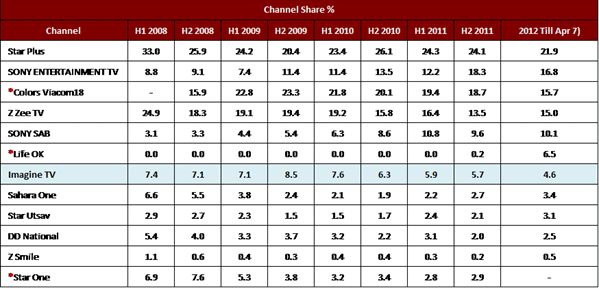
     

    Source: TAM Media Research / TG: CS 4+ yrs / Market: HSM / Period: H1 (Jan-Jun) & H2 (Jul-Dec) 2008, 2009, 2010, 2011 till April 7, 2012

     

    Mohit Joshi
    Divya Radhakrishnan
    Karthik Lakshminarayan
    Pankaj Krishna

    Explaining the implications, Mohit Joshi, Managing Director, MPG said, “The General Entertainment domain is very competitive and each channel is constantly improving content and production. The viewer has many options today and hence has become more ruthless with the channel choice. In spite of a great start, Imagine lost it mid-way. In an attempt to gain viewership and numbers, it resorted to telecasting shows like Rakhi Ka Swayamvar, Rakhi Ka Insaaf and so on. Though these shows could have given a short-term boost in numbers, in the long run, viewers didn’t find the content appealing enough. Also these shows dented the channel image by giving it a ‘sleazy’ tag – which is not acceptable in the GEC domain.”


    Divya Radhakrishnan, Founder, Helios Media, said, “GEC is a highly competitive segment and the cost of running a GEC is very high. Imagine had reached a level of stagnation especially in the last six months, however shutting down was not expected.”


    Karthik Lakshminarayan, COO, Crest, said: “Imagine had the brand heritage of NDTV and Turner. I think it was sheer bad luck that they eluded that one show which could give them success like Kyunki did for Star, Saat Phere did for Zee, Ballika Vadhu for Colors and Bade Acche Lagte Hain is doing now for Sony. For a GEC to break even it takes 4-5 years so one needs to stay invested for a long period to see the returns, hence the move is a surprise.” In fact, he has a surprising statement to make: “Their overnight decision has caught us unawares and our media plan needs a quick revision. We had spots to go on air on the channel as we talk. I think now those spots are up for grabs and may the best player win.”


    Blame customer pull, not distribution!

    There are primarily two ways of impacting Channel Trials – namely Consumer Pull led by content affinity, and Broadcaster Push led by Distribution initiatives, explains Mr Pankaj Krishna, Founder and Managing Director, Chrome Data Analytics & Media (see Analysis: How Imagine lost due to consumer pull, not distribution. “Going by Chrome OTS numbers (Opportunity To See – percentage of households that have access to a channel) – Imagine TV has clearly been in the league of the top GECs with an OTS of 95% across HSM.”


    According to Mr Krishna, “consumer pull clubbed with Strategic Distribution Planning has a huge impact on the overall performance of a channel”. “Over the years, Imagine lost out on factors contributing to the former.”


    Staff shocked

    It was Terrible Thursday for the staff at Imagine. They had no clue of the closure, even as they had faced yet another week of dismal ratings from TAM. Said Jain on the fate of the staff: “Turner will retain some employees for a transition period and some others are being offered permanent roles within other Turner channels to fill current vacancies. For the other Imagine employees getting impacted, Turner has set up an HR outplacement service which will provide advice on how to write a better CV, interviewing techniques and other job hunting skills. We will also introduce the employees to recruitment consultants, HR professionals from other media organizations and facilitate their new job search. Our focus is to ensure the closure is executed in a fair and appropriate manner for all of them and in full compliance with all legal requirements, employment terms and company policies. We will use our best endeavours to make this as smooth a transition as possible for them.”


    There has been much dismay in the brodcast fraternity too. Colors CEO Raj Nayak in fact made a clarion call to the industry via Twitter: “To all my friends in the TV business. Let’s try & accommodate our friends from Imagine wherever we have vacancies in our system.”


    Way ahead

    The move does spell a warning for other broadcast majors to sit up and take notice. Let’s not forget examples of a few channels that had to shut shop midway including Star One, Zee Next, 9x and Real for lack of vision and programming blunder.

     

    Ashish Pherwani

    As Ashish Pherwani of E&Y writes in his analysis for MxMIndia (when is it right for a channel to pull the plug): “Over the last decade or so, most unsuccessful channels which have tried ‘overhauls’ and ‘makeovers’ that have failed to achieve their objectives within six to eight months, have eventually shut down their operations.” According to him, for a channel to succeed, “the only asset it has is viewership. Channels which operate without a robust management team, a unique market position, and a defined target audience, won’t be able to garner sustained and loyal viewership. If channel management is able to make these three aspects fit seamlessly together, chances are the channel will succeed as a business, else, it would make business sense to pull the plug!”


    Turner may probably pay heed to Pherwani’s suggestions if it ever were to take another swipe at launching a Hindi general enterainment cahnnel  channel. Going by its past track record where it teamed up with Alva Brothers to launch Real and proceeded by acquiring Imagine from NDTV, chances are that the network may already be on the prowl hunting for its next prospect. Until then, the network seems content to bask in the laurels of its sister channels that have been showing good growth in the genres they operate in.


    Written by Johnson Napier with inputs from Anil Thakraney, Ashish Pherwani, Pankaj Krishna, Kshama Rao, Tuhina Anand and Robin Thomas

     

  • Analysis: Ashish Pherwani on when it’s right for a channel to pull the plug

    By Ashish Pherwani


    Rule of three

    The media business is largely governed by the ‘rule of three’ i.e. companies which are the top three or four players in a genre, or geography, tend to be profitable, while the rest tend to make losses in the long run.


    Accordingly, when a TV channel is unable to make it to the top of its segment for a long period of time, chances are it would have been hemorrhaging money for its owners, and that situation cannot last indefinitely.  Eventually, investors will pull the plug.


    Expensive programs as drivers

    TV channels which garner a majority of their viewership from reality TV shows and expensive films, and not from lower cost fiction programs, are also susceptible to being shut down in the medium to long term.


    Most large channels do not recover their direct variable reality content production and distribution costs through advertisements alone, but use such expensive programs as drivers to build channel loyalty and viewership for lower-cost fiction programs.  If this strategy does not work, and fiction shows continue to under-perform on a TV channel, the chances of broadcasters continuing the channel are remote even in the medium term.


    ‘Overhauls’ and ‘Makeovers’

    Over the last decade or so, most unsuccessful channels which have tried ‘overhauls’ and ‘makeovers’ that have failed to achieve their objectives within six to eight months, have eventually shut down their operations.  There are a few exceptions where channels are politically motivated, treated as marketing tools for large business houses, or those who believe they could build channel valuations for a profitable exit, but such companies are few and far between, and the recession of 2009 and the slowdown in 2011-12 have weeded out most of these.


    Foreign investors prefer less risky ventures

    In the case of foreign broadcasters enteringIndia, those with deep pockets and who believe in theIndiastory, which I certainly believe in, too, tend to stay invested inIndia.  But some foreign broadcasters prefer a less risky approach than creation of high-cost content.


    They prefer to exploit their existing global content library inIndia. Accordingly, more cautious and risk-averse foreign investors wouldn’t continue to fund under-performing TV channels indefinitely, and would rather take the less risky route.


    Viewership, the only asset

    To conclude, the only asset a channel has is viewership.  Channels which operate without a robust management team, a unique market position, and a defined target audience, won’t be able to garner sustained and loyal viewership.


    If channel management is able to make these three aspects fit seamlessly together, chances are the channel will succeed as a business, else, it would make business sense to pull the plug!


    Ashish Pherwani is Associate Director, Advisory Services, Ernst & Young Private Limited