Tag: Ashish Pherwani

  • EY survey on music publishing industry

    By Our Staff


    EY, better known as Ernst & Young, has launched a report on the state of the music publishing industry in India titled ‘The music creator economy: The rise of music publishing in India.’


    The report estimates that India generates over 20,000 original songs annually, contributed by 40,000 music creators. Music directly or indirectly generates over INR12,000 crore in revenues each year.


    Commenting on the survey findings, Ashish Pherwani, EY India Media & Entertainment Leader, said: “Music is an important part of India’s media and entertainment sector and is an important contributor to India’s Soft Power. Both local and international labels have driven the music segment’s sound recording revenues for a long time. However, music publishing revenues remain much smaller, given the differing views on its applicability and litigation.”


    Around 500 music creators participated in the study which indicated that their financial income is unpredictable and often limited:

    1. 87% of respondents would have liked to make a living off their music alone, but only 60% were able to do so

    2. Working outside of the traditional employer-employee relationship, one-time payments (upfront fees), live performances and royalties were the primary sources of income for most creators

    3. A majority strongly believed that they needed to learn more about music production and monetization

    4. Only 56% of respondents had access to the equipment and infrastructure required to produce music

    5. 35% of respondents reinvested more than 50% of their earnings from music on equipment, gear, software, and other infrastructure required to create music


  • Indian M&E sector grew 20% in 2022: FICCI Frames-EY report

    By Our Staff


    The Indian Media and Entertainment (M&E) sector grew 20% in 2022 to reach INR2.1 trillion (US$26.2 billion), 10% above its pre-pandemic levels in 2019. This was revealed in the FICCI-EY report titled ‘Windows of opportunity – India’s media & entertainment sector maximising across segments’ launched on Wednesday at the FICCI FRAMES 2023 in Mumbai.


    Digital media has grown significantly, reaching INR571 billion and increasing its contribution to the M&E sector from 16% in 2019 to an astonishing 27% in 2022. It is important to note that the digital segment’s share of the entire M&E sector would rise to 50% if data costs were also to be factored in.


    Said Ashish Pherwani, EY India Media & Entertainment Leader: “The Indian M&E consumer base is large but heterogenous, hungry for content but willing to pay only for value, and more than ready to experiment with technology, be it streaming, digital payments, online education, virtual experiences, e-commerce, social media, or gaming. The diverse consumer base, coupled with favourable macroeconomic and demographic factors, have translated into a very exciting time for the sector.”


    Added Jyoti Deshpande, Co-Chair, FICCI Media and Entertainment Committee: “It’s an exciting time to be in the M&E business, as we leverage the three pillars of the industry – content, commerce, and community, fuelled by technological innovation. The sector is expected to grow 11.5% in 2023 to reach INR 2.34 trillion and further grow at a CAGR of 10.5% to reach INR 2.83 trillion by 2025.  Through democratisation of the creator economy and disruption in digital distribution, I dream of an India with infinite storytellers finding infinite platforms to share their stories, engaging with audiences in every language, with India leading the charge across the global entertainment landscape.”


    Experiential (outside the home) segments recovered in 2022: Filmed entertainment, live events and Out-of-home media segments together contributed 40% of the M&E sector’s total growth in 2022.


    Advertising continued to outperform Indian GDP growth: At INR1,049 billion, advertising exceeded the INR1 trillion benchmark for the first time. In 2022, when India’s nominal GDP grew 15%, advertising recovered 19%. It is now 0.4% of India’s GDP, much lower than developed large markets like the US, Japan, and China, which are all between 0.6% and 1%.


    M&A activity continued strong in 2022: There were over 125 deals in 2022 compared to 118 in 2021, of which 65% were in digital, gaming, and new media segments.


    The M&E sector will grow at a CAGR of 10.5% to reach INR2.8 trillion in 2025: The key contributors to this growth will be digital, online gaming and television (together contributing to 65% of the growth), followed by animation and VFX (11%), live events (8%) and films (8%)


    Segmental performance in 2022

    • Television– Television advertising grew 2% to end 2022 just behind its 2019 levels, on the back of volume growth. Subscription revenue continued to fall for the third year in a row, experiencing a 4% de-growth due to a reduction of five million pay TV homes and stagnant consumer-end ARPUs. While linear viewership declined 7% over 2021, 8 to 10 million smart TVs connected to the internet each day, up from around 5 million in 2021
    • Digital advertising– Digital advertising grew 30% to reach INR499 billion, or 48% of total advertising revenues. Included in this is advertising by SME and long-tail advertisers of INR180 billion and advertising earned by e-commerce platforms of INR70 billion
    • Digital subscription– Digital subscription grew 27% to reach INR72 billion. 99 million paid video subscriptions across almost 45 million Indian households generated INR68 billion. Due to a plethora of free audio options, just 4 to 5 million consumers bought music subscriptions, generating INR2.2 billion while online news subscriptions generated INR1.2 billion
    • Print– Advertising revenues grew 13% in 2022 as print remained a “go-to” medium for more affluent and non-metro audiences. Subscription revenues grew 5% on the back of rising cover prices and has stabilized at 15% to 20% below the pre-Covid-19 levels. Digital revenues remain elusive for most newspaper companies.
    • Film– The segment grew 85% to reach 90% of its 2019 levels as theatres re-opened. Over 1,600 films were released in 2022, theatrical revenues crossed INR100 billion, and fewer films released directly on digital platforms. 335 Indian films were released overseas.
    • Online gaming– New players, marketing efforts, specialized platforms and brand ambassadors all worked to grow the segment 34% in 2022 to reach INR135 billion. Regulatory clarity improved, and this could lead to more FDI in this segment. There were over 400 million online gamers in India, of which around 90- 100 million played frequently. Real money gaming comprised 77% of segment revenues.
    • Animation and VFX– As content production resumed, service demand – both domestic and exports – increased, resulting in the segment growing 29% and crossing INR100 billion for the first time
    • Live events– The fastest growing segment of 2022, organized events grew 129% over a depleted base as weddings, corporate events and activations, government initiatives, and large marquee IP with international participation took place after a gap of almost two years
    • OOH– OOH media grew 86% in 2022 and reached 94% of 2019 levels. Capacity utilisation improved in 2022, but rates remained challenged.  Digital OOH screens increased to around 100,000 and contributed 8% of total segment revenues
    • Music– The segment grew by 19% to reach INR22 billion. Film music, which had reduced during the pandemic, returned at scale. 87% of revenues were earned through digital means, though most of it was advertising led, there being around only 4 to 5 million paying subscribers despite streaming reach of over 200 million
    • Radio– Radio segment revenues grew 29% in 2022 to INR21 billion but were still just 66% of 2019 revenues. Ad volumes increased by 25% in 2022 as compared to the previous year, though ad rates remained 20% below their 2019 levels.  Many radio companies are looking at alternate revenue streams to grow faster


  • Mera Non-Metro India Mahaan


    Given the economic disruption caused by the Covid-19 pandemic, non-metro markets are likely to recover faster than metro markets, an EY survey finds. The report titled ‘Will non-metro markets propel India’s recovery’, reveals a higher percentage of respondents from non-metro markets expect to spend more than before on several categories compared to metro markets indicating that when the lockdown ends, green shoots of recovery would probably sprout faster from the non-metro markets.


    The survey covered a varied demographic mix of more than 4,000 respondents (2,000 each from metro and non-metro markets) to understand the potential impact of the pandemic from the consumer sentiment perspective. It covered key aspects linked to the current and expected attitudes, behaviors and spending trends of consumers as they adapt to the new reality.


    Ashish Pherwani

    Said Ashish Pherwani, Partner and Media & Entertainment Leader, EY India: “The Covid-19 pandemic has radically shifted our way of life. However, despite uncertain and challenging conditions, our research shows that non-metros express a higher degree of resiliency and a resolve to bounce back quicker compared to metros. We may see long-term and even permanent changes in consumption patterns”.


    The survey results reveal that the pandemic and the ensuing social distancing measures put in place have led to fundamental changes in how Indians are consuming media, necessities, luxury products education and travel.


    Some of the key insights from the survey include:

    :: Health, hygiene and online services will continue to grow


    While COVID-19 has impacted overall consumption, categories like heath products, household products, hygiene products, vitamins and supplements and online services (gaming, home entertainment, online education, online banking) are expected to benefit.

    :: Non-metro market recovery is excepted to be faster than metro recovery


    Categories like consumer goods, travel, entertainment, automobiles and white goods are all expected to see increased and faster recovery of demand from non-metro markets post the lockdowns.

    :: Increase in digital adoption


    Digital trials increased significantly during the lockdown period.  However adoption was higher for metros vis-à-vis non-metros.  Some of the obstacles stated by non-metro respondents included lack of technological knowledge, absence of smart phones and fewer language interfaces.

    :: Newspapers remain the most trusted medium


    The impact of coronavirus has unfolded at a dynamic rate, causing a sense of urgency to absorb information, increasing the consumption of news coverage at unprecedented levels. Newspapers continue to remain the most trusted news source. 42% respondents in non-metro markets spend more than 20 mins in reading a newspaper compared to 36% in metros.


  • Reinvent! M&E execs underscore need to survive tech disruption


    By A Correspondent


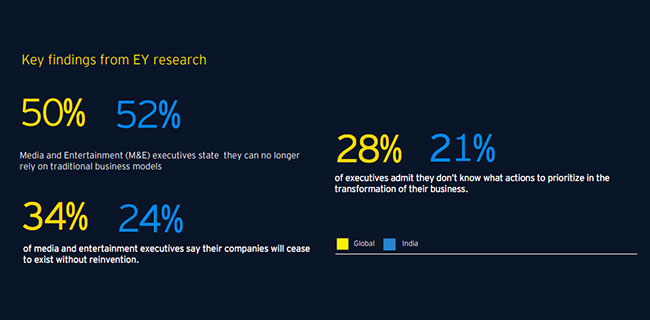
    Faced with multiple evolving and disruptive forces, 52% of executives say they can no longer rely on traditional business models if they are to remain future relevant, according to EY’s report titled, ‘How are media and entertainment businesses reinventing in an age of transformation?’. The report by EY (consulting firm Ernst & Young now refers itself as EY) analyses the views of leading media and entertainment companies and their executives to reveal catalysts, strategies and actions that are reshaping business transformation in a dynamic industry.


    The survey further highlights a sense of perplexity among M&E businesses, with 28% indicating the need to reinvigorate their business, without thorough knowledge of what aspects to prioritise. Due to a plethora of options available to invest in digital tools, one in five executives are unclear on how to prioritize their digital investments. The dilemma of whether to focus on content production for immediate gains as against building direct to customer and platform and data capabilities were cited as key points of contention.


    Said Ashish Pherwani, Partner, Media & Entertainment Leader, EY India: “With fast-paced transformations in business models and revenue streams, media and entertainment companies that otherwise are optimistic about change, are facing a challenge to determine a starting point. While there is no single path to reinvention, businesses are prioritizing direct to customer relationships, platformmatic ad sales and community subscription models, to wade through the waves of technological disruption.”


    The report states that one in two Indian executives felt the pressure to maximize short term results as a barrier to developing innovative business models which also reflected in the findings where just one in three Indian executives believe in upskilling of their existing workforce. 24% of Indian executives felt that their companies would cease to exist without innovation, demonstrating their confidence that traditional media will survive in the future.


    The survey also reveals three ambitions that M&E companies across subsectors are prioritizing above all else:

    :: Pursuing operational excellence and agility is the industry’s top transformation ambition

    Executives believe that simplification is the hallmark of the new operating model. 67% of the executives prioritise consolidation of internal segments to streamline the business, while 50% of executives identify de-layering management and increasing spans of control for remaining executives to be prominent.


    :: Rebooting innovation strategy and approach

    With 48% of executives feeling the pressure to maximize short-term results as a barrier to innovation, balancing sustained success against long-term vision requires a structured approach. 34% of executives see incubators within the core of the business, as a driver of innovation.


    :: Accelerating talent and skills development

    33% of the M&E executives cite upskilling of the existing workforce as the key to talent development highlights the growing imperative to foster continuous learning. To remain relevant, workers need to migrate up the value chain, reinventing themselves and continually improving their capabilities.


    For info: How are media and entertainment businesses reinventing in an age of transformation? is based on a survey of 350 global media and entertainment executives including 29 from India. It takes a representative view of companies by scale, geography and industry subsector. For each question and unless otherwise stated, executives were asked to select their top three responses from a predefined list of options. For example, a response of 50% means it was selected as one of the top three answers by half of respondents.

  • M&E grows ~13%, Rs 1.67 trillion in 2018: EY-FICCI report


    By A Correspondent


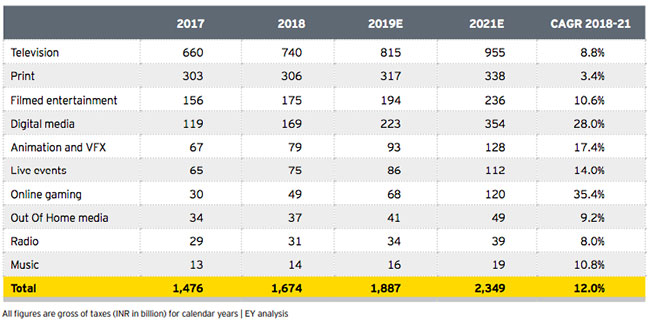
    The Indian Media and Entertainment (M&E) sector reached INR1.67 trillion (US$23.9 billion) in 2018, a growth of ~13.4% over 2017 states the EY-FICCI report ‘A billion screens of opportunity’, launched at the FICCI Frames 2019 in Mumbai on Tuesday.


    With its current trajectory, the M&E sector in India is expected to cross INR2.35 trillion (US$33.6 billion) by 2021, at a CAGR of 11.6%. While television retained its position as the largest segment, growth is expected to come from digital which will overtake filmed entertainment in 2019 and print by 2021. The report captures key insights from the exciting and fast-growing Indian M&E sector.


    The sector continues to grow at a rate faster than the GDP, reflecting the increasing disposable income and economic growth. India has the second highest number of internet users after China with ~570 million internet subscribers growing at 13% annually. The report estimates that approximately 2.5 million consumers in India today are digital only and would not normally use traditional media. It is expected that this customer base will to grow to ~5 million by 2021. Traditional media companies spent 2018 building their customer data through second-screen interactive propositions, polls, house-to-house surveys, integration of third-party data, etc. Digital consumption will grow, and monetisation avenues will see great innovation to cater to the new Indian customer segments. Telco bundling will drive consumption for a majority of Indian OTT audience. Advertising growth outpaced subscription growth and is expected to comprise 52% of the total pie by 2021.


    Said Ashish Pherwani, Partner and Media & Entertainment Leader, EY India: “The M&E sector has a significant opportunity given India’s young demographics. The growth of digital infrastructure is further enabling Indians to fulfil the need for personal content consumption, across languages and genre. There is a large shift in consumer behaviour from mass produced content to specific content defined to audience segments. The sector has an opportunity to serve a billion screens in India and globally.”


    Added Uday Shankar, Vice President, FICCI and Chair, FICCI Media and Entertainment Division, said, “The Indian M&E sector is entering a phase of accelerated growth. The status quo is being shattered by digital disruptions and that’s unshackling the creative economy in India like never before. These are exciting times for all it is to let our imagination and ambition guide us.”


    Key findings 

    :: Television:
    The TV industry grew from INR 660 billion to INR 740 billion in 2018, a growth of 12%. TV advertising grew 14% to INR 305 billion while subscription grew 11% to INR 435 billion. Television viewing households increased to 197 million, which is a 7.5% increase over 2016.Regional advertising growth outpaced national adverting growth on the back of national brands spending more to develop non-metro markets where GST created a level playing field between national and regional brands.  77% of time spent on television was on general entertainment content and film channels.

    Key insights – Broadcasters have started combined selling of ads across OTT and linear platforms to enable better monetisation of marquee properties and increased utilization of digital inventory.  The impact of the TRAI Tariff Order can have implications on total viewership, free television uptake, channel MRP rates and advertising revenues. However, 2019 promises further growth due to the elections and the ICC World Cup. The television segment can reach INR 955 billion by 2021, with advertising growth at 10% and subscription growth at 8%.


    :: Print:
    Print accounted for the second largest share of the Indian M&E sector, despite being static and growing at 0.7% to reach INR 305.5 billion in 2018. Advertising revenues stood at INR 217 billion and subscription revenues grew marginally by 1.2% to INR 88.3 billion in 2018. Newspaper advertising de-grew 1% while magazine advertising fell 10%. The fall in advertising is due to both reduced ad volumes as well as pressure on effective rates. Hindi newspaper publications continued to lead with 37% of total ad volumes, while the share of English publications stood at 25%. Rising newsprint prices and a depreciation in the value of the Indian Rupee led to pressure on print sector margins in 2018.

    Key insights – 2018 witnessed a 26% growth in digital news consumers over 2017 when 222 million people consumed news online. Page views grew 59% over 2017 and average time spent increased by almost 100% to 8 minutes per day in 2018. Print companies will tilt their sales pitch towards performance, linking physical space sales with digital inventory, activations (both physical and digital), interactive concepts like QR codes, digital couponing, etc. This will provide increased consumer data as well as a competitive plank to grow share of print.


    :: Films:


    The Indian film segment grew 12.2% in 2018 to reach INR 174.5 billion driven by the growth in digital/ OTT rights and overseas theatricals. All sub-segments, except home video grew. Domestic film revenues crossed INR 100 billion with Net Box Office collections for Hindi films at INR 32.5 billion – the highest ever for Hindi theatricals. Overseas theatricals grew to INR 30 billion from INR 25 billion in 2017 where China became the largest international market for Indian content. 98 Hollywood films were released in 2018 as compared to 105 in 2017. The box office collections of Hollywood films in India (inclusive of all their Indian language dubbed versions) was INR 9.21 billion. Multiplexes drove up the screen count to 9,601, though single screens continued to reduce.

    Key Insights:

    Digital rights redefined the content consumption processes as the segment grew from INR 8.5 billion to INR 13.5 billion. Online platforms invested heavily in exclusive film rights and a digital-only film market has emerged. In-cinema advertising grew to INR 7.5 billion in 2018 on the back of growing multiplex screens. Thirteen Hindi films entered the coveted INR100 crore club in 2018, which is the highest ever. The digital only film market came into existence in 2018.


    :: Digital media:

    In 2018, digital media grew 42% to reach INR 169 billion. Infrastructure propelled the growth in digital consumption. Digital ad spends grew 34% to INR 154 billion and now contribute around 21% of the ad market. Digital subscription grew 262% to reach INR 14 billion. Video subscription revenues almost grew three times in 2018 to reach INR 13.4 billion, on the back of new and relaunched video streaming platforms, growth of smartphones, spread of affordable broadband, regional language content, exclusive content and live streaming of major cricket and other impact properties.


    Key insights: Digital subscription reached INR 14 billion primarily due to telco bundling of content with their data plans to drive sales of data packs. The number of wireless subscribers grew from 1,167 million in December 2017 to 1,171 million in November 2018. This growth primarily came from rural subscribers who grew from 499 million to 526 million in the same period. Up to 60% of video viewership volumes were generated by telcos and the amount spent by them on acquiring content for their subscribers was INR 3.5-4 billion


    Mergers and Acquisitions in M&E


    The India M&E sector witnessed an interesting mix of deal activity in 2018 both on the traditional as well as the new media front. The number of deals in M&E in 2018 remained the same at around 40 though the deal value more than doubled in 2018 to US$2.8 billion from US$1.3 billion in 2017. 41% of deals were in the digital segment in 2018, compared to 30% of deals in 2017 while deals in the gaming segment came next with 20% of the deals. The digital segment has been at the forefront of deal activity as India’s demographic dividend in the form of smartphone users, internet penetration and improving bandwidth continues to grow exponentially. The consolidation wave in the M&E sector is expected to accelerate and continue as large media corporates strengthen their presence for achieving scale, reach and relevance. The sector is also gaining huge interest from global strategic players who want to be part of the rapid growth in this sector, on the back of greater availability of data.


    Please click here to read the complete report.


  • M&E to cross Rs 2tn by 2020: FICCI-EY report


    By A Correspondent


    FICCI-Frames 2018 took off on Sunday evening with I&B Minister Smriti Irani as Chief Guest. As part of the inaugural session, the annual M&E industry report, this time presented by the team at Ernst & Young (EY). The venue this year is the Grand Hyatt in Santacruz East, away from the Renaissance at Powai where Frames has been happening for 16 of the 18 editions.


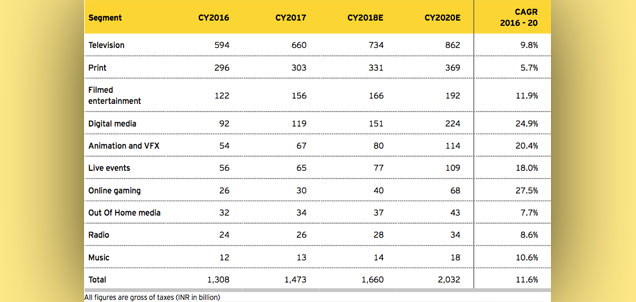
    Back to the report: the Indian Media and Entertainment (M&E) sector reached almost INR1.5 trillion (US$22.7 billion) in 2017, a growth of around 13% over 2016. With its current trajectory, it is expect to cross INR2 trillion (US$31 billion) by 2020, at a CAGR of 11.6%. The digital segment-led growth, demonstrating that advertising budgets are in line with the changing content consumption patterns The  FICC-EY report is appropriately titled ‘Re-imagining India’s M&E sector’ and captures key key insights from the Indian M&E sector.


    The M&E sector continues to grow at a rate faster than the GDP growth rate, reflecting the growing disposable income led by stable economic growth and changing demographics. The report states that subscription growth outpaced advertising growth in 2017 but advertising will continue to grow till 2020 led by digital advertising. The report estimates that approximately 1.5 million consumers in India today are digital only and would not normally use traditional media. It is expected that this customer base will to grow to ~4 million by 2020 generating significant digital subscription revenues of approximately 20 billion. Going forward, micropayments, enabled through the Unified Payment Interface (UPI) and Bharat Interface for Money (BHIM) platforms developed by the National Payments Corporation of India (NPCI) will further accelerate subscription revenues for entertainment content.


    Said Farokh Balsara, Partner and M&E Leader, EY India:  “Indian M&E sector reached INR1.5 trillion in 2017 led by digital. With digital subscribers expected to reach 20 million by 2020, has Indian M&E reached its digital tipping point? We now need to re-imagine the future of  Indian M&E sector.”


    Added Ashish Pherwani, Partner and M&E Advisor Leader, EY India: “Growth in 2017 was led by the digital, film & animation & VFX segments. We expect sectors like digital and gaming to grow between 2 to 3 times by 2020.”


    Key findings

    :: Television:
    The TV industry grew from INR594 billion to INR660 billion in 2017, a growth of 11.2% (9.8% net of taxes). Advertising grew to INR267 billion while distribution grew to INR393 billion. Advertising comprised 40% of revenues, while distribution was 60% of total revenues. At a broadcaster level, however, subscription revenues (including international subscription) made up approximately 28% of revenues.

    Key insights– While advertising is 41% of the total revenues today, the report expects it to grow to 43% by 2020. There are over 30% households in India which are yet to get television screens, but being at the bottom of the pyramid, these households will tend to move towards first towards free and sachet products.


    :: Print:
    Print accounted for the second largest share of the Indian M&E sector, growing at 3% to reach INR303 billion in 2017. Print media is estimated to grow at an overall CAGR of approximately 7% till 2020 with vernacular at 8%-9% and English slightly slower. This growth is expected despite the FDI limit remaining unchanged at 26% and therefore, restricting access to foreign print players and the imposition of GST at 5% on the advertising revenues of the print industry for the first time in history. While magazines contributed 4.3% to the total print segment, the segment was at largely status quo with not many significant new launches in 2017.

    Key insights– Today, 98% of readers read dailies and 20% read magazines. Reader base is 395 million, or 38% of the population. Readership has grown by 110 million over the last 3 years. Rural (52%) reader base is larger than urban (48%). 44% of children (aged 12 to 17 years) read a newspaper or magazine. Magazines have a higher readership in urban areas (57%) as compared to rural areas (43%).


    :: Films:
    The Indian film segment grew 27% in 2017 on the back of box office growth – both domestic and international – coupled with increased revenues from sale of satellite and digital rights. All sub-segments, with the exception of home video grew and the film segment reached INR156 billion in 2017.The Hindi films comprise the majority component of the Indian film segment. They contribute almost 40% of the net domestic box office (BO) collections annually, despite comprising only 17% of the films made. Films in 29 other Indian languages account for approximately 75% of the films released but they contribute approximately 50% to the annual domestic box office collections. Hollywood and international films comprise the balance. The top 50 films contributed approximately 97.75% of the total net box office collection. Box office collections of the top 50 films grew by 11.60% in 2017.

    Key Insights: Regional movies drove the growth in number of releases in 2017. Screen count increased from 9,481 in 2016 to 9,530 in 2017. Number of Hindi movies crossing the INR1 billion mark was highest in 2017 in the past 5 years. From 31 movies in 2016, Hindi dubbed movies increased more than 3 times to 96 in 2017.


    :: Digital media:

    Digital media has grown significantly over the past few years, and continues to lead the growth charts on advertising. Subscription revenues are emerging and are expected to make their presence felt by 2020. In 2017, digital media grew 29.4% (27.8% net of the impact of GST) on the back of a 28.8% growth in advertising and a 50% growth in subscription. Subscription, which was just 3.3% of total digital revenues in 2016, is expected to grow to 9% by 2020.

    Key insights: 250 million people viewed videos online in 2017 and expected to double to 500 million by 2020. Around 40% of total mobile traffic came from the consumption of video services in 2015. This figure is expected to touch 72% by 2020. 93% of time spent on digital videos is in Hindi and other regional languages. OTT subscription in India is expected to touch INR20 billion by 2020.

    M&A in M&E


    The Indian M&E sector witnessed a relatively new trend in deal activity with emerging segments such as gaming and digital gaining momentum, while the deal activity in the traditional media segments was slower. The slowdown can be partially attributed to challenges faced by the advertising segments of the industry due to demonetisation and GST. Overall, the number of transactions in the M&E sector decreased from 56 deals in 2016 to 40 deals in 2017. Further, the total deal value was also lower at US$1,261 million in 2017 compared to US$2,863 million in 2016.


    The entire report can be accessed at here


  • Indian events and activations biz to cross 10k cr by 2020-21: EY


    By A Correspondent


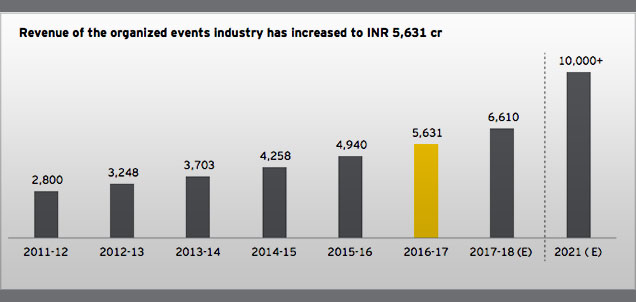
    The Events and Activations industry has grown at 16% in FY2016-17 and is expected cross INR 10,000 crore by FY2020-21 according to EY – EEMA (Event and Entertainment Management Association) report titled ‘#Experience_Next’. The key insights in the report suggests that average number of events are increasing across all formats, Government spending is expected to grow at 14% and sports is expected to grow at 18% over the next 5 years, wherein India attributes to 1% if the global sports market.


    Said Ashish Pherwani, Partner and Media & Entertainment Advisory Leader, EY India: “The Events and Activation industry is growing at a fast pace and is expected to further grow exponentially due to its ability to adapt and grow with innovative technology. With focus on newer avenues such as sports leagues, rural expansion, digital activations, increased Government marketing initiatives etc., we see events industry surpassing overall growth rate of M&E industry.”


    Added Sabbas Joseph, President, Event and Entertainment Management Association:“Event management has now transformed into experience creation with amalgamation of technology, innovative ideas and creative content. The Indian economy has undergone a lot of changes in the recent past and the Events and Activation industry has come out unscathed. This demonstrates the industry’s strength and ability to get things done under any circumstances.”


    According to the report which is based on a survey of 64 event management companies and 31 marketers, overall the events and activations industry is expected to grow from INR 5,631 cr in 2016-17 to INR 10,000+ cr in 2020-21. The organized events industry is growing faster than the 11% – 13% CAGR of the Indian M&E industry. The key growth drivers for the same are digital activation, sports leagues, rural expansion and government initiatives followed by IPs, personal events, product launches, expansion of mini-metros and BTL spends.


    Some more snapshots of the findings from the report on the current scenario:

    [] Managed events is still the largest segment, with around 90% of respondents providing these events

    [] Average IPs and activations per respondent have doubled since 2013-14, while average digital events per respondent have shown a 9x growth since 2013-14

    [] There is a fall in proportionate revenue generated by activations from 31% in 2015 to 22% in 2017, showing that there is a distinct move to digital activations

    [] More respondents are providing services internationally – up sharply from 8% in 2011 to 56% in 2017

    [] Around 75% of all respondents’ clients were corporates

    [] Technology, FMCG, auto, media and entertainment and telecom are the largest users of the Events & Activations industry

    [] An average of 26% of the total employees of the respondents consist of women employees


    And on opportunities for the industry:

    [] Digital is driving growth, as respondents felt that marketers spends on digital events would grow at 20% over the next two years

    [] Most respondents felt that sports would significantly grow at 18%

    [] Most respondents expected ticketed events to witness a moderate level of growth in the next 2-3 years

    [] 95% of the survey respondents agreed that rural events and activations would gain increased importance over next 2-3 years

    [] Over 85% of respondents plan to launch new products or properties in the next two years, and almost a fifth of respondents will launch 3 or more products

    [] 73% of marketers expected their BTL spends to grow during the next two years, with 43% expecting growth to be over 10% per annum

    [] Digital integration was either important or very important for the events of 90% of marketers


  • Solving the M&E Puzzle


    By A Correspondent


    At the recently held INMA South Asia Conference, Ashish Pherwani, Partner, Advisory Services, Media & Entertainment, E & Y LLP, spoke on how media companies should balance the pressures of running a profitable media business in the present while creating a business for the future
     

    This is a summary of what he spoke:

    At a global level,  newspaper ad revenue levels have been stabilised, as newspapers build digital models around some very strong communities; eg – NYT cooking app, Bild auto, etc. In India, the growth in news is 7%. It’s 4% lower than the other media. In many other developed countries, the primary source of news is TV or digital, hence the role of the newspaper is  changing to giving more opinion, analysis and width of coverage. According to a Reuters survey from across 26 countries and 50,000 respondents, younger audiences consume news online and through social media, and people above the age of 55 years also first receive news digitally rather than print. There is a possibility that print media will be dead in the next 10 years; digital deflation poses as a real threat. The solution? Organisations will have to grow reach exponentially (eg: Times of India and its width of offerings; creating the right brands for customer will be key), improve monetisation (via ad sales, ad network partnerships, syndication, transactions, subscription and monetisation of archives) and bring in cost efficiency via partnerships. All in all, the news organisation of the future will be focussed on building communities that are monetisable with news trading, curation-strategies, templated and AI-led efficiencies.


    And this was his presentation

    http://www.inma.org/Modules/Event/2017SouthAsia/Presentations/AshishPherwani-Southasia2017.pdf


  • M&E to touch $34.8bn by 2021: EY


    By A Correspondent


    The Indian Media and Entertainment industry is expected to touch USD 34.8 billion, witnessing a CAGR of 11.8% over 2016-21, according to a report titled ’Digital inflection point: Indian media and entertainment’, released at the FICCI-IIFA Global Business Forum in New York.


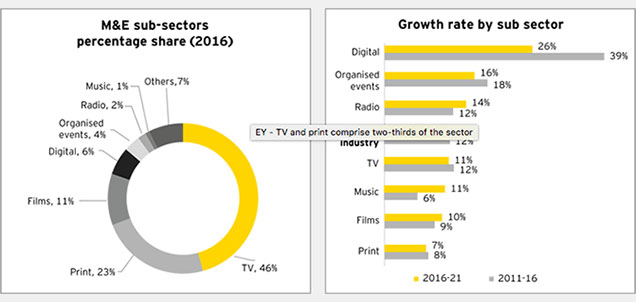
    Amongst the sub-sectors in the Media and Entertainment industry, Digital (which includes Digital advertising, advertising on mobile, OTT, etc.) is expected to register the highest growth at 26% CAGR in the 2016-2021 period. This is followed by organized sector (expected to grow at 16% CAGR), Radio (at 14% CAGR), TV (at 11% CAGR), Music (11% CAGR), films (at 10% CAGR) and Print (at 7% CAGR) respectively in the same period.


    Commenting on the report, Ashish Pherwani, Partner – Advisory, Media and Entertainment, EY said: “The Indian M&E sector is at a digital crossroads today. Every segment of the industry, including print, TV, radio, film, experiential marketing and OTT, is being impacted by digitisation, and is showing growth, consolidation and innovation. It presents an excellent opportunity for companies looking at establishing and expanding their presence in the country, and making the most of the India digital growth story”


    Added Leena Jaisani, Assistant Secretary General – FICCI: “India is home to one of the most vibrant, dynamic and differentiated M&E markets in the world. The Indian M&E industry has adapted and innovated its offerings to cater to the huge and varied demand in each segment of the industry, be it Films, Broadcast, Digital, Animation, Print or Live Events. The government has been imperative in boosting growth, investment opportunities & facilitating ease of doing business in the industry with initiatives such as single window clearance, favorable tax incentives, policies & regulations in place. Today definitely is the time to invest in Indian Media & Entertainment Industry.”


    According to the report, currently, television continues to dominate the M&E sector, with the segment accounting for 46% of the sector’s revenue share in 2016. Television, print (23%) and film (11%) segments together accounted for ~80% market share in 2016.Digital (6%), organized events (4%), Radio (2%), music (1%), and other segments (7%) constitute the other 20%.


    In 2016, total advertising spend across all segments in Indiastood at USD 8.18 billion which is estimated to reach USD 16.7billion in 2020.Print media and TV together accounted for 76.2% of the totalrevenue from advertising in 2016. Mobile advertising hasemerged as the third largest advertising medium in India afterTV and print, notes the report.


    The report also predicts the subscription market – pegged at USD 9.3 billion in 2016 – will grow to USD 15 billion by 2020.


    The report can be accessed at ey.com/in/InvestInMandE


  • Free TV viewership to touch 46mnby 2020: EY


    By A Correspondent


    Free TV viewership in India is set to register exponential growth, reaching 46m households by 2020, according to a report titled ‘India’s Free TV – A game changing opportunity’ published by consulting major EY (Ernst & Young). This will be in addition to consumption of content on mobile DTT handsets.The increase in the number of FTA channels has also led to asignificant rise in viewership for genres such as Hindi GEC, Hindi movies and, primarily, the Hindi news genre, in which FTA channels command 81% of the total viewership.


    Commenting on this, Ashish Pherwani, Partner – Advisory, Media and Entertainment, EY said: “Free television is increasingly becoming a viable option for channels looking to capture the base-of-pyramid audiences in urban and non-urban areas. With a large subscriber base, it also opens up new avenues of advertising for marketers looking to get reach in some of the fastest growing markets in the country. The change in customer behaviour will also have a significant impact on FTA and pay TV channel uptake, and corresponding spends on subscription income.”


    Currently, rural TV viewers contribute to 52% of the overall viewership.However, it is estimated to contribute 74% of the total viewershipon DD Free Dish.


    The report outlines four key factors which will drive the uptake of free television:

    1. Digitisation of cable TV distribution – DAS IV

    The mandatory move towards digitization will require consumers, particularly those in DAS III and IV markets, to opt for more expensive cable TV options, DTH or free TV options such as terrestrial TV or Free Dish. EY expects the price conscious customers may opt for free television services in the immediate term.


    2. The proposed new tariff order

    The new tariff order will make customers choose between the options to either pay more to receive pay channels oftheir choice or decide that free television would be a betteroption, given the quantum of quality content on it. This will help further drive subscriptions from price conscious consumers for Free TV.


    3. The fast growth of DD Free Dish

    DD Free Dish bouquet is set to increase to over 250 channels, featuring quality content, also including sports being available on its spectrum. This makesthe Free Dish bouquet a formidable competition to pay bouquets.


    4. DTT on mobile infrastructure

    Another important development relating to mobile television is theemergence of digital terrestrial distribution. Since this is a broadcasttechnology, the key implication will be that consumers whosemobile handsets have the required antenna would not berequired to pay any bandwidth charges. Consequently, once themobile handset ecosystem matures, DTT could also provide astrong addition to free television services.


    The report also notes the implications of growth in free television for broadcasters and distribution companies in the near future, which include:


    Broadcasters:

    :: Pricing of channels, particularly those that are not leaders in their genres, and determination of whether channels should move to FTA
    :: Number of channels to include in base and base+ packs of distributors
    :: Carriage fee considerations
    :: Creation of free television products and differentiation of free and paid television products
    :: Competition from Free Dish offerings to broadcasters’ pay channels
    :: Increasing audience reach from a DTT perspective


    Distributors:

    :: Creating packages for various customer segments, while at the same time convincing customers to pay more for fewer channels
    :: Ensuring channels from all broadcasters are present in each popular package
    :: Placement of channels in and within appropriate packages
    :: Prevention of subscriber migration to free television


    The report ends with providing some ideas which Free TV operators can consider.


    The report can be accessed at ey.com/in/FTA Opportunity


  • Surat, Jaipur, others to drive consumption: EY


    By A Correspondent


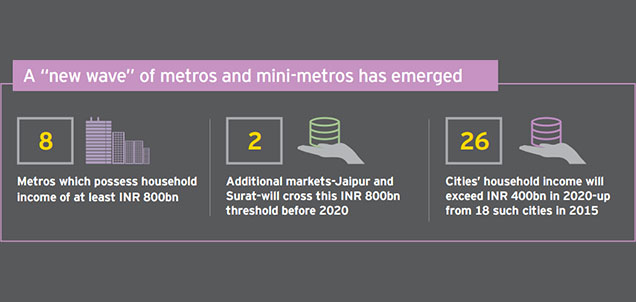
    India will see the rise of two new metros – Jaipur and Surat – by 2018, with a household income of over Rs 800bn by 2018, according to an EY report titled ‘India’s growth paradigm: How markets beyond metros have transformed’. These are projected to record real GDP growth of 8.7% and 10.3% respectively from 2015-20, relative to metros’ 8.3%. As a result, both cities will cross the Rs 800bn threshold within one to two years, with total consumption levels to reach 75%-80% of metros like Pune and Ahmedabad.


    The report identifies 42 new-wave markets, which are expected to grow at 8.9% as compared to the 8 metros that are expected to grow at 8.3% CAGR in the 2015-20 period.


    Said Ashish Pherwani, Media and Entertainment Advisory Leader: “Non-metro growth is out-stripping that of metros in India. There are clear cases of unmet demand in India’s Top 50 cities in certain sectors. This provides a huge opportunity for various sectors to both widen and deepen marketing strategies, and effectively tap into one of the world’s largest earning populations.”


    The report also notes the rise of eight new half-metros, with household income exceeding Rs 400bn by 2020. It also highlights 13 new-wave cities that represent a high-growth opportunity, but are largely untapped, according to the report. These include Patna, Raipur, Warangal, Gwalior, Dehradun, Allahabad, Rajkot, Vishakhapatnam, Jodhpur, Vijaywada, Ranchi, Kota and Jabalpur.


    Additionally, the top 23 untapped markets, as identified by the report, are all new-wave cities. These 23 markets represent 19% of metros’ household income-but only 12% of retail outlets 15% of telecom centres and 17% of malls, notes the report.


    The report further considers the potential of individual markets across each sector – FMCG, Retail, fashion and durables, Auto, Telecom and DTH, E-Commerce, Education, BFSI, and Real Estate. It delves into the expected ad spends across each sector, and highlights the top-10 untapped markets across each sector.


    The report can be downloaded at www.ey.com/in/urban-growth.


  • E&Y report on apps unravels amazing insights

    By A Correspondent


    With billions of devices expected to be connected in the coming years, media and entertainment companies are well-positioned to seize an early advantage as an enabler and receiver of IoT applications, according to the EY report ‘Internet of Things: Human-machine interactions that unlock possibilities’. The total potential for IoT in the M&E space is expansive — to create, deliver and tailor content for new platforms and to measure the context of media consumption using analytics.


    The increasing sophistication of IoT sensors makes it possible for devices to read, gauge and understand consumers at unprecedented levels. According to the report, the M&E industry is already using categories of sensors such as inertial, motion and image sensors used in animation, gaming, video images, camera stabilization, sports and 3D. This is opening up new, intimate entertainment experiences for consumers.


    One of the most anticipated benefits of IoT for marketers is its potential – through the use of sensors – to unlock data on a person’s habits, preferences and most significantly, the context in which media is being consumed. Better data analytics will also address deficiencies in the current measurement system for media consumption, such as avoiding the duplication of unique users across platforms, and enhance what marketers know about their audiences.


    Ashish Pherwani

    Ashish Pherwani, Partner and Head – Advisory, Media and Entertainment, EY says, “IoT is bringing a rapid disruption in the way content is distributed and consumed. The in-depth insights provided by smart devices is allowing M&E companies to respond to evolving customer needs and deliver personalized, contextually relevant entertainment experiences to consumers. Moreover, it is enabling them towards better targeting, thus boosting ad spends and subscription income via increased human-machine interactions.”


    If smart devices provide useful data to content providers that is perceived as non-intrusive and the resulting content experience correctly interprets consumers’ current readings (mood, need, intention) in real-time, and then quickly respond to those needs with relevant and targeted advertising, the implications for improved brand loyalty could be vast.


    For M&E companies to realize the full potential of IoT, they need to also consider the associated risks, including regulatory hurdles, legal precedents, intellectual property rights, lack of connectivity standards and lack of IoT scale to reach critical mass, the report finds. The biggest challenges are around privacy and cybersecurity. Protecting personal information is an issue that will become exponentially more difficult as IoT collects enormous amounts of data and connects more devices, software, machines and humans.