Tag: ASCI

  • ASCI’s updated advertising guidelines for education sector

    By Our Staff


    The Advertising Standards Council of India (ASCI) has updated its guidelines for advertising educational institutions, programmes, and platforms after rigorous rounds of public consultation. The exercise was undertaken with the aim of establishing a set of just and equitable principles that concern a critical industry in the country: education. Public consultation for the guidelines started on March 14, 2023 and concluded on April 15, 2023.


    Education has been among the top violative sectors for the past few years when it comes to advertising. In its Annual Complaints Report 2022–23, classical education ranked second among the top violative categories with 13.8% of total ads that did not adhere to ASCI’s guidelines.


    While ASCI’s existing education guidelines require educational entities to substantiate any claims they make in their advertisements with relevant evidence, this latest update ensures that the advertisers are also mindful that their ads consider the students’ mental and physical well-being. The amendments state that ads by educational institutions, including universities, colleges and schools, coaching classes, EdTech platforms and others that offer education and training programmes should not stereotype students based on their gender, or appearance, nor portray those who score low as unsuccessful or failures.


    Further to complying with the general rules of ASCI’s Code for Self-Regulation in Advertising, and the existing educations sector guidelines, the advertisements of educational institutions, programmes and platforms will now have to comply with the following additional guidelines:


    An advertisement may not show school students compromising on sleep or meals to study as this normalises unhealthy habits which are detrimental to student health.


    While an advertisement may show disappointment with low scores, it must not portray an average or poor scorer as an unsuccessful student or a failure,  or show him/ her/ them as demotivated, depressed or unhappy, or receiving less love or appreciation from parents, teachers or peers.


    An advertisement must not create a false sense of urgency or fear of missing out that could accentuate anxieties amongst school students, or their parents.


    While an advertisement may feature students of any gender, the advertisement must not suggest that certain subjects are associated with particular genders alone. Advertisements must also not suggest that students with high scores are always associated with stereotypical characteristics such as wearing thick glasses. This does not prevent advertisements from depicting such students so long as they do not suggest that only these students are successful.


    Responding to the new guidelines, Rohit Kumar Singh, Secretary, Ministry of Consumer Affairs said: “Education advertising touches almost every citizen in the country. Ensuring the sanctity of advertising in this sector is an important task. The ASCI guidelines address the various issues that plague the sector and we hope that the industry will follow these in letter and spirit. I would like to reiterate that misleading ads are also a violation of the Consumer Protection Act and all necessary steps will be taken to keep our citizens safe”.


    Talking about the amendment to education guidelines, Manisha Kapoor, CEO and Secretary General, ASCI, said: “In addition to ads not being misleading, the updated guidelines also provide for the physical and mental well-being of students, particularly school students. While fierce pressure in education is a reality, advertising must not perpetuate this problem. normalise it or exploit student and parental vulnerability. Based on our Ed-Next study, such issues were identified, and post extensive consultation with different stakeholders, we are now issuing the updated guidelines. ASCI remains deeply committed to consumer protection, and we will continue to update our Code to reflect contemporary and emerging concerns in advertising content”.

     

  • Goafest 2023 unveils agenda and speaker line-up

    By Our Staff


    The Goafest 2023 organising committee has unveiled its speaker line-up and the agenda for the festival.


    The three-day event will see over 60 leading global and Indian speakers and performers across 20 knowledge seminars and 11 masterclasses.


    Leading advertising personalities like Nick Law – Global Creative Chairperson – Accenture Song and Ed Pank – Managing Director – WARC APAC will address the audiences. Besides this, celebrities from Indian sports and Bollywood like Harbhajan Singh, Tabu and Rana Daggubati will talk abut their achievements and stories of strength.


    The panels will see participation of leading corporate personalities like Hemant Malik of ITC Foods, Rohit Kapoor of Swiggy, Prabha Narasimhan of Colgate-Palmolive, Chandan Mukherji of Nestle India, Priyanka Gill of Good Glamm Group, Ravi Santanam of HDFC and Vipul Prakash of MakeMyTrip.


    The sessions will also see industry leaders like Rajan Anandan of Sequoia Capital,  Sam Balsara of Madison, Josy Paul of BBDO, Rohit Ohri of FCB, Anusha Shetty of Grey, Dheeraj Sinha of Leo Burnett, Vikram Sakuja of Madison, Subhash Kamath, Anupriya Acharya of Publicis, Tarun Katyal of Coto, Lata Venkatesh of CNBC TV18, T Gangadhar of Quotient, Aditi Mishra of Lodestar UM, Amin Lakhani of Mindshare, Mohit Joshi of Havas Media, Naveen Khemka of Essence Mediacom, Geet Lulla of Comscore, Pankaj Krishna of Chrome DM and Salil Kumar of ITGD sharing their invaluable insights.


    Special sessions curated by the Advertising Standards Council of India on Creator Calling Creator, by the IAA on Voice of Change on Gender Bias and Ad Asia 2023 Seoul Roadshow by AFAA have also been scheduled. Advertising Rocks, a unique industry initiative and Musical Contest, will also be staged.


    On the entertainment end, there’s singer-composer Kanika Kapoor, playback singers Papon, Divya Kumar and Asees Kaur and Digital Creator and Stand Up Comic, Aiyoo Shraddha. Plus DJ Suketu, Savio and DJ AJ for the late evenings.


  • ASCI tables Annual Complaints Report 2022-23

    By Our Staff


    The Advertising Standards Council of India (ASCI) released its annual complaints report for 2022-23 which contains several startling observations, especially those pertaining to advertising in the digital space. During the period, ASCI reviewed 7,928 advertisements across different media, including print, digital and television. ASCI has stepped up its scrutiny of ads nearly 2 folds over the last 2 years. TV and print advertisers continued to be highly compliant at 94%, however the overall compliance is lower at 81% due to digital. Hence, digital ads emerged not just as a leading violator, with 75% of ads processed being from the digital space, but also as the least compliant. This raises serious concerns about the safety of consumers in the online space.


    As per the report, the real-money gaming industry surpassed the education sector to emerge as the most violative sector, moving from fifth to first place. An astounding number (92%) of gaming advertisements reviewed by ASCI for FY 2022–23 did not adhere to the guidelines for real money gaming and failed to inform consumers about the risks of financial loss and addiction. The sector also gained the dubious distinction of being the least complaint, with only 50% of ads being modified voluntarily after they have been called out. It may be remembered that ASCI had released its guidelines for the Real-Money gaming sector in December 2020, and the Ministry of Information and Broadcasting had thereafter released an advisory asking all parties to comply with the guidelines.


    The report also revealed a sharp increase in the number of misleading ads featuring celebrities. ASCI processed 503 such ads, as opposed to 55 the previous year, a growth of 803%. In 97% of these ads, the celebrities failed to provide evidence of due diligence as mandated by the Consumer Protection Act. This again is a serious issue as ads featuring celebrities have a high impact on consumers.


    In addition, influencer violations stood at 26%, with 2,039 complaints being processed against them. Categories, including personal care, food and beverage and fashion and lifestyle, topped the list of influencer-related violations.


    ASCI’s adoption of artificial-intelligence-based tracking has bolstered its ability to scrutinise digital media effectively, despite challenges such as the pace of advertising and the sheer number of ads to be processed. This goes to show that the self-regulatory organisation remains steadfast in its commitment to promote responsible advertising practices and protect consumer rights.


    The ASCI Annual Complaints Report serves as a wake-up call to advertisers, platforms, and regulators, urging them to join forces and create a secure environment and foster trust among consumers.


    NS Rajan, Chairman, ASCI, observed: “The digital advertising landscape is truly challenging us all and ASCI is no exception. Stepping up our surveillance through AI based tools and a robust complaint management system has ensured that ASCI is keeping pace with this dynamic environment. Updating our codes to reflect newer consumer concerns makes sure the ASCI codes remain contemporary. We will continue to act as the conscience keeper of the Indian ad industry with transparency and future-facing expertise.”


    Manisha Kapoor, CEO and Secretary General, ASCI, added: “The complaints analysis for 2022–23 clearly shows that the digital medium is leading in terms of violative ads. This raises significant concerns around online consumer safety and trust. Advertisers, content creators and platforms must come together to address this issue on an urgent basis to protect consumer interests. In addition, the sharp increase in the number of violative gaming ads needs serious attention from the industry.”


  • ASCI: Toothless Tiger or Scapegoat?

    Hand drawn toothy tiger. Designed By 千图网 from https://pngtree.com


    By Prabhakar Mundkur


    Prabhakar MundkurFor some time now, the Advertising Standards Council of India (ASCI) has been the subject of criticism about its effectiveness. There is the annual rant in the media with various commentators taking potshots before or during an IPL which sees a major blip in advertising in India. ‘Watchdog’, which is often used to describe the ASCI, is perhaps not wholly descriptive of what it does. It can watch like a dog, but I am not sure it can bite. To bite you need legislation and now we have the Department of Consumer Affairs which has the teeth to bite. In the UK, for example, it is not the ASA that is considered the watchdog, but the Competition Markets Authority. The CMA has teeth. It is a non-ministerial government department to prevent anti-competitive activities. The Indian equivalent is the Competition Commission of India which was formed under the Competition Act 2002, which was formed when the erstwhile MRTP Act was repealed. But unlike the MRTP, which was very high profile, you don’t hear much about the CCI. That’s a pity!
     

    Most critics of course miss the point that the ASCI is the advertising industry’s self- regulatory body. In many ways, it is the industry’s conscience that tells you what is misleading. And like we can always overcome our own conscience even when it is telling us not to do something, an advertiser can knowingly bend the rules. When you can overcome your conscience, you are being unscrupulous.


    But coming back to the issue of misleading advertising, there are several bodies that are responsible for misleading advertising in the country. For example, the Cable Television Network Rules does not permit advertising for alcohol or tobacco products. Section 7 of the Rules on the Advertising Code has an exhaustive list of things that cannot be permitted.


    (viii) promotes directly or indirectly production, sale or consumption of- (A) cigarettes, tobacco products, wine, alcohol, liquor or other intoxicants;


    But rarely does anyone complain to the network channels that surrogate advertising for alcohol is being found objectionable by then. After all isn’t ASCI the favourite whipping boy for advertising that seems to cross the borders of acceptable advertising norms?

    (1) The Central Authority may, after receiving any information or complaint or directions from the Central Government or of its own motion, conduct or cause to be conducted a preliminary inquiry as to whether there exists a prima facie case of violation of consumer rights or any unfair trade practice or any false or misleading advertisement, by any person, which is prejudicial to the public interest or to the interests of consumers

    – The Consumer Protection Act, 2019


    Equally, the Consumer Protection Act 2019 issued by the Ministry of Law and Justice protects the interests of consumers through legislation and it has a mechanism for accepting consumers complaints. It also has the authority to disburse fines for misleading products or advertising. Violation of their guidelines for endorsement can attract penalties from Rs 10 lakh to Rs 50 lakh.


    So why is the ASCI the favourite pick of advertising-watchers when they find objectionable advertising in our media? If one actually looks at the number of regulatory bodies in the country there are quite a few.


    1. Food Safety and Standards Authority (FSSAI)

    2. Central Drugs Standard Central Organisation (CDSCO)

    3. Insurance Regulatory Development Authority

    4. Telecom Regulatory Authority of India

    5. Securities and Exchange Board of India

    6. Reserve Bank of India

    7. Medical Council of India

    8. Competition Council of India

    9. Consumer Protection Act 2019


    But perhaps what India lacks is an inter-disciplinary body or an inter-ministerial apex body that can look at the subject of misleading advertising.


    For example, if we take the UK as a market, the Competition Markets Authority and the ASA form a powerful duo against misleading advertising. Also, misleading advertising can be controlled by the Consumer Protection from Unfair Trading Regulations 2008 and Business Protection from Misleading Marketing Regulations 2008. The Office of Communications (Ofcom) is the ASA’s co-regulatory partner and legal backstop for regulating TV and radio advertisements. The Financial Conduct Authority for example in UK blocks several financial services ads. In 2022, it removed 8582 consumer promotions and published over 1800 alerts to prevent consumers from losing their money to financial scams.


    The House of Commons briefing paper considers the ASA ( Advertising Standards Authority ) and the regulation of advertising in the UK and therefore has the indirect consent of the government unlike the ASCI.


    The ASA working hand in hand with the Competition Markets Authority gives the ASA very large teeth indeed. And the CMA will get some very extra large teeth from the Digital Markets, Competition and Consumer Bill to be introduced shortly. Also, the several legislations provide a whole bag of weapons for the ASA to conduct their business of tracking misleading advertising.


    In closing, I would like to point out that in markets like the UK it is possible for the self-regulatory body the ASA in the UK to have very large teeth that can bite those that stray away from the advertising standards code. India pales in comparison.


    So I leave you to decide whether the ASCI is a toothless tiger or is just being made a scapegoat for the lapses in the fight against misleading advertising in India.


    Prabhakar Mundkur is a veteran advertising professional and commentator. If it’s not his views on A&M, he’s very busy with his music, and in the lockdown produced several music videos (some 100-odd). His views here are personal.


  • Boycott: Our weapon to fight surrogate advertising

    Image courtesy Twitter handle @RoshanKrRaii


    By Vikas Mehta


    Vikas MehtaIt’s time to kick a few butts.


    For years, surrogate advertising has been the bane of the Indian communication industry. First it was cigarettes and alcohol and now for the last few years it’s been pan masala.


    More than a year ago, Amitabh Bachchan had raised the hackles of many when the septuagenarian appeared in an ad for Kamla Pasand along with Ranveer Singh. The actor, who once was the darling of the masses, took quite a beating on social media when he first defended his action saying that the ad was part of the entertainment business which provides employment to many people.


    When he was mercilessly trolled on social media and when a national anti-tobacco agency requested him to refrain from endorsing tobacco products, the actor put on a big act.


    He grandly announced that he is terminating his contract with the company, returning their money and also said that he did not know that the silver coated elaichi, which was the product shown in the ad, was part of surrogate advertising. Ha!


    Read that again. He said that he did not know that he was part of a surrogate ad. Mr. Bachchan wanted us to believe that his lawyers and his advisors were so unaware that they had no idea of this malaise called surrogate advertising. His naivety was an act for the ages.


    The campaign had broken out in September 2021 and in October, on his birthday, Mr Bachchan had made the grand announcement.


    But the ads continued. When another round of protests hit social media, Mr. Bachchan’s office released a statement in mid-November saying that they have sent a legal notice to Kamala Pasand, to stop broadcasting the TV commercials with Mr Bachchan immediately, as it was noticed that despite termination of the endorsement agreement ‘ Kamala Pasand ‘ has ignored the same and is seen to continue airing the TV commercials.


    The result: Nothing. Zilch. Nada. No change. Social media got tired, bored, disillusioned of this tamasha and moved on. And the ad continued to be aired. Another version of it was also released. Right through 2022, all major cricket events unleashed the campaign. It went on even in 2023. Till almost the half-way stage of IPL.


    After more than one-and-a-half year of endorsing a surrogate tobacco product, a time when other pan masala brands, no doubt emboldened by the free run that Kamla Pasand had, and featured celebrities like Akshay Kumar, Shah Rukh Khan, Ajay Devgan, Salman Khan; Mr. Bachchan, seemed to have finally persuaded the brand to remove its ad. No, that should read as, the ad was withdrawn after maybe it had run the course of its contract.


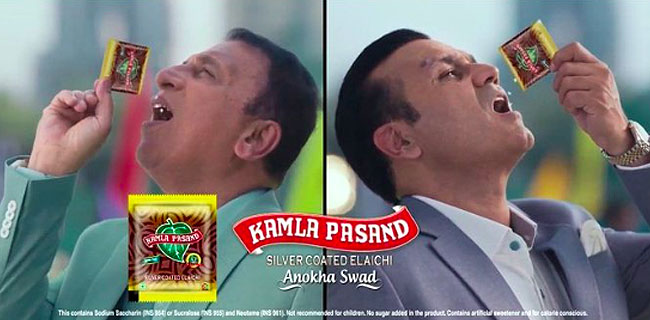
    But the legacy of endorsing a surrogate brand continued. And the culprit this time is another septuagenarian cricketing legend along with a dashing cricketer who has a school in his name.


    Ladies and Gentlemen, let me introduce Shri Sunil Gavaskar, ex-cricketing legend, ex-Sheriff of Mumbai, Padma Bhushan recipient, Arjuna Award-winner, ICC cricket Hall of Fame member as the latest entrant to the tobacco surrogate celebrity endorser Hall of Shame.


    And he is keeping illustrious company. Shri Virendra Sehwag is a cricketer who changed Test cricket with his fearless approach to the game. And now his fearless approach is to endorse a surrogate for Pan Masala. Not fearing that it will influence many people into believing the veracity of pan masala. A Padma Shri recipient, Wisden Cricketer of the year and ICC Test player of the year, Shri Sehwag has also started Sehwag International School in Haryana on a piece of land gifted by the Haryana government. Undoubtedly, he will be a role model for the schoolchildren to consume pan masala.


    It’s really shocking that neither the government, nor the advertising bodies and nor the celebrities themselves have an iota of responsibility to clean up this mess.


    Why are the anti-tobacco advertising laws full of loopholes for the manufacturers to exploit? Or, if there are no loopholes, then why no action is being taken against the offending brands.


    ASCI is a self-regulatory body of the advertising industry. Its rules and regulations are so warped that it is an impotent body which moves to takes action against advertisers after the deed is done. It waits for complaints and it has no legal leg to impose a punishment. It hopes for advertisers to be good boys/girls and accept the punishment, which incidentally cannot be a fine or a criminal complaint or any legal action. After all, the advertisers themselves fund ASCI. So this is a case of the accused having their own kin sitting on judgment?


    Whereas the likes of Messrs Gavaskar and Sehwag are joining in the fun. After all if a Mr Bachchan can earn a few crores, why not them?


    For the media companies, this is the easiest way to recover the millions they have put not their bids. At a time when inflation is high, global recession looms, a category like pan masala which always fears a blanket ban, is welcomed with open arms and big deals.


    The curse of tobacco be damned.

    The curse of a generation being influenced be damned.

    The curse of lingering health issue be damned.

    The curse of making an unhealthy product seem fashionable be damned.

    And of course the legacy of the celebrities will not be damned.


    All the above culprits, specially the celebrities deserve a kick on their backside. Because if a celebrity cannot care for the very people who made him a celebrity, if a celebrity will sell his soul for making his bank balance heftier and if a celebrity will doom a generation just because he thinks he can get away with anything then a kick in the backside delivered by millions of his fan in the form of a boycott may just make him see sense.


    The boycott has been used as an effective tool in the past for political and religious reasons. For once, if we are ready to use this tool for a healthier society, then it will truly reflect the spirit of what the father of our nation meant when he introduced boycott as a weapon. Not just a tool but a weapon.


    Let us boycott the channels which use these cricketers as commentators. Let us boycott the films which all the above film celebrities act in. Let parents boycott the school or whatever institutions or brands these celebrities endorse. Let’s boycott the shows which invite these celebrities.


    Because if we do not boycott them today, tomorrow a few more will endorse an unhealthy product. And the cycle will continue.


    So, stop waiting for the government or ASCI or anyone else to do anything.  Just boycott anything and anyone which is associated with surrogate advertising. 


    And do not expect me to post a link of the ad. I refuse to use it to make a point too. Boycott the ad on you tube. If a friend forwards it, stop it from being forwarded or boycott him.


    Make boycott the buzzword to fight surrogate advertising. To kick a few butts.


    Vikas Mehta is a senior marketing strategy consultant and educator based in Dehradun. He writes on MxMIndia every other week, and sometimes more often. His views here are personal.


  • ASCI shines at the Global ICAS Awards, Manisha Kapoor re-elected VP

    By Our Staff


    The Advertising Standards Council of India (ASCI) has been awarded at the International Council for Advertising Self-Regulation (ICAS) Awards 2023 . The award highlights the successful initiatives by the self-regulatory organisation (SRO) and its contribution towards ensuring higher ethical standards in Indian advertising. The award ASCI won is:

    The Inspiration Award – for the best charter commitment initiative of SROs with limited resources.


    Manisha Kapoor, CEO and Secretary General of ASCI, received the award at the ceremony held in Istanbul. Kapoor also presented the ‘Influencer Marketing – The India Experience and Learnings’ report to the Turkish government and ROK, the Turkish ad self-regulator which helped other attendees get a deeper understanding of the work done by ASCI in this growing space. Her participation in the panel discussion on ‘Dark Patterns – How Ad Standards Bodies Can Contribute to Fair Designs’ emphasised the crucial role such bodies play in promoting ethical practices. Recently, ASCI released a paper on Dark Patterns that aimed to spread awareness about misleading digital advertising practices that deceive or manipulate consumers.


    Kapoor was also re-elected Vice-President of ICAS. She has been an active member of ICAS and is at the forefront of advocating for ethical advertising practices and consumer protection. Said Kapoor: “We are honoured to receive the award and also at the re-election. The reappointment is a validation of the role that ASCI has played on the global platform over the past 35 years. Our association with ICAS is the next step towards taking the best advertising and self-regulation practises across borders, which can help in the development of the advertising sector while safeguarding the interests of consumers. It will also help advance our shared goals and ensure that self-regulation remains an essential part of our industry. We also congratulate other fellow SRO countries who have done some amazing work.”


  • ASCI updates advertising guidelines for education sector

    By Our Staff


    The Advertising Standards Council of India (ASCI) has recommended an amendment to its “Guidelines for Advertising of Educational Institutions, Programmes and Platforms”. For this purpose, it has invited public consultation so that all stakeholders can participate and frame a set of just and equitable guidelines for a critical industry of the country.


    All educational institutions, from universities, colleges and schools to coaching classes, EdTech platforms and others that offer education and training programmes play a vital role in in the development of the country’s intellectual capacity and will be subject to these guidelines. Since parents not only place great value on their children’s education, but also make significant sacrifices to get it, it is critical that marketing communication in this sector is honest and does not harm consumers through its portrayals or content.


    In this year, the education sector has contributed to 27% of objectionable ads that ASCI processed (Traditional education 22% and EdTech 5%). The recent EdNext study conducted by ASCI also revealed that 49% of parents chose EdTech platforms based on advertising, demonstrating the importance of advertising regulation in maintaining the robustness of the educational framework. The report also brought out some concerns that stakeholders and experts had when it came to the manner in which learning seemed to be solely linked to exams and high scores. It is to address some of these concerns that ASCI has proposed a comprehensive update of the existing advertising guidelines for the sector.


    The guidelines ensure that advertisements by the sector do not undermine the well-being of students. The guidelines continue to require educational entities to substantiate any claims they make with relevant evidence.


    The revised guidelines seek to ensure that students are neither stereotyped based on their gender or appearance nor are those who score low, portrayed as unsuccessful or failures. Advertisements must also not portray average or poor-scoring students as demotivated, depressed, unhappy or receiving less appreciation from parents, teachers, or peers. Together with considering students’ mental health, the updated guidelines will factor in their physical health; advertisements are required not to feature students sacrificing sleep or meals in order to study as this normalises unhealthy habits. Creating a false sense of urgency or fear of missing out which could accentuate parental or student anxieties regarding education, too, will be considered a violation of the ASCI code.


    Manisha Kapoor, CEO and Secretary General, ASCI, said: “The education sector impacts millions of students and parents who make immense sacrifices to ensure the best education for their wards. Unlike most other products, education cannot be tangibly measured. The value of a programme is determined by means such as degrees, diplomas and other qualification nomenclatures, recognition, affiliations, testimonials, accreditations, admissions/jobs/compensation promises. Hence, it is critical that, in addition to being truthful and compliant with Chapter I of the ASCI Code, advertisers must consider any harm that can be caused through depictions or messages to young, impressionable minds. These updated guidelines will go a long way in ensuring that emerging fields such as EdTech can be harnessed as forces of good. We request that the public come forth in large numbers and share their views for a cause that is vital for the well-being and the future of our country.”


    Read the proposed update of the guidelines: https://ascionline.in/education-guidelines.pdf


  • Transparency & honesty key reasons why consumers trust influencers


    By Our Staff


    The Advertising Standards Council of India (ASCI) released a short report titled ‘Influencer Trust Report’ preceding its Brand Influencer Summit 2023 to be held later this month. ASCI conducted an online dipstick with 820 respondents above the age of 18 about their trust in social media influencers who promote brands online. The report reveals how much consumers trust influencer advertising, what builds trust and what depletes it.


    According to the report, 91% of people trust advertising in general, and 79% of respondents trust social media influencers. Transparency and honesty stood out as the key reasons why consumers trust influencers on social media (63%), followed by relatable content (57%), and personal stories at (53%).


    The report revealed that consumers stayed away from influencers when they sensed a lack of transparency (43%), repetitive content (42%), and over-promotion (41%). Overall, it was found that both brands and influencers gained from meaningful partnerships. Around 64% of consumers felt the brand became more trustworthy when influencers endorsed it, while 58% of those surveyed thought that the influencers became more trustworthy when they endorsed the brand.


    Other key findings of the report include:

    :: 6 out of 10 respondents claimed they spent at least 2 hours on social media, daily

    :: 90% of the respondents revealed they made at least one purchase based on influencer endorsement, while 61% claimed to have made three or more purchases. This behaviour was particularly prevalent among consumers ranging from 25 to 44 years of age

    :: Besides established brands, newer brands benefited considerably with their products being discovered through content advertised by influencers


    Ever since ASCI launched its influencer guidelines in May 2021, it has processed 2,767 cases against brands and influencers for not declaring material connections. Platforms where the violations occurred included Instagram at 58%, YouTube at 33%, Twitter at 7%, and Facebook at 2%.


    Talking about the findings of the report, Manisha Kapoor, CEO & Secretary General, ASCI, said: “While ASCI released its guidelines in May 2021, the Central Consumer Protection Authorities also now requires disclosure of material connection between brands and influencers. Hence, non-disclosures are potential violations of the law. An important aspect of the dipstick is the revelation that non-transparency was among the prime reasons why influencers lost the trust of their followers. On the other hand, transparency in their communication significantly built trust. We will be having several important conversations on this and other interesting aspects of brand-influencer partnerships at the #GetItRight Brand Influencer Summit 2023 with brand leaders and top influencers. The summit will help both brands and influencers understand how to build robust and sustainable relationships in the social media space.”


    The survey was conducted across multiple locations including metros, Tier I and Tier II cities.


  • ASCI tightens disclaimer guidelines

    By Our Staff


    The Advertising Standards Council of India (ASCI), has updated its “Guidelines for Disclaimers made in supporting, limiting or explaining claims made in advertisements”. The ASCI code requires that suitable disclaimers be used to properly explain and support claims made in advertisements to ensure that consumers can read all the information presented. In the past three years, ASCI has processed over 800 advertisements which were found to be in violation of the disclaimer guidelines.


    In a recent survey carried out by ASCI with 130 consumers, it was observed that

    1. 80% of respondents did not notice the disclaimer

    2. 33% could not understand the disclaimers clearly even after adequate exposure  time had been provided

    3. 62% of respondents felt that the disclaimer was excessively long.


    The Consumer Complaints Council (CCC), during their meetings, have also observed that sometimes, the frame of the advertisement that contains the disclaimer was very crowded, and distracted the viewer’s focus.


    To address these issues, the Guidelines for Disclaimers made in supporting, limiting or explaining claims made in advertisements have been amended by ASCI after consultation with stakeholders. The key additions to the existing disclaimer guidelines are as follows:

    :: The use of disclaimer should be kept to a minimum. Long or otherwise complex disclaimers with large blocks of text and difficult words are a deterrent to viewers attempting to read the contents of the disclaimer. In such cases advertisers should modify the headline claim to reduce the need for further qualification through disclaimers.

    :: Hold duration and readability of disclaimer – In television commercials or any other video advertisement on digital media, all disclaimers should be clearly readable to consumers. In a single frame in an advertisement:

    >> There should not be more than one disclaimer

    >> The disclaimer should be restricted to two full length lines and remain on  screen for more than four seconds for every line

    :: For regulatory requirements where the disclaimer exceeds two lines additional hold duration should be accounted for. For the purposes of calculating the duration of hold of disclaimers, all forms of text appearing on screen at any one  point in time should be counted. This includes both disclaimer text and any text  content in the main ad creative regardless of where on screen it appears and  whether or not it is repeated in audio.


    Other key facets of the disclaimer guidelines which remain unchanged are:

    :: A disclaimer can expand or clarify a claim, make qualifications, or resolve  ambiguities, to explain the claim in further detail, but should not contradict/modify  the material claim made nor contradict the main message conveyed by the  advertiser or change the dictionary meaning of the words used in the claim as  received or perceived by a consumer.

    :: A disclaimer should not attempt to suppress material information with respect to  the claim, the omission / absence of which is likely to make the advertisement  deceptive or conceal its commercial intent.

    :: A disclaimer should not attempt to correct a misleading claim made in an  advertisement.

    :: A disclaimer shall be in the same language as that of the claim/s of the Advertisement. In case of bilingual advertisements, the disclaimer should be in the dominant language of the advertisement.


    Commenting on the changes, Manisha Kapoor, CEO and Secretary-General ASCI said: “While ASCI has had disclaimer guidelines since 2016, it was observed that over-use of disclaimers made it difficult for consumers to understand all the information presented in the ad. This is evident from our survey where 80% of consumers did not even notice the disclaimers. Hence, it is important that claims are crafted in a way that minimizes the need for qualificatory disclaimers. Where disclaimers are needed, they should be  presented in a manner that someone who is interested in reading them has the  opportunity to do so.” For the full disclaimer guidelines: https://ascionline.in/disclaimer-guidelines.pdf


  • ASCI releases report on advertising in the EdTech sector

    By Our Staff


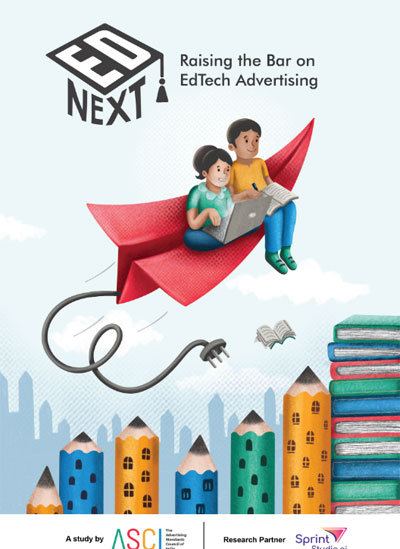
    The Advertising Standards Council of India (ASCI) released a comprehensive report on advertising in the education technology sector (EdTech) and the impact it has on parents and students. The report aims to decode the challenges and opportunities for EdTech sector advertising. The report also identifies ways in which the sector can shape a more responsible narrative, and move away from opportunistic advertising which many consider problematic.

     

    EdTech as a sector holds immense promise in being able to address the infrastructural and learning challenges in India, hence it is critical that the advertising of the sector does not undermine its potential. The study, done with the active participation of both industry and non-industry stakeholders identifies opportunities and challenges and proposes a framework that could guide advertisers to more balanced advertising.


    The EdNext study was undertaken by ASCI with Sprint Studio.ai as the research partner and UNICEF as the knowledge partner. A total of 100 EdTech advertisements across print, TV, digital video and static mediums were analysed by a wide set of stakeholders including parents, students, policymakers, educationists, child development experts, as well as representatives of the industry from the marketing and creative fields. The study was conducted across the cities of Delhi, Bangalore, Indore, Kanpur, Patna, Kolhapur, Warangal and Bardhaman.


    The analysis revealed that:

    Ads have a huge impact on parents’ choice of EdTech platform, with 49% of parents choosing platforms based on advertising

    Like traditional education ads, Ed-Tech ads too, have a huge focus on marks and ranks. Math and science dominated the subjects depicted

    While 81% of parents trust EdTech ads, 73% felt that ads showed high pressure of studies

    None of the endorsers/ role models were from the academic field

    Stereotypes of gender, physical appearances, and mother’s roles crept in to these ads

    The findings also noted some positives. Some of the key positives identified were:

    Ads featuring parents represented them as supporting partners to students, and thereby provided positive role models for progressive parenting (21 out of 23 ads)

    Parents and experts also felt that ads that focused on conceptual learning were progressive and enjoyable


    The EdNext study proposed a framework to elevate the communication around EdTech mindfully. Titled ‘RAISE’, the framework provides stakeholders a set of lenses to evaluate the creatives and develop messages that could be considered more progressive. Following the checklist guide provided in the framework will help marketers and creative experts review concepts at the inception stage of the ad itself.


    The framework is based on five principles which include:

    R – Relationship of the student with learning

    A – Authenticity of situations, promises and claims

    I – Inclusive representation of characters to depict diversity in gender, age, physical attributes, personality types, learning styles and pace along with regional inclusion

    S – Spectrum of pedagogy where there is information on learning methods and how they contribute to holistic learning outcomes

    E – Excellence markers to focus on overall development as a measure of success over ranks and marks


    Manisha Kapoor, CEO and Secretary General, ASCI, said: “EdTech has emerged as a very important sector in recent times, especially in the pandemic era where parents engaged with these companies to supplement their children’s education. Ed-Tech has the ability to solve some fundamental infrastructure and content challenges and revolutionize Indian education. However, given the particular asymmetry between vulnerable parents and students on the one hand, and large organizations on the other, it is critical to ensure that advertising is responsible and does not exploit these vulnerabilities. EdTech advertising has a massive opportunity to build a positive and future-facing narrative, which makes for compelling brand stories that also build confident and multifaceted learners.”


    Mayank Kumar, Chair at Indian Ed-tech Consortium, and Co-founder UpGrad added: “The EdNext report shines light on the sheer scale of the EdTech sector and highlights the need for raising the bar on advertising in the industry along with providing a roadmap on how that can be achieved. The report also shows huge acceptance of the benefits of EdTech products by students, parents and teachers. The in-depth research we undertook along with ASCI will help the industry get a clear picture of how the sector can benefit through responsible advertising, which it is already constantly working towards.”


    Divya Gokulnath, Co-chair at Indian Ed-tech Consortium and Co-Founder BYJU’S said: “The EdNext report highlights that almost all parents are appreciative of the ads which show children enjoying the process of learning, which is something we live by, work for, and showcase in our ads. We prioritize building strong and sustainable relationships based on first principles. While it’s natural for advertisers to highlight the best outcomes achieved by their users, the EdTech industry strives to present a balanced picture at all times. As a nascent industry that is constantly evolving, we must adapt in our effort so that we can make learning effective for everyone. This initiative by ASCI will help us design even more responsible and effective ad campaigns as we continue to grow and improve.”


  • ASCI extends the deadline for feedback on Dark Patterns to 16th January 2023

    By Our Staff


    The Advertising Standards Council of India (ASCI) recently published a discussion paper titled ‘Dark Patterns in Advertising’ highlighting how certain UI/UX deployed by digital platforms could manipulate consumer choices and consumption patterns to the detriment of consumer interest. The self-regulatory organisation had invited public feedback and comments on the recommendations of the discussion paper which will help ASCI extend its self-regulatory code on objectionable ads to cover dark patterns too.


    Now, ASCI has extended the deadline for the feedback until the 16th of January 2023 based on requests it has received from a few organizations. Submissions by any member of the public or any organization public can be sent to contact@ascionline.in


  • A wishlist for Advertising, Marketing, Media & More


    By Sanjeev Kotnala


    Sanjeev KotnalaIt is that time of the year, the first week of the new year, when your resolve not to break a resolution will be tested. Most will fail unless they have no resolutions. I pick my unfulfilled wishlist from the last so many years and lovingly look at it. I have repeatedly failed to find ways to nudge people into helping me. I need the help, as the intent and wishes don’t count, and they mostly need collective initiative.

    My dear friend and mentor, Vermajee, is still recovering from the hectic new year celebrations. He is back from his vipassana experience and promises to share something in the coming weeks. The wait is going to be worth it.


    WISHLIST

    So here is the wishlist. It is advertising, marketing and more, and you are free to discard it or try acting and helping out on at least one front. Trust me, it will make a difference.


    NO FREE PITCHING

    Pitching for business is an integral part of agency life. It is costly and sucks on agencies’ time, efforts and resource deployment. Focussing on it defocusses the agency from existing businesses.

    The brands laugh all the way with new ideas and solid research. Many brands continue to work with the incumbent agency making a mockery of the process.

    I wish agencies start charging a fee for pitching. And the pitch must result in a change of agency.


    INVEST IN CREATIVE DEVELOPMENT

    I have worked with clients who understand the importance and significance of investing in the creative development process in terms of time, effort and funds. They don’t undernourish the creative process to further invest in media and reach.

    Simply put, a better creative needs fewer exposures, thus saving funds and time. It is a different question of why any brand should be willing to expose mediocre creatives that work against the brand in the long term.


    AGENCIES MUST PARTNER WITH THE CLIENT

    The days of agencies being genuine brand custodians and strategic partners are over. The business is tricky, and consultants, advisors and strategic firms have made inroads. The lowest fee syndrome is a reality, and margins are wafer-thin, resulting in exodus and the absence of new talent.

    It is tough to expect the agencies to stop second-guessing the client or delivering what the client wants.

    The respect is lost, and I wish there were ways to win it back.

    At least tell the client what you really think and recommend.

    If the client wants to waste their resources, your drain is as good as any other. However, you still need to decide if you are willing to be a party to this wasteful non-strategic investment from the brand.

    I am hopeful. I know a few agencies that are very clear about what they want to do.


    ASCI IS DISBANDED

    My biggest wish is that the industry has no need for ASCI. And for that to happen, the brand owners and agencies must unite to voluntarily self-regulate. However, I know that prominent brands and repeat offenders will continue to test ASCI guidelines and reactions. We will have new and fresher guidelines before we have foolproof ways to implement the earlier guidelines.


    DIGITAL SPACE LEADS WITH RESPONSIBILITY

    Hopefully, digital and social media will act responsibly. They will do moment marketing with due permission and checks. They will keep the social, cultural, regional and religious sentiments in check. The disclaimer for paid (in cash or kind) associations will be prominently displayed. The warnings and statutory requirements are adhered to and not just executed for the legal framework.


    TRADITIONAL MEDIA FINDS A NEW LEASE OF LIFE

    Traditional media – print, radio, outdoor and television have much more to offer. Someone must work to ensure effectiveness and not just adapt the digital initiatives. Brands can benefit if the agency, client and traditional media work with rationalised rates.

    However, I believe the steady skew towards digital media will continue without many knowing how best to exploit it. Just like the investment in traditional media will decrease, with no one really trying to develop the right creative to enhance efficiency and effectiveness.


    CELEBRITY ENDORSEMENT IS NOT THE IDEA

    Celebrity endorsement seems to be the easy way out for the brands. And for some, the only way out. For many regional brands, it means credibility and a demonstration of success. Unfortunately, the audience consumes it accordingly, and brands keep using celebrities as the idea.

    I have nothing against the rightful use of celebrities or using celebrities as a character. But can we look beyond celebrities or at least use them in the right context and way.


    SOCIAL MEDIA FOR APPRECIATION AND HARMONY

    Social media is full of hate and fake stories. One does not know what to believe or disbelieve. Digital algorithmics keeps serving things one loves to read and react to, thus continuously narrowing thinking. Help make social media a good place to be. Appreciate and share things of community harmony and goodness whenever possible and don’t just react and forward things that you have reason to doubt.


    ONE NATION, ONE LAW

    The most challenging thing to expect. The nation really needs it. Every citizen must be governed, controlled and motivated by the same rules and regulations. Then true secularism will emerge; otherwise, we will continue to see growing communal distrust and hatred.


    RETURN OF PRIVACY. 

    We have sold our souls. We have given all the permissions, and the digital media is busy listening and watching us. The concept of privacy is dead. We are addicted to what we get by selling our information, reactions, location, dreams and desires.

    As individuals, we cannot do anything, and we cannot get out of the system.

    The government and consumer activist groups need to come in. We need stronger privacy laws.


    STOP WASTEFUL GOVERNMENT ADVERTISING

    There is no justification for the multiple full-page advertisements and the poorly produced AV by state governments in print and TV. There may be logic for intra-state advertisements, but hardly any for ads in other states. Even in the state, achievements, plans and projects are covered in the same media. There is no need for money-guzzling advertisements.


    PET-FRIENDLY SOCIETY

    I know how badly we behave and treat pets and animals. Yes, some people are afraid of them, and there are issues. But, instead of using them as an excuse, we must address them. We are responsible for them all, be it the dog, cat, cattle or any animal.

    If you have experienced a pet, you can appreciate changes in the family. How loving and caring becomes a natural behaviour. How pets help closely knit the family.

    Go experience it, and your thinking will change. Think again before raising issues and discussing how we treat pets and animals.


    KNOW YOUR CULTURE, RELIGION, RITUALS AND PRACTICES.

    If the generation next does not know about religion, region, language, culture, rituals and practices. In that case, we are responsible for it. I wish every religion would educate the next generation.

    I have been running #IgnorantHindu blogs to share knowledge and information on Hindu festivals, mythology, rituals and practices. Every practice does not need scientific explanations or logic, and you don’t have to be defensive about your religion. But you must allow everyone to follow their religion without discomforting anyone and following the land of the law.


    NET-NET

    I have too many wishes and know most of them will go unanswered. Nothing would change, even if all of the above were answered. However, I will make efforts from my side. At least open the discussion and perhaps influence and nudge someone towards my idealistic society. It will make a minor difference, but a difference.