Tag: ASCI

  • ASCI revises brand extension guidelines of restricted categories

    By Our Staff


    The Advertising Standards Council of India (ASCI) has updated its guidelines for ‘Qualification of Brand Extension-products and services’ under the restricted category prohibited from advertising by law. These modifications have been detailed in Chapter III Clause 3.6 (a) of the ASCI code, and specifically target brand extensions associated with restricted categories such as liquor and tobacco.


    Key Features of the New Code for Brand Extensions:

    Advertising spends have to be in proportion to sales turnover of extension: ASCI has mandated that the advertising budget for genuine brand extensions of restricted master brands has to be commensurate with the extension’s sales turnover. The proportions for the ad budgets are capped at 200 percent (ie. not more than 200 percent) of the turnover in the first two years of launch of the extension, followed by 100 percent (ie. not more than 100 percent) of revenue in the third year, 50 percent in the fourth year, and 30 percent thereafter. The advertising budget includes media expenditure across all forms of media in the previous 12 months, payments to celebrities for brand endorsements on an annualised basis, and the annual average money spent on advertising production for the brand extension in the previous three years.


    This measure will ensure a balanced approach to advertising investment in alignment with the extension’s sales performance over time.


    Treatment of Variants Under Brand Extension: For clarity, any variants launched under the brand extension will not be considered as a fresh extension. The original date of the first brand extension will apply.


    Certification by Reputed CA Firms: To ensure genuine compliance, all evidence supporting the brand extension’s qualifications for advertising must be certified by a reputed and independent CA firm.


    If a brand extension of a parent brand that is under one of the restricted categories don’t meet the updated qualifications, ASCI will not consider it to be a genuine extension, but a surrogate created to advertise a restricted category. ASCI’s updates will contribute to maintaining the integrity of advertising in India, upholding ethical standards, and protecting consumers from misleading practices.


    Said Manisha Kapoor, CEO and Secretary General, ASCI, on the guidelines: “As part of our ongoing commitment to consumer protection and ethical advertising, ASCI has introduced these new additions to the Brand Extension Guidelines. These measures are essential to prevent the misuse of brand extensions as surrogates for advertising in restricted categories. We believe that these guidelines will strengthen the integrity of advertising in the industry.”

     

  • ASCI unveils study on diversity & inclusion in advertising

    By Our Staff


    The Advertising Standards Council of India (ASCI) and the UN Women convened Unstereotype Alliance (UA), launched their collaborative study on Diversity and Inclusion (D&I) in Indian advertising. The report, prepared by Kantar, focused on ESG (environmental, social and governance) goals of corporates. The study was unveiled at the DEI Edge Summit, co-hosted by ASCI and UA on Thursday.


    Here are highlights of the report, courtesy a communique


    The joint report provides new insights on Indian advertising’s D&I representation versus global practice (leveraging data from the 2023 Global MONITOR survey) and a wealth of original findings on Indian advertising trends accommodating D&I. Some of the key dimensions of D&I representation mapped in the report were age, gender, sexual orientation, race, physical appearance, social class, disability, and religion, across 28 markets around the world.


    The global dimension

    Compared to 33 percent of consumers across the world, 48 percent of Indians expressed the need for more inclusive representation by brands. India’s socially aware consumers are an encouragement for brands on the way to inclusiveness and a wake-up call for those yet to embrace D&I.

    The research scoured through all the new ads that aired in October 2023. Coupled with Kantar’s extensive analysis of advertisements over the past few years, the study provides a snapshot of the patterns, progress, and scope for improvement in DEI in India.


    Key findings of the Indian study: There was a near absence of representation diversity in Indian advertising.   The study found a dismal less-than-1 % representation of the LGBTQ+ community, people with disabilities featured in less than 1% of the ads and only 4% of Indian ads depicted people aged above 65 years.


    Women representation: While the presence of women in ads was comparable to men, sticky stereotypes still prevail. More women are portrayed with fair skin tone (58% of women vs 25% of men on-screen), with less diverse physical appearance (39% of women were shown as slender vs 16% men on-screen) and low non-traditional roles (17.5% of women were depicted as the sole caregiver vs 3.5% men characters) and less authoritative (with male characters three times more authoritative than their female counterparts).


    Women tended to be shown as younger with 86% of them between 20 and 39 years of age compared to 62% of men.


    Said Manisha Kapoor, CEO and Secretary-General, ASCI: “There is no doubt that advertising shapes society. Indian advertising is missing the Diverse and inclusive narratives that can provide a real edge to brands, as can be seen in the study. Along with The Unstereotype Alliance and other partners, ASCI would like to nudge and support the advertising industry in getting its DEI representation right. The opportunity to include diverse perspectives and stories is a powerful one, and the event showcases the immense benefits both brands and society can derive from such progressive inclusions.”


    Added Susan, Fergusan, Country Representative, UN Women: “We, as the conveners of the Unstereotype Alliance India National Chapter, are pleased to host the DEI EDGE SUMMIT in collaboration with the ASCI Academy. Over the past two years, the Unstereotype Alliance in India has united brands, organizations, and individuals who believe in the transformative influence of advertising and media in fostering an inclusive society. Our efforts transcend campaigns; we strive to dismantle stereotypes, fostering a cultural shift that champions diversity and inclusion in advertising industry”.


  • Healthcare violations max mentions in ASCI roster

    By Our Staff


    The Advertising Standards Council of India (ASCI) has published its half-yearly complaints report for the period April to September 2023, offering insights into emerging trends and insights in advertising standards. The report shows a 34% increase in complaints (4491) processed, coupled with a corresponding 27% rise in the number of ads processed (3501).


    Of the 3,501 ads processed, 564 (16%) were flagged as potential direct violations of the law, which represents a 22% increase over the previous year. 35% of the total ads processed were not contested and were promptly withdrawn or modified. A further 47% of ads were found violative of the ASCI Code and the advertisements were recommended to be withdrawn or modified. Only 2% of complaints were dismissed


    Of the 3,501 complaints processed, digital media remained the primary source of violations at 79%. Print media and television contributed 17% and 3%, respectively, while other mediums accounted for 2% of the reported violations.


    Consumer complaints comprised 21.3% of the total complaints, indicating significant public engagement in upholding advertising standards. 75.4% of complaints were initiated suo-motu by ASCI, demonstrating the organisation’s proactive approach to identifying potential violations.


    Here are some key findings from the report:

    Digital Dominance: A whopping 79% of problematic ads were found online, highlighting the challenges in the digital advertising world.

    Regulatory Vigilance: ASCI’s focused monitoring mechanisms boosted digital surveillance to combat objectionable content in the medium. 98% of overall ads processed required some form of modification.

    Voluntary Compliance: In the digital advertising sphere, influencers contributed to 22% of total ads complained against at ASCI. 99.4% of advertisements processed for influencer guidelines were found to be in violation. ASCI received compliance with its recommendations in 92% of influencer cases taken up v/s 86% in previous years, signalling greater compliance with ASCI’s CCC recommendations.

    Healthcare in the Spotlight: Healthcare emerged as the most violative sector, constituting 21% of all ads processed. The surge is attributed to a high volume of drug and medicine advertisements on digital platforms.

    Legal Violations: ASCI observed a significant increase in ads directly violating the Drug and Magic Remedies Act of 1954, leading to the issuance of intimations to advertisers advising withdrawal or modification of the advertisement. ASCI referred 565 advertisements to the Ministry of AYUSH in just six months, compared to 464 ads referred in the last financial year.


    Said Manisha Kapoor, CEO and Secretary-General, ASCI, said: “ASCI remains committed to addressing the challenges posed by digital advertising. All stakeholders need to come together to tackle the issue of online safety of consumers given that they spend high amounts of time there, and where there is a proliferation of objectionable advertising. Our constant vigilance of the online space helps call out the advertisements and brands that violate the ASCI code requiring ads to be truthful, decent and safe. We hope that the various sectors recognise the breaches and commit to more responsible advertising.”


  • ASCI proposes draft guidelines for environmental claims in advertising

    By Our Staff


    The Advertising Standards Council of India (ASCI) takes a pivotal stride towards enhancing transparency and accountability in environmental advertising through the unveiling of comprehensive draft guidelines on “Environmental/Green Claims.” The draft guidelines are open for public feedback until December 31, 2023, post which they will be finalised. Developed by a multi-stakeholder taskforce, including environmental experts, these guidelines aim to ensure that advertisements are free from greenwashing practices. The draft guidelines establish a clear framework for advertisers to present truthful and evidence-based environmental claims.


    Said Manisha Kapoor, CEO and Secretary-General, ASCI, “ASCI’s draft guidelines on Environmental/Green Claims are a crucial step to ensure that consumers who wish to support green brands have the correct information to make an informed decision. These guidelines set a standard for advertisers, and aim to foster a culture of transparency and authenticity in advertising in the best interest of the consumers. We encourage all stakeholders, including consumers, industry, civil society members, and experts, to provide their feedback on the draft guidelines to enable us to sharpen and strengthen them.”


    Proposed Guidelines:

    1. Absolute claims such as but not limited to “environment friendly”, “eco-friendly”, “sustainable”, “planet friendly” that imply that the product advertised has no impact or only a positive impact must be supported by a high level of substantiation. Comparative claims such as “greener” or “friendlier” can be justified, for example, if the advertised product or service provides a total environmental benefit over that of the advertiser’s previous product or service or competitor products or services and the basis of such comparison is made clear.

    2. Environmental claims must be based on the full life cycle of the advertised product or service, unless the advertisement states otherwise, and must make clear the limits of the life cycle. If a general claim cannot be justified, a more limited claim about specific aspects of a product or service might be justifiable. Claims that are based on only part of an advertised product or service’s life cycle must not mislead consumers about the product or service’s total environmental impact.

    3. Unless it is clear from the context, an environmental claim should specify whether it refers to the product, the product’s packaging, a service, or just to a portion of the product, package, or service.

    4. Advertisements must not mislead consumers about the environmental benefit that a product or service offers by highlighting the absence of an environmentally damaging ingredient if that ingredient is not usually found in competing products or services by highlighting an environmental benefit that results from a legal obligation if competing products are subject to the same requirements.

    5. Certifications and Seals of Approval should make clear which attributes of the product or service have been evaluated by the certifier, and the basis of such certification provided. Certifications and Seals used in an advertisement should be from a Nationally/Internationally recognised certifying authority.

    6. Visual elements in an ad should not give a false impression about the product/service being advertised. For example, logos representing a recycling process on packaging and/or in advertising material can significantly influence a consumer’s impression of the environmental impact of a product or service.

    7. Advertisers should refrain from making aspirational claims about future environmental objectives unless they have developed clear and actionable plans detailing how those objectives will be achieved.

    8. For carbon offset claims advertisers should clearly and prominently disclose if the carbon offset represents emission reductions that will not occur for two years or longer. Ads should not claim directly or by implication that a carbon offset represents an emission reduction if the reduction, or the activity that caused the reduction, was required by law.

    9. For claims pertaining to the product being compostable, biodegradable, recyclable, non-toxic, free-of etc. advertisers should qualify the aspects to which such claims are being attributed, and the extent of the same. All such claims should have competent and reliable scientific evidence to show that:


    The product or the qualified component where applicable will break down within a reasonably short period of time after customary disposal.


    The product is free of elements that can lead to environmental hazards.


  • Marico CEO Saugata Gupta is new ASCI Chairman

    By Our Staff


    Saugata Gupta
    Saugata Gupta

    Saugata Gupta, Managing Director and Chief Executive Officer of Marico Limited, will be the new Chairman of the ASCI Board of Governors. This was announced following the board meeting that followed the 37th annual general meeting last week. Gupta’s association with ASCI spans several years; two years on the Board of Governors and four years as a special invitee on the Board of Governors.


    Partha Sinha, President, Response, Bennett Coleman & Company Limited, was elected Vice Chairman, and Sudhanshu Vats, Deputy Managing Director, Pidilite Industries Ltd., was appointed Honorary Treasurer.


    In his role as ASCI’s new Chairman, Gupta said: “Leading ASCI at this juncture is a privilege. We are in the midst of an extraordinary opportunity to reimagine what responsible advertising means and how consumers need protection in the digital age. ASCI is at the very forefront of this effort as it collaboratively shapes the industry. With the advent of the ASCI Academy, we are active architects shaping a more responsible future. Our mission is to instil the principles of self-regulation into the very heart of the creative process. I eagerly look to take further the ambition we have drawn for ourselves. With the support of my board colleagues and ASCI’s exceptional team, we are all set to raise the standards of responsible advertising.”


    Recalling his tenure at ASCI, the outgoing Chairman, NS Rajan said, “Leading ASCI over the past year has been an immensely fulfilling journey. I am proud that, as a collective team, we have strengthened our abilities to be ready for the future. The launch of the ASCI Academy is a significant event that I am sure will yield positive results.


  • ASCI launches academy

    By Our Staff


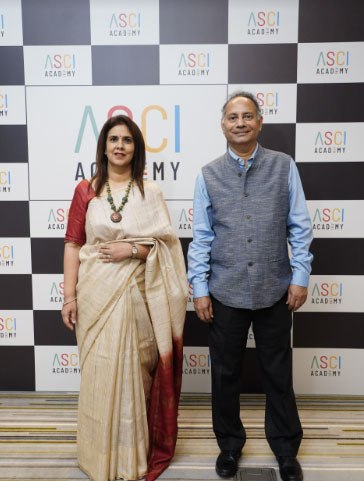
    (L-R) Manisha Kapoor, CEO and Secretary General and NS Rajan, Chairman, ASCI at the Academy Launch

    The Advertising Standards Council of India (ASCI) has unveiled the ASCI Academy, an initiative poised to amplify the advertising industry’s capacity to create more responsible and progressive advertising campaigns.


    The Academy has over 50 founding partners and supporters including Cipla Health Limited, Coca-Cola India Private Limited, Colgate-Palmolive (India) Limited, Diageo India, Hindustan Unilever Limited, Mondelez India Foods Private Limited, Nestlé India Limited, PepsiCo India Holdings Pvt Ltd., Procter & Gamble Home Products Private Limited, several leading universities and colleges, prominent Civil society organizations such as Mumbai Grahak Panchayat, Consumer Voice, CUTS, CMS and others, and, industry bodies like the ISA, AAAI, IAA and ISWAI, as well as research insight organizations.


    Said Rohit Kumar Singh, Secretary, Department of Consumer Affairs: “I congratulate ASCI on the launch of the ASCI Academy. In the digital age, preventive actions need strong impetus and encouragement, and the training of industry professionals – current and future is an important systemic intervention. The Department of Consumer Affairs is supportive of such efforts by the advertising self-regulator to foster a culture of responsibility in the advertising industry. We hope that the advertising industry engages deeply with the Academy programs to make their teams better trained and educated on the aspects of advertising regulations.”


    Added Vikram Sahay, Joint Secretary, Ministry of Information and Broadcasting, who is part of the ASCI Academy’s Apex Council: “Many congratulations to ASCI on the launch of the ASCI Academy. The Ministry of Information & Broadcasting has always supported self-regulatory mechanisms in the media and entertainment industry. We hope that the resources and support by the Academy would be extremely useful for the online advertisers and platforms.”


    Addressing the opening of the academy, NS Rajan, Chairman, ASCI, said: “While ASCI has always had a strong corrective mechanism, we also wanted to harmonise the dynamic interplay between creativity and responsibility and address the broader consequences of advertising on society at large. The ASCI Academy is a big step in this direction which will facilitate a preventive footprint and shape an advertising ecosystem to help the industry to get it right.”


    Added Manisha Kapoor, CEO and Secretary General, ASCI: “With short campaign durations, it is important that attention is directed at the point of creation of ads, not just after they are published. When the only ads to hit the market are responsible and compliant, it is a win-win for both consumers and industry. Over the next three years ASCI Academy aims to train 100,000 current and emerging professionals through self-learning and on-campus workshops and sessions, besides programs for research and consumer education. This is a new chapter in self-regulation in India, and we are grateful to all our founding partners for supporting this vision. We hope to add several more believers in this agenda- this is just the beginning”.


  • ASCI broadens definition of celebrities in its code

    By Our Staff


    The Advertising Standards Council of India (ASCI) has updated the definition of celebrities in its code to include social media influencers having a following of 500,000 or more.


    Notes a communique: “The ASCI code has a specific guideline for celebrities which requires advertisements featuring celebrities to not violate the ASCI Code, and for celebrities to be familiar with the code in letter and spirit. Testimonials of celebrities must reflect their genuine, recent opinion and must be based on adequate information or experience about the product or service being advertised. The guidelines mandate that celebrities conduct due diligence to ensure that claims featured in the advertisements can be objectively verified and substantiated. Celebrities, when called upon, need to produce evidence of due diligence. Alternatively, the advertiser should have developed the advertisement following ASCI’s advertising advice. Additionally, the ASCI code requires celebrities not to participate in the advertisement of a product, treatment or remedies that are prohibited for advertising under the Drugs & Magic Remedies (Objectionable Advertisements) Act, 1954; and the updated Drugs & Cosmetic Act, 1940, and Rules 1945 (Schedule J).”


    The communique further adds: The ASCI code now defines celebrities as individuals that:

    :: Get compensated Rs 40 lakh or equivalent value annually for appearing in advertisements or campaigns on any medium and any format

    Or

      :: Have a social media following of 500,000 or more on any single social media handle


    It may be noted that the Consumer Protection Act, 2019 puts the responsibility of due diligence on all endorsers, whether they are celebrities or not. However, due to the disproportionate influence and impact of individuals with large followership, ASCI requires celebrities to demonstrate a much greater responsibility in making sure that their followers do not get deceived or misled. ASCI has noticed a massive increase in ads featuring celebrities that are misleading. Versus the 55 ads that it processed in 2021-22, ASCI processed over 500 misleading ads featuring celebrities in 2022-23. This shows that in spite of their legal obligations, several celebrities continue to feature in ads that make misleading claims.


    Said Manisha Kapoor, CEO and Secretary General, ASCI: “With the advent of social media and the increasing popularity of influencers on digital media, the definition of celebrities has come to change drastically. Earlier, only personalities from the world of sports or entertainment were considered celebrities. Today, however, the scenario is different. We have a range of personalities who are extremely popular on social media and share a close personal connection with consumers. These personalities affect the spending habits of consumers who trust them. So, it’s vital to ensure consumer protection – especially when celebrities endorse products or services that can cause serious financial loss and physical harm. This update widens ASCI’s ambit and includes all those personalities who have a notable influence as celebrities. With this, we have taken yet another important step in furthering the cause of consumer safety with regard to advertising.”


  • ASCI and Khaitan & Co release whitepaper

    By Our Staff


    The Advertising Standards Council of India (ASCI) and Khaitan & Co, a law firm, have jointly released a comprehensive whitepaper on generative artificial intelligence (AI), highlighting the opportunities, risks and legal considerations around its use in advertising.


    Manisha Kapoor, CEO and Secretary General, ASCI, said: “AI is a groundbreaking technology with immense potential, especially in advertising. As advertisers increasingly adopt AI, they must be aware of its impact on consumers and society. From an ASCI and consumer protection perspective, advertisements made with AI are subject to the same principles of regulation and consumer protection that any ad is. As this field evolves, greater regulatory clarity will also have to keep pace with technological development. Privacy, copyrights, and responsibility over content creation are key issues that need to be dealt with in time. We extend our gratitude to Khaitan & Co. for their legal expertise and collaboration in producing this report.


    Tanu Banerjee, Partner, Khaitan & Co, added: “AI is set to disrupt how any business works today. The adoption of generative AI is particularly high in the advertising sector, given how AI has revolutionised the way creative materials used in ads can be developed. However, though the evolving AI technology offers massive opportunities, it also presents several legal risks and challenges, such as issues around ownership of content, privacy of data, AI bias, authenticity of prompts etc. While the regulatory framework for AI evolves, it’s critical for advertisers to be aware of the existing regulations and legal principles, to safeguard against these risks and to ensure ethical use of generative AI. We are very grateful to ASCI for their support and invaluable insights in preparing this report.”


    Generative AI enables advertisers to automate the creation of original content, including text, images, articles, marketing collaterals and more. It also enhances customer experiences through chatbots, AI assistants and interactive advertising. The whitepaper acknowledges the limitless applications of generative AI in advertising while addressing concerns around its potential misuse and manipulation, particularly related to consumer protection.


    With a focus on the Indian legal framework, the whitepaper highlights the legal risks and challenges that advertisers may face when utilising generative AI. It addresses issues such as potential copyright infringement, prevention of unlawful content, and data privacy concerns.


    Some of the best practices outlined in the whitepaper to mitigate risks associated with generative AI are:

    1. Review the AI platform’s terms of use and licensing compliance to reduce liability risks.

    2. Obtain the necessary authorisations and licenses for uploaded materials, including copyrighted and trademarked content.

    3. Avoid prohibited input prompts and carefully check the output for prohibited content before commercial use.

    4. Mitigate liability risks by implementing robust content review processes, establish guidelines, and including AI disclaimers in marketing materials.

    5. Safeguard confidential information and ensure data privacy by enforcing non-disclosure agreements and implementing robust security measures.

    6. Upskill human labour in editorial oversight and compliance to avoid employee displacement.


    The whitepaper concludes by addressing the future of generative AI and the unique challenges that must be addressed for its responsible and ethical deployment. It emphasises the importance of principles such as fairness, accountability, transparency, and ethics within the AI community. Advertisers are encouraged to embrace these principles, ensuring fairness in decision-making, accountability for actions, transparency in operations, and ethical considerations in their impact on individuals and society.


  • ASCI introduces guidelines for ads for charitable causes

    By Our Staff


    The Advertising Standards Council of India (ASCI) has introduced guidelines for advertisements for charitable causes.


    Talking about the new guidelines, Manisha Kapoor, CEO and Secretary General, ASCI, said: ASCI recognises that charities can have a challenging job explaining the nature of the important, and often sensitive work they do, and raise funds for beneficiaries in need. However, they must take care not to overstep the mark by misleading consumers or causing unjustified distress to those who may be merely surfing online. The guidelines strike a balance between allowing charities to do their important work, and at the same time, be fair to consumers who are viewers of such advertisements”.


    Adds a communique: “In recent years, charities have been active advertisers, particularly on digital media, and especially for the purpose of seeking funds and crowdfunding on behalf of their beneficiaries who may not have an active social network to reach and tap donors. Charities, including crowdfunding platforms, provide this reach through sponsored ads and organic posts, which tap potential donors. However, there have been some concerns about ads that create donor distress through the use of images that may be too graphic. While the intent of such posts is undoubtedly to nudge donors to contribute, such posts may cause undue distress to ordinary consumers who may be surfing through their news feeds. In addition, with crowdsourcing platforms, consumers may not know what amount, from their donation, goes to the beneficiary and what may be kept by the platforms for their administrative fees or charges.”

    de clear what such amounts are in the advertisement itself.


  • Can the Spirit of Advertising Help Self-regulation?


    By Sanjeev Kotnala


    Sanjeev KotnalaMaybe it will be easy for the advertising and marketing industry to understand. With so much following for cricket and huge interest in it, with half the population being experts in the field, it should make sense. After all, the industry spends huge sums of money on sports and IPL. The cricketers are the main set of celebrity models that the industry uses and people associate with.

    So, in the third Ashes Test 2023, Bairstow (England) was stumped by Alex Carey (Australia) as he wandered out of his crease at the end of a Cameron Green over. The third umpire upheld Australia’s appeal as the ball was yet ‘not dead’. Stuart Broad hit out at Australia for not withdrawing their appeal – the basis of request- Spirit of the game.

    Now as per the rules of the game, Jonny Bairstow was out. However, Australia could have withdrawn the appeal and called him back in the spirit of the game. They did not. And that’s as simple as that.

    The game is played by the rule and should be played by the rule, not the norms and spirit of the game. And for that, the rules should be simple, straight, not suspectable to differences or misinterpretation and applied equally to all.

    What is true for the game is true for other professions, including advertising and marketing, where there are clear rules in the case of tobacco. Clear expectations and guidelines in case of Insurance, mutual funds, and investments. Simple rules for celebrity endorsement. Rules for liquor advertising and betting and much more. However, some brands ensure that they do everything legally required by them. Morality and ethics are not weighed in. The spirit of advertising and marketing is not evoked as the Advertising Standards Council of India (ASCI) gives guidelines and expectations under self-rule. Something that does not have the bite of legally ensuring compliance.


    Do We Need a Law For Everything?

    The question is: should there be a law for everything. Can’t the professional incharge and executing such work take a call? Specific categories need to make moral and ethical calls even after meeting the legality of communication. Unfortunately, it’s a tricky business out there. They clearly are in no mood not to use the escape routes, including the classic surrogate advertising, misinformation, small point disclaimers, and such acts.

    Maybe being professional, the industry demands the practitioner remain brand and market objectives focussed and work within the legal framework. Being alive to the spirit of the work and the brand is not necessarily the industry’s expectations. They will, as expected, take a calculated judgement and withdraw (if they do) an advertisement only after someone complains, ASCI acts or the audience troll them for it.

    Like the Spirit of the Game in Cricket, values, expectations and a code of ethics are defined by the self-regulating advertising industry advertising that can be the difference and an example. But then, no one wants to be setting benchmarks. Everyone is busy and happy creating impact communication within the legal framework.

    And there is nothing wrong with it. Because following the rules is really the spirit of the industry.


    Net-net

    If I was to take the preamble of the spirit of Cricket and replace that with advertising, it would/ could read like this. It would make sense but hardly be practical as it will continue to mean different things to different people.

    Advertising, marketing and communication owe much of its appeal, enjoyment and impact to the fact that they should be created, crafted and exposed not only according to the Laws but also within the Spirit of communication. The major responsibility for ensuring fair play rests with the marketing head, brand custodians and their advertising agencies but extends to all players in the ecosystem, creative creators, media, trainers, institutes and the audience that watches them.  

    Self-regulation is central to the Spirit of communication.

    Play hard, play fair with the competition, and respect the audience’s sensitivities.

    Accept the ASCI decision and don’t repeat the mistake.

    Create a positive atmosphere through your conduct, and encourage others to do likewise.

    Show self-discipline, self-regulate, raise voices and object to anything harmful or not in sync even when things go against you.

    Congratulate the opposition on their successes, and enjoy those of your team.

    Communication, Advertising and marketing is an exciting field that encourages leadership, friendship, networking, insight mining and teamwork, which brings together people and help them make decisions when a creative is curated, crafted and created within the Spirit of self-regulation, societal moral, and industry ethics.


  • ASCI releases guidelines on ‘Online Deceptive Design Patterns’ in ads

    By Our Staff


    The Advertising Standards Council of India (ASCI) has published  comprehensive guidelines for ‘Online Deceptive Design Patterns in Advertising’, to “empower businesses, designers, and stakeholders to create user-centric experiences while promoting transparency, trust, and ethical standards in the digital landscape”.


    The following are the areas that the new guidelines address:

    1. Drip Pricing: Drip pricing refers to a practice in which elements of the costs are not revealed up front, and the total price is only revealed at the very end of the buying process or after confirmation of purchase. This creates ambiguity around the final price as well as prevents easy cost comparisons. The guidelines require quoted prices in advertisements and e-commerce sites to include non-optional taxes, duties, fees and charges that apply to all buyers. Incomplete price representations upfront would be considered misleading.

    2. Bait and Switch: When an ad or an element in an ad directly or indirectly implies one outcome of the consumer’s action but instead serves up another, it is misleading.

    3. False Urgency: Stating or implying that quantities of a product or service are more limited than they are is considered misleading. In case of a complaint, the advertiser would be required to demonstrate that the stock position at the time of the appearance of the limited quantity message was of a level where the urgency communicated could not be considered misleading.

    4. Disguised Ads: An advertisement that is of a similar format as editorial or organic content must clearly disclose that it is an ad. Examples could be influencer posts, paid reviews, and ads placed in a manner to appear like editorial content.

    Said Manisha Kapoor, CEO and Secretary General, ASCI: “With the government and the industry echoing their belief in self-regulation, we believe that the guidelines we have issued today will play a crucial role in fostering a more ethical and trustworthy advertising ecosystem and protecting consumer trust. These guidelines will require businesses to create communication and systems that respect user autonomy, improve transparency, and encourage well-informed choices.”


    Added Rohit Kumar Singh, Secretary Department of Consumer Affairs: “We welcome the new ASCI guidelines related to advertising. Deceptive online patterns are also a violation of the Consumer Protection Act. We look forward to working with ASCI and the industry to support a robust self-regulatory mechanism for the larger framework on online deceptive patterns”.


    The guidelines will be applicable from September 1, 2023.  To read the detailed guidelines, please visit link: https://www.ascionline.in/wp-content/uploads/2023/05/Guidelines-for-Online-Deceptive-Design-Patterns-in-Advertising.pdf


  • MxMLive with Manisha Kapoor, CEO & Secretary General, ASCI


    Readers of MxMIndia and folks in the advertising, marketing and media ecosystem know all about the Advertising Standards Council of India (ASCI, in short). Over the last few years, the self-regulatory body has reinvented itself with a slew of guidelines issued (including one on celebrity endorsement), tightened its guidelines on surrogate advertising, and embraced the ever-growing world of influencer-led advertising.


    Pradyuman Maheshwari, Editor-in-chief and Founder, MxMIndia caught up with Manisha Kapoor, Chief Executive Officer and Secretary General of ASCI, via an interview conducted over Zoom a few days after the conclusion of the 2023 edition of the Indian Premier League, which typically sees a large number of surrogate advertisements surfacing.


    Watch. Like. Enjoy.