Tag: ASCI

  • Letter from MxMIndia: A Year of Consolidation

    So how was 2014 for us at MxMIndia?


    The previous year was a horrible one for us. Annus Horribilis, we called it.


    Twenty-fifteen was pretty good in comparison. Even if the bucks hadn’t turned big, the mood was upbeat. We hate to admit it, but the ‘achche din aane waale hain’ slogan did change the mood of the nation.


    Many may not have forgiven those responsible for Gujarat 2002, but then there was Delhi 1984 and several other communal and civil unrests initiated by various political and community leaders. So even as it’s not right to condone the perpetrators of any riot, the blessed souls from across the spectrum are all the same.  It was the cry for rooting out corruption from the Narendra Modi and the BJP camp that caught the imagination of the nation.


    The news media was looking up. Their coffers -for many of them, if not all – were being filled legitimately and under the table. In my interaction with some politicians and newspaper biggies, I learnt how it was done. And how it was impossible to nail a publication. Unless and until one does something silly like this former chief minister…


    Twenty-fourteen saw the best and worst in the advertising business. Self-regulator ASCI has gotten hyperactive, Goafest, our version of the Cannes Lions, was saved from a no-show. An industry  association like the India chapter of the International Advertising Association was super-active. The Ad Club expanded its Abby Awards. And there was the birth of an all-new awards show  in the form of Kyoorius.


    There was some experimentation on the television scene even as the GECs went on their great ratings run. Zindagi, a channel with re-runs of Pakistani serials, may not have attracted GVTs in large numbers, but it was a winner idea. Sports television grew considerably with Star India putting its might behind the various leagues. Epic, the independent channel funded by Mukesh Ambani and Anand Mahindra, finally took off. Pal, the second Hindi GEC, didn’t take off very well despite the blitz.


    As for print, it isn’t dying. In fact it’s been proliferating. Not just in the regions (or the ‘unmetros’) and in Hindi, but in English too.  Radio is still waiting for its Phase III and news, but smart content strategy like BIG FM did with its retro-fication of some stations worked wonders.


    And what do we say for digital. It’s here, there and everywhere. A quarter of our billion-plus populace is connected with more than five million smartphones being added every month. Yet, digital is not going to the #1 media even in 2017, as per one study. And we don’t know what’s going to happen later.


    The big attraction in the media is integration. Along with BTL and social media, there is much focus on orchestrating an integrated campaign for maximum. Quite like the way Prime Minister Modi did in the run-up to the elections.


    The downer of the year has been the Indian Readers hip Survey. It’s sad to see otherwise outstanding professionals unable to come up with a measurement system that will be mutually acceptable. The new measurement regime under BARC is set to launch in April 2015, and one hopes that the television ecosystem handles it more maturely.


    As for MxM, we are happy that we are beign counted for our content. Regrettably, not as much for our business and sales. But that, we hope, will happen.


    We are looking forward to Twenty-fifteen. Warmest wishes for the year ahead.


    Pradyuman Maheshwari

    Editor-in-Chief and CEO

    MxMIndia


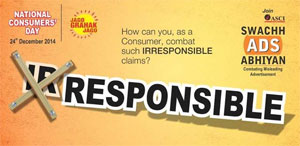
  • ASCI unveils ‘Swachh Ads Abhiyan’ on National Consumers Day

    By A Correspondent


    Observing  National Consumer’s Day on December 24, the Advertising Standard Council of India (ASCI) launched a ‘Swachh Ads Abhiyan’ campaign with the purpose of combating misleading ads. This follows the government’s Department of Consumers Affairs asking ASCI to come up with an initiative to create awareness amongst consumers to action for misleading content. The campaign was initiated across various social platforms like Facebook, Twitter, LinkedIn and YouTube.


    Said Narendra Ambwani, Chairman, of the advertising self-regulator: “It’s really important that consumers don’t blindly believe in advertisements and understand unethical and misleading claims. ASCI engaged with consumers through social media activities on Twitter, Facebook LinkedIn and YouTube which have massively driven consumer attention towards the campaign. We hope this initiative from ASCI will empower and encourage consumers to make the right decisions.”


    Added Sucheta Dalal – ASCI’s Consumer Complaints Council Member: “As a member of the consumer complaints committee (CCC) I have seen the big leap in ASCI’s effort to track misleading advertisements across different media and languages on a nationwide basis. ASCI has also made it easy to file and track complaints online or engage with it through social media. All we need now is better consumer awareness and action by concerned citizens to keep ASCI on its toes by filing complaints and making themselves heard on the evolving issue of misleading advertisements”.


  • ASCI hauls up 105 misleading ads

    By A Correspondent


    In October 2014, ASCI’s Consumer Complaints Council (CCC) upheld complaints against 105 out of 146 advertisements. Out of 105 advertisements against which complaints were upheld, 44 belonged to Personal and Healthcare category, followed by the Education category with 43 advertisements.


    The CCC found the following claims in health and personal care product or service advertisements of 44 advertisers to be either misleading or false or not adequately/scientifically substantiated and hence violating ASCI’s Code. Some of the health care products or services advertisements also contravened provisions of the Drug & Magic Remedies Act and Chapter 1.1 and III.4 of the ASCI Code. Some of the complaints that were upheld include:

    Hindustan Unilever Ltd (Fair & Lovely) – The advertisement of Fair & Lovely claims that the product marketed in India gives better results than other fairness creams marketed in Dubai, Singapore and Japan stating a comparison versus “some of the world’s best products”. The Advertisement is misleading by exaggeration and implication that the advertised product is unbeatable with all the products in those countries. Also the advertisement is likely to be misleading by ambiguity as the comparison is only for instant whitening effect of the advertiser’s product.


    Wockhardt Hospitals: The advertisement of Wockhardt Hospitals claims, “Best in Healthcare” and “Best in Bariatric Surgery”. The advertisement is misleading as the Registration Certificate of the doctor shows his registration only as MBBS and not a specialist (MS). Also, the advertisement is in breach of Code of Medical Ethics as the advertisement mentions the name of Dr. Bhandari promoting the Hospital which is in violation of the Medical Council of India (MCI) Code of Ethics Regulations 2002 Clause 6.1.


    Dabur India Limited (Dabur Range of Product): The advertisement of Dabur Range of Product claims “Do you have the energy of Shilajit Gold?” & “Shila X Oil – Full of energy”, were not substantiated. Also, when read in conjunction with the visual in the advertisement and specific to the advertisement claim, “Shila X Oil – Full of energy”,   the advertisement is in breach of the law as it violated The Drugs & Magic Remedies Act.


    As for Education, the CCC found following claims in the advertisements by 43 different advertisers were not substantiated and thus, violated ASCI Guidelines for Advertising of Educational Institutions. The complaints against the following were upheld.


    AKS University: The advertisement claims that AKS University is the best university. The claim was not qualified with appropriate disclaimers.


    Cloud Enabled: The advertisement states that Cloud Enabled announces cloud engineer training for freshers with 100% job guarantee on day one of training commencement.


    SR Engineering College: The advertisement of SR Engineering College claims to be the only college in the state with women technology power.


    Also, complaints against advertisements of all educational institutes listed below were upheld because of unsubstantiated claims that they ‘provide 100 per cent placement/and/or they claim to be the No.1 in their respective fields’:


    MIET Group of Institute (Meerut Institute of Technology), Swaraj Institute Management & Technology, HHITI Hamirpur, Institute of Banking Services – IBS, Seemanchal Group of Institute, Param Bhagwat Siksha & Samajik Vikas Sansthan – National Institute of Fire Engineering & Safety Management, Shreya Education, Careerspin Consulting India Private Limited, Best Tax Filer, Vivek Bharti Trust – Noble Engineering College, Shri Venkteshwar Institute of Technology, Mangalmay Institutions, Shri Siddhivinayak Polytechnic, CLAT Possible, College of Computer & Communication,  Sai Charitable Trust (College of Engineering), Andhra Mahila Sabha(College of Teacher Education), Kashi Institute of Management Science, EGS Pillay Engineering College, Guru Dronacharya College of Nursing, SDM Jainmatt Navgrahteerth Trust (Jain AGM Institute of Technology), Adarsh Institute of Indian Technology, Mahatma Gandhi Homeopathic Medical College & Hospital, Mahendra Gayatri College of Nursing, N.S Group of College, Prans Media Institute, Zala Paramedical Institute, Indraprastha Institute of Technology, ITV Network ITV School of Media & Management, Christian Medical Training Centre School & College of Nursing, CHM Institute of Hotel & Business Management, Career College of Management, Freedom Institute of Industrial Training Centre (FIITC), Doric Multimedia, Madras Institute of Business Management, Madam Mala Institute of Hotel Management, Mit Study Center, NVS College of Aviation, R&D Centre Bicycle & Sewing Machine and  Ibirds Services Group (Ibirds College).


    The other complaints upheld  include, HT Media Ltd (Hindustan Hindi Daily): The advertisement claims that Hindustan Hindi Daily is the No. 1 newspaper of Jharkhand. The claim contravened the ASCI Guidelines on Supers.


    AJK Network: The advertisement of AJK Network claims ‘250+ TV channels across different genres and languages including Local Channels’, ‘Electronic Programming Guide with genre-wise channel listings’ and  ‘Free Customer Support’, were not substantiated.


    Odisha Television Ltd (Odisha Television Network) – The advertisement of OTV Network claims to be No.1 through a bar graph compared to other channels. It was concluded that the bar chart comparison shown in the advertisement which appeared in Samaj, is a misrepresentation of facts and is misleading.


    Tata Teleservices (*) Tata Docomo Photon Max Wi-Fi: The advertisement of Tata Docomo Photon Max Wi-Fi claims, “Consistent high speeds” which was not substantiated with test reports from independent third party. Also, the Advertiser did not provide substantiation of actual speed achieved in real conditions and in several locations within the cities quoted in the advertisement.


    Viacom 18 Media P.  Ltd (*) (Sonic Power Rangers): This advertisement shows teenagers in uniform climbing the walls of their education institution and doing somersaults while entering the class. As the advertisement shows dangerous acts which are likely to encourage minors to emulate them in a manner which could cause harm or injury, the complaint was upheld under Chapter III 2b) of the ASCI Code.


    Philips Electronics India Ltd (Philips W6610): The advertisement of Philips W6610 – 12.7 cms (5) claims concerning the QHD display was not substantiated.


    Rupa & Co Ltd (Macrowomen): The advertisement shows a woman opening the sportswear and the men / coach staring at her, which was found indecent and vulgar.


    Mahindra & Mahindra Ltd (Mahindra Bolero Maxitruck Plus): The advertisement claims that a new Bolero MAXITRUCK PLUS is stronger than three “Chota Hatti”. The comparisons made in the advertisement were not substantiated, and were likely to mislead the consumers about the product advertised and ones with which it is compared.


    Procter & Gamble Hygiene and Health Care Ltd (Pantene Pro Vitamin Oil): The advertisement of Pantene Pro Vitamin Oil claims “OIL HAI BUT OILY NAHI”, used by the advertiser was almost identical to the slogan used in the earlier run advertisement of the complainant so as to suggest plagiarism.
     

  • DoCA partners with ASCI to halt violators of misleading ads

    By A Correspondent


    Strengthening its mission towards self-regulation in advertising, Department of Consumer Affairs (DoCA), of the Ministry of Consumer Affairs, Food & Public Distribution has officially partnered with Advertising Standard Council of India (ASCI) to augment the efforts on stopping misleading advertisements. The collaboration will see joint efforts to evaluate and pass strictures against the violators. The six priority sectors that would be covered are:


    ::  Agriculture and food

    :: Health

    :: Education

    :: Housing

    :: Financial services

    :: E-commerce


    DoCA will redirect the complaints received by it to ASCI to avoid duplication of processing of complaints against advertisements that is already under process by ASCI. The complaints will be evaluated across media like print, packaging, internet, outdoor, wall paintings, posters, bill boards, etc.


    Commenting on the partnership, G. Gurucharan, Additional Secretary, DoCA added, “The problem of misleading advertisements and the consequent unfair trade practices that arise is widespread – across sectors, mediums and geographies. DoCA’s effort is to build a coalition of stakeholders to combat this menace – partnering with ASCI is an important step”.


    Narendra Ambwani, ASCI Chairman added, “It’s a moment of pride for ASCI to have received such support from DoCA. Earlier our work has been recognized by various government bodies like Ministry of Information and Broadcasting (MIB), Medical Council of India (MCI) etc. It’s highly motivating to see such developments and this partnership has widened ASCI’s scope for complaints.”


    While the operational aspects of this collaboration between DoCA and ASCI is being worked upon, DoCA has requested ASCI to flag off  advertisements that are in clear violation of the law (e.g. claims regarding cure of diseases such as diabetes, cancer, sexual impotence, leucoderma (white spots), paralysis etc. covered under the Drugs and Magic Remedies Act. This would enable prompt action against such non-scrupulous advertisers and protect consumer interest.


    This partnership will go a long way in ensuring that all ads released in the country are honest, decent, safe and fair to competition.


  • I&B intervention gives ASCI more teeth to curb ads that violate guidelines

    By A Correspondent


    In a recent development, the Ministry of Information and Broadcasting (MIB) has ordered broadcasters not to air advertisements that have been found in violation of the Advertising Standards Council of India’s (ASCI) code and not complying with the decision of its Consumer Complaints Council (CCC). While deliberating on the complaints received in ASCI, the CCC observed that many of the teleshopping advertisements made unsubstantiated claims & violated the provision of code for self-regulation as well as provisions under Drug & Magic Remedies (Objectionable Advertisements) Act, 1954. MIB has in its Advisory compiled a list of these ads and asked broadcasters not to carry them in their respective channels and to ensure strict compliance of the advertising code in the Cable Television Networks Act (CTN).


    The CTN code and rules state that ‘no advertisement which violates the code of self-regulation in advertising, as adopted by ASCI for public exhibition in India, from time to time, shall be carried in the cable service’. Therefore, the ASCI decisions are not just bound for compliance by advertisers but also by TV channels.


    Partha Rakshit

    Partha Rakshit, Chairman, ASCI shared, “This is another feather in the cap of ASCI, in its efforts to make advertising more responsible. We were finding that some advertisers on TV channels, especially Tele Shopping Networks, were not complying with the ASCI decisions. We submitted the list to the Inter Ministerial Committee (IMC) of the MIB for their consideration. Based on that, IMC observed that any violation of ASCI code also violates the Advertising Code enshrined in the CTN Act and its rules. In short, IMC has directed that advertisements found to violate the ASCI code cannot be carried on TV channels.”


  • ASCI releases guidelines for skin whitening products

    By A Correspondent


    Advertising industry self-regulator Advertising Standards Council of India (ASCI) has released its final guidelines for the advertising of skin lightening and fairness products following industry and public feedback to a draft it had issued earlier. This, industry observers believe, could go a long way in correcting the communication issued by makers of a growing number of fairness products.


    Commenting on the new guidelines,  Partha Rakshit, Chairman, ASCI said:

    “Setting up these new guidelines for the skin lightening and fairness products will help advertisers comply with the ASCI code which states that advertisements should not deride any race, caste, colour, creed or nationality. Given how widespread the advertising for fairness and skin lightening products is and the concerns of different stakeholders in society, ASCI saw the need to set up specific guidelines for this product category.  As a self-regulating body, it is important to have the advertisers’ buy-in to the guidelines, and we are happy to note that both the industry and the consumer activists’ groups have welcomed these guidelines.”


    The following guidelines will be used when creating and assessing advertisements in this category:

    :: Advertising should not communicate any discrimination as a result of skin colour. These ads should not reinforce negative social stereotyping on the basis of skin colour. Specifically, advertising should not directly or implicitly show people with darker skin, in a way which is widely seen as, unattractive, unhappy, depressed or concerned. These ads should not portray people with darker skin, in a way which is widely seen as, at a disadvantage of any kind, or inferior, or unsuccessful in any aspect of life particularly in relation to being attractive to the opposite sex, matrimony, job placement, promotions and other prospects.


    :: In the pre-usage depiction of product, special care should be taken to ensure that the expression of the model/s in the real and graphical representation should not be negative in a way which is widely seen as unattractive, unhappy, depressed or concerned.


    :: Advertising should not associate darker or lighter colour skin with any particular socio-economic strata, caste, community, religion, profession or ethnicity.


    :: Advertising should not perpetuate gender based discrimination because of skin colour.


  • ASCI uphelds misleading ads across sectors

    By A Correspondent


    In May 2014, ASCI’s Consumer Complaints Council (CCC) upheld complaints against121 out of 140 advertisements. Health & Personal Care category continued to lead with the highest number of complaints received in May 2014.


    The CCC found the following claims in health and personal care product or service ads of 66 advertisers, released in the print media / TVC to be either misleading or false or not adequately / scientifically substantiated and hence violating ASCI’s Code. Some of the health care products or services ads also contravened provisions of the Drug & Magic Remedies Act. Complaints against the following ads were upheld.


    1. Diabacure: The advertisement of the product Diabacure claims that use of the said product curesdiabetes


    2. Mukherjee Ayurved Ashram:The advertisement claims that it is ‘World No. 1 & can cure smallness of penis, thinness, crookedness and make penis long, thick and shapely and cure premature ejaculation, nightfall, impotency, nil sperm count and increase desired sex time’. Also it claims that it has ‘no side effect’ and is’100% Ayurvedicmedicine’.


    3. VaidbanAyurvedic Products: The advertisement claims successful treatment of kidney stones without operation and successful treatment of STDs and impotence.


    4. Sun Pharmaceutical: The advertisement of Rid-Tobacclaims to be’100% herbal’. It ‘helps get rid of cigarette, bidi, gutka, masala, tobacco addiction knowingly or without the knowledge of the addicted person.’


    5. Dabur India Limited’s Odomos Naturals: The advertisement claim that Odomos provides all day protection from mosquitoes to children was misleading by omission as it does not provide clear instruction of the level of application and period for reapplication.


    6. Reckitt Benckiser Healthcare India Ltd: The Dettol Soap advertisement’s claim that ‘Only Dettol gives 10x more protection against germs’was misleading as the advertiser’s product with germicidal actives was compared against products without germicidal actives. Dettol being the “only” effective product was not substantiated by comparison with other products in the market with germicidal actives.


    7. Rana Clinic: The advertisement claims ‘successful treatment for having child. Those couples who are upset because of not having their own child and feel defeated after consulting everywhere are now happily living their life with a child after coming to us. Get successful treatment at any age for any mistakes made in childhood, weakness due to any reason, premature ejaculation, childlessness, small size problem.’


    8. HumiHerboceuticals: The advertisement of Immuno Booster Plus claims toincrease immunity, rejuvenate body tissues etc.in human beings.


    9. Marico Ltd: The advertisement of Nihar Naturals Shanti Amla Hair Oil claiming that it is enriched with 500% vitamin Ewas misleading as the comparison was being made with a product marketed in 2010Hindustan Unilever Ltd: The TVC of  Fair& Lovely suggests that fairness is essential for a girl to match a boy in status or essential when a girl is to get married or grow up in hierarchy at work place.


    The CCC found following claims in print ads by 39 different advertisers were not substantiated and thus, violated ASCI Guidelines for Advertising of Educational Institutions and hence the complaints against these ads were upheld –


    1. IIT Kalrashukla:The advertisement claims that ‘with Karlashukla youget into IIT or get your fees back. If you don’t make it, we return the fees, no questions asked’.


    2. SinhalClasses: The advertisement claims to give ‘scholarships worth Rs.5 crores, minimum scholarship of Rs.10, 000 for every qualified student. Also claims that ‘Sinhal IIT is Mumbai’s No.1. ITfacility’. ‘For the first time ever, the all-star top guns from other IIT coaching institutes under one roof.


    3. Ideal 21st Century: The advertisement claims ‘Scholarships worth Rs. 5 Crore, ‘highest selection rate in JEE advanced.


    4. Ideal 21st Century: The advertisement claims ‘How ideal 21stcentury scores over other institutes


    5. Career Launcher India PvtLtd’s’Career Launcher’claims that it is an ‘All India Leader in CLAT & IPM’, ‘India’s No.1 Institute for Law Entrance Exam’, ‘confirm your seat in your dream institute in just 45 days’.


    6. Kautilya Academy: The advertisement claims to have maximum selections for civil services and to be the best academy in Madhya Pradesh.


    7. Institute of Rural Management: The advertisement claims that it is ‘Ranked A++ among the Top Business Schools in India’, ‘3rd among Top Sectoral B-Schools of India- Competition Success Review’, ‘rated at level A2- Business Standard ”7th among Best Sectoral B-Schools- The Outlook’, ‘ranked A+ among Best B-Schools- Dalal Street Journal’, ‘exceptional 100% Placement with renowned corporates’.


    8. Tapasya Educational Institutions: The advertisement masqueraded in ‘breaking news’ format, thereby misleading audiences.


    9. PCMS Trust: The advertisement of PCMS claims that drop out students get a degree with In 6 Months (One Sitting).


    10. Research Information Technology and Management claims to give degree within 6 Months.


  • Hic, Hic, Hurray!


    By Pritha Mitra Dasgupta


    On Monday, @BudweiserIndia tweeted out a cheery message to its 6,000 followers: “How are you coping with your #MondayBlues! Keep your #Buds close and watch them disappear!” Does a tweet urging beer consumption constitute advertising? It’s not quite clear. The rules banning the advertising of liquor products are at least about half a century old and predate the computer age. Social media is, naturally enough, a grey area.


    No matter, liquor companies have been happily making use of the platform. Diageo, the world’s biggest liquor company, the UB Group’s Kingfisher beer, Budweiser, Tuborg, SAB Miller, Johnnie Walker are all active on Facebook and Twitter, using them to spread the message about their brands, complete with visuals. Kingfisher tweeted to its 44,000 followers on Wednesday from @kingfisherworld: “Okay so beerheads, here we go. Remember that 1st #KFBeer you ever had?


    We want to know the story! Tweet to #HowIMetMyKFBeer right away!” Last year, Diageo’s vodka brand Smirnoff, using the handle @SmirnoffIndia, had this to say: “You don’t need an occasion to gift someone gold! Treat your friends to the royal taste of Smirnoff Gold today.”


    Samar Singh Shekhawat, senior V-P (marketing), UB, said: “The guidelines do not clearly define ban on social media and there are no clear clauses for liquor companies by the I&B (information and broadcasting) ministry on social media and online advertising.”


    However, he added that liquor companies tend to self-regulate by strictly following the age-restriction policies of the sites. “So whoever comes on to the social media platform are well within the drinking age limit. Whatever is not allowed on mainstream media we do not put on as digital advertising unless it is age gated,” Shekhawat said.


    However, while brands ask consumers to enter their age or date of birth in order to access their websites, there is no way to restrict the visibility of tweets.


    A top executive at another leading liquor brand said, “The maximum traction that social media gets is from our core target audience. The absence of any law has made it easier for us to interact with them directly.”


    Arvind Sharma

    Arvind Sharma, former chairman of the Advertising Standards Council of India (ASCI), said social media messages from a manufacturer qualify as advertising.


    “On the whole any message put out by a company is an ad,” he said. “It is not an ad if it is created by the consumer.


    While ASCI is yet to receive any complaint against liquor brand related to social media activities, “such messages should not be allowed as social media is also a form of media”, he said.


    Although the rules haven’t been amended in the last 50 years, the spirit of the law can still be implemented, said Prem Rajani, managing partner of legal firm Rajani, Singhania & Partners. “While one may argue that you need a clear statute to pin them, I would say the current statute if interpreted properly should be enough to pin them down.”


    The information and broadcasting ministry hadn’t responded to queries as of press time. Interestingly, tobacco brands in India which are also barred from advertising, have not taken the social media route. Even international brands such as Marlboro don’t have any social media engagement with Indian consumers.


  • Don’t show bias on basis of skin colour: ASCI to fairness cream brands like HUL, Emami

    By Shephali Bhatt & Ravi Balakrishnan


    New guidelines from the Advertising Standards Council of India, a self-regulatory body, could quite literally change the face of advertising in the approximately Rs 3,000-crore fairness category which includes creams, face washes and lotions.


    Hindustan Unilever dominates the category with its Fair & Lovely brand, and other big brands include Emami’s Fair & Handsome for men, as well as Garnier from L’Oreal.


    A draft of the new guidelines specifically targets several well-established tropes of fairness advertising.


    The new rules propose, among other things, that ads should not show darkerskinned people as unhappy, depressed, or disadvantaged in any way by skin tone, and should not associate skin colour with any particular socio-economic class, ethnicity or community.


    According to Sam Balsara, chairman and managing director, Madison World and a former chairman of ASCI, “The reason for these guidelines is to make it clear to advertisers as to what society finds acceptable and what it doesn’t.”


    When asked about the ramifications on the guidelines on its advertising, a spokesperson from Hindustan Unilever, said, “We welcome ASCI’s move to further strengthen guidelines. This will help to promote transparency in advertising. These guidelines are currently at a draft stage and have been published for seeking industry inputs.”


    Adds a spokesperson from Garnier, “We strongly believe advertising should not encourage social discrimination of people based on aspects like the colour of their skin. All Garnier communication focuses on the efficacy of the product and is most importantly, backed by scientific fact. Our conviction is that there is no single model for beauty.”


    Both ASCI and Balsara say that advertisers have been consulted while coming up with the guidelines. And advertising folk who chose to respond off the record believe (or at least hope) that the letter and spirit of these guidelines allow a certain room for interpretation.


    Pioneered by Afghan Snow in 1919, the fairness category is dominated by Hindustan Unilever’s Fair & Lovely, launched in 1975.


    Today, almost every skin care brand worth its name, from Garnier to Ponds, has a fairness variant, with an entire sub-category targeting men. It has been built on storylines about how being dark skinned could materially affect the job and marital prospects of consumers.


    However, over the last decade, there’s been a groundswell of protests against these products and how they are marketed. Celebrities like film director Shekhar Kapur have taken on the category on social media including Twitter.


    An entire segment in Madhur Bhandarkar’s Traffic Signal is devoted to an anti fairness-cream rant. The category’s ads has been pilloried in global media for promoting a kind of “racism”.


    Chennai-based Women of Worth has been running a campaign around the theme Dark is Beautiful with support from actor and director Nandita Das. It’s finally made ASCI take notice.


    Long regarded as a well intentioned but powerless body, the ASCI has revitalised itself over the last couple of years, moving with speed and aggression against ads that break its code of conduct.


    Says Shweta Purandare, secretary-general at the ASCI, “Over the years, we have come across several complaints against advertisements regarding skin lightening or fairness improvement.”


    Source:The Economic Times

    Copyright © 2014, Bennett, Coleman & Co. Ltd. All Rights Reserved

    Licensed to republish


  • ASCI upholds complaints against 68 erring ads

    By A Correspondent


    In March 2014, ASCI’s Consumer Complaints Council (CCC) upheld Complaints against 68 out of 108 advertisements. Advertisements in Personal and Healthcare sector category again emerged as the category which accounted for a majority of Advertisements (44 out of 68) against which complaints were upheld.


    The CCC found the following claims in health and personal care product or service ads of 44 advertisers, released in the press to be either misleading or false or not adequately / scientifically substantiated and hence violating ASCI’s Code. Some of the health care products or services ads also contravened provisions of the Drug & Magic Remedies Act. Some of the ads that were upheld include: Hindustan Unilever Ltd: Vaseline Healthy White Lotion showing exaggerated claims of ‘instant whitening’ on skin; Wipro Ltd. (Glucovita Bolts): claims that ‘Glucovita has iron &glucose which gives energy to the body & brain in 10 seconds; Zydus Wellness Limited: claims that Everyuth Fairness Peel off to be India’s first intelligent delivering whitening technology that targets melanocytes to give unmatched fairness; Hamdard Laboratories India (Hamdogen Herbal Revitaliser for Men): the product claims to be a Herbal Vitalizer for men; Deemark Health Care Private Limited – Deemark Quit Addiction claims that ‘Now addiction towards intoxication won’t remain because Deemark has brought an Ayurvedic medicine, ‘Quit Addiction’, etc.


    In the education sector, the CCC found following claims in print ads by 14 different advertisers were not substantiated and thus, violated ASCI Guidelines for Advertising of Educational Institutions and hence the complaints against these ads were upheld. Some of them include Infinity Educare: claims that it is ‘No. 1 in India’; Institute of Fire Engineering & Safety: claims to be ‘India’s No. 1 Fire & Safety Institute’; Shyam Institute: claims that ‘10,000 people got jobs from our coaching classes’; ECC Academy: ‘within 45 days Bank/Government job’; etc.


  • ASCI reshuffles top cadre

    By a correspondent


    The Advertising Standards Council of India (ASCI) has announced that Alan Collaco, ASCI’s Secretary General will be retiring from the organization effective May 30, 2014. He will remain with ASCI through May 2014 to ensure a smooth and successful transition to his successor Shweta Purandare, currently Chief Operations Officer of ASCI. Shweta will assume the role of Secretary General as of June 01, 2014.


    Shweta has over 22 years of industry experience, having worked with some of the eminent companies such as Cipla, Merind, P&G and L’Oreal. She has been actively associated with ASCI as the Chief Operations Officer since past one year. In her new role, she will continue to handle Consumer Complaints process. In addition, Shweta will be leadingMarketing, Public Relations and Social Mediainitiatives for ASCI.


    Ashutosh Geedh joined ASCI in the newly created post of Chief Administrative Officer on May 5th, 2014. He has done his MBA from the Asian Institute of Management, Manila. His experience spans over 19 years in such companies as Patni Computers, LIC, Securex Capital Advisors and Towering Heights Telecommunications. He will broadly be responsible for Administration, Finance & Accounts, HR, Legal, I.T. and internal & external Communication.He will report to the Secretary General.


    Commenting on this occasion ASCI’s Chairman, Mr Partha Rakshit said, “Alan will be greatly missed by ASCI members for his tremendous commitment to excellence. While we are indebted to him for his exemplary service to ASCI’s mission, we are also confident that his successor, Shweta,will demonstrate strong leadership skills and analytical insights, further supporting the association’s vision and mission.”


    “Also, the appointment of Ashutosh will further strengthen the association’s operations, thereby ensuring seamless functioning across various departments and external bodies”. Partha further added.


    “I am grateful tothe ASCI team for offering me the desired platform to get associated with India’s largest self-regulatory voluntary organization of the advertising sector. I am deeply honoured to have had the opportunity to be in the core team of ASCI, supporting the association’s vision of protecting the interests of the consumers,” said Alan Collaco.


    About Advertising Standard Council of India (ASCI)

    Advertising Standard Council of India is a voluntary organization self-regulating advertising content for the advertising industry. The Role and Functioning of the ASCI & its Consumer Complaints Council (CCC) is in dealing with Complaints received from Consumers and Industry, against Advertisements which are considered as False, Misleading, Indecent, Illegal, leading to Unsafe practices, or Unfair to competition, and consequently in contravention of the ASCI Code for Self-Regulation in Advertising.


    For further information, please contact

    The Advertising Standards Council of India

    Ms. Shweta Purandare – Secretary General, ASCI 23512371/23521066


    Ketchum Sampark Public Relations Pvt. Ltd.

    Vikas S: 919892629404

    Shivangi J: 9167106693


  • ASCI upholds 99 ads in Feb ’14

    By A Correspondent


    ASCI’s Consumer Complaints Council (CCC) upheld 99 out of 136 advertisements in the month of February 2014. Along with product advertisements, product packaging is also misleading in many of the products upheld in the month of February, ASCI has noted.


    The CCC found the following claims in health and personal care product or service ads of 80 advertisers, released in the press to be either misleading or false or not adequately/scientifically substantiated and hence violating ASCI’s Code. Some of the health care products or services ads also contravened provisions of the Drug & Magic Remedies Act. A few of the complaints that have been upheld include Innovative Cure Health & Beauty Clinic, M.I.C Skin Care, Fat 2 Fit, Shreeji Marketing, Genesis Wellness Clinic Private Limited, AG Herbs Private Limited, Patanjali Ayurved Ltd, Satya Pharmaceuticals, Dabur India Limited, etc.


    In the education category, the CCC has found following claims in print ads by five different advertisers were not substantiated violating the ASCI guidelines for advertising of educational institutions and hence the complaints against the ads were upheld – The Institute Of Business Accountant, Guru Gobind Singh Indraprastha University, SMEC Automation Pvt. Ltd, Triumphant Institute of Management Education Pvt. Ltd. and Sachdeva College.


    In the F&B category, the CCC concluded that the claims mentioned in six advertisements were not substantiated. The complaints upheld belonged to Surya Food & Agro Ltd, I.T.C. Limited, Suman Proteins Private Limited, Marico Limited, and Torino.