Tag: Apple

  • Samsung, Apple to spend Rs 200 crore on promotions

    By A Correspondent


    The stakes couldn’t be higher for Apple and Samsung this Diwali as they unleash their newest devices – the iPhone 6 and 6 Plus will be ranged against the Galaxy Alpha and Note 4.


    Both companies will hurl almost everything they have in their advertising budget into a short, sharp burst of promotions as they seek to influence buyers seen to be emerging from slump-induced austerity – car sales for instance have picked up in the last five months. Diwali falls on October 23.


    As much as Rs 200 crore will be pumped into ads for the four products. According to trade partners and media planners, Samsung has lined up around Rs 100-120 crore on a big-bang launch of the two devices.


    Q3 Earnings to Plunge 60%: Samsung

    Apple is going to spend around  Rs70-80 crore along with its two telecom partners, Reliance and Airtel. Experts say this is among the highest amounts spent on new launches in Indiafs consumer goods industry. The iPhone 6 has a 4.7-inch screen, the same as the Galaxy Alpha, while the 6 Plus has a 5.5-inch display compared with the Note 4’s 5.7-inch size.


    The South Korean company has booked front-page jackets in all leading newspapers and primetime spots on television channels well in advance, forcing Apple to focus more on digital media and below-the-line activities such as in-store branding and product demonstrations that will be extended even to some small, neighbourhood stores.


    Apple’s media agency and company officials are also negotiating for prime space in leading newspapers. “Samsung has progressively increased their booking of advertisement spots during Diwali and they have indeed picked up huge ad inventory,” said a senior sales executive at a leading broadcaster with multiple television channels across genres.


    To be sure, Samsung needs to push products harder to gain an edge over Apple because of the US company’s skill at creating a media splash and generating public interest in its products. Meanwhile, Samsung also needs to counter the slowing demand for high-end phones, given the perception that newer devices in the high-price band only offer incremental advances. That trend has been bolstered by Chinese companies such as Xiaomi offering phones with advanced features at lower price tags. Such phones also include those made by Motorola and Micromax besides the recently launched Android One handsets.


    In fact, parent Samsung Electronics warned on Tuesday that its thirdquarter earnings would plunge 60% from the year before because of competition from Chinese rivals, Bloomberg reported.


    “It appears that Samsung has been cutting prices to maintain market share but has lost market share anyway,” analyst Richard Windsor told Bloomberg. “If market share continues to fall… Samsung will come closer to joining the long-suffering ranks of every other Android handset maker.”


    Samsung will also be keen to avoid the fate of Nokia, once the world’s leading cellphone maker, which was unable to cope with competition as iPhones and devices made by the South Korean company gained popularity. In 2013, Apple spent $1.29 billion (or 0.6% of sales) globally on marketing campaigns compared with Samsung’s $14 billion (5.4% of sales), although this includes spending for the latter’s vast range of electronics goods such as televisions and appliances.


    At the premium end, Samsung’s last major release, the Galaxy S5, failed to generate high demand. According to the latest figures from market tracker IDC, Samsung’s share of the Indian smartphone market dipped from 31% in the second quarter last year to 29% in the same period this year. As per estimates, Apple is the market leader in the Rs 30,000-plus smartphone segment in India, controlling almost half the market followed by Samsung with around 25% share.


    “In the premium segment, Samsung is facing intense competition as most of the international device vendors have aggressively revised their pricing strategies,” said Karan Thakkar, senior market analyst, client devices, at IDC. “On the other hand, in the affordable segment, most of the international brands are challenged by Indian and Chinese vendors, who attach a value-formoney proposition. The latest price reduction by Samsung for most of its products is one step to retain the leadership position.”


    A senior executive with a leading retail chain said Samsung would price the Alpha and Note 4 cheaper than Apple’s two new devices to get the attention of consumers.


    “Since Monday, after Apple announced the India launch of the new iPhones, the Samsung sales force has been meeting all trade partners to boost confidence in the two new models. In the same way it wants to bombard consumers with far more communication than Apple for topof-the-mind recall,” he said. Samsung and Apple will be deploying the bulk of their ad budget for the year in a short period, a reflection of how critically both sides regard Diwali sales.


    “The presenting sponsor of the Indian Premier League spends Rs 50-60 crore in 60 days,” said a media planner. The two companies will spend almost 60% of their total budget in the first six weeks, while the rest would be spread over the next few months.


    Samsung has told trade partners that while the Galaxy Alpha will hit stores this week at around Rs 39,990, the launch of the Note 4 will be on October 15-17 and is going to be priced at Rs 50,000-Rs 52,000. Apple’s two new iPhones will be launched in India on October 17. The iPhone 6 will start at Rs 53,500 and the biggerscreen iPhone 6 Plus at Rs 62,500. A Samsung India spokesman said the company would announce the launch dates of the Alpha and the Note 4 in a few days. “We are working on the pricing formula for Note 4. But yes, we have been aggressive on media buying this festive season since it’s a good time and would be launching new products,” he said. Apple didn’t respond to an email query as of press time.


    Samsung is going to become a highly visible brand this Diwali and may draw more eyeballs right from outdoor activations to in-store promotions, said D Sathish Babu, founder of leading cellphone retailer Univer-Cell. The intense competition will see demand revive across the board, he said. “Of course, the iPhone will have its own dedicated customers. It’s going to be an interesting fight and would revive smartphone demand since after almost 10 months some good models are going to hit the market,” Babu said.


    Apple started taking bookings for the iPhone 6 and 6 Plus on Tuesday, generating a substantial amount of interest. Industry executives said all top retail chains have ordered a few hundred devices each, while more than 1,000 have been booked at Infibeam. com, which is Apple’s official e-commerce partner in India.


    Going by the pre-order numbers, Infibeam expects demand to exceed that for the iPhone 5s and 5c launched last year, said a spokesman for the site. He, however, refused to share any numbers. However, sources said Infibeam has already received more than 1,000 orders. Samsung too is planning to start pre-orders for Note 4.


    Both Samsung and Apple have assured trade partners that they would ration stocks and supply strictly in line with actual sales to ensure that there is no online discounting by any seller. “However, there will be no shortage of inventory at anytime,” said a senior executive at a top retail chain.


    Source:The Economic Times

    Copyright © 2014, Bennett, Coleman & Co. Ltd. All Rights Reserved

    Licensed to republish
     

  • Lean, Bigger iPhone + the Watch


    By Sneha Johari
    with MxMIndia Bureau


    If bandwidth speeds went down across the country on Tuesday evening, blame it on Apple. For, around 10.30pm on September 9, the appointed hour had arrived. Apple unveiled its new toys at the Flint Center, the very place where Steve Jobs had first introduced the Macintosh.


    Apple has been using the “iAppleProduct” tag on its devices ever since Steve Jobs introduced the very first iMac computer in 1998. Sure enough, the iPhone, the iMac, the iPod and the iPad all have “i”s in them. But what does the “i” signify? “iMac comes from the marriage of the excitement of the Internet with the simplicity of Macintosh. Even though this is a full-blooded Macintosh, we are targeting this for the #1 use that consumers tell us they want a computer for, which is to get on the Internet – simply, and fast. And that is what this product is targeted for,” said Steve Jobs. He used these terms to describe what the “i” in Apple products stood for: Internet. Individual. Instruct. Inform. Inspire. You can watch the address here: https://www.youtube.com/watch?v=0BHPtoTctDY


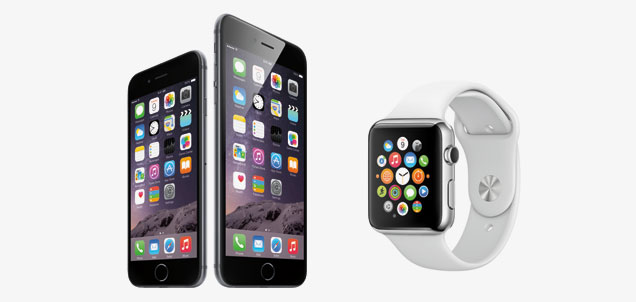
    Finally, after months of apprehension and a million rumour mills later, we have what is called the 4.7″ Apple iPhone 6 and the phablet 5.5″ Apple iPhone Plus. The change from the previous iPhone models is quite obvious with a design similarity to the Apple iPad Air with thinner and curved edges. The iPhone Plus has a better resolution of 1920×1080 with a 401 pixel density. This is also going to be known as the Retina Display (Macbookpro users will be familiar with this term for high resolution display). The iPhone 6 Plus will be 7.1 mm thin.


    Apple says that the iPhone 6 is the thinnest phone they have ever made at 6.9mm thinness. Both the iPhone 6 and the iPhone 6 Plus have better battery life and improved cameras. While most of these features have been guessed correctly by experts, Apple has also introduced Apple Pay through an NFC chip and Apple does not store your information on these devices. There is also what is called the one-handed mode with which you can navigate a website forward and backward by swiping it. Double tapping the home button will result in popping down of the image on the screen to use the phone easily with one hand.


    Talking about performance, the iPhone 6 Plus comes with a 64-bit A8 processor and runs iOS 8 with virtually no change in design. Apple Health will be useful in tracking your vitals by collectively keeping your data in one place.


    With some major changes to the camera, iOS 8 features autostraightening, cropping, automatic color correction and 2 sliders for lightness and color. It also has a brand new camera sensor.  Both the iPhone 6 as well as the iPhone 6 Plus have an 8mp camera with a True Tone flash and 43mp panoramas! The 6 has digital stabilization whereas the 6 Plus has optical image stabilization.

    As for video, you can capture full HD at 1080p at either 30 or 60fps due to the new M8 motion coprocessor.


    The iOS 8 App Store will let developers create short video app previews with a better control on app-buying by kids called Family Sharing. The battery for the iPhone 6 will last up to 10 hours in 3G and LTE mode and 11 hours on WiFi and video. The WiFi802 support will let you access the internet at a blitzkrieg speed of up to 150mbps downlink.


    The pre-orders for the iPhone 6 and 6 Plus will begin on 12 September and will be available in the UK, US, Australia, Germany, Japan, Puerto Rico, Canada, France, Hong Kong and Singapore. The 16 GB version will cost $199 on contract in the US and for another $100, you can buy the 128GB version for $399. The iPhone 6 Plus will be available in gold, space and silver colors. It will cost $299 on contract for the 32GB device and $399 on contract for the 128 GB (See Table for prices in the US, Singapore and HongKong in Indian Rupees).


    Apple also launched the Apple Watch with the specially designed and engineered Digital Crown with which you can scroll, zoom and navigate easily. You can send and receive messages, answer calls to your iPhone along with sending sensitive data such as your heartbeat. The Apple Watch will be available for $349 in the US starting early next year and will run the latest version of iOS 8.


    Will the Apple Watch herald an all-new era in gizmo-land just as the Mac, iPod, iPhone and iPad have in the past?


    Given that it does from Apple it sure will create quite a stir. Let’s wait and watch.


    Handset US US Rs Singapore Sing Rs Hong Kong HK Rs
    6 plus 749 45689 1288 63112 6388 51104
    6 649 39589 988 48412 5588 44704
    5s 549 33489 848 41552 4688 37504

    Unlocked phones. All conversions have been rounded off on the higher side
    Assuming following conversion rates: USD: Rs 61, SD: Rs 49, HKD: Rs 8


    The Press Releases from Apple:

    1. The iPhone 6 and 6 Plus: http://www.apple.com/pr/library/2014/09/09Apple-Announces-iPhone-6-iPhone-6-Plus-The-Biggest-Advancements-in-iPhone-History.html


    2. The Apple Watch: http://www.apple.com/pr/library/2014/09/09Apple-Unveils-Apple-Watch-Apples-Most-Personal-Device-Ever.html


    3. Apple Pay: http://www.apple.com/pr/library/2014/09/09Apple-Announces-Apple-Pay.html


    4. On iOS8 http://www.apple.com/pr/library/2014/09/09Apple-Announces-iOS-8-Available-September-17.html


  • 75 years young, John Sculley is rearing to go.


    By Moinak Mitra


    Youth is effervescent. Bubbling over that target audience, American businessman, entrepreneur and investor in high-tech startups John Sculley, who is more famously known to have ‘fired’ Steve Jobs from Apple in the mid-80s, gushes with renewed enthusiasm. After trouncing Coca-Cola as PepsiCo’s youngest CEO in the now-famous ‘Cola Wars’ by targeting the youth, Sculley amped up the youth quotient in Apple.


    In his latest avatar, at 75, he is now set to launch his ‘youth-centric’ range of Obi mobile phones in the Indian market as a test case, to be taken to other emerging markets upon the India experience. While reams have been written on how Jobs invited Sculley to Apple in the early 80s with the bait ‘Do you want to sell sugared water for the rest of your life? Or, do you want to come with me and change the world?’ and their eventual fallout over the Macintosh versus Apple II row, Sculley’s management mantra is pivoted on Jobs’ ‘zoom-in, zoomout’ approach.


    INDIAN CONNECTION

    Sculley had his fi rst brush with the Indian market in 1991 when Ratan Tata came to visit him with a delegation of Indian business leaders in his California home. When he left Apple in 1993, Tata visited him in his Connecticut home as well. “I’ve been coming to India ever since 1996 and have seen the country when there was hardly any electricity,” says Sculley. Apart from Tata, he counts Nandan Nilekani and Pradeep Kar of Microland among his close friends. He ‘s driven several thousands of kilometers in the hinterland with Kar and his wife, Kalpana. From a business standpoint, it is India’s emerging middle class and the frugal Asian business model that attracts him.


    Zoom in, zoom out

    The duo met for the first time in 1982 and took five months in getting to know each other over long sessions at Jobs’ triplex apartment on New York’s Upper West Side. Later, upon signing up with Apple, Sculley and Jobs would spend time walking around the Stanford campus, Apple campus and high-tech citadels on the West Coast. “So Steve would say, ‘Let’s zoom out’.


    That meant the big picture. He said, ‘When I was in Reed College, I learnt about calligraphy and then I got this opportunity to visit Xerox Park, Palo Alto research center and I saw what they were doing with the Star and the Alto.’ These were the first experimental media computers. He said, ‘If I could commercialize something and make it really easy to use and very inexpensive and I could connect the dots with calligraphy that I fell in love with at Reed, and put that together with a media computer, that would change the world’”, narrates Sculley.


    While the zoom-out principle encapsulated linkages that wove past, present and future into a missionary zeal for novelty, zoom-in was all about simplification. The most important decisions were not about what you put in, but what you leave out. Sculley would hang around with Jobs at the Mac building at midnight because all the engineers worked late. “An engineer would just come and say Steve, look, I just simplified this function to four steps. Steve would say, it’s not good enough. He said, Steve, you just didn’t look at it.


    Steve would say I don’t care. Come back when you have it in three steps,” says Sculley. One look at Apple today, whether it is iPod, iPhone, iPad—it is zoom-in, zoom-out in motion. Sculley believes Apple can only be understood correctly as a systems design firm. “It’s not a technology company. Most of the technology comes from other people. It’s a series of choices. When Steve was alive, one person made all the choices. That’s how you get a product like iPad, iPhone, iTunes, AppStore. It’s zoom in, zoom out.”


    Though he regrets the fallout with Jobs, the septuagenarian has surely imbibed the bulwark of his business philosophy from the man who saw the future. “It was my mistake not understanding back in those days how important the founder is in Silicon Valley as the most innovative companies are really the ones with founders at the helm, not professional managers,” says Sculley, dishing out sterling examples from Jeff Bezos (Amazon) to Jack Ma (Alibaba), Mark Zuckerberg (Facebook) to Larry Page (Google).


    Failures propel greatness

    It is his admission to mistakes that sets him apart. He confesses that at Apple, he made the mistake of not going with the Intel processor and Apple really lost out in the PC revolution in the 90s as Intel became the heart of every PC ecosystem. “I even failed to read Apple Newton’s (PDA) prowess, which was 15 years ahead of itself, and would become an inspiration of things to come, like the worldwide web and digital cellphones,” he says. Failure is looked upon as valuable experience in Silicon Valley and as startups fail, founders get asked about their learning, unlike in India. “You don’t have a culture that gives permission to fail, while we do,” says Sculley, pointing out that despite the IITs, India has zero success stories in high-tech.


    The Cola Wars

    Sculley would know better than most that good things crop out of failure. Back in the 70s, when Coca-Cola outsold Pepsi by 5:1 in the US, he tried a bevy of tricks to upset that, including imitating the hour-glass shaped Coke bottle, but every time met with dejection as it infringed on the Coke design. Armed with a mathematical and industrial design background, Sculley then ran a market research with a 550-home sample, wherein each week, Pepsi would deliver a certain quantity of soft drinks, including the competition, to these homes. After nine weeks, a very interesting pattern emerged—no matter how much was delivered to the household the week before, the household inventory was always empty the next week.


    “We realized that we were solving the wrong problem and shouldn’t be designing a little bottle with Coke’s little bottle,” he reminisces. In fact, that was the started the development of the world’s first 2-liter plastic bottle. This coincided with the rise of mass merchandisers in the US, like Walgreens, K-Mart and a certain Wal-Mart.


    “I remember going to meet Sam Walton to convince him to sell soft drinks as he said he would not sell soft drinks as bottles break and get messy,” he recalls. So Sculley took along with him the newly minted 2-litre PET bottle and held it out to Walton. But before Walton could grasp it, Sculley let it go. “Everyone gasped as it hit the floor and bounced.” With the buy-in, Sculley designed an entire line of merchandising equipment for plastic bottles and did the first off-shelf displays and visi-coolers and new shelf design.


    Again, to get one up on Coke, Sculley and his team at Pepsi co-developed with McKinsey & Co something called the universal product code, which came to be known as the bar code. In those days, the large chain stores had no idea how much soft drinks they were selling as they only had information about the products sold to the warehouses. Pepsi became the first consumer product to have a bar code.


    Bermuda Triangle

    Sculley’s 15 years at PepsiCo was marked by marketing-led innovations that made him the darling of corporate America with a call to ride the crest of the tech wave as CEO of Apple Computers in 1983. His siblings are equally illustrious. Arthur Sculley was Managing Director of private bank JP Morgan until 1995 and David Sculley was President of HJ Heinz & Co’s domestic ops until 1989.


    Through their family investment office, Sculley Brothers, John and his brothers are investing in smart tech and healthcare. “We’re extremely close and we’ve never had an argument our entire lives,” says Sculley. Perhaps, their work ethic has to do with the trio’s wonder years in Bermuda and New York, mostly raised by their grandparents as their folks passed away when they were young. Or, maybe, it has to do with Sculley’s grandpa, a marine engineer, who co-invented the first submarine at Liverpool


    Lesson in mentoring

    That said, Sculley increasingly sees himself as a mentor and rues the fact that he didn’t have one in his days. He is penning a book on mentorship slated to be out later this year. “The mentor is like a coach for an athlete. I like being a mentor because I can share my experience, and what you discover with more experience is that the best lessons are from your failures, not from your successes.”


    As our conversation starts winding up, Sculley has this unmistakable twinkle in his eyes and a surprise up his sleeve. In a soft stutter he says the world will be out of wireless spectrum when the next 2 billion people get smartphones, and every telco knows it. So he’s worked with Steve Perlman, his colleague at Apple, who introduced the world to Quicktime and Web TV and became Prez at Microsoft, to co-develop a solution to that problem for over a decade. “We’re planning to commercialize it now and it will be what we call a tubes-totransistor moment, or a moonshot,” he says, without batting an eyelid, harking back to a youth well spent, journeying along the cusp of talent and innovation.


    Source:The Economic Times

    Copyright © 2014, Bennett, Coleman & Co. Ltd. All Rights Reserved

    Licensed to republish


  • MobileMix study puts Apple, Samsung on top in APAC

    By A Correspondent


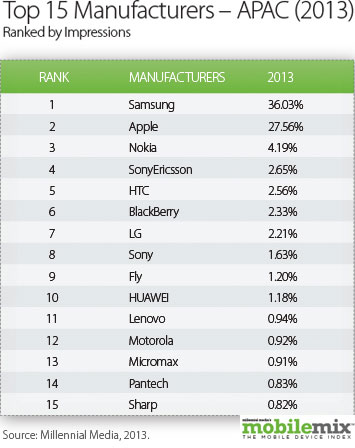
    MobileMix, the mobile device index from the house of Millennial Media is out with its findings for the year 2013. Highlighting the various trends that shaped up the mobile device platform last year, the report sheds light on the key advertising trends in Asia Pacific, with a focus on mobile manufacturers, devices, operating systems, connected devices and more.


    Where the APAC region was concerned, the report confirmed Samsung as the largest manufacturer in 2013 growing over four percentage points year-over-year. It was followed by Apple that retained its position as the second largest manufacturer, but growing nearly six percentage points year-over-year. Nokia was third on the list followed by Sony Ericsson that occupied the fourth spot.


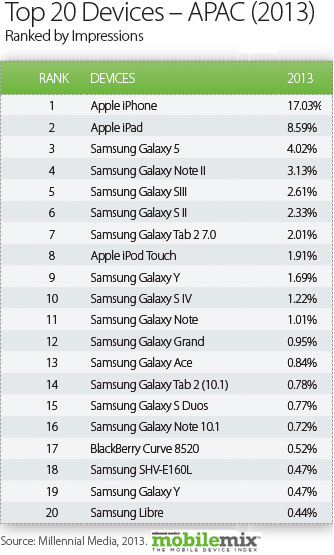
    When it came to devices, the report put Apple’s iPhone in the number one spot as it saw the largest amount of impressions in 2013, a 20 per cent year-over-year growth over the previous year. Next in line was another Apple product – iPad, that registered the second largest amount of impressions in 2013, registering a 51per cent year-over-year growth. Samsung Galaxy 5 was the third device on the list as it registered a 4.02 per cent share in 2013. A key trend in 2013 was that three tablets made it to the list of the Top 20 devices, accounting for 11 per cent of platform impressions in 2013.


    Where the device mix was concerned, smartphones accounted for 72 per cent of platform impressions while non-phone connected devices drove 21 per cent of platform impressions in 2013, representing a 35 per cent year-over-year growth from 16 per cent impression share in 2012.


    Where the operating system mix was concerned, the report put Android as the leading OS in 2013, accounting for 66 per cent of platform impressions in 2013, growing two percentage points year-over-year. iOs was the second on the list accounting for 31 per cent market share followed by BlackBerry in the third with a share of 3 per cent followed and Windows at the fourth spot with a 1 per cent share.


    Moving on to performances by individual countries, in India it was Samsung that emerged the top manufacturer, accounting for 48 per cent of platform impressions in India, followed by Apple with 13 per cent of platform impressions in 2013.


    As for devices, Apple was the top device in India representing 8 per cent of platform impressions in 2013 but Samsung had 14 devices in the Top 20 Device list, accounting for 36 per cent of platform impressions in 2013.


    As for the operating systems, Android led the category with 79 per cent impression share, up from 65 per cent in 2012. iOS was the second largest operating system with 15 per cent impression share in 2013.


  • Apple, Ferrari top world’s brand list


    By A Correspondent


    Ferrari is the world’s most powerful brand. Apple is the world’s most valuable brand. And Tata is the most valuable Indian brand.


    These are the headlines from the Brand Finance Global 500 released on Tuesday, the much-awaited annual study conducted by leading brand valuation consultancy, Brand Finance. The world’s biggest brands are put to the test and evaluated to determine which are the most powerful and most valuable.


    Ferrari is the world’s most powerful brand. The legendary Italian carmaker scores highly on a wide variety of measures on Brand Finance’s Brand Strength Index, from desirability, loyalty and consumer sentiment to visual identity, online presence and employee satisfaction. Ferrari is one of only eleven brands (including Google, Hermès, Coca-Cola, Disney, Rolex and F1 racing rivals Red Bull) to be awarded an AAA+ brand rating and has the highest overall score.


    Said Brand Finance Chief Executive David Haigh: “The prancing horse on a yellow badge is instantly recognizable the world over, even where paved roads have yet to reach. In its home country and among its many admirers worldwide Ferrari inspires more than just brand loyalty, more of a cultish, even quasi-religious devotion, its brand power is indisputable.”


    Though Ferrari is the world’s most powerful brand, being a niche, luxury brand with an officially capped production, it is perhaps unsurprising that it is some way off being the world’s most valuable. Its US$4 billion brand value puts it 350th in brand value terms. Mr Haigh added: “Apple also has a powerful brand, rated AAA by Brand Finance. However what sets it apart is its ability to monetize that brand. For example, though tablets were in use before the iPad, it was the application of the Apple brand to the concept that captured the public imagination and allowed it to take off as a commercial reality.” This is just one of the factors responsible for its US$105 billion brand value; it is the world’s most valuable brand for the third year in a row.


    According to a communiqué: Apple’s dominance is being challenged by Samsung however. The Korean giant’s improving reputation for reliability, a faster pace of innovation and wider range of devices are among many factors that have seen its brand value increase by US$20 billion to US$79 billion this year. Other tech successes include Netflix, which has nearly doubled its brand value to appear in the Brand Finance Global 500 for the first time. Its value has grown 93% in a year to US$3.2 billion, to make Netflix the 468th most valuable brand. Still operating only in the Americas, Scandinavia and the British Isles, there is huge potential for further growth. Facebook meanwhile has recovered from its problematic IPO, which saw its reputation suffer and its brand value plunge in 2013. This year it has rebounded, adding 76% to its brand value to bring the total to US$9.8 billion, putting it 122nd. Investor confidence in its long term prospects has returned as revenues from mobile advertising have grown.


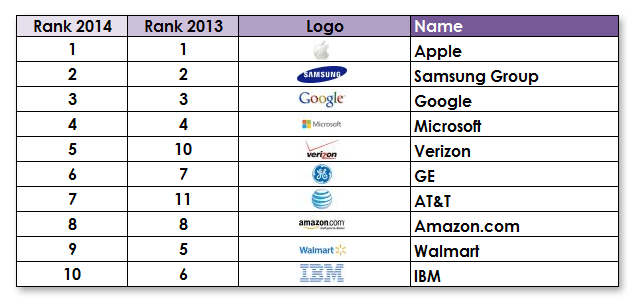
    Tech brands in general have tightened their grip on the Brand Finance Global 500. Walmart is the only non-tech brand remaining in the top 10. Once the world’s most valuable brand, it now sits in 9th having been overtaken by Amazon. The usurpation of the world’s biggest retail brand by the biggest online retailer represents yet another coup for tech brands over ‘real-world’ businesses.


    US brands continue to dominate the Brand Finance’s list, occupying 185 brands of the 500 spots. Japan is second. Despite 7 Japanese brands having dropped out of the table, the total for the country as a whole is up thanks to brand value increases of over 30% from Japan’s three biggest brands; Toyota, Mitsubishi and Honda. President Shinzo Abe’s ‘Abenomics’ programme has begun to pay off and global demand for Japanese goods is improving. Germany, France and the UK complete the top 5. Despite China’s status as the world’s second biggest economy, it is 6th in terms of total brand value as its brands are still developing. Huawei and Baidu have both increased their brand values by over 50%. While controversial for their close associations with the Chinese government, both are likely to exert increasing influence around the world in the next few years.


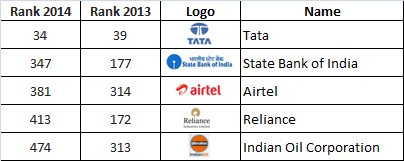
    Nations that have not fared so well include Finland. The country’s only brand, Nokia, has finally been squeezed out of the table after years of slow decline. Nokia has continued to hemorrhage brand value as a result of its inability to effectively counter the challenge Apple and Samsung. Falling out of the Brand Finance Global 500, it follows Blackberry, which dropped out of the top 500 last year. The BRIC nations of Russia, India and in particular Brazil have also fared relatively poorly. The number of Brazilian brands in the table is down from 9 to 5 and those that remain have all lost over 20% of their brand value. One Indian brand has dropped out of the table and several of those that remain have fallen further down the rankings. Tata, India’s flagship brand is the exception however, climbing to 34th worldwide with a brand value of US$21.1 billion.


  • Times Internet gets on Coast

    By A Correspondent


    Times Internet Limited (TIL) has announced a partnership with Opera Software to preload the group’s websites on Coast by Opera, the web browser for the iPad. TIL websites like Gaana.com, Timescity, Box TV, Speakingtree.in, Zoom and ET will be bookmarked as Speed Dial entries on Coast.


    Speaking on the development, Pratik Mazumder, Vice President and Head Marketing, Times Internet, said, “We are excited to enter this strategic partnership. Technology has always been very central to Times Internet’s plans of reaching out to maximum users, and this partnership with Opera will help us achieve that. TIL websites have maintained its number-one position across categories, and they engage with millions of users globally. This tie-up will help in the expansion of the entertainment sector, as this will open avenues of reaching out to new discerning readers.”


    “We are glad to offer the popular websites from the Times Internet portfolio to our users,” said Sunil Kamath, Vice President for South Asia, Opera Software. “Coast was custom-made with the iPad in mind and offers users a unique way of viewing the web by letting content take priority, and also makes watching online video a breeze.”


    Coast by Opera is available as a free download in Apple’s App Store.


  • Dhanda wasn’t really manda this Diwali


    By Sushma U N & Rajesh Chandramouli


    The Indian consumer did not disappoint. Early trends indicate they shopped with full vigour this Diwali. Everyone from hawkers on the streets to luxury brands on the high streets had pinned their hopes on the festive season this year, and from what retailers say, they are all heaving a sigh of relief.


    While mobile phones flew off the shelves, car sales remained brisk. However, refrigerators and washing machines sales were down.


    Chocolates, smartphones strike gold this season
    By Writankar MukherjeeThis Diwali, consumer goods brands across categories are striking gold. Brands like Apple, Samsung, Nestle and Ferrero are hitting new highs in sales, with products coloured various shades of gold, which marketers say Indian consumers associate with being premium.


    Check this out: Apple’s iPhone 5s in the gold version sold out within minutes of its launch, and received the maximum number of advance bookings. If that’s not enough, the model is now being resold by smaller neighbourhood retailers who have hoarded stock, and on websites like eBay, at Rs 10,000- Rs 15,000 premium.


    Last week, Apple’s rival Samsung too joined the ‘gold’ rush by launching its costliest smartphone ever in India, the golden-colour Samsung Galaxy Golden which, the company says, has sold beyond its expectations.


    Among chocolates, Nestle’s Alpino and Ferrero Rocher have sizzled retail shelves during the festive season gifting, both drawing the consumer’s eye with their gilded packaging.


    “Gold has huge appeal amongst Indian consumers since it’s a fantastic premium stand-out colour,” says Samsung India country head (mobile and digital imaging) Vineet Taneja. “This also means the product needs to be niche or super-premium,” he says.


    It is probably the same understanding which led Apple to launch just 200-odd units of the gold colour iPhone 5s as part of the launch phase last weekend.


    Cellphone retail chains like The MobileStore, UniverCell and PlanetM Retail said consumers are ready to pay in advance for the gold device. And of course, some customers who managed to score a gold iPhone5S at Apple’s launch events are re-selling the device on marketplaces like eBay, where a 16GB model is priced at around Rs 63,000 to Rs 67,000, compared with the device’s official retail price of Rs 53,500.


    UnivelCell Telecom CEO D Satish Babu said several neighbourhood retailers are selling the iPhone 5s model at a significant premium to the market price. The phone was available in the grey market even before its official India launch – dealers at outlets in Delhi’s Gaffar Market and Mumbai’s Heera Panna were quoting as much as 1 lakh for it.


    No wonder, Samsung is selling its gold-colour offering Galaxy Golden smartphone at Rs 50,000, compared with as compared to its flagship Galaxy Note 3 selling at around Rs 47,000. Samsung’s Mr Taneja says despite the premium pricing, demand for the model has been much more than the company’s expectation during Diwali sales.


    In chocolates, retail chains like Spencer’s Retail and Future Group say while Ferrero Rocher has been the king of Diwali gifting due to its similarity with the Indian ladoo in shape and golden colour wrapper, Nestle’s first premium chocolate brand Alpino has started off well with a similar packaging giving competition to Cadbury and imported brands.


    Spencer’s Retail president & CEO Mohit Kampani says while Ferrero’s share increased from 25% to 32% in Diwali FMCG gifting this year, Alpino has notched up a decent 2% share within a couple of months of its launch.


    Source:The Economic Times

    Copyright © 2013, Bennett, Coleman & Co. Ltd. All Rights Reserved

    Licensed to republish
     

    “Diwali sales were as good as last year. The theory that people prefer discount models in a downturn economy got validated. The beginning to the season was sluggish and we were nervous.


    However, last Friday (November 1) sales were way above expectations,” Raghunath Narayanan, MD of Europa Group, a clothing discount chains, said. “While exact sales numbers are still being collated, we have witnessed single-digit growth in Diwali sales. Per bill value of each customer was slightly lower than last year, but more shoppers compensated for that drop and ensured growth. In this market , not to have de-grown itself is an achievement,” he said.


    Several automakers who expected muted sales this season were in for a surprise . “Early numbers show that sales grew 10% during Diwali. Our daily shipments , which were 9,800 vehicles a day last Diwali, rose to 15,800 this year,” said Mayank Pareek COO, marketing & sales, Maruti Suzuki.


    “What we saw this year was a result of pent-up demand. Customers, who postponed purchases, chose Diwali to complete the purchase. However , for the past five or six years, Diwali sales were sluggish. We need to wait and see if this momentum in sales will sustain,” he said.


    Mobile phone sales appear top draw this year. Sales at India’s largest mobile phone retailer Univercell grew 30% this year. “Sales have been very good this year, with a 30% increase in sales by value compared with last Diwali. This was driven by the Rs 5,000-10 ,000 and the Rs 10,000-Rs 20,000 price bands, which saw highest growth,” Soumya Menon , V-P of marketing and brand strategy, UniverCell Telecommunications.


    Charath Narasimhan, CEO of Indian Terrain, a mens’ clothing brand echoes this view. “Overall sales have been reasonably good with 30% same-store growth in sales. This has been in line with our expectations. Trousers saw highest growth with khakhi coming back in fashion and sales spiking during the weekend,” Mr Narasimhan said.


    The consumer durables sector saw mixed response with sales of TVs growing, while sale of refrigerators and washing machines fell this year, said B A Srinivasa, CEO and joint MD, Viveks, a multibrand consumer durables retailer. Over the last few weeks, there was doubt over sales of durables as RBI had banned sales of products at 0% interest on credit cards but this has not impacted sales, Mr Srinivasa said.


    The monsoon/end-of-season sale in July was good, Diwali turned out better, and going forward too, for the new year sale, retailers expect the buoyant mood to carry on through what is left of the year. “The wedding season in the north is just a week away. Weathermen have said the winter is going to be strong, and this bodes well because retail will stay longer due to the winter,” said Mr Narasimhan of Indian Terrain.


    MAKING MERRY

    Europa Group, a clothing chain, has seen single-digit growth in sales. Per bill value was lower but more shoppers were seen.


    Maruti Suzuki’s daily shipments for Diwali this year were 15,800 cars compared to 9,800 vehicles last year. Sales grew 10% Mobile phone retailer Univercell saw 30% sales growth this year with 5k- 10k, 10k- 20K segments growing most Multibrand consumer durables retailer Viveks witnessed good sales in TVs while refrigerators and washing machines fell.


    Source:The Economic Times

    Copyright © 2013, Bennett, Coleman & Co. Ltd. All Rights Reserved

    Licensed to republish


  • Apple, Google topple Coca-Cola out of top slots in Interbrand’s Best Global Brands report

    By A Correspondent


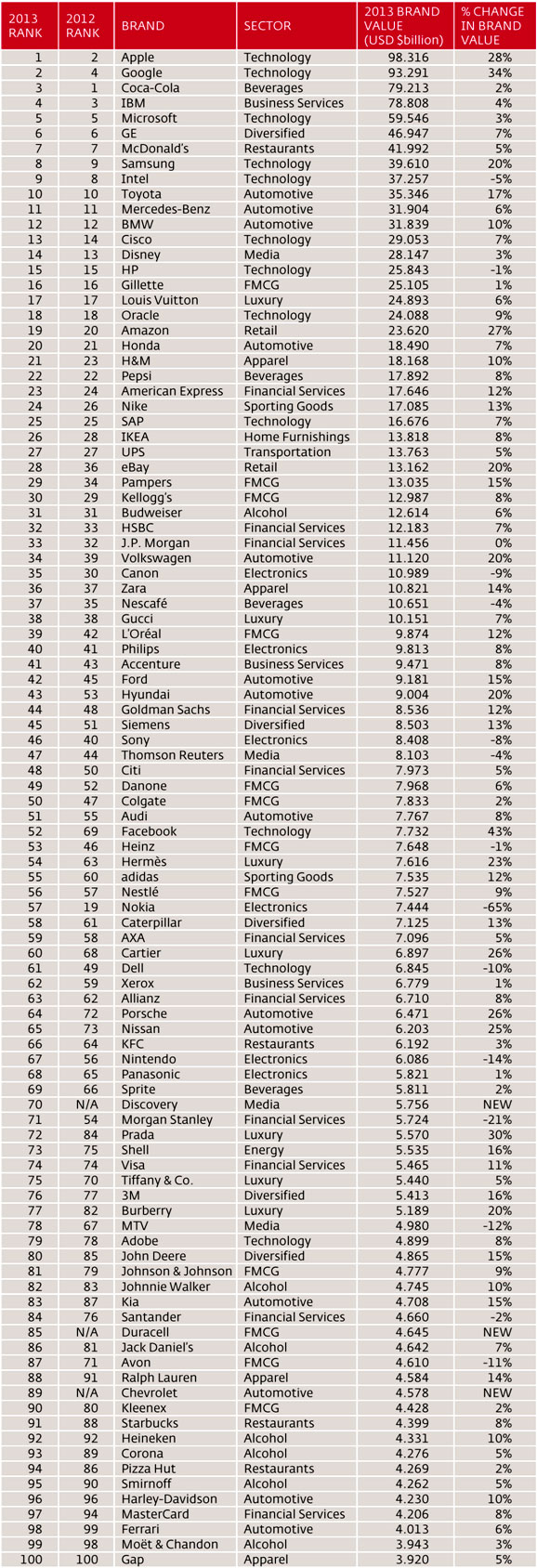
    For the first time in the history of Interbrand’s Best Global Brands report, there is a new #1 brand: Apple. Leading brand consultancy Interbrand publishes Best Global Brands on an annual basis, identifying and examining the Top100 most valuable global brands.


    With Apple claiming the top position this year, Google jumps to #2 and Coca-Cola, the brand that held the #1 position for 13 consecutive years, moves to #3.This year, the total value of all 100 Best Global Brands is USD $1.5 trillion — an 8.4 percent record increase over the total value of the 100 Best Global Brands in 2012.


    Apple hasappeared on Interbrand’s Best Global Brands ranking since 2000, when the ranking debuted. In 2000, Apple ranked #36 and had a brand value of USD $6.6 billion. Today, Apple’s brand value is USD $98.3 billion- almost 15 times the amount of its brand value in 2000.


    “Every so often, a company changes our lives-not just with its products, but with its ethos. This is why, following Coca-Cola’s 13-year run at the top of Best Global Brands, Apple now ranks #1,” said Jez Frampton, Interbrand’s Global Chief Executive Officer. “Tim Cook has assembled a solid leadership team and has kept Steve Jobs’vision intact – a vision that has allowed Apple to deliver on its promise of innovation time and time again.”


    Ashish Mishra

    Adds Ashish Mishra, Managing Director, Interbrand India – “Yes, for the first time in the BGB’s 14-year history, Coca-Cola is no longer #1. This year, Apple claims the top spot – and Google captures the #2 position.This to our minds is the single biggest story of the new times, of a changed world. Of who really leads the brand – the marketer or the consumer, or both? And how anticipation, co creation, conversation, innovation, investment in people &big data, strategic CSR and new leadership is the new way”.


    When determining the Top100 most valuable global brands, Interbrand examines three key aspects that contribute to a brand’s value:

    :: The financial performance of the branded products or service
    :: The role the brand plays in influencing consumer choice
    :: The strength the brand has to command a premium price, or secure earnings for the company

    Interbrand’s 2013 Best Global Brands (Top 100)


  • Samsung, Nokia, Micromax more researched than Apple

    By A Correrspondent


    PrecisionMatch, data provider for digital marketing in India, MEA and SEA, has released its ‘Mobile Handset Market Insights’ for India for the period December 2012 to February 2013. The consumer data in the mobile handset market suggests that Samsung, Nokia, Micromax, Sony and HTC are the five most researched brands on the internet and Samsung Galaxy S3 with its unique features is the most researched handset model.


    A key insight gathered from the data is the increasing consumer interest in Micromax phones. Micromax was the second most researched handset brand after Samsung in Feb 2013 while Micromax A110 Canvas 2 was the most researched handset model in January 2013. The data also suggests increasing popularity of Nokia, with its range of Nokia Asha and Nokia Lumia models that are competing with the likes of HTC, Apple and Sony Mobile. Another interesting revelation is Sony’s consistent performance making Sony Mobile the 4th most researched handset brand.


    PrecisionMatch Mobile Handset Market Insights was derived from aggregation and analysis of audience data for 5.3 million unique users across India over the 3 months. The 5.3 million unique users are audiences who displayed strong purchase intent by either researching, comparing or reviewing handset brands across sites. PrecisionMatch utilizes advanced data mining and analytics to identify prospective consumer segments for advertisers, generate actionable insights from aggregated data and develop consumers online behavior models.


  • Young Track by Samyak Chakrabarty | What youth think of Samsung vs Apple

    What’s a 23-year-old writing a column on a site where the average age of columnists is… ? Ok, ok, we won’t reveal that number, but like it or not the youth constitute a majority of India’s population. Since the last few years, young Samyak Chakrabarty has been in and around media events and offices with his vision of how the youth can be targeted.
     

    In this period, he has organized a few conferences, participated in several of them in India and abroad, and works as Chief Youth Marketer with the DDB Mudra group. He’s organized a TedX youth conference in Mumbai, was invited to meet Hillary Clinton when she visited India and has co-authored a book ‘Generation Einstein 3.0 – India version’.


    Samyak’s column appears on Wednesdays and as the title suggests, it tracks the young – specifically keeping in mind the advertising, media and marketing fraternity – Ed


    Why Samsung can never enjoy the same aspirational value as Apple amongst Young Indians

    Post the courtroom battle, we conducted a brand tracker to ascertain what young india thinks about the two mobile giants and has any of the legal proceedings affected their opinions. The result was clear – Apple not only maintained its high aspirational value, it crushed ‘ image to a level where many students were even ashamed to bring out their Galaxy smartphones out of their pockets for a long while. Those who could afford it, even discarded them. We looked at what Apple does so right, that it is (not only in India) the most highly regarded youth brand.


    1. Innovation: They always ensure there is enough fodder amongst techies and enthusiasts to talk about ensuring that the word of mouth is sustained. Secondly, as a technology brand they have kept up their promise of delivering to customers newer products at regular intervals. But then so does Samsung, but the difference is – at Apple it is not about ‘new’, its more about being ‘ahead of time’ – something every consumer wants to be!


    2. Design and packaging: Suave and simple is the new flashy. From looks to functionality to packaging, they have ensured that the word ‘sleek’ is heard everywhere. The problem with Samsung is that even though loaded with equal amount of features, if not more, it has not been able to create the aura around its products as Apple.


    3. Pricing: Everybody knows that an Apple does not come cheap, hence if you have one, you have arrived in life. In this case, the higher tag is working to its advantage even for volume sales. Youngsters in colleges are known to save up and cut down on other expenses just to have that device even though going by the SEC they belong to, it would be unaffordable. The likes of Samsung and Micromaxes are perceived as a poor man’s smartphone and more crudely (after the battle) – a copycat brand!


    4. Steve Jobs: Believe it or not, many youngsters aspire to posses an Apple product because of their sheer respect for this genius. He is the best brand ambassador they could ever have and it continues to be so even after his death. Samsung unfortunately has no story behind its creation, hence the legacy factor is missing.


    My reading from this is that today’s young indian consumer is all about the 360-degree. It does not matter if one factor alone is perfect – everything has to be so! Apple has sustained its brand promise and the proof of loyalty is that even through various criticisms related to the product, its perception equity has never been affected. Samsung may end up being the choice of actual purchase due to economic reasons, but Apple will always be a dream possession.


  • Is Apple still the ‘hot’ company Steve Jobs left behind a year back?

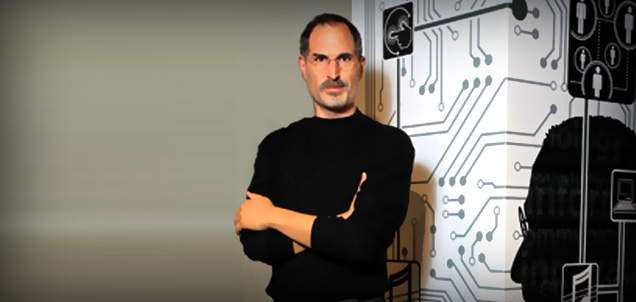
    A wax figure of Steve Jobs was unveiled at Madame Tussauds Hong Kong to mark the first death anniversary


    By A Correspondent


    Dassera Day, 2011. We were woken up by the news of Steve Job’s death.


    That he was suffering from cancer and indifferent health thanks to that was known. He had announced that he was moving on from the role that he was playing, but was around. And for many that’s what matters.


    A lot of what has been written on Steve Jobs before and after he passed away. There have been many who’ve said that the Maps controversy wouldn’t have happened had Jobs been around. But, remember, it’s not that Jobs has always got all his products right, and Tim Cook wrote a letter to consumers and apologized for the booboos.


    Would Jobs have done that? Perhaps not in the good old days. But in the era where social media (and Twitter) can be cruel and demolish one’s reputation, a ‘sorry’ works wonders. Jobs hence may well have done that.


    Would Jobs have fought Samsung so much to the point of upsetting die-hard loyalists? Should Apple have just let Samsung be… after all imitation is the best form of flattery, right? Yes, but imitation could also lead to a deep erosion of income, and one can be sure, that Steve Jobs would’ve not let it pass. It’s in fact the spirit of Jobs that Apple has ensure it doesn’t lose out on.


    “While we’re improving Maps, you can try alternatives by downloading map apps from the App Store like Bing, MapQuest and Waze, or use Google or Nokia maps by going to their websites and creating an icon on your home screen to their web app,” Tim Cook wrote in his mail.


    Would the iPhone 5 have had cooler features and not dispensed the age-old power connector? Perhaps Jobs would’ve done the same. Only if he had unveiled it, people would’ve hailed it as a masterstroke. Now, it’s being questioned.


    Would Jobs have planned launching an iPad mini with a 7-inch screen that he had scoffed at? We are sure he would have. It’s the need of the hour. As the mobile phone is turning into a small tablet and vice versa, he would have been compelled to change the course of his thinking.


    To those who’ve followed Jobs, he was more than just a device-maker. He was a thinker. A visionary. A designer. The Personal Computer became truly personal with Apple. The mobile phone became cool with the iPhone. Tablets were no longer bitter, and computing had an all-new meaning when the iPad was launched.


    On October 5, 2011, Apple issued a media advisory:

    “Apple has lost a visionary and creative genius, and the world has lost an amazing human being. Those of us who have been fortunate enough to know and work with Steve have lost a dear friend and an inspiring mentor. Steve leaves behind a company that only he could have built, and his spirit will forever be the foundation of Apple.

    No words can adequately express our sadness at Steve’s death or our gratitude for the opportunity to work with him. We will honor his memory by dedicating ourselves to continuing the work he loved so much.”


    In his letter on August 24, stepping down as CEO of Apple and recommending to the Board of Directors that Tim Cook be appointed CEO, Jobs wrote:


    I believe Apple’s brightest and most innovative days are ahead of it. And I look forward to watching and contributing to its success in a new role.

    The question is: are Tim Cook and his team at Apple worthy inheritors of the Steve Jobs legacy. Yes, they are. Steve Jobs did for Apple what he did for his various technological breakthroughs: make it Future Ready.


  • Mobile handset revenues drop 5% to Rs 31k cr

    By A Correspondent


    The Indian mobile handset market saw a drop of 5 per cent in revenues in FY 2011-12. The revenues dropped to Rs31,215 crore from Rs33,031 crore a year back. The annual survey of the Indian telecom industry by CyberMedia Group’s flagship journal for the telecom industry – Voice&Data attributes this drop to de-growth in the feature phones sales as well as lower average selling values (ASVs).


    The 17th annual study ‘V&D 100’ surveyed over 30 mobile handset firms – both multi-national and Indian – selling feature phones, multimedia phones, enterprise phones and smartphones in India.


    The disappearing act by the home-grown handset makers was a big surprise of the year. Barring Karbonn and Lava, none of the Indian handset players could face intense competition. Their main stay – feature phones – saw a negative growth while the entry level smartphones of various companies saw a marginal rise.


    “Indian mobile phone brands that had hoped to make a mark by sourcing Chinese handsets and selling them only on the price plank were in for a big surprise. These players will have to quickly rethink their product, marketing and service strategy afresh to put their house in order,” said Ibrahim Ahmad, Group Editor, Voice&Data.


    Top 10IndiaMobileHandset Vendors: Voice&Data 100 survey 2012
    Revenue in Rs Crore
    Rank 2011-12 2010-11 Change Mkt Share in %
    1 Nokia 11925 12929 -8 38.2
    2 Samsung 7891 5720 38 25.3
    3 Micromax 1978.0 2289 -14 6.3
    4 Blackberry 1460.0 1950 -25 4.7
    5 Karbonn 1327.0 1004 32 4.3
    6 HTC 923.0 450 105 3.0
    7 Spice 790.0 920 -14 2.5
    8 LG 780.0 1834 -57 2.5
    9 Huawei 750.0 626 20 2.4
    10 G’Five 670.0 1326 -49 2.1
    Total 31,215.0 33,031.0 -5 100.0
    Source: Cybermedia’s Voice&Data Annual survey of the industry 2012


    Nokia remained the number 1 player in the handset business in FY 2011-12 with revenue of Rs11,925 crore, despite a 8 per cent  drop. The Finnish company lost market share in smartphones and multi-media segment to Samsung, HTC and Apple, among others.


    Nokia felt its absence in the Android ecosystem dent its performance, it made a head way in the dual SIM phones category but lost out in the smartphone market and ended the year with a market share of 38.2 per cent.


    The Korean giant Samsung, grew its revenues 38 per cent to Rs7,891 crore at the second spot with a market share of 25.3 per cent. Voice&Data analysts attribute Samsung’s success to its rich product portfolio based on Windows, Android and Bada operating systems. Samsung’s Galaxy Note, a hybrid between smartphone and tablet was a trail blazer selling 40,000 units each month since launch in late 2011.


    “As consumers look for applications beyond voice and SMS, the market will see fight for high-end feature phones and smart phones intensify further. Consumers can also look forward to steeper price drops and more features in the same price,” said Mr Ahmad.


    Homegrown handset company Micromax with revenues of Rs1,978 crore ranked third among Voice&Data100 Top10 mobile handset brands, recording a 13 per cent negative growth and a market share of 6.3 per cent.


    The only other Indian player to post revenues of over Rs1,000 crore was Karbonn. The company grew its revenues 32 per cent to emerge as the No 5 player with a market share of 4.3 per cent.


    Among the global companies in the V&D100 Top 10 players, BlackBerry maker Research In Motion dropped the most- 25 per cent – to post revenues of Rs1,460 crore. At No 4, Blackberry had a market share of 4.7 per cent on the back of entry level smart phones last year.


    Taiwanese handset maker HTC saw maximum growth among all the brands surveyed by Voice&Data. HTC’s revenue more than doubled to Rs923 crore to inch a 3 per cent market share.


    The other key players in the Top 10 list include Spice Telecom (Rs790 crore), LG (Rs780 crore), Huawei (Rs760 crore) and G’Five (Rs670 crore),