Tag: anil thakraney

  • Anil Thakraney: Cool Britannia!

    By Anil Thakraney


    To be honest, I couldn’t bring myself to keep awake all night to watch the London Olympics opener. One, because I really am not a huge fan of the games. Stuff like long jump, high jump, pole vault, rowing, archery, and so on bores me enormously. Second, I was simply being my lazy old self. But the opening ceremony I did want to view, especially after all the orgasming on Twitter. And the internet videos came to my rescue as usual.


    Yes, the opening ceremony was spectacular. I don’t know what Beijing had done, and knowing the way the Chinese operate, it must have been all about tech prowess. The Brit event was more about drama and emotion. Which is why asking Danny Boyle to put the opening ceremony together was a smart idea. He used the opportunity to do what he does best: tell stories. The show took us through the passage of time. The industrial revolution, James Bond, Paul McCartney, Rowan Atkinson, and a whole lot of other symbols that have defined Britain over the centuries. Plus the stunning fireworks and the dazzling lights.


    Thehigh point, of course, was the Queen being parachuted into the park. I thought this was a master stroke, and only Boyle could have pulled it off. The stunt wasn’t just totally unexpected, it told you two things: One, that Britain is changing, that while they value their history and culture, they also understand the word ‘cool’. And in that one single act, they brought the old and the new Britain together. Clever thinking. Only a movie director or an advertising creative director could have come up with this audacious idea.


    All in all, a super show.Britain should be proud of itself. This is going to be a tough act to follow. I have just one regret: Millions and millions of pounds were blown away in one single evening. And to think it’s the Games that really matter at the Olympics. Imagine the things that could have been done with all that dosh. An entire underground train network in Mumbai. Thousands and thousands of flyovers. Anyway, let’s not go down that road, there’s no end to my carping.


    Let’s just hope, after all this mega shor sharaba, our folks return with at least one medal.


    * * *


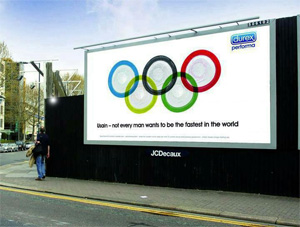
    PS: Surely the best London Olympics ad. From Durex. Perfect. This is what is called seamlessly attaching your brand to a global event. With no chance of needless ‘spill over’. 🙂


  • Anil Thakraney: Page 3 versus Oprah

    By Anil Thakraney


    Oprah Winfrey is a super talk show host. That is well known. We now also know that apna Aamirbhai is a huge fan of the lady, after he formatted his maiden TV show based on her work. All very fine and dandy. But we’ve just discovered another thing about Oprah that some hoity toity Indians are finding very hard to digest: Apparently, she thinks poorly of us Indians because we ‘still’ eat food with our hands. And the TV queen has made a video of her shock over our crazy dietary habits for the consumption of her local audiences inAmerica. And it’s mainly targeted at the Texan rangers, who must obviously be having a good gaff at our expense.


    I searched for the offending video on Youtube, and not surprisingly, they have been blocked for viewing in India. And that’s stupid, really. You can find the link through other websites. Oprah made this sensational comment when she sat down for a desi thali meal with a conservative Somani family from Mumbai. One can see in the video that the family is going out of its way to please the honourable guest.


    The result: All those Page 3 types who were falling over each other to get close to Oprah when she visited India in January this year, are busy spewing venom against her on TV talk shows. These are the same people who were excitedly tweeting their smiling thopdas in the company of the exalted lady. I have only two things to say to these angry beauties.


    One, Ms Winfrey is a television presenter and she will use footage that can get her American audiences transfixed. That’s her profession, that’s her job. Western audiences don’t want to see the high rises of Nariman Point, nor are they interested in videos of Parmeshwar Godrej’s glitzy party in Oprah’s honour. They want to see the poverty and squalor they usually associate withIndia, stuff they find quaint. The huge success of Slumdog Millionaire proves that. So don’t hold this video against the lady, she’s got TRPs to worry about.


    This incident should also remind you guys and gals to quit the gora (which ironically, Oprah is not even) fixation and get over the colonial hangover, it’s been over sixty years since we ousted them. Treat them like any other guest when they arrive, so that when they return to their own nations and report unflattering things, we simply ignore it and move on.


    Let’s be a little more confident about ourselves for god’s sake.


    * * *


    [youtube width=”400″ height=”225″]http://www.youtube.com/watch?v=x3jTSB2ez-g[/youtube]

    PS: Do watch this video on the art of designing a logo. It talks about the evolution of the logo over the centuries and its huge relevance to marketing. And there are some super examples too.


  • Debrief: Raymond’s boring celebration

    By Anil Thakraney


    The Raymond shop wants the suits to celebrate everyday. Even if they are stuck on potholes or the share prices have crashed or the babus are sitting on their business proposals or their wives have walked out on them. (Okay, all that is my nasty two-bits!). Nothing wrong with the concept per se, so then it’s all left to the execution.


    The TVC lives the life of a suit through the week, from Monday to Sunday. It shows how, by wearing the Raymond suit on different occasions, the man makes his life rock. Whether it’s work, partying, chicks… and of course, spending time with parents. The Raymond man is a complete man, you see, and until he obediently touches the feet of the elderly, his week is incomplete.


    [youtube width=”400″ height=”225″]http://www.youtube.com/watch?v=Jf5R_fIyZb0[/youtube]

    Completely stupid work this is. While I appreciate Raymond’s attempt to expand their market share by positioning the brand for all occasions, the ad is totally dull and trite. Same old suits, same old corporate meetings, same old moving and shaking… this looks like a commercial from the sixties. And the thakela jingle only manages to pull things down even further.


    A complete wash-out in my books. However, I shall add a rider: I am not a suit, so perhaps I don’t understand these pin-stripes. It’s quite possible they like such floozy stuff. In any case, with the general dumbing down that’s happening with Young India, perhaps such work is the order of the day. And I feel very saddened to state this.


    Rating: (On a scale of 1 to 5): 1. Tired and jaded.


  • Our battle is to out-think TOI: Meenal Baghel


    Meenal Baghel is the founder and Editor-in-Chief of Mirror, the nation’s most sprightly newspaper. Mumbai Mirror was launched seven years ago, and today the paper has editions in Pune, Bangalore and Ahmedabad. A part of the Times group, Mumbai Mirror boasts of a fantastic circulation of nearly 600,000 copies, and it’s become the city’s favourite compact paper.


    Meenal relives the journey with us, and speaks candidly about the many challenges she’s faced along the way. We also discuss her first book, ‘Death in Mumbai’, which received wide critical acclaim.


    I did a stint with Mumbai Mirror some years ago, and this gave me a chance to watch her in action. Meenal can be a demanding editor, she can be impatient, she can be tough. While these qualities don’t endear her to some, they have played a huge part in her success. I have to say she’s the most passionate editor I have worked with.


    By Anil Thakraney


    It’s been seven years editing Mirror. How’s the journey been? Tell me the highs and the lows.

    The high obviously has been to see the paper become an important part of Bombay. We have been successful in forging an emotional connect with the readers, which is very important. We get an enormous number of people calling in with stories. And we’ve routinely broken a lot of stories, so those are the big highs. The low is that the paper is still a bit inconsistent. You know, when we started the paper, it used to be called Mumbai Error. I wish we had a cleaner start in terms of the paper being more finished. But it’s been a sort of work in progress. We have learnt a number of journalistic lessons along the way because the market has changed, the reader has changed. For instance, when we were at Mid-Day, you could get away with a lot of things. But in this day and age, you can’t.


    Give me an example

    Like sometimes when, just to break the monotony, you put an entertainment story on the front page, there is a backlash. People now expect a more serious newspaper, it’s something different from what I had envisaged. But that’s also because there’s so much of entertainment everywhere that people don’t want more of it.


    One story you regret

    We ran the FIR of the TISS girl who was raped. That was a mistake. Because the details in the FIR were very graphic on what had transpired. And you realize that you may have ended up titillating. I regret that story, we got terrible feedback for it and we apologized for it.

     

    “I don’t think journalism offers enough challenges to the really bright people any longer.”

    I still see a number of typos in Mirror. Is this an un-lickable problem?

    I think there is a very real problem with journalism today, and it’s not only limited to Mirror. The problem is that the deskies is a disappearing breed. And it’s going to be a big challenge over the next few years. Also, there are very real problems we are facing, and these are going to change the profession drastically. It’s so rare to find people who want to come into journalism because they want to be journalists. For example, when you ask people, ‘Who edited this copy?’. Invariably the response will be: ‘I looked at it/I glanced at it/I skimmed through it.’ Another thing is I don’t think journalism offers enough challenges to the really bright people any longer. There is an attrition problem across aboard. People want to try out various things. When you and I were growing up, it was about sticking to a profession, a career path, and that no longer holds true. People now have the advantage of taking breaks, taking gap years, studying, etc. The journalism hours don’t allow too much of a personal life. And I think HR, owners, publishers, editors need to take all these things into account.


    Is the passion for journalism diminishing in young India?

    I think the important thing now is personal growth and personal life. That has taken precedence over wanting to change the country.


    What was Vineet Jain’s brief to you when you signed up for Mirror?

    His brief was very clear. He said it should be a smart paper and that it should be different from the Times of India. And because it’s a compact size, there are elements of a tabloid that you can incorporate. In fact, when we started the paper, there were a lot of conflicting opinions, so I was a little tentative in the beginning. And then one day he called me and asked why was I so tentative. He said, “I have given you this brief, just stick to it. And don’t be apologetic about it.” So that was wonderful.


    You think this country is ready for a Brit style tabloid?

    No. Though it’s very interesting because everybody is trying to incorporate the tabloid elements, but you can’t be openly unabashed about it. We are not ready for it. For instance, look at the responses Dr Vatsa’s column gets.


    Guess it’s a tightrope walk. You want to be tabloidy, and still have to be aware the nation isn’t ready

    Yes. Sometimes in the newsroom we think we can do a story, but when we see the backlash the next day, we start being more careful by censoring ourselves.


    And the problem is if you play safe and cut down on controversy, you get dangerously close to the TOI

    Yes. So what we try and do is this: I always say our competition is the Times of India. Because we go with the TOI. Now the TOI has massive width, they do like sixty stories at an average. So our battle is to out-think the TOI, in the sense that ‘this is what they will do, so let’s do something different’. We can get away with some naughty things that they can’t.


    Lots of court cases?

    Actually they’ve come down, ever since we’ve become safer. (Smiles.) But there’s also a lot of frivolous litigation, which is easily dealt with.


    More editions in the offing?

    At the moment, no.


    And for Mumbai Mirror, are you still as hands-on as ever?

    See, I am out for lunch with you! (Laughs) But yes, I like being hands-on. There are times when I can breathe down people’s necks. But I am trying to back off a little now that we have a very competent senior team. I also realize that people should be given more space, but it’s difficult. (Laughs.)

     

    “The TOI has lots of products that come with it, but everyone doesn’t necessarily read all of them, right?”

    Meenal, the perception is that Mirror benefits a lot from being the TOI’s free paper. Without that advantage, your circulation would be nowhere close.

    I am lucky and I won’t question my luck. We have a great readership, thanks to the TOI. But then you have to capitalize on that luck, you still have to deliver a good product. The TOI has lots of products that come with it, but everyone doesn’t necessarily read all of them, right?


    If you were a standalone paper, how much circulation do you think you’d lose?

    I guess we’d retain 60%. Because Mirror has become a genuine commuter’s paper. You have to travel in the train to see how many people carry it. It started off as a guilty pleasure, which people didn’t want to acknowledge they were reading, but they were all reading. But over time it has also become a lively paper. And that can’t be said about too many other papers in town. And people like that.


    Would you say Mid-Day was your training ground?

    Absolutely. I had always worked with broadsheets before that – Pioneer, Asian Age and The Indian Express. So when I joined Mid-Day, for a while it was like, where the hell have I landed? This is not how journalism is done. For the first six months I had no idea what I was doing. But I was in a senior job and I was getting paid an X amount, and I must tell you I HATE giving up. And then one day I went for a walk and said to myself the paper won’t change because of me, there was a reason why this paper was so beloved in Bombay. And that was the Eureka moment for me. I decided to try and understand it rather than look down upon it. And that changed things. I must say I learnt a lot from Aakar Patel (the then editor of Mid-Day). I learnt a lot from what the paper did on Page 1 and on headlining.


    One Indian print editor you most admire.

    I owe everything I learnt in journalism to MJ Akbar. About writing, about making pages, about what not to do, etc.


    It’s been seven years at Mirror. Don’t you feel the itch? Isn’t it tiring to do the same thing day in and day out?

    I keep wondering why nobody else offers me a job! I am joking, of course. Which is why doing the book was wonderful for me. It gave me a chance to step back and follow a story that had been fascinating me. And it was extended journalism. I have always felt when the number of days you feel bad about what you do exceeds the number of days you feel good, you should quit. I haven’t reached there. And there’s always something exciting happening.


    Being a hard-edged journalist, how do you reconcile with something like Medianet?

    That’s easy, because we don’t have Medianet in Mirror.


    But it’s there in your group.

    It doesn’t affect my life, so I don’t care about it.


    You aren’t asked to carry plugs?

    No. And it’s one of the things that has pleasantly surprised me. They have maintained the Chinese wall from the start.


    They have left you alone?

    Yes. And there’s another reason. Mirror is a small paper in the group, so it’s not necessarily the focus. We are a small cog in comparison.


    Have you ever been asked to drop a story?

    (Pauses) Not drop a story. I think what one learns over a period of time is that you have to pick your battles. I’ll give you an example: If there’s an entertainment story which is coming right ahead of the Filmfare awards, where somebody is going to be performing, and I have a damaging story on that person, would I delay it by a few days? Yes, I would.


    There used to be intense rivalry between the Independent and the TOI. Is it the same with you?

    Not rivalry, but there is great competition. When the TOI does something, and we’ve missed it, I give my reporters hell. And I am sure JoJo (Jaideep Bose) does the same when we get something.


    “Mid-Day killed itself. And I feel really bad. I feel bad that what was such a robust paper is no longer that.”

    You’ve pretty much killed Mid-Day. Feels good?

    The paper killed itself. And I feel really bad. I feel bad that what was such a robust paper is no longer that. We all worked very hard out there. We worked our asses off at Mid-Day and we used to take great pride in the paper being so robust, that it was second only to the TOI.


    What would you do if you were editing Mid-Day today?

    I’ll bring in more energy. What’s going for Mirror despite the inconsistency is that it’s never dull. And dullness in journalism is a cardinal error. Especially if you are a tabloid.


    Let’s shift to your book, ‘Death in Mumbai’. Does Meenal think Maria Susairaj got away lightly?

    I must tell you I ended up liking her quite a bit. I feel that she is a manipulative woman and that she may be a tease. But that’s not a crime, there are a lot of women like that out there. Did she kill or abet the killing? I don’t think so. She was in love with Emile Jerome, she really wanted to marry him. But he wasn’t committing to her. When he killed this guy, it was, in her mind, like his commitment to her.


    When you started writing, was there something you had decided you won’t do in the book?

    The only thing I told myself is to not be judgmental. Because someone else’s idea of morality could be different from mine. Like, I started out with a certain view of Maria but it became something else.


    In fact, that was the only criticism I read about the book. As a journalist, readers expected you give us your own view. Perhaps as the epilogue.

    There were genuine difficulties. Something happened in a room where there were only three people. One guy is dead and two are in jail. There is only so much information I had. And I genuinely did not want to play judge.


    You have always kept a very low profile. Marketing the book must have been tough.

    (Laughs.) It was! It was terrible. The only time you would see me on television was on things that were related to the book. Otherwise I wouldn’t be caught dead going on TV.


    Any more books coming up?

    I would like to write more books, but I love this job too much. Ideally I’d like to do both. But I haven’t thought of another subject so far. Might be interesting to write fiction.


    Would you like to edit the TOI?

    No. I think it would be fun to edit a broadsheet, but I don’t think I am ready to edit the Times. It’s the biggest paper in the country, it requires a greater understanding of business, politics… and I don’t think I am ready for it. Also, it requires certain people skills which I perhaps don’t have.


    Don’t rate yourself high on people skills?

    I think I am very good. But I need to be more patient. I can be impatient and that’s a serious shortcoming.


    You are 43. Don’t want to marry?

    It’s too late now (Laughs).


    Is it important to be single to edit a high pressure daily? Is it a price one pays?

    Sure. It’s a price a lot of women, more than men, have to pay for any high pressure job. It’s unfortunate, but it’s a fact. I may have been married, but it would have been very difficult with children.


    Photographs: Fotocorp

     

  • Anil Thakraney: Murder in the factory

    By Anil Thakraney


    What happened at Maruti’s Manesar plant is extremely sad. You don’t go to work and expect to get burnt alive by your own colleagues. And this is no longer a business story, it has moved to Page 1 as a sensational crime story.


    Naturally, we now have to wait for the police investigation to get done, so that we know exactly what transpired that fateful day. Apart from nabbing the criminal workers (which isn’t going to be easy given the political pressure), another truth needs to be uncovered: There are rumours that the slain HR manager provoked a group of workers by hurling casteist or communal abuse. This doesn’t lessen the crime, but it still needs to be investigated.


    As of now, I know just one thing: HR managers who deal with factory workers need high level of skill and training. It is a very difficult job because there is always a huge degree of mistrust between white and blue collar workers. Everything is vastly different: Sensibilities, motivations, attitudes, culture, language, you name it. I sometimes wonder if CEOs put in special efforts to appoint the correct HR personnel for their factories. And ensure they are heavy trained for the job. It’s just not the same as air-conditioned corporate offices, where even if the HR staffers did nothing (and many do precious little!), life simply goes on.


    How do I know all this, since I have never worked in HR? It’s simple. My dad, before he retired, was the chief of personnel and human resources at Shaw Wallace. And the factory HR was his key result area. I am aware of the high level of tact and diplomacy he used to need at his disposal to keep the workers and the management at peace. It was a very stressful job, and despite his best efforts, he would, at times, receive violent threats from a section of workers.


    I got a chance to watch him in action when he took me for a factory visit to the company’s Uran (Maharashtra) brewery. This was when I was in school, and the visit introduced me to beer very early in life, but that’s another story. 😉


    * * *


    [youtube width=”400″ height=”225″]http://www.youtube.com/watch?v=pTjHCCU2E4c[/youtube]

    PS: ‘The web is what you make of it’. Google Chrome has been doing some nice adverts in this campaign. This particular one, where a man is trying to woo his lost love back, is quite charming. The strength of this work lies in what is known in advertising parlance as ‘vivid demonstration of the product’. Whereby you experience exactly how the product works. But they do it in a very entertaining way, which is why the ads shine. Something to learn here for all those guys who make those ultra boring mechanical car commercials.


  • Debrief: HCL: Fresh and entertaining

    By Anil Thakraney


    HCL is back with its Mr HCL and Mr Banker campaign. The positioning is the same as before: ‘Technology that touches lives’. But innovation is at the heart of the new commercial.


    This time the two dudes are marooned on a remote island. The banker plays the bumbling idiot, and Mr HCL is, of course, the smart one. The latter uses the banker’s dead cell phone to light a fire on the beach. The smoke is detected by a rescue helicopter, and the two are saved. But not before the banker has made a fool of himself for some quick laughs.


    This commercial works for me. Mainly because Mr HCL isn’t shown using technology to provide a solution, he uses ingenuity. Imagine if he had used techno magic to perform the rescue act, the TVC would have become literal and therefore boring. At the same time, this approach projects HCL as an innovative company that’s ready to think out of the box. Ergo, message delivered.


    [youtube width=”400″ height=”225″]http://www.youtube.com/watch?v=1gAASVe09VM[/youtube]

    I didn’t much care for the ‘ass on fire’ slapstick stuff, it is much too forced, but our cold techie friends will find this funny, so that’s fine. But why make fun of investment bankers? Are they such morons? This is the only part I don’t quite get.


    All in all, an entertaining ad that delivers the message. Also, the Discovery Channel type of a setting, of being rescued from wilderness, adds to the freshness of the communication.


    Rating: (On a scale of 1 to 5): 3. Focused message. Cool delivery.


  • Anil Thakraney: Cap on TV ads harsh. but necessary

    By Anil Thakraney


    TRAI’s proposal to control television advertising does sound anti-free market at first glance. They have proposed 12-minutes per hour cap on ads. And also a ban on drop-downs and half-screen ads. Surely this is unacceptable. In an open market economy, marketers must be allowed to run their own commercial agendas, as long as no law is being broken. Just as all other media formats and most other businesses are allowed to. And I do see matters reaching the boiling point as the D-Day gets closer. Fair enough.


    Having said that, there is no doubt that TRAI’s new guidelines will vastly enrich the TV viewing experience. There are often too many ad breaks, and the Hindi news channels are particularly guilty of this. Many of us get scared of watching these channels more because of the breaks rather than the bhoot prets they regularly feature.


    And on some entertainment channels, the ad breaks are so long, leave alone No 1, you can actually manage No 2 inside one break! I know this example is crass, but you have to admit it’s quite relevant in this context. 🙂


    And of course, some of the sports channels have made a mockery of the TV screen. The way they splash live action with ads and commercial graphics, it’s like a naughty child has been let loose on canvas with a bucketful of paint. Half the fun of watching live action cricket has gone because of these sad gimmicks.


    TRAI’s proposal attempts to correct these things, and that’s a good thing. Also, because the ad rates will zoom up in the new regime, advertisers will be pickier about the programmes they choose, and will make sure they are focused. This will provide them with better return on investment. Today, on a very serious programme like Satyamev Jayate, one is bombarded with rubbish chaddi/baniyan ads. This makes no sense, neither as a marketer nor as a viewer.


    In addition, advertisers and their ad agencies will be compelled to get innovative on television. People will have to think beyond the classic 30 seconder, and as a creative person, I find that idea pretty challenging.


    Bottom-line: Yup, TRAI’s proposal is autocratic and draconian. They have no right to decide how private operators choose to make their money. I accept that point. But if their new guideline does get implemented, the television medium will regain some of its lost sheen. That, too, is a fact.


    * * *


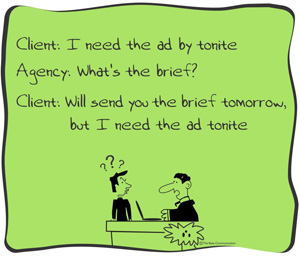
    PS: Ah! Just another fun filled day in the ad world. It was like this a hundred years ago, and it’s still the same. And outsiders wonder why ad guys are often found inside watering holes. This is the key reason!


  • Debrief: Maggi: Weak stories

    By Anil Thakraney


    ‘Spreading happiness’ is an interesting platform for Maggi. Going beyond just the fast food narrative, the new ad tries to bring out people’s happy association with Maggi noodles. So as to build an emotional connect with the brand. The theme is: ‘Meri Maggi – 2 minute mein khushiyan’.


    The commercial features Amitabh Bachchan as the host, as we watch vignettes of junta’s happy Maggi moments. A hungry biker is fed Maggi by a stranger woman. Some kids use candles to cook Maggi. A bahu wins over her in-laws’ affection by serving them Maggi (really?). These are supposed to be authentic consumer stories. And Big B dutifully invites viewers to send in their own Maggi tales, which will be shared with everyone.


    While the intent is right… Maggi is an old brand and it needs to build bonds with consumers to stay relevant in their lives… the execution left me totally unmoved. The Maggi tales/moments/whatever need to have some adrenalin, some energy and most importantly, a surprise element. If they remain at the basic level, which currently is the case, the communication isn’t able to do its job. Because the emotional quotient is very weak. And yes, Bachchan plays an over-paid prop in the commercial.


    [youtube width=”400″ height=”225″]http://www.youtube.com/watch?v=FmE4xnWoTQ4[/youtube]

    We need touching, heart-felt stories, dear Maggi. Cook them up if you can’t find real ones. And take your time, you don’t need to do it in two minutes. Just like good food, good things take time to happen. 🙂


    Rating: (On a scale of 1 to 5): 2. Right idea. Let down by very average execution.


  • Anil Thakraney: NewsX needs the X. Very badly

    By Anil Thakraney


    No, I don’t watch NewsX. There are two reasons for this. For one, as far as the English news channels go, I have my plate full. With NDTV, Times Now and CNN-IBN. And that’s already more than I can handle. There is simply no appetite left for another ‘helping’. In addition, when I am in a particularly foul or salacious mood, I log into the Hindi news channels. Like India TV and Aaj Tak. And there’s no question of being able to deal with anything beyond this, as far as television news goes.


    Second, and more importantly, when I have accidentally dropped by at NewsX on the odd day when I am mindlessly surfing, I have noticed they have absolutely nothing new to offer. It’s just a bad copy of the leading English news channels, a poor me-too. So there’s been no motivation to go back.


    Within the above two reasons lie the key problems for this fledgling news channel. The English news channel market is saturated and very busy. Regular TV viewers have formed their individual loyalties, and it’s really tough for a late-comer to grab attention. No wonder NewsX has been languishing on the sidelines for four long years. And worse, because they have nothing fresh to offer, the channel will continue to languish.


    Now, to be fair to NewsX, the channel has seen enormous tumult since it was born. Friction within the senior management partners, ugly controversies and frequent change of ownership. Already placed in an extremely competitive market, this is not the kind of stuff they needed. The channel staffers should consider themselves fortunate the brand has survived thus far. And now, yet again, NewsX has a new owner: the ITV Group.


    I really can’t understand why ITV acquired the channel; it neither has the ratings nor the distribution. But their best bet now is to do one thing very quickly. Which is to get the X-factor injected into NewsX, the one and only ingredient that will help it survive. That critical factor is the only thing that will help the channel develop a distinctive identity. And if that doesn’t happen fast, it’s good bye to NewsX. And the saddest part is that no one will even notice when the channel’s gone.


    * * *


    [youtube width=”400″ height=”225″]http://www.youtube.com/watch?v=0eisbkQgY2Q[/youtube]

    PS: ‘Take the stage.’ A good campaign released by Adidas, especially for the UK market. This is not just to motivate the Brit athletes but also to create a buzz around the Olympic Games. Would have been nice if there was such an encouraging film produced for the Indian athletes. So that they don’t lose their passion even if Kalmadi lands up at the games to say a warm hello. 🙂


  • Debrief:Toyota: Yeh Waku Doki kya hai, bhaiyya?

    By Anil Thakraney


    It took me a lot of time to figure what in hell Waku Doki means. It sounded like Japanese to me, so I called a Jap pal for help. And he said it roughly means: ‘Excitedly waiting for something cool to happen’. Toyota has unleashed this Japanese colloquial phrase as the umbrella positioning for two of its brands: Fortuner and Etios. And the other common factor is cricketer Virat Kohli.


    In the ad for Fortuner, Kohli says Waku Doki to a kid who’s bored of playing video games. In the ad for Etios, the young cricket sensation plays the same trick on a heart-broken gal. And no prizes for guessing that in these ads Waku Doki means hitting the road in a Toyota. And once the car comes into the picture, it’s back to the usual shots of interiors and exteriors. And speed and dirt tracks, etc, etc.


    This is dicey stuff. Indians aren’t going to run around looking for a Jap-English dictionary to figure what Waku Doki means. And without that knowledge, the phrase means nothing, it’s pure nonsense. Which means Waku Doki adds no value whatsoever to the communication, and to think it’s the central idea! Worse, they are using it for multiple brands, so each individual brand story gets lost as we are left scratching our heads over Waku Doki.


    [youtube width=”400″ height=”225″]http://www.youtube.com/watch?v=jWSrRYJHwl0[/youtube]

    I suspect Toyota opted for a Jap phrase to highlight the Japanese association of the mother brand. Where was the need for that? Bachcha bachcha in India already knows Toyota is a Jap car maker. They would have been better served by coining a desi expression, something like ‘Jhingalala’. So that at the very least the communication doesn’t go over the head. Though frankly, these gimmicky phrases are suitable for low-involvement products like wafers and candies. And not for vehicles which will set you back by lakhs of rupees.


    Rating: (On a scale of 1 to 5): 1. Incomprehensible and irrelevant.


  • Anil Thakraney: Satyamev Jayate: Handkerchief entertainment

    By Anil Thakraney


    Okay, the nation’s most expensive and the most-hyped TV show is drawing to a close. In a few weeks from now Satyamev Jayate will be history (there may or may not be a sequel). In fact, host Aamir Khan’s already moved on to what he does and what he knows best: Making movies. The hero’s strutting around in his ‘Dhoom 3’ look these days. It’s a good time to do an appraisal, and I have three large points to make.


    The ratings of SJ have been disappointing. It reported an okayish 4 when the show began, but in recent times the TVR points have dipped to about 3. And that is sad. This means India isn’t really euphoric over a TV show that discusses serious public issues. Dance reality shows enjoy better ratings. We can’t blame this on the channel or the producer. And this is also the reason I doubt they’ll put out another season.


    I also doubt if the show has made any impact on the nation. And I had expressed this concern when I first wrote about SJ. Because every Sunday, a new issue is being raked up, the one discussed a few weeks ago gets erased from the memory. In that sense, SJ has ended up becoming what I call ‘handkerchief entertainment’. Weep a bit and then discuss where to step out for lunch. This also tells me entertainment channels cannot change this nation. News channels can, but they have other problems which we’ll discuss another day.


    The onus then falls on the star host to keep the pressure going on the various issues he’s brought up. The only reason SJ even scores a TVR of 4 is Aamir Khan. Take him out of the equation and it will earn less than 0.5 points. It’s his charisma that drives the show. Which is why if Aamir doesn’t keep the fires burning, no one else will. But obviously the actor won’t and can’t do this. He has many other fishes to fry, and in any case his involvement in public causes in the past has been at a superficial level. So there’s no reason to believe it will be any different this time.


    Net net: An average performer. A nice Sunday tear jerker. Even voyeuristic to some extent. But all those of us who believed SJ will change India got a might egg on the face. Just as Aamir hummed ‘Meri jaan meri jaan Sunday ke ande’ in the show’s promos.


    * * *


    PS: Here’s a respected TV producer saying that advertising is killing the television medium. Of course he makes valid points. However it’s tough to visualize a situation where TV is freed of these irritating ads. Unless subscribers are ready to pay a lot of money to broadcast stations. That’s never gonna happen. Also, if there were no ad breaks, what happens to the loo breaks? 🙂


    Link: http://news.bbc.co.uk/2/hi/uk_news/scotland/8227864.stm


  • Debrief: BombayTimes = Lokhandwala Times?

    By Anil Thakraney


    I like the Bombay Times commercial. Mainly because it’s entertaining and the musical score is nicely languid and quite catchy. The ad also has an idea: People in Bombay like to dress well and like to get noticed for their glam quotient. The TVC features aam aadmis and aurats wearing bling and lagaoing style: a government daftar babu, a fisherwoman, a rick driver, etc. So unlike the colourful supplement, the ad isn’t air-headed and that’s great.


    However, there are a couple of problems I have with this treatment. The ad doesn’t really gel with the product. The commercial features people who would NEVER be seen in the pages of Bombay Times. And this creates dissonance in the head. Because every morning, all I spot in the supplement are pics of the hundred usual suspects. And I must add here that I would actually like to see pics of the shining aam junta in Bombay Times. Would make it a little interesting.


    [youtube width=”400″ height=”225″]http://www.youtube.com/watch?v=tUjhPjGw8DI[/youtube]

    Secondly, I am not sure all Bombayites like to glam up on the streets. Most are forever stuck in the worst sort of traffic jams, or packed inside the ultra-crowded public transport. And surviving the city is all that goes on in the mind. Therefore, it doesn’t really capture the ethos of Bombay. This ad would have worked wonderfully for Andheri’s Lokhandwala Complex, the one street that’s swarming with glam wannabes.


    Still, the TVC does deserve good marks. Because it doesn’t bore you even on repeat exposures. And because it’s (thankfully) not even trying to project BombayTimes as an intelligent read.


    Rating: (On a scale of 1 to 5): 3.5. Strategically off the mark but very entertaining.