Tag: Amul

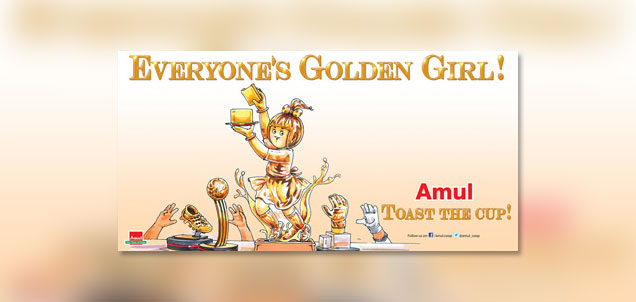
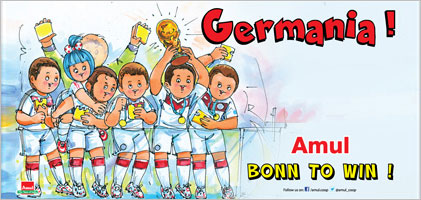
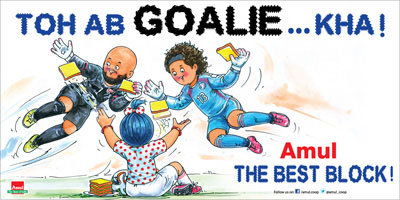
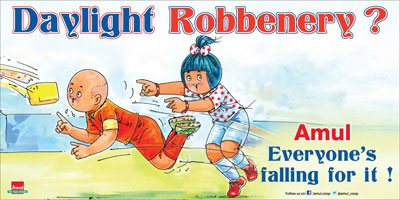
  • Utterly, Butterly, FIFA-licious


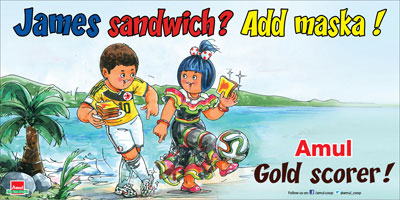
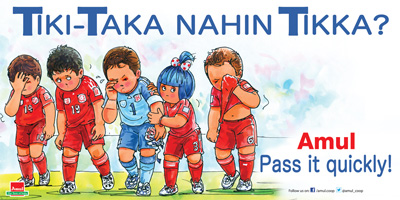
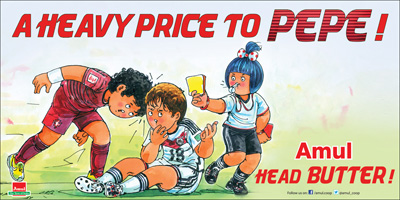
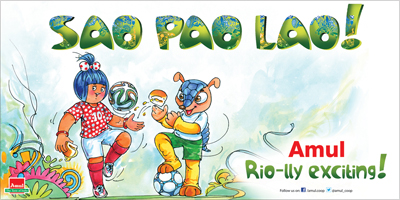
    You know how much we love to tell various stories via Amul ads. Over the years, they’ve indeed been the true chronicler of the times. Given the growing interest in the FIFA World Cup, there have been 12 ads created by da Cunha Associates for Amul Butter for the just-concluded championship in Brazil… and one more last year. We are sure there will be several more in the coming weeks. There have also been some classics over the years, though we couldn’t locate our favourite on Paolo Rossi from 1982 (Pau lo Roz hi) on the Amul website. Enjoy


    FIFA World Cup winners ! – July ’14


    Brazil’s humiliating defeat ! – July ’14


    Lax officiating breaks Brazil’s back – July ’14


    The stars of FIFA 2014 ! – July ’14


    Dutch footballer fakes dive! – July’14


    Leading goal scorer – Rodriguez – June’14


    Uruguay striker uses his teeth! – June’14


    Brazilian star excels!


    Reign of Spain ends – June’14


    Portugese player’s aggro behaviour ! – June’14


    Persie helps Netherlands thrash Spain!


    FIFA fever begins…


    And here are some classics:

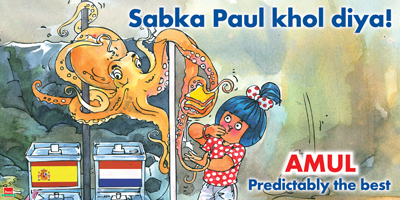
    Octopus Paul predicting the outcome of the World Cup Football final (2010)


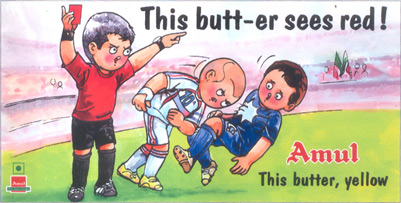
    On French Captain Zinedine Zidane shown red card sending him off for vicious
    head-butting Italian defender in the chest during the World Cup Football Final (2006)


    On the Brazilian team’s star football players (2002)


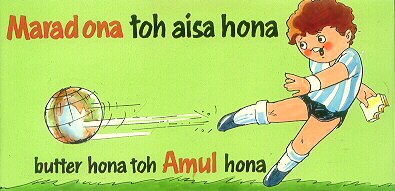
    Football sensation Diego Maradona takes on the world by storm (1989)


  • IPL 2018 via Amul Topicals


    By A Correspondent


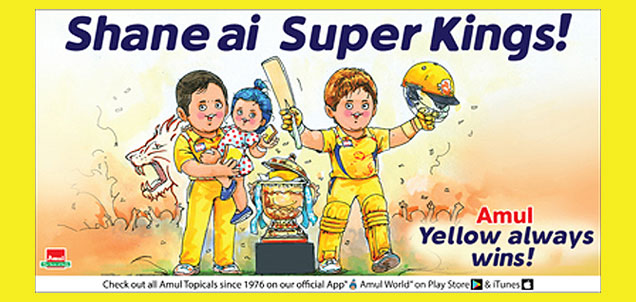
    You know how much we at MxMIndia love to re-tell stories via Amul ads. Whether it’s Sachin Tendulkar’s long innings as a cricketing great or India winning the World Cup, we go to the Amul topics to help reflect on the times. Here we bring you eight Amul ads that tell the IPL 2018 story… from Star bagging the coverage rights to Dhoni& Co turning champions. Enjoy!


  • Remembering Sridevi via her ads & Amul Butter topicals

    While we await the new Amul Butter tribute to the late superstar, here are a few Amultopicals that featured Sridevi through the years:


    And these are the ads that she has done over the years.

    Dabur Amla:


    Saheli:


    Vanish:


    Jos Allukas:

    (Malayalam)


    Tanishq Kolam:


    Shanthi Masala:


    Gokul Oil:


    Fiona RO:


    Chings:


    Chings:


    Chings:


    Chings:


    Lux:


    If you find an ad missing, please do send a link to it or the creative and we will put it up. Please mail at editor@mxmindia.com

  • Spare a Thought on Pollution


    By Your Editor


    The image you see above is the creative of the Amul billboard put up last November (2016, that is). That the godawful weather in the capital and a good part of north and bits of the west and east have become such a routine that the butter-maker and and its agency didn’t think it worthy to capture the sentiment yet again.


    The worst is possibly over, some say. We read a news report saying that pollution levels will go down yet again.


    We write this for several reasons. For one, a majority of our readers come from the National Capital Region. Mumbai is high, but Delhi, Gurgaon and Noida are a notch higher. And while we aren’t headquartered in Delhi or have a full-fledged office in the region, we care about our readers. In fact our primary allegiance is to our readers. In our content, and in every possible way.


    So we understand what many of you are going through. And feel awful that we can do nothing about it.


    However, it’s important that we in the media do something about it. And ensure that November 2018 doesn’t see an encore.


    We shouldn’t just leave it to our newspapers and news channels, even advertising folk need to chip.


    How about employing creative and innovative energies to improve life in smog-hit parts of the country. Get clients to fun such projects. Build pressure on law-makers to start acting now.


    Get media owners to give out available inventory.


    Can there be tickers across channels while the popular shows are on? Can some of our big reality show hosts make a plea for cleaner air?


    It’s time that the media gets together to do something. For, we all depend on people to consume our content and messaging. And if they aren’t able to do that because of health- and environment-related issues, the losses could be bigger than those that happened post demonetisation and GST.


    Let’s do something for our own future.


  • Zee TV launches Season 6 of Amul Sa Re Ga Ma Pa Li’l Champs

    By A Correspondent


    After screening more than 60,000 entries over eight weeks of grueling auditions across 27 cities to discover India’s most talented singers, only 15 of the most striking voices with an ability to touch hearts will make it to the stage of Zee TV’s ‘Amul Sa Re Ga Ma Pa Li’l Champs. Starting Saturday, 25th Feb 2017 at 9:00pm, the popular singing reality show for kids ‘Sa Re Ga Ma Pa Li’l Champs’ is back with the sixth season.

     

    This season, the kids will be mentored by music composer-turned-actor Himesh Reshammiya, the soulful playback singer Javed Ali and joining them for the very first time on Sa Re Ga Ma Pa Li’l Champs will be playback singer NehaKakkar. Aditya Narayan returns to host the upcoming season. For the first time ever on Li’l champs, a panel of 30 jury members who are experts from the music fraternity, will closely assess the aspiring child singers right from the audition stage and help the mentors in the selection process.


    Commenting on the launch of the new season, Zee TV Deputy Business Head Deepak Rajadhyaksha says, “Having wrapped up our top-rated weekend thriller ‘Brahmarakshas- JaagUthaShaitan, we now present Sa Re Ga Ma Pa Li’l Champs, the children’s edition of Zee TV’s iconic franchise -  Sa Re Ga Ma Pa. The last season of Sa Re Ga Ma Pa broke all records of 2016 on television, delivering the highest ratings for a non-fiction episode. The sixth season of Sa Re Ga Ma Pa Li’l Champs has on board Himesh Reshammiya, Javed Ali and NehaKakkar as mentors for the kids. Not only are they extremely warm, affable and great with kids but also have the ability to step in as role models and guiding forces for their growth as singers. We have enlisted the support of 30 music connoisseurs – experts in the music fraternity who will aid the selection process right from the outset. We are pleased to partner with Essel Vision Productions in presenting the new season”.


    The hunt for the country’s best singers has spanned across 27 cities including Bhubaneshwar, Guwahati, Patna, Lucknow, Chandigarh, Nagpur, Dehradun, Ahmedabad, Jaipur, Kolkata, Indore, Delhi, Mumbai and Bangalore.


  • 14 times Jayalalitha featured in the Amul ad

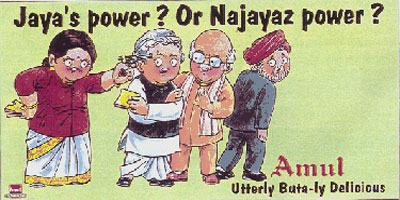
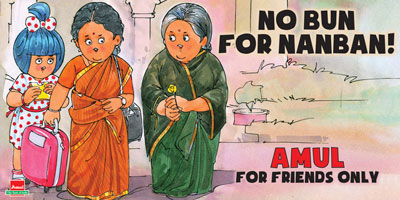
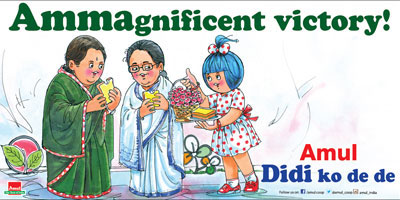
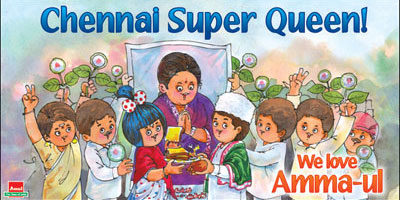
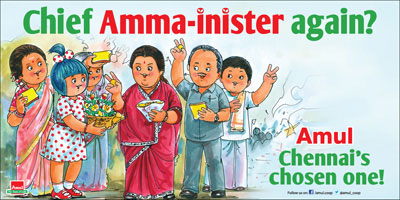
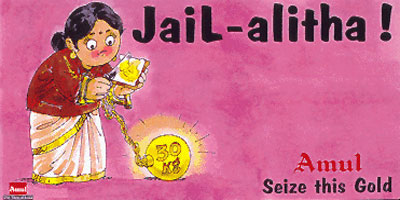
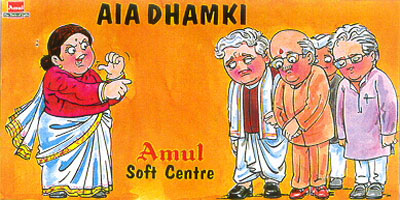
    Not all of them are very positive, but like all Amul topical advertisements that reflect the prevailing mood or issues of the country (and the world), the late former Tamil Nadu Chief Minister J Jayalalitha featured at least 14 times to the Amul topical ads. As the nation and we pay homage to one of India’s most powerful and enigmatic political leaders, we reproduce these here, in random order:


  • Amul appointed official sponsor of the Indian contingent to the Rio 2016 Olympic Games

    By A Correspondent


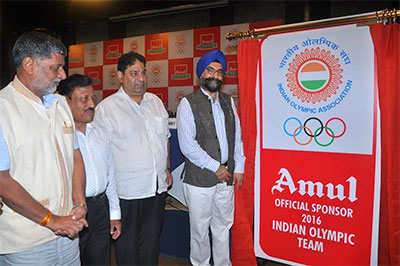
    Amul has announced its sponsorship of the Indian contingent at the biggest multi-sport event – the Rio 2016 Olympic Games. The contract was signed by Shri Rajeev Mehta, Secretary General, Indian Olympic Association IOA and Shri R S Sodhi, Managing Director, Gujarat Cooperative Milk Marketing Federation (Amul) on June 29, 2016. Amul is now the Official Sponsor of the Indian team.

     

    In 2012, Amul sponsored the Indian contingent at the London 2012 Olympic Games. Amul has always been an avid supporter of various sporting events, may it be the Asian Games, Commonwealth games or other sports.


    To be inaugurated on August 5 in Brazil, the Rio Olympics will play host to the largest Indian contingent ever, with close to 100 sportspersons being a part of it. Amul aims to engage with youth and leverage the connection between the energy of milk and sports. It is the main ingredient for the fitness of any sportsman. Hence it is an appropriate association for Amul.


    Announcing Amul’s support, R S Sodhi, MD, GCMMF said, “Amul is committed to strengthening the Olympic movement in India and encourage young generation from all over the country to take up Olympic sports. I take great pleasure and pride in announcing our sponsorship of the Indian contingent to the Olympic Games Rio 2016. Explaining the foundation of this association, he said that milk is nature’s original energy drink and plays a pivotal role in building the physical and mental strength of the athletes. Nutritious dairy diet is an important part in the diets of athletes around the world. Participation in Olympics is the aspiration of every athlete and with the kind of investments made by our country in this arena to select, nurture and train the best athletes, we are confident that Indian contingent will deliver the best ever performance in the Olympic games and make our country proud.  Further, he said that this association will help in engaging the kids and youth so that they can enjoy a healthy life.”


    Amul will launch a series of advertising campaigns for milk and various dairy products to promote this association in the coming months. Amul has embarked upon an “Eat Milk with Every Meal” campaign to highlight the importance of milk and dairy products like cheese, yogurt, butter, ghee, paneer etc. in the daily diet. Amul Doodh Pita hai India, one of Amul’s most loved campaign, will be used to cheer the Indian contingent.  India is the largest producer of milk in the world and Amul is not only India’s but Asia’s largest milk brand.


    Praising Amul’s support to the Indian contingent of Rio Olympics, Rajeev Mehta, Secretary General, Indian Olympic Association said, “I would like to thank Mr. RS Sodhi and Amul family for coming on board as the sponsor for our Indian contingent for Rio Olympics. I am happy that Amul family is supporting Indian Olympic Association from past sometime. The preparations for our athletes are in full swing and till date more than 100 athletes have qualified for Rio Olympics, this is the largest ever contingent we are sending to Olympics”.


  • 10 Amul topicals that effectively capture the Budget over the years

    When the Budget proposed a service tax hike in 2015


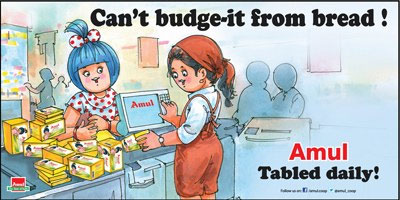
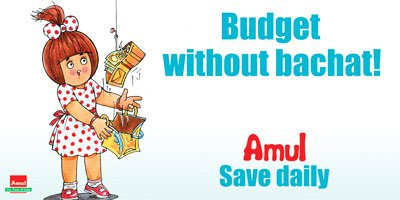
    Over five decades, the Gujarat Cooperation Milk Marketing Federation (GCMMF) which owns the brand name Amul, has been presenting some memorable advertising on billboards and, in recent times, in print as well. In many ways, the Amul topicals — all created by Mumbai-based da Cunha Advertising — have come to reflect the mood of the nation. It’s Budget Day today, and like MxMIndia has done in the past, what better way to remind ourselves of speeches and proposals made by finance ministers over the years.


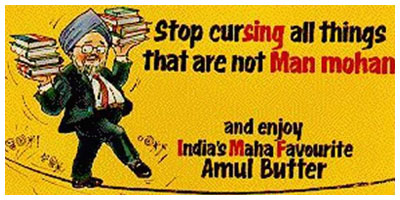
    Here are 10 creatives, including the one released in 1991 after Dr Manmohan Singh presented his historic Budget and brought liberalisation to the country.


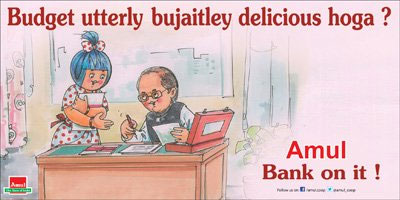
    Ahead of current Finance Minister Arun Jaitley presenting his first Budget in 2014, after the newly-elected BJP-led NDA came to power


    The UPA’s farewell Budget in 2014, presented by then Finance Minister P Chidambaram


    On the Union Budget of 2013


    On the Union Budget of 2012


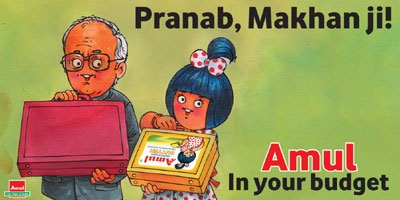
    When former Finance Minister Pranab Mukherjee presented the Budget in 2011


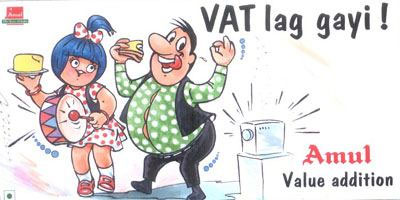
    On the Budget incorporating the new Value Added Tax (VAT) in 2005


    On the effect of increased taxes in the Budget in 2002


    On Finance Minister P Chidambaram’s first balanced Budget in 1996


    When former Finance Minister Dr Manmohan Singh had to do a tightrope walk for his maiden Budget in 1991


    This story first appeared in dna of brands on February 29


  • Amul is India’s Most Meaningful Brand


    By A Correspondent


    Amul has emerged as India’s Most Meaningful Brand as per the Havas Media ‘Meaningful Brands’ study announced today. This is the study’s sixth edition globally and for the third year in India.


    In India, ‘food’ is one of the most meaningful sectors, according to the study, attaining strong attachment and trust. Food brands are especially meaningful for making our daily lives better with their rational benefits of savings, convenience, health and better nutritional habits. Local brands like Amul take the lead with multinational corporations like Cadbury who introduce local brands to resonate with consumer context and tastes, locally, according to a communique.


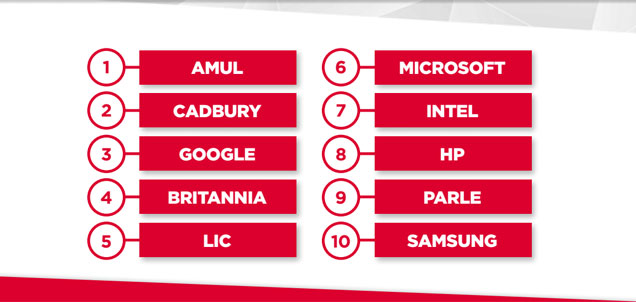
    The Top 10 Meaningful Brands 2015 are as follows:

    India: Amul, Cadbury, Google, Britannia, Life Insurance Corporation (LIC), Microsoft, Intel, HP, Parle, Samsung


    Global: Samsung, Google, Nestlé, Bimbo, Sony, Microsoft, Nivea, Visa, IKEA, Intel.


    The findings note that Indians have the highest attachment towards Life Insurance Corporation of India (LIC), the state-owned insurance group. Interestingly, 86% of people would care if LIC disappeared tomorrow (globally most people do not care if 74% of brands disappeared the next day).


    Meaningful Brands, Havas’ metric of brand strength, tracks 1000 brands and 300,000 people over 34 countries, across 12 industries. The India leg, its most extensive yet, covered 100 brands, 13000 people, 11 sectors, across the country. The research covers all aspects of people’s lives, including the impact on collective wellbeing (the role brands play in our communities and the communities one care about), in personal wellbeing (self-esteem, healthy lifestyles, connectivity with friends and family, making lives easier, fitness and happiness) and marketplace factors, which relate to product performance such as quality and price.


    Further, Asia Pacific stands out as one of the best relationships between consumers and brands from across the globe. According to the study, in India, brands have a high level of meaningfulness and are seen as providers of personal and collective wellbeing. They are viewed as much more than functional products. Brands here are also seen to be meeting consumers’ expectations more than in any other region. Sample this: 75% of Indians believe brands should play a role in improving our quality of life and wellbeing; the Asia Pacific the average being 69% and the globally average 67%. More than half i.e. 67% of Indian’s feel that brands are working hard at improving our quality of life and wellbeing, compared to an Asia Pacific average of 55% and Global average of 38%.


    The study found that for every 10% increase in meaningfulness, a brand can increase its purchase intent by 6.6%, repurchase by 3.2% and price premiums by 10.4%, statistically demonstrating that a brand’s


    Speaking about the study, Anita Nayyar, CEO, Havas Media India & South Asia, explained:  “This is our largest India study to date in size and scope. Marketers will be encouraged to know that India once again stands out as the No.1 country, globally, where consumers have the closest relationship with brands. India is also the most ‘grateful’ country, rewarding meaningful brands, in business terms. We are seeing that in a developing economy like India, unlike the West and more developed economies, people are more trusting of brands. People here believe brands can play a meaningful role in their lives and that brands are working hard towards improving our quality of life and wellbeing. This creates tremendous opportunities for brands in India to communicate and connect with their customers, in our organic world – which is at the core of the Meaningful Brands Project.”


    Added Mohit Joshi, Managing Director, Havas Media Group India: “People in India are happy to have brands as partners and as enablers to help them improve their quality of life and wellbeing. While in the West there is a high commoditisation of brands, people in India,have ‘high expectations’ and ‘reward’ those brands that contribute to their wellbeing – this is the second time in a row that LIC has scored as the brand with the highest attachment. The study throws open exciting possibilities for marketers and brands to interact with their customers.”


  • Ghee is good for health, says FCB Ulka’s ‘Ek Chammach Amul Ghee’ campaign

    By A Correspondent


    FCB Ulka has unveiled a campaign of ‘Ek Chammach Amul Ghee’ that talks not only about how a spoonful of ghee will add taste to the food but also about its health benefits.


    Commenting on the campaign, R S Sodhi, Managing Director, GCMMF said “Repositioning the brand – Amul ghee, and the category itself on the platform of wellness has been our strategic focus for more than a decade. While ghee has always been an integral part of our culture and tradition since thousands of years, we feel that our younger generation should be informed about the intrinsic goodness of ghee. As pan-India brand leaders in the category, it our responsibility to ensure growth of branded, packaged segment within ghee market, since it ultimately benefits consumers.


    Said Haresh Moorjani, Executive Creative Director, FCB Ulka: “As a nation of food lovers, we are always looking for that special ingredient that adds an extra something to our dishes.  Actually that special ingredient is as simple as a spoonful of Amul Ghee. The TVC talks about the virtues of this spoonful of Amul Ghee, adding an extra zing to food”.


    Credits:

    Creative Agency: FCB Ulka

    Chief Creative Officer: Satbir Singh

    Executive Creative Director: Haresh Moorjani

    Creative team: Deepti Gera, Varun Sharma

    Account Management: Sharon Picardo, Sagar Kabra, Shamima Pereira, Saumo Chatterjee

    Account Planning: Ruta Patel, Mubina Quraisshi

    Production House: Anonymous Films

    Director: Atul Manjrekar

    Producer: Smitha Baliga


  • Saare Jahaan Se Achhca…


    It’s Independence Day on Saturday. There are several brands which have done some splendid work in independent India, but there are some which stand out amongst these. Presenting a selection of these…


    Why Airtel wants to be everybody’s friend


    By Ravi Balakrishnan


    Airtel may want to be remembered for its snazzier, youthful advertising, but one of its definitive commercials is the barber’s shop ad from the mid-2000s. As the trademark Airtel ring tone sounds, customers and the barber hastily reach for their phones. But the call is actually for the chaiwalla, subtly establishing the brand’s ubiquity and ability to cut across classes.


    Over the last two decades – Airtel turned 20 this July – it has grown to be India’s largest mobile network. For lakhs of Indians, it’s been the first telephone connection of any sort. No mean feat in a hyperactive market that at one point in 2009, had close to 10 players and has been through supposedly giant slaying trends like mobile number portability.


    According to Srini Gopalan, lead – consumer business, Airtel owes it all too keeping its core essence intact. He explains, “Human connections are at the heart of the brand. Over the years, we’ve been able to capture this in multiple memorable ways.” For instance, Express Yourself starring AR Rahman to the more recent Har Ek Friend which acknowledged that friends were a new form of family. It’s a singleminded stance at variance with many newer entrants who initiated price wars or took potshots at other players. Says Gopalan, “While others have obsessed about specific technology or the competition, we have obsessed about customers, providing a great network and service.”


    Of course, there’s a lot more to Airtel than a few well-liked ads. It has tailored itself to various target audiences offering internet and videos at Rs 1 for the population that’s getting online for the first time. It claims to have started providing 4G to its 3G subscribers at no extra cost. Gopalan explains: “I don’t think the basic formula has changed from when Sunil Mittal started this business. We’d rather keep that intact and customise product, communication and service rather than be different things to different people.”


    How Amul, the taste of India, buttered generations of toast


    By Ravi Balakrishnan


    Few brands can stake as much of a claim to literally having fed India as Amul. Its ubiquitous butter shows up in bread baskets at fine dine restaurants and at streetside sandwich and snacking stalls that advertise their ‘made with Amul’ credentials on large chalk boards as an assurance of quality.


    Amul Butter came into its own in 1966 when its agency DaCunha Communications, perhaps unwittingly, created what would go on to be one of advertising’s longest running campaigns. The Amul Butter girl was initially a foil to a sexy milkmaid mnemonic of arch rival Polson’s. Topical ads were introduced a year after the Amul girl first appeared and continue to date.


    Along the way, the campaign has become less about butter and more about what Amul stands for. A good move since butter is no longer Amul’s flagship product, accounting for a mere 10 percent to 11 percent of its Rs 21,000 crore turnover of which 50 percent is cornered by milk. It’s arguable if the campaign flogs more product. But the ads – now also freely available via Facebook – have become an amusing, sometimes sentimental, sometimes sardonic document on life in India over the last five decades. Rahul DaCunha, director, DaCunha Communications observes, “The advertising has stayed consistent and the Amul girl has truly become the daughter of India: there’s a possessiveness people have about her. Too many advertisers let go of concepts too soon. That we’ve stayed consistent while updating the campaign every year has helped.” While hoardings are still a mainstay, on Amul’s Facebook page there are sometimes new topical ads every day that are eagerly discussed and shared.


    Amul has staved off competition, which has intensified particularly over the last decade and a half. According to managing director RS Sodhi “Our business strategy evolved 68 years back by Dr Veghese Kurien is C2C or cow to consumer. When both producers and consumers are with you, you are not afraid of competition. We do not replace expensive natural ingredients with synthetic cheap ones like other companies.”


    Which explains why Amul and its moppet are one of the few Indian brands that have survived the slog from pre to post-liberalisation India, a culling that consigned many former market leaders to history books.


    Ambassador – the first Indian car still lives


    By Delshad Irani


    In May 2014, Hindustan Motors stopped manufacturing the car with Sophia Lorenesque curves, the Ambassador, due to fast declining demand. For almost six decades, the Ambassador traversed across India, carrying multiple generations of Indian families. She’s still around, though, thanks to government and military officials, taxi drivers ferrying natives and tourists and Amby aficionados.


    The story of the first Indian car began in 1957, when BM Birla owned Hindustan Motors (established in 1942) manufactured the first Ambassador, modelled on the Morris Oxford. It was a matter of prestige to own one, especially after a five-year waitlist. She was a symbol of a liberated, new India, forging ahead in nothing less than a beautiful tank, so to speak. You couldn’t find a tougher passenger car. And still can’t. In 2013, the BBC show Top Gear put this to test – before Jeremy Clarkson famously punched his way out of favour. The Ambassador went up against Maruti Suzuki, Hyundai, Toyota and Honda, all in service as cabs around the world, in a deadly taxi shootout. While the rest emerged dismembered, the Ambassador crossed the finish-line intact and in good spirit. The irony: It was the advent of the Maruti 800 in the mid-80s and 90s that heralded the decline of Ambassador as the queen of Indian roads. Of course, changing consumer likes killed the Ambassador, too. Unchanged over the years, a car reminiscent of the bowler hat isn’t everybody’s cup of tea. And competition grew from two (Premier Padmini and later the Maruti 800) to today’s smart sedans, SUVs, MUVs, hatchbacks for every taste and type of Indian clan. Just 2,200 Ambassadors were sold in the year ended March 2014, according to reports.


    However, the Ambassador’s legacy is one adopted by others as their own. Even before Maruti pitched itself as the “people’s car” with an outpost in every cranny, it was the Ambassador that could be mended by the sides of highways with a spanner and some ingenuity. Today, however, Ambassador parts are increasingly rarer, expensive and harder to source. The Amby is also the original ancestor of supersize, utility vehicles, which can accommodate the entire family, pets and luggage for holidays through temperamental terrain. With room to spare for Ego. So, you see the Ambassador’s not quite dead. Long live the Queen.


    How Bajaj scooters gave Indian middle-class its first two-wheeler


    By Shephali Bhatt


    If you lived through the 80s and 90s without witnessing a family of four (man, wife and two kids) on a Bajaj Chetak, it’s safe to assume you weren’t living in India. Bajaj Auto gave India its first family car: only it was actually a scooter.


    The journey of bringing mobility to people in a country marred by poor transportation began in 1961. Bajaj got a licence from Italy’s Piaggio to manufacture and sell Vespa in India. Around early 70s, Piaggio went ‘No can do’ on renewing licence which led to the launch of Bajaj Chetak. In 1977, Chetak raced ahead of every other player in the two- and four-wheeler category securing sales of over 100,000 units in a year. Ten years later, this number had soared to 500,000 and by the time we hit the 90s and liberalisation set in, Bajaj Auto was selling 100,000 scooters per month. The brand had practically attained the status of ‘Chunnu Munnu de Pappa di Gaddi.’


    Bajaj scooters succeeded because they were active in a scarcity economy, says Suman Srivastava, founder of Marketing Unplugged consultancy and CSO of FCB Ulka. Incidentally, it’s the first brand he worked on. “The 70s was a rationing era which made Bajaj the undisputed king. They had a product at a reasonable price and the consumer badly needed it. You had to wait for a decade to get a Chetak,” he recounts. “When Rahul Bajaj, then MD of Bajaj Auto (now chairman) took over the reins and started focusing on scooters, his main fight was with the Bombay Club to grant him licence to expand capacity, to sell overseas. The product was always in short supply,” Srivastava adds.


    So what if Lintas’s marketing genius of ‘Buland Bharat ki Buland Tasveer -Hamara Bajaj’ was only a holding operation, acted upon when scooter sales were plummeting in the wake of 100cc bikes? It did its job. With confirmed reports of Bajaj Chetak making a comeback next year, one can be certain the scooter’s success wasn’t a flash in the pan. It is a ‘Lambi race ka ghoda’ indeed.


    How Thums Up still manages to be the king of colas


    By Amit Bapna


    There are people who won’t drink their favorite rum, Old Monk, if it’s not served with Thums Up, leaving many a barman wondering if the tippler’s loyalties lie with the rum brand or the cola? Launched in 1977, Thums Up continues to have a hold across the length and breadth of the country and remains an enigma that marketers, over the years, have tried to unravel on the success recipe of the brand. It also remains a case study for the Atlanta based Coca-Cola company that has not faced such a situation anywhere in the world – of having a homegrown brand take on the might and muscle of the big brother (Coca-Cola) and continue to be the winner. According to Debabrata Mukherjee, vice president, marketing & commercial, Coca-Cola India and South West Asia, “Thums Up has had a clear ‘masculine cola’ positioning and the brand has continuously adapted to the relevant codes of masculinity over the years that have worked very well for it.”


    The brand launched by the maverick Ramesh Chauhan was already a force to reckon with when it was acquired by the Coca-Cola Company in what was possibly the most famous deal of the early 90s. A person familiar with developments of the deal says on condition of anonymity, “Coke by buying the largest cola brand in the country was hoping to get the entire cola equity transferred to it.” That it didn’t pan out that way was something that the cola giant had not bargained for while closing the deal. Says KV Sridhar, chief creative officer, SapientNitro, “In a country like India it is not cola that is culturally rooted: what is rooted is the strong taste of Thums Up – a product made for the Indian palate.”


    Neither pulling the plug by reducing distribution strength nor scuttling advertising budgets – something that the parent Coca-Cola has known to have tried many times – worked in the case of this brand that continues to own the mind and heart space for millions in the country. Points out Sourav Ray, chief strategy officer, Havas Worldwide, “Relative to Coca-Cola, Thums Up had more freedom but less budget which worked as the perfect tonic for the marketing team to create a differentiated positioning for the brand, focus, think out of the box and freely express themselves.”


    Source:The Economic Times

    Copyright © 2015, Bennett, Coleman & Co. Ltd. All Rights Reserved

    Licensed to republish


  • Utterly Butterly Amulicious


    Over the last 50 years, the Gujarat Cooperation Milk Marketing Federation (GCMMF) which owns the brand name Amul, has been presenting some memorable advertising in the form of topical hoardings. These have turned markers of contemporary issues and events.  A few years back, daCunha Communications and DYWorks came up with a book titled ‘Amul’s India’ capturing the best of the outdoor creatives. Last week, a revised and updated edition was released celebrating the topicals with comments from Amitabh Bachchan, Alyque Padamsee, Harsha Bhogle, Rahul daCunha, Rahul Dravid, Rajdeep Sardesai, Sania Mirza, Santosh Desai, Siddharth Kak, Shobhaa De, Shyam Benegal, Suhel Seth and Sylvester daCunha.


    Meanwhile, Amul has also launched a new app “Amul World” which has all the Amul topicals created over the last 50 years. This app will soon be available for download on Android and Apple devices.


    At the release last week, R. S. Sodhi, Managing Director, Gujarat Cooperative Milk Marketing Federation (GCMMF) said, that “We had promised to release the updated edition at the time of launch of the first edition. It is an honour for us to have published the revised and updated edition of this book after the phenomenal print run of 1.2 lakh copies of the first edition. The Amul topical advertising campaign and our consistent advertising strategy has played a very pivotal role in the growth of brand Amul and we shall endeavor to continue our efforts.”


    Give us this day our daily ad!


    By Rahul daCunha


    Every day is a new day in the life of the Amul hoarding (or meme as it is now referred to on social media). My job is two-fold — to shepherd the brand, and to spoof the many events that emerge from this Pandora’s Box called India. Seven thousand billboards and twenty-one years later, I have never been tired of saluting and spoofing the numerous facets and faces of our colourful country.


    For 50 years, our little Amul moppet, or the Amul girl with her polka-dotted dress and bow, has commented on all things amusing, annoying, absurd and alarming. And unfailingly, India waits for what she has to say with expectation and excitement.


    The human race, certainly the Indian human race, has a newly-acquired, collective case of Attention Deficit Disorder. What holds good as a piece of news one day, is irrelevant the next morning. Plus everything is chatworthy news today – take male chauvinist politicians, mass hysteria Bollywood, multi-crore scams, messy scandals, Mamata Banerjee’s diatribes or M.S. Dhoni’s decisions, both follicular and on-field.


    In the ’60s and ’70s, daCunha Associates created one hoarding a month. By the ’90s, it had increased to one a week. This year, we went daily.


    One new Amul ‘topical’ goes online and outdoor every day. Every morning my creative team — comprising Manish Jhaveri, Jayant Rane and I, connect on what’s on the Amul menu for the day. Is it an upmarket issue that will tickle the fancy of snot-nosed south Bombay? Or a Bollywoodised titbit that will satisfy celebrity-obsessed north Bombay? Or is it a Laloo Prasad witticism that will amuse the Hindi belt? Or has Rajnikanth’s new movie galvanised the south of India? Or has TV show Game of Thrones thunderstruck the Twitter generation?


    There are five Indias today – Mumbai, the Hindi belt, the East, the South and social media. Mumbai is a country by itself. The East is passionate about Durga Puja, Dada, Mishti Doi and Didi. The North is political and paparazzi-obsessed. The Hindi belt is focused on Yadav Senior and Junior’s shenanigans. And Facebookers and Twitterers are just obsessed with the flavour of the moment.


    In the 21 years that I’ve been campaign custodian, we’ve poked fun and parodied, but never viciously. Our spoofs and satirical messages have been welcomed sportingly by both politicians and popular figures, actors and anarchists. Just occasionally, lampooning has led us to the doorstep of the legal process.


    Rahul daCunha is Managing Director and Creative Head of da Cunha Communications, the ad agency that creates the Amul outdoor billboards.


    A For Awesome


    By Suhel Seth


    Very few brands across the world speak a borderless,  timeless and ageless language. Amul is one of them. Very few brands across the world create both a sense of entitlement and waiting. Amul is one of them. Very few brands touch the soul of consumers in an enduringly consistent manner: reflecting the pathos of an evolving society: Amul is one of them.


    The history of India can be told in a three-part voluminous tome or can be absorbed simply by going over the advertising that Amul has created. It is however, as much the history of Amul. Just like the India we see today, ever-evolving; ever brushing aside challenges which may seem insurmountable and yet holding a place of pride in the comity of nations, Amul too has had a story of inspirational zeal. One which is more than about a brand that delights us on dining tables. It is a brand that we never seem detached from.


    Over the years, Amul has represented not just innate quality and the vision and coming together of millions of dairy farmers but equally, through its advertising, Amul as a brand has both been a chronicler and a mirror to each one of us. In our lives of drudgery, Amul helps us smile; it helps us laugh away the worries and at times it helps us celebrate the enormity of Indian achievement. It also, at times, very poignantly shows us the way.


    For me personally, Brand Amul has been a part of my growing up: not in terms of chronology but equally in an insightful way, capturing the trials and tribulations of a nation that India is. It has always been something that I have looked up to. The advertising that Amul has unleashed over decades is not something that is designed to sell butter. It is indeed designed to help reflect on who we are. I have always believed that Amul’s advertising is not about selling more butter or more milk: it is about helping the young and the old understand the India we are creating: either wilfully or as mere spectators. I have often said to those who care to listen: the biggest civilian honour one can hope to attain in India is to be on an Amul hoarding or in an Amul press advertisement.


    Because in a strange way, Amul speaks for every Indian. Amul is infact, many a time, the voice of a multitude of voiceless Indians and herein lies its eternal charm and its enduring appeal. The reason is not because of what it says. But equally about how and why it says it. There are moments in time when silence is not a virtue. That is when Amul’s advertising speaks for millions. There are equally times when in the din we fail to separate the good from the not-so-good. It is at that time that the advertising of Amul helps us set the right course.


    Amul’s advertising is a barometer for what India has been, what India is and what India is likely to be. Which is why Amul the brand has morphed into Amul the being.


    Suhel Seth is a former Amul baby and now the Managing Partner of Counselage India


    Footnote:

    Excerpted with permission of the authors from:

    Amul’s India

    Based on 50 Years of Amul Advertising

    by daCunha Communications

    (Revised & Updated Edition)

    HarperCollins India

    Rs 299