
Tag: AdEx

  • The Ripple Effect of Coronavirus


    By Indrani Sen


    A lot has happened in the last one week, when we speculated about how Covid-19 might affect the AdEx in 2020. As India fights against all odds to stop the accelerated outbreak of the virus through community transmission with the entire country is facing partial to total lockdown, there is no doubt that our economy will be badly affected like many other developed and developing countries. So, along with the rest of the world, India will be getting into a severe recession for the rest of the year. The point we need to speculate, will there just be a dip in the growth rate of AdEx or will we see a negative growth as we saw in 2009?


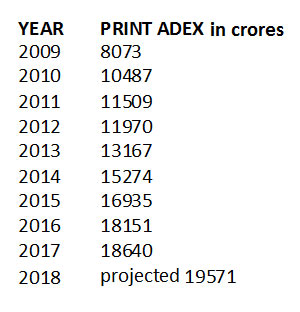
    The international financial crisis of 2008 which originated in the sub-prime mortgage crisis in the US and led to a severe recession in many countries over 2008 and 2009 also affected the Indian economy and we saw first a dip in the AdEx in 2008 and then a negative growth in 2009. However, AdEx recovered quickly from that recession and we saw a healthy growth in 2010.


    Source: Pitch Madison Media Advertising Outlook 2015


    The ripple effect of Coronavirus is going to create an employment crisis across the globe and India will not be an exception. We were already at a high unemployment situation before this crisis hit us. With industries experiencing forced shutdowns, many are asking their employees on go on leave without pay or with truncated pay.  Employees who work on the basis of contracts, as per terms and conditions of the contracts are often not paid unless they report to work and in the present situation are likely to lose financially. Financial loss will be experienced by the lower end of self-employed workers (Ola/ Uber drivers, auto drivers, rickshaw pullers, plumbers, electricians, etc.) as well as the daily wage earners. MSME sector which is known as the engine of growth and employment in India will also take a big hit. A combined effect of these muted wage or loss of wage will lead to decrease in consumer demand. In addition, there will be a disruption in the supply chain also due to temporary closure of production, lack of transport for distributing the goods, etc.  These changes in demand and supply will have adverse effect on the marketing and advertising budget forcing the advertisers to curtail their expenditure.


    Circulation of our print media so far has not been affected like global print media many of who have stopped the printing of hard copies, thanks to the last mile delivery by newspapers delivery persons and hawkers as against the sale through news-stands in developed countries. Indian newspapers managed to develop a schedule of work from home for their reporters and a system of rotation for other essential staff in order to reduce the number of employees present on their premises.


    The ‘Janata Curfew’ on March 22 followed by lockdown of some cities/ districts from March 23, may force newspapers also to take a call regarding their production as the distributors/ hawkers and the delivery boys will also get hit by the lack of local transport. Probably, newspapers from second-tier cities under lockdown will be less affected than the newspapers from metros facing a similar situation. So, some Indian newspapers may experience temporary closure and fluctuations in their circulation and readership and subsequently lose ad revenue as supplies of goods dwindle due to logistical issues related to production, transportation, etc. and consumer demand drops.

    There is going to be an increase in TV viewership, particularly the viewership of news and entertainment channels as people try to stay abreast with Covid-19 related news and entertain themselves with serials and movies during their stay at home. With all production of Film and TV industry closed till March 31, there is a chance that the serials will run out of their banked episodes which have been already shot and canned. Lack of new episodes will affect the viewership of serials adversely. Even if the viewership of GEC and Movie channels increase, ad revenue may go down due to demand and supply related issues as mentioned above in relation to print.


    Sports Channels are going to lose both viewership and advertising revenue with cancellation of sporting events and their telecast. As TV still accounts for the major share of our ADEX, the extent of loss of TV revenue will determine the fate of AdEx in 2020.

    Contributions of radio, cinema and outdoor to the overall AxEx are much less than Print and TV. However, ad revenue of FM radio stations will be affected as listening to car radio goes down with people being forced to stay at home. In the US, Nielsen is working on special analysis as well as a quick survey to give the advertisers some idea about how Covid-19 has affected radio listenership. Our Radio Audience Measurement is already affected by lack of financial support from the sector and it may not be possible for them to react in a similar way (http://www.insideradio.com/free/nielsen-to-release-study-on-covid–impact-on-radio/article_6c1e0246-6a81-11ea-8ab4-17d484c1eb56.html).


    Many of radio advertising deals are linked with on ground activities and consumer activations and radio ad revenue will see a decline due to curb on all such activities. With closure of malls and cinema halls, cinema will lose the ticket sales money as well as advertising revenue. Traffic on the roads, stations, airports will dwindle due to lock down of cities, social distancing and work from home which will have a negative impact on OOH advertising.


    Usage of digital as well as social media will increase during this troubled days as people are trying to get constant update on the pandemic, keep in touch with their friends and relatives while staying at home and opt for some entertainment of their choice on OTT platforms. There is a good chance that advertisers will try to utilise this opportunity by stepping up their budget on digital and social media till the ripple effect of Covid-19 force them to stop advertising.


    So far, we have seen only an estimate for loss by events and experiential industry which has been estimated as Rs 3000 crores with ten million jobs at risk which was published on March 17, 2020. (http://everythingexperiential.businessworld.in/article/Loss-to-events-experiential-industry-in-India-estimated-at-Rs-3000-Cr-due-to-COVID-19-ten-million-jobs-at-risk/16-03-2020-186335/). Other media sectors have not yet made any forecast of their probable losses.


    The ripple effect of Coronavirus will be directly proportional to the number of days that India takes to control the spread of the virus. In some European countries currently experiencing community transmission, economic analysts are already forecasting that at least 12 to 16 weeks period will be required to curb the virus. If India gets into a similar situation, it may take us longer to curb the virus given the expanse of our country and irresponsible behaviour of our citizens. In that case AdEx will end up with a negative growth like we experienced in 2009.



  • Just how much Covid-19 impact AdEx in 2020?


    By Indrani Sen


    Today, it is difficult to make any guess on when our country and the world at large will be free from the deadly attack of Covid-19. The UN Conference on Trade and Development estimated it may wipe off $1 trillion from the global economy in 2020. It is too early to estimate the effect of the pandemic on Indian economy and business and the consequences of the same on media and advertising industry.


    Our economy has been slowing down from last year and now various manufacturing industries are facing a forced halt in production due to lack of supply of parts and ingredients which are usually imported from China. Recently, we have been witnessing a fluctuating Sensex in a jittery stock market which is unlikely to recover soon.


    On March 12, the Indian government suspended issuing tourist visas till April 15 and on the next day BCCI postponed IPL 2020 till April 15. What miracle are we expecting to happen in next 30 days? Experts in healthcare have declared that this 30 days window is the most crucial period for India to control the spread of Covid-19 and stop it from getting into the third stage of community transmission, though some of them feel that community transmission of Covid-19 is inevitable (https://economictimes.indiatimes.com/industry/healthcare/biotech/healthcare/community-transmission-of-covid-19-is-inevitable-icmr/articleshow/74621197.cms).


    In other words, by end-March/ early-April, we will know if we have been able to contain the progress of Covid-19 and escape from getting into the dreaded stage three of community transmission. If we fail to contain the disease in stage two of local transmission, then the current restrictions may be extended beyond April 15 till we are able to curb the growth of Covid-19. Considering that from January 30 when the first case of Coronavirus was reported in Kerala, it took 40 days for 50 cases to be detected in India and then in the next six days the number climbed from 50 to 108 cases spreading across the country, the virus is an active growth phase in our country.


    What will be the fall out of Covid-19 on media spending by Indian advertisers? The industry sectors/ organisations whose production will be affected may start reducing their ad spend to mitigate economic losses. The sectors/ organisations who are dependent on Chinese supply chain, may also find their sales taking a dip as consumers are not likely to spend less and save more in the current situation of uncertainty. Some industries like travel, tourism and hospitality are already in severe loss and are unlikely to spend on advertising during the first half of 2020. Events have also taken a hit and are not likely to recover before the festive season. A lot of money rides on IPL and if BCCI is forced to cancel the tournament due to Covid-19, it will be a great loss of revenue for traditional as well as digital media.


    As severe to moderate restrictions are imposed by different state governments on their citizens, they have started avoiding shopping in crowded malls and markets and are utilizing online shopping for purchasing daily necessities and other goods. Advertisers who would like to reach out to their consumers during the next six to eight weeks can ride on this wave of online shopping. E-commerce is likely to get a boost as people also try to avoid cash transactions in brick and mortar outlets.


    With closure of schools and colleges in various states, there is bound to be an increase in content consumption across traditional media and digital media at home. It will be interesting to analyse the readership and viewership data for this period to assess if traditional media were able to get a share of the consumers forced to stay at home. Many organisations who have adopted digital technology are asking their employees to work from home which in turn can boost the other uses of internet for entertainment e.g. engagements with OTT platforms and other digital media.  However, given the current scenario of consumer spends across various categories of goods and services, it is unlikely that such consumer engagements will attract higher investment in digital advertising.


    The two other media which are going to be affected are cinema and outdoor. As state governments close down malls and cinema halls to prevent spread of Covid-19, cinema will not only loose the ticket sales money, but also advertising revenue. Due to travel restrictions, social distancing and forced staying at home, the traffic on the roads, stations, airports etc. will be less having a negative impact on OOH advertising.


    As a combined effect of all the above factors, it will not be surprising if the growth rate of AdEx drops from two digits (10.4% as per Pitch Madison Media Outlook 2020) to single digit in 2020. On the whole, 2020 does not promise to be an exciting year for media and advertising in India.


  • Traditional media grew 6% in 2019. Forecast for 2020: 5.1%: Pitch Madison report


    By A Correspondent


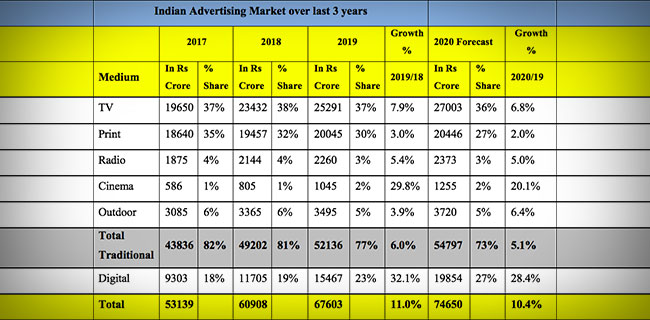
    The annual Pitch Madison Advertising Report 2020 was released on Thursday in Mumbai with the message that didn’t need much spelling out: traditional media grew only 6% in 2019 and actually degrew in the third and further quarter. The forecast for growth in 2020 is down to 5.1%. But digital media is galloping ahead. It grew 32 in 2019, and the forecast for 2020 is 28.4%.


    Said Sam Balsara, Chairman, Madison World: “Whilst 2019 has been a tumultuous year for AdEx, I believe Adex will grow dramatically over the next five years given that we are one of the larger growing economies of the world and already growing at twice the rate of global AdEx (11% vs 5.4%). Despite this India’s contribution to global AdEx is under 2%, which is bound to go up. Advertisers need to experiment more with media and do things differently to harness the power of media for Brands.”


    Key findings of the report:

    A. Overall:

    1) In absolute terms, AdEx has grown from Rs. 60,908 crore to Rs. 67,603 crores, an addition of 6,695 crores or 11%. This makes it the 2ndhighest addition to AdEx in a single year in the entire last decade.

    2) The growth rate of 11% in 2019 is lower than the PMAR mid-year projection of 13.4% and last year’s growth of 15%.

    3) 56% of this growth has been contributed by Digital, which has expectedly grown by as much as 32%.  Traditional media has grown by mere 6%

    4) TV still continues to be the largest contributor to AdEx with 37.4% share, followed by Print at 29.7%, Digital at 22.9%. Outdoor at 5.2%, Radio at 3.3% and Cinema at 1.5%. All mediums except Digital and Cinema have lost share.

    5) A quarter-wise analysis shows that unlike in most years, when Quarter 4 shows a blip because of the festive season, this year Quarter 2 showed a blip on the back of IPL, World Cup and General Elections and in fact Quarter 3 and Quarter 4 show a de-growth of 3% and 7% respectively.


    B. TV:

    1) After a rocking 2018 when TV AdEx grew by 19%, TV grew by only 8% in 2019.

    2) TV lost 1% share point and its share in the total AdEx stands at 37%, demonstrating that it is vulnerable.

    3) FMCG continues to rule the roost in TV AdEx, contributing 49% although its contribution came down by 1% share point in 2019. Telecom and Auto follow with 12% and 7% contribution respectively. Ecommerce category also gained dramatically during the year by as much as 20% and has reached Rs. 1,320 crore.

    4) The main categories that have fueled the overall growth of Rs. 1,860 crore in 2019 is FMCG (Rs. 740 crore), Telecom (275 crore) and Ecommerce (Rs. 220 crore). Predictably contribution of the Auto sector to the overall growth is negative in 2019 at -4%.

    5) There is a marginal decline in total FCT that has been telecast in 2019, perhaps because of disappearance of the FTA channels, unlike in most previous years when FCT has gone up year on year.

    6) In terms of revenue, Sports genre has grown the highest by as much as 47% and Hindi GEC by about 7%, which leads us to conclude that despite a soft market, these two genres have been able to command a rate increase.


    C. Print

    1) Print grew by 3% in 2019, lower than PMAR’s mid-year projected rate of 5%. Whilst this is the 3rdconsecutive year Print has grown less than 5%, it continues to be the 2nd highest contributor after TV with a share of 30%.

    2) Print share in AdEx has gone down from 42% in 2011 to 30% today.

    3) FMCG, Auto, Education, Real Estate and Retail continue to be the main cash cows and contributed almost 50% to Adex in 2019. Ecommerce is fast emerging as an important category for Print and grew 14%, over 2018. Political Parties are estimated to have contributed Rs. 200 crore on account of  Lok Sabha Elections.

    4) Nearly 65% of Print’s growth of Rs. 588 crore is accounted for by 4 categories – Education, Ecommerce, Real Estate and Retail.

    5) In terms of volume there is a 3% decline in 2019. Hindi publications continue to maintain the lead over English Publications, contributing 35% followed by English at a distant 25%.


    D. Digital

    1) Digital Adex made impressive gains during the year and achieved a growth rate of 32.1% in 2019, the highest growth achieved by any medium in the year taking Digital AdEx to Rs. 15,467 crore.

    2) Digital has grown at a compound annual growth rate of more than 30% over last 5 years and now contributes 23% of AdEx, an increase of 4% share points over last year.

    3) Search, Social, Video & Display have all equally contributed to the growth of Digital AdEx, with each contributing between 20% to 30% to the total.

    4) Consumption of video is going up year on year and in 2019 video spends grew by as much as 59% beating the Digital AdEx growth of 32%. Almost all of Digital AdEx (94%) is on mobile.

    5) 52% of Digital AdEx came from “classical advertising” ie display banners (22%) and online video (30%).

    6) If we were to combine TV+ Online Video, TV growth of 8% would increase to 16%.


    E. Forecast

    1. The PMAR Forecast for 2020 for AdEx is muted. In arriving at the projected growth figure for the whole year at 10.4%, the report is guided by the expectation that the economy should bounce back in the 2ndhalf of 2020 as indicated in the government’s Economic Survey published on January 31, 2020. PMAR therefore sees a subdued H1 for AdEx and a buoyant H2, specially Q4.

    2. We also expect a wide variation of growth rates across mediums with Digital medium leading the growth at 28.4% and ending the year with 27% share of AdEx at Rs. 19,854 to be precise.

    3. TV will continue to be the largest medium with a 36% share of AdEx, but will have a subdued growth rate of 6.8%.

    4. Print will lose 3 percentage points in terms of share of AdEx and end up with a 27% share registering a 2% growth.

    5. Radio and Outdoor are expected to grow at 5% and 6% respectively and maintain their share at 3% and 5%.

    6. Cinema, amongst traditional media should grow at a high growth rate of 20.1% taking its spend to Rs. 1255 crore.


  • 10.7%: GroupM forecast for AdEx 2020


    By A Correpondent


    GroupM formally announced its advertising expenditure (AdEx) forecast for 2020.  As per the GroupM futures report ‘This Year, Next Year’ (TYNY) 2020, India will continue to top the list as the fastest-growing major ad market in the world. TYNY forecasts India’s advertising investment to reach an estimated Rs. 91,641 crores this year. This represents an estimated growth of 10.7%, for the calendar year 2020.


    India will continue to be the third-highest contributor to the incremental ad spends, only behind UK and USA while China drops to the fourth spot and the eight fastest-growing country with respect to ad spends across the globe.


    Commenting on the TYNY 2020 report, Prasanth Kumar, CEO – GroupM South Asia said: “We expect the global AdEx to grow by 5.1%. The Indian media landscape is constantly evolving, will continue to witness the fastest growth of 10.7% to reach Rs 91,641 crores. While we expect sustained and stable investment across media in India, Digital to garner 65% of incremental ad spends in 2020. In 2020, India faces challenges and uncertainties across sectors just like other markets. However, this also brings opportunities for brands to innovate because of which we see an evolving media stack. This will be propelled by greater use of technology and better content across media.”


    Digital secures #2 position as the most used media vehicle and is estimated to reach 30% of adspend in 2020 with growth coming from 3Vs (video, voice, vernacular-Indic) and advertising on e-commerce. The growth of digital is set to soar high because of changing consumer habits.


    Added Tushar Vyas, President Growth and Transformation – GroupM South Asia: “There are multiple advancements happening in technology which is transforming digital advertising and other mediums. India being a diverse country, digital will keep growing, especially with the rise of content platforms and its availability in multiple languages powered by the growth of 3Vs. From a predominantly ‘at home’, ‘urban’, ‘English print’ & ‘TV’ consuming market, the Indian media consumer evolved to include ‘on the move’, ‘rural’ & ‘regional’ counterparts, experimented with digital media in the early 2010s’, adopted social media in middle of the decade and started consuming digital videos voraciously after 2016.”


    Even with an overall slowdown in the global economy Indian media spends are expected to be between low to moderate in H1, with robust growth anticipated in H2 2020.


    Said Sidharth Parashar, President – Investments and Pricing of GroupM India: “The format of print storytelling is changing but the content is still the strongest. With print media organizations undergoing transformation across India. Publication houses have invested heavily in promoting digital subscriptions and have started limiting access to digital versions of epapers. We believe that this would pave the way for newer business models. Print will continue to remain relevant to advertisers wanting to build credible brands. Television will continue to grow at a steady pace. This year, the growth rate for TV is estimated to be 7% and Radio is expected to grow at 6%. While cinema and OOH will grow at 15% and 6% respectively in 2020.”


    OTT has seen a faster evolution in India, which is now complementing television. OTT hybrid models looking at both advertising and subscription will continue to be an effective model.


    Speaking on the trends for the year, Ashwin Padmanabhan, President – Partnerships and Trading of GroupM India said: “While there are challenges and uncertainties in the market, it is a world of abundant opportunities in the content eco-system. This gives us vibrant options to reach and engage with consumers. It necessitates us to be agile, invest in new-age talent and technology while keeping an eye on the future. The key is to be always prepared while we are shaping the media landscape.”


  • AdEx to grow 12.6% in 2020: GroupM


    By A Correspondent


    Adspends in India will grow 12.6% in the year 2020, a slight increase from the 12.4% in the year 2019. This was part of the global ‘This Year Next Year’ report released by GroupM at a global level. It may be noted that GroupM presents its India-specific numbers every year in early February, which can hence be expected two months from now.


    According to the numbers released, for India, the growth in television will be 11.1%, whereas for radio it will be 8%. The growth forecast numbers for newspapers and magazines are 1% and -10% respectively. While the growth for outdoor and cinema is pegged at 8.1%, that for internet will be 26.3%.


    Prasanth Kumar

    Said Prasanth Kumar, CEO, GroupM South Asia: In 2020, India faces challenges and uncertainties across sectors, just like other markets. However, this also brings opportunities for brands to innovate. This will be propelled by greater use of technology and better content across media.”


    Meanwhile, here’s the rest of the report:


    The global economy has weakened in 2019 and will remain similarly soft in 2020. By our calculations, based on Refinitiv data, the gross domestic product (GDP) of the countries we track in “This Year, Next Year” is growing by only +2.6% this year in real (inflation-adjusted) terms.


    Growth in 2020 is expected to be similar (+2.5%), with only slightly faster growth (+2.8%) in 2021 and beyond. For reference, +2.5% would be the slowest pace of growth in any non-recession / non-recovery year over the past two decades. In nominal terms (including inflation), 2019 growth for these countries is expected to be +4.9%, down from growth of +5.8% in 2018 and +5.7% in 2017. 2020 looks somewhat similar to 2019, and marginal improvements follow in subsequent years.


    Nominal growth rates are important to track because they are the most directly comparable figures to those with which marketers and media owners work in determining their own financial plans.


    Personal consumption expenditures are holding up better. One factor that has probably helped sustain marketing growth so far this year is growth in personal consumption expenditures (PCE). As consumer spending represents more than half of all economic activity, PCE can be more important to monitor than GDP. Global growth in nominal PCE is holding up as well in 2019 as it did in 2018 at +5.5% in both years. Growth is expected to slow, but only modestly in the years ahead. Of course, changes in inflation levels diminish these figures, with expectations for real (inflation-adjusted) PCE growth at incrementally slower levels each year over the next five years.


    Industrial production often correlates more tightly with advertising growth trends. Industrial production (IP) figures are another key set of metrics to monitor, as IP often correlates better with advertising activity than either GDP or PCE (manufacturers generally only make things for sale if they are planning to spend money on advertising them). Weighted against GDP in the markets captured here, we see pronounced weakness in 2019 and 2020 (+1.2% and +1.5%, respectively) relative to 2017 and 2018 levels (+3.5% and +3.1%, respectively). Recovery toward slightly higher levels is anticipated for 2021 and beyond.

    Trade and other factors are key sources of uncertainty. As the Organisation for Economic Co-operation and Development (OECD) has pointed out, slowing global trade is clearly dragging on economic activity, and seemingly heightened geopolitical uncertainties are similarly unhelpful. All of this would worsen if the U.S. experienced a recession, although the U.S. economy has remained resilient, likely aided in part by low interest rates and corporate tax reductions, alongside a federal deficit of nearly $1 trillion during the most recent fiscal year. This was equivalent to more than a quarter of all government expenditures and nearly 5% of the overall economy, or more than double its recent trough in 2015.


    Mean and median growth rates may tell different stories. We note the difference between mean and median growth rates, with larger economies expected to perform relatively better than smaller ones in the years ahead.


    Global Advertising Growth Summary


    In this environment, deceleration in advertising growth should be generally unsurprising. Global advertising, excluding U.S. political advertising (large enough to distort global growth rates by +/-1% each year), expanded by +5.7% in constant currency terms during 2018, capping the third year of better than +5% growth and the best year of the current economic cycle. However, 2019 appears set to grow nearly a percentage point slower at +4.8%, and growth is expected to slow by another percentage point in 2020 and 2021. We forecast +3.9% growth next year and +3.1% growth the following year. Growth is expected to range between +3–4% through 2024. Although much worse than recent years, we note that this would amount to a similar pace of growth to what was observed during 2012–2014. We estimate that the total global advertising market during 2020 will amount to $628 billion as we define advertising here, but would likely approach $700 billion on a broader definition that includes spending on direct mail and directories around the world.


    Notably, a substantial share of global advertising is now accounted for by digital-first brands that are endemic to the internet. Based upon their securities filings, we can see that Alibaba, Alphabet, Amazon, Booking.com, eBay, Facebook, IAC, JD.com, Netflix and Uber are each now $1 billion+ advertisers, accounting for $36 billion in spending during 2018, up by a quarter over 2017 levels; growth in 2019 was presumably very similar. Adding a couple dozen companies from the next tier of comparable marketers would easily add tens of billions of dollars of additional activity. Combined, this small group of companies accounts for a majority of the world’s growth in spending on advertising. To the extent that these companies tend to take shares of consumer spending from others and do not directly cause the global economy to expand, at some point their growth converges with global averages, resulting in slowing growth in spending as well.


    The median growth rate has exhibited sharper deceleration in 2019 than the mean. For the countries we have tracked with consistent data back to 1999, the median growth rate in 2018 was +5.2%. It is expected that 2019 will be +2.1%, followed by +2.7% growth in 2020, with generally slower growth than the weighted average. The difference between the mean and median highlights that growth is driven by a small number of large countries and that the typical small country is experiencing worse growth trends, bringing down the worldwide average. By contrast, median country growth was typically well above the mean as recently as 2013, reflecting a period where much of global advertising growth was driven by smaller countries. This maps to the aforementioned global economic trends.


    The U.S. remains the largest global advertising market, with $246 billion in advertising as we define it here, and growing above global averages. With nearly 40% of the world’s total and a still-robust advertising market in 2020 and beyond (at +4–5% growth excluding directories, direct mail and political advertising), the U.S. is helping raise global averages. Our forecasts anticipate a slowing economy as well as the gradual maturation of the digital brands that have driven so much recent growth. On the basis described here, normalized U.S. advertising should slow from +7.6% in 2019 to +5.0% in 2020, +3.4% in 2021, and similar levels in subsequent years.


    China’s $90 billion media market is maturing and beginning to slow, but is still more than two times the size of the number-three market, Japan. After many years of rapid growth, China is now solidly the world’s clear number-two market for advertising, with 16% of total media-owner ad revenue, nearly matching the country’s 17% share of global GDP. However, macroeconomic concerns—including issues referenced above and a general maturation of the Chinese advertising market—are weighing on growth


    this year and beyond. We forecast growth of only +3.7% in 2019 and +1.4% in 2020. Similarly, low levels of growth are anticipated in subsequent years despite faster levels of economic expansion for the overall Chinese economy. Japan remains a solid number three, with 7% of global advertising ($41 billion in 2020) and 6% of GDP, but growth is expected to be tepid there as well; +1.7% growth in 2019 is expected to be followed by +1.8% in 2020, and closer to +1% in subsequent years.


    The U.K. is still growing at a remarkably fast pace. Among larger advertising economies, the U.K. and the U.S. stand out for their healthy growth expectations. For the U.K., it is a feat made more remarkable given how much uncertainty has persisted over the past three years since the Brexit referendum. Five years ago, the U.K. was essentially tied with Germany as the number-four market for global advertising, but since that time the U.K. has grown by +44% while Germany has only expanded by 7%. The factors driving the U.K. are likely similar to those that have helped make the U.S. a strong market, including a substantial presence of digital brand spending as well as the expanding availability of ad inventory (in digital environments, primarily), which help make it possible for smaller marketers to use media. Although we do expect growth to taper off from the high-single-digit levels we have observed since 2014, solid mid-singles (+6.7% in 2020 and +5.5% in subsequent years) are now expected.


    Germany and France are growing at below-global average rates; so is much of the rest of Europe. Brazil should be above average, while India is the world leader among larger media markets. Germany and France have certainly underperformed U.K. and U.S. levels of advertising growth in recent years, but remain in the number-five and number-six positions for now. France appears set to grow at a slightly faster pace than Germany, with a +2.8% five-year compound annual growth rate (CAGR) through 2024 for France versus a +1.6% CAGR for Germany. By 2024, Germany should still be the fifth-largest advertising market, but France will likely be overtaken in importance by both India and Brazil, currently number six and number seven, respectively. Brazil should grow at a solid +4–5% level through 2024 after a soft 2019 (we believe the ad market there grew by only +3.3% in 2019), but India should continue to be stellar, maintaining double-digit growth rates (we estimate +12–13% each year from 2020 to 2024, similar to 2019 levels). Of course, inflation is an issue for both of these countries, negating much of Brazil’s growth. However, in India the effect will only mean that real growth is in high-single digits rather than low doubles.


    Canada and Australia are similarly sized markets, but they are growing in different directions. Canada and Australia round out the world’s $10 billion+ ad markets in 2019, with Canada expected to grow slightly faster over the next five years and growth likely largely tied to the health of its southern neighbor. Australia’s trends will likely differ, as we see at the present time with that country’s economy soft and facing a real risk of recession for the first time in decades. The Australian ad market was likely only stable in 2019 versus 2018 and probably grows only slightly in 2020, for a +2.0% gain expected next year. By contrast, Canada is expected to grow +5.0% in 2019, and should slow toward a high 3%+ growth level next year and in subsequent years. Overall around the world, 14 territories are expected to decline during 2019, with Italy the largest among them: We anticipate Italy will fall by -0.4%. Other large markets among this group include Mexico and Switzerland, which are expected to decline by -4.6% and -8.0%, respectively. Next year, fewer markets are expected to decline, with Switzerland the most significant among them


  • ‘TV festive spends to degrow by 5%’


    The response to the first part of this series where veteran media agency professional Shripad Kulkarni focused on festive spends in print (https://www.mxmindia.com/2018/01/exclusive-to-mxmindia-irs2017-top-5-takeaways-by-shripad-kulkarni/). In the second part, he trains his research lens on spends on television:


    By Shripad Kulkarni


    Shripad Kulkarni

    The Rs 1000 crore-plus additional ICC World Cup adspend seems to have taken the sheen of festive TV growth. The festive kickstart phase (week before Independence Day till Shradh) has registered a decline as compared to the same period last year. Based on weekly the average, compared to 2018, the degrowth in TV advertising this year is 6% on All India NGRPs across all advertisers and 6.5% on duration.


    A study of genre-wise growth clearly showcases classical cost optimisation. Planners seem to have increased the focus on cost-effective genres, cut duration on high cost/GRP genres and maintained GRP delivering Channels at 2-4% over 2018. Thus, second line GECs, Regioinal Movies and Kids Channels get more emphasis, the low cost/GRP genres of long tail of Television Genres, Regional News and English Channels get a shave. GRP delivering-channels of Top GEC, Long Tail Hindi GEC, Regional GECs and Hindi News have been maintained around a 2-4% growth over last year.

    Personal Hygiene and Health, Durables, BFSI and Fashion and Textiles have shrunk drastically, while Services, Telco, Retail and Personal accessories have shown a massive growth.


    So what’s the Outlook for festive 2019 looking like?

    My forecast for the festive 2019 is that with a normal last-minute surge aided by the 6-Week Diwali Week period, TV Spends will recover a little. Assuming no rate increase over last year, I forecast TV festive spends to degrow by 5%.


    Veteran advertising professional Shripad Kulkarni has been leading consulting assignments in the fiels of strategy, content and adsales. Having helmed teams at Carat, Percept Media and Vizeum and also running a media training and consultancy company called M:Ideas which was bought over by Carat Integra, Kulkarni is set to launch AdXforce, an end-to-end software solution for adsales, which facilitates sales process, Call calendar management and CRM.


    Using AdXforce, Kulkarni undertook the unenviable task of forecasting the festive season spends for MxMIndia. This is the second of a three-part series. The first focused on print, and the other two will be on television and other media (outdoor, radio and digital). This report is part of a comprehensive white paper the veteran professional and his team have worked on. For more on that, please refer to ShripadKulkarni.com. The detailed TV white paper will be uploaded on the site by noon on Friday, October 11.

  • AdEx for Festive Advertising in 2018


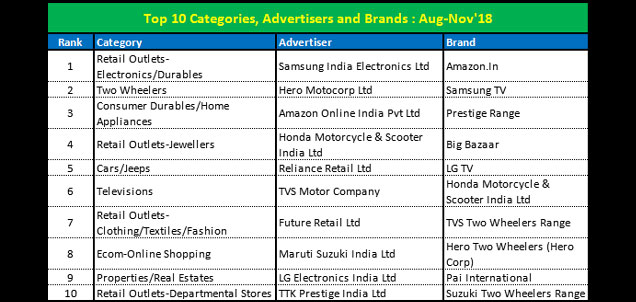
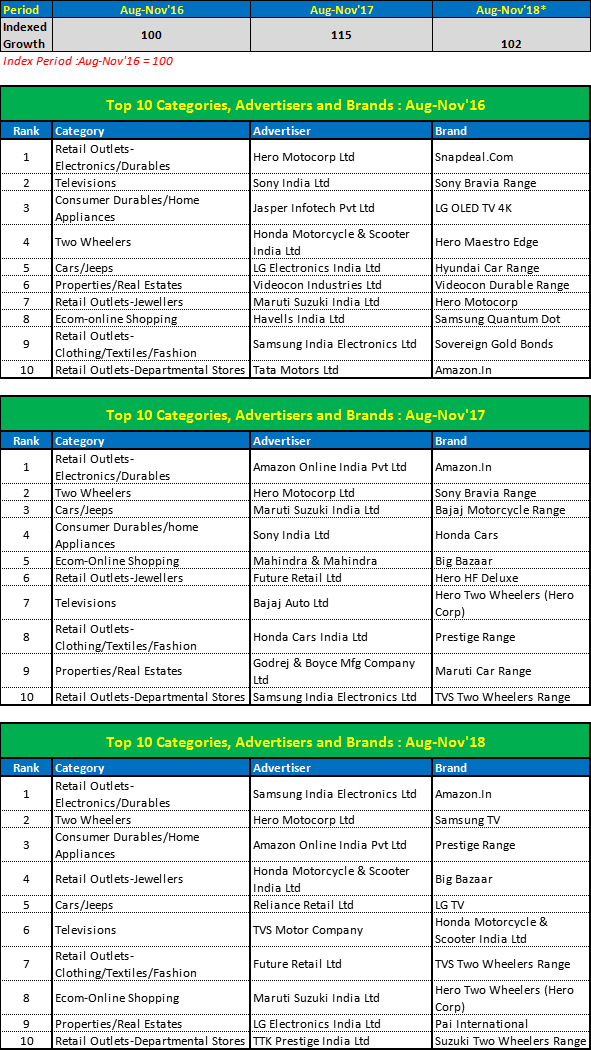
    TAM AdEx, a division of TAM Media Research, has shared with MxMIndia numbers for festive advertising for 2018. The data tells the story:


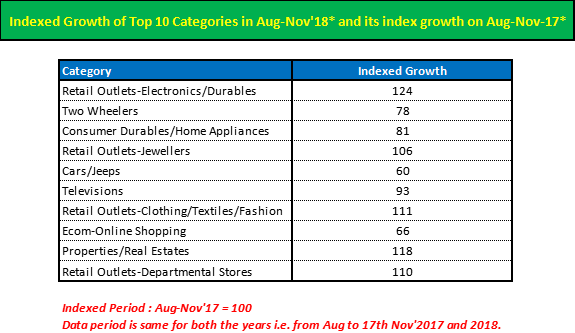
    This is a very important chart. Index grew to 115 in 2017 but only 102 in 2018. Below the first chart are the Top categories, advertisers and brands for 2016, 2017 and 2018 (also above as the main story image)


  • Achche Din…! Zenith forecasts 15% AdEx growth in 2019


    By A Correspondent [to be updated by 9.30am]

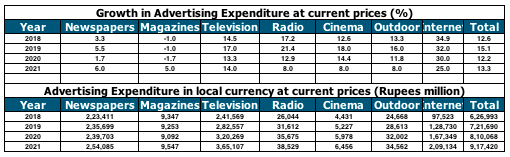
    Media agency network Zenith forecasts that adspends for India in year 2018 will close at Rs 62,699 crore. And the total AdEx for India will see an increase of 15% and climb up to Rs 72,169 crore in 2019.

    India remains one of the fastest growing economies, with strong GDP growth of over 7%, led by reforms in sectors such as retail, infrastructure, manufacturing and services, notes a Zenith communique, adding: “Given that a significant part of the population is below 30 years of age, there is likely to be continued consumption-led growth with less reliance on export-led momentum.  This should give a boost to businesses across the board, ad investments and government initiatives.”


    Furthermore, the release adds: “However, 2018 has also seen the depreciation of the rupee and oil price volatility. The overall expectation is that oil prices will stabilise, giving Indian consumers more disposable income. Indian consumer confidence continues to remain relatively high. “

    According to Tanmay Mohanty, Group CEO at Zenith, many parts of India were experiencing digital transformation, led by mobile. This will accelerate categories such as banking, financial services, healthcare, entertainment and sports, travel and lifestyle. “2019 is the year of the Indian General Elections. These and the State Elections will boost marketing spends.  Additionally, the Cricket World Cup and the Indian Premier League will drive growth.” Mohanty said.

    “Digital will continue to accelerate both in reach and consumption.  Television – linear and catch-up will be on an upward curve. The expectation for radio is that it will digitise aggressively in response to streaming services while both cinema and out of home (OOH) will innovate and increase reach-led investments. Print will thrive on regionalisation.” Mohanty added.

    According to a similar report released last year (Dec 4, 2017), total AdEx for India was estimated to climb up to Rs 58,422 crore, growing  at 8.4% in 2018, led by television. This estimated has been bettered by the figure of Rs 62,699 crore as quoted earlier for adspends in 2018.

    Meanwhile, online video and paid search are driving the growth in global adspend, as advertisers focus on personalised and targeted communications, according to Zenith’s Advertising Expenditure Forecasts, published today (December 3).

    This is what the rest of the summary, as provided to the media, notes:

    With advertisers now able to use these channels to target with pinpoint accuracy and serve personalised messages, they are increasing both the efficiency and effectiveness of campaigns. Between 2018 and 2021, online video advertising will grow at an average of 18% a year, twice as fast as other forms of internet display advertising and well ahead of any other channel.

    Paid search is not growing as quickly in percentage terms – it will grow at an average of 7% a year over this period – but in dollar terms will contribute even more to global growth than online video. The application of AI techniques, better location targeting, integration with commerce and the rise of ‘in the moment’ search are all making search more effective for advertisers. We forecast that between 2018 and 2021, online video advertising will grow by US$20bn, while paid search will grow by US$22bn. Between them these two channels will account for 60% of the extra ad dollars added to the market over this time.

    Online video and television are more important to brand-building than ever

    Advertisers commonly use online video together with traditional television, combining television’s broad reach and immersive experience with online video’s ability to target and optimise frequency. Taken together, these two media are becoming more important to advertisers’ brand-building campaigns. Their combined share of adspend in ‘display’ media (i.e. all media except paid search and classified advertising) has risen from 46.2% in 2012 to 48.4% this year. By 2021 we expect television and video to have a combined 48.8% share of global ‘display’ – a higher share than television ever achieved on its own. Taken together, television and online video are working harder for advertisers than ever before.

    Global e-commerce advertising starts to accelerate

    E-commerce advertising – advertising that sits alongside and within search results and product listings on e-commerce sites – is well established in China, but is only just starting to get going globally. Zenith believes it has the potential to transform the way brands convert customers online, and add about US$100bn of new money into the global advertising market.

    E-commerce advertising has risen from 0.8% of all adspend in China in 2009 to an estimated 18.2% this year, driven by investment by companies like Alibaba in turning e-commerce into advertising revenue. Until recently, e-commerce platforms outside China have largely focused on direct sales to consumers at the expense of advertising, but that is now changing. Amazon generated nearly US$5bn in advertising revenue in 2017 as a whole, and in Q3 2018 its ad revenues grew by 122% year on year. Other shopping platforms are following suit by investing in their own advertising activities.

    Globally, e-commerce advertising is about as advanced as it was in China at the end of the last decade. Amazon accounted for 0.8% of global adspend in 2017, the same proportion that Chinese e-commerce occupied in 2009. If e-commerce follows a similar path globally to the one it followed in China, it could account for 18% of global adspend by 2027. That’s equivalent to over US$100bn in today’s ad market, representing a huge revenue opportunity for the platforms, and a whole new way for brands to reach customers at the point of purchase. This money typically comes from brands’ commercial teams rather than their marketing teams, from budgets set aside for negotiating with retailers. It is therefore new money to advertising, and should expand the market without cannibalising money spent elsewhere.

    Steady growth in global adspend to continue

    We estimate that global advertising expenditure will grow 4.5% by the end of this year, boosted by the Winter Olympics, FIFA World Cup and US mid-term elections. Growth will then remain steady and positive for the rest of our forecast period to 2021, at 4.0% in 2019, 4.2% in 2020 and 4.1% in 2021.

    Central & Eastern Europe will be the fastest-growing region, with average growth of 6.3% a year between 2018 and 2021, driven by continued strength in Russia, which is growing at 6.8% a year and accounts for 39% of the regional total. Asia Pacific is next, growing at an average of 4.9% a year, or 5.7% a year excluding Japan. India is the stand-out growth market here, growing at 13.5% a year from US$9.7bn in 2018 to US$14.2bn in 2021, when it will become the world’s eighth largest advertising market, entering the top ten for the first time. India has huge potential for further growth, with advertising taking up just 0.3% of GDP, less than half the Asia Pacific average of 0.7%

    Young advertising markets like India are playing an ever-more-important role in driving global growth in adspend. ‘Mature’ markets – by which we mean North America, Western Europe and Japan – account for 62% of global adspend this year, down from 75% ten years ago. ‘Rising’ markets – by which we mean all markets apart from the ‘Mature’ ones – will contribute 54% of the growth in global adspend between 2018 and 2021, increasing their share of global expenditure from 38% to 40%.

    “E-commerce advertising is poised to transform the advertising market in much the same way that paid search did in the last decade,” said Jonathan Barnard, Zenith’s Head of Forecasting and Director of Global Intelligence. “It could bring US$100bn in new money into the market over the next ten years.”

    “Brands are transforming their businesses to take advantages of the new digital opportunities available to them,” said Vittorio Bonori, Zenith’s Global Brand President. “Better segmentation and targeting, personalised creative and direct transactional relationship with consumers are combining to drive brand growth.”


  • Just how much do we spend on media for Diwali ad campaigns?


    By Indrani Sen


    Trying to estimate the traditional media expenditures during the three months, from August to October, is like the age old story of the blind men with the elephant. Each blind man made a guess based on which part of the elephant he was touching! In this case, please read it as based on the media agency or the advertisers own experience with rate negotiation for Diwali campaigns. The estimates put up by TAM India for Adex is therefore corrected accordingly.


     

    Well, TAM India estimates Adex for Print, TV and Radio which is based on monitoring of large number of media vehicles during the stipulated three months. As we all know, Adex is calculated on the basis of market rates and not on the basis of actual negotiated rates. Industry insiders are also aware of special discounts offered by media houses over and above their negotiated rates with media agencies/ advertisers for the Diwali campaigns. It is important for the leading media houses to get a fair share of the Diwali budget, the once a year bonanza for which most of them are prepared to bent backwards!


    The scheduling off course depends on the actual date of the Diwali festival, which falls on a date between mid-October to mid-November in the solar calendar based on the calculations given in advance about the auspicious dates in our lunar calendar published in our almanacs. So, it is debatable if we should look at the three months August to October or redefine the period as 12 weeks before the Diwali. For example, this year Diwali is on November 7, 2018 and we have been seeing lot of frenzied advertising activities in all traditional media as well as digital and social media since October 1. Obviously, if the TAM Adex reports compare August to October 2017 with August to October 2018, then a large chunk of the pre-Diwali advertising will not be reflected in the analysis.


    Last year TAM India published in their newsletter a comparison of pre-Diwali Adex for 2016 and 2017 https://www.tamindia.com/wp-content/uploads/2018/03/tam_newsletter_04.pdf and concluded that there was drop in print and radio expenditures in 2017 compared to 2016. Diwali festival in 2016 was on October 30, 2016 and in the next year the date fell on October 19, 2017. There is usually a huge drop in advertising traffic immediately after Diwali across all traditional media. Last year, therefore the Adex naturally dropped after October 19 while 2016 enjoyed the full thrust of Diwali advertising till October 30. Obviously the lull over the last ten days of October painted Print and Radio at a disadvantage in comparison with the same period in 2016.


    It is my earnest request to TAM India to change the period for comparing Diwali expenditures to 12 weeks before the festival instead of the standard three months August to December. Their calculations will still be on market rates, but at least the estimates would be comparable across the different media. We generally see a long diminishing tail of TV media after Diwali which are part of free spots or bonus spots which generally feature in the rate negotiations. Ideally speaking, the same TV spots should not be added to the overall cost of the particular advertisers’ Diwali campaign.


    TAM India is working on publishing a Digital Adex shortly, which will complete the process of estimating Diwali media expenditures by adding to traditional expenditures, digital and social media expenditures. There has been a trend since 2014 to link Diwali campaigns with social needs and year on year we are finding more advertisers climbing into that band wagon. Needless to mention, a considerable chunk of their Diwali advertising budget is being utilised through the new media channels.  We need to end this game played by blind men and have a robust estimates of how much we are spending on Diwali advertising on a year-on-year basis.


    Wishing the readers of www.mxmindia.com a Happy Diwali and a Prosperous New Year!


  • What must newspaper barons do?


    By Sam Balsara


    Johannes Gutenberg (1400 –1468) can smile on India. Look at the table below:


    Print advertising has grown by 142% in the last decade, clocking an average annual growth rate of 9.26% and even today contributes 33% of the growing India Adex. Possibly no other major market can boast of such growth figures or market share. Print has over 2,00,000 advertisers, (not including classifieds and tenders) whilst television has only 12,000. Audit Bureau of Circulation (ABC) tells us that the total audited average circulation per day of all newspapers in the last decade grew dramatically from 42 million to 61 million.


    Whilst all this no doubt is making Gutenberg smile, it is clear that there are signs of head winds. The percentage contribution of print to Adex has come down over the last decade, though ever so slowly from 41% to 33% today. Last year (2017) which was not a good year for Adex, thanks to the combined effect of demonetisation and goods and service tax (GST), print grew by only 3% and the Pitch Madison annual Advertising Outlook Report projects Print to grow at 5% compared to total Adex which is projected to grow at 12%, in 2018.


    English print which dominated Adex all through the 60s until the turn of the century did not grow at all last year. Almost all language newspapers did. But on the positive side, we need to recognise that headroom for growth in print in India is still very high, given that literacy is only at 74% and the new that literacy is only at 74% and the new literates or semi literates can get enticed by the charm of newspaper reading. Whilst sourcing news through digital has become a common practice in the West, its universal adoption in India is still 2-3 decades away, given that vast masses of middle aged and old aged population are not digitally savvy, Reliance Jio notwithstanding. We also need to recognise that we live in a multimedia world, where the target audience multitasks. What matters therefore is not the parameter of share of Adex, but absolute growth in print Adex. What should newspaper barons do? They say only the paranoid survive, so giving due weightage to the head winds, I have 7 suggestions for my newspaper baron friends who have been Lord and Masters virtually ruling their territories and on the back of their vast influence have expanded their empires to cover various industries.


    1. Sell print aggressively to advertisers as a medium. Television, Radio and even Digital sell themselves to Advertisers a lot more aggressively, using every trick in the book. Comparatively print seems to be a passive seller.


    2. The IRS 2018 highlighted a dramatic fact that total readership of newspapers (Last one month readership) has increased by a dramatic 40%. Unfortunately, what matters to the advertisers in terms of reach is Average Issue Readership (AIR), (because that is the number of readers likely to notice an advertiser’s ad) which has been flat. To take advantage of the increase in total readership, advertisers need to take 3 -4 insertions of the same ad in the same publication in the same month and print media can facilitate this by offering additional insertions at lower prices.


    3. Print has become the medium of choice of large advertisers, but only when they have an important news announcement to make, like for a launch, a brand promotion or a price announcement. This considerably restricts use of print by such advertisers. What Print needs to do, is to urgently identify new categories who can use print on a regular basis. Print successfully did that for Real Estate where television failed.


    4. Half of the advertising that appears in print displays poor creativity, which diminishes their selling or persuasive power. Print must invest in specialist creative talent for developing print ads to improve ROI on print advertising and offer their services to agencies and advertisers.


    5. The cost-plus model for fixing advertising rates adopted by print is hurting the growth of print adex. Print must at least annually review the cost per thousand (CPT) it offers to advertisers and compare its CPT with that offered by other media.


    6. Print must re-evaluate the working of INS, the system of Accreditation of Agencies and the MRV system, which puts considerable pressure on cash flow of advertising agencies. When most other media are moving to sequential liability and holding clients accountable for paying on due date, print’s insistence on holding only the agency accountable will have serious consequences in the long run.


    7. Whilst it is true that print generally offers higher CPT than most other media, data analysts working for print must identify those situations where print in combination with other media can add additional reach at lower additional cost, than if money was invested in the same medium.


    I think it was Bill Gates who said that we overestimate the impact of technology in the short run and under estimate the impact of technology in the long run. In India past experience shows that the short run is not so short. So relax, my print baron friends. But don’t forget to start redefining your business as the business of news / content rather than the business of newspapers.


  • AdEx to grow 12.1% in 2018: IPG Mediabrands


    By A Correspondent

    India ​will ​be a ​Rs ​1 t​rillion​ advertising market by 2022 India has waned through the lingering impact of currency exchange in November 2016 and pass through effect of unified tax structure in July this year​, notes IPG Mediabrands.​


    Transitory costs for introducing bold structural reforms have been paid and upswing in economic activity is strengthening. The bank recapitali​s​ation plan coupled with insolvency and bankruptcy code 2016 revives the sector and this will boost private investment. Revival in rural economy and growing middle class will boost economic growth. GDP in real terms is expected to grow +6.7% a speck slower than earlier projected +7.17%. In 2018 IMF report predicts growth of +7.4%.


    Advertising revenue will grow at CAGR of +12.1% in the next five years to touch INR 1.07 tn. Growth will be led by digital with +21.6%. Television will still rule the top as the largest media in 2022 with a market share of 41%. Digital and Print will have equal share of 25%. Mobile will displace desktop as the 3rd largest category by 2020.


    United States and China contribute close to 50% of the incremental ad dollars between 2018 and 2022 while India ranks third with a 6% contribution. The traditional categories like Print are so strong and growing YOY in India that over 60% of this incremental dollars is coming from traditional categories.


    The ​estimated Adex growth rate of +11.5% ​made ​earlier in June ​2017 ​has been revised marginally downwards to +11.1%. In 2018, ​IPG Mediabrands expect​s​ the Adspends to grow +12.1%. Categories driving up spends next year will be:-

    AUTO enjoys a strong domestic demand due to rising income, rising middleclass and a young population. Demand for commercial vehicles due to heightened infrastructure activity and government’s focus on electric vehicles to meet emission targets are some of the growth drivers.

    FMCG penetration will increase with modern trade growing faster in Tier-II and Tier-III cities. Raising disposable income among rural consumers, E-commerce strengthening their offering with daily products, evolving consumer lifestyle and government FDI policy is infusing growth.

    BANKING demand will raise thanks to increase in working population. Housing and Personal finance are key drivers. Government’s financial inclusion plan is expanding the reach of banking services and insurance coverage to rural segment.

    CONSUMER DURABLES demand will grow with rural electrification and e-commerce expansion.

    E-COMMERCE growth is propelled by increasing smartphone penetration, digital literacy combined with affordable data costs. GST will help E-commerce players to streamline supply chain and eliminate dual taxes. The sector is attracting more users from Tier-II and Tier-III cities.


    Net Advertising Revenues by category (​Rs Cr Net)


    Net Advertising Revenues: 2018-2022 (​Rs bn Net)


    Net Advertising Revenues:Top 10 markets (​USD Bn)