Tag: AdEx

  • AdEx grew 21% in 2022, to grow 16% in 2023: Madison


    By Our Staff

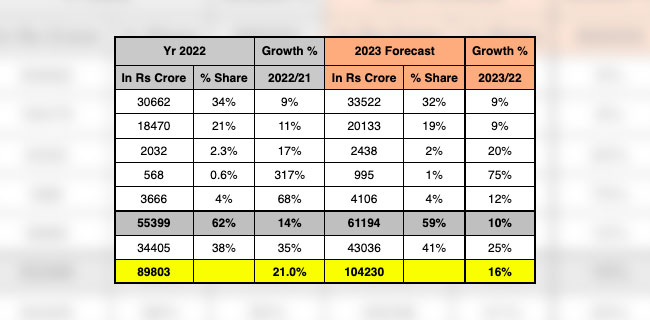
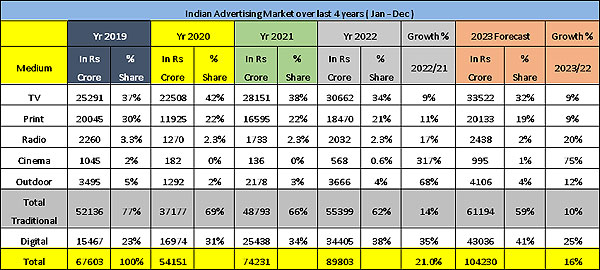
    Madison Media presented its predictions for the advertising industry for 2023.  The highlights of the report were released by Sam Balsara, Chairman, Madison World. According to Madison Media, AdEx has grown by 21% in 2022 to reach Rs. 89,803 crore. AdEx is expected to grow further in 2023 by 16% and will cross the landmark Rs. 1 lakh crore number to settle at Rs. 1,04,230 crores. In 2022, Digital grew by 35% to become the largest medium in AdEx with a 38% share, compared to TV’s 34%. TV grew by a modest 9% vs our projection of 14%.


    Figures at a glance:
     

    Key findings of the report:

    A. Overall:

    1) In 2022 total AdEx grew by 21%, Traditional AdEx by 14% and Digital AdEx by as much as 35%.

    2) Compared to Indian AdEx growth rate of 21%, Global AdEx, according to WARC grew by just 8% in 2022. The Top 11 countries that account for 70% of Global AdEx grew by only 1%.

    3) In absolute terms, AdEx has grown from Rs. 74,231 crore to Rs. 89,803 crore and this is the second highest gain of the last two decades.

    4) Traditional AdEx dominates Indian AdEx with a 62% share, whereas in Global AdEx the figure is 32%.  With a growth of 14% in 2022, Traditional Media at Rs. 55,399 crore, has just crossed its 2019 figure of Rs. 52,136 crore.

    5) Digital AdEx is now the largest medium with a share of 38%, followed by TV with a share of 34%.

    6) The Audio Visual medium contributes to 45.6% of total AdEx. Linear TV at Rs. 30,662 crores and Digital Video at Rs. 10,314 crores, totalling to Rs. 40,976 crores.

    7) FMCG continues to be the largest category, but its share has moved down from 38% in 2020 to 32% in 2022.

    8) Ecommerce has now established itself as the 2nd biggest category of AdEx, growing in Share from 4.9% in 2019 to 14% in 2022.

    9) The Top 5 Advertisers in AdEx are HUL, Reckitt, RIL, Dream11 and Mondelez. There are only 11 Start-Ups in the Top 50 Advertisers List vs 15 last year, confirming that VC money is drying up.


    B. Digital

    1) Digital grew by 35% in 2022, on top of a 50% increase in 2021, to reach Rs. 34,405 crore and has emerged the largest medium in AdEx with a 38% share, overtaking TV.

    2) A 10-year review shows that Digital has grown from a mere Rs. 3,050 crores with a 9% share, to Rs. 34,405 crores with a 38% share today.

    3) Inspite of all this growth, Digital AdEx in India trails behind Global AdEx. Digital share in Global AdEx is 68%.

    4) Video, Social, Display, Ecommerce and Search drive Digital AdEx. Digital Video continues to dominate Digital AdEx and having grown by 40%, has further improved its Share from 29% to 30%.

    5) Social grew the most at 45% and increased its Share from 20% to 22%. Display has grown more modestly at 19% and has lost 3 percentage Share points from 19% to 16%. Search has grown by 32%, but is only 16% of the market.

    6) Ecommerce has registered a 35% growth and now has a share of 16% of Digital AdEx. Whilst Google and Facebook account for the lion’s share of Digital ADEX, Amazon and Flipkart account for almost 80% of Ecommerce spends.

    7) Digital is going to continue to fuel growth of AdEx in 2023. It is expected to grow by 25% to reach Rs. 43,036 crore and increase its share to 41% of AdEx.


    C. Television

    1) TV registered a modest growth of 9%, against our forecast of 14% to reach Rs. 30,662 crore.

    2) In 2022, for the first time we see signs of stress in Linear TV and its Share has come down from a high of 42% in 2020 and 38% in 2021 to a new low of 34%. With increasing spends in Digital, TV has now moved down to number 2 position in the Indian AdEx.

    3) TV has also seen a 8% decline in viewership over the last year, and a 13% drop compared to pre-Covid year 2019.

    4) TV has seen a marginal drop in Advertisers from almost 11,000 in 2021 to less than 10,500 in 2022.

    5) FMCG continues to be the largest contributor to TV AdEx with a share of 45%. Ecommerce, the 2nd largest contributor to TV AdEx, further increased its share from 18% to 20%, followed by Auto which has maintained its share at 5%.  Education has dropped its share from 6% to 4%.

    6) In terms of Genres, Hindi GEC 2 has registered the highest growth of 47% followed by Sports at 22%. News, witnessed a degrowth during last year. Among the regional satellite channels, Tamil continues to rule the roost, followed by Telugu, Marathi, Bengali, Kannada and Malayalam in that order.

    7) TV AdEx is expected to grow by 9% in 2023 to reach Rs. 33,522 crore.

    8) FMCG, the largest category of TV Market, is likely to substantially increase its Advertising budgets, instead of reducing consumer prices because of lowering of raw material inflation.


    D. Print

    1) Print AdEx grew last year by 11% to reach Rs. 18,470 crores, a little short of its pre-covid figure.

    2) Both Volume and Value in Print have gone up by 15% and 11% respectively.

    3) H2 performed well for Print and 58% of its AdEx came from H2 vs only 46% in pre-Covid year 2019.

    4) In terms of category contribution, although, Education de-grew marginally, it has emerged as the largest category in Print overtaking FMCG, which grew by as much as 8%. Two other large categories, Clothing, Fashion & Jewellery and Household Durables grew substantially by over 50%.

    5) In terms of languages, Hindi Publications continue to dominate, followed by English and Marathi, the latter two having grown by 19% over 2021.

    6) We expect Print AdEx to grow at 9% in 2023, to reach Rs. 20,133 crore and reach pre Covid levels.

    With this growth, its Share will be 19%, compared to Global AdEx where it is a mere 4%.


    E. Other Media

    1) OOH AdEx has registered a high growth of 68% on the back of a growth of 69% the previous year, taking the industry to Rs. 3,666 crore and surpass its pre Covid level.

    2) Digital OOH continued to be the growth driver with its big bright, colorful and moving displays.

    3) Radio AdEx has grown by 17% to reach Rs. 2,032 crore, but it is still at 90% of its pre Covid level. Its Share in total AdEx is at 2%.

    4) Real Estate has emerged as the largest category in both OOH and Radio, pipping FMCG.

    5) Although Cinema grew by 317%, it has reached only the half way mark of its pre Covid number of Rs. 568 crore. But with new movies coming up, we expect Cinema to grow by 75% this year and reach Rs. 995 crore, almost upto its pre pandemic level.


    Added Balsara: “Indian AdEx is the bright spot in a relatively dull and uncertain global environment. Our AdEx has grown by leaps and bounds in the last 3 years marked by Covid and the War, except in 2020. However, media habits of Indians are rapidly changing and this is reflected in our AdEx numbers and commentary. Advertisers who ignore these changes will do so at their own peril.”


    Bharat Puri, Managing Director, Pidilite Industries Limited who launched the report said: “Experiment, innovate, know your consumer and don’t be afraid of failure”. He said, “Whilst chasing impressions, don’t forget to make an impression!”
     

  • Tailored digital ads and ecommerce to drive 8% growth in OTC AdEx: Zenith


    By Our Staff


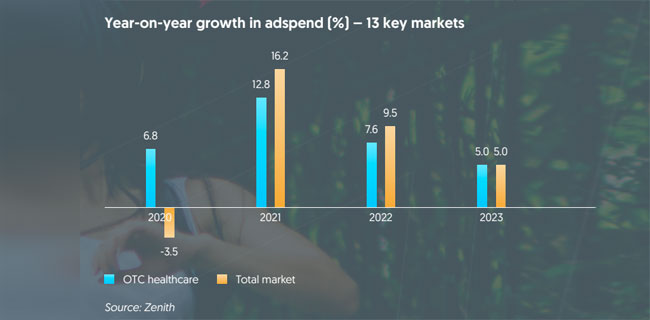
    Advertising expenditure by over-the-counter (OTC) healthcare brands in 13 key markets (including India) will expand by 7.6% in 2022 and 5.0% in 2023, according to Zenith’s new Business Intelligence – OTC Healthcare report, published today. This growth will be driven by tailored digital brand advertising, as well as performance advertising driving traffic to OTC ecommerce platforms.


    OTC advertising grew throughout the pandemic. OTC adspend expanded by 6.8% in 2020 while the market as a whole shrank by 3.5%, as healthcare messages soared in relevance for consumers. Demand for cold and flu remedies sank sharply as social distancing cut their transmission, but most other sub-categories continued to grow, and sales of sleep aids spiked. When the pandemic hit, brands in many categories cut back or even ceased their communications, concerned that their messaging was no longer appropriate, or in some cases counterproductive in the new context. This gave OTC brands the opportunity to use plentiful cheap media to reinforce their contribution to consumers’ health and wellbeing.


    “The continued shift to digital allows OTC brands to use smart segmentation and dynamic creative to market the same products to different people with different needs, within the framework of regulations for digital advertising in this category,” said Benoit Cacheux, Global Chief Digital Officer, Zenith. “The gym-goer with muscle ache, the office worker with a headache and the parent whose child has growing pains all need pain relief, but brands need to talk to them in different ways to persuade them most effectively. This ability to tailor the creative to the needs of the audience gives digital advertising an advantage that traditional media never had.”


    “The pandemic has focused consumers’ attention on their health and disrupted their reliance on traditional OTC distribution channels,” said Jonathan Barnard, Head of Forecasting, Zenith. “Brands will continue to step up their investment in digital advertising as the rise of ecommerce gives it a greater role in driving OTC sales and brand growth.”


    From the communique issued by Zenith:

    OTC advertising then rose a very healthy 12.8% in 2021, though in this case its growth was slightly behind the overall market, which had its lost ground to make up. Zenith forecasts growth in OTC advertising to remain healthy over the next two years, as brands defend their price premiums and ecommerce platforms compete to establish dominance.


    OTC has lagged some way behind the market as a whole in embracing ecommerce, but the lockdowns and other restrictions led to a leap in OTC ecommerce in 2020. Now that more consumers are aware of and comfortable with the option of shopping for OTC products online, it will become an ever more important sales channel over the next few years. This means traditional distributors such as pharmacies and supermarkets are facing new competition from digital ecommerce platforms, and brands have new opportunities to launch new partnerships or even direct-to-consumer ventures. The increased competition for traffic and sales will fuel continued growth in brand and performance advertising.


    Zenith forecasts that OTC healthcare adspend will grow from US$20.1bn in 2021 to US$22.7bn in 2023, 36% above pre-pandemic spending level of US$16.7bn in 2019.


    Shift to digital helps brands tailor messaging to consumers’ specific needs: When consumer first buy an OTC product, they often spend time researching the purchase and discussing it with family, friends and trusted advisors like pharmacists. However, after the first purchase, buying OTC products quickly becomes routine, part of the regular shop. The fundamental role of OTC advertising is therefore to maintain brand awareness at the point of purchase, much like FMCG advertising. Similarly, OTC healthcare makes heavy use of television for its high-impact mass reach. OTC advertisers spent 38% of their budgets on television advertising in 2021, compared to 21% for the average advertiser across all categories. OTC brands also spend more on radio and magazines – radio for its mass reach and magazines for their high impact.


    Until recently, it was difficult to use digital advertising to create emotional connections and lasting brand awareness. The rise of high-quality advertising environments, online video and retailer media – ads that appear on retail websites and ecommerce platforms – means brands can use digital to convey brand values effectively right through to the sale. Brands are also spending more on performance advertising as OTC ecommerce scales up.


    Zenith forecasts that OTC brands will increase their digital adspend at an average rate of 11% a year between 2021 and 2023, while radio grows by 5%, television by 3%, and magazines shrink by 3%. Digital will account for 49% of OTC advertising in 2023, up from 46% in 2021.


    *The 13 markets included in this report are Australia, Canada, China, France, Germany, India, Italy, Poland, Russia, Spain, Switzerland, UK and USA, which between them account for 74% of total global adspend. The report covers medicines and remedies sold over the counter, including cold and allergy remedies, contraception, digestion care, eye care, oral care, pain relief, skin care, sleep aids, stop-smoking aids and wound care.


  • Indian ad industry nears 100k cr milestone


    By Indrani Sen


    Indrani SenLast week, both GroupM’s This Year Next Year (TYNY) and Madisons Media’s Pitch Madison Advertising Report (PMAR) got released and their basic findings have already been reported by all business and trade media. The general mood in the advertising industry is exuberant as both the reports have confirmed that AdEX zoomed in 2021, by 37% as per PMAR and by 26.5% as per TYNY in spite of the third wave of the pandemic. In 2021, India was the fastest growing market in the top 10 countries, ranking 9 globally and ranking 5 on incremental ad spend predicted for 2022.
     

    The current year also promises to be a good year for Indian ad industry with PMAR predicting 20% growth and TYNY predicting 22% growth in adspend in 2022 over 2021. However, this year the two reports raises a paradox, will the ad industry cross INR 100,000 crore milestone in 2022 as predicted by TYNY or touch 90,000 crore as predicted by PMAR? It seems that we will be celebrating the milestone of achieving INR 100,000 crore ad expenditure twice, once in 2022 by GroupM, its constituent agencies and clients and once again in 2023 by another large part of the industry who prefers to use PMAR.


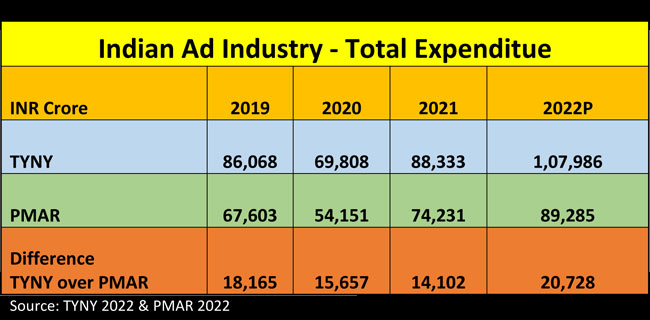
    It is acceptable that two or more research studies done by different agencies may yield different estimates of adspends by media and as long as the trends are the same, all such estimates can be used by the industry. Indian media, advertisers and agencies have learned to live with different estimates for the industry size, growth rates as well as predictions from different sources including TYNY and PMAR. However, as the difference of almost INR 21,000 crore between the estimates for 2022 in the two reports is huge, it may be prudent to analyse the macro level statistics of PMAR and TYNY to find out the source of such huge difference.


    As digital, TV and print account for a total share of 94% to 96% of the total ad expenditure in both the reports, a review of the adspend across these three media will suffice for finding out the sources of the difference in estimates.


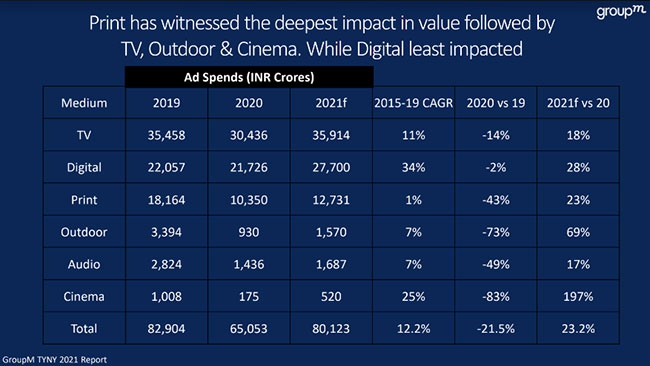
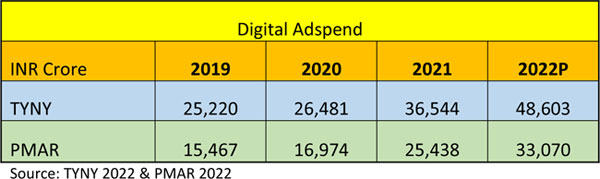
    Both GroupM and Madison Media have reported digital as the fastest growing media in 2021 and a continuity in the momentum of growth in 2022. In TYNY, digital adspends has equalled the TV adspends in 2021, where as in PMAR the digital adspends will equal or cross TV adspend in 2022.  Over the last three years, TYNY has been consistently reporting about INR 10,000 crore more in digital media ad spend than PMAR. In 2022 the ad spend in digital media is estimated to be INR 15,533 crore higher in TYNY than in PMAR.


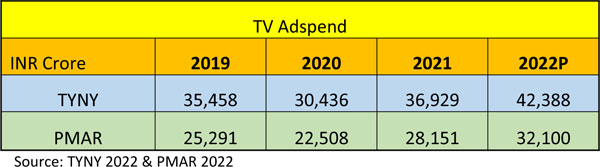
    Similarly, in case of TV adspend, the estimate by TYNY was higher than TYNY by INR 10,000 crore in 2019, which reduced to INR 8000 crore in 2020 and 2021. However, in the estimate for 2022, the same has again become higher by INR 10,000 crore. So, the estimates for digital and TV taken together account for a difference of INR 25000 crore between TYNY and PMAR in their predictions of 2022.


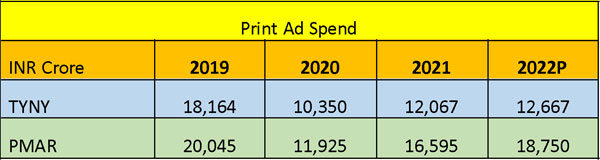
    When it comes to print adspend, the table is turned as PMAR has been consistently estimating higher spends in print than TYNY. In 2022, PMAR’s prediction for print ad spend is INR 6000 crore higher than that of TYNY. So, by combining print with digital and TV and other traditional media, the difference of INR 25000 crore gets reduced to INR 21000 crore.


    Source: TYNY 2022 & PMAR 2022


    It seems a bit unfair that TYNY has condemned print adspends in India to almost zero growth in 2022. As TYNY is done as a global report, has this estimate for Indian print ad spend been influenced by the global scenario where in most countries print ad spends have been steadily declining for years?


    I have written about the difference in the findings of TYNY and PMAR earlier in www.mxmindia.com. I know that we will never really get to know the reasons for such huge differences between the estimates of TYNY and PMAR, but it is becoming increasingly difficult to explain the reasons for the same to students of media management in a classroom as there is a danger that they may get confused and lose faith in media research.


    Read past commentary by Indrani Sen at:


    https://www.mxmindia.com/2021/02/so-how-do-the-groupm-madison-forecasts-compare/

    https://www.mxmindia.com/2020/02/a-roller-coaster-ride-of-adspends/

    https://www.mxmindia.com/2020/02/well-pitched-delivery/

    https://www.mxmindia.com/2019/02/indian-ad-industry-are-happy-times-really-here-again/

    https://www.mxmindia.com/2018/02/indrani-sen-mind-the-tv-adex-gap/

    https://www.mxmindia.com/2017/02/what-is-the-real-size-of-indian-ad-industry/

    https://www.mxmindia.com/2016/02/indrani-sen-boomtime-for-media-a-review-of-the-pitch-madison-advertising-report-2016/


  • Adspends to grow by 20% in 2022 to reach 90,000 crores


    By Our Staff


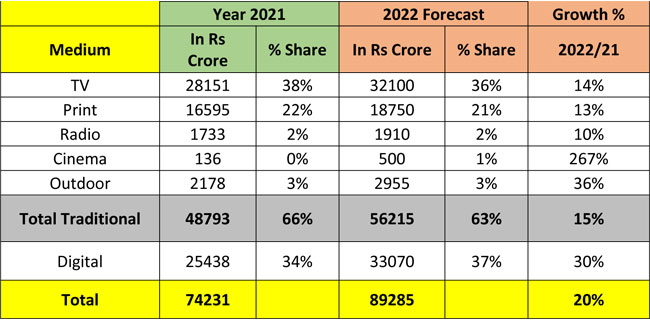
    Madison Media predicts adspends (AdEx) will increase 20% in calendar year 2022. The highlights of the Pitch Madison report were released on Wednesday by Sam Balsara, Chairman, Madison World. According to Madison Media, AdEx is expected to grow by 20% in 2022 and reach Rs. 90,000 crore. This growth is on the back of a dramatic Rs. 20,000 crore increase in 2021 inspite of Covid wave 2. In 2021 Digital grew by 50% and in 2022 is expected to pip television to become the largest contributor to Adex with a share of 37%, compared to TV’s 36%. Print, too has grown dramatically by as much as 39%, retaining its share of 22% in Adex.


    Said Sam Balsara, Chairman, Madison World, “Advertisers seem to be returning to advertising with a vengeance. After Covid year 2020, Global Adex has registered a whopping 21% growth in 2021 and 18% versus pre-covid 2019. Compare this with a compounded annual growth rate of just 5% over 10 years from 2010 to 2019. India infact leads this return, with a growth of 37%, compared to a last 10-year compounded annual growth rate of just 10.4%.”


    Key findings of the Report:

    1. Overall:

    1 • In 2021 total Adex grew by 37%, Traditional Adex by 31% and Digital Adex by as much as 50%.

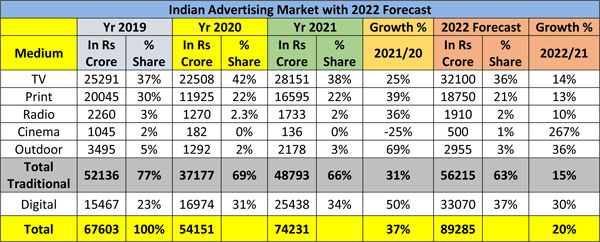
    2 • In absolute terms, ADEX has grown from Rs. 54,151 crore to Rs. 74,231 crore and comfortably surpassed the 2019 figure of  Rs. 67,603 crore by 10%.

    3 • Traditional Media contributes 66% of total Adex, whereas the global figure is 35%.  Despite a growth of 31% in 2021, Traditional Media at Rs. 48,793 crore, has not reached its 2019 figure of Rs. 52,136 crore.

    4 • Digital Adex has now reached a share of 34% and is in striking distance of TV, the leader of the pack which ended the year with a share of 38%. TV and Digital Adex now account for 72% of Adex.

    5 • Q3 and Q4 2020 contributed to 60% of Adex. Q4 registered a whopping 49% increase over Q4 2019.

    6 • FMCG continues to be the main category, but its share moved down from 38% in 2020 to 34% in 2021.

    7 • Ecommerce emerged as the 2ndbiggest category of Adex and the largest contributor to its growth, doubling in size from Rs. 3,000 crore to Rs. 6,000 crore.

    8 • 15 new-age Companies / start-ups have entered our list of Top 50 advertisers namely, Dream 11, BYJU’s, Phone Pe, Upstox, My 11 Circle, CRED, Netmed, MPL, Policybazaar, Unacademy, WhiteHat Jr, Swiggy, Netflix, Coin Switch Kuber and Coin DCX.


    2. Television

    1 • TV registered a high growth of 25% to reach Rs. 28,151 crore, following a 11% de-growth in 2020. TV is the only traditional medium that has comfortably surpassed the 2019 number of Rs. 25,291 crore, by as much as 11%. TV’s market share is at 38%, down from a high of 42% last year but one percentage point higher than 2019.

    2 • TV Adexwitnessed a 25% spike in Ad volume or FCT in 2021 over 2020 and a 11% increase against 2019. Significantly ad volume in 2021 is higher than 2020 in all four quarters.

    3 • FMCG continues to be the largest contributor to TV Adex with a share of  46%, but lost as much as five percentage points from a high of 51% in 2020. Ecommerce, the 2ndlargest contributor to TV Adex, increased its  share from 11% to 18%, followed by Edtech which increased its share  from 4% to 6%.

    4 • News as a genre has registered a high growth of 19% over 2019 and  29% over 2020. Marathi and Tamil Regionals have also grown dramatically by 36% and 24% respectively over 2019. Second line GECs de-grew by a massive 18% and mainline GECs de-grew by a negligible 3%. Hindi GEC continues to be the largest segment, followed by Sports and then News.

    5 • TV Adex is expected to grow by 14% in 2022 to reach Rs. 32,100 crore, 27% higher than 2019.


    3. Digital

    1 • Digital grows by 50% in 2021 to reach Rs. 25,438 crore and has emerged as a strong No 2  for the 2ndconsecutive year, at 34% share, a little short of TV at 38%. Digital has achieved a CAGR of 27% over last 10 years.

    2 • Q4 was the largest quarter, where Digital Adex touched almost Rs. 10,000 crore and contributed 39% to the full year.

    3 • Video is the highest contributor to Digital with a share of 29%, followed by Social & Display at 20% each.  E-commerce and Search now contribute 16% each to overall digital pie.  In terms of growth rate,  E-commerce has grown significantly by as much as  50%.  Display, Video and Search have also grown substantially at 30%+.

    4 • Programmatic has firmly taken route in India and its share continues to be 42%.

    5 • Ecommerce advertising revenue is rising rapidly and we estimate ecommerce advertising spends in 2021 to be at Rs. 4,100 crore, mainly on the back of Amazon and Flipkart, but newer entrants like Nykaa, Big Basket and JioMart are also finding favour with a relevant set of advertisers.

    6 • Digital is set to grow by 30% in 2022 to reach Rs. 33,070 crore and set to emerge as the single largest contributor to Adex, overtaking TV by almost a 1000 crores.


    4. Print

    1 • Following a 41% decline in 2020, Print Adex grew by a whopping 39% to reach Rs. 16,595 crore. Despite the high growth rate, Print is still only at its 2015 levels and has registered a 16% drop vs 2019.

    2 • With a share of 22% in Adex, India is the Print Capital of the world, along with Germany. Global share of Print is a mere 5%.

    3 • Print volume in terms of CC has also gone up by 31%.

    4 • 3 categories FMCG, Education and Auto make up 45% of total Print Adex. Both FMCG and Auto have come down in share by 2 percentage points each.

    5 • English and Hindi publications put together, contribute to 63% of total  Adex volume. English publications grew 40% over 2020. Hindi publications which are the largest volume contributor, also grew by 30%, Telugu by 37%, Assamese & Marathi by 33% and Bengali by 27%. All languages grew, the least to have grown are Kannada, Gujarati and Punjabi by 18-19%.

    6 • Print Adex is expected to grow by 13% in 2022 to reach Rs. 18,750 crore, but it will still be at the level it reached in 2017.


    5. Other Media

    1 • OOH Adex has registered a high growth of 69%, taking the industry to Rs. 2,178 crore, but still way below 2019 level. Conventional OOH grew by 63% and Transit Outdoor by almost 100%. Digital OOH is also beginning to take root and grew from Rs. 50 crore to Rs 300 crore and has a share of 13.77%, far below the global average of 40%. We expect OOH Adex to grow by 36%, to reach Rs. 3,000 crore, the level it had reached in 2017.

    2 • Radio Adex has grown by 36% to reach Rs. 1,733 crore, with a share of just 2 %. With this Radio is at the level it had reached in 2016. We expect Radio Adex to grow by 10% and reach Rs. 1,900 crore.

    3 • Cinema has been by far the worst affected medium. Because of 2 years of Covid, it has degrown by a further 25% over 2020 to reach 136 crores. We expect Cinema to grow by 267% to reach Rs. 500 crore, almost half of the  pre Covid level of Rs. 1050 crore.


    Figures at a glance:

  • Covid Second Wave notwithstanding, AdEx zooms 37% last year, notes Pitch Madison Report 2022

    By Our Staff


    AdEx in 2021 grew to Rs 74,231 crore, having grown at 37%, despite the Covid Second Wave which for the second year adversely impact the economy and AdEx for the three months of May, June and July, notes a teaser from the Pitch Madison Advertising Report 2022. Contrary to its own forecast of 26% growth in February 2021, which meant AdEx in 2021 would not even reach 2019 levels, AdEx has comfortably surpassed 2019 figures by 10%.
     

    In a departure from convention, the Pitch Madison Advertising Report 2022 released flash figures of AdEx estimates only for 2021. An exhaustive report giving medium wise figures, forecast for 2022 and commentary will be released three weeks later – February 16, 2022, to be precise.


    The flash report estimates that total AdEx has not registered a 37% increase in the last two decades for which figures are available. The closest it has registered was a growth rate of 22.9% in 2007. For context in 2020, Adex had degrown 20% over 2019.


    Said Sam Balsara, Chairman – Madison World, “The two Covid years of 2020 and 2021 have altered the structure of AdEx, but Indian AdEx has shown that it is resilient and contrary to expectation surpassed 2019 AdEx levels. Whilst the Covid First Wave had a disastrous impact on AdEx, India Inc has taken the more deadly Covid Second Wave in its stride and despite a setback of four months has not only recovered during the year itself but also comfortably surpassed 2019 levels.”


  • Looking Ahead at 2022


    By Indrani Sen


    Indrani SenThe Indian advertising industry showed a strong trend of recovery in the second half of 2021. The market became quite buoyant and industry experts began to predict a strong double-digit growth in advertising expenditure in 2022 with digital and TV driving the growth. Print, radio and outdoor were expected to recover their revenues faster than what was envisaged earlier. The experts making these predictions assumed that we would not have a Third Wave of Covid-19 in 2022 and there would not any major economic disruption.


    But, before 2021 ended, our world again became under the shadow of Covid-19 and its new variant Omicron. Over the last two days of 2021 and the first two days of 2022, almost all the states where the cases are rising, have taken various measures from partial lockdown to night curfew to stricter vigilance by the authorities. Though national health authorities have not yet declared this upsurge as the “third wave”, we need to recall that AdEx had a degrowth of 25% to 30% between April-June 2021 due to the effects of the second wave on our economy. As per our AdEx, the April to June quarter has the second highest level of advertising expenditure after the October to June (festive) quarter. The number of Covid-19 cases are increasing on a daily basis and according to an announcement made by Union Ministry of Health and Family Welfare on the first day of the new year in 24 hours India registered 27533 new Covid cases, a substantial spike in the ongoing resurgence of the pandemic. The current situation makes it extremely difficult to predict the trends of AdEx in 2022.


    The traditional media will bear the burnt of various regulatory guidelines if the situation becomes serious, particularly if Maharashtra and Delhi declare a partial or full lockdown. However, it is quite certain that digital media would be growing in spite of the resurgence of Covid-19 in India and certain new trends are going to emerge in 2022.


    We have been hearing lately a lot about NFT, the short form of Non-Fungible Tokens which are used to denote digital assets or cryptographic tokens available through the blockchain. The key idea on which NFT is based is non fungible, which means that it is a unique item which cannot be replaced with another similar item. Non-Fungible Tokens can be understood as basic digital assets, which are ‘copies’ of real or tangible objects/ actual instances and they come encoded with the same infrastructure of blockchain which enables the cryptocurrencies. NFT can be sold or bought between two different parties online, just like the cryptocurrencies. However, non-fungible tokens and cryptocurrencies have many differences. Although NFT has the word ‘token’ in its name, it’s not a virtual currency like Bitcoin (BTC) or Ether (ETH). But they both operate on the same underlying technical mechanism, the blockchain technology.


    NFT has unique identification codes and metadata which cannot be copied or replicated. NFT can be used to represent various types of digital assets like music, audio, video, photos, artworks and other digital files. It can be considered as a certificate of ownership of any digital content or digital asset owned by any company which has invaded not only the blockchain industry, but also the other media and our popular culture.


    Read a useful article in May, 2021( https://www.jpmorgan.com/commercial- banking/insights/future-blockchain-media-entertainment ) which discussed why blockchain is going to play an important role in Media and Entertainment industry. “Media and entertainment places a premium on protecting and monetizing intellectual property. For media companies, blockchain has industry-wide applications that can transform the way content is created, consumed and protected.” If the pandemic persists globally in 2022, then in media & entertainment industry 2022 will perhaps be known as the year of NFTs driven by the blockchain technology.


  • Effects of Covid-19 on M&E in 2021


    By Indrani Sen


    Indrani SenThe second wave of the pandemic is spreading all across the country and we are seeing state after state imposing various restrictions like night or weekend curfews, conditional lockdowns etc. The central government has decided not to impose a nationwide lockdown like last year which paralysed the entire Indian economy. The decision to impose restrictions for curbing the spread of the second wave has been left to the state governments. As the pandemic situation stands now in the second month of the April-June quarter, our economy is likely to see a contraction in this quarter which will have a cascading effect on M&E industry as advertisers will spend less on promoting their products and brands.


    Till now, most economists have predicted that the effect of the second wave of COVID 19 will be less on India Inc. than the effects of the first wave when we had a national lockdown for 70 days. However, it is too early to be assured about that prediction. The outbreak of Covid-19 is no longer concentrated in urban areas, it has been spreading virulently across villages, particularly in the Hindi hinterland of Uttarakhand, UP, MP, Bihar and Chhattisgarh. The rural areas of other states, particularly the states which recently held Assembly elections, are also experiencing a surge of the pandemic.


    Urban India contributes to 60%-65% of the sales of FMCG companies while rural India accounts for the balance 35% to 40. In certain FMCG categories the share of urban and rural is 50%: 50% or even tilted a bit more to the rural sector. Last year, when the lockdown had affected the sales of FMCG industry in urban areas due to restricted consumer spends, Bharat or Rural India spurred the growth of FMCG companies. An article published on February 28, 2021 in www.livemint.com  said: “To be sure, companies are betting on large swathes of consumers in rural India switching from unbranded, loose products to branded ones over the next few years. This gives them room to push their soaps, shampoos, biscuits, beverages and packaged staples in India’s villages, albeit at lower price points. Demand in rural markets has outstripped sales growth witnessed by companies in urban markets over the last several quarters. Companies expect India’s smaller cities and villages to continue driving growth.”  (https://www.livemint.com/companies/news/why-are-fmcg-majors-chasing-growth-in-rural-india-11614504243913.html). At the beginning of 2021, most economic analysts expected the momentum of sales in rural areas to continue. However, the ground realities have already turned out to be different which will affect not just the sales of FMCG products in rural areas, but also the production of Argo industries.


    The controversies over vaccination between the Centre and the states coupled with shortage of oxygen supply and inadequate health infrastructure have given a different dimension to the Covid-19 crisis induced by the second wave. Middle class urban families are spending their live savings, begging and borrowing to try and save their near and dear ones, in the process reducing their subsequent purchasing power. Upper class affluent urban families have realised suddenly that the big fat medical insurance in which they invested are not of any use to them if they cannot get their relatives admitted to any hospital or nursing home. Many insurance companies are refusing to give coverage for Covid treatment. These rich people are feeling the need of having large amount of cash in hand for emergency treatment of Covid, which will reduce their disposable income and affect the sales of consumer durables.


    The pandemic has already managed to disrupt our cricket calendar by postponing the IPL 2021 indefinitely to another venue in another country and it is unlikely that T20 World Cup will be held in India in 2021 which has affected the tourism and hospitality industry, the on-ground display, etc. The advertisers having peak season during summer months are putting a brake on their TV expenditures due to state level lockdowns, restricted movement of transport for delivering of goods and reduction in consumer spends due to very small windows of time available for daily shopping.


    Medical experts are predicting a third wave of the pandemic around September, 2021 which may result in further contraction of the economy in the October-December quarters, in spite of the festive season. Lack of economic recovery in the next two quarters will result in further loss of business for the M&E industry. As per the Pitch Madison Advertising Report 2021, overall AdEx de-grew by 20% and traditional media AdEx degrew by 29% in 2020 with only digital media growing by 10% during the same period. The PMAR 2021 predicted that in 2021 overall AdEx will grow by 26% touching the 2019 level. In the second month of the second quarter of 2021, it is too early to predict the overall effect of Covid-19 on the M&E industry over the entire year. The current signs indicate that it will be difficult for the AdEx to jump back to the 2019 level in 2021.


  • Achche Din… GroupM forecasts 23.2% in CY2021

    GroupM share of adspend


    By Our Staff


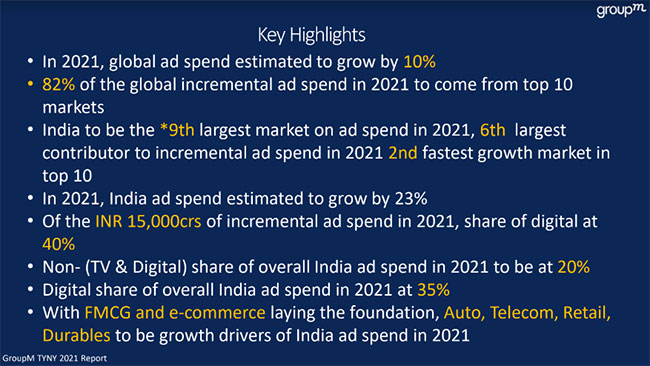
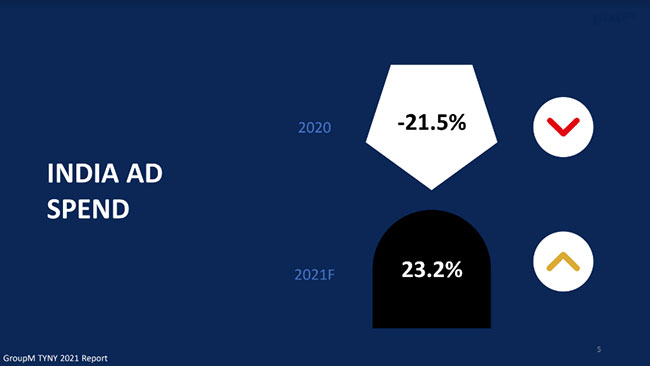
    GroupM India has announced its advertising expenditure (AdEx) forecasts for 2021. As per the GroupM futures report ‘This Year, Next Year’ (TYNY) 2021, India will see a major ad recovery in 2021 given the downfall of ad spends in 2020 due to the pandemic.


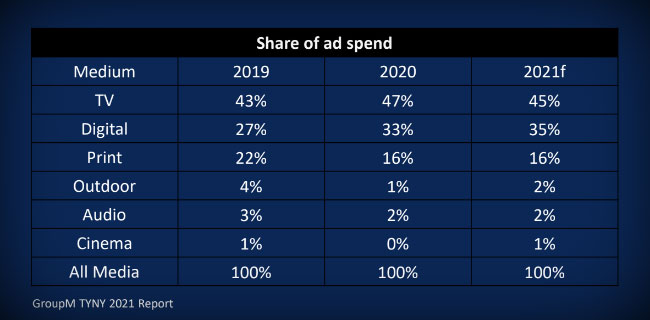
    TYNY forecasts India’s advertising investment to reach an estimated Rs. 80,123 crores this year. This represents an estimated growth of 23.2%, for the calendar year 2021. India is the 2nd fastest growing market in the top 10 countries and will be the 6th largest contributor to incremental ad spends in 2021 globally. While India was ranked 9th in the global ad spend rank in 2019, it dropped to 10 in 2020 and is likely to regain its 9th rank this year.


    Prasanth Kumar, CEO - GroupM South Asia
    Prasanth Kumar

    Commenting on the TYNY 2021 report, Prasanth Kumar, CEO – GroupM South Asia said, “2020 was an unprecedented year. The pandemic impacted across sectors and it, therefore, affected the media investments too. As we are aware, the year that went by had a mixture of lockdowns, many restricted market momentum and overall threw a challenge and impacted multi-industry economies. The ad industry too had its challenges and 2020 witnessed a steep drop in the overall media investments. However, we have witnessed a month-on-month upturn in the industry starting Q3 last year and we are quite optimistic about the revival that 2021 will see. With the gradual easement of the lockdown backed by seasonal spends and big-ticket events like IPL, we expect 2021 to continue to build on that momentum. While the global ad spends are estimated to see a rise of 10% in 2021, digital is expected to take 67% of ad spends. With the help of technology, marketers have adapted to pandemic-proof ways by constantly innovating, staying relevant and offering digitally charged solutions to brands.”


    Digital was the only medium to witness a gain of USD 27bn globally in 2020. Digital as a media vehicle will continue to skyrocket due to the increase in digital dependency and changing consumer patterns.


    Tushar Vyas, GroupM
    Tushar Vyas

    Added Tushar Vyas, President – Growth and Transformation, GroupM South Asia: “2021 will see 90% incremental ad spends on digital globally. The massive switch to digital reliance over the past 1 year has been a major driver for this shift. Brands have been forced to think big and different to transform their businesses, match the newer expectations and overcome the challenges faced. The post-pandemic era will continue to see this upsurge in digital demands. The crisis has brought about a sea change in mindset, adoption, and role of technology in doing business. Brands are seen renewing their business models and are constantly ideating to find better ways to connect with the consumer on a digital tangent.”


    Ashwin Padmanabhan
    Ashwin Padmanabhan

    While Covid-19 resulted in an overall slowdown in the global economy, Indian adspends will continue to see a month-on-month recovery considering the overall media landscape. Said Ashwin Padmanabhan, President – Partnerships and Trading of GroupM India: “Based on a strong foundation built on the back of FMCG and e-commerce, 2021 is expected to see growth across sectors like auto, telecom, consumer durable, retail and education. Manufacturing, which was severely impacted by the pandemic, is now stabilising and moving toward a positive outlook enabled by automation, technology and supply chain optimisation. 2020 has accelerated the adoption of agile, cost-effective business models, which will help brands and marketers offer better products, services and experiences to consumers.”


    Sidharth Parashar, President - Investments and Pricing, GroupM India
    Sidharth Parashar

    Added Sidharth Parashar, President-Investments and Pricing of GroupM India: “Along with digital, television saw a spike in consumption during the lockdown. With acceptance on the subscription bandwagon increasing, OTT will continue to witness a constructive growth and is likely to develop with more players attracting users by investing in content. Print & Radio expected to be backed by local advertisers and certain categories with marketeers leveraging the brand solutions that these media offer. We expect OOH and cinema to see double-digit growth after a difficult year. Given the uncertainty and cautiously spending consumer, brands are realising the importance of being present wherever consumers are. Hence along with continued relevance of television & other mass media, we will witness advertisers leveraging relevant platforms to reach out to its audience.”


    GroupM TYNY Key Highlights

  • GEC AdEx in 2020: Commercial ads: 55% share, Promos 45%


    By Our Staff

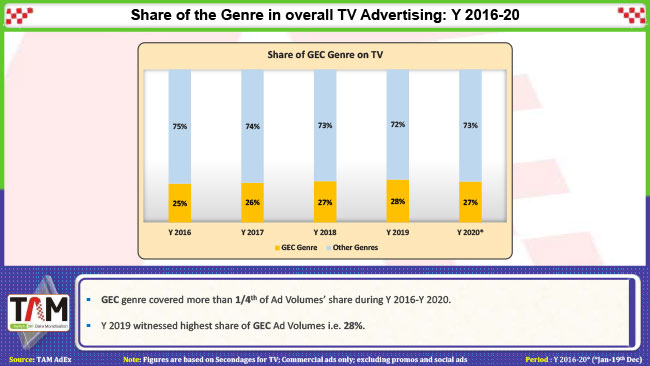
    TAM AdEx has released the second of its reports on 2020 for television advertising. This time it focuses on advertising on general entertainment channels.

    Here are some highlights

    GEC genre covered more than 1/4th of Ad Volumes’ share during Y 2016-20.

    True Shield Hand Sanitizer was the top brand during Apr’20 to Jun’20 & Aug’20 in GEC Genre.

    Toilet Soaps leads among the Top 10 categories of GEC Genre with 9% ad volume share in Y 2020.

    Ecom-Media/Entertainment/Social Media saw highest increase in ad secondages during Y 2020 compared to Y 2019 in GEC Genre.

    In GEC genre, HUL topped among the GEC advertisers followed by Reckitt Benckiser on 2nd position during Y 2020.

    6 out of Top 10 brands on GECs were from HUL and 3 were from Reckitt Benckiser.

    1.3K+ advertisers & 2.7K+ brands exclusively advertised during Y 2020 on GECs compared to Y 2019.

    Primetime is the most preferred time-band on GEC genre followed by Afternoon and Morning time-bands.

    20-40 second ad commercials were most preferred for advertising on GECs during both Y 2019-20.

    Commercial advertising added 55% share of Ad Volumes on GECs whereas Promos had 45% share in Y 2020.

    Highlights of the report are Advertising Trend during Lockdown versus Unlockdown, Covid Prevention categories, Celebrity Endorsement, Social Ads by Govt. etc.

    According to the report, advertising volumes in 2020 saw a marginal rise versus what it was the previous year (2019). Average ad volumes in the all-important fourth quarter of the year rose 39% over the average ad volumes in the first three quarters of the year. There was 90% growth in Average Ad Volumes/Day witnessed during Post Lockdown period.

    FMCG players ruled the list of Top 10 advertisers with HUL leading the list. Four of the Top 10 brands advertised were from Hindustan Unilever and three were from RB. Personal Care/Personal Hygiene sector had 20% share of Ad Volumes followed by F&B with 18% share.

    Please click on this link for the report:

    TAM AdEx – Mirroring Y 2020 for GEC Genre


  • IPL 13 Rules. And how!


    By Indrani Sen


    Ever since IPL 13 began on September 19, 2020 with a massive 20 crore viewers on Star India Network and Disney + Hotstar, the tournament has been delivering high ratings on TV and OTT platforms.


    On the digital media front, IPL 13 is generating huge tractions over and above its coverage through Star India’s OTT platform Disney  + Hotstar. On October 30, 2020 Wavemaker published a press release on their mid-season report of “IPL Mesh 2020” covering matches from September 19 to October 24. Mesh is Wavemaker’s Realtime Data Intelligence tool which has integrated data from “multiple consumer touchpoints across Digital ecosystem ranging from Social Listening, Google Searches, Website visits, BARC, Video analytics in partnership with VIDOOLY, Interaction data points collected from Facebook, Twitter, Instagram and YouTube” to arrive at the observations and predictions shared in the report.


    The press release by Wavemaker contains a few charts and whets the appetite for the total report. The report predicts that the IPL buzz volume of the digital track will grow from 37 Mn in 2019 to 60 Mn + in 2020. During the first 36 days of the tournament, CSK was the driving force behind the interactions on social media. Now that CSK has failed to secure a place in the playoff matches, it will be interesting to watch if the buzz volume of the track gets affected. Similarly, it would be interesting to see who takes the place of M S Dhoni as wicketkeeper in the Leading Player Index Leader Board.


    In the Leaderboard ranking of most loved ads, Dream 11, Oppo and Tata Motors took the first three positions in desending order. IPL 13 has also seen a never before engagement in gamification of Cricket Fantasy League with the top five Fantasy League in September 2020 generating 30 million google searches and 90 Million web traffic. Based on historical data, the report claims that there will be huge surge both in TVP and social buzz during the next two weeks which will counter the drop in the social media buzz over during the last few weeks as shown in the chart above.


    While the Wavemaker’s report reconfirms the accelerated growth of the digital media intractions in India, in traditional TV media also IPL 13 continues to deliver high ratings to the satisfaction of the advertisers who have invested their advertising rupee in cricket. A fortnight back on October 15, TAM released “IPL 13 Advertising Report 1” based on their ADEX data covering the period from September 19 to October 10 (25 natches).  The report has shown an 8% growth registered in average ad volumes from IPL 12 to IPL 13 during the same time span/ number of matches. 5 out of the top 10 categories have been from E-commerce with 35% share of IPL 13 advertising volume and Oppo India’s commercial made it to the top position quite fast during IPL 13 compared to 2nd position in IPL 12.


    The most interesting fact which has emerged from this Advertising Report is the participation of new categories and brands in IPL 13. According to the TAM Adex report 30+ new categories and 150+ new brands advertised during IPL 13 compared to IPL 12. It remains to be seen how the advertising frenzy builds up further during the last two weeks of IPL 13, strategically scheduled during the pre-Diwali season in this pandemic hit year.


  • Dramatic changes in Indian Ad Industry


    Editor’s Note: The Pitch Madison Advertising Report 2020 is a significant industry milestone held every year. Although MxMIndia belongs to the same space as the Exchange4media group-owned Pitch magazine, we believe the report is an industry property and are glad that the two entities – Pitch and Madison – are doing this for many years. Our report very clearly acknowledges the association of both Pitch and Madison, and have hence not called it the Madison Advertising Report, but the Pitch Madison Advertising Report 2020, as it should be.


    By Indrani Sen


    The Pitch Madison Advertising Report 2020 presented its mid-year review yesterday and revealed the extent of damage done by the pandemic to Indian ad industry.


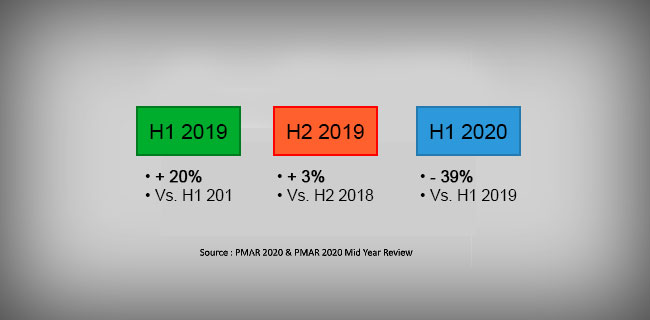
    A comparison with 2019 shows that the overall AdEx lost INR 14,000 crore and declined by 39% in H1, the first half of 2020 due to the effects of Covid-19. A break up of the first half by two quarters showed that Q1 had an 8% decline in the overall AdEx in the pre-Lockdown period due to the slowing down of Indian economy. In Q2, during the complete lockdown in April and May, the overall AdEx dropped into almost a bottomless pit. The fall was partially arrested with the unlocking starting in phases from June 1, but overall AdEx still declined by 65% in Q2.


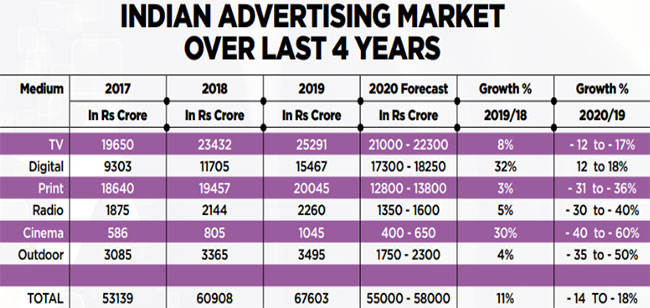
    Citing the trends of recovery of TV and Digital advertising in June and July, PMAR has predicted 60% -72% recovery of overall AdEx in H2, the second half of 2020 boosted by the festive season, revival of IPL, big ticket TV shows like KBC and Big Boss. The estimated recovery of AdEx in H2, is expected to arrest de-growth of overall AdEx in 2020 and contain it within a range of -14% to -18% as shown in the chart below.


    Source: Pitch Madison Advertising Report 2020 Midterm Review


    While TV and Digital are set on getting back to normalcy, Print is lagging far behind and Radio, Cinema and OOH are yet to show signs of regaining normalcy. The report has refrained from calculating a specific growth number in the forecast for 2020, instead has indicated a range for the AdEx value of each sector as well as the overall Ad Industry as reflected in the above chart. PMAR needs to be congratulated on their commendable efforts of mapping the effects of COVID 19 on Indian Ad Industry in the current situation.


    As per the usual format of reporting, PMAR has presented a detailed picture of TV, Digital, Print, Radio, OOH and Cinema and an analysis of advertisers active during the first two quarters of 2020 across different media. Among traditional media TV suffered the least damage with TV AdEx dropping by -43% in H1 ‘20 and retained 38% share of the advertising pie. Print AdEx dropped by 51% in H1’20 and it had to concede the number two position to Digital in terms of share in the advertising pie which dropped to 25%.  Adex dropped respectively by 52% in Radio, 55% in OOH and 52% in cinema in H1 ’20.  Digital had only a minor contraction of just 7% in H1 ’20 and its share in the advertising pie went up to 30%.


    As far advertisers are concerned, more than half disappeared from Print and Radio during the first half of 2020. TV also lost a quarter of its regular advertisers. 13 new advertisers entered the list of Top 50 advertisers which accounted for 31% of the overall AdEx. HLL topped the list with INR 1300 to 1500 crores advertising in H1 ’20. A wide gap was noticed among HLL and Procter & Gamble who ranked second with an ad spend of INR 250 to 350 crores.


    The Indian ad industry has never experienced such a decline. If we look at the last two decades, we find the industry growing in leaps and bounds during the first 8 years of this century with year on year double digit growth. In earlier PMAR reports we saw the growth rate of overall AdEx dropping to -8.9% in 2009 from 18.9% in 2008 as the international financial crisis triggered off by the sub-prime mortgage problem in the US led to recession in many countries and cast a shadow also on our economy. However, the overall industry recovered quickly with a whopping 27.9% growth in 2010. During the current decade there has been ups and downs in the performance of the overall AdEx but we never saw actual de-growth of our Ad Industry. According to PMAR 2020 Midyear Review, COVID 19 may set the industry back by 2 to 3 years. It is unlikely that the industry will recover as quickly as it did in 2010. A lot depends on how the government can control further spread of the pandemic and how soon vaccine for coronavirus can be available for Indian masses.


  • Is Legacy Media Recovering in the Unlocking?


    By Indrani Sen


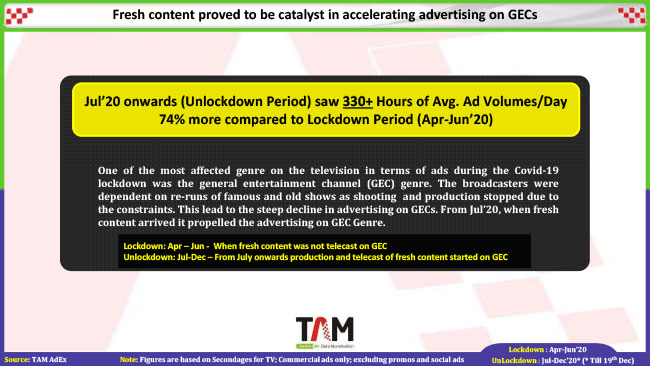
    During the last two or three weeks, we saw many reports on how the AdEx has improved in June 2020 ensuring us that not only digital, but TV and print are also on the path of recovery after Covid-19. TAM AdEx for June has shown that TV advertising volumes increased by 74 per cent per day in June compared to April, when adspends declined sharply due to decline in demand during the nationwide lockdown. TV ad volumes saw 46% growth in June compared to May.


    Print, which suffered a bigger hit in terms of revenue due to distribution problems during lockdown, has recorded a higher increase of 325% in average ad volume per day in June 2020 when compared to April 2020. Most of the business newspapers and industry websites reported on the recovery of digital and TV media. None of the articles highlighted the comparison between the first quarter and the second quarter of 2020 which could have given a better idea about the recovery of ad volumes in digital and TV media.


    I saw only one article in details on Print AdEx on the recovery of Print AdEx which also did not have any such comparison (https://www.financialexpress.com/brandwagon/print-advertising-on-the-road-to-recovery-as-average-ad-volumes-per-day-rose-325-in-june-2020-tam-adex/2032701/). This trend of lack of reporting on print clearly indicates that the medium has lost its position to digital not just in terms of share of the advertising pie, but also in the share of mind map of the audience, the advertisers and agencies.


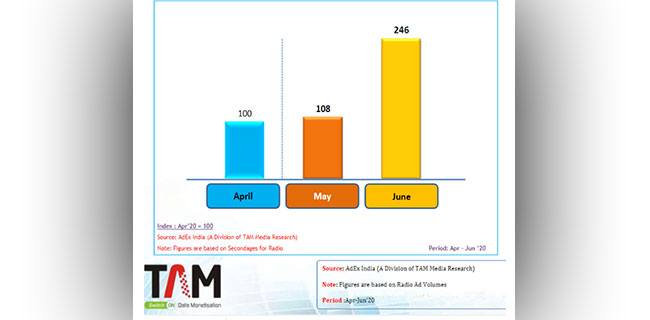
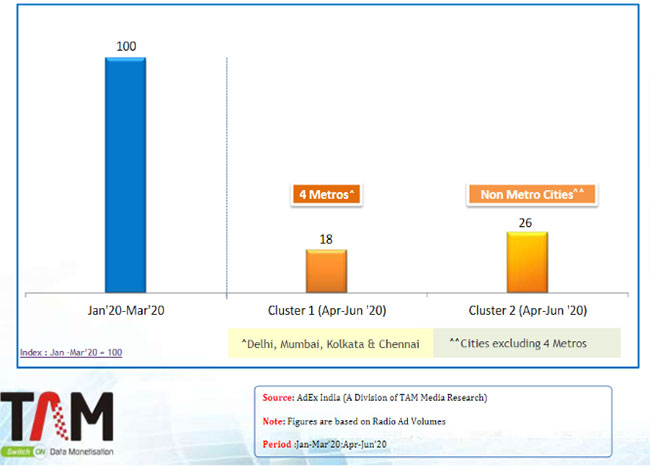
    The Advertising Report on Radio – April-June 2020 published by TAM shows that average ad volume per day increased by more than two-fold in June compared to April and May. However, a comparison with the first quarter of the year (Jan-March) shows that the ad volumes in radio are still much below the pre-Covid-19 phase. It is interesting to note that FM Radio ad volumes in Non-metro cities have recovered better than metro cities.


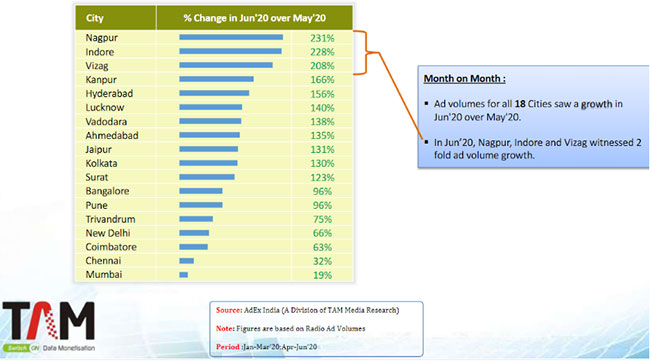
    The ad volumes of radio advertising in all 18 cities grew in June 2020 over May 2020. The chat below shows that the eight non-metro cities, Nagpur, Indore, Vizag, Kanpur, Hyderabad, Lucknow, Vadodara and Ahmedabad have shown much better growth in June 2020 compared the four metro cities. Kanpur, Indore and Vizag led the chart with each accounting for two-fold growth in ad volumes. Among the four metro cities, Kolkata has shown the highest percentage change in June 2020 over May 2020 with Mumbai showing the least percentage change. The listenership of FM radio increased during the period of lockdown and has retained the level, but advertisers across different cities are investing in the medium in different way.


    The report has detail analysis of radio advertising by categories, advertisers and brands as well as city wise analysis of the performance of radio AdEx. It also presents comparative analysis of TV and radio and digital and radio advertising during Jan-June 2020. The Top 10 common categories, advertisers and brands between TV and radio shows that during the first six months of 2020, Top 10 common categories, advertisers and brands added 33%, 14% and 4% on TV while they added 10%, 7% and 4% on radio.  Similarly, the Top 10 common categories, advertisers and brands between digital and radio shows that during the first six months of 2020, Top 10 common categories, advertisers and brands added 47%, 18% and 12% on digital while they added 19%, 2% and 1% on radio. The role of radio in the media mix needs to be reassessed by advertisers and agencies for the growth and survival of the FM radio industry during this period of unlocking and subsequent return to normalcy.