The Advertising Agencies Association of India and The Advertising Club has announced the dates for the 12 edition of Goafest. The three-day fest will be held from April 6 to 8, 2017 at the Grand Hyatt, Bambolim.
Said Ashish Bhasin, Chairman of Goafest 2017 & Vice President of Advertising Agencies Association of India (AAAI): “It is our endeavour to make Goafest 2017 more fascinating and rewarding for all stakeholders by providing an Enriching, Engaging and Entertaining festival experience. The objective is to offer learning enrichment to participants through thought- leadership platforms, engaging with them through debates and discussions forums on relevant and industry- imperative topics. Keeping up the spirit and ethos of the Abby Awards, the 3 day festival will also keep participants entertained though high decibel networking events. We are sure that the Goafest 2017 will help build synergies and add significant value to the learning curve of all participants.â€
Speaking about the elite speaker line-up, Nakul Chopra – President of AAAI, said, “Continuing to be the most impactful ideas-exchange platform for the industry, Goafest 2017 will consist of a great mix of world-class speakers and industry thought leaders. As in the previous years, we will continue to see representation from senior advertising and marketing professionals who will share their experiences and learnings. Our effort is towards providing an interactive platform for the 2500+ participants to listen and engage with the best the world has to offer on global advertising trends and ideologies.â€
It is for the 10th year that AAAI and The Advertising Club will come together to deliver the Abby Awards, India’s premier awards in the field of advertising that celebrate creativity. Speaking about the awards, Raj Nayak- President of The Advertising Club said, “The initiatives introduced last year were widely appreciated by all the stakeholders and played a decisive role in establishing the preeminence of the festival and the awards. We will continue to follow the stringent standards and now well-accepted norms for the Abby awards that makes it the most competitive and sought after awards in the industryâ€.
He further added “This year the shortlisted Abbys will also be open for the industry to review through a seven-day window before the final judging round.â€
The three-day festival will include the Industry Conclave to be held on Day 1; the Knowledge Seminars on Day 2 & 3. Closing the Festivals will be the Leadership Summit to be held on 8th April, 2017.
The Award shows for various verticals are tentatively scheduled as under:
:: April 6: Media & Publisher Abby Awards
:: April 7: Radio, Radio Craft, Design, Direct, Brand Activation & Promotion, Public Relations, Out of Home & Ambient Media, Print Craft, Branded Content & Entertainment & Broadcaster Abby Awards
:: April 8: Digital & Mobile, Print, Film, Film Craft & Integrated Advertising Abby Awards, Gender Sensitive, and Young Abby’s.
The Advertising Agencies Association of India (AAAI) under the aegis of the AAAI Prowess initiative announced a half-day workshop ‘‘Beyond Logo– How Brands Add Value to Business’’ led by Lulu Raghavan scheduled for October 19 in Mumbai.
The interactive workshop will help participants understand the true value of brands beyond logos, colours and communications. It will equip participants with ready to deploy tools that they can use to add significant value to their clients’ businesses.
Lulu Raghavan is Managing Director of Landor Mumbai and is well-known industry commentator and thought leader.
The Advertising Council of India (ACI) whose members are The Indian Society of Advertisers, The Advertising Agencies Association of India, The Indian Broadcasters Foundation, The International Advertising Association and The Advertising Club will be sponsoring six professionals for a special Fast Track program curated by the Asian Federation of Advertising Associations (AFAA). The program called “Fast Track†will be run in Kuala Lumpur between 20th and 22nd September 2016.
This opportunity is available to young (below 35 years of age) professionals with at least five years work experience in marketing, advertising and media.
Candidates desirous of taking advantage of this industry-oriented initiative need send in their applications with a brief profile of themselves, their valid passport number and a 100 words piece on “How I would improve certain aspects of our industry that I believe need improving†to acifasttrack@gmail.com by 16th August 2016.
Shortlisted candidates would be called for an interview in Mumbai and six of them would fly to Malaysia for an all-expenses trip that would otherwise cost around $2500.
Srinivasan K Swamy
Srinivasan K. Swamy, Vice Chairman AFAA, speaking on behalf of the ACI said “We see this effort as our way of helping develop talent and ultimately enriching our industry.†He further added, “This is the fourth time the ACI would be undertaking this initiative. The response from the first three initiatives was overwhelming, so we are investing in the future of our industry once again.â€
Nakul Chopra, CEO – South Asia, Publicis Communications India Pvt Ltd, was elected President of Advertising Agencies Association of India (AAAI) for the year 2016-2017 at its Annual General Body Meeting held recently.
Ashish Bhasin, Chairman & CEO South Asia CEO – South Asia, Dentsu Aegis Network (Aegis Media India Pvt Ltd), was elected Vice-President of the Association.
Other members of the Executive Committee include CVL Srinivas from Group M Media India Pvt Ltd, Ganesh Baliga from Fifth Estate Communications Pvt Ltd, Kunal Lalani from Crayons Advertising Ltd, Pranav Premnarayen from Prem Associates Advertising & Marketing, Rana Barua from Contract Advertising, Srinivasan K Swamy from R K SWAMY BBDO, T Gangadhar from Mediaedge:Cia India and Vivek Srivastava from Innocean Worldwide Communication Pvt Ltd.
Immediate Past President, Dr M G Parameswaran will be the ex-officio member of the new AAAI Executive Committee.
Sundar told me about it casually, like he usually does. He could well have been telling me “I am going to get a cup of coffeeâ€. I accepted the news casually, mumbling something like “Good, congratulationsâ€. I can’t recall if I shook his hand. No theatrics from either side. Both of us were there when our father accepted the same award 22 years ago. May be both of us knew this was going to happen.
Enough will be said and written about his various activities in the industry, so I am not going there. In my mind, no one else deserves it more. He has been tireless, period. The only thing about this news was that I didn’t hear about it from the driver, who somehow always seems to know more about Sundar’s whereabouts, and happenings relating to him, than I do.
Our growing up years in Chennai were pretty unremarkable and middle-class to the core. Busy father. Housewife mother. Grandmother and an aunt always at home. Six siblings, who as I think about it, were all pretty well-behaved, perhaps even boring. Lots of cousins and family around. Home was a place to be shared. The front door was hardly ever shut, except at night. One day in the ’70s there was a lot of hushed talk. My father and his elder brother, and the wives, were in a huddle. I later learnt that my dad had quit his job, which was his life. He was to do something on his own. The import of it hardly made a dent to my teenage senses. Over the next few months, lots of people kept coming and going. There was a sense of urgency and preparation. The puja happened, and R K Swamy opened shop in his brother’s house, I suspect because he could delay rents as much as he wanted.
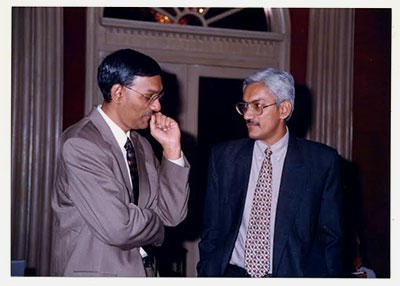
A vintage pic of the Swamy brothers: Shekar (left) with Srinivasan Swamy
The rest of it was a whirl. So many people working so hard to meet so many unreasonable deadlines. Sundar finished his MBA, and went into the business, five years after it started. Comments were heard. “He is looking after his father’s business†was a common refrain, like he was literally sitting in the shop. Little did people know.
R K SWAMY the agency was never meant to be another shop. The DNA from ever was to build a lasting institution. The ambition stretched beyond the Chennai roots, which in itself was unusual. In this, Sundar played a strong role, running around from city to city, often trailing behind Mr Swamy. As one of our colleagues put it, if Mr Swamy was the Account Director, then Sundar was the Account Supervisor carrying artworks around. Clients always came first, people always had to be respected and family interests came thereafter.
BBDO joined hands in the mid-80s. We kept building the core advertising business. We recast the Research activity. We created a Television programming game. We expanded into diversified marketing services. We pioneered the Analytics and Customer Marketing space, embracing marketing technology. We ventured to build a US presence, on our own.
All of this underpins Sundar’s ability to take that risk, and continue with the DNA of building the institution. He is a serial entrepreneur – no angel investor or VC here – on his own dime. He has been in the lead, helping fashion the foremost Indian-owned and controlled advertising and marketing services group, by itself a serious contribution to the industry.
Sundar no doubt grew up in the business. But his participation stretches way beyond to very many social causes. He gives, more than he takes, again and again and again. There is a lesson there, somewhere. Perhaps awards come when one does this without nary a thought.
The Advertising Agencies Association of India (AAAI) announced the recipient of this year’s AAAI Lifetime Achievement Award – Srinivasan K Swamy, popularly known as Sundar Swamy. This Award is the highest honour to be given to an individual in India for his/her outstanding contribution to the advertising Industry. This award was instituted in 1988 by AAAI and so far 23 persons have been bestowed with this award earlier.
Swamy is the Chairman of R K Swamy Hansa, a prominent and well diversified marketing communications group. Swamy has been active in various industry bodies working towards the growth and development of the advertising industry. He was President of AAAI for three consecutive terms (2004 – 2007) and continues to take active interest in the activities of AAAI. He is the Vice Chairman of Advertising Standards Council of India (ASCI), and a Board Member of Audit Bureau of Circulations. Swamy was also President of All India Management Association during 2008-09. He was the President of The Madras Chamber of Commerce & Industry (2008-10), Madras Management Association (2001-02) and the Advertising Club, Madras (1988-89).
He is serving his fourth term as the President of the India Chapter of International Advertising Association and was recently elected as Senior Vice President of International Advertising Association, the global body. Swamy is Vice Chairman of Asian Federation of Advertising Associations. Earlier he was Chairman of Confederation of Asian Advertising Agency Associations during 2008-10.
In addition, Swamy is actively involved with socially relevant institutions for the improvement of society viz. Â 220 bed, multi-discipline tertiary care, Hindu Mission Hospital at Chennai catering to the urban poor and the surrounding rural areas; Chairman of Valluvar Gurukulam School Society which runs a school for 2800 poor students, primarily girls and Vice President of National Boys and Girls Education Society, a premium education institution in Central Chennai which runs three reputed schools. He is also Chairman of Vidyadhanam and Annadhanam Trust, a Vedic Padasala of Sri Ahobila Mutt and Trustee in the Consumers Association of India and Concert.
M G Parameswaran
Making the announcement, Dr M G Parameswaran, President, AAAI, stated that “If there is one person who has tirelessly worked for the advertising industry, for over two decades, in various industry bodies, it is Sundar Swamy. So in a sense it was an easy choice this year. We are hopeful that AAAI and its member agencies will have his continued involvement and inputs as we navigate the ever changing terrain of advertising business.â€
The AAAI Lifetime Achievement Award is presented annually to an individual who has been a practitioner of advertising for twenty-five years and had been in the top management position; has been or continues to be an active participant in industry bodies and or made significant contributions in shaping the industry priorities which enabled the advertising industry to grow, prosper and  become more professionalized; individual known for his integrity, ethical practice and leadership qualities; contributed to his Company/Companies growth by innovative thinking and taking them in newer directions; involved in projects of social consequence which is seen as a role model for the industry at large and had been an industry veteran.
The AAAI Lifetime Achievement Award will be presented to Swamy on 29th July 2016 in Mumbai.
The Indian advertising industry has several leading lights but few have got down to chronicling the industry and documenting case studies like MG Parameswaran has. Ambi, as he’s known in the fraternity, recently set up Brand-Building.com after 35 years in advertising, sales and marketing, a large part of it was helming FCB Ulka. He is also President of the Advertising Agencies Association of India (AAAI). In his new book titled ‘Nawabs, Nudes, Noodles’, Ambi writes how advertising has changed society and adapted with the times. Excerpts from a free-wheeling interview with Pradyuman Maheshwari:
You are among the few advertising professional who have written books, and this is your eighth. How do you manage to make time for writing?
The writing started in reverse. In 1997-98, I was looking for cases to use for teaching when I discovered they were still using some veryold books. Then I started writing some short cases based on brands I’d worked with and . Tata McGraw Hill was interested [in publishing them as a book] so that’s how it started. I wrote cases for teaching, and those became books. Once the books came out, they actually sold, and the publisher stared asking what are you writing next? Then I wrote the second, and the next, and it just continued. Obviously, there was a big lacuna of professionals writing books, in the late 90s. Now there are a lot more people writing, which is good. Myfirst bunch of books was more academic. Then my agent, Anish Chandy, said I need to write for a larger audience and that is how ‘For God Sake’ was born. It was based on my thesis, but it was a light book. And, after I finished writing it, the idea for [the latest] book came up and we started discussing.
How much time did this last book take?
40 years (laughs).
And it’s packed with loads of information…
80,000 words (smiles). The idea for the book happened about two years ago, and it took a year of writing. I was working full time so I used to devote three or four hours every weekend to compile stuff. I did not want to do a history of agencies, but wanted to look at how society has changed. First you have to compile information, and I went through 30-40 books. Also, one had to not just write about different topics but also see if there are any international parallels. So I had to hunt for relevant books on that topic. Fortunately, some of my friends are senior professors, so they helped identify the books I should look at. It took six months of collecting information, and six months of writing.
In the book, there are a fair number of references to influences in society and how it has changed. For instance, you write on ads having helped Indians discover new products and services. Really?
If you ask a consumer ‘did you buy this product because of the ad’, the response will be no, I heard about it from a friend. But where did your friend hear about it? She heard it from her friend. There might be an ad involved. Take the example of Dalda, which was the first Indian product advertised in 14 different languages in print. Each ad was different because it was specific to the cuisine of a particular region. Ads were written in 14 different languages to convince Indians that Dalda was as good as ghee, during the days of a ghee shortage. And it succeeded. Today I saw an ad where they were trying to sell 4G services saying you can use it to locate a loo for your kid. That is education. Advertising is performing the role of disseminating education so consumers do learn from ads. They may not admit it, but they definitely learn a lot.
At the same time, there is a lot of advertising which is possibly instilling values you don’t want, like fairness creams or ads for colas which are not good for health. Advertising can be educational, but there are many brands which don’t sending out positive messages…
I believe if it is legal to sell a product in a country, it should be legal to advertise a product. If it is legal for me to make and sell beer, it should be legal for me to advertise the beer too. If you go back to how this idiocy started in this country, 25 years ago the government suddenly decided that sanitary napkins would not be advertised on TV. They said the ads could only play after 10 pm. Maybe that has caused a problem. Today, one of the biggest issues we have is girls are afraid to go out because of their menstrual cycle. If they had allowed those products to be advertised widely, maybe we would have had more innovative products coming out. But why was it was not allowed before 10pm? Because it was considered a bad, female hygiene thing, which could not be shown on TV. We banned the ads, and now we are saying girls are not going to school, not going to work on those days because of this problem, and now we are regretting it.
Every month, the Advertising Standards Council of India (ASCI) comes out with a list of ads against which complaints have been registered. A fair amount of such advertising shows that not all practitioners are doing their job correctly…
Yes, it is a combination of the agency and the client. Often the agency pushes the limit and the client says okay let’s do the ad and see what happens. I am happy that ASCI has become powerful now because in the good old days, it used to take a month to respond to a complaint. Now they come back to you within a week, whether they uphold the complaint or reject it. The government has also mandated that if some ad complaint is upheld by ASCI, TV channels cannot run that ad. To be fair, every brand owner and agency is trying to claim whatever they can do to the maximum.
In your book you have referred to the Tuff shoes ad, and the case against it that went on for two decades. Do you think the ad was beyond decency? And would it be accepted now?
I do not think it would be accepted. Today we will probably react just as badly to that ad. As a piece of art, it was brilliant and beautifully art directed, and launched an unknown brand in a sensational way. But it got into all sorts of trouble and the court case ran for 20 years…. Today, the complaint would have gone to ASCI, which would have either upheld or rejected it. For all you know, ASCI may have even passed it.
There is a lot in your book about the changing man, woman, child or youth. You have mentioned that the Raymond ad was a milestone in the way it depicted men.
I have been a follower of Raymond advertising for a long time, and for a hot country like India, Raymond made suitings cool. But it moved away from an executive suit to embrace the concept of a complete man. One of the best ads they had was about this man from abroad looking for his friend and discovering that his friend has lost his legs and is in a wheelchair. He takes him to Marine Drive and they are shown having fun, chatting about old times. There is no mention of suits except for the fact that this guy was dressed in suit but carried his jacket in his hand. Suddenly this presented a whole new face to the guy who wears suits — that he is not an automaton but a guy with a heart. Such ads have redefined suiting advertising.
You have written about men, women, children and teens in ads. Which of these strata do you think have changed the most in terms advertising in the last 15 years?
All of them. May be women more significantly, because earlier, women were never featured in a financial services ad or in motorcycle, scooter or car ad. Like the ads for Hero Pleasure, which is a scooter for women. A lot of car brands are showing the woman driving the car. The biggest change in Indian society has been with respect to women. Their education and desire to work has dramatically changed over the last 20 years. Therefore, the depiction of women in ads has also dramatically changed.
Yet there is a lot of advertising that is not gender-sensitive…
I think there is a need to sensitise people to this. Sometimes you do it even without thinking. Some ads are being created without any deep agenda on pushing down of women. It’s just a lack of awareness.
Do you find that in the last 10 years, effectiveness awards have become very big and that even creativity in advertising tries to earn brownie points from social media and the buzz created?
I do not think so. Advertisers today are looking at two different kinds of advertising. First is the classic way, where you spend a big amount on advertising. The second is the ad which is created for social media. One is the 30-seconder which will run on TV channels, and the other is the three-minuter which will run on YouTube. Today, these two are working on two different agendas, but one day the two will meet.
The book covers about 50 years of advertising, but perhaps some inside stories and gossip would have made it more juicy. You have stayed clear of controversies…
The last chapter is all about the problems advertising has faced. It deals with the Tuff shoes ad, the Kamasutra ad or the problem I had with an innocuous Sweetex commercial, where I was showing the navel of a model, which got into trouble. I have not discussed any gossip, such as who copied whose idea, because that is not the domain. I am writing this book because I hope the young people entering advertising can, in just a few hours of reading, understand how this business works and have a positive impression of the industry.
If you were to pick three, five or 10 ads that have been game-changers, what would they be?
I would say go back in history. The Maharaja ad for Air India is one. The Amul hoardings (which even the client gets to see only after it goes up, shows the kind of trust you need to have with your agency partner), the Lalitaji ad which re-defined and put the middle-class woman in the market. Or ‘Doodh’, which made milk cool. Also, the Cadbury cricket film….
And Liril?
Yes, Liril was path-breaking. And in recent times, stuff like the Gundappa film for Lifebuoy and the Airtel ‘Hare ek friend zaroori hota hai ad.’ So, there have been quite a few films, Fevicol take a very humble adhesive in to landmark creative, again that is a very good client-agency partnership.
Ads like ‘Doodh’ for Amul that you have worked on at Ulka, which you are extremely proud of?
I am proud of what FCB Ulka has done with Naukri.com – the Hari Sadu ad. I am especially proud of the work done on Tata Indica. Then of course the work we did on Santoor, Sundrop – two brands which took on the might of Levers and succeeded. Some fabulous work we have done on Zee, Zee Cinema especially.
What next?
Well, I do not know. I hope this book does well and serves the purpose of both making people like you and me nostalgic about the past and make young people say these guys actually did some good work and now we need to do better.
This interview first appeared in dna of brands on May 23
Advertising Agencies Association of India (AAAI) under the aegis of the AAAI Prowess initiative announced a one-day workshop ‘‘Digital Hackfest – How to Power-up Brands in the Digital Space’’ scheduled for 26th May 2016 in Mumbai at the AAAI’s Training Centre at Lower Parel. This workshop will be led by Meera Sharath Chandra.
Today it is not about brands wanting to go digital but brands deepening their connect and co-creating experiences with their consumers across interesting and emerging digital apertures. Digital is more than a medium. It is a way of life. A whole new sphere where brands can sharply define their mission, personality, positioning and conversations with consumers. How can the digital strategy seamlessly dovetail with the brand intent? How can it be the heart of a totally integrated experience? How can we better understand the art and the science of digital engagement?
The workshop will be in four parts. First, a look at how our digital and physical worlds collide. Second, examining how brands can leverage the online space in impactful and meaningful ways. Third, an understanding of the role and power of social media. Fourth, joining the dots to create a holistic brand story. Every session will conclude with a fun hack on the theme.
Meera Sharath Chandra is Founder, CEO & CCO of Tigress Tigress – an agency that specialises in integrated communication with digital at the heart of the experience.
An integrated creative professional with 35 years of global experience, handling both MD and ECD responsibilities, Meera has over two decades of specialisation in the digital and integrated space. She has been an award winner and jury member at Cannes Lions, One Show, D&AD, Clio, Art Directors Club and New York Fest among others.
Meera has worked in the US, the UK, Hong Kong and India. As an entrepreneur, Meera has earlier run an Intel-funded dotcom enterprise servicing clients in the US, Europe and Hong Kong, leading a 250-strong team. She has been a member of global task forces on brands such as Nestle, Unilever, Ford and Citibank. She has specialised in UI/UX from the University of Maryland’s Human Computer Interface Lab.
When you see members of your team pack floral shirts and shorts as they head to Goa, it’s hard to believe they have anything other than partying on their minds. But Goafest — organised by the Advertising Agencies Association of India (AAAI) and The Advertising Club, which forms the backdrop to the ad world’s best-known creative awards, the Abby – is able to strike a great balance. There is a lot of out-of-office bonhomie and boisterousness (and more than a reasonable amount of liquids flowing), but the days are filled with interactions with industry movers and shakers, sessions by thought leaders from around the globe and an invaluable swapping of insights and tips.
Goafest 2016, in its eleventh year, upped the bar quite a bit. With some 2,400 delegates and 4,460 entries for the Creative and Media Abby, the 2016 edition was the biggest Goafest yet. Two new categories were also introduced, to keep pace with the rapidly-changing times: The Young Abby and an award for gender sensitivity. A more digitally-enabled Goafest greeted delegates who could download the app and post their questions for various speakers on it.
Ambi M G Parameshwaran, President, Advertising Agencies Association of India said: “The last three days saw some of the brightest minds from the world of media, marketing and advertising congregating to make Goafest 2016 an exciting experience for all. Undoubtedly this was the biggest Goafest and the most well balanced — over 15 seminar sessions, three award shows, two sundowner parties and three after parties — all done in one venue, both indoors and outdoors.â€
According to Raj Nayak, President of The Advertising Cub: “As organisers, we tried to create a unique and wholesome experience for all the delegates attending the event to ensure that everyone had an interesting takeaway when they leave from Goa at the end of the festival.â€
Indeed, the organisers had a stellar line-up of speakers from the ad and marketing world, and the tedium of industry-specific sessions was broken by talks by writer-columnist Shobhaa De, former Army man and founding-CEO of the security agency Natgrid Raghu Raman, and young writer Varun Agarwal, and an interaction former cricketer Arjuna Ranatunga and journalist Rajdeep Sardesai.
The session that really packed them in — and had everyone in splits – was a freewheeling tete-a-tete between adman-filmmaker R Balki and director-producer Karan Johar, where they chatted about marketing, the Oscars and Bollywood, of course. As for the seminars, they were divided into three industry-specific themes. Day 1 was about forging better client-agency partnerships, which was followed by better marketing of brands on the second day, while the last day was about using data and technology to leverage creativity.
Chandramouli Venkatesan, Managing Director of Mondelez India (the makers of Cadbury) opened the first day with the instantly-engaging idea that client-agency partnerships need to be like that of Jai and Veeru, the protagonists from the film Sholay. “It should be a study in contrasts. A client and an agency, who are two different entities, coming together to create magic,†he said. “Not two entities who think in a similar manner.†But no matter how different, they must have a shared purpose and passion, and a friendship that allows each to challenge the other to do better. Samar Singh Sheikhawat, Senior Vice President, Marketing, at United Breweries had a slightly different take when he said that agencies first need to get to know the business (almost as well as the client) if they are to offer any worthwhile solutions. Sheikhawat says he facilitates brewery visits for agency execs he works with, just as he had to – early on in his career – spend time in the offices of advertising stalwarts like Roda Mehta, to understand the agency side of things. Oliver Maletz, head of connections planning, media and international communication at Volkswagen, in his session, outlined that agencies need to be true business partners to clients, along with being innovators (though not just for the sake of innovating) and aim to deliver meaningful value to a meaningful number of people.
The second day, which was about better marketing your brand, had Benny Thomas, strategy head at Crispin Porter + Bogusky, talk about gauging a ‘return on creativity’ instead of the rather more prosaic(but financially-necessary) RoI. One way to ensure that a client accepts a brilliant idea, is to bombard it with hundreds of others. “If you give clients 200 ideas, they are bound to pick one,†Thomas said, giving the example of a campaign-turned-social initiative called Small Business Saturdays, that was spearheaded by his agency and has now become a local trade promotional in the US. Tara Marsh, global head of content at Wunderman, dealt with how neither clients nor agencies give enough importance to the behavioral aspects of consumers that make them choose one brand over another. “Your content needs to be something that users will choose to spend time with,†she added. Prakash Sangam, CEO of the RedBus and writer-filmmaker Varun Agarwal provided the ‘inspiration quotient’ for the day. Sangam, who has successfully run a bus-booking portal, talked about how the bus industry (like so many others) has been transformed by technology. Now, passengers can download apps to not only book tickets and select seats, RedBus has enabled various kinds of information conveniences to travellers.
In today’s world, much more of both data and technology is available, but advertisers and marketers are not using it enough, feels Carter Murray, Worldwide CEO of FCB. “Most marketers use data for only six per cent of their decisions,†Murray said. “Data is waiting for its [Martin] Scorsese – where marketers use data to make the creative product better, not just to drive change.†Jean Lin, Global CEO of Isobar, in her talk, outlined seven breakout things that indicate a changing landscape (e-commerce, borderless buying, programmatic videos etc) and said the future of brands is clearly brand commerce. “[Marketers] need to bring the brand inspiration closer to the point of transaction,†she said adding that ideas that reimagine that last mile are the ones that are likely to survive in an ever-changing world. While Fergus O’Hare, Director of Facebook Creative Shop, APAC,took the idea of providing creativity with a crucible of technology by giving examples of how Facebook as a platform could be used to deliver personalised marketing at scale through mobile, Alasdair Lennox, Executive Creative Director, EMEA, Fitch discussed how ‘advertising’ as a word will die out, and be replaced by the concepts of ‘experience’ and ‘conversations’.
That’s not all. Goafest also give participants a chance to view lots and lots of great advertising and hear behind-the-scenes stories about some of the most successful initiatives in the world – often from people who have been in the trenches themselves. While YouTube makes it possible to watch every ad ever aired, you’d never know about Nivea’s remarkable sunburn campaigns, or Kraft’s marketing of its healthier mac-and-cheese option without changing its packaging, or even learn how Paypal caught people’s attention by putting their faces on dollars, if it weren’t for the seminars. You would’ve heard of Burger King’s Subservient Chicken or seen Cadbury’s eyeballs-grabbing Gorilla beating a drum, but to know about the incisive decisions that shaped these seemingly-inane promos, is something else. Closer home, if you’ve ever wondered why messy chocolate-eating has become adorable on TV, you had to hear it from the people who made the Dairy Milk ads. And the thumping success of cutting-edge campaigns like Domino’s Anyware (ordering pizzas with a tweet) and Disneyland’s MagicBand (a bracelet that is park ticket, hotel key and credit card rolled into one) was brought to life by the global speakers’ analysing the social impact these have had. Indeed, Netflix’s ads have sparked a sociological phenomenon of ‘TV adultery’ (watching ahead to the next episode of a show without your spouse) in the US. This year’s Goafest had all of that. Indeed.
The Indian Broadcasting Foundation announced the appointment of Sudhanshu Vats, Group CEO, Viacom18, as the Chairman of the IBF Credit and Collections Committee & Co-Chairman of the joint IBF- AAAI Sub-Committee.
IBF in association with AAAI (Advertising Agencies Association of India) had formed a joint credit collections committee which scrutinizes, regulates and evaluates the credit worthiness of the advertisers active through AAAI member advertising agencies on IBF member channels. It plays a pivotal role in dispute resolution between channels and agencies vis-a-vis advertisers.
Sudhanshu Vats, Group CEO, Viacom18, who is also an IBF Board member stated, “I am delighted to have been entrusted with this responsibility. Strengthening our relationship with the advertisers would be our goal and I look forward to introducing newer mechanisms in line with the global standards, to normalize the revenue mechanisms for all parties.â€
The outgoing Chairman I Venkat mentioned, “I know Sudhanshu would bring his ethos and greater clarity in the functioning of the Committee. I am thankful to all the members for their support and their valuable contribution and also to Ashish Bhasin , the Co- Chairman of the Committee, AAAI who helped me conduct these meetings in a more organised and transparent mannerâ€.
IBF President Uday Shankar says, ”Both Mr Vats and Mr Venkat have been valuable colleagues in the IBF Board and both deserve admiration and appreciation for taking up the task of revamping the broadcaster’s ad revenue flow. I am sure Sudhanshu will bring greater efficacy and democracy to the functioning of the Committee.â€
The Awards Governing Council of Goafest 2016 has announced the Jury Chairs of Film, Digital and Publisher Verticals. Agnello Dias, Chief Creative Officer of Taproot Dentsu Private will chair the Film Jury of Creative Abby, Karl Gomes, Chief Fanatic at Fanatics will chair the Digital jury and Mitrajit Bhattacharya, President & Publisher of the Chitralekha group will chair the jury for the Publisher Vertical.
Jury Chair of the Film Category Agnello Dias, fondly called Aggie amongst his peers is reckoned in the advertising community as a creative powerhouse. Dias is credited with catapulting India into the global advertising map by winning India’s very first Grand Prix and Titanium/Integrated Lion at Cannes. He has also won various other awards like the double Grand Prix at Asia’s Media Spikes Awards for his landmark and inspiring “Teach India†campaign.
The Jury Chairs for other Creative Abby verticals will be announced shortly.
Presented by the Advertising Club and AAAI the Goafest ABBYs 2016 will once again see the entire advertising and marketing fraternity come together in Goa from 7th April, 2016 to 9th April 2016 at  The Grand Hyatt, Bambolim, North Goa.
The Goafest Abby’s, the coveted advertising awards that recognizes the best in advertising and marketing in a 3-day celebratory event has called for entries for the Creative ABBY’s 2016. The last date for entries will be 23rd February, 2016 and campaigns brought alive in the period from 1st January, 2015 to 15th February, 2016 will be adjudged by a reckoned jury panel. The entry forms for the awards can be downloaded on the Ad Club website.
This year two new categories that have been introduced are, Category 26: Special Abby (Gender Sensitive) and Category 27: Young Abby. Also, the Design vertical will have new sub-categories of Typography Design, Best Integrated Design involving 2 or more sub-categories. Plus there is a sub category as Computer Generated Imagery in Print Craft.
Announcing this major development, Awards Governing Council Chairman Ramesh Narayan said “this year’s Abby Awards will have three very significant improvements. Firstly to make the awards more in line with global practices, entries for almost all categories can be uploaded online. Secondly, to reinforce the idea that “what’s good, is good for the industryâ€, there will be a special category for Gender Sensitive Advertising. Thirdly, to bring youth and the future onto center-stage there will be a special ABBY for entries received from copy and art teams under the age of 35 on the theme of how communication can help mitigate gender violence. These are all issues which were came up in our interaction with the creative fraternity and the media, and I am pleased to say we are responding with alacrity to industry and societal needs. The young winners of this new category would not only get a coveted Abby but also be sent for the Cannes Lions festival this June, all expenses paid. This would give them a great exposure to international professionals and work.â€
GoaFest Chairman Nakul Chopra said “I welcome these new developments. They are a part of our ongoing effort to keep evolving and improving. The online uploading of entries will pose a technological and financial challenge but we have decided that it is important enough to implement immediately.â€
Raj Nayak, President The Advertising Club said “To remain the gold standard of awards in India, we decided that technology, sensitive thinking and the future all needs to be addressed. I had said earlier that we could expect a lot this year, and it is beginning to show. The pre-eminent awards show in the country should show the way in every area.â€
Dr. Ambi Parameswaran President AAAI added “I am very happy that what was publicly requested on an AAAI platform (an award for gender sensitive advertising) just last year, is becoming a reality. We need to be in synch with what is being sought for. The award for young creatives is the industry’s way of nurturing young talent.â€