Blog

  • Voice for Imagine TV

    By Dhara Salla

    After Colors with Bigg Boss and Sony with Kaun Banega Crorepati, it is the turn of Imagine TV to come up with a big-ticket reality performance show – The Voice. The Voice is an American reality talent show based on the reality singing competition The Voice of Holland, created by Dutch television. MxM India talked to Mr Nikhil Madhok, Senior Director Marketing and Communications, Imagine TV, about the show and what it means for Imagine.


    Q: Imagine already has a great new lineup of content; why did you feel the need for this big-ticket?

    One of the things we are trying to achieve is a good balance with fiction and non-fiction. We are revamping and refreshing the line-up of our show. We got our fiction shows line-up in place and it was the time to start the phase with non-fiction. Imagine TV has done a lot of reality shows like Rakhi ka Swavamyar, Shaadi Teen Crore Ki and Pati, Patni Aur Woh, to name a few, but had never tried a talent show. If you talk about Nach Le, it was a differentiated concept with Saroj Khan teaching the contestants to dance. Therefore, we never had a talent show per se, and The Voice is it.


    Q: Tell us about the show.

    The Voice, which will start in January 2012, actually has a differentiated concept, we are not saying it just for the sake of it. We will have blindfold auditions; the judges will be blindfolded and will select the contestants only on the basis of the voice. The contestants cannot influence the decision of the judges with their looks, crying or an emotional sad story. Beyond this, there will be involvement of the coaches. There will be four teams, with 14 contestants per team and every week the coaches will only select the good and the bad from their team. With The Voice we want to ensure that the final talent will be a superlative talent. The auditions will go to 12 cities – metros and important states where we can pull the maximum talent. It will be positioned in cities where people can easily drive down to the location.


    Q: Why an adoption of the international format, why not original?

    If you see Imagine TV has already experimented a lot with original shows such as Rakhi ka Swayamvar and Shaadi Teen Crore Ki, and we thought that it is the right time to get this show on board. We did not want to experiment at this stage. The Voice has already been a successful show in other countries and its rating has proved it. This format has already been syndicated in 25 countries. It has proven itself in markets and the strength is the format of the concept.


    Q: What is the show’s budget? We hear it is a big number…

    (Laughs) If I tell you the budget then I will have to resign from my job. But I can tell you that we have invested a lot in this show and it is a big ticket in real terms.


    Q: What part of the total budget will be allocated to marketing?

    We are going to do a heavy marketing campaign and about 20 to 25 percent of the total amount of the budget will be dedicated to marketing.


    Q: How will the marketing campaign be distributed, and what is the strategy?

    It will be distributed among different phases. The first phases will be the call for entry, second will be about educating the viewers to know how the show is different and talent matters, third will be the launch campaign. The show will run for 12-14 weeks and we will be marketing throughout the time the show is on air. The campaign is still in progress and we will come out with it once everything is finalized and things fall into place.

  • TopGear marks 6th anniversary

    By Akash Raha

    BBC TopGear celebrates its sixth year in India with a mega 214-page issue. The October anniversary issue has hit the newsstands at a price point of Rs 150. The rising price of fuel has not deterred the hottest cars of the world from descending on Indian shores. Moreover, with the Indian GP around the corner, the sentiment around is all for performance.

    Commenting on the anniversary issue, Mr Tarun Rai, CEO Worldwide Media, said,

    “The last six years have been an exciting ride for TopGear. And this year has been exceptional. We went in for a redesign, added lots of new sections in the magazine but kept the price at Rs 100, even though the others increased their cover prices. We believe with so much action in the car market, including the top end glamour segment and the F1 contributing its bit, the time is just right for TopGear. We are gunning for the number one position.”

    The anniversary issue of the magazine from the Worldwide Media group drives Koenigseggs, Aston Martins, and Jags with an India exclusive drive of one of the most exotic – The Maserati GranTurismo.

    Mr Girish Karkera, Editor, TopGear India said “In the increasingly crowded segment of auto magazines, TopGear has been growing from strength to strength with its hot cars, cool features, great photography and striking design. The magazine, thanks to its unique approach to cars and bikes, has managed to stand out from the rest of its ilk. And while conventional wisdom would suggest that the current environment is that of high fuel prices, high interest rates, and higher cost of living, TopGear, with its unique style of writing and presenting has managed to rise above the mundane and keep the readers engaged with cars… by providing dollops of entertainment, humour and information to maintain itself as an engaging and exciting read; irrespective of the world around it.”


    Mr Debolin Sen, Publisher, TopGear India said “2011 is the year for BBC TopGear in India. The year has seen the magazine perform exceptionally well in a crowded marketplace and we aim to build on the momentum that’s been generated. Together with the magazine redesign in April, the launch of www.topgear.com earlier this year, the magazine’s ready to host the TopGear Awards on November 25 in Mumbai.  With BBC TopGear the excitement and passion never ends. It just gets bigger and better. The sixth Anniversary Special is yet another reflection of the TopGear spirit.”


    Since TopGear is celebrating, the readers reap the benefits with a free DVD worth Rs 599 of XXX-2, an exclusive small car directory along with the TG Lifestyle supplement.

    Since it’s the flavour of the season, readers stand a chance to win Rs 1.5 lakh worth of Indian F1 GP tickets by participating in the TopGear Air-drive to F1 contest. More details are available in the issue and on www.topgear.com/india.

  • ‘Diplomacy? Not for Mail Today’

    Rahul Thappa, COO, Mail Today in a candid conversation with MxM India’s Akash Raha.

    Q: For a long time you had been in Malaysia, how does it feel to come back to India and join the India Today Group?

    Well, these are two different questions and I will take them separately. Coming back to India… I don’t think I ever had a big departure from India. Perhaps, there a few more cars on the road and lots of development since then, but the people are still familiar and the same. Moreover, I was in India fairly often even when I was working abroad, so coming back wasn’t a shock. As far as the rest of the family is concerned, and it was important decision for them too, they have been doing very good. Whereas joining India Today Group is concerned, I think it has been an excellent experience and a very good opportunity thus far. It is one of the best media houses and also one of the oldest. Usually in media, the oldest have the advantage of having settled down well and not being in a state of flux, like many new media organizations trying to find their DNA. So it’s been good on both accounts.

    Q: What is change of tactic that you are adopting, since you have been on the other side of the business too – Media Planning?

    How I characterize it is, I came from the demand side (for media) which would be the advertiser, advertising agency side of the business. And now, I have come to the supply side. I know how the demand side works. I know the psyche of the demand side and that helps me to understand on our end how our supply is to be sold to the demand side, what changes they may need to facilitate the exchange better etc. The knowledge helps us in building and positioning our product better in their mindset and in the way they conceive our product.  Since, we all have an ad-revenue model it is essential know more about the demand side. If we were a subscription based model, it would, perhaps be not as essential. I think that is what I bring to the table apart from the fact that I have been in senior managerial roles for a while now which helps me shape an organization; you could call us (Mail Today) a start up considering that we have spent merely three and a half years in the industry. I hope my past experience will help shape our team further as we will have exciting times ahead. We bring a strong differentiated product in the market and it’s doing very well. I am not saying it will meet the main stream newspapers head-on, as it was never meant to. It might very well contest against the magazines. It was purposed differently and not to take on the big boys on, and our aim was never so. It might look like such a product, but our content is packaged very differently, unlike other newspapers. Hindustan Times and Times of India are everything for everyone. And anyone who wants to read an English newspaper can pick them up. They are fairly democratic that ways and the entry barrier for those who want to come in is low. They have something for everybody. However, we are not everything for everyone… Our content is curated and our content is for a certain demographic.  And in that demographic itself we have several focal points. SEC as we know it today is not as flat as it is… IRS in the coming years with developed and enhanced methodology will aptly point out the fact where they will have a more living standard measure gauge of SEC’s rather than educational and occupational parameters. So if I were to see SEC as a pyramid, which it rightly is, then we as a product, we cater to the top half of that pyramid. Hence, we will not go deep in the market, because we don’t intend to…We don’t intend to access that audience. By choice we have defined our own playing field and it is, in a way, a niche product. We have lower values in mass product and yet, we are a subscription based product. Since we are a subscription based model in time we will have the leeway or flexibility to depend less on ad revenue and focus more on subscription.

    Q: So what are some of the changes that Mail Today has seen since you joined the group and what are some of the changes that the group is likely to see in future?

    Change in management doesn’t mean change in the way how a company is run. There are only subtle changes where efficiencies are creamed out of each system. A person X will look in efficiencies in one place and a person Y will look at efficiencies at another. That is how they are made and that is how they think. But yes, since I have joined, I have looked for efficiencies in certain places… Given the state of economy currently, everyone is making sure across all boards that all processes are running smoothly and efficiently. But a change in management doesn’t change a way in which a newspaper works… the DNA of our product can’t be changed. As we learn about the market, consumers and demand side of the industry, if any process needs to be changed/improved then so be it.

    Q: Efficiency since the slowdown has become an euphemism for job cuts, is that what you are hinting at?

    No, job cuts happens when one process grows faster, builds up fat and then realizing that that process wasn’t necessary to begin with . But in a media industry all processes are equal and that is not what I am hinting at.

    Q: Mail Today began as a paper for the newer audience – the office goers, to put more literally, the metro commuters. Being a ‘compact’ it is easier to handle and read? Are we right in understanding that this focus still continues?

    No, our compact size had nothing to do with the ease at which it could be handled in tight situation, like the model Mid Day in Mumbai. At least, that was never the overt intention. However, if does mean that a person travelling in a metro finds it easier to read, then so be it. One can observe a trend that successful international newspaper are or have switched to compacts such as Daily Mail, Independent, Guardian… One, it is good for savings in terms of the newsprint cost on the other hand it is also fairly easy to read. Ease of reading, pleasing to the eye, logistical advantages, cost advantages… We think that the newspaper industry can take this (compact) route in the years to come. We have taken a bold decision first and we are proud of that. We have taken the first step towards taking compact forward this format that has been a trend internationally too.  If people say only broadsheet is a serious daily then they are out of date… their size has got nothing to do with the seriousness of content. That’s just stereotyping. One cannot compartmentalize the products content by its size.

    Q: Talking about content… Mail Today was known as the ‘Paper Tiger’.

    Yes that focus still continues and will always continue because that is the belief on which media organizations are built. There is no ‘Madhyam Marg’ to it for us…which is what we call our competitors. They are large and fairly entrenched and they take the ‘Madhyam Marg’, or what we will call, being diplomatic. And we don’t believe in that. We tell a story straight, take the bull by the horns… several idioms come to my mind, but in essence we are very direct. We say what we mean and mean what we say, whatever be the consequences.

    Q: Not too long ago Mail Today used to have their circulation number on the masthead. We see that it is not there anymore… Any specific reasons for this change?

    We can put it back there… that is not a problem. But if it becomes two million and two hundred copies I can’t change it every day. It is a little tedious too and is nothing short of a live ticker. We started it only to tell that we were approaching a milestone and thereafter, that we have crossed it. Printing it every day will not make any difference to anybody’s mindset. Eventually, it will become a blind spot. We are currently at over two lakh copies and when we reach our next big milestone, we will put it up too. But keeping it up there permanently solves no purpose. It was for our detractors who said that we won’t grow. The market is growing and with it we are growing too. The market is not only growing only vertically but also horizontally… and there is enough space for us to grow in it. Everything is being diced up and segmentalized according to age, gender and so many other parameters. So the way media is going to grow is with more choice and there is going to be space for everybody; in fact, journalists will have far more trouble keeping their roots. But getting back to your point, the numbers were just to point out to the fact that we are alive and kicking and growing at a steady rate. In three and half half years, I think the numbers we have got in this cut-throat market is phenomenal.

    Q: Since Mail Today was launched in 2007, it was said that expansion was on the cards. Especially Mumbai and Chandigarh were being talked about. Yet, the industry is still awaiting the expansion. Is it still on or has it been scrapped?

    Hopefully you will hear of it soon, expansion has always on the cards. But expansion just for the sake of expansion, what you would have seen in several publications, is something we won’t like to do. We have seen several premiere media houses which saw splits, mergers, acquisitions expanding and trying to enter into every business, launching in every market that they can think off. And look where they are, look what the recession has done to them… Yes, money has become scarce; funding has become scarce too… There are companies in the market close to 80 and 150 years old and that’s why they are successful. We won’t take that long to be successful as they are, but we will get there. But we won’t ruin our work by trying too hard to get into newer markets. Delhi is our market and we know this market and stabilizing Delhi is of critical importance, which we have done. And very soon you will hear of us launching into major markets in a major way. We don’t want to be insignificant players in several markets. We won’t go into a market just because it’s large and growing… Big newspapers which are meant for all audience types can do that but not us. We are also looking for a certain/specific audience type; be it Bhopal, Cuttack or Port Blair. However, we already have a few marked city, the plans are at place and are being deliberated by the management. And very soon you will hear of our first foray out of Delhi.

    Q: What is your annual revenue from Mail Today, and what is your revenue target for 2011-12 and what is the growth number it has seen?

    Our readership is constantly growing. As far supply side, we are growing on that front too. As far as revenue side, we are growing at high double digits. Our growth over the last year is well into 40 per cent. For us, being a relatively new organization and having faced the slowdown, and yet being in the market with such a substantial growth figure is an even bigger achievement. Otherwise the way we started in 2007, we would have been growing currently at 60-70 per cent. We would love those times to come around but till then we are fairly happy with our growth rate.

    Q: It is being said that the IRS-NRS merger are at hand. Do you think it will solve the measurement problem that the industry faces?

    It won’t solve the measurement problem but it will certainly reduce the confusion. We will have one metric to go by and it will make it easy to everybody to look for improvements. When there are two measurements, it’s like having a pound and metric systems working together. The merger won’t solve the endemic problems immediately that publications may have but it will benefit if everyone focuses on one metric. For example, the simplest thing is when you go to a client or planner or agency you might find one of them focusing on one set of data and another one on the other. You waste a lot of productive time that way, which we can now do away with. Two sets of money which was used in setting up samples can now be used to set up double the samples, hence more robust data.

    Q: What are your digital plans?  We have seen your epaper on the digital space but do you have a plan to do more on the digital space and monetize it with advertising revenue, and perhaps subscription revenue through partial pay walls etc.

    We realize that the digital era is already here, yet, none of the Indian players have been able to do anything substantial on it. But I can’t hide behind and say since it’s not working and we will not go there. Digital has become a way of life, information is dynamic and people want information at any time and at any place. When the demand will increase, so will the entire market and then, people will have many models. For example, if you have a complete pay wall it might not work, yet, if you have a partial pay wall it might just work. Also, you can focus on advertising and give content for free. Ad rates, as we see today differ for a digital pixel and a print pixel, which is not right. It is a peculiarity of mindset and it has to change. In years to come, digital will reign. Yet as I say that, I believe that physical product will co-exist. In 20 -25 years when today’s generation consuming digital grow older and new generation of people consuming arrive, print might see a little fall, yet it will co-exsist and then better product will reign. Mobile, tabs and more futuristic system will come into existence and then the sole factor will be how you reach out to a consumer throughout his day on various mediums. Answering your question, eminently, we have been a little slow on that front (going digital) because we are just a start up and we wanted our editorial to focus on the paper product first and we wanted to keep it growing. The demand side still understands print better and hence it was understandable to keep that going before we jump into anything new. We are already making plans to go digital… But we want to come up with something different… Not something regular and utility base like the other Indian websites we have today. The idea will be to be a Huffington Post equivalent, otherwise, the content and the medium will not be differentiated. For example, god-forbid, if there is a bomb-blast everyone in a matter of 10 minutes will have the news. Hence, time is not a differentiator in that space because everyone has caught up and is as fast. Wealth, is the second dimension (one could be paid, one is not) yet, there is yet to be a successful model in it. Lastly it is skill, which is where one can differentiate. A well curated news and content is important. How does an event affect a person’s life and how you add value to it, which is the skill dimension… Currently at number two, Mail Today, our parent in the UK are competing on time and content. They have most of the news and on time too… You have to see it to believe it, how they put content together, on time and seamlessly where the designing is superb.

    Q: It is interesting how you say Daily Mail is your parent, I was more expecting a term like partner.

    Yeah, they are our parent as far as the website is concerned. And then again, I could say that we have two parents, one is Daily Mail and the other is India Today group, which undoubtedly is a parent. If you see the mast head (of Mail today), one can say that they are similar. We borrow a lot from them. Our DNA in terms of look, feel and the physical self of the paper is from Daily Mail. The way the content is put together is an India Today DNA.

    Q: What is the interaction level of Daily Mail with Mail Today after three years?

    We are very interactive. In content sharing of course we are the equity partners. Apart from that, they provide us the glimpse into the future and whole lot of other learning, as to how to handle multi-national clients. They have been handling the same format for a longer duration of time than us, hence the expertise. Our relationship is a fairly active and very cohesive.

    Q: Do you think that media houses should do something to change the current overdependence on advertisement revenues? Do you think rationalizing cover prices will help? What are the challenges?

    Yes they should. The biggest challenge is, the fear that if prices are hiked circulation will be affected. For example, there are houses where there are 4-5 a paper going in each day and the fear is with a hike in price they might cut down on 1-2 paper. But I don’t really see it as fear, rather it is a affirmation of two things –How valuable your product was in that person’s life if he can do away with it? On the other hand if that person was so price elastic that he couldn’t pay another two rupees for valuable information he or she is buying the first thing in  the morning, it creates serious doubts over the buyability of the reader as a valuable asset to an advertiser. For certain advertisers selling regular day to day stuff it will be bad. But for an advertiser selling a car, it becomes interesting… Let’s say my circulation is one million. If all products become double the price, the people who drop out are for instance 300 thousand. In that case, I would value that 700,000 more than the entire 1 million. Now that 700,000 I have are taking me no matter what the cost, they are actually reading the product and see value in it. The other 300 million weren’t reading me and taking me only because I was cheap.

    My argument to the advertiser would be, as it is earlier only 700 thousand were reading the product. And hence you continue paying me as much as you were, since that’s the exact number I still have. Then, my cost comes down and my revenue stays stable and I am a little more profitable. Some of these costs can be shared with the advertisers like they will want you to, but there are other ways of doing that; by elongating their campaigns, making content for them, doing events etc.,  not by giving them a price off.  The aims should not be to talk to everyone, but to talk to fewer people and be sharper in the communication.   It is time we bite the bullet, it is time we increase our price and it is time we do something rational for ourselves rather than keep digging ourselves deeper in the pit. If two rupees a day can bring down the edifices of large organizations then it is a slap on their face. If the whole network of large newspapers is built on Rs 2 a copy then there is no point discussing their value anyway.  It speaks a lot about what you have built over the past so many years. If you have built content-based credible organizations then the consumers will read you irrespective of a Rs 2-3 price hike. It can’t do away with what I call ‘Elasticity of Doom’. ‘Elasticity of Doom’ will come irrespective of the money – Sorry, you didn’t build a strong enough organization. You can very well increase 50 paise every month for four month. Then people in the industry say that do it all together, how would it make a difference, what is the point of doing it slowly. But like one of my colleagues in Mindshare used to say, you don’t boil a frog by putting it in hot water, it jumps out. You heat it slowly, and sooner or later you can boil the frog and make a nice broth. And all publishers can do it together, 1st of every quarter, across all boards. So that one is not costlier than the other and the parity stays. So it’s possible, you just need will to do it, because the ‘Elasticity of Doom’ eventually is inevitable. The cost of paper has to rise up, it’s not a renewal source, so might as well do it right now. Especially in the paper industry there is no reverse logistic. So till reverse logistics become a part and parcel of life, you will never have cheap recycling and cheap paper. Most of the paper today gets imported and there are tariffs, company disputes etc., due to which prices will always keep rising.

    Q: Talking about lighter subjects, Mail Today comes up with interesting initiatives. What are some of the upcoming marketing initiatives that the paper has planned?

    We have planned a lot of initiatives. But unfortunately we can’t talk much about it as it is a revenue stream for us. Olympics, Delhi centenary year we plan to do a lot on a lot of topics. Delhi has its own problems and being Delhi’s own paper we will try to tackle it in the best way possible. You will see several campaigns in times to come.

    Q: On a broader note, what are the new emerging trends in print media?

    There are wiser people who can talk about trends, but there is one trend that I will talk about which is the rise of tablets. I think it’s at our doorstep right now. While it might seem very quiet… you see cheap tablets of Reliance, Beetel. Samsung too have been known to lower costs drastically. The ipad market, I feel, will grow faster than the penetration of smart phones. There is still very little Indian content on the ipad. Yes the Times of India has an ipad app and a few others too, which is good and evolving, but it is not seamless yet. It is nothing like the foreignpolicy.com apps. We were talking about consuming content at ease in a metro. Consider the iPad which collapses a newspaper to one-eighth its size. You don’t have to open it any more, you can just slide your way through the complete newspaper. There are already about 250 thousand iPads in the country by official or unofficial estimate. Every second member in our industry has an iPad. It’s just a matter of time before the market explodes, and when it does, it will be everywhere without anyone having to curate content for it. That is something we should all keep our eyes on.

    Q: Can we expect Mail Today to come out with an iPad app soon?

    Mail Today would certainly like to do it; but probably as an organization we don’t think we ‘need’ to do it right now. But we have our eyes pinned on it, and will offer a value package to our consumers if and when we think it is the right time.
  • SRK does a ‘chhammak chhallo’ as World Mag Conf gets underway in style (Text & Video)


    By Akash Raha (text) and Shruti Pushkarna (Video)


    The 38th FIPP World Magazine Congress began on October 10 in New Delhi with huge fanfare. The first ever India edition of the World Magazine Congress is being attended by over 600 delegates from 50 countries (including India). The biggest names of the media fraternity, from India and internationally, were present on the inaugural day of the WMC which is scheduled to last till October 12.


    The welcome address was given by Mr Aroon Purie, Chairman of FIPP and Chaiman and Editor in Chief, India Today, India along with Mr Chris Lewellyn, President and CEO, UK. Mr Purie said, “It is indeed a matter of pride that India was showcasing the FIPP WMC 2011. The conference is possible because of the hard work of FIPP and AIM members. We welcome you all to, what the advertisement slogans rightly call ‘Incredible India.”


    In his short note Mr Lewellyn said, “There are three reasons why it is going to be a great congress. Firstly, the Indian magazine association has worked very hard to put it together. Secondly, it is for all our sponsors, especially UPM. Lastly, it is for you (the delegates) for whom the congress is going to be successful.” He concluded by saying that “FIPP World Magazine Congress is a place where some of the biggest deals are forged”. He termed the interactions at the WMC the “speed dates” of the business world.


    [youtube]http://www.youtube.com/watch?v=mTxOmOwhVjw[/youtube]

    Thereafter, Bollywood actor Shahrukh Khan said that being on the cover of over 8000 issues of magazine was a privilege, but his tryst with magazines had come much earlier when he was not as famous. “As a child, magazines were the window of my world,” he said, “long before I was on them.” In an enjoyable and witty talk, Mr Khan said it began since the time he saw Samantha Fox on the cover of People magazine when he was still very young. He asserted that even though life is becoming faster with the digital age, “this form of writing is not going away; not in our lifetime.”  He emphasised his faith for magazines and whished magazine publishers from around the world luck, as it was a vital medium. Mr Khan thereafter entertained and enthralled the crowd with this dance performance on ‘Chamak Challo’, the song from his upcoming movie Ra-One.


    Apart from dancing to contemporary Bollywood numbers, dance troupes presented classical Indian dance forms and Bhangra. This was followed by a networking session over dinner.

  • So near, but yet so far

    In one of those delightful ironies which make life interesting, Karan Thapar’s The Last Word on CNNIBN featured three newspaper editors to discuss the question of whether the media did enough to get details about Congress president Sonia Gandhi’s illness.

    Here you had four journalists discussing “the media” as if it was some animal in a zoo, with whom they had only spectator contact. N Ram of the Hindu, Kumar Ketkar of Divya Marathi and Chandan Mitra of The Pioneer could not explain to us what their own newspapers had done to inform their readers about Gandhi’s mysterious illness. What is this “the media” they are talking about? The media is them.

    Instead they discussed a colonial hangover, the love or Jawaharlal Nehru, respecting laws of privacy, fear of Sonia Gandhi and a host of reasons for the media’s failure. This would have been okay if the panel was not made up of three working editors of three newspapers.


    **

    The television media’s insistence that J&K chief minister Omar Abdullah answer questions about the custodial death of a National Conference worker lead to a almost-funny situation where anchor extraordinaire, Arnab Goswami of Times Now, was rendered silent by Abdullah’s belligerence. As Goswami demanded answers (for the sake of India), Abdullah asked some pertinent questions about the way investigations are conducted in India, which left Goswami lost for words, looking down and away from the camera.

    Team Anna representative Kiran Bedi was in a similar situation on Times Now later when she could not answer a simple question from Kumar Ketkar: if Team Anna claimed that the whole country was with them why were they so frightened of getting a two-thirds majority vote in Parliament? Bedi had no answers for Ketkar or indeed for Goswami or the analysis put forward by Crest’s political editor Arati Jerath.


    **

    The lack of depth of TV is exposed again and again whenever there are no dramatic events to follow. Print journalists have to come to the rescue every time – whether on TV or in print – to provide perspective and analysis.

    This constant desire for drama and old-fashioned Indian style “jatra” at prime time sadly shows up TV on the slow days.


    **

    Newspapers are luckier of course because the front page presents whatever the editorial team considers to be the bog news of the day. It is a boon to decide what to choose when you don’t have to look for the loudest guests and try and save the nation at every given moment.

    The big problem for newspapers – especially in English – is the same one which irks Infosys mentor Narayana Murthy about the standard of students at IIT: bad English and bad grammar. Chetan Bhagat can perhaps get away with it, but newspapers should not.

    Examples of boo-boos big and small are welcome.

  • RAM releases the first 9 cities sweeps

    RAM has released its first set of findings basis sweeps in nine cities. The findings have been arrived at, based on Universe Establishment Study and Panel based Respondent data collected during May-August 2011. These nine additional cities are Ahmedabad, Chennai, Hyderabad, Indore, Jaipur, Kanpur, Lucknow, Nagpur and Pune.


    For the last 4 years, RAM operated out of the four Indian metros – Bangalore, Delhi, Kolkata and Mumbai.


    As per RAM, This initiative will help the Radio industry – Broadcasters & Media Planning Agencies, to assess the impact that Radio medium is having on Audiences in towns other than the major Metros.


    RAM communiqué states that given the favorable response from across the industry, RAM will continue to undertake the next sweeps during February-March 2012.


    To quote LV Krishnan, CEO, TAM Media Research, “Our commitment to take RAM beyond the  four metros has fructified. This time, the RAM roll out is much wider and deeper. These 9 cities will throw light to Advertisers the interaction Radio is bringing to their Consumers and also help Broadcasters fine tune their basket of programming to these Audiences. This will help propel higher commercial viability for the Industry at large. As always, we will work very closely with the Industry to help them understand the dynamics of this very high potential communication and brand building medium from these markets as well. Like in 4 RAM metros earlier, we believe that in these 9 metros too, RAM’s entry will boost the Radio advertising investments.”


    The study offers trends about Radio listenership or consumption behaviour between the different cities. Some highlights are:


    • The universe size of the newly added 9 markets is an impressive 50% of the existing 4 RAM markets (Bangalore, Delhi, Kolkata and Mumbai).
    • Southern markets observe higher FM penetration as compared to northern markets.
    • On an average, there is 95% FM universe has been reached in a week across all the markets.
      • Chennai and Jaipur observe 100% weekly reach.
    • Time spent listening among the 9 new markets is comparatively more than the existing 4 metro markets. Markets like Nagpur and Jaipur observe 28.29 (hh:mm) and 24.05 (hh:mm) time spent on a weekly basis.
    • Indore and Lucknow observe least OOH listening among the new RAM markets.
    • Majority of the new markets have heavy composition from male audiences whereas existing Mumbai and Kolkata market witness substantial composition from female audiences.
    • Listenership in Northern cities like Delhi and Jaipur are skewed towards higher SECs. Market like Nagpur and Kanpur are skewed towards lower SECs.
    • Morning time band observes highest listenership contribution across the day. Indore market observes highest listenership contribution from Mid Morning time band

    Listenership contribution on Saturday and Sunday are higher for the new markets whereas in the existing markets Saturday observes least contribution

  • FMCG biggies go America to co-brand wares

    By Sarah Jacob & Meenakshi Verma Ambwani


    As Tintin, the boyish hero with a slick mohawk and do-good spirit, breaks out of the comic strip into a 3D animation film in November, brands in India too have begun to partake in the Hollywood adventure.


    Consumer goods companies in India and American film studios have found value in each other’s consumer base, leading to movie mania on the retail shelf. Chocolate Junction, which made chocolates printed with New Delhi monuments for the Commonwealth Games, is creating chocolates wrapped in Tintin characters.


    Holding the licence for Paramount Pictures’ The Adventures of Tintin: The secret of the Unicorn, it plans to retail at multiplexes and supermarkets just as Sweet Dreams will make leisure wear for children and Funskool India will develop puzzles around Tintin characters.


    Or take perfume firm York Transnational, which adapted Archie comics to eu de toilette (EDTs) and eu de perfumes in India recently. It is in talks with Sony Pictures’ India agents Bradford License to launch EDTs for Men In Black-3 across malls and its Perfume Station retail chain next year.


    In such agreements, the licensee pays a royalty based on the sales it projects for the extension of the movie into a particular product category. These partnerships typically extend for 10-12 months, leading up to the film’s release and after.


    While Bangalore-based Chocolate Junction is betting on the eyeballs to grow its profile and distribution into a national chocolatier by creating products, others are cobranding existing products with films to generate higher sales by breaking through the competition clutter.


    Studios, in turn, gain by engaging with viewers and potential ones off screen. “It gives us an edge over other brands and give consumers another reason to buy,” said Sushil Sushant, Godrej Tyson Foods’ associate vicepresidenty -India. The frozen foods company entered into a strategic partnership with Walt Disney for brand Yummiez.


    It not only co-branded the party packs of its dinosaur-shaped nuggets with Toy Story-3 last year but has also tied up with Cars-2 this year. The sales of the packs have grown 70% over the past year.


    “Since Hollywood movies are being well received at the box office, brands are beginning to view it as an effective marketing medium,” said Pritie Jadhav, COO of film marketing arm of Percept, P9 Integrated. Hollywood movies contributed about 5% to the total box office revenues in India in 2010 from less than 1% a few years ago, trade analysts said.


    Hindustan Unilever too tied up with Disney’s Tangled as Rapunzel’s story tied in with Clinic Plus shampoo’s benefit of long and strong hair. “Hair clips (bundled with the bottles) had immense badge value for young girls,” said Piyush Jain, category director (hair care), HUL, adding that it influenced purchases by parents and was evident in both the sales and market share for the period.


    In fact, much of this increase in licensing and merchandising opportunities is because of the fast growth of the retail industry in India, said Divya Pathak, Sony Picture Entertainment’s marketing director.


    Horlicks-maker GlaxoSmithKline (GSK) too bet on the magical world of Narnia by featuring the film’s characters on its biscuit packs. And when the rotund Kung Fu Panda landed his menacing kicks for the sequel, GSK found synergies between the Panda’s noodles restaurant business and its brand Foodles.


    It bundled a Kung Fu Panda fork, spoon and bowl with Foodles packs. “Our core consumers are children and such films help us talk to them in a language they understand,” said Puneet Das, GM, Horlicks. He said superhero movies tie in very well with their promise of making children taller, stronger and sharper.


    In fact, marketing spends of Hollywood movies are growing at faster pace than Bollywood movies, said Navin Shah, joint MD of film branding company EMC Worldwide. It has grown from a few lakh rupees in the past 2-3 years to close to Rs 1 crore today.


    This is also because Hollywood films are now being launched in a larger number of prints. “As studios focus on dubbed languages, we are spending higher to reach out to audiences across the country and that has meant more cobranded promotions,” Vivek Krishnani head-marketing distribution and syndication Fox Star Studios, said.


    Source:The Economic Times

    Copyright © 2011, Bennett, Coleman & Co. Ltd. All Rights Reserved

  • Engagement Study holds hope for magazines

    By Akash Raha

    With the World Magazine Congress round the corner, New Delhi is set to host magazine publishers, marketers and advertisers from all over the world.

    However, with news doing the rounds each year that the future of magazine is in doldrums (at least on print and paper), a lot of hopes are likely to be pinned on the Engagement Study conducted by Association of Indian Magazines (AIM), which is to be announced at the congress. The study aims to become a robust currency for advertisers.

    Media planners and buyers whom MxM India spoke to about the study feel that it will herald a change for the better.

    Premjeet Sodhi, President, The Collaborative, Lintas Media Group said, “Yes, the currently available syndicated research studies in India are not adequate to take fully informed decisions about selection of magazines from a media planning perspective. A lot of additional inputs are derived from proprietary research by agencies to be able to make prudent recommendations. Overall, there is a huge scope for enhancement of the syndicated data sources from the perspective of magazines. While, I am not aware of the research design of the Engagement Study, I am sure it will fill a critical void of information for magazines and will be a valued input for media planners and advertisers. I hope that going further the research does not stay at the ‘Category Level’ and does provide information at the ‘Individual Title Level’ else the applicability of the information will always be limited.”

    S Yesudas, Managing Director – Indian sub-continent, Vizeum India said, “Personally I was shocked to see the numbers of some of the magazines when the Registrar of Newspapers of India publicized the print order claim made by magazines on its website, presumably through an oversight, as it was subsequently withdrawn.  Coupled with this is the reality of IRS certifying a consistent southward trend.  There are too many titles fighting for the same share of the audience pie, unlike the newspapers, they themselves are currently feeling the pinch.  While the engagement study might help differentiate one against the other in the same area of operation in terms of affinity, it will not make any substantial changes in the current perceptions and judgments by media planners, from an overall industry perspective. At best it will result in the publication with the highest affinity, scoring over the others compared to the current judgment allocation where the one with the perceived audience retention possibility gets 80 percent and the rest 20 percent. With the engagement study it might become 90/10 or 100 in favor of the one with highest affinity.”

    With digital being the watchword for the future, this year’s theme of the magazine congress is ‘The 360° Opportunity’.

    Dinesh Vyas, Business Head, MEC India said, “If you look at the way the print medium has been faring of late, I wonder how much of a difference the Engagement Study is going to make. The situation has changed drastically over the years and today, digital is taking away massive part of the advertiser’s money. According to me, digital is a very engaging medium, perhaps more than print as a whole. Whether Engagement Study will make a difference or whether clients will buy into a medium which is already losing interest amongst consumers, only time will tell.”

    A few questions arise here: Will the media planners and buyers appropriate the study? Will they be able to trust a survey conducted by the very group on which the study is being conducted? The answers to these questions are close at hand.

    Also Read:

    http://www.mxmindia.com/2011/09/engagement-study-may-solve-magazines%E2%80%99-measurement-blues/

  • The Anchor: Sumanto Chattopadhyay on 7 reasons why print cannot die as an advertising medium

    #1 Every time a new medium comes into being, premature obituaries are written for preexisting media. This happened with radio, when television arrived. And with TV, when the internet came along. But I ask you, are radio and television dead?
    #2 In India, newspaper circulation is on the up and up. New newspapers are being launched every day. Almost every page of every paper has an ad or two. So where does the concern arise?

    #3 If paperbacks and magazines died, we might worry that print advertising could be next. But novelists are thriving. The Economist is growing. So me no worry!

    #4 While there are writers, print advertising cannot die. As a writer, I can tell you that the urge to write is too strong to shrivel and give up the ghost.

    #5 The smart phone, tablet and laptop are just not as easy on the eye as the printed page – so to protect our ocular health we will opt for print and print advertising.

    #6 Paper running out could be a serious blow. But with afforestation and recycling we are licking that problem.

    #7 And finally, imagine sitting on the pot with your laptop and clicking on some web banner… Nah. Print rules.


    Sumanto Chattopadhyay is Executive Creative Director, South Asia, Ogilvy & Mather Mumbai.

  • Industry expectations from WMC2011

    By Akash Raha

    As the World Magazine Congress gets underway today, the industry awaits lessons which will lessen the woes of magazine publishers in India. The topic of this year’s congress is ‘The 360° Opportunity’ and with the advent of digital, the publishers will be interested in sharing and gaining knowledge on how to monetize the digital space better and leverage the brand on multi-media platforms effectively. MxM India spoke to several members of the media industry to know what they are expecting from the congress and express their views on it.


    Suresh Selvaraj, President, Outlook and Marie Claire.


    “WMC kind of events should provide practical solutions to safeguard the magazine industry in its original avatar – i.e., the print version. Increasingly everyone suggests how digital could change the landscape and why one should invest in it etc. but what about the returns? Show me one website of a popular Indian magazine that makes equal amount of reach or turnover or the potential to do so in the next couple of years. When international magazines make a beeline to enter into India, how many Indian magazines venture into the neighboring countries, at least? Can Indian magazines use WMC to open the doors to the world – especially when we have some very successful titles and talent?”


    Rasina Uberoi, Vice President, Media Transasia Thailand Ltd.


    “At the World Magazine Congress we are looking forward to meet all our global partners. Although we meet them on a regular basis, WMC gives us a platform to meet everyone at the same time. We are looking forward to exchange of thoughts and ideas with our partners. However, my biggest expectation here is how we are going to monetize our digital business. Everybody has been talking about digital business and social media for a long time. And everybody is still toying with the idea. So I am keen to learn from WMC and from other publishers what a successful revenue model in digital is.”


    Anant Nath, Director, Delhi Press and Managing Editor, The Caravan.


    “My expectations from World Magazine Congress are the same as before – To re-establish and re-articulate the cause of magazines and help it stay relevant. Magazines have to grow in the right eco-systems in a multi-media framework, and be relevant for the various digital offshoots. I am eagerly looking forward to exchange of ideas and learning with our international counterparts. Since the congress, for the first time, is being held in India there is going to be a lot of participation from Indian publishers. The publishers will have a lot to learn from their international counterparts, who will share their learning and insights to what the future might hold for Indian publishers.”


    R.Rajmohan, Publisher, Open Media Network Pvt. Ltd.


    “WMC, held every two years, is a very significant conference for magazine publishers across the world. It is an achievement for AIM and Indian magazine publishers that India is the venue for WMC, this time. It also reflects the growing importance of India as a magazine publishing market. FIPP has brought together eminent panelists, making the congress a must-attend for magazine publishers. Opportunities magazine publishing offers in the digital ecosystem is tremendous and the conference will discuss this and far more, which will be a great learning experience. I look forward to meeting fellow publishers from all over the world and to the exchange of ideas and thoughts.”


    Sandeep Khosla, CEO, Infomedia18.


    “Since World Magazine Congress is an international event and several international publishers are coming from around the world, we are looking forward to interacting with them. There is a lot happening internationally and there are some new vehicles which we can possibly tie up and bring to India. Apart from that we are looking forward to understand, as to how publishers co-exist with technology too. We want to understand what various publishers are going to do with ipads and android platforms and how will we co-exist with them… what sort of a revenue model is one looking are looking at to remain relevant. We will be looking forward to understand that in the light of dropping readership, a sort of recession that we are seeing, how do we survive and make profits.”


    Riyad Mathews, Senior Assistant Editor and Chief General Manager, Malayala Manorama, Malayala Manorama


    “Well, it’s not often that you can get all leading publishing houses under one roof. The World Magazine Congress gives us all an opportunity to interact, meet and discuss issues facing the magazine industry and it also gives us business opportunities.”

  • Reviewing the Reviews: Rascals

    Rascals

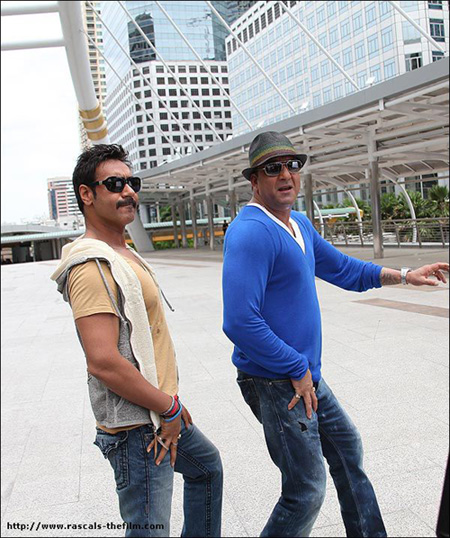
    Key cast: Sanjay Dutt, Ajay Devgan, Kangana Ranaut, Lisa Haydon

    Written by: Yunus Sajawal

    Directed by: David Dhawan

    Produced by: Sanjay Dutt, Sanjay Ahluwalia, Vinay Choksey


    Nobody expects masterpieces of comedy from David Dhawan, but now, more often than not his films are what would be called in Mumbai slang thakela (tired). The idea of Rascals is overused and in the hands of the two lead actors who have done better comedy before—Sanjay Dutt in the Munnabhai films, Ajay Devgan in the Golmaal series, it is quite disconcerting– more so when a large part of their comic antics involve pawing the much younger and very under-dressed leading ladies Kangana Ranaut and Lisa Haydon.

    Most critics panned the film with one or one and a half stars. Only Taran Adarsh of bollywoodhungama.com found it worthy of three and a half. He writes, “Be forewarned. Rascals is strictly for the hoi polloi, those who relish masala entertainers with glee, those with an appetite for movies that transport them to a different world in those hours spent in the dark auditorium, those who swear by movies that defy logic, motive and intellect. Do you think you fit into this description of a moviegoer? If you do, Rascals is just for you.” A backhanded rave, sounds like.

    Sukanya Verma of rediff.com finds it “lame” but still gives it a generous two and a half. “Recycling paper is nice. Recycling movies? Now that’s plain lame. But director David Dhawan has never been the discerning sort. He painstakingly built his brand around cheesy, slapstick wit, resolutely steering clear of logic, relying on spontaneity and a cast skilled in comedy to accomplish the shtick to which his coterie of writers like Rumi Jaffrey, Anees Bazmee, Sanjay Chhel, Kader Khan and Yunus Sajawal have contributed immensely.…Rascals, with no structure or motive, cannot (rather does not even try to) conceal its desperation to make itself funny. And this insecurity shows in each and every gag.” Then why the higher rating?

    Anyway, Mayank Shekhar of the Hindustan Times goes with one star and cribs, “No one minds mindless movies. They come with known caveats: leave your brains behind, as they say. It may be hard to tell what your brains would do, alone at home. Replacing the hollow space between your ears with some hilarious stuff may not be a bad idea still. The unconnected, unfunny skits here offer you none of that relief. You just feel brain-dead instead.”

    Rajeev Masand of IBNlive is understandably caustic. “David Dhawan, who’s no purveyor of good taste, plumbs new depths of crassness with this expectedly insensitive film that’s so short on real jokes that it makes light of everything from starving orphans in Somalia to the physically handicapped….The laughter, if it was ever intended in the film, is strictly incidental. The gags in the movie are so stale and tasteless and the situational comedy so devoid of any kind of originality or freshness, you wonder if David Dhawan just made this unfunny comedy to please his friends who play the major roles in the film.”

    Manisha Lakhe, writing in DNA sounds anguished, “Surely smashing your toes by a hammer would be more entertaining. Invest in that hammer instead of buying a movie ticket. And please sign an online petition that will prevent David Dhawan from remaking Chupke Chupke.”

    Gaurav Malani of TOI online writes, “Rascals is what one can call a ‘vacation’ filmmaking stint where everyone works on the film as if they were on a ‘holiday’ and the audience is expected to ‘leave’ their senses behind. The actors make least efforts to add conviction to their performances and the patchy writing just allows them to play as they please. Invariably the director tries to camouflage the shallowness in the story by adding depth only in the decibel levels of the dialogue delivery.”

    In Outlook, Namrata Joshi commenting on the actors, writes, “Kangna makes a grand entry in a white bikini, goes on to wear assorted minis, shrieks, displays her shapely legs and cleavage and shows off her inability to pronounce difficult words like ‘congratulations’. Ajay goes loud, Sanjay sports multi-coloured shirts and Arjun looks perpetually flustered. The climax whimpers, is utterly clumsy and needlessly protracted, as though Dhawan forgot he needed to wrap up what he’d wrought. Let alone laugh, I could barely manage a smile through ‘Trashcals’ (oops!)”

    There’s more of the same across publications. Clearly David Dhawan needs a sabbatical.

  • AdStrat: Safe Drinking Water by Triton

    The Campaign:

    AquaSure Kitanu Magnet

    The Client: Eureka Forbes

    The Agency: Triton

    The Brief :

    To launch AquaSure’s Kitanu Magnet which has 100 crore active sites that attract and remove bacteria, virus and cysts from water. Thus, making drinking water 100% safe without the use of any chemicals.


    Any specific advisory from the client:

    To launch AquaSure’s new breakthrough water purification technology that gives you ‘Safest Drinking Water’ unlike inaccurate claims of some of the other water purifiers currently available in the market, some of them even using harmful chemicals for purification. The AquaSure process works most effectively due to 100 crore active sites that attract and remove bacteria, virus and cysts from water, more so without the use of any chemicals.


    Research insights:

    “For my family’s health, there can be no compromises in the safety of drinking water, It has to the safest or nothing”

    People are grudgingly aware that their cheaper & ineffective methods of water purification are grossly inadequate & (if known to them) are also acutely against the use of harmful chemicals for something that goes into their body.


    [youtube]http://www.youtube.com/watch?v=I7NoD8q0RyI[/youtube]


    The thought process behind the creative:

    Renton D’Souza, National Director – Creative and Strategy, Triton Communications Pvt Ltd, said,” It’s the role & responsibility of the ‘Water purification leadership company in India’ to make people aware of what is truly safest water. It was imperative to introduce ‘AquaSure’s breakthrough technology’ in a manner that is relevant, simple to understand & persuasive for the sake of their family’s health. It was important to have an impactful everyday life analogy to serve as an eye opener & make consumers wake up to reality to initiate action”.


    Media vehicles chosen:

    TV, Print, Digital & POS


    Key issues kept in mind while executing the ad:

    Bring out the technical excellence of the product that is not cold but relatable, is beneficial & empathizing while building on the emotional connect that the brand already enjoys with the consumer.Establish the promise of ‘100% Safe Water’ with the strong ‘Kitanu magnet’ led reason to believe.High quality graphics to depict devil-like harmful kitanus to shake consumers from their inertia.


    Does the treatment does justice to the brief?

    The treatment & execution is highly clutter breaking & impactful in media. Also the analogy is honest, relevant, simple & persuasive.


    Market and client feedback and follow-ups (if any):

    Highly effective balance of strategy & creative as well as rational & emotional connects that will change consumer perceptions and behavior.

    Will work to give business results.


    Credits:


    Company: Eureka Forbes Limited

    Brand: AquaSure Amrit with Kitanu Magnet

    Creative Agency: Triton Communications, Mumbai

    National Director – Creative and Strategy : Renton D’Sousa

    Creative Team :  Vinayak Pattar (Creative Director), Atul Purohit (Creative Director), Arun Balgopal (Art Director)

    Account Management Team: Kim Solomon (Sr. Vice President), Chirag Tana (Client Services Director)

    Media Agency: Triton Media

    Production House: Milestone Films

    Producer: Ajay Wasu