Blog

  • Analysis: Will Omnicom upset the applecart?

    By Tuhina Anand

    Now for years, Omnicom has been trying to gain a greater share in the Indian market, but it has finally managed to get it right with the Mudra acquisition.

    It has been making moves recently to gain a foothold in the Indian market by debuting in the country its media agency OMD and then by bringing creative agency BBDO. Omnicom also acquired 100 per cent stake in TBWA but the coup is definitely getting Mudra and the talks of majority stakes turning to 100 per cent stake, Omnicom will in one sweep manage to pocket a sizeable chunk of the advertising pie in India.

    In fact, the seriousness of India as a market could be gauged from the fact that Tim Love , the Chief Executive Officer of Omnicom, Asia Pacific India Middle East Africa (APIMA) region has always pointed to his business card which puts India separately and not club as part of Asia or APAC as is the norm. He had stressed during his meetings that this showed how important is India as a market for Omnicom and its commitment to the country.

    Many youngsters in the agency have applauded Omnicom’s present move in Mudra, hoping that it would give the agency a fresh lease of life. Not to forget that Mudra has been on an overdrive in the last two years, with the agency winning awards at the national festival. Recently the network (DDB) also won at SpikesAsia so there has been a buzz. Its sub-brands Water, its strategy and design consultancy unit and Terra, bottom of pyramid marketing had also been launched earlier with much fanfare.

    In fact, with Mudra’s acquisition, Omnicom gains in getting hold of a fully integrated advertising services agency which otherwise would have been difficult if the latter had gone doing things on its own. Currently, Mudra has- Mudra India, DDB Mudra, Mudra Max and Ignite Mudra and each of these have their own strategic business units like Mudra India has 5 SBUs including Mudra West, Mudra South and Mudra North & East. Water, a strategy & design specialist, and Maatra, a localization & pre-media specialist. DDB Mudra comprises four strategic business units, DDB India, Tribal DDB India, RAPP India and DDB Health & Lifestyle. Mudra Max consists of 16 strategic business units that provide clients seamless solutions across a wide array of media touchpoints.

    In the months to follow, it would be interesting to see how Omnicom would try to bring its own flavour to Mudra. Also how would its other agencies like BBDO, TBWA and OMD be placed in the scheme of things and continue as independent units would be worth the watch. But one thing is sure with this move Omnicom has suddenly leapt in the big circle as there is no denying that Mudra has the pedigree that can give Omnicom though a late entrant, a name and grip in the industry that it has been trying for long but had not succeded ealier.

    More importantly, will this move shake the WPPs who have well-settled in the Indian industry? After all, any new player comes with the big intentions which if not shakes the sedentary life of the oldies but definitely puts them on their edges. Only time will tell.

  • Amid firecrackers, the papers are quieter

    By Ranjona Banerji

    Although Mumbai is my normal hunting ground, I have spent this Diwali in Hyderabad. And it is wonderful how easily you can get into another news cycle, no matter how unfamiliar at first. There are no large well-packaged newspaper campaigns about roads or health or public transport. The outraged citizen is also more subdued than in Mumbai – Dear sir, I have not yet received my aadhaar card after so many reminders, gentle stuff like that.

    Politics is far more in evidence and clearly Tellywood has not overtaken every page of every newspaper the way Bollywood has done to our Mumbai papers. No one can suggest that the Telugu film industry is not huge and does not command a massive fan following or commercial presence. Yet, no film star has jumped out of the pages wishing us Happy Diwali, Halloween or anything else. Happy Days!

    Telengana is a big issue obviously, but everything has been a bit quieter over the holidays. Diwali-related allergies, pollution and injuries also got their fair share of attention, proving that social consciousness is a seller.

    Between the Times of India and Deccan Chronicle, the former is more national in its outlook and the latter more local. The day after the Metallica concert was cancelled in Gurgaon, TOI led with the story while DC was happy with a single column.

    The colour pages however are as full of the vacuous page 3 stuff and the scale varies, presumably depending on celebrity activity, which appears to have been quite slow. Or it could be that local celebs are not yet professional party goers who make deals with photographers to ensure themselves so many pics a week and all from the most flattering angle!


    **

    Not surprisingly, the Formula 1 race and the continuing travails and protestations of Team Anna hogged TV and newspaper headlines. The Big Fight on NDTV had a discussion on the corruption charges against Team Anna and its anti-Congress stand at Hisar, featuring former Delhi police commissioner Maxwell Pereira, actor Kabir Bedi, politician Renuka Chowdhury, former TOI editor Dileep Padgaonkar and a young girl from Team Anna. Anchor Vikram Chandra tried to ensure that Team Anna got fair treatment but even he was a bit stunned when Kabir Bedi said that he was not bothered by Kiran Bedi’s creative accounting. Audience members were far more critical.


    **

    The fiasco over the Metallica concert in Gurgaon demonstrated how TV needs to up its reporting skills. Anchors and reporters clearly did not have the wherewithal to probe what had gone wrong and relied on unsubstantiated claims made by fans. Oddly, TV channel websites appeared to have more clarity. It took the newspapers the next day to answer most questions. Yet, even now, the facts seem a little hazy, that is, juicy details of why the concert was not held are missing.


    **

    Most intriguing of all is the fate of some 130 tourists who have apparently been kidnapped in Lakshadweep. TV ran the story late one night and forgot about it the next morning. Newspapers have been silent and the web, normally a fount of information and misinformation both, has provided only sketchy details. So what’s happened to them?


  • Mediaah!: When Delhi Times and HT Cafe reported that Metallica performed

    By Pradyuman Maheshwari

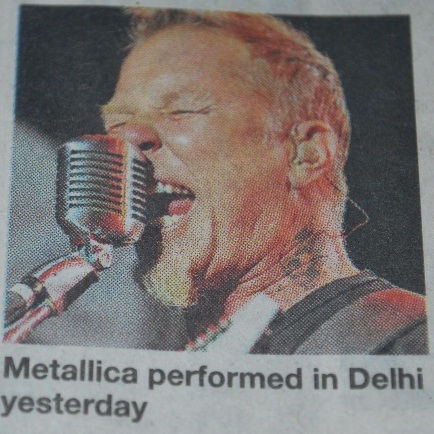
    The Delhi Times clip
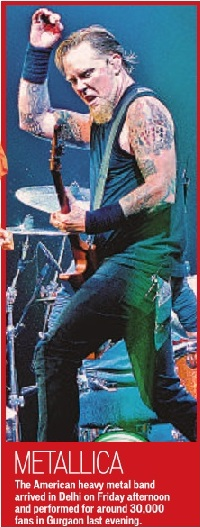
    The HT Café photo-story

    It’s not something that’s not happened before. I recall Time magazine doing it in the late 1970s when it reported that an Indian politician had visited China when in fact he had called off the trip last-minute.

    I was alerted on this thanks to a Facebook post by a former colleague, Narendra Kusnur. The city supplements of both the Hindustan Times and Times of India in Delhi reported that the Metallica concert had happened on


    Friday. While the front page of the main paper did make a mention of the chaos at the venue, that of their supplements – which Kusnur believes happened because of an early deadline – was incorrect.

    I am sure this is more than just a severe embarrassment for the editor and management of both publications. It’s not the case of an error in reportage or a typo or even a wrong picture that was printed. And mind you it doesn’t appear to be an inadvertent error.

    Here was a case where the paper’s editors cheated their readers by deliberately printing incorrect information. We got to know about it thanks to a vigilant reader and also because it was a much-hyped event.

    But my worry is what if the editors do such acts habitually, with other events too. Also a cause of concern is that the city supplements of the two leading newspapers in the capital carried a similar error. The Times of India blanked out the news item on the epaper, while HT didn’t do that. So obviously the decay exists not just in one publication.

    I went through the front page of HT City and Delhi Times on Sunday to see if there’s any apology. I didn’t see any in the epaper edition. Times magazine, btw, had apologised for the error.

    This only further accentuates my distress that the reader is being taken for a ride and no one really appears to care.


    The Niira Radia exit. Good riddance or sad to see her go?


    I still remember the days when Vaishnavi was setting up. The Tata group accounts were consolidating under an agency with a name unlike the other PR agencies. In the early days, the folks were working out of makeshift office at the Taj Mahal hotel and the Army and Navy Building in Mumbai.

    But the proof of the pudding is in the eating, and I found it very pleasant interacting with Vaishnavi staffers. For a period when I was with the Dainik Bhaskar group, we had recruited Vaishnavi with an assignment which again was executed very well.

    The PR industry grapevine always had assorted stories about how the Vaishnavi bosswoman Niira Radia had managed to net the entire Tata group account. Needless to say most of it was out of jealousy. Guess they found some merit in getting the entire business group to go to just one agency for PR just as you tend to do for, say, media buying.

    My sense is that this policy doesn’t work. It’s always good to get a few different players, given their strengths in various business areas and have experience professionals available in the locations you want them.

    Two questions: now that she’s gone (well, as of close of business today), what’s the view. How would the world remember Niira Radia? High profile lobbyist or a quality communications professional? Lobbyist yes, but perhaps incorrect to stretch it to her being a wheeler dealer.

    There’s a lot that exists as part of the deliverables under public affairs, and there’s nothing wrong if the influencing has to happen beyond media folk. For instance, if a senior politician from Kerala thinks he or she is not being recognised by the powers that be in Delhi, then there’s nothing wrong in pushing your way around in Delhi.

    And if there’s a journo or bureaucrat who is amenable and can get influenced, it’s surely not the crime of the practitioner.

    That both the Tatas and Reliance groups entrusted their responsibility to Radia speaks volumes for her skills.

    There is a lot on Radia that the various enforcement agencies are busy with. I don’t see anything happening to her. She has enough contacts to get her out of any mess and has enough dirty stuff on people to pull the trigger if anyone gets naughty.

    Question 2: were the Tatas wise by going in for Rediffusion? I would be interested to know what swung it for Arun Nanda. After all, he doesn’t have the best PR brains with him any longer.  Perhaps that’s why tied up with Edelman.

    But then 10 years back when the group went in for Vaishnavi, similar questions were being asked. Radia’s team put up a decent show. The Tatas can obviously spot talent where not many of us can.


    PostScript: Are news media professionals worried about the mutterings of Press Council chief retired Justice Markandey Katju. Read this hilarious account on Legally India. Must-read. More on Katju’s comments on the media next time (which I promise you won’t happen after three weeks!)

  • It’s official! Omnicom to pick up majority stake in Mudra

    Omnicom Group Inc announced that it has entered into an agreement to acquire a majority stake in the Mudra Group. As part of the agreement, Omnicom will extend its partnership with the Reliance ADA Group.

    Mudra will significantly expand Omnicom’s service capabilities and presence in India. The Mudra Group comprises: branding and communications agency Mudra India; marketing and advertising agency DDB Mudra; integrated engagement and experiential agency Mudra Max; and Ignite Mudra, an agency that caters to entrepreneurs. Mudra has 26 offices across the country and an extensive field activation network.

    In conjunction with the strategic partnership, Reliance Group Chairman Mr Anil Ambani will join the Omnicom International Advisory Committee. “This acquisition is an important step in achieving Omnicom’s strategy to extend and deepen our presence in rapidly growing markets,” said John Wren, President and CEO of Omnicom Group in a communique. “Our vision is to be a source of innovation in every market we serve. Mudra is widely acknowledged as an outstanding company with impressive creative product and expertise in a broad range of disciplines. Mudra’s innovation and depth of talent will strengthen our business capabilities not only in India but around the world.”

    “DDB has been an excellent partner over the years. We have benefited immensely from the collaboration and transfer of knowledge from around the globe. We are proud to belong to such a storied network,” Mudra Group CEO Madhukar Kamath said. “Omnicom and DDB have clearly been the inspiration for Mudra Group’s transformative growth over the last five years. My colleagues and I look forward to the next decade of explosive growth in the Indian market.”

    DDB Worldwide President and CEO Chuck Brymer noted, “This acquisition will further unite two companies that have long held the same values, creative goals and ambitions. Under Madhukar’s leadership, Mudra is the original challenger brand of the Indian communications industry, and it shares DDB’s culture of creative excellence. Together, we will create even greater growth for our clients in this rapidly changing, technologically driven region.”

    DDB and Mudra Group’s shared history is rooted in a relationship that began in 1988 and has grown tremendously since the formation of DDB Mudra in 2007, which established DDB India, Tribal DDB, Rapp and DDB Health & Lifestyle in the Indian market.

    John Zeigler, CEO, DDB Asia Pacific, added, “Mudra has an impressive history as both creative leaders and strong believers in integrated solutions making them one of the most innovative companies in India.”

    Omnicom Group EVP and CFO Randall Weisenburger also noted, “In addition to significantly expanding our service capabilities in the region, this partnership will bring with it an exceptional Shared Services and Operations Center in Ahmedabad that will help Omnicom more efficiently expand its other operations in India. Additionally, Mudra recently moved into a new headquarters facility in Mumbai called Mudra House, a sustainable building and one of the few in India to be awarded LEED (Leadership in Energy and Environmental Design) Gold certification. Mudra House is widely acclaimed for its conservation features and state of the art technology.”


  • The Anchor: 7 reasons why Formula 1 will never overtake cricket in this country

    By Rahul Kishore


    I was at the F1 over the weekend and got a grandstand view. Quite impressed with the show… a slap in the face of the detractors who said we were a nation incapable of organising mega-events, especially after the Commonwealth Games fiasco.


    I came  away with a sense of pride… at India producing a world class event. I was asked by a  friend if I saw F1 overtaking cricket in a few years. Set me thinking… the answer was a simple and emphatic: NO!


    The reasons are obvious:


    1. Cricket has Sachin,  Dravid, Laxman, Yuvi.  F1 has, er, Karthikeyan.’ Now who’s he?  Dhoni is worshipped.  In India we have Vijay Mallya saying he will announce in the next two days if he wants to back an Indian team in the next  F1 in Abu Dhabi! In cricket,  entire series are planned five years in advance!


    2.Cricket has a 100-year history. F1 is relatively new… it will take time to grow.. may be 10 years or so. It needs big money, infrastructure, commitment… do we have it in us? We have just about made one track for such a large country. Yes, it’s a start and where it goes is anyone’s guess. Races are held 20 days a year. Is it worth investing in a track in every metro and price tickets at upwards of Rs 6000?


    3.Cricket is played for national pride. Where in the F1 world will you find a India vs Pak or Australia contest? How long will it take F1 to capture the spirit of Indianness as it were.


    4.These race drivers have no relevance to the aam Indian. Can at max be TV heroes, in  a sport primarily meant for television viewing. In fact as I watched the race I was very impressed with the start and after the first three laps which took about five minutes, I was glued to the giant screen… could’ve easily come back home and watched it on TV, to grasp the nuances better.  On a cricket field, I can catch all the action with a swoop of the eye.


    5.There is an entry barrier. It is an expensive sport that needs a track, money, an expensive car and a sponsor with very deep pockets. How can it penetrate into the small towns of a third world country is beyond me. It is for the privileged few, not a mass sport. However, I do see it penetrate into the middle class slowly. On the other hand, cricket can be played with a makeshift bat and ball in almost any small hamlet of the country. It is this aspect that makes it our national sport!


    6. Cricket has created icons and genuine stars. These guys live out the aspirations of millions of youngsters. Look at a Dhoni: came out of nowhere and is India’s best ever skipper. I cannot imagine a race car driver come out of a small village in North Kerala, but in cricket a Sreesanth can!

    7. The television rating points follow the fever, the hunger and the passions of the masses.  And the ad monies will chase that.  F1 has a long way to go to capture the masses.


    We have seen EPL, tennis, badminton, golf remain the preserve of a niche audience. To my mind, F1 will stay in this genre for some time to come.

  • The husband’s predicament

    The Campaign:

    Amitabh Diwali Campaign


    The Client:

    Tanishq


    The Agency:

    Lowe Lintas


    The Brief:

    To promote Tanishq diamonds during the peak jewellery buying season – Diwali. It is also the most auspicious time for jewellery purchase.


    Research insights:

    According to Arun Iyer, National Creative Director of Lowe Lintas, “Usually during Diwali gold is the main metal of purchase among consumers. But we have taken this opportunity to push diamonds this Diwali.”


    The thought process behind the creative:

    “We have used the insight of how men always go wrong with their choice of gift during festivities. And this time the attempt is to ensure that they are clear about their choice of gift this Diwali.”


    Media vehicles chosen:

    TV, Radio and Outdoor


    Key issues kept in mind while executing the ad:

    “Since we were using Amitabh and Jaya again, we had to ensure that they come across as normal husband and wife and not like celebrities. Also the situation that was shown is a predicament that every husband goes through in marriage.”


    Does the treatment do justice to the brief?

    “Absolutely. Like I have mentioned earlier Amitabh behaves like any husband would. Despite having clarity about the choice of gift he still falters as women, being women, will always have a different point of view.”


    What is the differentiating factor about the ad?

    “I think it’s the execution. Amitabh and Jaya have been shown going through life’s moments just like any other normal couple would.”


    Market and client feedback:

    “There has been a positive feedback from the market and client. Customers have been talking about it and find the ad very entertaining. The fact that Amitabh gets stumped again by Jaya in the end is the highlight of the film.”


    Credits:

    Creative: Arun Iyer, Rajesh Ramaswamy, Abhijit Ghosh, Adarsh Atal, Indrashish Mukherjee, Prasad Baggi

    Account Management: Sudhir Rajasekharan, Pritish Wesley, Arunabho Sen

    Director: Prakash Varma

    Production House: Nirvana Films

  • Ad Asia set to take off

    By A Correspondent

    Close on the heels of the Formula One extravaganza comes the annual Asian advertising mela, AdAsia 2011, which begins tonight with an opening gala. The three days that follow will see sessions featuring some of the biggest names in the advertising, media and marketing fraternity take the stage and share their views with the more than 1,000 delegates from 25 countries who have registered for the event.  The theme of the congress is ‘Uncertainty: the new certainty’ but there is nothing uncertain about the buzz around AdAsia 2011, New Delhi.

    Over the 20 sessions planned for the congress, panels will share their invaluable experiences, insights and sharp analysis of ongoing events, providing new ideas, concepts and a firm handle on how the changes we are witnessing today will translate into trends in the future. They will go beyond analysis to address the question of ‘How’, and to elaborate innovative ideas and solutions to key global challenge.

    Some of the key members who will share their views include Harish Manwani, Chief Operating Officer, Unilever, and Chairman, Hindustan Unilever Ltd, Nikesh Arora, Senior Vice President and Chief Business Officer, Google, Indra Nooyi – Chairman & Chief Executive Officer, PepsiCo, Joseph Tripodi – Executive Vice President and Chief Marketing & Commercial Officer, The Coca-Cola Company, David Droga – Founder, Creative Chairman, Droga5, Kelly Clark, Worldwide CEO, Maxus and Mainardo De Nardis, CEO, OMD Worldwide among othes.

    Piyush Pandey, Executive Chairman and CD, South Asia, Ogilvy & Mather India will be part of a session on `Asian Creative? A New Brief’ which will discuss if Asia can lead the next creative renaissance, what is lacking to achieve this and how it can be tackled. There will also be a session on ‘Conversation as a route to driving certainty’. The topic will be addressed by Chuck Brymer, President & CEO, DDB Worldwide and Nikesh Arora Senior Vice President and Chief Business Officer, Google who has wide experience in various functions at Google. There will also be a session by BCG Japan on ‘Marketing to Women Consumers in Asia’ which will share insights and analyse traits of the Asian Woman Consumer and will try to ascertain whether her DNA affects her shopping habits. An interactive session with Luis DeAnda, Chief Operating Officer, TBWA\Hakuhodo, Japan will follow.

    Commenting on the Agenda and the delegate participation, Madhukar Kamath, MD & CEO, Mudra Group and Chairman of AdAsia 2011 said, “The amount of buzz and excitement this event has generated is truly incredible. I can confidently say that this is an Asian event that has caught the interest and attention of the world. Apart from Asia and the Middle East, even delegates from countries like USA, UK, Australia, Poland and Africa have registered for the event. The magnitude of the event this year is much larger than the previous years with nearly 50 speaker confirmations from across the globe. Delegates of AdAsia 2011 can look forward to intellectually thought provoking sessions of debates and discussions which will redefine how we look at the world we operate in. Speakers will include leading lights from the fields of business, marketing, advertising, media and communications.”

    This year AdAsia 2011 will also be different as it will bring to attention, provoke debate, and challenge the minds present to think of providing creative solutions to one of the critical issue on ‘The girl child’. During the AdAsia, this effort will surface in different aspects and areas of the congress. It will include a special presentation dedicated to ‘The Female Equation: Communicating with Conscience’  by  Frederika Meijer, Representative – India & Country Director- Bhutan, UNFPA.

    AdAsia began as a three-day Asian Advertising Conference in 1958 sponsored by the Japan International Advertising Association (JIAA). The principal objective of the conference was to give Asian advertising a boost in the post-war era. The conference was attended by delegates from six countries including Japan. The modest conference grew into a congress in the 1960s and was named AdAsia in 1984. AdAsia2011 is being organised under the aegis of the Asian Federation of Advertising Associations (AFAA).

  • Vatsal Asher is DMA chief

    By A Correspondent

    Direct Marketing Association: India has appointed Mr Vatsal Asher as its Chief Executive Officer. In his new role at DMA: India, Mr Asher will be responsible for strengthening DMA: India’s presence as an apex body for advocacy of direct marketing practices.

    On his new role, Mr Asher said, “With multitude of choices, Indian consumers are becoming more discerning about their brand preferences and where they spend money. Considering this consumer behavior and the increasing media clutter, it is imperative for marketers to create data driven customer centric campaigns. From traditionally being defined as ‘response generating’ domain, direct marketing is now used for ongoing customer engagement. By emphasizing on global best practices for marketing services providers and marketers, I aim to carry forward DMA: India’s vision of establishing industry standards and promote the direct marketing community.”

    Mr Sanjiv Swarup, Member of DMA: India Board of Directors, said, “In 2010 spends on direct marketing accounted for more than 50 percent of overall ad spends in the United States. Similar trend is also witnessed in India where marketers using data, backed with analytics are focusing on creating campaigns that generate interest, measure customer response and continuously engage with their customers. Considering this trend, onus is on us at DMA: India to increase member interaction and provide them with access to the latest information in domain of direct marketing. Vatsal’s depth of experience will help drive our agenda to advocate direct marketing and provide networking opportunities that will help the marketing industry to reach the customers more effectively.”

    Direct marketing has gained immense popularity in past few years with emphasis not just being laid on measuring the returns on marketing spends but also campaigns being created to initiate a dialogue with the customer. With advent of new media and innovative usage of technology to engage with customers, spends on direct marketing have also increased significantly.

    Mr Asher was associated with Deepak Fertilisers’ consumer facing VARE division as Vice President before joining DMA: India. Prior to Deepak Fertilisers, Vatsal has worked with Reliance Retail, Tata Teleservices and RPG group.

    He brings with him more than 15 years of rich and varied experience in domain of marketing communications across brand management, sales and promotions, loyalty and customer experience.

    Direct Marketing Association: India (DMA: India) is registered as a public limited company and has been adjudged as a non-profit organization. DMA: India is an active member of the International Federation of Direct Marketing Association (IFDMA). DMA: India’s members include national and international firms engaged in various activities of Direct Marketing. DMA: India connects businesses using and supporting all forms of direct marketing.

  • High-end matchmakers emerge to tap HNIs

    By Sobia Khan

    A new generation of high-end matchmakers has emerged to cater exclusively to the rapidly growing affluent entrepreneurs and professionals, who are willing to shell out whatever it takes to seal just the right alliance.


    Elite Matrimony, a matrimonial website, for example, offers membership by invitation only, to those who have a net worth of over Rs 3 crore and can pay a fee of Rs 50,000 to 2 lakh for three to six months.


    Chennai-based Mr Murugavel Janakiraman, who founded the portal, says 60% of his clients are first-generation entrepreneurs, professionals such as high-profile lawyers, or senior executives in multinational companies, while the rest represent old money with their fourth-generation into business. The portal maintains a database of more than 50,000 high net worth individuals.


    The noveau rich who have benefited from India’s economic boom, or non-resident Indians who have made it big abroad, are turning to such professional matchmakers.


    “It was like I was helping them strike a business deal,” says a marriage counsellor who does not wish to be named, about a recent case, “Both parties wanted to know about the other’s net worth, business prospects and succession planning, among other things.”


    He recounts that a Mumbai-based business family was scouting for a suitable boy for their 20-year-old daughter six months ago. The father owns a 10-year-old textiles firm that has grown into a top firm in the apparel exports business. “Like all families, they wanted their daughter to marry higher in society, but people in the same wealth category were not convinced about their new status when they approached them with proposals. So they came to us,” he says. After taking the proposal to some of the big entrepreneurs registered on his portal, the counsellor finally zeroed in on a Gurgaon-based diamond merchant who had inherited the business from his ancestors.


    With spends at big fat Indian weddings averaging between 5 crore and 25 crore, the domestic wedding market, estimated at 1.25 lakh crore – 1.9 lakh crore, is believed to be growing at 25% to 30% a year.


    “There has to be a perfect match, in terms of both the family and the business,” says Mr Janakiraman, explaining that whoever is finally picked will become part of a business house and also contribute to its growth. “We assign a personal matchmaker to our clients, visit their families, carry out background checks, access current and potential business, family structure and succession planning, among other things, and then begin the process of matchmaking.”


    Often, even if the family is well-known, not much may be publicly known about the educational background and management and entrepreneurial capabilities of the scions. “In such close-knit societies as those of the rich and the elite, it is difficult to enquire about such things in public. This is where we come into the picture,” says Ms Rekha Vaid, senior marriage counsellor at Sycorian, an online matchmaking service. “You need professional help to carry out complete background checks of the families and, especially, the prospective grooms.”


    Mr Janakiraman recounts the case of a director with a top MNC in Bangalore who found just the girl he was looking for on the Elite Matrimony portal. However, it emerged that the girl’s family was not interested in the proposal for his son because the girl’s family, a first generation infotech firm in Chennai, was looking for a groom who would eventually lead the company as she was their only child. After much discussion, the executive father convinced the girl’s parents that his son, who was working in an IT firm in the US, had plans to return to India to start his own venture, and was capable enough to lead a business in future. The marriage will be solemnised soon.


    Business is growing at 50%-60% a year, says Mr Janakiraman. “There was a need for segmentation in matrimonial websites. Affluent people need a different service and paying money for a niche service will never be a constraint for them,” he says. “In fact, some people say that we are charging very less,” he laughs.


    Ms Vaid says business has grown over 75% in the past two years. Sycorian, through Shrishti, a business venture that caters to big-ticket weddings, has helped affluent Indians from the US, UK, Canada and Australia take the vows, she says.


    “The online matrimonial market offers better choices for people who have moved out of the social circle to find a relevant soul mate,” says Mr Nilanjan Roy, group business head, Times Business Solutions, which owns the matrimonial website Simplymarry. She says there is a huge demand from the elite, who are taking the online route to matchmaking.


    Kerala-based wedding planner Spice.Nair – which recently organised an all-white wedding, with everything from flowers to dresses in white – caters mainly to such NRIs. “We are getting queries from people in South Africa, UK and Australia who prefer to come to India to tie the knot. NRIs always look for variety,” says proprietor Mr Suresh Nair,who plans to set up a wedding shop to offer from invitation cards to dress to decoration to match with the themes.


    Source:The Economic Times

    Copyright © 2011, Bennett, Coleman & Co. Ltd. All Rights Reserved

  • BBC Knowledge goes 3D

    By Akash Raha


    Come November BBC Knowledge is all set to bring out its first anniversary issue in 3D, priced at Rs 100 and due to be on stands from November 1. This is a ‘Space’ special with 22 pages of exclusive 3D images which can be enjoyed with 3D glasses available free with the magazine.

    Speaking about the anniversary issue Soela Joshi, Brand Publisher said, “BBC Knowledge for its first anniversary had to do something special for its readers. We wanted to use the power of interactivity to engage our readers and capture audiences. Coverage of Science & Technology in 3D has a high potential for disruption. Hence we have created ‘Space in 3D’ for our anniversary issue. The moment you put on the 3D glasses and look at the pages…the magazine comes to life. It is so exciting to create an environment where the readers can have a truly interactive experience.”

    The magazine has also come up with a 360-degree plan to engage with the young adults who are the main readers. The marketing activities for the issue will be carried out in areas which are popular with this age group. There will be print ads as well as key outdoors. “We will also run a social media campaign where this TG is most active, including our own Facebook page. In addition, in terms of onground, we have tie ups with organizations like science centres and nature groups to reach out to a new set of readers for this issue. We also have a tie-up with Imax Big Cinemas where we will promote this issue through on-ground branding and contests. Their 3D screen provides a perfect backdrop for our special issue,” said Komal Puri, Brand Manager, BBC Knowledge.

    The BBC Knowledge team has carefully handpicked the iconic stories for this issue – it contains a mix of breath-taking images of NASA’s space exploration as well as the exclusive inputs of Indian experts like Retd. Wing Commander Rakesh Sharma and spacecraft designer Susmita Mohanty among others.

    Preeti Singh, Editor, BBC Knowledge explains, “For our anniversary issue we have pulled out all stops. A first in India’s magazine history, BBC Knowledge brings a spectacular Space in 3D special with iconic NASA images, never seen this way before. With features from astronaut Rakesh Sharma to 35 biggest questions about the cosmos answered, this extraordinary issue is a perfect preview of what’s to come from us in the future.”

    BBC Knowledge was brought to India by Worldwide Media last year.  It is a magazine for young inquisitive minds where well-researched, handpicked stories are matched with breath-taking pictures and graphics to cover history, science and nature.

  • Tom Friedman in the IE Adda

    By A Correspondent

    Flat-world proponent Thomas Friedman was the special guest at the third Indian Express Adda on October 28. Mr Friedman, Foreign Affairs Columnist, The New York Times in New Delhi, is a three-time Pulitzer prize winner and author of several famous books including The World is Flat, From Beirut to Jerusalem and the most recent That used to be US.

    Every week he helps millions understand and interpret change in a way no other commentator does. Along Mr Shekhar Gupta, Editor in Chief, Indian Express Group, Mr Friedman debated and discussed several topics of international significance and discussed it with the enthusiastic crowd. Issues regarding global slowdown, economic issues in Europe and US, rise of China as a global force to reckon with, capitalism, neo-imperialism, the uprising in Middle East and North Africa etcetera were some of the topics discussed at length in what was an intriguing and thought-provoking evening.

    This is the third Adda hosted by the Indian Express.  Guests at previous Addas were Sir Martin Sorrell and Shahrukh Khan, in New Delhi and Mumbai respectively.

  • Hard Knocks: Event mismanagement

    By Anil Thakraney


    Whenever I get invited to participate in an event, my first reaction is to hesitate. And this is because, of the many I have visited in my life, most have turned out to be shoddily organized. Mismanagement of crowds, late start, poor banquet service, clueless hosts/hostesses… it’s a long list of gripes. And this turns out to be the case even when professional event managers have been hired. I must also add here, the few events I have visited in London, Cannes and New York, were a pleasure. Which is why I have always wondered why we screw things up in India.

    Since most events are usually private/low-scale functions, no one discusses the bloopers, and life simply goes on. But we get caught with our pants down when they are held on a mega scale, when the world is watching. Our pathetic show at the Commonwealth Games, and now with the mess on Metallica’s performance in Gurgaon, has made us look like bloody jokers.


    [youtube width=”400″ height=”300″]http://www.youtube.com/watch?v=VELQ39QAYP4[/youtube]

    I really don’t understand why we Indians make for such poor planners and executors. Maybe it’s in our DNA. Or, we can blame it on bad karma, as we usually do for everything! However, here’s a hunch: I suspect our event management companies are not being run professionally. And they aren’t being held accountable for flop shows. Perhaps a hefty fine for botched events may make them pull up their socks. I wonder if these people train their staffers on the skills required to run an event. If there’s any quality control in place. I would stick my neck out and say that most staffers are hired based on their general enthusiasm and little else. When the ground reality is that running a huge event takes a lot more than enthusiasm. It needs astute planning skills, a resourceful temperament and a jihadic passion to execute a successful event.

    Our event management companies need to clean up their houses. Or be ready to get penalized for bringing embarrassment to the host. Or to the whole country on occasion.


    ***


    PS: Haha. Came across this funny ad on the need to wear proper lenses. Must say the dude reminds me of a bumbling Indian event manager. Just kidding!