Blog

  • AdAsia: From chat rooms to Twitter

    By Akash Raha

    That the digital revolution is already here, and is here to stay, is a given. But marketers are still perplexed on how to make full use of this phenomenon. In AdAsia 2011 a complete session was devoted to this very issue, and to be more precise, the subject of social media was discussed. The session in context was called ‘From chat rooms to Twitter… what next?’

    The panelists at this session were Kate Day, Communities Editor, Daily Telegraph Online, Arvind Rajan, Managing Director & Vice President, Asia Pacific and Japan, LinkedIn and Earl Wilkinson, Executive Director and CEO, INMA. The session was moderated by Rishad Tobaccowala, Chief Strategy and Innovation Officer, Vivaki.

    The session proposed that discussions were going to be a reverse of what this conference is about ‘Uncertainty: The new certainty’. What the session proposed was ‘Certainty: The new uncertainty’. It is certain that over the next few years the driving force will be social media. However, the uncertainty aspect is only what it means to marketers, media company etc.

    Ms Day said, “The question one often asks is, ‘What is the next big platform?’ My answer is it’s all about the people rather than the technology. Actually the underlying shift is with the patterns of behaviours of the people involved and audiences. Brand and customer relationship is the key. If that’s the case, then what platform is next does not matter because the people are here.”

    All the panelists stressed on the need to build consumer relationship and make the social media experience more real and humane. The consumers today want to interact with a human rather than with an automated interface, they want real conversation, moreover, in real time. It is essential to “get your own house in order and make the customers feel at home”. Also, often while we talk about social media, there are assumptions made about the product, content and consumers. Such clichés are something one should stay away from and not base one’s social media plans on them. Crating content and platform for ones invaluable customers is the key.

    FB, Twitter and LinkedIn are three global platforms, but as Mr Rajan said, the reason they are used still remain different. Twitter is a syndication platform. FB is for friends and family and LinkedIn is a professional network. The social media platforms are still new, there is still a lot to be done and lot of understanding needed. The essence is to have meaningful conversation with the audiences, connect with the customers and once that is done, it can be leveraged upon.

    Earl Wilkinson, of INMA also shared his learning in the field of social media apropos newspaper publishers across the globe. He pointed out how sharing has becoming the value added special sauce for journalism online. And in a way, he emphasized that digital times have saved journalism. Now that social media is here already, and everyone knows that communication is essential, the trick is how to structure the communication. For newspaper publishers, the way forward is going to be projecting newspapers and news brands as a trusted voice out in the community and the blog-sphere and get the audiences back on the websites.

    Arvind Tobaccowala of Vivaki said that the essence to being leader in social media space is differentiating content. Speaking about social media platforms he expressed hope for Google+. He said “Google is an amazing company… Believe it or not, Google+ will work, and it will work in a very big way. I don’t know how it will fit into broader eco system but it will be interesting to watch.”

    Pointing to sharing content on the social space as an interesting behavioural aspect and social media phenomenon, the panelists expressed hope that it will only grow further as it is a great way to engage with the audiences. Mr Tobaccowala also pointed out that on the social media space it is important to understand the behavioral aspects of the consumers. There are heavy users and heavy influencers. Right now the focus is less on heavy influencer… Heavy influencers can be further be divided into advocates and detractor. In a nutshell, he stressed that it’s imp to talk to detractors because they are the ones who are more vocal, even more than the advocates. Social media helps rediscover the idea of sharing in new and different ways to new and different audience. The essence is to start with Social media and start with it now. The panelists beseeched everyone to get on it and one might stumble upon something wonderful… “It is not necessary that you always know what you are doing,” said one of the panelists. Also, one should not look for any returns, one will get it eventually. Social media is new and still developing. Not everything that one experiments with comes out right, but one should try nevertheless. Ms Day emphatically suggested, “Don’t throw the baby out with the bathwater,” advocating that even if a few ideas don’t turn out right, it is a must to explore social media, as it is the big thing of the future.

     

  • AdAsia Exec Summary: Lively sessions mark Day One

    By Tuhina Anand

    AdAsia 2011 was inaugurated with the anthem of the Republic of AdAsia and a performance by the Shillong Choir Group.  This was followed by lighting of lamp by the Minister of Information & Broadcasting Ms Ambika Soni along with Dr Bhaskar Das, Co-Chairman of the Organising Committee and President, The Times of India Group and Mr Madhukar Kamath, Chairman Organising Committee for AdAsia and Group CEO and MD, Mudra Group. The flag for AdAsia was hoisted by Shahrukh Khan who also addressed the audience and reminded people of all the brands he has endorsed in his short speech. He however did emphasise that he believes advertising is not just for entertaining but about informing the consumer of a product so that when he or she is making a purchase he can make an informed choice.

    The keynote address was delivered by Mr Ram Charan, Author, Speaker and Business Advisor. The first session of the day was on ‘The Game Changers’ where Mr Harish Manwani, Chief Operating Officer, Unilever , and Chairman, Hindustan Unilever Ltd gave an insight into the company reinventing itself according to the changing times.  Mr Michael Roth, Chairman and CEO, Interpublic posed questions to Mr Manwani who answered all with aplomb. The key that emerged from this session was on the importance of adapting to the changing environment thus making the brands relevant to its consumers while at the same time being able to sell its products.

    The second session was on ‘Decoding the New Age Consumer’  where Mr Adil Zainulbhai, MD-India, McKinsey and Company Inc and Mr Laxman Narasimhan, Director, New Delhi, McKinsey & Company Inc, Mr Kochi Yamamoto, GM, Global Solutions Center, Dentsu tried to understand the behavioural pattern of the ‘New Age Consumer’.  The session gave insight into the changing world where the future remained uncertain and how marketers are grappling with this reality and trying to understand today’s consumers.

    Tom Doctoroff, JWT, North Asia, Area Director, Greater China CEO moderated the next session on ‘Asian Creative? A New Brief. On the panel were Akira Kagami, Global Executive Creative Advisor, Dentsu, Bruce Haines-Chief Strategy Officer, Cheil Worldwide, Kitty Lun, CEO, Lowe China and Piyush Pandey, Executive Chairman and CD, South Asia, O&M India. The panel gave an insight into creative from different countries where they operate including Japan, Korea, China and India. While Ms Lun talked about challenging authority and showing by example to help youngsters come up with great ideas. Mr Pandey brought into fore the relevant issue of remuneration where he stressed, ‘if you want good people, start paying them better’. Defending  standard of Indian advertsing, Mr Pandey said, “Just because a market is not in international domain for a century doesn’t mean that India is not into brand building.” He mentioned The Times of India and Cadbury’s advertising over the years that have made them successful brand in the country.

    Mr Kagami on the other hand who too was on the panel discussed the importance of corporate brand building that is critical in Japan as this helps in creating trust for thecorporate and its brands.

    Nikesh Arora, Senior Vice President and Chief Business Officer Google gave a ‘Google’ angle to his session where he began by asking people to put questions to him as QandA was not allowed in the earlier sessions. This set the mood for his session.  The next discussion was on ‘From Chat Rooms to Twitter…What Next?’. Kate Day, Communities Editor, Daily Telegraph Online, Arvind Rajan, MD and VP, Asia Pacific and Japan, LinkedIn, Earl Wilkinson, Executive Director and CEO, INMA were on the panel which was moderated by Rishad Tobaccowala, Chief Strategy and Innovation Officer, Vivaki.

    The last session of the AdAsia on Day 1 was on India 2020 where Kurush Grant, Executive Director, ITC, Sanjay Kapoor, CEO-Bharti Airtel Ltd, India and South Asia, Ravi Swaminathan, MD and Regional VP (Sales and Marketing), AMD South Asia shared views on how India can be made a truly global brand in the next 10 years. The session was moderated by Pankaj Ghemawat, Global Strategist.

  • AdAsia: Learning the rules of the game from Harish Manwani

    By Tuhina Anand

    So what does behemoth like Unilever do when a shampoo sachet priced at Rs 2 and projected at doing big sales doesn’t take off in the market? It focuses on listening to the consumers and gets an insight into why the market is not responding as expected. Then goes into reverse engineering which helps in bringing down the cost of the product, builds a manufacturing plant for sachets and prices the sachet at Rs 1, a pricing figure that consumers were more comfortable with thus getting the perfect recipe for success. This and many more such insights were shared by Harish Manwani, Chief Operating Officer, Unilever and Chairman, Hindustan Unilever Ltd (HUL) who was speaking at AdAsia 2011 on the topic ‘The Game Changers’.

    Mr Manwani termed HUL as the `emerging market company’ as the economic centres shift to emerging markets. In fact, 54 percent of their business comes from the developing market. But one of the lessons to keep in mind is that it’s not one India but many Indias and how one caters to such heterogeneous consumers is the key to succeed. Affordability and accessibility needs to be kept in mind but at the same time one has to make money too and that’s where consumer insight comes in handy. He also talked about having a sharper focus on shoppers than consumers.

    The key that also emerged from this session was Unilever’s belief in doing well by doing good like the project Shakti that has empowered women which has also helped them in selling their product. The strategy that has emerged is of making brands meaningful as well as brands that are marketed should have a social purpose. Mr Manwani said, “We have been ensuring that all our brands just don’t have functional benefit but also has social benefit.” In fact Unilever factories have been working relentlessly towards sustainability and creating products through innovation that would also help in bettering our environment.

    This shift can also be seen in communication that Unilever has adopted like in the case of Surf where initially the messaging was simple and talked about the whiteness that is the basic want from detergent to taking the route of saving and addressing the housewives the obvious customer for the product in famous Lalita Ji. The communication has now taken the route of saving two buckets of water, thus the brand becoming socially responsible. So there is a technology that helps in building product that is superior and then there is communication that helps in delivering a social message with brands that have social purpose. That’s Game Changers.

    He also pointed that power of brands will not change, power of consumer insights will remain and so will the ability to create great advertising and its power will remain unchanged but going forward what will change or bring about a change will be the advent of the digital medium, the ability to work with consumers, importance of 360-degree communication, having a strategic and not opportunistic relationship with the agency and creating tools that will help marketers in knowing exactly where there money is going when they spend on advertising.


  • 6 reasons why you can do without attending AdAsia 2011

    #1 Rs 40,000 for entry. Okay, you could get early bed or bulk entry discounts, but it’s still not small money. Plus travel – flight tickets, local travel and hotel. All of this amounts to around Rs 75,000 if you stay in a budget hotel. Rs 1 lakh if it’s 4-star-upwards.


    #2 Usual suspects, usual suspects, usual suspects. It’s the same old faces at all our industry events. AdAsia had Harish Manwani of Hindustan Lever on Day 1. But Shah Rukh Khan? Grrrr!


    #3 There is a need to draw younger professionals to AdAsia and not 40-plus and 50-year-olds.


    #4 The same old format of keynotes, speeches and panel discussions is boring. C’mon marketers and advertisers. You guys are creative, why not think of something innovative?


    #5 You network every day with your friends and aspirational friends on Facebook, LinkedIn and Twitter. So conferences like these need to relook the role of these events for connecting with the fraternity. Agreed there’s nothing like meeting people face-to-face, and Facebook friendship is also fine.


    #6 Why Delhi? It was good to not do it in Mumbai. How about Bangalore, Pune, Amritsar, Calcutta, Chennai? Wasn’t Calcutta once the capital of the adwallahs?


    The writer of this is a senior member of the media industry. She/he prefers to stay anonymous as according to her/him, the industry is not much of a sport and may not take kindly to the criticism.


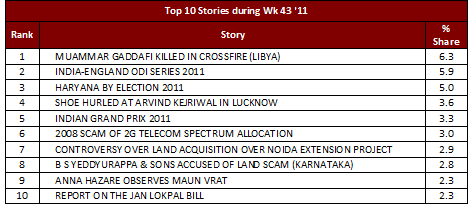
  • NCT Data Wk 43 ’11

    Source: News Content Track – A service of TAM Media Research Pvt. Ltd

    Channels: Aaj Tak, CNN IBN, Headlines Today, IBN 7, India TV, NDTV 24/7, NDTV India, Star News, Times Now & Zee News

    Period: Wk 43 – Oct 16 to Oct 22, 2011

    Note : Analysis is based on the telecast duration

    About TAM Media Research


    TAM is a joint venture between Nielsen Company & Kantar Media Research. Besides measuring TV Viewership, TAM also monitors Advertising Expenditure of Television, Print & Radio through its division AdEx India. Since 2004, it extended its presence in the PR Measurement & Analysis space for Corporate/Marketing Clients by setting up a separate division Eikona PR Measurement.


    In 2007, the joint venture introduced RAM (Radio Audio Measurement) service to track Radio Listenership for the Indian Radio Broadcast Industry. In year 2009, TAM launched a division, called TAM Sports that specializes in monitoring Sports Sponsorship ROI.


    TAM Media Research’s objective is to fuel media insights that will drive the growth of the Indian Media Industry.


  • AdAsia opens in grand style

    By Akash Raha

    AdAsia went underwent today with a gala high decibel opening ceremony called the ‘Zee Gala Night’. The event will host over 1200 delegates from over 25 countries. All the leading names of the advertising fraternity were present to grace the opening ceremony of AdAsia 2011, held in New Delhi.

    The evening began with traditional Cambodian dance which represented the dance of Asia. It was followed by several other dance forms from Taiwan, Thailand, Japan and not to mention, India. The day’s proceedings was anchored by the multi-talented Boman Irani who enthralled the crowd by his witty comments, his humour and not to mention, by singing wonderful songs. Mr Irani also announced the Chariman of AdAsia, Mr Madhukar Kamath of the in-the-news Mudra Group.

    This was followed by a speech by Mr Tejender Khanna, Lieutenant Governor of Delhi. Mr Khanna spoke about India, Delhi and the theme ‘Uncertainity: The new Certainity’.  A part of this amazing evening also was percussion maestro Taufiq Qureshi who enchanted the crowd with his amazing performance.

    The day ended with mouthwatering food and drinks. The food from all over Delhi was brought to the table for the delegates and was named ‘Streets of Delhi’.

    Day 1

    The day one of the conference begins today (November 1) with several key sessions and addresses by prominent members of our industry. The day will be started off with the Indian national anthem followed by a choir performance. Bollywood star Shah Rukh Khan and Minister of Information & Broadcasting Ms Ambika Soni are scheduled to  be the guests of honour.

  • Debrief: A shining ad!

    By Anil Thakraney


    Here’s the Micromax ad that did not leave actor Shiney Ahuja very amused. And he’s taken legal action against the advertiser.


    Now, Micromax is notorious for over-the-top and often offensive advertising, so this commercial came as no surprise to me. It sits in well with their brand personality. A young lady excitedly tells her female friend that her hubby, whose name is Shiney, has bought her a new Micromax Bling handset. And she’s surprised to find that the naughty Shiney has bought the same instrument for her pal too. But she gets the shock of her life when the housemaid declares Mr Shiney has bought one for her too!


    Hahaha. I think the ad is very funny and very Micromax. I like advertising that cleverly ties in the brand’s message with current affairs. It just makes the communication that much more engaging. It’s a pity that Shiney Ahuja lacks a sense of humour. Also, if he had kept quiet, some people would have noticed the ad. Now that he’s protested, many more will. Enjoy!

    [youtube]http://www.youtube.com/watch?v=iBascDwOIiQ[/youtube]

    Rating: (On a scale of 1 to 5): Full 5! I am still laughing! 

  • The Anchor: Hoshie Ghaswalla on 10 reasons why B2B media will thrive

    By Hoshie Ghaswalla


    B2B media is the most connected to both its key constituents – be it the reader or the advertiser / sponsor. Its in-depth understanding of the domain it operates in gives it a clear, distinct and sufficient edge over the other media forms. Here are 10 reasons why this media will thrive.


    #1 Domain Engagement – B2B media is deeply engaged within the domain it operates. In fact more often than not B2B media thinks it’s business is the same as that of the domain it caters to. At times, it is dangerously stitched to the domain it works with and people at the media venture often forget that they are in the media industry and need to apply those norms to their working, contrary to those of the domain they operate. There can’t be anything as powerful as this where people passionately believe they are a part of the business they cater to.

    #2 Reader engagement – The understanding of reader requirement is key in this business and good B2B media players regularly carry the reader with them at all stages. Their understanding of the domain comes in from the reader and you often see very involved and long tenured editorial / content committees that aid in the content strategy and delivery for the entire industry they operate across. How much more powerful can it be when the main customer of media has an active say in the creation and shaping of the editorial product on a consistent basis.

    #3 Advertiser engagement – This too is natural. B2B media players work very closely with advertisers as they understand their needs. From selling simple inventory, B2B media has much earlier begun to offer complete 360-degree solutions to advertisers who want to reach out to their customers in a more meaningful manner. In fact qualified lead generation is a new trend that has begun to emerge over the past few quarters in this space. What more can the advertiser ask for when s/he is getting their communication directly in to a relevant audience.

    #4 No wastage – B2B media players do not focus on mass. Their objectives are to be able to connect the advertiser / sponsors to the information consumer. So while other media would have a much larger audience they reach out to, B2B is controlled and the advertiser / sponsor pays for rich visibility. Likewise for the information consumer that gets the information they seek and do not have to go through clutter to find what they are looking for.

    #5 International trends – In the US B2B online marketing spend is projected to grow 40 percent faster than core media in 2012.

    #6 Advertiser Trust – B2B media enjoys the highest trust from the industry amongst other media. Most B2B publishers work to enhance the objectives and standing of the domain / industry they operate in rather than containing themselves to simple media-related objectives such as top-line and bottom-lines. They are a key part of the domain they operate in and very often lead in the cause of betterment of their domains.

    #7 Trust from the reader – Readers too love the B2B media because of its comprehensive understanding of the industry. This is possibly the only form of media they trust before taking significant decisions for their business. In fact this author has had instances over the past few years where readers have come to him and his colleagues and requested them to take large decisions on their behalf.

    #8 Passionate / Committed to cause – Objectives often different from commercial / profitability.

    #9 Medium agnostic – Unlike readers and advertisers of other mediums who need their daily fix of a particular newspaper, or a soap opera or a news capsule, B2B readers are sworn to the brand they have been following and are happy to get their information across any delivery medium. Likewise the advertisers / sponsors too are looking for connects to their customers and not just inventory purchase.

    #10 Content is monetizable – Due to the rich and relevant nature of content, B2B media is able to charge more for its content, contrary to other forms of media. In fact this trend is increasing and it seems highly likely that B2B will gain significant revenue from the main customer, which is the information consumer, thereby bringing down its revenue dependence from the advertiser / sponsor.


    Hoshie Ghaswalla is President – Publishing at CyberMedia India Limited.

  • Shika Mukerjee: Mamata dream sequence ends

    By Shikha Mukerjee

    Like a grand infatuation that is pursuing its natural course towards an inevitable end, the heady, halcyon days of the media’s romance with Mamata Banerjee as the harbinger of “change” or “parivartan” are coming to an end. Sunday, October 30: the mainstream print media is showing distinct signs of doubt about Didi’s capacity to deliver on her promises; her announcement that for the next one month all her attention would be focused on “industry,” her “Diwali-gift” of projects to the people of West Bengal produced sceptical headlines.

    Of the two dozen or so daily newspapers in Kolkata, the story of the Diwali gift or Industrial Revolution was the lead in many, the second or even third lead in some and appeared below the fold in a few rare exceptions. It is not a categorical imperative that Mamata’s initiatives on industrialisation must be the universal lead in every newspaper or even television. The Telegraph said, ‘A Diwali ‘gift’ but not so perfect’. The Times of India said, ‘Industry bonanza hits Singur hurdle’. The Ananda Bazar Patrika said, ‘Mamata takes the field to gain Industry’s confidence.’ Ekdin said, ‘Assurances of Industrial revolution in West Bengal to restore its golden past’. Pratidin said, ‘Now the Industrial Revolution.’ Bartamaan said, ‘Migration in search of jobs to end: Mamata.’

    On television, especially the top five 24X7 Bangla news channels, more widely watched and consequently of greater significance in terms of reflecting popular sentiment, the story was listed a long way after news on crib deaths and the newest Maoist demands. National news channels insistently reported on the growing number of crib deaths and the failure of the political leadership, namely Mamata, to respond to the situation as an emergency.

    A month or two earlier, no market savvy newspaper or television channel would have given a negative spin to any story featuring Mamata as the principal actor. By describing her Diwali gift as old projects repackaged as new, the newspapers are signalling that the romance is nearing its end. Some newspapers even listed which of the 10 projects that Mamata had announced as new initiatives had been sold to the public before. Some said that the list included so many public sector projects that the lack of interest of private investors was obvious. Some even quoted unnamed industrialists and public sector officials on why the list was a made up story of possibilities.

    One strong indication of the romance going stale was a story in The Telegraph on October 21, ‘Mamataisms at the Crossroads’, that analysed and checked off the status of her initiatives on her priority issues during the long, long campaign against the Communist Party of India Marxist’s misrule and arrived at the conclusion that she had made little headway though many starts, even if most were false ones.  The clash between the suave and pedigreed Trinamool Congress finance minister Amit Mitra and the former less socially elite, but no less academically qualified finance minister Asim Dasgupta was a delicious play off in which Dr Dasgupta has certainly scored a bull’s eye. As the story appeared, it was evident that The Telegraph, The Ananda Bazar, Ekdin, The Times of India were all clued in on who would win the fight.

    Assisted by the media, Dasgupta launched a methodical and technically sound demolition job on Mamata’s claims that a mere 6 per cent of the state’s money was available for development. The apparently academic point that Dasgupta made – on how the calculation was wrong – is in effect a lit fuse, politically. The positive play that Dasgupta received is the measure of the decline of Mamata’s magic in the media. The contrast is particularly striking because three months ago, when he made a similar point and was very critical that the new government had not presented a conventional budget, the media found ways of converting the criticism into the peeve of a loser. It dragged in seriously negative evaluations of his tenure as finance minister of the CPM government and quite openly jeered at him.

    It is intriguing that whereas Dasgupta’s earlier salvos did not get any support from the popular band of economists, this broadside had several economists, including one or two known CPM baiters and Trinamool Congress admirers confirming the accuracy of the ex-finance minister’s statement.

    In contrast, the very soft treatment that Mamata has received over crib deaths underscores her star quality.  The “failure” of the health system in tackling a crisis was played up in terms of the numbers of crib deaths at the BC Roy Memorial Hospital for Children. Media went out into the districts to find more instances of failure, in a show of initiative that indicates that the story has regained its own life instead of being a frame within which Mamata and her government are artfully displayed. But the media did not pick on her when she brushed aside questions at a press meet, declaring, “ask the health secretary” and “this is about industry”. Nor did it bay for her blood when she responded “What can I do.”

    The quagmire in which negotiations with the Maoists have been stuck, the declining credibility of the negotiators, the revision of strategy for dealing with the obviously reinvigorated ultra Left has not led to direct criticism of Mamata, but it has produced a shift in treatment. Even though the media has not underlined the abrupt change in Mamata’s stand, from declaring “There are no Maoists-Phaoists in West Bengal” to calling them “supari-killers” and “cowards,” it has turned watchful and cautious about the chief minister’s capacity to handle the problem, classifying it as one of the “Mamataisms.”

    Industry, finances, health, Maoists covers much of what Mamata promised as part of her Parivartan politics. By reserving judgment on the promises that she made – return of land to unwilling farmers of Singur, now mired in a legal battle, ending the Maoist problem, opening the doors to a flood of fresh investments, delivering better governance, extracting more money from the Centre – the media has played fair or even handled her with kid gloves. It has not clamoured for answers at the gradually but noticeably fewer press meets. She has not been cornered or pushed up against a wall.

    In fact the media has been unusually, almost unethically, gentle in its interactions with Mamata Banerjee. It has tolerated, even after she became chief minister, the ferocious regulation of access that she exercises with the media. It has accepted with good grace the fact that there are some newspersons who have 24X7 access to her and that the rest have to depend on these select few for camera footage and reporting. The band of faithful is privy to the best footage at every photo-opportunity; they are welcome in her office and get interviews. The rest have to make do with crumbs cast their way. The absence of protest is, as one journalist said, a measure of her “charisma.”

    Put differently, the news media cannot function without the crumbs because its audience or public remains loyal to the charismatic leader. No media publication or channel can afford to black out the things that Mamata does or says. No media channel can complain on air that it never gets a chance to interview the leader. No media channel can protest if a newsperson from another “house” sits in on an interview when it is finally granted. If after this prolonged discriminatory treatment the media has chosen to suck it up rather than raise a furore then it signals the popularity of Mamata Banerjee and the risk of annoying her. Therefore even when media persons privately complain bitterly about the “humiliation,” “discrimination” and “difficulty,” they have not as yet turned critical or even objectively analytical. The stories that the media does not report vastly outnumber the stories that it does; the discretion is exercised over what the public and positive image of Mamata can bear versus the stories that reveal the negative in terms of faults, whims, bad decisions.

    A year back, the CPM government would have been excoriated if it had spun the funds available for development story in the manner in which Mamata presented her desperate case at the National Development Council meeting in New Delhi. It would have trashed stories about promised bailouts by the Centre, especially Prime Minister Manmohan Singh to the West Bengal government for reasons of political sympathy. It would have gleefully pointed out that the Centre’s failure to deliver on promises was a pointer to the declining clout of the political leadership of West Bengal. In other words, Mamata is getting the best deal that the media has ever offered to any member of the political establishment anywhere; it has suspended disbelief and meekly accepted its assigned role in the Mamata era, as a faithful purveyor of designer messages.


    The writer is a senior journalist.


  • Omnicom moves to rule India with Mudra buy


    By Rajiv Banerjee, Amit Bapna & Sonali Krishna


    After a decade of on-and-off parleys, US advertising giant Omnicom has sealed a deal to gain control of the Mudra group, the last of the major homegrown advertising networks left in the country.


    The deal for a 41% stake will fetch Mudra’s majority shareholder and ADAG boss Mr Anil Ambani around Rs 700 crore, making it the biggest deal in the history of Indian advertising, a person involved in the transaction told ET. Omnicom agency DDB Worldwide has held a 10% in Mudra since 1993, and the latest transaction effectively hands control of the firm founded by Mr Anil Ambani some three decades ago to the US-based firm.


    Ambani will continue to own a 49% stake in his personal capacity in the agency, which has revenues of around Rs 200 crore in revenues and Rs 33 crore in net profit. The deal values Mudra at a little over Rs 1,700 crore, around eight-and-a-half times its top line. Omnicom has the option of acquiring another 25% in three years and the entire network in five years, according to the agreement. Reliance ADAG chairman Mr Anil Ambani, add those privy to the details, was offered a board position but opted for a berth on Omnicom’s international advisory committee.


    “I am happy for 1,100 families of Mudra professionals, who will now be part of the global network of Omnicom. It’s been a fulfilling journey for me, having started this agency from the shop floor of Reliance Industries’ textile division in Ahmedabad (in 1983),” Mr Anil Ambani told ET.


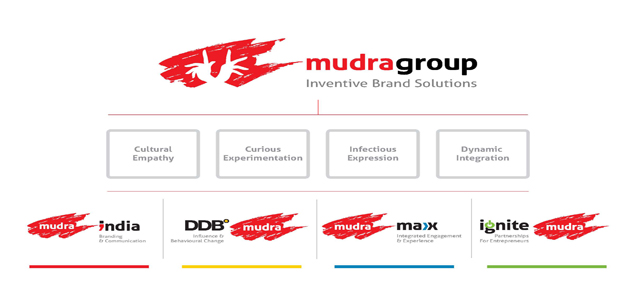
    As per the agreement, Omnicom will now control the Mudra group’s four agencies – Mudra India, DDB Mudra, Mudra Max and Ignite Mudra. Along with these, Omnicom also gets access to 26 pan-India offices. Those close to the deal say that Mudra’s focus on diversified advertising services (DAS) was the primary attraction for Omnicom. Along with branding, communication and marketing, Mudra also has an ‘integrated engagement and experiential agency in Mudra Max and perhaps India’s only agency for entrepreneurs in Ignite Mudra.


    Significantly, the Mudra Institute of Communications, Ahmedabad (MICA), a communications management institute, is set to become a global school for Omnicom.


    Omnicom Gets Foothold


    “Over the past few years there have been heightened levels of discussions that finally culminated in this partnership. We now get aligned in with DDB, and then perhaps can look forward to several tie-ups with Omnicom brands or working closely with several Omnicom brands that come to the country,” says Mr Madhukar Kamath, MD & CEO, Mudra Group. Other than DDB, the Omnicom network includes BBDO, TBWA Worldwide, and public relations firms like Brodeur Worldwide and Fleishman-Hillard.


    Omnicom for its part gets a solid foothold in a fast growing market in which it has been distinctly overshadowed by the big boys like WPP, the Interpublic group (IPG) and Publicis. Mudra would rank amongst the top five agencies in India in billings, behind JWT and Ogilvy & Mather, and in a similar league as Draftfcb Ulka and Lowe Lintas (both a part of the IPG network).


    Says Mr Tim Love, vice chairman, & CEO, Omnicom Group APIMA (Asia-Pacific India Middle-East Africa): “The deal is an important confirmation of the importance of Asia and India for Omnicom Group’s long range plans for our clients.” “The partnership gives us unprecedented scale across India,” adds Mr Randall Weisenburger, CFO, Omnicom. That scale may still not be enough to unseat the big boys. As IPG CEO Mr Michael Roth says: “Even after the acquisition of Mudra, IPG is still larger.”


    Mr Ambani started Mudra in 1983 with a capital base of Rs 10 lakh. The story goes that patriarch Dhirubhai gave the younger son Rs 10 lakh to start the agency, which essentially was an in-house division of Reliance back then. Fresh out of Wharton, Ambani converted it into a separate agency with the Reliance-owned Vimal brand being its first and only account. Ambani came close to selling Mudra in 2002 to Sir Martin Sorrel-lheaded WPP, which offered Rs 170 crore back then for a 70% stake. The wait has been worth it.


    Source:The Economic Times

    Copyright © 2011, Bennett, Coleman & Co. Ltd. All Rights Reserved


  • SAB eyeing ZEE’s ranking

    By Rishi Vora


    In a bid to increase viewership on the weekends, especially in the primetime 9 – 10: 30 pm band on Saturdays, SAB TV will air three brand new shows – Oye Bunty Babloo Oye, Kya Hoga Is Desh Ka, and Gaadi Bula Rahi Hai starting November 5. These shows will be aired for 20 weeks and each episode will offer a new story line with varied flavours of comedy. The shows will be produced and directed by Ravi Rai, Siddharth Tewary, Vipul D Shah, J D Majethia and Rajesh Beri.

    The move comes at a time when the channel is placed No 5 in the pecking order of general entertainment channels with 121 GRPs.

    Anooj Kapoor, Executive Vice President and Business Head, informed MxM India that his target is to reach 165 GRPs in the next three months and possibly beat Zee on overall GRPs. So while that means an increase of 40-odd GRPs, it will be interesting to see whether the channel is really able to topple Zee from the No 4 position. If that does happen, it will be a significant achievement, from where the channel could look at reaching the 200 GRP mark. Early this year, the channel did touch 150 GRPs and gave its sister channel – Sony a good run of their money.

    As for the new shows, Mr Kapoor is optimistic that they’ll bring fresh set of viewers to the channel. “Mostly people watch movies in the weekend, and if not that, they go out shopping, to restaurants and other places. We’re trying to cash-in on these audiences by offering something they would want to watch on a Saturday evening and then convert them into loyal viewers.” These shows will also help the channel get more advertising revenue, in the 9 – 10:30 pm band.

    On the marketing front, the channel will make best use of the MSM network. As far as the TG market is concerned, Mr Kapoor said that the idea is to look at broadening the viewership base across cities and towns in India and in making SAB-like comedy-family drama, a habit in many a households.


  • Rediffusion subcontracts Tata work to SBU with Edelman

    By A Correspondent
    We told you so. Rediffusion-Y&R and Edelman India announced a strategic alliance to take care of the Tata group business that starts today, November 1.

    The alliance brings together ad agency Rediffusion and PR firm Edelman. Edelman India is an independent public relations (as against others like Hanmer, Genesis and Sampark being part of international networks). The alliance will involve the formation of a separate business unit within Edelman to operate as Rediffusion/Edelman. Note: the SBU is part of Edelman. So, for all practical purposes, the Tatas have awarded the PR contract to Rediffusion which in turn has let it out to Rediffusion/Edelman. A spokesperson clarified that although the unit has been set up for the Tata account, in future it could also take on other businesses. A la Vaishnavi, which started out with the Tatas and took on other accounts.

    “The complexity of the Indian market favours an integrated communications approach that needs to seamlessly combine multiple marketing disciplines,” said Arun Nanda, Chairman and Managing Director, Rediffusion-Y&R in a communique. “Our partnership with Edelman allows us to partner one of the world’s finest PR companies and offer our clients the best in class thinking and capability in this area. This will enhance our already existing offerings in Advertising, Direct Marketing through Rediffusion/Wunderman, Media through TME/MPG and Digital. We will be able to add greater value to our clients across all of their marketing and communications requirements.

    “We believe this alliance will further enable us to push the boundaries of how PR is practised in India today” said Robert Holdheim, Managing Director, Edelman India in the statement. “We are seeing a significant shift in strategic stakeholder communications. An integrated marketing approach is crucial in addressing today’s communications challenges.”

    The spokesperson from Edelman was tightlipped about the staffing and who would be incharge of the SBU. It will evolve, he told MxMIndia.