Blog

  • The Anchor: 5 ways a marketer can use SMS to his/her advantage

    By Ravi Sundararajan


    #1 Acquisition of customers. SMS is a great tool to connect with new customers, and a marketer can leverage this medium to use it to target and acquire new customers.

    #2 Engaging customers. According to their area of interest, SMS can be used effectively to engage customers.

    #3 Retaining customers. It can also be a potent tool to retain customers by keeping them informed about promotions or information that might interest them.

    #4 Service Transaction. SMS also works well when one needs to give customers service-related information such as regarding bill payments or cash transactions.

    #5 Building infrastructure. There are many who don’t have infrastructure to set up communities or a mobile infrastructure service company. That’s where a company like ours can help marketers create such companies for others in the industry.

    Ravi Sundararajan is the Vice President Marketing at SMS GupShup.

  • Mediaah! Extra: Now, Vice Prez Hamid Ansari calls for debate on erosion of editor

    Pradyuman MaheshwariIt had to happen. Everyone has a view on how a newsroom should be run. The aam aadmi (and aurat) has a definite opinion on how newspapers and news channels ought to be run. They also know how Sachin Tendulkar must bat to score that hundredth hundred, but that’s another story.

    Here’s what the Vice President, Government of India, said while inaugurating the Press Council of India’s National Press Day celebrations.

    “Finally, I venture to hope that your debate would also focus on the erosion of the institution of the editor in our media organisations. When media space is treated as real estate or as airline seats for purpose of revenue maximisation, and when media products are sold as jeans or soaps for marketing purposes, editors end up giving way to marketing departments.”

    The Vice President didn’t go into  the controversy over his host Marandey Katju’s recent outbursts, but did talk on paid news. But it would be interesting to note how the big boys in the business (especially @ The Times of India group) have to say to this. Am sure they’ll laugh it off. After all, if the editors (and the tribe of journalists) don’t have a problem, why bother.

    Here’s what the VP said, courtesy the Press Information Bureau’s communiqué:

    “It gives me great pleasure to inaugurate the National Press Day. I congratulate The Press Council of India, its Chairman and Members, on this occasion.

    In over 45 years of its existence, the Council has fulfilled to a significant extent its mandate, as a quasi judicial body, of preserving the freedom of the press and of maintaining and improving the standards of press in India, and adjudicating complaints.

    Ours is an age of great change – social, economic, political and above all technological. Each has impacted on our individual and collective thought processes. Major premises are being revisited and the certitudes of an earlier era called into question. The answers are often disconcerting, in many cases tentative.

    The theme of today’s celebration is Media as an instrument of public accountability. A useful starting point of discussion would be to enquire into the basic premise of being a democracy.

    An essential feature of democracy is constraint on unlimited exercise of power. Democratic practice seeks to bring about accountability of actions of institutions and individuals in an objective, verifiable and transparent manner. While common understanding of constrains on power is limited to exercise of ‘public power’ by state actors, it is important to remember that it also extends to ‘private power’, of non-public authorities, especially when such entities acquire or exercise power traditionally associated with state structures.

    It is a truism that humans are social creatures who formulate rules of interaction aimed at furtherance of harmony and common good and avoidance of anarchy.  Rules and rule-based regulations are thus essential and unavoidable, more so in a democracy that eschews arbitrary exercise of power.

    Another truism is that some form of media has been integral to human civilization since time immemorial. Its principal purpose, to inform, remains unchanged. Technological innovations like the invention of paper and the printing press, radio transmission, TV broadcasting, and the World Wide Web have spawned new media platforms and devices for consumption.

    Today, the convergence between news media, entertainment and telecom has meant that the demarcation between journalism, public relations, advertising and entertainment has been eroded.

    The new trends in technological development and media conglomeration characterized by an emphasis on commercial values and outcomes, pose challenges to traditional public service values in news broadcasting.

    How do they impact the lofty ideal of journalism – of communicating reliable, accurate facts in a meaningful context?

    This aspect is of relevance because the media is the fourth estate in a democracy. It plays a major role in informing the public and thereby shape perceptions and through it the national agenda. Its centrality is enhanced manifold by increased literacy levels and by the technological revolution of the last two decades and its impact on the generation, processing, dissemination and consumption of news.

    Media outlets today assume importance not only for marketing and advertisement but also for the ‘soft power’ aspects of businesses, organisations and even nations. It is a harsh reality that media entrepreneurship is now a necessary condition for a business enterprise, a political party and even individuals seeking to leverage public influence for private gain.

    It would be instructive to study how other democratic systems have dealt with the media revolution and the convergence of communication technologies. Three stable democracies, namely the United Kingdom, the United States and Australia can be studied for best practices.

    In December 2000 the United Kingdom published a White Paper entitled A New Future for Communications in Britain. It suggested conceptual restructuring to bring together the five sectors of telecommunications, television, radio, broadcasting standards and radio spectrum allocations under a single-umbrella communications regulator. In addition, it proposed covering access, choice, content and competition.

    The White Paper proposed a new three-tiered regulation of broadcasting so as to provide a level playing field between the broadcasters, depending on the extent of their public service role. It stressed that all broadcasters be subject to minimum standards, impartiality in news, provision of protection of minors and access of people with disabilities.

    Emanating from this, The Communications Act 2003 established the Office of Communications (OFCOM) as the regulator for all communications industries to further the interests of citizens and consumers. It was tasked with ensuring optimal use of electro-magnetic spectrum, availability of electronic communication services, a wide range of TV and Radio services of high quality, maintaining plurality in broadcasting, applying adequate protection for audiences against offensive or harmful material, and against unfairness or infringement of privacy.

    The British experience of transition from a multi regulator to a single umbrella regulator, accountable to Parliament, and covering telecommunications, broadcast media and wireless spectrum, indicates that turf battles between economic sectors, government departments and individual companies have to be carefully managed in the midst of building a national consensus and enacting legislation.

    The experience of the United States and its Federal Communication Commission in regulating communications by Radio, Television, Wire, Satellite and Cable for over 75 years is also instructive. It promotes competition, innovation and investment in communications, encourages the best use of spectrum and revises media regulations so that new technologies can flourish alongside diversity and localism.

    American law imposes limitations on multiple ownerships and cross-ownership of media establishments across radio, television and print media to prevent emergence of monopolies and to ensure adequacy of independent media voices in the market that could serve public interests, localization of news and bring about diversity.

    In the case of Australia, it is The Australian Communications and Media Authority which is responsible for the regulation of broadcasting, the internet, radio communications and telecommunications sectors. In its role as a broadcast regulator, the ACMA plans the channels that radio and television services use, issues and renews licenses, regulates the content of radio and television services, including digital services, and administers the ownership and control rules for broadcasting services.

    The regulator enforces statutory control rules based on license area and audience reach, limitations on multiple and cross-ownership, limits on foreign control of the mass media, regulations on transfer of media operations and media groups, and determines acceptability or otherwise of media diversity. It seeks to bring about programme diversity, help foster a national cultural identity, bring about fair reporting of news and ensure respect for community standards.

    While media outlets in Australia have the main responsibility for ensuring that the broadcast content reflects community standards, most aspects of such content are governed by codes of practice developed by industry groups. The regulator registers these codes once it is satisfied that the codes contain appropriate community safeguards and are a product of public consultation. National content and children’s programmes on commercial television are regulated by compulsory programme standards determined by the regulator after consultation with the industry and the general public.

    You would notice that the experience and practice of other democracies indicates that media licensing and regulation is seen as a normal and essential activity to help its functioning as the watchdog of public interest. One is reminded of Gandhiji’s dictum that “an uncontrolled pen serves but to destroy”.

    In our country today, media represents a sector of economy that is the envy of others because of the extremely buoyant growth rates witnessed over the last two decades, in an environment characterised by minimal or no regulation. In the absence of any other government regulator, the focus has shifted to self-regulation by the media organisations, individually or collectively.

    Collective self-regulation however has yet to succeed in substantive measure because it is neither universal nor enforceable. Individual self-regulation has also failed due to personal predilection and the prevailing of personal interest over public interest.

    In an address at the Indore Press Club earlier this year, I had mentioned that while economic deregulation has been the dominant trend of the recent past, it is premised on a dynamic market place with a system of independent regulation, especially competition regulation, to prevent cartelisation, abusive behaviour by dominant firms and corporate transactions that derail the competitive processes in the market.

    Two questions arise here. In the first place, who will step in to address the gap when the government, the polity, the market and the industry are unable to provide for full-spectrum systemic regulation that protects consumer welfare and citizen interest?

    Secondly, can the constitutional safeguards on freedom of speech be used to evade regulation of the commercial persona of media corporates and groups? Where does public interest end and private interest begin?

    The experience of other countries shows us the way. The ongoing national debate on the subject should involve all stakeholders leading perhaps to the publication of a White Paper. This should lead to further consultations and evolution of a broad national consensus so that appropriate frameworks can be put in place combining voluntary initiative, executive regulation and legislative action, as appropriate.

    Such an effort can cover issues of multiple-ownership and cross-ownership, content and diversity, and a cogent national communications policy that covers print, radio, television, cable, DTH platforms, video and film industry, internet and mobile telephony, and electro-magnetic spectrum.

    Our democracy is poorer without active media watch groups engaged in objective analyses of the media, discerning prejudices and latent biases, and subjecting the media to a dose of their own medicine. For an industry that has over fifty thousand newspapers and hundreds of television channels, systematic media criticism is non-existent in India. This should be remedied and I hope your deliberations would address this important aspect.

    A related matter pertains to the recent controversy over ‘paid news’. It has been debated extensively in the Press Council and other fora, including Parliament. It is a matter of some satisfaction that the ‘culture of silence’ on the subject is being replaced with an attempt to grapple with this malaise at multiple levels.

    Finally, I venture to hope that your debate would also focus on the erosion of the institution of the editor in our media organisations. When media space is treated as real estate or as airline seats for purpose of revenue maximisation, and when media products are sold as jeans or soaps for marketing purposes, editors end up giving way to marketing departments.

    I would like to conclude by saying that all stakeholders – the government, the media organisations and the industry, civil society, advertisers and sponsors, and the audience and readership of the media – must address the various concerns regarding the profession and work towards securing and defending the public good.

    I thank the Press Council and Justice Katju for inviting me to the National Press Day Celebration. I wish you all success in your deliberations”.


    You’ll read more on this on MxMIndia (and Mediaah!) in the coming weeks.
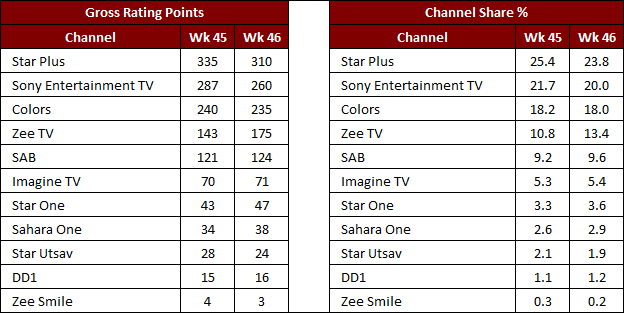
  • GRP Channel shares of HGECs- Wk 46 2011

    Source: TAM Peoplemeter System

    TG: CS 4+ yrs

    Market: HSM

    Period: Wk 45: Oct 30 to Nov 5, 2011

    Period: Wk 46: Nov 6 to Nov 12, 2011


    About TAM Media Research

    TAM is a joint venture between Nielsen Company & Kantar Media Research. Besides measuring TV Viewership, TAM also monitors Advertising Expenditure of Television, Print & Radio through its division AdEx India. Since 2004, it extended its presence in the PR Measurement & Analysis space for Corporate/Marketing Clients by setting up a separate division Eikona PR Measurement.

    In 2007, the joint venture introduced RAM (Radio Audio Measurement) service to track Radio Listenership for the Indian Radio Broadcast Industry. In year 2009, TAM launched a division, called TAM Sports that specializes in monitoring Sports Sponsorship ROI.

    TAM Media Research’s objective is to fuel media insights that will drive the growth of the Indian Media Industry.

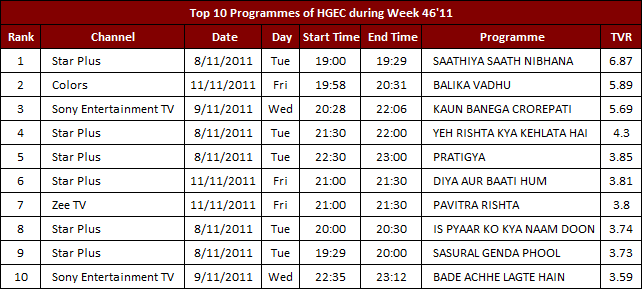
  • TAM data Top 10 programmes on HGEC – Wk 46’11

    Source: TAM Peoplemeter System

    TG: CS 4+ yrs

    Market: Hindi Speaking Market

    Period: Wk 46: Nov 6 to Nov 12, 2011


    About TAM Media Research

    TAM is a joint venture between Nielsen Company & Kantar Media Research. Besides measuring TV Viewership, TAM also monitors Advertising Expenditure of Television, Print & Radio through its division AdEx India. Since 2004, it extended its presence in the PR Measurement & Analysis space for Corporate/Marketing Clients by setting up a separate division Eikona PR Measurement.

    In 2007, the joint venture introduced RAM (Radio Audio Measurement) service to track Radio Listenership for the Indian Radio Broadcast Industry. In year 2009, TAM launched a division, called TAM Sports that specializes in monitoring Sports Sponsorship ROI.

    TAM Media Research’s objective is to fuel media insights that will drive the growth of the Indian Media Industry.

  • Times for news media to report on each other

    By Ranjona Banerji


    Uttar Pradesh chief minister Mayawati’s move to divide the state up into four parts obviously hit the headlines on TV on Tuesday night, competing with tycoon Vijay Mallya and his attempt to save Kingfisher Airlines. Since every political party other than the Bahujan Samaj Party took exception to this plan on some grounds or the other, it had news impact. Also as was eagerly pointed out, this took the shine off just-launched Rahul Gandhi’s UP poll campaign.
    Oddly though, Hindustan Times decided that the news did not deserve the front page in Mumbai – although it made it in Delhi – and only scant treatment within. Most other papers decided that this bold move was front page-worthy. Perhaps HT is going with the old belief that Mumbai is not interested in anything that happens in its own backyard. In which case it could have given it a local spin like ‘If UP breaks up, then Maharashtra becomes India’s biggest state’ or something equally parochial.
    **

    The fact that most media bodies are taking on the judiciary in the Times Now-PB Sawant defamation case is most heartening. If Rs 100 crore is the penalty for using the wrong photograph, most media houses would have long been bankrupted and had to close down. While using Sawant’s photo instead of PK Samantha’s photo in a judicial bribery case was unfortunate, the channel did apparently correct itself and apologise. There does not seem to have been any malice on the channel’s part here. In which case, Rs 100 crore is excessive.
    It would be wise not to get into too many “freedom of the press” arguments here. Clearly, the media is not free to defame, slander or libel anyone. But the media is liable to make mistakes and those mistakes cannot be misinterpreted as being deliberate and malicious.
    Largely thanks to the aggressive and sensationalist posture taken by television news channels, the conduct of the media has itself become a topic of conversation in India. While in itself this may not be a bad thing, it is dangerous when it becomes obsessive and every sundry TV guest becomes an “expert”. The media is open to scrutiny but a Katju-like approach is unnecessary and unlikely to be fruitful.

    **
    Having said that, how about a contrarian point of view? Is it time that newspapers and channels started reporting on each other? The Guardian took on Murdoch and The News of the World over phone-hacking. The Independent has now exposed the BBC over a set of documentaries about Malaysia. But in India, we are terribly polite about each other. Barring the Hindu – which has taken on its competitors like exposing holes in the Hindustan Times’s Bhopal editions sensational stories about babies having sex change operations – most media outlets spare each other.
    Is there room for change or should we give this British method a wide berth and live together with each other’s mistakes in perfect harmony?
    It may well be likely that owners and journalists have two different viewpoints here. Owners stick together very closely and as we have seen, the Indian Newspaper Society operates almost as if with a single mind, often to the detriment of journalists and sometimes, journalism.
    Any ideas?

  • FMCG retail will hit $100 billion by 2025: Nielsen

    By A Correspondent
    Nielsen estimates that the country’s rural FMCG retail landscape will grow from $12 billion in 2011 to $100 billion by 2025, as it unveiled its Consumer 360 report in New Delhi on Tuesday. Prashant Singh, VP, Nielsen, said: “The rural mindset is open to consumption of newer, more contemporary food categories and as a result, drives consistent growth.”

    The research firm has identified four key trends that will drive consumption: premiumisation, consumers switching from commodity to brands, from indulgence to regular consumption, and acceptability.

    “While small-sized packages are vital for entry into the market, as purchasing power increases, rural consumers are increasingly buying larger pack sizes to share with family and friends,” said Singh. Indian shoppers will increase spends on FMCG at modern retail stores from $1.8 billion to $5 billion by 2015.

    Sales at modern trade stores are up 31% since last year across the country’s socio economic spectrum.

    Source:The Economic Times

    Copyright © 2011, Bennett, Coleman & Co. Ltd. All Rights Reserved


  • The Anchor: 7 reasons to never ignore research analytics. Ever

    By V Balasubramanium


    The word “dynamism” has left a strong impression in the mind as we, like other consumers, have also embraced “dynamism”.  We experience the pace of this accelerating dynamism on a continuous basis. Dynamism in consumer behaviour as a result of a plethora of factors leads to the dynamism in the market. Given this increased pace, any brand – whether small or big, weak or healthy – needs to monitor its performance not only on a day-to-day basis but practically minute by minute. This monitoring and thus implementing quick course correction as required by changing consumer tastes is the biggest catalyst for any brand’s sustenance and growth. Research analytics come into play at this juncture. Without a proper and systematic research analytics strategy, brands, irrespective of size, will find the going tough. Thus the reasons for not ignoring research analytics are mainly connected with the word “dynamism”.

    #1 Consumer needs are evolving. Thanks to the increased exposure of the consumer to the globe through media, or through increased affluence, the attitudinal shift is the main driver to this ever-changing need. The resultant effect is tuning the mind for more brand messages, increased trial, and reduced loyalty.

    #2 The market is getting filled with more and more brands with varied offerings along with evolving needs. This crowding will lead to a greater effort by brands to gain increased consumer connect. Too many brands thus try to get consumer mindspace through various mechanisms.

    #3 Increasing knowledge of brands for the consumer. Consumers in this dynamic society try to get more knowledge of brands and switch decisions without any lag. This leads to expansion of the consideration set basket and reduction of loyalty.

    #4 Media is proliferating. Increased choice of connect points leads to more information being provided to the consumer, thus expanding the consumer’s knowledge base and aspiration levels. This results in increased brand trials.

    #5 Innovative distribution strategies of brands lead to more consumer brand interactions that influence changing brand choices.

    #6 Given all these complexities in markets and consumer behaviour patterns, marketers are increasingly looking for not only marketing RoI estimation but management of effective marketing RoI, the resultant benefit thus in monitoring the bang for the buck behind brands.

    #7 Static is an old word now. All brands are passing through this dynamic phase. To constantly gear to new challenges and create a proactive strategy for the win, brands need to look into present and past trends. Without proper ongoing marketing research analytics, brands of any size will find it difficult to face a new challenge.


    V Balasubramanium is the Director at RainMan Consulting.

  • Prashaant Bhatt to head Fiction at Colors

    By Rishi Vora


    In a recent development at Colors, Mr Prashaant Bhatt has been appointed as the head of fiction programming. He will be responsible for driving the fiction properties on the channel Colors and will take key decisions on new shows and concepts. Mr Bhatt will start his new role on December 1, 2011, reporting to the CEO Mr Raj Nayak.

    Announcing the appointment, Mr Nayak said, “Given Prashaant’s extensive experience in delivering compelling content for multiple successful fiction properties over the years, we are confident that he will take the Colors’ Fiction shows to a new peak. I am proud to have him on the team, and look forward to co-creating new frontiers in fiction programming on the channel.”

    On his new assignment, Mr Bhatt said, “I have tremendous appreciation for Colors’ constant attempts towards providing new and innovative content to viewers. I am looking forward to working with this incredibly talented group of people and to applying my knowledge and experience to fiction programming”.

    Mr Bhatt joins Colors from Balaji Telefilms, where he was the Creative Head for various successful shows. He has over 16 years of experience as a writer and creative director of various successful fiction properties. In the last few years, he has also been involved in conceptualising shows and creatively heading them for various production houses which include not only Balaji Telefilms, but also Rajshri Productions, Cinevistas, Creative Eye, AK Films, UTV and Shreya Creations among others.

  • Amod Dani is ECD, Leo Burnett

    By Shubhangi Mehta


    Leo Burnett India has promoted Amod Dani to Associate Executive Creative Director, Leo Burnett India. He will be based out of Delhi henceforth and will be directly reporting into K V ‘Pops’ Sridhar.

    Samir Gangahar, Executive Director, Leo Burnett, said, “Amod is one of the best talents of our country as well as a well awarded creative person. We are very excited to have him in the Delhi team and expect him to continue with the great work.”

    Mr Dani said, “The move is challenging, yet very humbling. It’s an absolute honour to be a part of Leo Burnett Delhi. Working with great people such as Nitish, Sam and Sai is truly exciting. Delhi is one of the fastest growing offices in the entire Burnett family. I hope to concentrate my efforts towards the upsurge and do justice to their faith in me”.

    Mr Dani has been in the industry for close to seven years. After completing his post-graduation from MICA, he joined Lowe, Doha as an intern. He then moved to Lowe, Mumbai, where he worked with Priti Nair for a year.

    He joined Leo Burnett in 2006, where he has worked on brands such as McDonald’s, Tata Capital and Reliance Mobile. The brands he handled at Lowe include Surf, Idea, Wheel and Liril.

  • Amritendu Roy catches Fever

    By Robin Thomas


    Amritendu Roy is now Regional Head – East, Fever FM. Prior to Fever FM, he was Head, Radio Business, Friends FM. Mr Roy who joined Fever FM in August 2011, is based out of Kolkata and will be reporting to Mr Harshad Jain, Business Head, Fever FM.

    One of his main responsibilities as Regional Head- East will be to drive the sales for the region.

    Confirming the news to MxMIndia, Mr Jain stated, “With substantial industry experience, he will be able to add a lot of value into the existing system and will prove to be an asset for Fever FM.”

    Mr Roy was instrumental in setting up Friends FM from scratch. Mr Roy started his career in advertising with Mudra Communication in 1990 and went on to become the Group Business Director at the time he left in 2004. In the 14 years with Mudra he worked in various cities like Kolkata, Delhi and Mumbai. He handled various clients with Mudra, the prominent ones being McDonalds, Indian Oil, Orient Fans, National Insurance, Reliance Telecom and Kitply. Mr Roy then moved to the FM radio industry in 2004 when he took over as Vice President and Station Head of Radio City in Delhi.

  • Hard Knocks: BCCI needs a third umpire

    By Anil Thakraney


    The first day’s play at Calcutta in the current India/West Indies series produced a real shocker. Near-empty stands at the Eden Gardens. Who would have imagined such a day would come in that cricket-crazy city? And this, despite a player like Sachin Tendulkar being in the house, and perched on the verge of a historic milestone of his 100th 100. Now, I realize cricket in India has become a television sport and that’s where all the money comes from. Still, it must be said there is no fun watching a match on TV with no cheering, booing, placards-carrying crowds in the backdrop. That’s the essential part of sports excitement. Already, the TRPs of test match cricket have taken a beaten in recent times, and with no crowds in the stadia, I am afraid more and more fans will give even television viewing a miss. And that would be an alarming situation for advertisers.

    There are many reasons why test cricket is dying a slow death in this nation. The obvious one is the BCCI’s greed, which has resulted in excessive cricket tournaments, leading to crowd fatigue. Then there’s the issue of New India’s impatience with a five-day game. These problems I would leave for the cricket pundits to tackle. However, I must say sponsors and advertisers must come together and set out a few guidelines for the BCCI if they don’t wish that the game, which is always a good marketing vehicle, dies out. Because today it’s test cricket, tomorrow it could be the one-day game. And if the BCCI chaps don’t listen, sponsorships should be cancelled.

    One thing the BCCI must be compelled to do is to ensure that the various cricket associations sell stadia tickets for a low price. Perhaps Rs 20 a ticket. And all minors and school kids should be allowed in for free. Also, facilities in the stadia should be improved so that going for a cricket match is a joy and not a pain in the you-know-where, which it currently is. The very very, very cash-rich BCCI can easily re-imburse the associations for their losses/expenses. This will make sure the stands are reasonably packed at any point of time. And we don’t have a situation where Sachin scores a ton and there’s no-one around to cheer him.

    Bottom line: The always greedy BCCI is determined to kill the goose that lays the golden eggs. And I think marketers must crack the whip and ensure this does not happen. It’s no longer enough being passive spectators in the game. It’s time to play the role of a strict referee.


    ***


    PS: Waiting for a cutting-edge column from Ms Shobhaa De on the Kingfisher mess. Mallya is the lady’s BFF, so let’s see if she gets after him like she does with all else. Will she risk missing out on a yacht invite? Take a guess!

  • Bride and, well, prejudice

    Every week, my least favourite life-form in the media changes. It’s confusing, with so many creeps and monsters to choose from. Not anacondas and sting rays and the rest of those. I mean humans.

    This week I watched with pissed-off fascination as those bridezillas, western and Indian, obsessed on their wedding. While they fume, fret and squeeze their parents dry so that they and everything around them looks fairytale etc on their wedding day, the merchandizers sponsoring the shows and the channels showcasing their anxieties and fears laugh all the way to the bank.

    When the western bride shows first appeared, it would have been funny, were it not so grotesque, to watch a grown woman steam rollering even the groom, let alone her parents, in her consuming need to live up to the fantasy in her head. Now it’s the Indians who are out-Shining everyone in the bid to be the reigning Bridezillas of the world. Helped along, of course, ably by anyone who has a stake in their delusions of grandeur – skin, eyes, nails, hair people, body sculptors, designers and tailors, jewelers, caterers, decorators, wedding card printers, photogenic priests, hired white guests, photographers, honeymoon packagers, planners, et al.

    Casting is simply not a problem, for these bride TV shows. All you need is a dullish looking girl, with even duller wits, and there’s your heroine! Of course it’s big business. The industry, estimated at $11 billion a year, is growing at 25 percent annually. And this does not count jewellery sales, which are growing at 7 percent annually, and are projected to reach $280 billion by 2015, is what we are told.

    At the risk of carbon-dating myself as a relic of the ’80s, I ask: Does anyone remember a time when such weddings were only something that the rich and famous indulged in? And the time when the average Indian simply got married; they didn’t have an ‘event’ which needed to be ‘managed’? The wedding was not at a ‘venue’. A local ‘badminton hall’, or a modest and pleasant wedding hall was booked for the day. The girl changed her sari once or possibly twice. Guests dressed well, but did not spend a month’s salary and man hours on what they would wear.

    Not any more, though. Like Woody Allen says, life doesn’t imitate art, it imitates bad television.

    The invitation card, as one of the shows on TV lovingly showed us, is the first indication of the shape of things to come. It is often bulkier than your local restaurant menu. These cards definitely have more zari work, silk, tassels and sequins on them than any piece of clothing that many of us possess. In fact, you could wear one of them around your neck, and carry it off as a piece of jewellery. Some people even produce little booklets – complete with Indian miniature paintings, shlokas, minor treatises on vedic rites and other fundas about the auspicious and holy act of matrimony… all in a more-Indian-than-thou kind of font, that was at one time used by royal calligraphers when kings bestowed citations on people they wanted to honour. Sometimes, the invitation card is not a card at all – but a CD, complete with clips of the bride and groom and their families inviting you; there could also be a little audio-visual bio-pic of the bride and groom, running you through their first baby steps, taking you on a tour of all their achievements in school, college, work – a mini-movie of sorts!

    In these bride-busting-papa’s-bank shows, when I watch grown people talking seriously into the camera for 10 minutes running about the relative merits of wearing Ostentatious Orange over Fussy Fuchsia, etc, I have this one thought: if we put even one-hundredth of the energy that goes into the making of a wedding, into what goes into the making of a marriage, there would have been much less aggro in our families.

    However, there are early signs that, in some circles at least, this psychedelic dream may not be for everyone. Already, in some families, it is becoming retro-fashionable to have a traditional but quieter wedding.  The kind in which the bride’s and groom’s parents didn’t have to quietly sell off their retirement home, and can feel proud that the education that they gave their girl child has trickled down into her psyche, so she doesn’t think that marriages are made in Bollywood.

    Perhaps someone will then do a retro-show on TV – and call it the Small Slim Indian Wedding.