Blog

  • UTV Movies India to launch in UK

    By A Correspondent


    UTV Movies India is set to launch on December 12 in the UK. Premiering on the Sky platform, the Hindi language movie channel, which will also carry English subtitles, draws on the universal passion for Bollywood.


    The channel upholds the promise of ‘Jeeyo Bollywood’ – living the Bollywood dream, giving viewers a direct experience of the spirit of Bollywood. The channel has a library of more than 400 titles.


    Advertising representation for the channel in the UK will be handled by Sky Media. Richard Hawking – Operations Director commented, “It’s a fantastic opportunity for us to add UTV Movies India to our portfolio of channels; it adds a new dimension to our offering for advertisers and great content for a growing and important audience.”


    Commenting on the expansion in UK, MK Anand, CEO – Broadcasting, UTV said, “With the launch of UTV Movies India in the UK we further expand our international footprint. The UK is a vital market for us as it has a large South Asian diaspora who are avid Bollywood movie lovers. We are proud to be associated with the UK’s largest media sales house – Sky Media, which comes with extensive media prowess in the region. We look forward to a successful entry into the region.”


    Kamlesh Patel, CEO, TVMedia3.com who concluded the deal between Sky and UTV said, “UK television viewers will be able to enjoy a rich and vibrant Bollywood movie experience that will appeal to mainstream television audiences. Bollywood movies are massively popular in the UK and with UTV Movies India we hope that this popularity increases further. It has been a real pleasure working with the teams at Sky Media and UTV Movies India.”


    Along with the United Kingdom, UTV Movies International is now also available in Canada on Rogers Digital Cable TV. With this development, UTV Movies’ international footprint now encompasses the United States, Australia, New Zealand, Malaysia, Sri Lanka, Nepal, the United Arab Emirates, East Africa, the United Kingdom and Canada.

  • Mid-Day shuts Delhi & Bengaluru editions, to focus on Mumbai


    By Rishi Vora


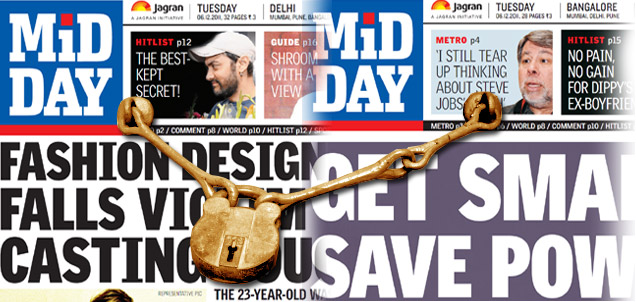
    After having tried out the Delhi and Bengaluru markets for a few years now, MiD-Day has finally decided to shut its editions in the two metros. The focus, as company officials inform, will be on Mumbai from now on, where the idea is to increase the paper’s circulation and enhance profitability.


    Mr Manajit Ghoshal, MD and CEO, Mid-Day Infomedia said “Advertising revenue in the two markets was on the decline, and so we have now decided to focus on our Mumbai edition.”


    Addressing the staff, he wrote in a mail on Monday evening, “It’s with a heavy heart that I have to announce the closure of MiD-Day – Delhi and MiD-Day – Bangalore editions. Tomorrow’s issue will be the last issue for both the editions. This has been necessitated by the prolonged losses we had to incur on these editions. The idea behind starting these editions was to establish these brands in these cities and make a difference in the lives of the citizens there. We had begun well and were appreciated for the quality of product we put out. However, in a corporate scenario, the books need to be balanced. Due to the ever increasing competition in the print media space, the funds required for breakeven in these cities kept escalating. Finally, we had to take this call. We will however, continue to maintain a news bureau in Delhi and our sales offices in Bangalore and Delhi.


    “By cutting our losses in Delhi and Bangalore editions, we will be able to bolster our circulation in Mumbai. Apart, from the plan to channel these investments, Jagran group (our parent company) will invest a large sum in boosting MiD-Day’s circulation in Mumbai. This will give our sales guys across the country to pitch Mumbai MiD-Day to clients and agencies in a new light. We need to now concentrate on building brand MiD-Day in Mumbai and monetizing Mumbai MiD-Day’s large increase in circulation and in this our sales colleagues in Delhi, Bangalore and Pune will have to play a significant part. Gujrati MiD-Day and Inquilab continue to go from strength to strength. We are increasing the circulation of GMD at a brisk pace and will continue to do so. Inquilab has flourished in the north and we now have 14 editions in all and are far ahead of any competition in the Urdu space.


    “MiD-Day Pune is an extension of MiD-Day Mumbai just as the Pune city is an extension of Mumbai. MiD-Day Pune will continue to run at an ever increasing pace and we will be monitoring the Pune media market keenly to spot opportunities to improve the circulation of MiD-Day Pune.


    “We will continue to invest aggressively in our digital properties as we believe that this is a medium whose time has come.


    While the shutting of the Delhi edition has been rumoured for a while, the same cannot be said for Benguluru. A senior member from the MiD-Day Benguluru office who did not wished to be named said that the letter took everyone by surprise.


    The paper was launched in the garden city in 2006. On why the edition failed, Mr Anil K Sathiraju, AVP and Head – Mudra Max Bengaluru said, “MiD-Day is a Mumbai paper, positioned as the traveller’s paper. The reason it didn’t work in Bengaluru is before it was launched, there were newspapers that had been in the market for ages and MiD-Day came with a different positioning which wasn’t right for a market like Benguluru.” He further added that the paper’s stagnant circulation was an indication that brand MiD-Day wasn’t very popular among readers, which led to a greater perception problem.


    The Delhi edition, as is known, was first launched in 1986, and within three years of launch, it was sold to industrialist Lalit Suri’s family. Then again in 2006, it went up for sale and was bought back by Mid-Day Multimedia. Madison Media CEO Ms Basab Datta Chowdhury feels that it was purely on the basis of market reality that the Jagran Group chose to shut the Delhi edition. “It’s a call that you need to take. If a product is not delivering as per expectations, and if you feel that shutting shop is the only way, then the sooner you do it, the better it is. The paper tried its best in Delhi, it didn’t work out. It’s doing well in Mumbai, so the decision to focus there.”


    Citing similar reasons is Mr Sundeep Nagpal, Director of Stratagem Media and a veteran planner who has been following the print media (and MiD-Day specifically) closely. In fact, he is of the opinion that the daily could have done better in its marketing efforts, especially in Benguluru to increase circulation and readership. Mr Nagpal said, “The scope for a No 4 or No 5 newspaper in any language category, to generate both readership or advertising revenue, especially in a cosmopolitan market/ metro, is quite minimal. Both, Delhi and Bengaluru were already dominated by giant groups like TOI, HT, and even Deccan Herald, not to mention others like Indian Express etc. And so they proved to be the big hurdles for Mid-Day, despite the fact that Mid-Day was always supposed to be an evening paper. Also, given the landscape of the public transport in these cities, vis-a-vis that in Mumbai, the scope for Mid-Day to find traction as a commuter’s paper, was also considerably lower than that in Mumbai. And lastly, as a late entrant in these markets, the paper also required very aggressive promotion, perhaps of the likes that we saw in the case of DNA and Hindustan Times in Mumbai.”


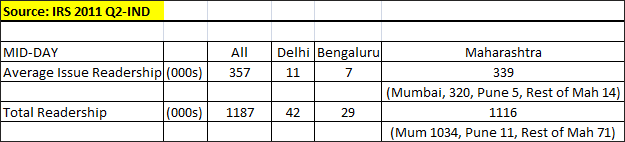
    The recent IRS figures (2011, Q2) indeed don’t show a good picture. The papers average issue readership in Delhi stood at 11,000, while in Benguluru, it was 7,000 (see table). Now that the two non-performing markets have been shut, and with investments to pretty much go to Mumbai, it will be interesting to see how the paper picks up on circulation in the city and whether it is able to pose a greater challenge to the market leaders.


    Lock image: Nuttakit

  • Citing profitability, Mid-Day bids ‘ta ta’ to Delhi & Bengaluru editions; to concentrate on Mumbai

    By Rishi Vora


    Mid-Day, Mumbai’s leading English daily, has announced the shutting of its Delhi and Bengaluru editions. The reason: profitability. Mr Manajit Ghoshal, MD and CEO of the company, confirmed this to MxMIndia. “Both Delhi and Bengaluru editions will shut down with immediate effect. Tomorrow is the last time the papers will be circulated in the respective markets,” he said.


    Elaborating on the reason behind the decision, Mr Ghoshal  said, “We have decided to shut down both editions in the strategy to be more profitable. Advertising revenues in the two markets was on the decline, and so we decided to focus on our Mumbai edition.”

  • R.I.P, Dev Saab

    By Ranjona Banerji


    The death of Dev Anand, not unnaturally, took up most of Sunday’s news and a good proportion of Monday’s newspapers. To the more maudlin amongst us, it seems that 2011 has stolen many of our “icons” (The cynical might argue that death is inevitable). But when it comes to Dev Anand, no amount of mourning is enough and no encomium over the top. This is a loss of an amazing spirit and an irrepressible zest for life. In this ego-ridden world, Anand refused to rest on his past laurels and kept looking ahead to his new ventures. He did not seem fazed – or if he was he did not let them daunt him – by his many failures in the last 20 years. He just kept on. The Times of India most appropriately headlined their lead, ‘India’s Youngest Star Dies at 88’.


    From being one of the triumvirate who ruled Hindi cinema in the 1950s,60s and even the 70s and beyond, to a whimsical director who refused to be defeated either by age or opinion, Dev Anand carried the flag of both the golden age as well as the future.


    The fact is that Anand was criticised through the later part of his life – albeit affectionately – and he took it all in his stride. In death, then, we can only look back on a glorious life.


    **


    Most called Anand’s death ‘end of an era’, which indeed it does signify. The international media has picked it up as well and not just because Anand died in London. Bollywood and India’s reach is now well known. But Anand also made a name for himself a long time ago with Guide. Renowned novelist Pearl Buck adapted RK Narayan’s novel for the 1956 English version of the movie. The Hindustan Times, harking back to one of Dev Anand’s seminal films, headlined their second lead, ‘Indian cinema loses its ‘Guide’. Though one is not sure whether Anand would have been happy with being called a guide; perhaps he saw himself more as a trailblazer! (It is another matter that the making and final versions of Guide, gave Narayan close to a nervous breakdown!)


    **


    The newspapers have been full of tributes and over the next weeks we are bound to see more, from those who know him well, those who met him only once, the various people he introduced to cinema and his millions of fans.


    **


    Based on a conversation on Twitter and my own observation, it appears that reporters have so much to thank social media and micro-blogging for. The tedious task of calling people for reactions to some event has now been replaced by logging on to twitter and taking down comments. So much easier than conventional calls and with no chance of the person being “misquoted”?


    (Unless of course you quote Suhel Seth whose twitter account is apparently hacked into at regular intervals!)

  • The Anchor: Piyush Pandey picks his 6 all-time favourite Dev Anand numbers

    By Piyush Pandey 


    When asked to list my favourites, I actually wrote down these songs on a piece of envelope recalling his work. I don’t use the internet so I didn’t rely on Google to help me with these songs. These are songs that have left an impression on me and are stored somewhere within me. [First published: December 5, 2011, updated September 25, 2023]


    #1 Main zindagi ka saath nibhata chala gaya, har fikr ko dhuen main udata chala gaya from the movie Hum Dono. The philosophy of life that the lyrics of this song embody makes it my favourite. It’s about being happy, and not looking back but moving ahead in life.


    #2 Yeh dil na hota bechara, kadam na hote aawara from the movie Jewel Thief. All the songs I am listing express emotions in a beautiful manner. These do not rely on any kind of musical gimmick but are genuine pearls on life and its ways.


    #3 Hum bekhudi mein tumko pukare chale gaye, sagar mein zindagi ko utare chale gaye from Kala Pani. The song is a perfect example of stringing emotions with powerful lyrics.


    #4 Apni to har aah ik toofan hai, upar wala jaan kar anjaan hai from Kala Bazaar. The song plays a pun on the word uparwala. It’s picturised in a train and Dev Anand in the song actually means the girl on the upper berth but puns the word to signify uparwala as God.


    #5 Dil aaj shayar hai, gham aaj nagma hai from Gambler. Dev Anand’s songs, like the man himself, reflect his passion for life. He had been romancing life through all of his songs and somewhere this passion kind of drips from the work he did.


    #6 Phoolon ke rang se, dil ki kalam se tujhko likhi roz paati from Prem Pujari. I am a big fan of Dev Anand’s, and have seen some of his movies like Johnny Mera Naam repeatedly.


  • Aidem Ventures to handle sales for The Economist online in India

    By A Correspondent


    Inez Albert
    Suprio Guha Thakurta
    Neena Dasgupta

    Aidem Ventures has been appointed as the media representative for The Economist online business in India.
    Announcing the appointment, Inez Albert, Digital Sales Director – The Economist Group (Asia/Pacific) Ltd. said, “We look forward to strengthening our business presence in India by appointing Aidem Ventures as our representative in India. This partnership, enhanced with Aidem’s business acumen and expertise in the field, will ensure that our commitment of sharing world views and unbiased news reaches out to all stakeholders in the Indian market.”


    Speaking on the appointment, Suprio Guha Thakurta, Managing Director, India at The Economist Group said, “We have appointed a strategic sales partner in Aidem and going by their domain expertise (news and digital), we are certain that we can take our online business to new heights in India.”


    Neena Dasgupta, Head, Digital & International Business – Aidem Ventures, said, “We are very excited with this mandate to enhance the advertising potential of a credible, global and iconic media brand like The Economist in India. As India continues to integrate strongly with the world economy, an increasing number of Indian companies and brands are looking at expanding their footprint globally, and are seeking robust global media platforms to build their brands to ensure a sustained engagement with the consumers. Aidem, with its extensive experience and track record in the news and digital space, is best equipped to partner with The Economist Online to strengthen their presence in the Indian market.”


    It is estimated that the advertising expenditure by Indian entities (like Incredible India) and companies (private and public sector) in the international markets would be around US $ 100 million. With new emergent sectors like medical tourism, software companies, telecommunications, spiritual and wellness tourism, it is anticipated that there will be brisk growth in the years ahead.


    Inez Albert

    Neena Dasgupta

    Suprio Guha Thakurta

  • Moneycontrol.com launches first app for iPad

    By A Correspondent


    Moneycontrol.com has announced the launch of its new app exclusively for iPad users. Already the no 1 financial app on iPhone and other smart phone platforms, the new moneycontrol.com iPad app will provide enhanced real-time access to financial markets.


    Users can get real time stock quotes, commodity prices, currency rates, Indian and global market indices as well as enjoy in-depth coverage and analysis of financial markets, economy, business and much more. Besides this, users can also access their portfolio and watchlist and watch live streaming of CNBC-TV18 and CNBC Awaaz. Users can also access moneycontrol’s large investor community through moneycontrol’s message board service. The app also includes a whole host of other features like alerts, in-depth information and data on all listed companies, video-on-demand etc.


    Commenting on the offering, Joyson Thomas, COO, Web18 said, “As increasing number of users are now consuming content and services through tablets and smartphones, it made sense to tap into this fast growing segment of savvy users, and carve out a dominant position in this space. Launching the moneycontrol app for iPad is part of our endeavor to stay in tune with changing user preferences. Looking at the overwhelming response to the moneycontrol app across all other platforms and the feedback that iPad has received from the market, we are positive that the combination of both will take this product to a new level.”

  • AdStrat: Humming Girl

    Amod Dani, ECD, Leo Burnett


    The campaign:

    Humming Girl


    The client:

    Tata Capital


    The agency:

    Leo Burnett


    The brief:

    To create a campaign (led by television) to launch their Home Loan vertical. This is the brand’s first foray into the Home Loan category.


    Any specific advisory from the client:

    Tata Capital is a brand synonymous with the values of the parent group Tata Sons. The brand stands on the platform of doing what’s right, and we have worked hard to bring this philosophy alive through our previous two campaigns (Old Coin & Sardar Twins).


    Going forward we had to keep the core values of trust, sincerity, consumer empathy and integrity alive in the new home loan campaign as well.


    [youtube width=”400″ height=”250″]http://www.youtube.com/watch?v=e8qvFzkGnOE[/youtube]

    Research insights:

    Through focus groups and through Burnett’s hot button research we were able to unearth several insights which concerned rented homes. However, one truly stood out and struck a chord with everyone.


    If there is one place in the world where an individual can be herself, express herself freely and do what she likes, it’s her own home. It’s the place where she feels liberated from the external pressures. She is devoid of any scrutiny or judgment of the society. Where there is absolutely nothing to fear and where she feels most secure.


    Media vehicles:

    We led the campaign through Television supplemented with Outdoor &Print.


    Key issues kept in mind while executing the ad:

    The home loan market is quite intense and competitive. With the growing need to find a suitable home advertisers have constantly tried to push the envelope. But this has often resulted in complex communication that is more informative than emotive. We believe that buying a home is not just a rational decision.


    We planned to ride on the emotional equity associated with owning one’s own home. The truth that only in your own home can you truly express yourself is a liberating insight. The creative lens of viewing the complex financial world through a child’s eyes gave us the platform to bring this insight to life.


    The brand prides itself on human truths and consumer understanding. Therefore, we were very careful and worked to keep the execution real, honest and simple. The tone as you can see in the commercial is thus empathetic and genuine, true to the Tata values.


    The differentiating factor about the ad:

    The one thing that truly sets this ad apart from the rest is the fact that it is deeply rooted in a human insight. The ad is something that people residing in rented homes can truly connect with.


    The execution is a very sincere and honest attempt at connecting with these very people. Therefore the performance of the talented young actors is also very real. Her humming is memorable and sweet and once you see the ad, it’s hard not to hum along. Overall Amit has delivered a very charming film.


    Market and client feedback and follow-ups:

    We are currently awaiting actual numbers since the TVC went on air. However, the initial response both from the market and the industry seems very positive. The charming execution has been well appreciated by the client, industry peers and most importantly the common man.


    Credits:

    National Creative Director: KV Sridhar

    Creative team: Rajesh Mani, Amod Dani, Anirban Sanyal, Sachin Kamath, Nilesh Ajarlekar

    Client Servicing: Suvadip Ghosh, Manish Somani, Nandita Das, Yash Bhawsar


    Head | Brand Marketing & Corporate Communication: Veetika Deoras

    Production House: Chrome Pictures

    Director: Amit Sharma

  • Very challenging times for radio: Rana Barua


    By Robin Thomas


    Rana Barua is a veteran media professional. He is Chief Operating Officer (COO) at Red FM. Prior to joining Red FM, he was the EVP – Programming & Marketing at Radio City. Before he moved over to radio, he was VP and Head – Mumbai at Bates. And earlier:

    Client Services Director at Rediffusion DY&R, Account Director at McCann, Senior Account Exec at Ogilvy & Mather and Account Exec at JWT. He’s been through it all.

    In conversation with MxMIndia.com, Mr Barua speaks about FM phase III, and how radio can emerge stronger from the ongoing slowdown.


    Q: How did your transition from advertising to radio happen?

    Advertising was getting a bit stagnant, the market in media was opening up, television had opened up in a big way at that time, newer media were on the anvil, movie marketing was also opening up, radio was also growing at that point in time (ie about six years ago). I have always been very keen to move into a domain which is more or less a specialized medium. Since radio was also into huge expansion mode with phase II at that time, it made more sense to move into radio rather than any other medium.


    Q: And the advertising experience came in handy…

    Oh yes! I think it comes in extremely handy if you come in from classical advertising or communication which is more specialized. Since I moved as Head, Marketing, it made a lot of sense because I worked with a lot of brands, and had the entire expertise of knowing clients, advertising, communication skills, media and creative agencies. Thus the entire gamut came in handy which helped me settle in easily. So, the transition was good, it was just that the scope was very different.


    Q: Can you throw some light on the overall importance of phase III for FM radio?

    Phase III is extremely, extremely important for radio growth. This is probably going to be very exciting, at the same time a really challenging time for the industry because radio is multidimensional. There is huge expansion, multi frequency will be allowed and news will be available but not in its best form as it will be sourced from All India Radio (AIR). FDI gets raised from 20 percent to 26 percent. I’ve always said it should have been higher because that would have allowed more international players or private investors/ equity holders to look at it in a more serious way. Fourthly, networking will be allowed, which means one will be allowed to run the FM station sitting out of a main hub; as a result the cost may come down. Therefore if you look at it on the whole, these are definitely exciting times and we will probably know how all of us shape up in the next two years. There are going to be many challenges and a great number of opportunities for everybody in the radio medium.


    Q: And this will help increase the ad pie…

    It should! The only contrary point is that you may have new FM players entering, but the ad pie will grow because of different genres coming in, as a result new clients may also come in who would have not necessarily advertised on radio. And since costs will also come down, you will find a lot of innovative programming happening in radio. Nevertheless, these are still early days; the overall scenario looks very positive, but the challenge is, what will be the benchmark for research? There are also other challenges like the music royalty issue, the entire migration process from phase II to phase III, the e-auction as bidding process etc.


    Q: Do you view e-auctions favourably?

    We are pretty okay with e-auction, and from what I have understood from a lot of people, it is a much cleaner exercise.


    Q: Are there any setbacks…?

    Everyone will have some issues which are different from each other. The common factor however is the music royalty issue which is still unresolved. We are still a little unclear about the multiple licensing because if the e-auction bid goes into some preposterous amount it will naturally lead to some kind of setback for the overall industry, so we are hoping that this does not happen. News could have been better if it had been a bit more independent and I am sure we would have invested in the entire medium/department. Nevertheless if you see the overall picture, especially the way radio has been growing over the last three or four years, this gives you an impetus. Today if you look at the global economic scenario you just can’t predict any more but, yes it is a movement forward, with exciting times, greater challenges. Yes, certain things could have been better or more favourable for us, but we will go step by step.


    Q: How is Red FM gearing up for FM phase III?

    We are still weighing the pros and cons. Yes, we will be seriously involved in Phase III. We are clear about being present in most of the markets which will have some kind of ROI but we will weigh the pros and cons, we will see the costs, we will be extremely cautious about the approach because breaking even in radio is not the easiest of forms as it will all depend on the return on investment (ROI), the advertising revenues etc. If you ask me whether we are serious about phase III, then yes we are definitely looking at it in a very serious way.


    Q: Any specific cities that you are looking at?

    No, we are not looking at certain cities, but we are looking at towns… say where we are not available, which are important for advertisers. We are looking at these as one of our strategies, but we are weighing all the pros and cons and only then are we going forward.


    Q: Is there any lesson or takeaway that the radio industry should learn in Phase III from Phase I and II?

    One of the critical learnings for a lot of us in phase I and II is probably going to be that we must not overestimate the potential of the market. We also know that we look at certain benchmark figures and we tend to overestimate and because of that one tends to overbid. This is one of the key learnings one is hoping that everybody puts on the table before one gets into the e-auction process because at the end of the day it’s a fixed pie and from that fixed pie you would probably get a certain amount of revenue for radio. More than phase I, and phase II, one of the learnings for all of us is the uncertainty of the markets as we don’t know what’s coming up in the next three months. Therefore, I think the biggest challenge that lies ahead for all of us is the uncertainty, which has become such a huge thing that everybody is talking about the uncertain future. Hence I think a cautious approach is going to be extremely critical.


    Q: So, is the uncertain future – the global economic slowdown that seems to have come back – is that something to worry about?

    Yes, absolutely. However, more than worry I believe we should be taking complete cognizance of the fact that there is definitely a slowdown. The clients, advertisers, everybody are extremely, extremely careful about the money they are investing in any form of media. Taking things for granted and creating business plans for the next two or three years seems passé now. It’s more like making a business model and reviewing it every month because the numbers keep changing every month, not because of wrong projections of estimation, but because the moment costs go up, inflation goes up, prices go up. The environment has become so dynamic – which it wasn’t even a year ago; every day there is a new story. So, it’s great to plan for the future, but I think one needs to be very cautious about any kind of numbers or projections or predictions made by various studies and research etc, which will however be reviewed very soon.


    Q: How would you sum up 2011 for Red FM?

    We have definitely grown; even this year we have made overall growth in our entire network, at a certain target we had set for ourselves. But as I said, with the environment being so dynamic naturally those numbers are nowhere close to what one would have guesstimated maybe earlier, say last year when things were so much on the rise and one had hoped that coming out of a slump the next two or three years would be on the way up. What we have managed to do very well is that as a network we have grown extremely strong – into a formidable player post the RAM numbers which were released I think a month or two ago, wherein for the first time RAM went into the nine markets which they are hoping to do more frequently. So we are pretty confident that all the efforts of building the brand and all the efforts in programming have really helped. We are confident because we have got people and our talent in place.


    Yes, we are aware that with phase III coming in there would be a lot of movement again, but that’s part of the business. We have got a great team going, who are extremely motivated and work passionately for their brand and numbers therefore are showing very well. As I said the larger markets are not showing growth that it should have ideally shown, but it’s the mini metros and towns which have grown much more dynamically for us.


    Q: And how would you sum up 2011 for the radio industry?

    Overall if you look at the numbers one had predicted for radio, the growth has not been as dramatic as one would have expected because it is understood that there has been an overall slowdown. One of the things we need to look out for is some kind of consolidation which is how we would want the medium to grow.
  • Change is the biggest challenge, says Divya Gupta (now @ Dentsu Media)

    By Tuhina Anand


    Divya Gupta, who has joined Chief Executive Officer, Dentsu Media is back in the media agency side of the business after a gap of almost seven years. She has been away from the agency set up but not really away from the industry as she was gaining experience being on the other side of the fence. First with Reliance ADA Group as Media Advisor to the Chairman’s Office providing strategic advisory on media investments for the group; later at Hindustan Times Media as Business Head – West with the mandate of building the business. Just before joining Dentsu India, Ms Gupta was an independent consultant advising and consulting marketers, media agencies and owners in the media business.


    In seven years, a lot has changed in the media landscape and MxM India deicided to catch up with Ms Gupta and find out what changes in the industry she can outline. She puts it concisely, that the changing environment presents both challenges and opportunities for the industry.


    Ms Gupta says, “First, I think the changing environment allows for having meaningful dialogues with consumers, almost on a one-on-one basis. Media today allows us to actively engage, build and nurture rich relationships with our consumers. And both the message and the medium can be tailored and served to each consumer.” For example she cites that the advertisements that are served to the consumers while accessing mail, search, etc, is basis their past interests and behaviour. Hence, the targeting goes beyond the demographics and makes a marketer’s and media professional’s job much more exciting.


    “Second would be about harnessing collective media synergies, seamlessly, in real time. Media roles are changing and no single medium, even TV, will be self-contained. The opportunity lies in media blending; combining and harnessing each medium in a digital chemistry that delivers across all, paid, owned and earned media,” continued Ms Gupta. “Centered on the brand engagement idea, the focus will be to get better “earned” dividends and the ultimate goal being allowing our consumers themselves to carry forth our crusade.”


    Also she emphasized that today’s landscape allows for realtime, instantaneous consumer feedback. If on the right track, one can march forward or do some quick course correction if need. No more waiting for months to understand the impact of advertising that used to happen some two decades ago, as now the response is instant.


    “Lastly, it is about tightening ROI from computing mere eyeballs to an engagement metric. Reach that is layered with engagement, in both planning and pricing, is a step forward in computing actual ROI. Today, computing eyeballs alone is sub-optimal. Think about it, how often do we check our mobiles while supposedly viewing TV? Dual screens are here to stay. Or how often do we read and register (keep click aside for the time being) all advertisements that get served to us on a search page?” said Ms Gupta.
    Concluding she said, “To encapsulate, it is exciting times, with media posing huge challenges and opportunities in building engaging consumer connections, experiences and nurturing relationships.”


    Talking about her task at Dentsu Media, she shared that it is to first stabilize and deliver to their current clients and then harness their global experience, to the way they work and their suite of media tools to deliver an integrated, multi disciplinary, channel solutions to their clients.

  • Thakraney: Sony after KBC. Reality shows must face the music

    By Anil Thakraney


    I really don’t know what Sony’s revenue model was for the recently concluded KBC. As in, did the channel actually make money on advertising and sponsorships after deducting the massive costs? Which include phenomenal sums going to the host Big B, not to speak of all the prize monies (Mr Sushil Kumar alone walked away with five crore rupees). Maybe they did make a little profit on the show, maybe they did not. But here’s what has happened immediately post the show: On the ratings chart, the channel slipped to No 3 from its position of No 2.


    Now, traditional programming logic suggests that expensive reality shows and blockbuster cinema films play the role of a magnet, of getting a channel some stickiness with the viewers. Having come onto the platform, viewers would taste the regular fare on the channel and hopefully stay on. Well, KBC doesn’t seem to have delivered on that promise. After enjoying the show, clearly many viewers defected to the other channels. This naturally raises a doubt in the mind: Are reality shows over-hyped in the desi entertainment channels? Are they worth all the effort and the expenditure? Is too much expectation being loaded on them?


    There are no easy answers to this one. But one thing is clear: You can tempt patrons into a restaurant by offering an outstanding dessert, but they will only return if the food is delicious. You can’t build loyalty through window dressing. The idea should be to first build a powerful back-end… which is to create super regular programming. And then run a huge reality show, so that viewers like what they taste when it comes to the ‘bread and butter’ shows.


    In this context, one has to wonder if Sony put the cart before the horse. Star Plus’s consistent No 1 position should provide a way forward for other channels: Which is to first do the basics rights. And then dial Mr Bachchan’s number.

    ***

    PS: LOL! Watch this ad for Snickers. A good example of how to (literally) use research methods in advertising, AND make it work very nicely!

  • Emgee group gives Quadrant creative mandates

    By Shubhangi Mehta


    In a multi-agency pitch, EMGEE Group has provided Quadrant Communications with the creative mandates for their property in Goa called Anantham.


    The account size is estimated to be around Rs 15 crore. Though no confirmation could be attained from the agency, industry sources close to the development have confirmed the news to MxM India.


    Poised for scaling greater heights in India and abroad, the EMGEE Group, with its solid financial roots and invaluable experience spanning 25 years, is spearheading the dreams of millions. The Group has raised the bar for quality construction, through modern homes strapped with luxury, astutely laid out commercial complexes and self-contained townships in vantage locations.