Blog

  • Hard Knocks: Crossed signals over FDI

    By Anil Thakraney


    I often wonder why international corporates even want to invest in a messy country like India. Why do they wish to take on all the headaches of operating inside such a chaotic nation. The answer, I suppose, is the market saturation in their own lands, and a raging desire to capitalize on the booming spending populace of this third world nation. Which makes the suits risk an entry into this snake pit.


    Well, all I can say is that these companies are either gutsy or desperate or both. If I was an international investor, I would quietly park my money in China. Or even Vietnam and Indonesia. And fly over India. Look at all the tamasha that just happened over the issue of FDI in multi-brand retail. And now it’s been put on ‘hold’… an euphemistic way of saying that the government chickened out of the deal. Here are the three messages we just sent to the global businessmen:


    1> The Indian PM is lamer than a lame duck. He has the vision, but lacks the ability, wherewithal and support to push new projects through. That, not just his rivals and allies, even his own party men can upset his plans at any time.

    2> Even if the FDI in retail bill gets passed, which is now a very remote possibility (even Baba Ram Dev doesn’t like it!), it’s left to the various states to accept or reject it. So you could be present in Delhi and Mumbai but missing in Bangalore, Kolkata and Chennai. And when the state government changes, there’s no surety the new government won’t kick you out of the city. So there’s never any hope of stability.

    3> Goons of various political parties are always ready for some action on the streets. So to pacify a particular vote bank segment, there’s always a chance that they will strike your super expensive store. Shattered glass panes, damaged wares and bruised business could be just a stone’s throw away.


    Yes, India is a hot destination for dhandha. But only for the steely, hardy, brave risk-takers.


    ***


    PS: Quite liked the rich tributes various TV channels paid to Devsaab immediately on the news of his death. The best package was put out by Times Now (pretty much non-stop coverage) and Aaj Tak (the only channel that told us some untold Dev Anand tales). The only disappointment came from NDTV. On a day like that, when the whole nation was humming Dev’s classics, they ran an hour-long, maha-boring prime time show on parliament adjournments. From the sublime to the ridiculous.

  • The world according to JWT, in 2012


    By A Correspondent


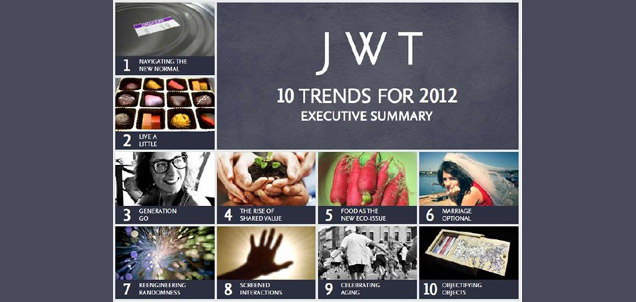
    Ad hotshop JWT feels that in 2012, the economy will push brands into opening up more entry points for cost-sensitive consumers as the “new normal” becomes a prolonged normal in the developed world while at the same time, tough times will generate an unprecedented entrepreneurialism, with the so-called Lost Generation of youth becoming a uniquely resourceful group that creates their own opportunity. The above findings and plenty more, are the result of their annual forecasting exercise – the seventh in the series – of key trends that will drive or significantly impact consumer mindset and behaviour in the year 2012.


    JWT’s ’10 Trends for 2012′ is the result of quantitative, qualitative and desk research conducted throughout the year for the report. It includes inputs from nearly 70 JWT planners across more than two dozen markets and interviews with experts and influencers across sectors including technology, luxury, social responsibility and academia.


    “With our annual trends forecast, we aim to bring the outside in-to help inspire ideas beyond brand, category and consumer conventions-and to identify emerging opportunities so they can be leveraged for business gain,” remarked Ann Mack, director of trendspotting for JWT. “Trends, like any complex and dynamic human phenomenon, are not preordained-once they are spotted, they can be shaped.”


    Previous trends that have been forecasted over the past years include: “De-Teching” in 2011 (more people logging off, at least temporarily, to get a break from technology); “Location-Based Everything” in 2010 (the explosion of location-based or -aware services that leverage data from mobile phones); The Small Movement” in 2009 (the shift away from “bigger is better” in everything from homes to cars to mobile technology); and “Radical Transparency” in 2008 (the “nothing to hide” ethos seen in some online behaviours).


    The top 10 trends that have been predicted for 2012 are as follows:


    1. Navigating the New Normal

    As the new normal becomes a prolonged normal in the hampered developed world, more brands in more categories will open up entry points for extremely cost-sensitive consumers. Marketers will find new opportunities in creating stripped-down offerings, smaller sizes and otherwise more accessible products and services.


    Example: In the US, Heinz is introducing several reduced sizes at a suggested retail price of 99 cents, including a 10-ounce ketchup pouch and a 9-ounce yellow mustard, as well as mini Worcestershire and Heinz 57 sauces.


    2. Live a Little

    Faced with constant reminders about what to do (exercise more, eat better) and what not to do (smoke, overspend), and fatigued from several years of austerity, consumers will look for ways to live a little without giving up a lot. People have been exercising more self-control, and increasingly they are looking to let loose once in a while: indulging in sinful things, splurging on treats and escaping from today’s many worries.


    Example: Whiskey in South Africa, premium beer in the U.K and cheap eclairs in India are small indulgences that consumers with little to spend are enjoying.


    3. Generation Go

    While twenty-somethings in the developed world feel they’ve been dealt an unfair deck, many are finding opportunity in economic adversity. Out of continued joblessness or discontent with the status quo will spring an unprecedented entrepreneurial mindset, enabled by technology that obliterates traditional barriers to entry. A so-called Lost Generation will transform itself into a uniquely resourceful cohort.


    Example: More than half of Millenials in the US agreed that if they lose or have trouble finding a job, they’ll start their own business, according to a JWT survey, up from 25 percent in 2009.


    4. The Rise of Shared Value

    Rather than simply doling out checks to good causes, some corporations are starting to shift their business models, integrating social issues into their core strategies. The aim is to create shared value, a concept that reflects the growing belief that generating a profit and achieving social progress are not mutually exclusive goals.


    Example: Philips is partnering with the Dutch government in a bid to provide affordable, sustainable energy solutions to some 10 million people across 10 sub-Saharan African nations by 2015.


    5. Food as the New Eco-Issue

    The environmental impact of our food choices will become a more prominent concern as stakeholders-brands, governments and activist organizations-drive awareness around the issue and rethink what food is sold and how it’s made. As more regions battle with food shortages and/or spiking costs, smarter practices around food will join the stable of green “best practices”.


    Example: U.K. supermarket Sainsbury’s featured a summer promotion in 2011 offering customers who asked for cod, haddock, salmon, tuna and prawns an alternative, more sustainable species such as herring or mackerel for free.


    6. Marriage Optional

    A growing cohort of women is taking an alternate life route, one that doesn’t include marriage as an essential checkpoint. Both in the West, where this trend is building, and in the East, where it’s gaining momentum, “happily ever after” is being redefined as a household of one, cohabiting or single motherhood.


    Example: In 2010, a third of Japanese women entering their 30s were single, while 37 percent of all Taiwanese women 30-34 were single.


    7. Reengineering Randomness

    As our individual worlds become more personalized and niche-and the types of content, experiences and people we are exposed to become narrower-greater emphasis will be placed on reintroducing randomness, discovery, inspiration and different points of view into our worlds.


    Example: Airtime, due to launch at the end of 2011, is being touted as a random real-time video chat platform where strangers will be “smashed together”.


    8. Screened Interactions

    More flat surfaces are becoming screens, and more screens are becoming interactive. Increasingly, we’ll be touching them, gesturing at them and talking to them – and becoming accustomed to doing so as part of our everyday behaviours. This is opening up novel opportunities to inform, engage and motivate consumers.


    Example: In New York, a restaurant at high-end department store Barney’s features 30 individual screens in a large communal table that’s covered in glass; diners can digitally order their meal, then browse the store’s catalogue while eating.


    9. Celebrating Ageing

    Popular perceptions of ageing are changing, with people of all ages taking a more positive view of growing older. And as demographic and cultural changes, along with medical advances, help to shift attitudes, we’ll redefine when “old age” occurs and what the term means.


    Example: To appeal to Gen Xers and Boomers, Polish beer brand Zywiec launched a campaign with the tagline “The best is ahead of you”. Commercials showed older male celebrities including actors, a boxer and a cartoonist, speaking about their lives, offering insights and advice.


    10. Objectifying Objects

    As objects get replaced by digital/virtual counterparts, people are fetishiZing the physical and the tactile. As a result, we will see more “motivational objects”, items that accompany digital property to increase perceived value, and digital tools that enable creation of physical things.


    Example: Sincerely’s Postagram app allows vacationers and others to turn snapshots into snail-mailed postcards. Similarly, Postcard on the Run reminds potential users that for recipients, a physical card is “a real keepsake they can hold close to their heart, put up on the fridge or display at work”.

  • Too many people taking undue advantage of TAM, says NDTV’s Vikram Chandra [from our archives]

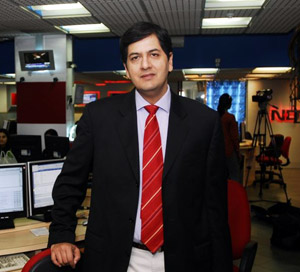
    While CEO Vikram Chandra wasn’t reachable for comment, this is what a spokesperson told MxMIndia: “We confirm we have filed a lawsuit in the Supreme Court of New York State. Because the matter is sub judice, we have no further comments at this time.”

    While the legal documents present the NDTV case, this interview of Mr Chandra from the MxMIndia archives (interview published on December 7, 2011) gives you a good idea of NDTV’s standpoint. – Ed


    By Akash Raha


    Recently NDTV 24×7 came out with an advertisement announcing the GFK-Mode survey which showed it to be most watched English News Channel. The survey which the group has conducted for the third time since 2009 places it well above its competitors. MxM India spoke to Mr Vikram Chandra, CEO, NDTV Group to know more about why he went in for the survey.


    Q: Could you tell us a little more on the GFK-Mode survey…are there any other insights that you would like to share?

    We have now done three surveys over the last three years since 2009. We did the last one in 2011 the results of which you have quoted. The results of this survey have been very consistent now. All the three surveys have shown the same kind of results for us. A large sample base has been used here showing NDTV 24*7 to be the most watched channel with 56 percent. There is obviously an interesting lesson in here somewhere which someone should try and figure out.


    Q: The findings are very much in variance with those published by TAM. Why do you think this is the case?

    You know, we have our own opinion on the way TAM ratings are conducted and we have frequently discussed this with TAM without gong forward. We are hoping that they will get the complete picture…We do feel that the TAM rating meters aren’t adequate to measure a country like India. I think that there are not adequate boxes to measure viewership. Moreover, I think that TAM has not been able to focus on all parts of the society to derive their ratings from. One of the issue which is of concern for us, and it is causing a lot of concern to TAM too, is that there are people who are using undue advantage of the way TAM functions. There are a large numbers of outliers who are there in the TAM samples. I think TAM needs to be a little robust in their system. Measurement is a serious issue which has been going on for a while now.


    Q: Media planners and marketers still subscribe to TAM as the ‘currency’ for buying ads on channels? Would they take your survey findings seriously?

    There are two things to it…While numbers and TAM ratings remain important in the absence of any other measurement system, media buyers and planners look at other variables and other aspects of channels. So I think the message is being communicated to them. We are also drawing attention to some of the anomalies that are there, and we are hoping that media buyers will also join us to get rid of these anomalies. That there are anomalies, everyone knows… A lot of money is been spent on this data and hence it is important that the data which comes out eventually is robust.


    Q: What do you think should be done to come out with a robust currency?

    First of all the broadcasters should work together with TAM and other measuring organization to try come out with one robust measurement. I think we should all work in partnership as this is in everyone’s interest – It’s in TAM’s interest, broadcaster’s interest and in interest of media buyers too. What does it mean? It means that we need more boxes and a bigger sample sizes. Also, if somebody is trying to tamper with the measurement system, how can that be identified and corrected. These things are in everyone’s interest. It is not only NDTV who face these problems, I am sure the others do too. So we are appealing to the entire industry to come together and fix the measurement system. We are in the process of trying to reform and fix the whole media business. That is the most important challenge before us. Digitization, distribution problems are being sorted out and only in a few years time everything should be stream lined and a systematic model. Similarly, on the other side of the business we have a measurement system which is a cause of concern and we have to find a way to make it more robust.


    Q: You’ve said ‘why scream and shout’ in your advertisement. But isn’t that what most news TV channels do? On air in their shows and in their advertising and sales pitches?

    I am glad you ask this question…We have a very strong viewpoint on what we think we should do. At the end of the day NDTV’s strongest asset is our brand and we stand for something. We try to do a certain type of journalism and a certain type of programme, and this is one of the things that we have tried not to change too much. And if you compare us to other Hindi channels, you will clearly know the difference and how we are different from most of the channels. Now that I am the CEO one of the things I want to do is to make this differentiation even stronger. We are not ready to put up random shows and we don’t believe in going tabloid. We don’t believe in bhoot banglas, tantriks and astrology and alien abduction. We are not going to do any of this and that’s the kind of environment we want to build for our advertisers. And we will appeal to media buyers and people who want to protect their brands to think about that.


    Q: Would you like your advertiser to buy spots on your channel for the number of viewers or because of the environment it offers…quality and experienced anchors and reporters, sobriety in coverage, credible leadership?

    Both! And that is precisely what we say to our advertisers. We have numbers, not like we don’t have numbers, but one should also consider the people who are coming and watching our show. People who come and watch our channel come for a certain kind of program and sobriety. I am not doing a value judgment on others’ programs…everyone is free to do whatever kind of programming that they want. But people who are coming to us are coming for a certain type of program. There is a certain style that NDTV stands for and we believe that that’s the style we are most comfortable with. And we think that offers the advertisers an environment, which if they sit and think is going to be beneficial for them in the long run.

  • Mid-Day Delhi & Bengaluru closure a shame

     Ranjona Banerji


    The day started with the sad news that Mid-Day was closing down its Delhi and Bangalore editions with immediate effect. Undoubtedly the owners have their reasons but it is still a shame.


    Having worked with Mid-Day many years ago and also having been part of a publication which shut down years before that, I can feel the pain. Commiserations to all involved.


    **


    Part of Tuesday on television and twitter was about Kapil Sibal wanting websites like Google and Facebook to screen “offensive” content on the internet. Outrage broke out on all levels. So far, except for China, no government has had much success with patrolling or reining in the internet, so good luck to Sibal and the government. Initial reactions have been largely over the top with twitterers and TV commentators rushing to protect India’s democracy, Article 19 A and so on. Without irony (actually irony is conspicuous by its absence on Indian television), Times Now rushed to Varun Gandhi to get his opinion on free speech, he of course, is known for an infamous hate speech.


    **


    Kudos to Mumbai Mirror on its story that “fans” were paid Rs 300 each to cheer for Hollywood star Tom Cruise, who was on a Mission Impossible promo visit to India. Since almost nothing in the media appears to be real, when it comes to entertainment, why not pay for a few people to cheer? The whole celebrity-entertainment culture appears to be a carefully constructed falsehood – and the media is an integral part of this.


    Sadly for the PR genius who came up with this scheme, the death of cinema stalwart Dev Anand pushed Cruise off the main Indian news pages and segments. Also, isn’t Rs 300 a bit cheap for a star as big as Tom Cruise?


    **


    Congratulations to film star Aamir Khan and his director wife Kiran Rao on their new baby. Good for them that they told the world it was through an In Vitro Fertilisation-surrogate process, thus giving untold free publicity to the expensive IVF process and its doctors. But is this headline in Hindustan Times’ HT Café appropriate: “Baby Boy! Produced by Aamir Khan, Directed by Kiran Rao’?


    Cleverness gone too far, I think.

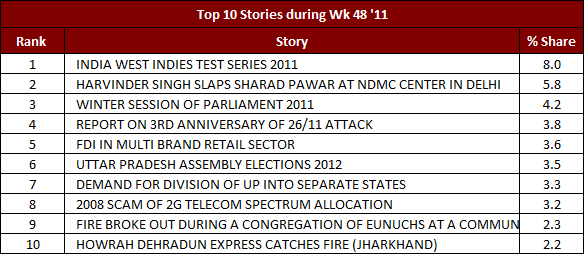
  • NCT Data Wk 48 ’11


    Source: News Content Track – A service of TAM Media Research Pvt. Ltd

    Channels: Aaj Tak, CNN IBN, Headlines Today, IBN 7, India TV, NDTV 24/7, NDTV India, Star News, Times Now, News 24 & Zee News

    Period: Wk 48 – Nov 20 to Nov 26, 2011

    Note : Analysis is based on the Telecast duration


    About TAM Media Research


    TAM is a joint venture between Nielsen Company & Kantar Media Research. Besides measuring TV Viewership, TAM also monitors Advertising Expenditure of Television, Print & Radio through its division AdEx India. Since 2004, it extended its presence in the PR Measurement & Analysis space for Corporate/Marketing Clients by setting up a separate division Eikona PR Measurement.


    In 2007, the joint venture introduced RAM (Radio Audio Measurement) service to track Radio Listenership for the Indian Radio Broadcast Industry. In year 2009, TAM launched a division, called TAM Sports that specializes in monitoring Sports Sponsorship ROI.


    TAM Media Research’s objective is to fuel media insights that will drive the growth of the Indian Media Industry.

  • Magnaglobal predicts 15% ad growth in India

    Magnaglobal, a division of IPG Mediabrands, released updated Global Advertising Forecasts, showing media owners’ revenue growth for 2011 and 2012 to be slower than previously projected, but still resilient.


    Key and detailed Findings, all from the Magnaglobal communique

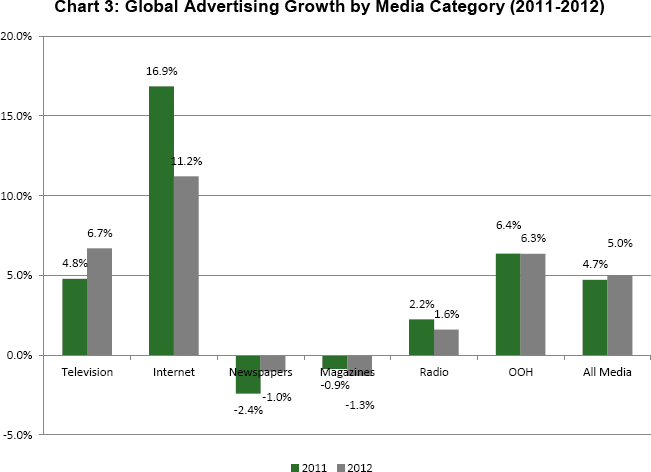
    -2011 global growth is revised down to +4.7% (downgraded by -0.5%), totaling $427 billion.
    -2012 global growth is revised to +5.0% (downgraded by -1.5%), totaling $449 billion.
    -Quadrennial events, combined with the scale and dynamism of the BRIC countries will help sustain global growth despite worsening economic outlook. They contribute to 45% of the global growth in 2011.
    -Internet will become the second biggest media category in 2011, reaching a 20% global market share in 2012.
    -China will become the second largest advertising market in 2012, outgrowing Japan.


    2011: The Slowdown
    In 2011, media suppliers around the world will see their advertising revenues grow by +4.7% to total $427 billion (constant USD 2010 basis). That estimate is down slightly (-0.5%) from our +5.2% forecast published in June 2011, due to the softening of some markets in the second half of the year. Our media suppliers advertising revenue projection includes: television (pay and free), Internet (search, display, video, mobile), newspapers, magazines, radio, cinema and out-of-home (traditional and digital). It excludes direct marketing categories such as direct mail or traditional “yellow page” directories. We monitor media suppliers’ revenues in 63 markets (including all major markets), representing more than 95% of the world’s economy.


    The geography of growth. More than ever, emerging economies drove global advertising revenue growth in 2011, posting an average +15.0% growth during the year. Among these developing economies, Latin America posted the strongest growth rates, averaging +13.2%, closely followed by Central and Eastern Europe (+13.0%). Developed markets, meanwhile, grew at much slower rates, such as +1.6% in Western Europe and +3.1% in North America, due to a number of factors including: a strong 2010 comparison (revenues were up +8.2% compared with 2009); macro-economic slow-down and persistent financial uncertainties; the absence of major sporting events or U.S. elections; and natural disasters in Asia. Among individual countries, the strongest growth rates came from: Argentina (+37.9% in the context of a strong inflationary economic growth), China (+22.5%), Kazakhstan (+25.6%), Russia (+20.4%), India (+15%) and Brazil (+10.2%).


    Eleven countries (out of the 63 analyzed by MAGNAGLOBAL) suffered a decline in advertising revenues, including countries in Southern Europe hit by protracted economic turmoil and political instability (Greece: -19.3%; Portugal: -6.9%; Spain: -6.3%; Italy: -2.5%); emerging markets temporarily destabilized by the Arab Spring (Egypt -21%); and Asian countries hit by natural disasters (Japan -2.0%, Thailand: -2.0%). Many of the large markets of Western Europe and North America wound up in the middle, typically showing low single-digit growth (UK: +1.8%; Germany: +3.0%; U.S.: +2.9%).


    Among media categories, television, an unexpected winner in 2010 (+12.7%), continued to show strength in 2011, despite the absence of cyclical sporting events or elections in the U.S. Broadcasters’ advertising revenues grew +4.8% to $175 billion, in 2011, maintaining TV’s leadership with a 41.0% market share globally. Strong audience levels and audience measurement improvements – such as the integration of time-shifted DVR viewing into ratings for the first time (e.g. France) – made the medium attractive. Out-of-home (OOH) media fared even better. Including cinema, OOH grew +6.4% globally, driven by the incremental revenues generated through digital billboards (+19.9%), which have rolled out in various parts of continental Europe and Asia. Other traditional media categories, however, had a tougher year. Radio grew only +2.2%; newspapers’ revenues were down -2.4% and magazines declined -0.9%.


    Declining circulation, shrinking readership, Internet competition and short term media buying patterns (which penalizes monthly magazines), all contributed to print’s decline in developed markets. Things are different in emerging markets, however, where literacy is still increasing and broadband access is still relatively low. In those markets, magazines are growing along with the middle class, and there is enough advertising demand for every media beyond TV to benefit. Overall, print advertising revenues are up by high single digit percentage points in emerging markets.


    The big winner of 2011, however, was Internet media. Total Internet advertising revenues increased +16.9% to $78.5 billion. While Display subcategories increased +15%, Paid Search reaped the benefits of usage growth and algorithm improvements to reclaim its position as the largest digital revenue driver (+19%). Within Display, online video continues to show impressive growth (+58.5%), reaching $4.7 billion in revenues.


    Pre- and mid-rolls in online videos now generate 6% of total Internet advertising revenues and one percent (1.1%) of global advertising revenues. Even more than online video sharing specialists, TV broadcasters offering free, ad-funded online “catch-up” of long-form, full-length episodes are driving category growth.


    Overall, coming after a strong 2010 and in a poor macro-economic context, media suppliers displayed a resilient performance in 2011. But the global market is barely back to where it was in 2007 ($423 billion in constant USD), and still smaller in the case of Western Europe (2007: $112 billion, 2011: $106 billion). This reflects that media costs that are still low from a historical perspective.


    2012: The BRIC Engine
    For 2012, we now forecast media owners’ advertising revenues to grow by +5.0% to $449 billion. This is -1.5% below our previous prediction published in June 2011 (+6.5%).


    This downward revision is due to deteriorating macro-economic perspectives. Our forecast model is based on current, official economic forecasts that are generally predicting weaker – but still positive – growth next year. However, the uncertainty remains high, especially in Europe. In September, the IMF reduced its global output forecast (real GDP growth) from +4.5% to +4.0%. Although that forecast suggests the world economy would still grow, it’s an awkward average between emerging economies that are growing at healthy rates and developed economies that are still sputtering (average +1.9%, US: +1.8%).


    In late November, OECD revised its own global output forecast to +3.4% (including +1.6% for OECD countries and only +0.2% for the Euro area) warning that 4Q11 and 1Q12 could tip negative in most European countries, in line with 3Q11 slowdown. Greece, Italy and Portugal, in particular, are now expected to suffer full-year recessions in 2012. Other economic indicators (industrial production, personal consumption and business confidence) have been similarly downgraded in recent months and some independent forecasters have expressed increasingly gloomier views.


    Despite the worsening economic outlook, we are still projecting a positive growth rate based on a few factors:
    -First, the well-known “quadrennial” cyclical driver is back, and we believe it will be stronger than ever. The incremental ad spend generated by major sporting events (London Summer Olympics, Poland/Ukraine European Soccer Championship) and the U.S. Presidential Elections will bring an additional +1% to +2% on top of organic revenue growth across markets. In the U.S., Political and Olympic (P&O) money will account for three billion dollars of incremental ad spend, mostly on television ($2.4 billion related to the Elections, $600 million generated by Olympic Broadcasts). Meanwhile, major sporting events will help in European markets that are otherwise hit by economic stagnation, such as the UK (which is hosting the Olympics, although the games are broadcast on the ad-free BCC) and Italy (where the Games and Soccer tournament will mostly be broadcast by RAI, one of the few European public television groups still allowed to carry a full, all-day advertising load).


    -Second, big emerging countries will increase their share of global economic and advertising influence. At the end of 2012, emerging markets will represent 24% of global advertising revenues (compared with 7% in 1999) and the four BRIC countries alone will account for 14% (compared with 3% in 1999). Adding scale to dynamism, the BRIC markets have the capacity to offset part or all of the Western weakness. The four BRIC markets equated to only 10% of Western Europe’s advertising revenues in 1999. That ratio will grow to 59% by the end of 2012, and by 2016 the BRIC countries will almost match the size of Western Europe (94%). The BRIC countries contributed to 45% of the global market growth in 2011 ($9 billion out of $19 billion). With a growing proportion of the BRIC countries’ population adopting Western-style media consumption patterns, and with Western and local brands competing for top-of-mind among the emerging middle class, media demand is in excess of supply and inflation reigns. BRIC countries lag behind the global average advertising spend per capita ($80) – Russia: $70, Brazil: $60; China: $21, and India: $4. With such structural factors, we expect advertising spending and revenues in those markets to keep growing faster than the general economy, supporting global revenues in their wake.


    -Thirdly, some lessons learned in 2009 may help avoid a replay. Some major advertisers, e.g. in FMCG, have since admitted that they may have over-reacted back then by cutting advertising expenditures too hard and too quickly, harming their brands. We believe that this time, even if sales forecasts are being revised downwards, marketers will remember that market shares are subject to losses or gains, including – and perhaps even more so – during a recession, as consumers reconsider their choices. In addition, the Western advertising market is still smaller than five years ago, which means prices and net costs per thousand – despite some inflation in 2010-2011 – are still competitive and attractive by long term standards. Therefore, brands in various sectors have both the incentive and capacity to invest smartly to boost or defend their market shares.


    In 2012, advertising revenues will grow by +12.4% in emerging economies, with Latin America still leading the charge (+13.0%) followed by Central and Eastern Europe (slowing down at +7.7%). Asia Pacific will re-accelerate to +8.3% due to the recovery of Japan and the continued growth of China. Western Europe will slow down at +1.1%. The sports driver will not be enough to offset recession in many European countries: Greece, Portugal, Spain, Ireland will decrease again (between -2% and -6%); Italy and France will be flat at best. UK and Germany will grow below +2%.


    The biggest growth rates of 2012 will come from Argentina (+26.4%), Ukraine (+21.0%), Indonesia (+16.0%), China (+16.1%), Brazil (+12.0%), India (+13.5%) and Russia (+9.6%).


    In terms of media market share, Internet will grow by 11.2% and outrank newspapers to become the second biggest media category globally, accounting for nearly 20% of global advertising dollars (19.5% at $87.4 billion). The category already stands at 23% in both North America and Western Europe (where it even takes the #1 spot in a few markets, such as the UK). Television will receive the bulk of the “quadrennial” bonanza and will benefit from the typical concentration of advertisers into leading media at the expense of secondary media during harsh times. TV will grow by +6.7% globally to $187.1 billion. Newspaper and magazine revenues will shrink by an average -1.0% and -1.3% respectively, with much deeper drops in Western markets, where circulation losses of 2011 will be reflected in 2012 ad pricing. Radio will grow by +1.6% to $30.4 billion. OOH will also benefit from the “quadrennial” events and the roll-out of new digital (+6.3% to $28.3 billion) platforms. In the UK, the innovative upfront auction process conducted last summer to allocate the most premium London inventory during the Games did not quite meet the high expectations, but the industry is still expected to grow healthily next year.


    China Takes the #2 Spot
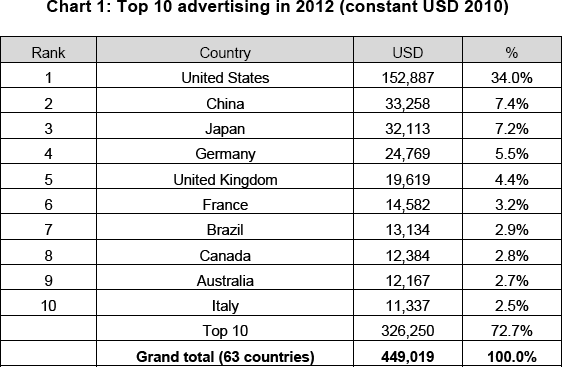
    China’s advertising market is expected to continue outperforming its already impressive economic growth in 2012, with a +16.1% growth. At $33.3 billion, China will become the second biggest advertising market, ahead of Japan, now third at $32.1 billion. Germany remains the fourth biggest market, some distance behind ($25 billion). Other top 10 markets are – in order – UK, France, Brazil, Canada, Australia and Italy. Russia will enter the top 10 in 2013, at the expense of Italy.

     

  • The Anchor: Lara Balsara’s 5 reasons media agencies should attract talent from outside

    By Lara Balsara


    #1 Thinking beyond numbers and objectivity. A typical media planner tends to think very objectively and tends to opt for plans and media that are supported by numbers and makes only data-based decisions. Whilst this is a basic necessity, you have to use your imagination based on quality of content, its appeal to different target audiences, etc for your plan to be a holistic media plan that is based on rigour and discipline but does not lose out on the soft factors. If you look only at hard numbers, most media plans would look exactly the same and that would not serve the brand’s purpose.


    #2 To come up with innovative and comprehensive solutions. Media in India has now been a specialist discipline for over 15 years and therefore there is a certain sameness in thinking that has come about among professionals. To counter this, you need people who are better with lateral thinking capabilities as they would balance a plan supported only with numbers. When you have a diverse talent pool working together, each individual brings in their own unique perspective and their area of expertise; as a result you come up with a brilliant strategy, idea and execution. At Madison Media, we have experts in analytics, account planning, creative and content integrated in the core media plan and we have seen this diversity work magically for our clients.


    #3 Scope of media is very broad. Today anything and everything is a communication medium, and the biggest challenge for media agencies is to come up with new and interesting ways to reach out and engage with audiences. Increasingly with so much noise in the marketplace, there is a need not just to expose your target audience to the message, but to affect them in a deep and engaging manner. If you look at media awards, which are a barometer of good media thinking, you will see some outstanding examples.


    #4 There isn’t enough talent available. It’s a simple issue of demand versus supply. Media professionals are in huge demand and there is a huge shortage of good talent available. Media agencies have no option but to look outside.


    #5 Media professionals rock. Having said all the above, you can’t underestimate the skill sets of media professionals; they are the most equipped to handle almost any job in communications, but the same can’t always be said of other communications professionals’ ability to handle a core media planning job.


    Lara Balsara is Director, Madison World.

  • Move to promote South Indian film industry globally

    By A Correspondent


    The Federation of Indian Chambers of Commerce and Industry (FICCI) recently concluded the third Media and Entertainment Business Conclave (MEBC) 2011 in Chennai. The two-day conclave in Chennai welcomed the recommendation from Wizcraft International, that the South Indian film industry join hands to create a global platform which presents the South Indian film industry at key markets across the world.


    Sabbas Joseph, founder-Director at Wizcraft International, the global event management and communication company, shared the IIFA success story, wherein key global markets were opened and quantum growth was achieved by the Hindi film industry. The IIFA story also demonstrated the attention that is being given to Indian culture and business by global counterparts, he said.


    The weekend for the South Indian film industry would be a huge step towards recognizing the growing importance of South Indian cinema, by celebrating it on a global platform. Joseph spoke of IIFA being a channel for the expansion of the regional film business, generating revenues from International avenues.


    Mr Joseph added, “The talent in the South Indian film industry is enormous. We wanted to seize this opportunity to establish a platform for talent to be promoted and honoured on a national level and international level for South Indian films. Regional Indian cinema has grown into a global phenomenon and we would surely look at promoting and leveraging it on a global platform through brand IIFA.”


    Pioneered and executed by Wizcraft International, the International Indian Film Academy (IIFA), is supported by key members of the Indian film fraternity. IIFA is the most respected South Asian film academy and its main highlight, the IIFA Weekend and Awards, are India’s biggest media event, with a viewership of almost 600 million worldwide.

  • Nature Valley ties up with Aircel Chennai Open

    By A Correspondent


    Snack bar manufacturer Nature Valley has announced that it has come on board as the official “Healthy Snack Partner” for the Aircel Chennai Open 2012. The 17th edition of India’s only and south Asia’s leading ATP World Tour event will be held from January 2 to 8, 2012, and will see in action an impressive line-up of Indian and International players including world number 9 Janko Tipsarevic and world number 10 Nicolas Almagro.


    Further to associating with Aircel Chennai Open for the first time, Nature Valley has taken a key initiative in giving scholarships to highly ranked young tennis players who will be selected by Tamil Nadu Tennis Association (TNTA).


    Commenting on Nature Valley’s association with 2012 Aircel Chennai Open, Arindam Haldar, Director – Premium Foods for General Mills India, said, “Aircel Chennai Open has emerged as one of the most prestigious sporting events in India. Nature Valley is delighted to be associated with Aircel Chennai Open 2012 as the official ‘Healthy Snack Partner’ of the event. To become a part of such global sport/event is a natural fit for a successful global brand like Nature Valley. Nature Valley Granola Bars are all about wholesome, healthy and tasty snacking which suits the requirements of tennis – a health and fitness sport.”


    Elaborating further about the association with tennis, he said, “Our granola bars are convenient, wholesome snacking options for players during tough training sessions and hectic travel schedules. We look forward to a successful partnership with a fast-emerging and leading sport like tennis in India starting with Aircel Chennai Open 2012, and we see a long-term synergy through this association.”


    Ashu Jindal, COO, IMG Reliance said, “The growing support from global corporations such as Nature Valley is yet another testament that the Aircel Chennai Open has built the reputation of being the definitive ATP World Tour event in South Asia. I am certain sure this is the beginning of a long and mutually beneficial relationship between Nature Valley and Aircel Chennai Open.”

  • Debrief: Rusky business

    By Anil Thakraney


    Britannia claims their new biscuit called Britannia Rusk is crunchy and juicy. And it’s difficult to find such a taste anywhere in the world. And so, the creative takes you out of the world. Into a spaceship.


    In the TVC, a young astronaut takes a tea break and munches on Britannia Rusk. Suddenly, literally out of the blue, his entire family arrives to share the biscuits. Mom, dad, granny, even the kaamwaali bai. The message: Britannia Rusk brings the family together with its sensational taste.


    While I like the unusual setting of a spaceship, which will help the commercial get noticed, there are two factors that weaken the communication. Even as family bonding is demonstrated, the novelty value of a rusk biscuit, the ‘crunchy and juicy’ promise, gets lost somewhere in, well, outer space. Since rusk is a relatively new breed of biscuits out here, the initial advertising ought to have focused on product attributes rather than lifestyle. Secondly, the humour is weak. The maid’s appearance will bring a little smile, but that’s about it.


    All said, the TVC will arouse a little curiosity but may not be effective beyond that.


    Rating: (On a scale of 1 to 5): 2. The strategy needs a rethink.

  • ET summit to focus on solutions for poor

    By A Correspondent


    The third edition of the ET Financial Inclusion Summit, being held on December 7 at from 9am at The Oberoi, New Delhi, is on the theme of ‘Customer-Centric Finance: Steps toward Sustainable Solutions for the Poor’. The keynote address will be delivered by Montek Singh Ahluwalia, Deputy Chairman of the Planning Commission.


    The summit intends to take stock of the current scenario and focus on customer-centric financial inclusion, whether it needs to redesign what it offers so as to attract the poor and enable them financially, and to explore sustainable solutions for the poor in the realm of financial services.


    The topics that will be covered in this session of the ET Financial Inclusion are: Regulations that Protect the Poor – Perspectives on the recent RBI regulations and Draft MFI Bill; Designing Insurance to meet the needs of the poor; SHGs, No Frill accounts and Beyond: The Government’s role in Financial Inclusion; and Alternative MFI Financing: Diversifying beyond Bank Funding.


    Some of the other prominent speakers are:
    A P Singh, Deputy Director General, Unique Identification Authority of India.
    Anurag Jain, Joint Secretary (IF), Department of Financial Services, Ministry of Finance, Government of India.
    Gregory Chen, Regional Representative for South Asia, CGAP.
    Sameer Kochhar, Chairman, Skoch Group.
    V Saikumar, OSD – Life, Insurance Regulatory and Development Authority.
    Shahid Vaziralli, Programme Head, Centre for Micro Finance.
    Sanjay Datta, Head – Underwriting and Claims, ICICI Lombard General Insurance Company Ltd.
    N C Kulbhe, General Manager, Bank of India.

  • RAMcheck: Media agencies on new FM listenership numbers

    By Robin Thomas


    The latest RAM data on radio listenership for the month of September to mid-October has thrown up a few surprises in radio listenership. New leaders have emerged in cities that were once strongholds of their rivals. Barring Kolkata where Radio Mirchi continues its leadership position, the remaining three markets – Mumbai, Delhi and Bengaluru have new No. 1s.


    Take Mumbai for instance, once a Radio Mirchi bastion, the latest RAM figures (category: all people 12+, all places of listening, shares) show Radio City as the number one private FM station in the city, slightly ahead of Radio Mirchi. However this time (i.e. week 38-42, 2011) Radio City had to share the No. 1 slot with the government owned FM radio – AIR FM2-Gold. Bengaluru where Big FM held its number one status for a very long time is now overthrown by Radio City. In Delhi Fever FM has become number one taking over from AIR FM2- Gold, Radio Mirchi which was number one in the city for very long time has slipped to number three position. These figures are according to RAM, All People 12+, all places of listening and all daypart (i.e. Sunday to Saturday 12 am to 12 am).


    In addition to these developments we find that when we compare week 35- week 38, 2011 (last week of August to 1st three weeks of September, 2011) and week 39- week 42, 2011 (Last 2 weeks of September and 1st two weeks of October, 2011) not all FM stations have witnessed growth in their listenership. When asked whether FM stations have reached a stagnation point in listenership, Mr Janardhan Pandey, Associate VP, Mudra Max explained, “It has not reached a stagnation point, but a period of stabilization. To further increase listenership, FM stations will have to take the quality of content and programming to the next level along with higher-level product promotions.”


    Mr Ajay Rao, Vice President, Dentsu observed, “FM stations do not have novelty working for them any more. It is today a force of habit for people who find themselves without a smartphone to keep them going. For the young people FM is losing out to other more engaging past times. Can one differentiate basis the content? Listeners tune in for music and switch channels during breaks.”


    AIR FM2- Gold which has been growing strong in listenership particularly in Mumbai and Delhi where it has emerged as a strong number two contender. What remains to be seen is whether this trend continues or will it see a decline or stagnation in listenership. Media planners are however of the view that since AIR FM2- Gold offer only specific contents it is not considered as often as the private stations. Mr Narendra Kumar Alambara, Vice President, Starcom Chennai was of the view that, “Since the entertainment content is limited in AIR, the advertisers do not consider AIR as often as compared to the private stations.”


    “AIR FM- Gold has been consistently delivering impressive numbers, this suggest that the music is most important content of a radio station and RJ/ innovations and promotions alone cannot keep you on top,” said Mr Janardhan Pandey.