Blog

  • Goafest 2012 brings S Asia into ambit

    By Robin Thomas


    Goafest 2012 has been extended across South Asian countries. Pakistan, Sri Lanka, Bangladesh and Nepal have been invited not only as delegates, but also as award entrants. Specialist agencies have been encouraged to participate in Goafest 2012, and Grand Prix have been introduced in more categories. These were some of the announcements made by the Goafest Committee. The advertising festival is scheduled to be held from April 19 to April 21, 2012 at the Zuri White Sands in South Goa. The theme this year is ‘Magic of ideas’. Goafest 2012 has been presented by AAAI and Ad Club Bombay.


    Since specialist areas like Out-of-Home, Ambient, Design, Interactive Digital Advertising, Direct and Integrated Advertising have been growing over the years, Abbies at Goafest 2012 will have a provision for Grand Prix in all nine verticals. Last year the Grand Prix was given only in Film, Print and Radio verticals. Grand Prix will also be introduced in the media awards.


    Goafest 2012 is said to be looking at strong client participation with senior clients expected to be an integral part of knowledge seminars. The Goafest committee is also said to be looking to attract young client delegates in large numbers. It is offering special packages for under-30 marketers.


    In order to spread awareness about Goafest 2012, the committee has decided to conduct roadshows across South Asian countries.


    In conversation with MxMIndia, Arvind Sharma, Goafest Committee Chairman said, “The theme is inclusiveness, we clearly present what value each one will get by participating at the festival. We haven’t really reached out and marketed ourselves. We have not sent out a clear message about inclusivity and the importance of participation. It is said the nature of business is changing, and that there are a whole lot of specialist areas to be ventured into. By allowing Grand Prix in each of the verticals Goafest 2012 has highlighted the importance of each of the verticals. Goafest is a property like no other else therefore it is important to bring in specialist agencies that have traditionally not been part of Ad Club.”


    On his expectations from Goafest 2012, Shashi Sinha, President, The Advertising Club Bombay and Chairman of the Awards Governing Council said, “With Grand Prix opening up and more organizations participating, hopefully even from other countries, expectations are quite high. This time although the delegates are much higher, there will be a lot of fragmentations because of increased participations from different agencies.”


    The decision is also expected to encourage many more specialist agencies to come forward and enter their work in the show. This is likely to give a further impetus to the trend observed over the last few years. Consistent with its growing importance, digital will find a place at Goafest 2012. Digital Awards will be held on April 20, 2012 as will Media Awards. Design, Direct Awards will also be held on April 20, 2012 and as in past the rest of the Creative awards will be held at the awards night on April 21, 2012.


    In line with the overall festival theme, Goafest 2012 Conclave theme is ‘Ideas for impacting the full circle’. The Conclave aims to help the entire industry gear up for opportunities that lie ahead. The festival is said to be inviting global leaders from major clients as well as major communication groups to participate in the Conclave.

    Click here to view all Goafest 2012 stories

     

  • Gouri Dange: Writing a novel? Who isn’t?

    By Gouri Dange


    We are in the midst of an epidemic – an overabundance of unimaginative, thinly-veiled autobiographical pretend-fiction: how I loved and lost in IIT; how I lost and loved in JNU; how I was Cinderella in med college; how I was Cinderella’s ugly sis in IIM, and on and on and on.


    My uncle, his neighbour and his neighbour’s sister and her brother-in-law and their cocker spaniel – they’re all writing a novel, it looks like. Ever since Arundhati wrote about ordinary things happening in ordinary places and their far-reaching impact, all of us Indians have come uncorked with our stories.


    Now don’t get me wrong, I’m no snob who believes that English fiction writing is the exclusive turf of the chi-chi haw-haw strata. Or that fiction has to come from the deep tortured insides of a writer. I don’t care about the distinction between high brow and low brow and middle brow and no brow. Everything is narration.


    What I find (as a reader and as a book editor who reads the works of hundreds of hopefuls) is that too many aspiring Indian writers in English are totally mired in autobiographical material. Again, nothing terribly wrong with that, all writers ‘mine’ their minds and lives. Why, however, a lot of it is unreadable is that many writers are simply unable to take what happened to them and universalize it in any way. The autobiographical never makes the jump to the kind of writing/narration to which other people can relate and in which they can hear echoes.


    If the memories and incidents from the past came with any kind of emotional/social/intellectual insights, these stories might have held some interest and become publishable. This is not the case. There is nothing touching or instructive or engrossing or revealing in any of the strings of episodes that a lot of people choose to simply prattle on about.


    So much unpublished guy writing (called lad-lit, like chick-lit) is about life in school or engineering college hostel, and monotonously tells you about the adolescent crush on another boy, or the English teacher, the smoking/drinking experiment, or goes into excruciating and baffling detail about the physics lecture. It often boils down to nothing more than those ‘hey remember when we were in college…” kind of reminiscences that are ok when you’re sitting around with four friends, but does not make the cross-over to being readable literature, frankly.


    It’s the same with a lot of young (and old) women writers, who are putting in a lot of hard work, no doubt, in telling stories that no one wants to hear. That’s because, again, the stories simply don’t ‘travel’ from the writer’s life, to touch the life of the reader.


    The minute you say this kind of thing (as kindly as possible) to a person who wants to be published, sadly, the response is something like: “Oh everyone can’t be a Rushdie.” But I’m not talking Rushdie here at all. I’m not talking about ‘classes’ versus ‘masses’ kind of distinctions. I’m all for more easily accessible writing, but if you’re writing fiction (and not just your autobiography), it has to grow horns, a tail or two, some sharp nails, some moments and nuances in the content as well as in the way you tell it. Or else it’s just canteen (or kitty-party or chai tapri or board-room) chit-chat trying to pass off as fiction.


    Sometimes, people write down stories or incidents/anecdotes from their life to better understand the past and its impact on the present. It is therapeutic, perhaps, this exercise. And I’m all for it. However, this does not necessarily automatically transform it into a piece of writing that is accessible and/or of interest to anyone else. For this kind of self-examination to turn into fiction of any kind of wider appeal, much more would need to go into it.


    The art and craft of writing is definitely more demanding business than simply uncorking your memories and theories, is what I’m trying to say here to all of you (us) working so hard and hoping so fervently to be published. Self-absorption and contemplating your navel are rarely the right tools to become a good writer, frankly.


    There are so many avenues for people wanting to talk about their pasts or their presents, without having to do the complicated hard work of fictionalizing and universalizing the story. There are blogs, and chats or diaries or amateur, informal writers’ forums.


    There is a Marathi sentence that I always find very touching when people use it: “Mala kahi sangaychay” – ‘I have something to tell’. This is a universal impulse – but that doesn’t necessarily make it literature. Hemingway put it wonderfully: “All good books are alike in that they are truer than if they really happened and after you are finished reading one you will feel that it all happened to you and afterwards it all belongs to you: the good and the bad, the ecstasy, the remorse and sorrow, the people and the places and how the weather was.”


    If you can do that, you are a writer.


    Naming no Names is the mid-week column where novelist, columnist and counsellor Gouri Dange presents her tongue-in-cheek view of our world.


  • Prathap Suthan: 8 fun ideas for Republic Day without being unpatriotic [Recall]


    This was first carried on MxMIndia in January 2012. Save the Kolaveri context, all of it is still relevant and we felt it was worth carrying given that it’s Republic Day on Sunday.


    By Prathap Suthan


    I better walk the tight rope here. Caught as we are between two completely disconnected groups of Indians.


    One is a grizzled leadership that’s way too hemmed in, frugal, and touchy about the tricolour and its marching bells and regimented whistles.


    And the second is a younger generation who are anything but bothered with the antediluvian huff we make about pride and other mushy matters of the soul.


    Come to think of it, in these days of viral Kolaveri, the Republic Day and its patriotism shouldn’t continue to be seen as the preserve of those sitting behind bulletproof glass.


    Our Republic Day shouldn’t lie trapped in strict Government imagery. We must ease up on the straitjacket we have strapped ourselves in. Our nation is free. Not bound.


    It must be the day ofIndia. Celebrated with more freedom and fun. It must be more popular and populist. The democracy should celebrate it. Less stiffness, and more abandon.


    Love for the land should be much more than just standing ramrod straight when the national anthem plays. Loosen up people. We cannot be snoozing all day on the 26th.


    So what can we do to inject fun into this grave day? Please add your own versions.


    Though please don’t skid over the edge, and start redefining bikinis. Some amount of restraint is good. Atleast in public.


    1. Instead of curling into your couch to watch the parade on TV, get your society to hire a big screen. Watch the parade like an IPL final. Get some hot samosas and jalebis. Give flags to all the kids, and watch the soldiers pound the Rajpath. I can guarantee monster goosebumps.


    2. Ride a horse. Get off your cars and bikes, and live true horsepower. Get on the back of an old unemployed filly and relive a bit of royalty on hooves. I am sure you won’t be able to gallop. But I am pretty sure that fine equine discretion will lead you to the difference between a canter and a trot. Pay the local ghodawalla some attention. I am sure he will smile a wider smile.


    3. Invent a patriotic dish. Give it the finest name possible. Buy from theRepublicofChicken. Or do something that needs a handful of saffron. Ouch. Don’t do the tricolour rigmarole pudding. It’s too cliched. Make the Dal of Thunder, The Saffron Inquisition, or the Great Onion of Panipat.


    4. Step out of home, and go and meet your neighbourhood fauji. Remember them. Those gallant valiant men with moustaches curled. Also do shake hands with the neighbourhood cops. They might expect a rolled up currency note. Instead, wish them a great day.


    5. Fight for the flag-raising event. Let a younger member raise the flag. Why do we depend on brash old men? The nation belongs to the little ones. Instill nationalism early in their lives. They will never forget. They will be grateful. Jai Hind!


    6. Add a flourish of Indianess to the Armani ensemble you wear everyday. Applies to both originals and fakes. Or offset the affected kurta you will stuff yourself into on Republic Day. Basically, try a new thing, and wear a Gandhi cap. You could wear it on your monkey cap if you are a devout Bangla. But there’s something earthy that happens when you switch to khadi. Gurkha cap also doesn’t work for me.


    7. I think we should make an effort to commercialize the day. Why waste a full day sitting at home? Imagine the plight of the millions people who eke out their living on a daily basis. For them, it’s a forced holiday. Maybe we should take the lead and get the great T-shirt sale going. Or we should begin a series of Republic Day picnics; initiate a nationwide drive to buy a compulsory flag for all homes, or do something else that will go to annually fund war widows or something as noble.


    8. How come there’s no tradition connected to this day? Barring that really long speech the society elder will deliver. In which he will talk more about himself, his childhood, how Nehru almost shook his hand, and how he braved British boots. Maybe we should all speak in Hindi that day. Maybe we should only eat Indian food. Maybe we should have a fireworks show where the whole city is invited. Or maybe we will have a citizen’s parade in the city stadium.


    Whatever we choose to do, we must celebrate in our own way. We must take the celebration to the people. We must make it more meaningful and involving. Otherwise this country’s pride will get locked up inside octogenarian ministries. And we will all have breakfast at 3 pm.


    Prathap Suthan is the Chief Creative Officer at iYogi.


  • Anil Thakraney: ‘Giving’ season for Bollywood & TV-land

    By Anil Thakraney


    It’s that season when many organizations will gave away many awards to many Bollywoodians. And the number of award givers is increasing with time, and I hope it stops right here. It would be a joke if in the year 2020 we have stars lining up for 30 events. Rather, I wish there were, at the most, two ceremonies, so that the awards are truly coveted and valued.


    Aside from numbers, there are many problems with these awards shows in the Indian context, and for their own credibility, the organizers must do their damndest to sort them out.


    For one, there must be absolute integrity in the judging process. Everyone and his father knows some winners get picked by non-jurists. Often either by the organizers themselves or by their sponsors or associates. And this gets amply proved when everyone who attends the show gets an award, and only the winners land up for the events. This is not the way it pans out either at the Oscars or the Golden Globes. And that’s the reason why Aamir Khan shuns these tamashas. Surely there is a way to deal with this continuing malaise. Maybe the will is lacking.

     

    Two, since all the moolah comes from television rights, these shows are tailor-made for the tube. Quite a few acts don’t happen on stage, they get inserted in later. This makes no sense. If the stars are going to perform on stage, then they must do so in real time, in front of the hundreds of people in the audience. Because capsules get inserted in later, the show looks pretty artificial and scripted. Again, nowhere does this happen in the world. Organizers must make it mandatory for performers to perform live. That’s the beauty of an event. If we wanted to watch recorded stuff, we’d watch the regular TV shows.


    And third, because these events get packaged as TV dramas, awards become the side show. ‘Extras’, in filmi lingo. In fact, awards for vernacular films and for the technical crew get done in a big rush, so that the entire time and energy goes into entertainment. Which is dance and thakela banter. Awards should be the big act, the rest of the stuff woven around them.


    Lots of issues to be dealt with, and I am not even talking of the shoddy camera work. Hope one day we can put out an awards show that the West will envy and emulate.


    * * *


    PS: If you haven’t watched ‘Shattered Glass’ already, you should quickly grab the DVD. Especially if you work in the media. It’s the story of a young reporter who cooks stories and quotes to quickly rise up the hierarchy. And also to deal with the intense pressure in the newsroom. This can so easily happen to any young journo. A warning for everyone.


  • What the government can’t, Goswami can!

    By Ranjona Banerji


    Last night on Times Now, Arnab Goswami took on the case of an Indian couple in Norway whose children have been taken away from them by the Norwegian authorities. What the government of India could not do, perhaps Goswami will. Child welfare is a concept that Indians know little about (any journalist who has visited orphanages in India or tried to meet any official in the concerned government departments will know what I mean). Therefore, the outrage is all to do with Indians being made to suffer rather than the legality of the case. Indians, as we know, cannot be criticised, attacked, ridiculed, or made fun of. We absolutely will not tolerate it. Look at the anger over a reference to Amritsar’s Golden Temple on American comedian and TV host Jay Leno’s Tonight Show if you want further proof.


    Meanwhile, it is amusing to watch Goswami use the BJP’s Mahesh Jethmalani for target practice. If I was Jethmalani, I would ignore calls from Times Now for a bit. It’s not easy to defend the BJP and its Sangh Parivar friends when the debate is about freedom of expression.


    TV anchor Barkha Dutt’s American-type accent as she interviewed US talk show empress Oprah Winfrey was also amusing. Where did that come from? Can Winfrey not understand if there’s not a couple of rolled rrrs in every sentence?


    **


    The Mumbai Anti-Terrorism Squad has made two arrests in the July 13, 2011 bomb blasts in Mumbai. However, given the police track record in such cases, TV and newspapers both displayed a little scepticism here. The two arrested are already in custody for some other cases and the masterminds are still elusive. Everyone has pointed that out. In which case we must ask ourselves if we really want to see giant photographs (Hindustan Times) of police officials with photos of the accused in their hands? Needless glorification of public servants who are just doing their jobs? Return of favours by grateful reporters?


    **


    It is a measure of how much Anna Hazare and his friends have faded from the public eye that their letters to political parties did not get the full treatment from the media. They asked many questions to which no party has bothered to provide any answers.


    **


    The Salman Rushdie controversy continues to intrigue and annoy. It seems to have taken precedence over whether the army chief was born in 1950 or 1951.


  • Why the PR industry needs some PR


    By A Correspondent


    The PR industry in India today is facing potential growth-limiting challenges such as a dearth of home-grown talent, the fallout from recent PR scandals and a move away from traditional PR towards strategic communications.


    This is the thrust of the most recent executive report on the public relations industry in India from MSLGroup India’s Hanmer MSL and 20:20 MSL, both part of MSLGroup, Publicis Groupe’s flagship public relations, speciality communications and engagement group. The report, Understanding the Public Relations Industry in India: Challenges, Opportunities and 2012 Outlook, takes an in-depth view of the PR industry in India, drawing on quantitative and qualitative research to bring together a hard-hitting and frank appraisal.


    The report touches on these issues, as well as the widely reported misconceptions about size of the Indian PR industry, and the ramifications of this over-inflated figure on the market. A recent Associated Chambers of Commerce and Industry of India study pegged the size of the industry at a “wildly inflated” $6 billion whilst MSLGroup’s research points to $140 million being a more true representation.


    Jaideep Shergill, CEO for Hanmer MSL and Member of MSLGroup India Management Board commented, “The challenges before the Indian PR industry are not that different from what other service industries have had to face in the past – a serious talent shortage, disconnections between fees and value, and measuring performance accurately. Furthermore, we must look ahead and ask ourselves how the industry should react to a worsening global economic situation. These are questions this report tackles and by bringing these tough issues to the fore, we hope that it puts the industry into perspective and kicks off a discussion on the roadmap that PR in India so desperately requires.”


    “The industry is at an important crossroads, and we have taken the first step in not only asking difficult questions of ourselves and the industry, but also providing potential solutions to foster a stronger and sustainable India PR market,” added Sunil Agarwal, founder of 20:20 MSL and Member of MSLGroup India Management Board.


    In addition to highlighting a variety of trouble spots, Understanding the Public Relations Industry in India: Challenges, Opportunities and 2012 Outlook report also identifies opportunities for PR agencies such as offering integrated strategic and speciality communications, bridging the compensation gap, ensuring performance measurement and understanding client expectations.


    Throughout the report, critical questions are posed to agencies and their staff, clients and their organizations, media and the industry at large which are aimed to spark debate, ideas and potential solutions that can strengthen the industry’s future. Some of these include:


    • A misunderstanding of the size of India’s PR industry, hiding the on the ground realities and core issues.
    • A serious Indian talent crunch, stunted by a more lucrative in-house corporate communications sector, increasing the demand-supply.
    • A lack of understanding of how PR can play a strategic role, resulting in low PR retainers – in the Rs 20-lakh ($40,000) range compared to the average advertising retainer of Rs 2 crore ($400,000).
    • A vital need for PR firms to offer integrated communications as the line between PR, advertising and digital begins to blur.
    • Speciality communications such as niche PR, engagement through social media and employer branding to be recognized as growth focus areas for PR agencies.
    • Despite the global economic turmoil, India continues to grown at 7%, presenting a unique opportunity for PR firms in terms of global and Indian MNCs.


    MSLGroup India has developed this report to further its and the industry’s goals for sustainable and professional development. PR professionals, clients, organisations and the industry recognise that PR in India is at a critical juncture and Public Relations Industry in India: Challenges, Opportunities and 2012 Outlook offers a transparent and robust précis to move the industry forward.


    (To learn more about the Public Relations Industry in India: Challenges, Opportunities and 2012 Outlook, or to read the report by MSLGroup India in full, visit asia.mslgroup.com.)


  • 6 reasons why wall graffiti advertising attracts brands

    By Mihir Mody


    #1 Wall advertising is cost-effective

    These campaigns act like small billboards, which are comparatively cheaper than hoardings and give distinct visibility in any part of India. It is a cost-effective method of communicating with the people.


    #2 Shapes, sizes and more…

    Brands get a variety of options to reach out to consumers. Wall paints can be done in any shape and size and at any location according to the target audience.


    #3 Effective media

    It is the most effective media in reaching masses – it reaches the small town as well as interior villages across the country. For example, if a firm has a Rs 20 lakh budget, it can cover any state deeply.


    #4 Different strokes, different flavours

    Painting in regional languages with good innovation can create high brand awareness among the local population. It is easy for people to connect with that brand which creates a brand image with a local touch.


    #5 Wall paintings have rural reach

    There are a number of brands which target semi-urban and rural audiences. For them wall painting is an excellent way of reaching these audiences en masse. They can reach out to nearly 75 percent of the rural audience. Wall paintings create a better impact through good visuals as they target uneducated people across the country.


    #6 Longer shelf life

    Wall paintings have a longer shelf life as compared to other media. They can give distinct visibility for a longer period of time which other media fail to do. A TV commercial, for example, has a shorter span of time – a few seconds – while on the other hand print media (newspapers) have a short span too, of one day.


    Mihir Mody is Founder and CEO, Adwallz.


  • Future Media takes its partnership with banks to regional level for ‘Sabse Saste 5 Din’

    By A correspondent


    It is that time of the year when hordes of people throng the alleys of the country’s most economical retail supermarket for a once-in-a-year opportunity to purchase goods at the most economical price ever.


    Big Bazaar is back with its ‘Sabse Saste 5 Din’ offer and has loads of surprises planned for the consumer. For the year’s most economical five days of shopping to be held from January 25-29, Future Media, the Retail Media arm of Future Group has partnered with three leading banks ofIndiaat a regional level.


    Having tasted success in 2010, Future Media has been tying up with various partners for a variety of Future Group’s properties. However, for the first time, staying true to the potential of the medium, Future Media has broken down the partnership at a regional level.


    While UCO Bank is the banking partner forMaharashtraand Madhya Pradesh, Dena Bank would be the partner forGujaratand Rajasthan and Corporation Bank for Karnataka.


    As part of the partnership, each of the banks get branding visibility across the stores in their respective markets and also a perfect platform to interact with millions of customers who will shop in Big Bazaars during this period.


    “For the first time, we have opened up the sponsorship at a regional level, thereby enabling banks to partner us in markets crucial to them,” said Sandip Tarkas, CEO, Future Media.


    “In addition to the Branding and Customer Interaction, these banks will also get presence across Big Bazaar’s ATL & BTL promotions”, he added.


    Every year more than 10 million customers acrossIndiashop in 200 Big Bazaar, Food Bazaar & Fashion@Big Bazaar stores spread over 89 cities, making it one of India’s largest consumer events.


  • 92.7 BIG FM presents BIG Music Parade this Republic Day

    By A Correspondent


    92.7 BIG FM,India’s No. 1 FM Network and the radio broadcaster of the year at the Golden Mikes, plans to celebrate this Republic Day by bringing alive the true patriotic spirit of our nation with the BIG music parade.


    The musical parade will see different states being brought together, with hand-picked songs, cutting across language barriers, making music the true unifier. The BIG Music Parade has been conceptualized as an acoustic reminder for the audiences of the extravagant floats and pageantry which are displayed each year in Delhi.


    The BIG music parade will take the best of each state’s music to 45 markets across the length and breadth of the country. On January 26, every hour from 7 am to 9 pm, 92.7 BIG FM will play one smash hit from the different states across its network. Each song will be introduced by a well known personality from the region explaining what makes the song special. This special programming will seek listeners’ votes and will be promoted heavily to ensureIndia gets what truly meets their expectations.


    Popular singers like Shaan, Sonu Nigam and Shankar Mahadevan who have sung in multiple languages will also come on air and share their views on why they like a particular song and how it helped them to connect with listeners in that region.


    Leading up to the Republic Day, listeners can suggest songs they believe are true representations of their state through an SMS or by posting on the 92.7 BIG FM Facebook page.


    On Republic Day, each state’s jhanki (song selection) will be posted on the station’s Facebook page. Listeners can then share their opinion on the song selection and why they think their state’s jhanki deserves to be the best jhanki of this year.


    Reliance Broadcast Network Limited is a multi-media entertainment conglomerate with play across radio, television, intellectual properties and out of home. 92.7 BIG FM, BIG CBS, BIG CBS Prime, BIG CBS Love, BIG CBS Spark are some of the brands under their umbrella.


  • Komli Media launches Komli Labs to research digital advtg (and hence offer innovations)

    By A Correspondent


    Komli Media, Asia Pacific’s leading media technology company, has announced the launch of Komli Labs, a centre for research in advertising sciences. Srinivasan H Sengamedu (SHS) has been appointed as the Vice President and Head of Komli Analytics and Labs. SHS, former Director of Research at Yahoo Labs, is a world class researcher in the field of machine learning and data mining.


    Komli Labs will be primarily focused on driving innovation in digital advertising through applied research and big data analytics, in the areas of real time bidding, audience measurement and targeting, ad verification and traffic quality management. This, in turn, will help create innovative solutions to deliver more relevant ads to users, maximizing value for all: users, advertisers and publishers.


    The Labs team will be deeply integrated with various teams at Komli, and complement product, engineering and business functions.


    “Komli Media is committed to bringing scientific and technological innovation to the digital advertising ecosystem for the benefit of our customers”, said Prashant Mehta, CEO Komli Media.


    “With SHS’s leadership, I am confident Komli Labs will help create huge differentiation for us,” he added.


    “There are three aspects to what we do: developing best-in-class technology to power Komli products, creating long-standing IP, and authoring high-impact research papers. The Labs team is armed with deep technical knowledge and data expertise.  At the same time we are passionate about solving practical problems and fearless about being hands-on,’ said SHS, on his role.


    “SHS is a top notch applied researcher who is driven by creation of economic value and real business impact. Under his leadership at Komli Labs, we are confident that Komli Media will fortify its position as an innovative media technology company,” said Satish Kadu, VP and Business Head – ATOM, Komli Media.


    SHS has a PhD in Computer Science from the Indian Institute of Science and has several years of experience in research, technology leadership and entrepreneurship with over 100 research papers published, 30+ patents filed and 3 patents granted.


    Komli Media is APAC’s leading media technology platform, one of the few companies in the world offering 360 degree digital media solution across real-time display, mobile, video, social and search.


  • Singham voted as the Best Film of 2011: Ormax Media

    By A Correspondent


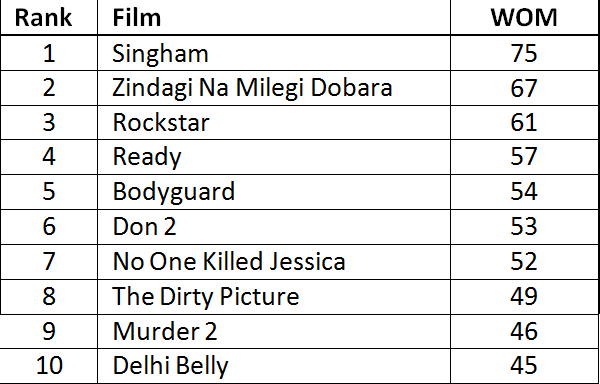
    According to Ormax Media’s consumer based year-end report – Front Page 2011, Singham is the most favourite film of Bollywood audiences in 2011. Zindagi Na Milegi Dobara and Rockstar complete the top three favourites.


    The ranking of the top 10 favourite Bollywood films of 2011 was derived basis the ‘Word of Mouth’ (WOM) score of the film, using data collected through consumer research throughout the year.


    The WOM score represents the percentage of audiences who liked the film enough to recommend it strongly to their friends.


    While box office business is heavily influenced by the opening weekend of a film, the WOM score reflects the audience feedback on the content alone, irrespective of the marketing or the distribution of the film. The table below lists the Top 10 favourite films of 2011, as decided on the basis of WOM score.


    Rohit Shetty’s Singham, starring Ajay Devgn in the title role, had a significant lead over the more multiplex-skewed Zindagi Na Milegi Dobara and Rockstar. The next three positions were also occupied by the big grossers of the year, with Salman Khan’s Ready and Bodyguard just a notch ahead of Don 2.


    The latter half of the chart consists of more experimental films that lacked a big star. In particular, No One Killed Jessica performed creditably at no. 7. It is the only film in the list that had an opening weekend of less than Rs15 crore, yet found appreciation on the strength of its content.


    Commenting on the results, Shailesh Kapoor, CEO – Ormax Media said: “There are various award shows that give away Best Film awards. However, this ranking is based on structured consumer data from more than 32,000 cine-goers acrossIndia. There can’t be a bigger award than this!”


    Ormax Media isIndia’s first and only research and consulting firm specializing in the Media & Entertainment industry. It works withIndia’s leading broadcasters, film producers, radio networks, print publications, media agencies, DTH service providers, in the areas of qualitative research, quantitative research and consulting.


    Ormax Media is also the owner of 19 proprietary research products that are being used widely across the media industry.


  • Social Wavelength wins 2 Biggies at WAT Awards, 2012

    By A Correspondent


    SocialWavelength,India’s leading social media agency, has been awarded the ‘Social Media Agency of The Year 2012’ for the outstanding all-round work done in the Social Media space at the recently concluded WAT Awards 2012.


    To make the evening more special, Mr. Sanjay Mehta and Mr Hareesh Tibrewala, serial Internet entrepreneurs and co-founders of Social Wavelength, were also awarded ‘Social Media Entrepreneurs Of The Year 2012’.


    WAT Awards is an initiative of WAT Blog to recognize and felicitate agencies and professionals who have done ground breaking work in the Indian digital media space.


    “The ‘Social Media Entrepreneur Of The Year’ award is a recognition by our peers, for the passion and hard work we have put in to build the organization thus far. It also serves as an inspiration to scale greater heights”, said Hareesh Tibrewala, Joint CEO, on receiving the ‘Social Media Entrepreneurs Of The Year’ award.


    “The double success of being ‘Social Media Agency Of The Year’ and also the ‘Social Media Entrepreneurs Of The Year’ makes for a fabulous start to 2012. Coming as it does after the Red Herring Asia 100 win, it puts us in the perfect mind frame and motivation to make 2012 a big year for us,” added Sanjay Mehta, Joint CEO.


    Mihir Karkare, AVP, said: “Being recognized as the ‘Social Media Agency of the Year’ is a proud moment for our entire team. It makes all the sleepless nights and the hard deadlines worth their while.”


    Social Wavelength is a social media agency, headquartered at Mumbai. It’s suite of services include social media monitoring, online-reputation management, online PR, social media management and building online communities. Social Wavelength has a client portfolio of more than 50 Indian and international brands.