Blog

  • Headlines Today scores on 2G

    By Ranjona Banerji


    The fault is mine: I got to the television two hours late on Thursday – after the Supreme Court ruling on the 2G licences. The punishment was purgatory: I knew something had happened but I had no idea what. Every TV news channel showed a press conference addressed by the BJP’s Arun Jaitley reacting to the court ruling but no one told us what the ruling was. I travelled up and down the channels that my cablewallah allows me and learnt nothing. Jaitley could have been ranting or talking sense but since I had no context I could not fully appreciate or understand him.


    After 10 minutes of fruitless frustration I did the sensible thing: got online and read the latest updates by print journalists. Till Thursday evening, the whole thing was only about “reaction” on television, sometimes from small-time party functionaries and sometimes by bigwigs like Kapil Sibal who had to counter Jaitley with his own spin. One poor reporter even ran after the judge AK Ganguly as he retired and asked him how he felt. The honourable judge ran away as fast as he could. All through the day they broadcast a reaction from some telecom honcho but never told us who he was.


    It says something about the way television journalists operate that they cannot explain events or interpret them for viewers themselves. Something as important as this 2G ruling requires reporters and anchors to get all the facts themselves and tell the viewers exactly what has happened before playing the “reaction” game. Also, instead of telecasting every single press conference live in its entirety, they could edit or cut back to studio to explain what was happening mid-way.


    Business channels were, sadly, no better since they are all obsessed with the stock market and cannot consider implications beyond that. But one would imagine that the cancelling of 122 licences would have huge impact on their constituencies. I guess one imagines wrong.


    The most sensible TV debate on the subject was a surprise – it was not at prime time and it was on Headlines Today. Thanks largely to Paranjoy Guha Thakurta as well as to Sandeep Bamzai, we got a clear idea of the economic and political implications of the judgment.


    The rest of debates seem to have the usual suspects who talk about everything – Chandan Mitra, Ravi Shankar Prasad, Mahesh Jethamalani, Nirmala Seetharaman, Renuka Chowdhury and perhaps Suhel Seth was there somewhere but I didn’t catch him.


    Niira Radia and Ratan Tata were not there.


    * * *


    This round once again goes to newspapers who explained the matter in every detail from the political implications for the UPA government to the business implications for the telcos to the fortunes of A Raja and P Chidambaram and so on. However, while every newspaper and TV channel said it was 122 licences, The Times of India decided on 121. No idea why.


    Most newspaper editorials did raise the question of the unfairness meted out to telcos which were being punished for following government laws. This is a tricky one. It would be interesting to see whether there’s more discussion about the dangers of corporate lobbying and the role played by journalists in getting A Raja the ministry of his choice.


    I’m not holding my breath, actually.


  • Gopal Vittal back @ Airtel

    By A Correspondent


    Having resigned from Hindustan Unilever just last month as Executive Director – Home & Personal Care, Mr Gopal Vittal is set to return to Bharti Airtel Gopal Vittal as Group Director for Special Projects from April 3. He will be incharge of the data and international businesses.


    Mr Vittal was with Airtel from 2006 to 2008. Said Mr Sunil Bharti Mittal, Bharti Airtel CMD, in a statement: “We are delighted to have Gopal back at Airtel. Given our global aspirations and a fast evolving mobile telephony landscape led by explosive growth of data services, we are preparing a strong platform for the next phase of our growth.”


  • Naukri.com launches job search apps for iPhone, Blackberry and Android devices and HTML5 site

    By A Correspondent


    Naukri.com, India’s no 1 job site introduces free job search apps on mobile for all smart phone users. This includes special apps for Iphone, Blackberry and android devices and an exclusive HTML5 site. In today’s world, where everyone is competing to be ahead of time, these applications will provide jobseekers an efficient and customized way to search and apply for jobs even on the move. These mobility solutions have specially been designed to bring the power of internet job search on mobile, thus ensuring that their users never miss out on any opportunity.


    Both the mobile app and the site are enriched with features which allow jobseekers to filter job openings by location, keywords, functional area, experience bracket and minimum expected salary. Also, users can create up to 5 custom job alerts on the basis of the search criterion defined by them. These job alerts are directly sent to the users’ inbox 3 times a week. To make job search further convenient and mobile friendly, as soon as the user logs into the site it will automatically recommend jobs on the basis of the information provided during the profile creation process. Jobseekers can view the detailed job descriptions and apply in a secure and confidential environment – directly from their mobile devices.


    It will be an added boon for employers as well because it acts as an additional platform to reach to their target audience. With the introduction of this mobile site, the response time for jobs posted will be reduced considerably and thus recruiters will be able to cater to a larger audience within a short span of time. This site has specially been designed keeping in mind the need and convenience of a mobile user.


    Commenting on the same, Vibhore Sharma, EVP, Technology, Naukri.com said: “Mobile devices are bringing about a revolution in the way people use internet and consume content from the web and smartphones are the new basic phones that would eventually engage users more than a PC. With the launch of our apps and (re-purposed) website for mobile devices, we aim to offer our users the ability to continue their job search on the go and never miss out on a career opportunity.”


    This HTML5 site has been optimized to work with all popular smart phones. Further, through this platform jobseekers can also manage and update their Naukri profile effortlessly and conveniently. Users can keep a track on how many times their CV has been viewed by an employer and also which companies have they applied for jobs earlier. Thus, this bouquet of mobile solutions will make job search simpler, productive and much more efficient.


    Naukri.com, India’s No. 1 job site and the flagship brand of Info Edge revolutionized the concept of recruitment in India. The site enjoys a traffic share of around 61% as per the Aug Comscore data.


    Naukri.com is a recruitment platform that provides hiring-related services to corporates/recruiters, placement agencies and to job seekers in India and overseas.


  • The Anchor: 5 reasons why it’s the best time to be in English movies

    By Ajay Trigunayat


    #1 India has the largest English speaking population.

    India has one of the largest English speaking populations in the world, and as a result has been a potential market for all things English! English enjoys the status of subsidiary official language but it is the most important language for national, political, and commercial communication. English speakers inIndiaoutnumber those in all of Western Europe, not counting theUnited Kingdom. And Indian English speakers are more than twice the UK’s population.


    #2 Amongst English channels, English Movie Channels have the maximum viewership.

    Amongst the English TV category, it is the English movie channels that comprises of 35 percent of the market share. This is the highest in this category. The English movie category also has a reach of around 27 percent of the total television viewers. These numbers definitely move the genre which was earlier seen as niche, to be highly influential.


    #3 English urban audiences.

    Yes, English is everywhere in India. Urban population: 33 percent of total population and 95 percent of all households have a TV. 2012 will also see Times Television Network launching new English channels in a bid to strengthen the overall channel bouquet. The timing could not be better at the pace which theEnglish Channelspace is growing.


    #4 Digitization.

    • Indiais riding on robust cable and satellite growth. The television household universe has grown from 134 million homes to 148 million homes over two years.
    • Within this cable and satellite has grown from 103 million to 126 million. The media and entertainment industry is at an inflexion point with digital being the buzzword. Rightly so, every segment within the media and entertainment ecosystem is getting impacted by digitization in a significant way.
    • Digitization, where the feed will be received through set-top boxes, is expected to be executed in phases and the four metros ofDelhi, Mumbai, Kolkata and Chennai have to shift to digital addressability by March 31, 2012.
    • Increased Digital penetration will lead to parity in audio-visual reception and experience. Thus, channels which are on hi-frequencies which has distorted channel reception will tend to gain in viewership.
    • With CAS being mandated soon, the carriage fee should go down and subscription revenues should take a leap.
    • Currently the digital viewership contribution to the English Movie Channels is 31 percent which will go up to 50 percent by the end of 2012.


    #5 Increasing footprint.

    Transition of viewership from 5 – 8 metros – 1 mn.+ markets: 35 markets as per 2001 census to 53 markets as per 2011 census

    • Having expanded the horizon from 5/7 metros to 8 metros: All 1mn.+ towns is the next big opportunity
    • With the perception change amongst the viewers’ mindsets and the recent news about Lok Sabha passing the second bill to amend the Cable TV Networks (Regulation) Act 1995 has opened newer avenues for the English movie channels.
    • With the target audience no longer residing only in the metros and moving into the Tier 2 and Tier 3 cities, there is an opportunity to penetrate into the smaller cities, thereby expanding the overall viewership.


    Ajay Trigunayat is the CEO, English Entertainment Channels, Times Television Network.


  • [PR Channel] ‘Industry resilient in times of turmoil’

    By Nitin Mantri


    A new year heralds a new beginning. Year 2012, however, began on a note similar to last year’s, with news of a world economy in crisis continuing to grab front-page headlines. As the world kept an anxious eye on Europe, where talks to avert a debt default by Greece are under way, the rupee recovered its lost ground, touching a two-and-half month high of Rs 49.65 against the dollar. However, a CII survey has shown that Indian corporates are not very upbeat about the economy and their own businesses.


    So what does a tottering economy mean for the public relations industry? Nothing damaging, thankfully. There used to be a time, about 10 years ago, when PR budgets topped the list of cutback targets whenever the financial markets dragged down the economy. Not anymore. The industry has proved to be a valuable partner to companies in good times and more so in bad times by internalising all critical issues affecting clients. PR advice has become especially valuable during difficult times, primarily due to the advent of social media and a changing communication milieu. PR also delivers more cost-effective results when compared with advertising and marketing. Companies have realized that investing in PR campaigns and sending out the right messages is critical for business recovery after an economic downturn. In fact, experience shows companies that desist from PR engagements fare the worst.


    Year 2012 will provide plenty of growth opportunities to PR professionals who spot the key trends and react early. While global trends remain relevant for us, in the Indian context the stress will be on a few areas. With businesses slowing down, client retention will be the natural focus. PR professionals will have to walk that extra mile to be a valuable partner to our clients. This means more value-driven PR campaigns that give a demonstrable return for the clients’ money. This is also the time to leverage research capabilities and provide real-time information and analysis on different industries and competition to clients. But it all has to be done ethically. With Public Affairs capabilities being offered by agencies, it has to be done in an honest manner.


    The controversy last year has also turned the spotlight on media accountability. The industry has nursed a secret hope that the Indian media will become more accountable and with the recent controversies, it may just become a reality. But blind worship of the media should stop. The focus should be on what value we can give (to the media and client) and not what we get. Accountability-based influence should be the new harbinger of change and we should be the face of that change. This will also be the year when regional media will continue to grow. Since mainstream English publications have limited reach (read urban population), clients will shifted their focus on regional newspapers and channels, which hold the key to the semi-urban and rural markets.


    Social media will of course continue to grow, but there will be blurring of lines between paid and unpaid. The important thing is to be present in all streams-paid, earned, shared and owned-so the message is heard. Content will continue to be king, but the industry needs to think of ways to use the content strategically in both traditional and digital media. Since consumers are spoiled for choice, the key differentiator would be good content that breaks through the information overload and relays the clients’ brand messages. 2012 will also be the year of knowledge curation. All of us will have to play the role of curator at some point or the other and lead our clients to the content that they really value.


    There is, however, one thing that remains unchanged in this business of people – connections. PR is creating and enhancing connections with various stakeholders. In this era of social media it is even more critical as opportunities to interact are many. We have to look for peers, journalists, organisations and allies who with time have vanished from our list and make 2012 the year to re-connect.


    The past decade has shown the results of effective PR planning and it looks like we will get another opportunity to confirm the PR industry’s resiliency in these troubled times.


    Nitin Mantri is the CEO of Avian Media.


  • New campaign dares to highlight Mahindra SUV ‘masculinity’

    By Shubhangi Mehta


    Mahindra’s new SUV Campaign, ‘Stories’ created by Interface Communications focuses on the ‘masculinity’ of Mahindra with an extreme but engaging story.


    The campaign actively seeks out new experiences that become a global trend. People today aren’t just happy with accumulating riches and assets. Living a rich life is as important, if not more, is what the campaign focuses on.


    The media vehicles chosen for the same are TV, as of now, and going forward the campaign will also focus on press, digital and outdoor.


    On being asked about the ‘bold’ avatar of the campaign, Mr Robby Mathew, NCD, Interface said: “Here is a vehicle that doesn’t look like any other SUV in the country. It is truly a global vehicle. Its design and technology rivals the very best in its category, anywhere in the world. Hence the edgy idea and the British humour. The ad, with it’s over the top plot, different narrative style, and lastly the action and setting tries to reflect this”.


    [youtube width=”400″ height=”220″]http://www.youtube.com/watch?v=CJue4VKbWUk[/youtube]

    The creative idea revolves around ‘interesting people’ who have stories to share.

    People who have travelled lot, seen different places, done different things, in short are interesting people and they have interesting stories to tell. They are the life of any party or get together. Everyone wants to listen to them. They take us out of our mundane existence and promise us a life that we could live if we only we had the courage and desire to. Hence the creative idea of stories.


    In fact, the tag line of the brand is not just a tagline but a wish/blessing which says “may your life be full of stories”. It is a wish that you live a very rich, very fulfilling life. And that is the life the brand wishes for you.


    Mr Matthew added: “International production values, exotic locations, never seen before car shots – unlike other car ads where the car shots are smooth and romance the car slowly – here the shots resemble the action scene in a Hollywood film: ‘edge of the seat’ treatment is how I will describe this campaign and this is what makes it different from others”.


  • It’s wait ‘n watch for TOI-Matrubhoomi alliance

    By A Correspondent


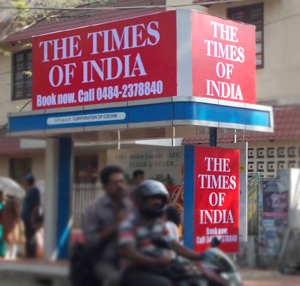
    After much speculation, The Times of India has finally made its foray into the Kerala market, forging a strategic alliance with Mathrubhumi to make inroads into this market. While for readers this alliance might be the best deal as just for Rs2 extra they get a copy of Mathrubhumi and the TOI with its many supplements, as a reader quipped: “This is not a bad deal for 2 bucks”.


    This exactly is the sentiment that TOI wants to ride upon – the bundling with a regional newspaper which the readers are familiar with and allow them to test something new definitely is a great way to enter a new market dominated by regional players.


    Kerala, in that sense, is a unique market with high literacy rates and people who are proud of their culture, willing to try something new but not at the cost of old. Hence, it is primarily seen as a two newspaper-market where one paper is regional, which appeals to the older generation and is more of a habit, and the other is an English newspaper appealing to the younger population.


    It is this younger population that TOI is trying to appeal to. The English newspaper market is primarily dominated by The Hindu, The New Indian Express and more recently Deccan Chronicle. The Hindu too has become aggressive and gone all out to protect its turf.


    Recently, on January 29, just two days ahead of the TOI launch, The Hindu and The Hindu Business Line launched its Kozhikode edition. This shows that The Hindu understands the might of TOI and has gone aggressive with its 360 degree campaign to reiterate its hold over this market. In fact, it has also taken around 30-35 hoardings to make itself visible while sources inform that TOI has taken up around 80 hoardings across to announce its presence in Kerala.


    The divide in Kerala, according to reading preference, is: South to Cochin (till Trivandrum) is where readers prefer Malayala Manorama whereas the area from Cochin to Kasaragoda is dominated by Mathrubhumi. This liking is also based on the political inclination too. Currently, TOI has come out with editions fromKochi, Thiruvananthapuram,Kozhikode, Kottayam, Pathanamthitta, Malappuram, Palakkad, Thrissur, Alappuzha and Kollam, thus being seen all over Kerala.


    However, it is learnt that the paper is having teething troubles: The newspaper is not available at many places; the hawkers union’s in Kerala raising ruckus over the availability of the newspapers in some pockets.


    Giving his view, Kiron Kurian, Group Manager, MudraMax said: “For TOI the real competition is The Hindu in this market. Their current strategy of tying up with Mathrubhumi, as I see, suggests that as the former caters to Sec A and B audience it will be easier to convert this TG to also adopt TOI as a second newspaper.”


    Swarup BR, Founder Stark Group, a Kerala-based 360-degree communication agency feels: “I think largely the TOI offering in Kerala market is nothing phenomenal from what has been seen in the other markets. There would be many people who would want to try out the newspaper and along with their aggressive marketing strategy, it should work out well for them.”


    However, for all, it’s ‘wait and watch’ to see how the market evolves. Some feel that a new trend might start with homes having three newspapers, with both Hindu and TOI having their share of readers. Also there could be revised rates to capture more audience.


    This TOI- Mathrubhumi alliance, while is advantageous for the former, will also be good for the latter as it might give it the much needed push that it requires to lessen the gap with the leader Malayala Manorama.


    Vidya Nandakumar, Business Director, LMG based in Cochin is doubtful that TOI will find it easy to break the monopoly of The Hindu. She said: “In Kerala people are die-hard loyalist and if they like a brand, it is difficult to make them switch. So it would be interesting to see how TOI gets them to convert.” She is of the opinion that probably it would be some pockets where TOI might succeed.


    But Mr Swarup countered: “Kerala is a ‘rurban’ economy; hence there is no clear divide between rural and urban. The brand proliferation too is across the market hence it is one big market. The opportunity for a TOI to reach across is immense. The entire state is a captive market, not just few pockets of interests. Yes, The Hindu is a formidable power and people would not be willing to give the newspaper so easily for TOI. So in that sense it would be interesting to see how the market plays itself out. It is possible that a whole new audience will evolve who will be readers of TOI.”


  • Mudra Max OOH drives home HT’s No TV Day message


    By A Correspondent


    Hindustan Times returned with its popular and inclusive initiative on January 28 this year, following its success on January 29, 2011.


    What started as an HT initiative became a people’s movement in Mumbai, making it the only city in the world to have its own special day. Hindustan Times called upon Mumbai to switch off TV and be open to the immense possibilities that their relationships and the city had to offer.


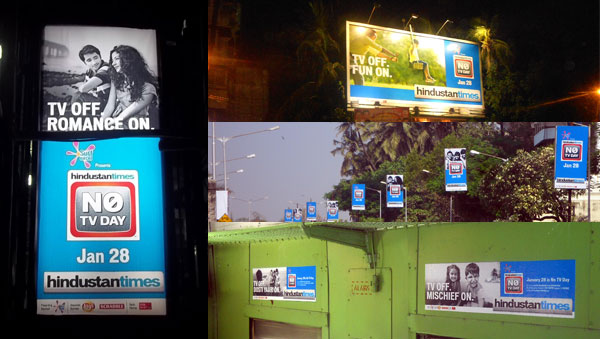
    To drive home the message – TV Off, Mumbai On, Mudra Max-OOH planned and executed an effective OOH media campaign for No TV Day, beginning January 13.


    The agency deployed a wide mix of OOH media, namely billboards, gantries, BQS, DBQS, pole kiosks, in-train branding, bus back/side panels, station branding & domestic airport branding.


    Considering the growing population which prefers air travel these days, a few interesting media vehicles such as cutouts on conveyer belts & standees were deployed at strategic locations inside domestic terminals.


    To break through the clutter, Mudra Max-OOH executed a couple of innovations at marquee sites in Mumbai (Juhu Koliwada & Mahim Causeway).


    Innovation 1: At Mahim Causeway (one of the important congregation points for vehicular traffic in Mumbai), the idea was to create the NTD Facebook homepage on a billboard. There was a daily change in the status, just the way one updates their statuses and the number of growing Facebook fans on the billboard. The status updated continued was for 5 days as a build up towards No TV Day.


    Innovation 2: This was executed at Juhu Koliwada / Juhu Tara Road (one of main arterial roads of Mumbai), since the core essence of NTD is TV Off, Mumbai On, this execution tried to bring that alive on a billboard by showing a father-son having fun on the swings in a park and the copy read ‘TV Off, Fun On’. The swinging movement on the billboard caught a lot of attention and was really talked about.


    Like last year, Hindustan Times organized a plethora of activities on January 28, encouraging Mumbaiites to step out of their homes and explore the city with their family and friends.


    The activities ranged from school painting competition attended by around 34,000 children with their parents, helicopter rides, and exclusive discount deals at more than 400 outlets in the city, heritage rides, dance workshops and many others.


    Across the city, around 250 housing societies registered for the No TV Day Best Society contest. A city specific treasure hunt was organized across three zones in Mumbai (western suburbs, Navi Mumbai andSouth Mumbai). While 1,300 participants raced against time to reach the finishing point, 3 winners were selected in each zone.


    The engagement with Mumbai was sustained in the social media space as well with the HT Mumbai No TV Day Facebook page and a special microsite. In just 3 weeks, 1.5 lakh new fans were added to the No TV Day Facebook community, taking the total strength to 2.5 lakh fans. The Facebook page also generated 6.5 million unique impressions and was the among the top branded Facebook pages inIndiain terms of engagement. On January 28, the strong buzz about the initiative resulted in No TV Day featuring among the top trending topics nationally on Twitter.


    There were various partners, such as Railways, Prince of Wales museum and MTDC, and brands like Surf Excel,Toyota, Lays, Micro Technologies and Scrabble who joined in this initiative.


    Ajay Dang

    Mandeep Malhotra, President, Mudra Max (OOH, Retail, Experiential) said: “NO TV DAY is an annual property built by HT and we were required to create a history connecting the brand with Mumbaikars. Our aim was to establish a property better and louder than the last year’s campaign. In a city dominated by competitors, it was an indispensable task to keep Mumbai ‘On’ for a quality life. We, along with HT, delivered the message effectively and took OOH from the position of a reminder medium to a call for action platform.”


    Ajay Dang, Marketing Head (West and South),HindustanTimes said: “Very few times does an initiative by a brand/ newspaper becomes a people’s movement. Hindustan Times has added an important day in the calendar of Mumbai when the city takes time to reconnect to important relationships be it family and friends or the city that we call home.”


  • Better innings for IPL 5?


    By Rishi Vora


    At a time when India’s economy is slowing down and the advertising-media industry is facing a bit of a setback, the Indian Premier League readies itself for a mega show which, experts believe, will come as a relief to all stakeholders – the broadcaster (Multi Screen Media Pvt Ltd in this case), advertisers, sponsors and of course, the franchise owners and the otherwise cash-rich BCCI.


    There is a great deal at stake as far as the actual delivery of the event is concerned, with crores of rupees spent by brands on sponsorships and advertising, and the question doing the rounds within the media fraternity is whether IPL season 5 will deliver well on the ratings front.


    As Sundeep Nagpal, Director, Stratagem Media, said, “All else notwithstanding, we could do well to consider that Indians are emotional about IPL. It’s almost like it’s a contest for the Indians, by the Indians, even if it’s not of Indians only. So this is good enough to get over any overdose. Secondly, memories of test cricket losses, or Sachin not getting his 100th ton, no matter how sordid, would by then be two months old and have faded by the time the IPL gets under way. Besides that, clever marketing has always propped up the IPL. And if some of our heroes click during the tournament, that would bolster the popularity ratings even further, because let’s not forget, success tastes even sweeter after failure.”


    The general sense is that even if it doesn’t match the success of the first two seasons, the event will put up a better showing than last year, where it delivered an average rating of 3.91 across 74 matches, the lowest ever in four years.


    The primary reason cited by media planners and observers was that the ICC World Cup and India’s win that contributed to the slump in IPL viewership. It may be recalled that a few advertisers had stayed away from the event last year, having chosen to advertise with the World Cup which had preceded the IPL.


    But this year, it’s going to be very different, says Rohit Gupta, President, MSM: “IPL is the single biggest property. So I don’t see any reason for it to not deliver as per expectations. The cricket fatigue or India not doing well does not impact IPL in a big way. It’s a different format altogether. Viewers look forward to IPL every year, for it promises live entertainment.”


    Punitha Arumugam, CEO, Madison Media, says, “India’s recent losses and a slowdown in ad spends, especially in the non FMCG segment will impact the advertiser’s sentiment on IPL. However, given the prime time of IPL for over six weeks day after day, we expect the viewership to be sustained.”


    Divya Gupta, CEO, Dentsu Media, is even more upbeat: “IPL viewership will not be affected, at all. Consider this – the IPL game and format is completely different. Team performance and outcome can change with every game. And IPL is beyond just India Team performance. It is live entertainment, at its best!”


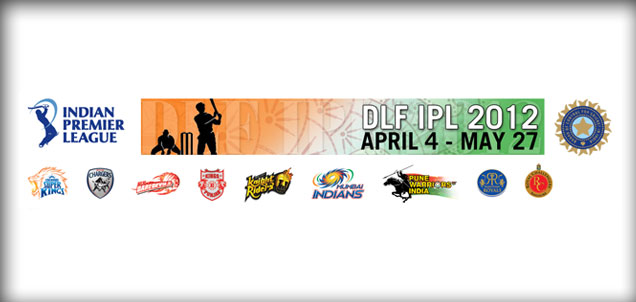
    MSM will be heavily promoting the event, which is scheduled to begin on April 4. Mr Gupta added, “We have marginally increased the ad rates (about 10 per cent). We hope to sell out our inventory well before the tournament begins.”


    Though Mr Gupta refused to divulge names of advertisers, industry sources have said that TV screens will be buzzing mainly with players from the telecom sector. Brands like Vodafone, Idea, Tata Photon and Pepsi have agreed to be a part of IPL this year.


    Rema Harish, Co-Founder, DoMore Communications, says, “Advertisers may lose out a bit as far as ROI is concerned because cricket seems to have lost its charm among fans in India. There is a sense of fatigue and also the fact that the Indian team has not performed well in the recent past. While advertisers are aware of the risk, they’re betting on IPL because it is the only event in that size, promising greater reach and visibility.”


  • Tata group firms to launch common loyalty plan

    By Sagar Malviya


    Tata Group’s consumer-centric firms including Taj Hotels, Croma and Westside will soon initiate cross-marketing activities such as promotions and campaigns by sharing customer database and insights.


    “What we plan to do is leverage different databases and provide more value to the customers,” says Akash Sahai, managing director, AIMIA India, a joint venture between Tata Capital and Canadian firm AIMIA (formerly Groupe Aeroplan) that will launch a common loyalty card for clients within and outside Tata Group.


    “For instance, we are using the database of Taj Hotels to give its customers additional promotions at Tata’s department store Westside,” he says. “Similarly, consumers could use Tata Capital card at Westside and Croma for added benefits and finance schemes.” Most Tata Group companies have been working together in legal, real estate sourcing and IT services among other administrative work, but the conglomerate so far did not have a common customer relationship management (CRM) programme for its half a dozen consumer-centric companies spanning retail, consumer goods, hospitality, financial services and telecom segments.


    AIMIA has started managing Taj Group’s customer relationships and will soon include other consumer firms of the group to create a unified CRM programme.


    Customer service is clearly emerging as a differentiator for consumer-centric companies as competition increases and consumers become more empowered.


    Several global multi-partner loyalty operators have set their sights on the Indian market, valued roughly around $1 billion.


    While Tatas roped in AIMIA last year, another Canadian firm, LoyaltyOne, has acquired a stake in local firm Directions. Kishore Biyani’s Future Group, the country’s largest retailer, is partnering German loyalty management firm Payback.


    Penetration of loyalty cards in India is just 42% of organized retail consumers with an average of 2.8 cards for each person compared to 74% penetration at an average of 3.8 cards for each consumer in the US.


    LoyaltyOne Chief Marketing Officer Rathin Lahiri says loyalty programmes will help marketers leverage consumer insights for developing customised programs. “That will not just impact the way that consumers respond to their brands, but also in the long term will shape their buying patterns,” he says.


    AIMIA will launch its multi-party loyalty card later this year. Apart from Tata Group firms, it is in talks with several non-competing brands in the aviation, petrol retailing and financial services space to launch a loyalty card to be used across companies.


    Source:The Economic Times

    Copyright © 2012, Bennett, Coleman & Co. Ltd. All Rights Reserved

  • Amazon enters India via Junglee.com

    By Correspondent


    The world’s largest online retailer is tiptoeing into India, using cover from a comparison shopping site Junglee.com it acquired 13 years ago.


    Amazon, whose moves have been closely watched for any sign of an imminent entry into the Indian retail market, will not sell or buy anything in the country for now. Instead, it will direct customers to both online and offline vendors listed on Junglee.


    Amit Agarwal, vice-president of Amazon, would only say Junglee would “help customers discover products from online and offline retailers in India and from Amazon.com”. He declined to say more about the company’s plans.


    Conspicuously missing from the list of vendors on the Junglee site is Flipkart.com, India’s biggest online retailer founded by two former Amazon executives. Flipkart expects to post sales of Rs 500 crore by March 2012. Amazon ended 2011 with revenues of $48 billion (about Rs 2.5 lakh crore).


    “Its recent moves to set up a fulfillment centre (in Mumbai) and now the Junglee launch certainly look like precursors to a retail launch whenever the government allows FDI in multi-brand retail,” said Devangshu Dutta, CEO of retail consultancy Third Eyesight. A legal expert at one of the country’s largest law firms said Amazon was making a ‘clever entry’.


    Agarwal said Junglee will display over 1.2 crore products and 14,000 brands for Indian consumers. The company has also launched Amazon seller services in India where vendors can hook up to Amazon’s portal to acquire customers.


    Source:The Economic Times

    Copyright © 2012, Bennett, Coleman & Co. Ltd. All Rights Reserved


  • New twist to hair colour campaign

    By A Correspondent


    There is just one type of hair colour advertising that we normally see on television, one with celebrities explaining the science behind hair colouring as they sit in swanky labs and settings. Creativeland Asia’s film for Godrej Expert portrays hair colouring as a fun social activity, and in sync with the times, discards the embarrassment attached with it.


    Depicting hair colouring as no more a chore that is secretly performed in the confines of the bathroom, the TVC, set to a youthful rendition of the Bollywood hit number, ‘Jawan-e-jaaneman’, shows people from diverse social statuses and different parts of the country, unabashedly colouring their hair. From young daughters surprising their mother on her birthday with a hair colouring session for her, to a husband playfully applying hair colour on his wife’s hair as she frantically oversees a wedding decoration, to a man colouring his hair using the mirror of his scooter while a game of street cricket is being played in the background, to a computer astrologer colouring his ‘ponytail’ on the banks of a river, to a bunch of ‘ghoonghat’-wearing middle-class women overcoming their shyness to pick up a pack of Godrej Expert at the supermarket, to three brothers in a typical Gujarati home while their family member applies hair colour for them one by one, to a Parsi woman who colours her hair in the balcony of her home while talking to her neighbour who is getting her son ready for school, to a rockband member in his fifties colouring his hair; the situations offer a peek into the lives of various Godrej Expert users.


    [youtube width=”400″ height=”200″]http://www.youtube.com/watch?v=5ZIEMHXfzCc[/youtube]After the voiceover which says, “Jab baat aati hai ek safe, simple aur long lasting colour ki, toh chaar crore se bhi jyada Indians bharosa kartein hai sirf ek hi naam par – Godrej expert’, we see the protagonists post their hair colouring sessions. While the mother of the three daughters does a small catwalk to flaunt her hair, the woman overseeing the wedding decorations now breaks into a dance with her husband admiring her beautifully coloured hair. We see the man checking his coloured hair in the mirror of his scooter, and the Parsi woman being appreciated by the little boy in the neighbourhood with a flying kiss.


    Tarun Arora
    Sajan RaJ Kurup

    Tarun Arora, EVP Marketing, Godrej Consumer Products Limited says, “Despite increased competition, Godrej Expert continues to be the largest selling hair colour brand in India. As the market leaders, we sensed a need to deliver beyond just hair colouring, hence we decided to adopt a benefit-based strategy. This brought about the genesis of the Godrej Expert range – available in Original, Care & Advanced variants. The challenge then was how to communicate the functional benefits of these variants and also to make the brand more likeable.”


    “Working on Godrej Expert has been an interesting challenge. I am glad we have been able spike something as mass as the powder hair colour category with a lot of freshness, and live up to what Creativeland is known to bring to a brand. The TVCs are extremely sweet and enjoyable. This is obviously only the very first step. And watching the response from our client partners, I look forward to more exciting work on this brand.” commented Sajan RaJ Kurup, Founder and Creative Chairman, Creativeland Asia, on working on Godrej.


    “The challenge with the campaign was to make functional hair coloring less boring, less inhibited and more acceptable. What makes me happy is that we have managed do it relevantly in the most interesting way possible.” he added.


    The film is directed by Ram Madhvani of Equinox Films.