Blog

  • Debrief: Maaza: Refreshing take

    By Anil Thakraney


    Mango drink Maaza has a brand new positioning: ‘Bin mausam aam’. But instead of focusing on mango lovers, they have featured mango hawkers in the advert. And that’s actually quite clever, because it injects freshness into the communication.


    In the TVC, three mango sellers wonder what to do with their lives since the mango season is over. Desperate to earn a livelihood, the ‘aam aadmis’ try out new career options. One becomes a soothsayer, another tries his hand at dentistry and the third one becomes a car mechanic. Naturally, being untrained, they fail miserably in their new roles. Then, a smart lad introduces them to the ‘Bin mausam aam’ called Maaza. And so they begin selling that.


    [youtube width=”400″ height=”200″]http://www.youtube.com/watch?v=UizD1CD2oBM[/youtube]

    The twist in the tale works. One, because the ad indirectly cues that Maaza = Real mango, without hammering it down our throats. And two, because the commercial talks about aam sellers, the ad becomes off-beat and entertaining. And one must appreciate the client for not insisting on Maaza sipping shots in every frame. This idea would have been impossible to execute with such a demand.


    If there’s one negative, it’s that the idea only works in a long format, because it’s an indirect route. I don’t see them being able to pull this off with a fifteen-second edit.


    Rating: (On a scale of 1 to 5): 3. Novel approach pays off.

  • Top Ramen consolidates its advertising duties with Dentsu

    By A Correspondent


    Top Ramen, the instant noodle company from Indo-Nissin, has consolidated its advertising duties with the Dentsu India Group. Dentsu Communications has been already handling the creative duties and now with media, too, coming under its umbrella, Dentsu has consolidated the entire business.


    The media duties were earlier being handled by Madison Media. The size of the business in the last financial year was close to Rs10 crore and is slated to scale upwards and be in the range of Rs15 crore.


    Confirming the development, MNVV Prasad, General Manager, Sales and Marketing, Indo-Nissin Foods Ltd, said: “At this juncture we were looking at integrating our communication. Since Dentsu is already partnering with us for creative, we decided to consolidate the media with them too.”


    He added: “The instant noodle market has undergone tremendous change in the last two years, especially with international players coming into fray and the existing ones going aggressive. Top Ramen has been a leader in the world in this category and scores in innovative product strategy. We hope to combine our advantages and come out with a strategic communication that will differentiate us from others. We want to grow on the basis of our different positioning in this category.”


    Top Ramen has been competing with Nestle’s Maggi much before Knorr, ITC’s Yippee or GSKs Foodles came in the fray. Sensing competition, Top Ramen has gone aggressive on its marketing plan in the last two years and even signed on Saina Nehwal to feature in its advertising, which is a shift from its earlier strategy.


  • Scarecrow turns 2, launches design division

    By A Correspondent


    With two offices, 45 people and 25 brands, Scarecrow has completed two successful years today (Feb 9). On the occasion of its second Anniversary, Scarecrow Communications Ltd. has announced the launch of a design division -www.scarecrowdesigns.net. Primarily, Scarecrow Designs, headed by Kapil Tammal as Design Director, will provide exclusive design solutions to various clients.


    Scarecrow Designs also endeavours to produce pure graphic design content on its own. The in-house designers and budding talent from design schools will be roped in to create merchandise (t-shirts, bags, accessories and so on), which will be showcased at the Scarecrow Art Gallery and on www.scarecrowdesigns.net


    Why Scarecrow Designs?

    Scarecrow Communications Ltd provides all advertising solutions under one roof. But the team realizes that there is a lot of demand for pure design-led jobs. From brand manuals to corporate & brand identity, and packaging. Due to the retail boom, mall culture and entry of many international lifestyle brands inIndia, design has become extremely imperative.


    Many national/international brands, more often, avoid spending on full-fledged ATL campaigns due to media costs. But what they can’t avoid spending on is to create a look, feel and imagery of the brand where design is sacrosanct. And so, these clients specifically seek design-led communication solutions. And there was a need gap here.


    The team at Scarecrow also observed that good talent from design schools normally joined design houses rather than ad agencies, leaving them with substandard design talent.


    To correct and balance the design ecology of talent and need, Scarecrow believes in identifying design talent at an early stage. Even when the current Design Director Kapil Tammal was brought on board, he was also offered a senior position in Landor, one of the leading design houses. Subsequently, Scarecrow has also attracted talent from design institutes like NID.


    Yet, to complete the ecology of design, one needs to create a complete environment of design that attracts and nurtures great design minds to provide great design solutions. Hence the launch of a separate interface called Scarecrow Designs.


    Idea behind the new identity:

    Crop Circles have been the biggest design mysteries in the world. Even today, some believe aliens create them, while some believe it’s a hoax. Being Scarecrow, standing tall in the field, the team thought of owning and associating with Crop Circles. No one has officially claimed to own them yet.


  • The Anchor: 7 things for Lifestyle channels to remember

    By Smeeta Chakrabarti


    #1 Till a few years ago, most of the programming on lifestyle channels was imported. Giving an Indian touch to programming is important as it makes it exciting for the Indian audiences. For example, even though there are many international news channels such as BBC and CNN, the perspective changes when the programming is done by an Indian channel.


    #2 India has the most amazing and interesting lifestyle. We can teach something to every other country – About food, the way we eat, we drink, the way we get married, clothes etcetera. It is important to keep in cognizance that India has a lot to give to the west.


    #3Today the world is adopting our lifestyle and not the other way around. The flow is now from East to West, and countries like India and China are going to dictate to the West about lifestyle issues. The world has to catch up to the big fat Indian wedding.


    #4 India is a young and affluent country and the current generation spends in a different way from the way our grandparents used spend. We are not hoarders any more and we don’t necessarily save.


    #5 Especially in the Indian context, lifestyle is not just about brand names and tags – it’s also about quality and trades craftsmanship, something that India is very good at. It’s not just about imported labels but also feeling pride about what we Indians are doing indigenously at the grass root levels. That is what makes us special.


    #6 Being Indians, we have to be proud of the India we live in and have to feel great about this country. It’s about living in the best possible way with the resources available.


    #7 The genre will definitely grow. When we started there was just one international channel, with international programming, and the genre has grown ever since with launches of newer channels. Along with the regional space, lifestyle and news spaces will grow too.


    Smeeta Chakrabarti is the CEO of NDTV Lifestyle Limited.


  • Now Meru to offer special services to key customers

    By Preethi Chamikutty


    From zero to 5,600 radio taxis in under five years, with a presence in four metros to boot, has helped Meru Cabs become the largest such service in the country. With Rs300 crore in revenue, Meru has raced ahead of competitors like Easy Cabs and Mega Cabs, with the company even claiming that it is the third largest radio taxi operator in the world. The sauce of this success is no rocket science, at least on paper: a clean car, a knowledgeable driver, non-negotiable fares and a tamperproof meter.


    “You provide these things to the customer and he will be happy,” said Gavin D’abreo, who heads marketing & sales for Meru. This, of course, is just the beginning, and as Rajesh Puri, CEO, pointed out: “This industry is still at a nascent stage and there is a lot of upfront investment that needs to be done. Technology has been a major investment for us to improve our service offerings.”


    So what next for Meru, now that it has established a sound base in Mumbai, Delhi, Hyderabad and Bengaluru? Well for starters, turning profitable is the priority, with Mr Puri expecting to be in black in three out of four cities at the end of the quarter ending March. Beyond that, identifying new revenue streams by offering specialized services is the way to scale up operations.


    Meru, which has partnered with the airports in the cities it operates in, is now testing out a service called Meru Select in Hyderabad. This is aimed at giving its regular users a guarantee of up to 80 per cent of getting a Meru cab when they book for one. The trigger for Meru Select: only 5 per cent of its customer base gives Meru about 60 per cent of its revenues.


    “Because of limited inventory, customers have complained to us about the non-availability of cabs when they order for one. We work on first come, first serve basis, but our loyal customers get an additional assurance of getting a cab with Meru Select,” explained Mr D’abreo.


    Meru Corporate, aimed at corporate customers who want more than a service from point A to point B as being offered by Meru currently, is another service being tested. Meru Corporate is targeted at executives who have to travel from one meeting to another across the city in a day.


    A preloaded plastic card will be given to the eligible executive, which will be swiped by the Meru driver at the end of day’s travel. Some 21 companies have so far expressed interest in this service and Meru is in the process of giving the finishing touches. Other services being planned are transporting kids in absence of their parents as well as a service for medical emergencies.


    Also on cards are expansions into Chennai, Kolkata, Ahmedabad and Vizag. However, such growth won’t come easy. One reason for that are restrictions – fares, distances and licences are regulated by the government. Another hindrance in growth, according to Mr Puri, is finding drivers. And then there’s competition. Mega Cabs, the oldest brand in the radio taxi business, is present in seven cities. Then there’s Easy Cabs -present in four cities – which are available at malls, hotels and even hospitals. Niche services like For She, an exclusive ladies taxi service driven by lady chauffeurs in three cities, are also available.


    Yet, there are brands – like Gold Cabs and Star Taxi – that have not been able to survive the tough regulatory environment and the investments that need to be pumped into not just vehicles but the technology back end. Meru estimates the size of the radio taxi business in India at 9,500 cabs across Mumbai, Delhi, Bengaluru & Hyderabad, which is growing at 50-60 per cent per annum. Nabankur Gupta, founder, Nobby Brand Architects, a brand consultancy, reckons the radio taxi space has tremendous scope for brand building.


    “What exists today is commodity service with a name; a brand can be built only if customers come back to a brand for the experience they get. Security and assurance of good service will help build stronger brands in this space,” said Mr Gupta. He suggested having two levels of service offerings – one level is a limousine kind of service, which is about exclusivity and pampering; the second level is the existing sedans that can cater to the mass market. Mr Puri of Meru agrees there is a demand for super premium service in India, but the constraints are not just restricted to acquisition of vehicles. “To have differentiated cabs, there has to be a differentiated pricing system and a backend IT infrastructure to support it. Technology is the most important aspect of our business.”


    He adds that evidence of Meru’s tech edge is that its drives can do “six duties a day compared to 2-3 duties of others. Our backend alerts them about the next job nearest to where they are positioned,” explained Mr Puri.


    Mr Gupta says in countries like Singapore and Hong Kong radio taxis have made a big difference and have also replaced the public taxi fleet. “Black & yellow taxi drivers should be spoken to and, if they can be taken over, we will have a much better taxi service in our cities,” he suggested.


    Source:The Economic Times
    Copyright © 2012, Bennett, Coleman & Co. Ltd. All Rights Reserved

  • Bright Future, Generali speaking

    By Shubhangi Mehta


    The overall slowdown has not spared the life insurance industry – a recent report by CNBC stated that overall de-growth has been in the region of 30-40 per cent, which effectively means the industry is at 2008-09 levels three full years later. Against this very challenging environment, Future Generali India Life Insurance has posted an overall business growth of 14 per cent on a year to date basis over last year.


    Future Generali is now increasingly looking at localised below the line activations and “reach out” programmes to promote the brand and reach out with advisory services to customer prospects. This includes school based programmes, park or recreation based programmes, mall/shopping programmes, health oriented programmes/camps, renewal camps etc. They are exploring various ways to reach out beyond the clutter and high costs of pure play advertising. Future Generali does approximately 200 such activities across the country per month.


    Abraham Alapatt, Senior Vice President & Head – Brand & Corporate Communications at Future Generali India Life Insurance Company & Future Generali India Insurance Company, said, “Our General Insurance business is doing very well and is well on track to possibly being among the fastest General Insurance companies in India to achieve operating break-even. We offer best in class ‘Total Insurance Solutions’ in the form of products and services across Life and General Insurance, and top-notch post-sale experience. We also offer the convenience of dealing with our branches, agents, online via our portal futuregenerali.in to buy, service and renew your policies or even via our unique Mallassurance outlets at Big Bazaars across the country.”


    As per the marketing initiatives this year by Future Generali, there is an overall brand budget of Rs40 crore which is line with their budget of the last FY.


    Among the various marketing initiatives by Future Generali is a ‘Financial Planning Tool’ which is a simple interactive tool they ask their advisors or FPAs to complete with customers/prospects. This is a 10-minute exercise, that helps one understand where one stands by comparing short-term financial needs with short-term income streams and then helps one check if he/she is prepared to meet their medium- to long-term goals.


    Another initiative is the FG Game of Life, a simple Facebook game which allows one to journey through the perils of everyday life and collect ‘shaguns’ along the way for protection. This game was launched in December, and a contest for higher scorers was launched 10 days ago. Since then there have been a large number of new followers, and now there are close to 18,000 followers with over 20 per cent people “talking” about it.


    Future Generali has also just launched the Online Video Bank which is an intuitive service, allowing a person who has bought their Online term Plan ‘Future Generali Smart Life’ to upload a short video message to his family/loved ones. This video will be stored against his policy data and at the time of claim settlement, they undertake to retrieve and deliver this message on a CD to the nominee/nominees of the policy. He/she can change/replace the video as often as they want during their lifetime as long as they are existing/registered customers.


    Mr Alapatt adds, “We have a five-year strategic plan towards break-even and growth and we are doing what it takes to stay true to that. I am particularly excited about Video Bank this because it delivers a huge emotional payoff to the customer (in absentia) and his/her family at the real ‘moment of truth’. Our plan is minimising cost while maximising ROI in printing and production, innovation in idea and execution for ATL, more localised reach programs in BTL and aggressive online and social media initiatives and investments.We have a five-year strategic plan towards break-even and growth and we are doing what it takes to stay true to that.”


    The continuous balloon chain formed of the balloons signed by people during FGIW were strung together on February 9, 2011 at Mumbai to form a 20+km-long chain – adjudicated by a Guinness World Records representative as the world’s longest balloon chain.


    The FGIW campaign also went on to win Indian Marketing & Advertising’s highest recognition of effectiveness, by wining an Effie award at the Advertising Club of Mumbai in the Financial Services category in December 2011.


  • Market research firm Majestic MRSS opens shop in India

    By A Correspondent


    Realising the extensive scope that the discipline of marketing research could offer to its patrons in India, decade-old full service market research company Majestic MRSS has announced its foray into the country recently. The new venture seeks to capitalize on technologies around insights developed by Majestic MRSS and its partners in the US, Europe and Japan.


    In India, the venture will be headed by Sarang Panchal who comes in as Chief Mentor and Principal advisor. Mr Panchal has more than two decades of experience in Market Research and has worked in P&G prior to his career with D&B, VNU and Nielsen.


    On his responsibilities at the company, Mr Panchal said, “My primary role here would be to mentor the leadership team that we are putting in place. My extensive experience that I have gained in the field of research marketing would enable me to guide marketers on what will work for them and what to avoid. We expect the full team to be in place by the end of the month.”


    Outlining the objectives of the company, Mr Panchal said “Our aim at MRSS in India would be to further leverage the use of technology to offer better and customized services. We will continue adding more innovative and strategic technologies as we become one of the leading players in India. We are pioneers in getting technology in the Asia-Pacific region, and are now ready to introduce them to India.”


    Raj Sharma, Co-founder and President of Majestic MRSS said, “We believe Mr Panchal’s extensive knowledge around research, associations and active presence in the industry will bring instant recognition to MRSS India as a brand with global technological leadership and hyper-local understanding.”


    When asked on how MRSS would differentiate from the other players in the space, Mr Panchal said, “We have leveraged technology in the field of market research in the areas of data collection and advertising / media research. Moreover we are ‘known’ for our high quality work in researching upscale and ‘difficult to contact’ target groups. This is what sets us apart.”


    Adding further he said, “Currently MR agencies are considered to be data suppliers. We hope to change this perception and become partners of clients and enable them to grow their business in India and Asia Pacific. The industry may not change in perception unless larger players begin to offer truly-world class research in marketing and that is what we would excel to provide.”


    Going forward, the goal for the company would be “to become the largest independent MR agency by the end of the decade,” affirmed Mr Panchal. Given the huge void of players in the space, it isn’t an impossible proposition, he feels.


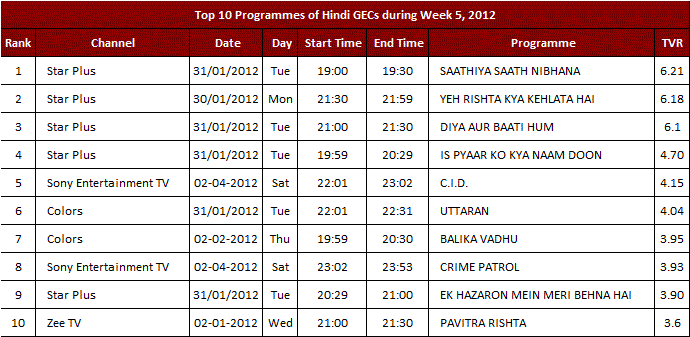
  • TAM data Top 10 programmes on HGEC – Wk 5 ’12


    Source: TAM Peoplemeter System
    TG: CS 4+ yrs
    Market: Hindi Speaking Market
    Period: Wk 5 (Jan 29 to Feb 4) 2012


    About TAM Media Research


    TAM is a joint venture between Nielsen Company & Kantar Media Research. Besides measuring TV Viewership, TAM also monitors Advertising Expenditure of Television, Print & Radio through its division AdEx India. Since 2004, it extended its presence in the PR Measurement & Analysis space for Corporate/Marketing Clients by setting up a separate division Eikona PR Measurement.


    In 2007, the joint venture introduced RAM (Radio Audio Measurement) service to track Radio Listenership for the Indian Radio Broadcast Industry. In year 2009, TAM launched a division, called TAM Sports that specializes in monitoring Sports Sponsorship ROI.


    TAM Media Research’s objective is to fuel media insights that will drive the growth of the Indian Media Industry.

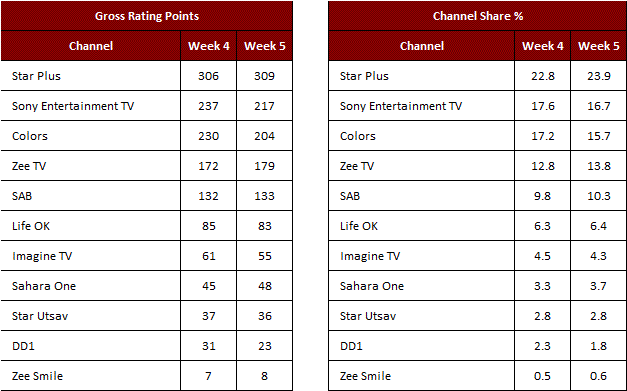
  • TAM Data (GRPs Channel shares of HGECs)- Wk 5 ’12

    Source: TAM Peoplemeter System
    TG: CS 4+ yrs
    Market: HSM
    Period: Wk 4: Jan 22 to Jan 28, 2012
    Period: Wk 5: Jan 29 to Feb 4, 2012


    About TAM Media Research


    TAM is a joint venture between Nielsen Company & Kantar Media Research. Besides measuring TV Viewership, TAM also monitors Advertising Expenditure of Television, Print & Radio through its division AdEx India. Since 2004, it extended its presence in the PR Measurement & Analysis space for Corporate/Marketing Clients by setting up a separate division Eikona PR Measurement.


    In 2007, the joint venture introduced RAM (Radio Audio Measurement) service to track Radio Listenership for the Indian Radio Broadcast Industry. In year 2009, TAM launched a division, called TAM Sports that specializes in monitoring Sports Sponsorship ROI.


    TAM Media Research’s objective is to fuel media insights that will drive the growth of the Indian Media Industry.

  • Inorbit Malls’ interactive feedback mechanism on Twitter & SMS

    By A Correspondent


    Inorbit Malls, the pioneers in mall culture in India, now brings to its shoppers an interactive feedback mechanism that will enable them to connect with their consumers in real time as well as provide a forum for consumer interaction and response. Inorbit Malls have created an online forum on micro blogging site, Twitter as well as launched a dedicated 24 hour GSM customer short messaging services (SMS).


    The feedback mechanism will enable an expeditious and inexpensive forum to shoppers for resolution of complaints relating to certain services rendered by the mall. All that the consumers, who are active on Twitter, have to do is #InorbitMall on twitter while posting their queries or complaints and Inorbit Malls will respond immediately. A dedicated digital and social media team has been set up, which will monitor these posts and respond to shoppers in real time.


    Similarly, people who are not active online can send an SMS with key word ‘FEEDBACK’ on 9619792233. The query will be stored after the mechanism captures the key words, which will thereafter send an alert to the response team for further action. The response team will respond to all the queries within 24 hours.


    Talking about this initiative Kishore Bhatija, Chief Executive Officer, Inorbit Malls Pvt Ltd, said: “Consumer engagement and feedback is an integral part of brand awareness and commitment. As a brand, it is extremely critical to understand and connect with consumer on a personal level, as these help us in improving and furthering brand experiences. With this feedback mechanism, we will able to communicate with our shoppers in real time and build trust in the brand.”


  • Reliance Entertainment’s BigFlixs unveils its latest ad campaign

    By A Correspondent


    BigFlixs, a part of Reliance Group’s digital entertainment business on Tuesday announces the launch of a new ad campaign to increase awareness and promote its movies on demand service – BigFlix+ which lets the user ‘Click-Download-Play’ over 500 Blockbusters at a subscription fee of Rs249/ a month across PC, Tablets and Mobiles.


    Today’s metro generation is not able to see all films in theatres; they don’t want to watch the same on TV because of lack of variety and time limitations. There was a clear need of a service that can offer users the best in class movie experience on the devices that they are comfortable using – laptop, mobile or/and tablets.


    Hence the brief to agency was to establish BigFlix+ as a premium movie on demand service, where users of the service can also download blockbuster movies in addition to merely streaming them online.


    Commenting on the new campaign, Shreyash Sigtia, Business Head, BigFlicks Pv Ltd said: “The basic idea behind the campaign is to let the viewer know that they can now finally select a movie of their choice and view it wherever and whenever they want to see it. With BigFlix+, they can rest assured about the picture quality and enjoy a complete movie experience without the annoying ad breaks, on the device of their choice. This makes BigFlix+ service a Personal Blockbuster Theatre of the viewer. We deliberately kept the creative simple and focused the communication on the core offering and its benefit in order to build the category in the country.”


    On the completion of this campaign, Joy Ghoshal, Marching Ants, said: “Film content is not exclusive and viewing it comes with its irritants, so we decided to challenge the biggest provider; television. Big Flix+ is about to change the role of the laptop and other mobile devices to that of a ‘blockbuster theatre’, supported by huge choice of quality content and uninterrupted viewing.”