Blog

  • PR Satheesh joins as President, Travel Trendz TV

    By A Correspondent


    PR Satheesh, who recently quit as the President of the mobile solutions company TELiBrahma, has joined Travel Trendz Tv as its president.


    Mr Satheesh will spearhead the company’s revenue opportunities acrossIndiaand rest of the world. He would also be overseeing the marketing and brand building of the channel, along with giving strategic inputs in the content creation and distribution space of the channel.


    Talking about his role, Mr Satheesh said: “I am excited to be part ofIndia’s first travel channel that plans to projectIndiato Indians and foreign nationals – the true culture, history and diversity ofIndia.”


    He has been instrumental in taking TELiBrahma from its nascent stage to a high growth stage, and was part of their recent Series C fundraising efforts from Intel Capital. He had also set up and managedIndia’s first IN Store TV Network Tag Media.


    Mr Sateesh has worked with Zee Network, Deccan Chronicle and The Asian Age in the past.


    Talking about Mr Satheesh’s appointment, Abdul Azeem, CEO & Executive Director of the company which is promoted by the Agri Gold Group said: “We have found an ideal partner in Satheesh. He brings with him decades of experience in the industry, along with great passion and entrepreneurial mind-set that will go a long way in carving TTTv’s passport to success.”


    He added that PR Satheesh joining the company has added a fillip to the efforts of the channel in showcasingIndiain its true spirit towards promoting global travel and tourism in its real spirit.


    TTTv has also recently appointed Som Banerjee as the Channel Head. Banerjee comes with an experience of creating content across genres such as sports, travel, fiction and reality. A graduate in Philosophy from thePresidencyCollege, Kolkata, he is a multi-brand and a multi genre professional with over a decade of work experience.


  • Rural women – how strong is their ‘spending say’?

    By Ritu Midha


    The rural marketplace has long been touted as Destination Next for marketers. FMCG and mobile marketers along with a few evolved consumer durable ones have made inroads there. Considering that seven out of every 10 consumers reside in rural India, it comes as no surprise.


    As per the Nielsen estimates the fast-moving consumer goods (FMCG) market in rural India will hit $100 billion by 2025. As per Nielsen Consumer 360 India 2011, premiumization, commoditization, indulgence and brand acceptance levels would be the most important components of sales growth.


    Another study undertaken by ASSOCHAM on “Rise of Consumer Durables in Rural India states that the consumer durable market in rural India will witness an annual growth of 40 per cent in 2011 -12 due to higher disposable income of the rural India that has brought in lifestyle changes.


    But unlike urban India, where women are involved in purchase decisions in most of the product categories – women’s involvement in most purchase decisions was missing till lately. Divya Radhakrishnan, Managing Director, Helios Media, explains, “The rural woman unfortunately does not get involved in the purchase decision of even FMCGs. In the first place, rural India is a lesser consumer of branded products – loose/unbranded products work even in essential segments like salt, tea etc. The incidence of the woman going out to the mandi is limited, and hence it’s generally the male who takes purchase decisions.


    However, as per the Nielsen study, “Reaching rural Indian consumers today is becoming easier. Increasingly, rural consumers are upgrading technology – 84 percent have a television and 80 percent own a mobile phone.” With a television and mobile phone at their disposal their exposure to Urban India is increasing, and so is women’s involvement in purchase decisions.


    Anita Kotwani, Principal Partner, Client Leadership, Mindshare opines, “Women in these markets do make purchase decisions specially for FMCG brands. The strength of rural marketing lies in the 4A approach: of Affordability, Acceptability, availability and awareness and there is effort by marketers to ensure that they have the pricing strategies in place for such markets.”


    Opinion leaders have a huge impact on rural women’s purchase decisions, and smart marketers are taking note of it, and using them as influencers. States Shubha George, COO, MEC, South Asia, “Key influencers play an important role in connecting with the rural woman. By key influencers I mean trustworthy people from their environment such as a lady teacher or a social activist. These influencers are catalysts in permanent change in attitudes and behaviour. Touchpoints such as the local NGO or the health centre are significant in reaching out to rural women. Local activation is an important supplement, especially in the pockets where mass media is still limited.”


    Activation is key to reach rural women. And it has been noticed that activation by women’s groups is more effective. Microfinance and children’s education/ opportunities are two other major concerns and brands might gain by associating with these.


    No discussion on rural women can be complete without a mention of Shakti, HUL’s rural women empowerment project. States Anita Kotwani, “HUL’s Project Shakti is unleashing the potential of rural India. It is ushering in prosperity and more importantly self-respect. It is an Entrepreneurial Programmer that helps women in rural India set up small businesses as direct to consumer retailers. There is a definite need for such projects as they are all in the space of empowerment and making individuals self-dependent and confident of taking care of themselves.”


    In another direction, Nielsen Consumer 360 India presents a very interesting insight based on the spending habits of two rural Indian families for a three-week duration in which income increased each week. The study indicated that as spending increased three-fold, the housewife took on a greater role in the process.


    Going by the study, as the per capita income grows in rural areas, there is a fair chance of rural woman’s involvement increasing in purchase decisions. Perhaps it would pay off if marketers increasingly include women’s engagement in their rural marketing strategies.


    INDEX
    Success mantras from media captains
    All work and some play
    Riding the creative crest
    Holding up the managerial sky
    Celebrating the difference
    Managing Middle India’s Golden Lady
    Wooing vibrant India’s Wonder Woman
    Rural women – how strong is their ‘spending say’?
    Is the serial woman tellying it like it is?


  • Is the serial woman tellying it like it is?


    By Ritu Midha


    About a decade ago, we saw the emergence of Tulsi, Parvati and Kussum. Strong protagonists – but all of them set in more or less the same socio-cultural setting, grounded in traditions but fighting against the evil (another woman in most cases) trying to tear their families apart.


    Cut to the present-day GEC. The protagonist is stronger, and differentiated. She is no longer just about pacifying the mother-in-law, and mothering her growing-up children. She is aware, educated, has a mind of her own, and she speaks it too. She has the spunk, and many a time, she takes the lead in decision-making. To put it simply, she does not wait for someone to save her, she is fully capable of doing the saving. And in between all this, she has a heart too, and dotes on her family.


    There is a Pratigya fighting against the issues in her own house – a decision maker in Allahabad; there are working or aspiring-to-work women in quite a few soaps – among them Kuch Toh Log Kahenge set in Lucknow and Afsar Bitiya with a Bihar backdrop. There also is a Hitler Didi, where the protagonist, living in Delhi, is the master of the house, and of course Balika Vadhu and Diya Aur Baati Hum (both set in Rajasthan), which propagate women’s empowerment in the rural and semi-urban areas.


    Is it an accurate reflection of the real Indian woman, or are these shows akin to the funhouse mirrors that exaggerate certain parts of our collective reality? Even if it does exaggerate the social consciousness, it definitely provides an example for those women whose staple diet of entertainment is still the Hindi GEC.


    States Anamika Mehta, COO, Lodestar Universal: “Undoubtedly media, at an overall level, influences society and television has a huge role to play in that sense. While at some level, some shows and protagonists do play a role in sounding a wake-up call or instilling confidence, courage, and independence of thought, they thereby create followers or loyalists. However it’s more of media mirroring society on television essentially – witnessed for instance in the shift from ‘saas bahu’ soaps to the current lot.”


    While the woman protagonists are bolder and more intelligent now, the socio-cultural cauldron from which they emerge varies from show to show. The reason, of course, is increase in purchasing power of women across middle India – Madhya Pradesh, not a favourite setting for television serials till some time ago, suddenly finds itself as the backdrop for a number of soaps. Is the appeal of these shows universal or does it appeal to audiences in a particular geography? States Nandini Dias: “The traditional shows like Uttaran and Balika Vadhu do find better resonance in smaller towns while the talk shows like Oprah Winfrey or Barkha Dutt show a skew towards metros. The shows which do well across all towns are usually love stories like Kuch Toh Log Kahenge.”


    However, Shubha George, COO, MEC, South Asia, believes that in case the objective is to target a specific audience profile, a lot more needs to be done in this direction. She states: “Indian TV shows are fairly homogeneous and cater to a pan-India audience in most instances. I cannot think of any particular example that is more popular in metros because of a bolder woman character. Rather, this is a concept which is yet to be experimented on by Indian TV shows for mass audiences.”


    Many of these shows depict subjects like second marriages, domestic violence and other women-centric issues, but do they manage to send a message across to society? As per Anamika Mehta: “Frankly it’s little to do with evoking social consciousness and more to do with experimentation with new audiences, new generation, different content and eventually eyeballs. While many of these shows initially kicked off with a social idea and an attempt to rouse audiences, eventually, given the eyeball battle, they turn more into trials and tribulations of a woman with plot twists and turns.”


    There is a conscious attempt at creating a protagonist who wants to change the world, who would capture the attention and imagination of young women. Are these shows with the new realistic woman favoured by certain brands – or it is only TRPs that matter in the end? States Ms Dias: “Media planning is called a science and an art for exactly these reasons. Media planners do look at data , quantitative parameters. But finally when they take decisions they need to predict the future of how a show will do in the future. So the qualitative factors need to be considered too. In fact with the number of brand integrations that are done, it is detrimental to a brand if they do these brand integrations without understanding the content and relevance of the show.”


    Ms Mehta too states that brands do look at the content of the show, however, many times the storyline changes in chase of TRPs. She says, “Only if the brand’s personality is in sync with the show do they look at doing show exclusive deals. Very often the shows digress/change/derail chasing eye balls which often could defeat the rationale for association.”


    On India’s wide-ranging social canvas, there are many Indias, and the psychographics change not only from New Delhi to Basti, but also from Defence Colony to Rohini. It is not easy to depict the myriad colours of the Indian woman. However, the effort is being made towards being progressive, covering a broader spectrum, and bringing to the fore social issues that women in particular face. Does it matter that it is for the sake of eyeballs, or to get more advertisers on board, if the issues are addressed in the end?


    INDEX
    Success mantras from media captains
    All work and some play
    Riding the creative crest
    Holding up the managerial sky
    Celebrating the difference
    Managing Middle India’s Golden Lady
    Wooing vibrant India’s Wonder Woman
    Rural women – how strong is their ‘spending say’?
    Is the serial woman tellying it like it is?


  • How the WPP and Interpublic Group fared in 2011

    By A Correspondent


    WPP reported record profits of more than $1.45 billion for 2011, up a whopping 43 per cent from the year prior, and the holding company expects to see continued momentum in 2012 due to increased ad spending for the US presidential election and this summer’s Olympic games, according to Ad Age.


    Reported revenue for WPP, the biggest ad holding company in the world and home to creative agencies such as Ogilvy, JWT and media-buying behemoth Group M, was up 11.4 per cent year-over-year to $16.05 billion. However, WPP’s CEO-Executive Director Martin Sorrell is less optimistic about 2013, as there are no big events to bolster ad spend, and political ad dollars will drop off following the election.


    “We think 2012 looks similar to 2011, maybe at a slightly reduced level,” said Mr Sorrell. “But the one big cloud on the horizon we feel the need to address in 2013 is deficit reduction after the US election.”


    WPP said North America performed well, and in Europe the debt crisis is impacting growth, but overall the company said it still fared well in the region thanks to strong growth in the UK and acquisitions in Western Continental Europe.


    The company reported that Austria, Germany, Switzerland and Turkey, all showed strong like-for-like growth for the year, but France and especially Greece, Portugal and Spain remained affected by the Eurozone debt crisis. In 2011, nearly 30 per cent of WPP’s revenue came from Asia Pacific, Latin America, Africa and the Middle East and Central and Eastern Europe.


    The company said that emerging markets in Asia, Latin America, Africa and Eastern Europe represent the highest growth regions for WPP. The company plans to spend between $470 million and $630 million on acquisitions this year, Mr Sorrell said. The focus will remain on small and medium-sized agencies, particularly those in new markets or specialising in digital work, data analytics and technology.


    The past year saw a number digital agency acquisitions, including: F. biz and Gringo in Brazil; Rockfish and Lunchbox in the US; Who Digital in Vietnam; Promo in Russia and A4A in China. The company made a total of 38 acquisitions and 10 investments in 2011.


    The Interpublic Report-Card 2011

    US-based ad holding company Interpublic Group of Cos has reported that it nearly doubled its net income for 2011, up 96 per cent to $551.5 million, up from $281.2 in 2010, according to Ad Age. The company’s annual revenue was up 7.8 per cent, to about $7 billion.


    “Building on a very good 2010 result, we continue to show organic revenue growth that is at or near the top of our peer group,” said Interpublic CEO Michael Roth. “This performance keeps us on track to deliver on our goal of fully competitive profitability in 2014.” Mr Roth added all of the company’s regions grew in terms of organic growth in 2011, except for Europe, which is in the midst of a debt crisis.


    For the full year, continental Europe was down 0.1 per cent. The best region for organic growth last year was Latin America, which was up 17.8 per cent. For the fourth quarter, US organic growth was up 2.2 per cent, Latin American was up 30.4 per cent and Europe was down 3.2 per cent. Interpublic’s digital agencies, MRM, part of the McCann network, Huge and R/GA, significantly contributed to the company’s growth.


    In 2012, the company is targeting 3 per cent organic growth, noting “significant macro uncertainty on the global level.” Interpublic agency networks McCann Erickson and DraftFCB both saw major accounts defect in 2011. McCann Erickson lost Nescafe and other accounts, while DraftFCB lost SC Johnson and is now having to share Miller Lite with Publicis Groupe’s Saatchi & Saatchi.


    Source: The Economic Times

    Copyright © 2012, Bennett, Coleman & Co. Ltd. All Rights Reserved


  • Dunkin’ Donuts to introduce savoury products at outlets in India

    By Sarah Jacob


    Quick service restaurant company Dunkin’ Brands will localise its menu in India to have savoury products, said John Costello, Dunkin Brands’ chief global marketing and innovation officer.


    In China, for instance, Dunkin’ Donuts not only retails chocolate-flavoured doughnuts but also rice-based doughnuts called Mochi rings and milk tea. In Singapore, it offers Kaya (coconut-based) doughnuts.


    The American firm which has a presence through its 462 Baskin-Robbins outlets in India, will open its first Dunkin’ Donuts store in New Delhi in the first half of 2012. It is betting on NBA player Lebron James to promote both brands in India, besides China, Taiwan and South Korea.


    Mr Costello said India’s economy and growing middle class presented a significant opportunity for the $8.4-billion company to partner Jubilant Foodworks and the Indian firm’s success with Dominos Pizza added to it. It plans to have 500 Dunkin’ Donuts outlets in India over 15 years.


    “This is our largest national store commitment,” said Mr Costello. As part of the master franchise agreement, Dunkin’ would provide brand, product and marketing expertise and Jubilant Foodworks would build, own and operate the stores in India. Dunkin’ Brands operates 16, 800 outlets globally.


    Of this, the Asia-Pacific region accounts for over 5, 400 outlets, driven by brand Baskin Robbins. Mr Costello said the company intends to expand store count to 7,000 in the region by 2015.


    Source: The Economic Times

    Copyright © 2012, Bennett, Coleman & Co. Ltd. All Rights Reserved


  • SMG strengthens South ops, Sriram Sharma elevated

    By A Correspondent


    Starcom MediaVest Group has promoted Sriram Sharma as the Vice President, Starcom MediaVest Group, South India. He will take over as the head of the Chennai operations in addition to the Bangalore office. He will continue reporting to Mallikarjunadas CR, CEO, SMG India.


    In another senior management appointment GV Sudha has been appointed as the Business Director, Starcom & VivaKi Exchange, Chennai. She will lead all businesses in Chennai and will report to Sriram Sharma. Ms Sudha comes to SMG after a two year stint with Madison. She has 14 years of experience in media and has worked with organizations like Lodestar UM, Ogilvy & Mather and Lintas.


    Confirming the appointments, Malli CR said: “We are delighted to announce that Sriram Sharma has been appointed the Vice President for South. His track record with us speaks volumes of his talent and capabilities. We are sure he will lead the southern offices successfully. As for Sudha, we are extremely happy to welcome her to the SMG family. Her experience in media will surely accelerate the growth of SMG in Chennai.”


    Commenting on the appointment, Sriram Sharma said: “I am thrilled and honoured to be given this opportunity to lead SMG in the South. My experience till now has been fabulous and I look forward to the new responsibilities.”


    Starcom MediaVest Group is one of the youngest, largest and most diversified media networks in the country. It has over 250 human experience strategists and activators across its four full service offices. It prides itself on its ‘people first’ approach at workplace and is known as one of the best places to work in. In addition to communication strategy development through its two networks Starcom Worldwide and MediaVest Worldwide, the group offers solutions in the area of ‘any screen content’ LiquidThread.


  • Holi-day Notice

    It’s Holi and our offices are shut tomorrow, Thursday, March 8.
    There will hence be no updates and no edition of our newsletters.
    We will be back on Friday, March 9.

    Happy Holi!

    And yes, celebrate responsibly.

    It’s also International Women’s Day tomorrow. Happy Women’s Day!


  • Anil Thakraney: Full service agencies must return

    By Anil Thakraney


    In my interview with Lodestar’s Shashi Sinha, we discussed how the advent of media buying global conglomerates has killed the media planner. Here’s a link to the interview, in case you missed it: http://www.mxmindia.com/2012/03/the-media-planner-has-become-a-zombie-shashi-sinha/


    What gives me heart is that Shashi believes integration is the best way to work, and that he will re-start that structure in Interface. Good luck to him. That discussion also brought back memories of my days in advertising. When the client servicing, the creative team and the media planner would work under one roof and operate as one unit. And how that bonding facilitated many opportunities to conceptualize and execute cool media innovations for clients. Having quit the ad world a long time ago, I personally cannot even imagine working in an ad agency where there’s no media planner I can discuss ideas with. And nag her into making my crazy creatives come to life in the media. I shall go to the extreme and say that I consider the cutting off of the media function to be like an amputation, the loss of a limb.


    In fact, so connected were we with the media planners back in my days as a young account exec at O&M (then called OBM), I vividly recall that one evening when the then fiery media chief, Rhoda Mehta, threw me out of her department, accusing me of spending too much time with the girls in the media. Yes, in those days the media department was packed with members of the fairer sex, and I must also confess it wasn’t just work that attracted many of us lads to that pretty department. So, Rhoda wasn’t exactly over-reacting, heheh.


    On a serious note, it’s obvious that one of the reasons the industry produces such few media innovations is the break-down of the full service ad agency. A way has to be found to reverse things, and bring people back under a single roof. I am not sure how that can happen in these days of independent media buying outfits, and, therefore, we must all keenly observe how Shashi goes about things at Interface.


    Like it happens in Karan Johar’s weepy flicks, the broken family must re-unite for the greater good.


    * * *


    PS: Blast from the past! One cannot even imagine that a marketer would run such an advert in these times of militant feminism. The brand would get skewered on the streets. And what if this ad appeared on March 8, International Women’s Day?


    The brand manager won’t live to tell his version of the story, haha.


  • Freaking News: SP goes UP, Times Now went down

    By Ranjona Banerji


    What a mouth-watering cornucopia of choice, you think, as you settle down to watch the election results unfolding at 8 am on Tuesday morning, what with so many TV channels to choose from. In a couple of hours of course, you’re weeping at the cacophony, the grand, sweeping statements and the sheer confusion caused by so many channels.


    For once, the loser is perhaps Times Now. The channel, which so often knows what India wants to know, appears to have overplayed its hand. Its bizarre desire to clock 100 hours of election coverage meant that it started long before the results day and created unnecessary boredom for the viewer. Plus an enormous range of “guests” some of whom were colour-coordinated (Vinod Mehta and Meghnad Desai on Monday night and Meghnad Desai and Neerja Chowdhury on Tuesday morning) and too much on-screen graphic hysteria made Times Now distracting and the remote more appealing.


    CNNIBN made large generalisations even as early trends were being reported and then hopped back and forth to little avail. If Times Now had too much, CNNIBN did not have enough.


    In the English news segment, the battle seemed to be between NDTV and Headlines Today. NDTV had Prannoy Roy and Dorab Sopariwalla, the old and trusted team, bolstered by words of wisdom from Indian Express editor-in-chief Shekhar Gupta. Headlines Today had Mani Shankar Aiyar to add his considerable wit to the mix apart from a very eager energetic Rahul Kanwal.


    I have to be honest here – I preferred NDTV until Barkha Dutt arrived, which is when I switched to Headlines Today – which by the way also claimed that only its exit polls were correct (more on that in a bit).


    Of the Hindi channels, Aaj Tak was professional and easy to watch – although they all have a better ground presence in terms of reporters than the English channels. The Lok Sabha and Rajya Sabha channels both had serious debates and less fluff than all the others combined.


    Mid-morning, the confusion between the channels reached its climax as each of them showed different trends, some almost at odds with each other. At which point, I switched everything off and went for a walk!


    **


    It’s now 12.55 pm and we have no results yet but some very strong trends. Most exit polls had decided that the Samajwadi Party would win UP, but the feeling was for a hung assembly where the permutations and alliances would be paramount. Right now, it seems like a clear win for the SP. The BJP has not done as well as it must have expected and nor has the Congress – but it has done better than before. Most channels have been debating this “failure” of Rahul Gandhi in UP although the numbers show a Congress gain.


    Punjab was tagged as a clear Congress win but instead the Shiromani Akali Dal-BJP alliance has retained power – although the BJP’s losses have been the Congress’s gains.Uttarakhand is still too close to call – but again, it was seen as a Congress win.


    Manipur has gone to the Congress – as expected and Goa seems to be heading to the BJP, again as expected.


    **


    Which means once more, the Indian voter has done her own thing and flummoxed everyone.


  • IRS 2011Q4: Not much change in rankings but dailies witness significant growth

    By A Correspondent


    Top 10 Hindi Dailies:

    IRS Q4, 2010 v/s IRS Q4, 2011

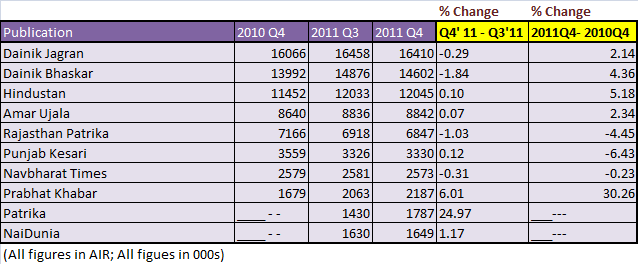
    There is not much of a difference in the rankings of the Top 10 Hindi Dailies. Dainik Jagran, Dainik Bhaskar,Hindustan, Amar Ujala and Rajasthan Patrika continue as the Top 5 Hindi Dailies. When compared to IRS 2010 Q4, IRS 2011 Q4 reveals the Top 4 Hindi Dailies, namely Dainik Jagran, Dainik Bhaskar,Hindustanand Amar Ujala have further strengthened their readership.


    A look at percentage change from Q4, 2010 to Q4, 2011 finds that Dainik Jagran has witnessed a growth of 2.14 per cent, Dainik Bhaskar grew by 4.36 per cent,Hindustanby 5.18 per cent while Amar Ujala grew by 2.34 per cent. The only Hindi daily to have witnessed double digit growth is Prabhat Khabar with a whopping 30.26 per cent growth in Q4, 2011 as against Q4, 2010. A total of five Hindi dailies have witnessed growth Quarter on Quarter.


    Q3, 2011 Vs Q4, 2011

    But the results for IRS Q4, 2011 Vs Q3, 2011 have a slightly different story to tell. The top two most read Hindi dailies – Dainik Jagran and Dainik Bhaskar – have witnessed a decline in Average Issue Readership (AIR), the decline is however marginal. Besides Dainik Jagran and Dainik Bhaskar, the Hindi dailies to have recorded growth in Q4, 2011 v/s Q3, 2011 are Hindustan, Amar Ujala, Punjab Kesari and Prabhat Khabar.


    Top 10 English Dailies:

    IRS Q4, 2010 Vs IRS Q4, 2011:

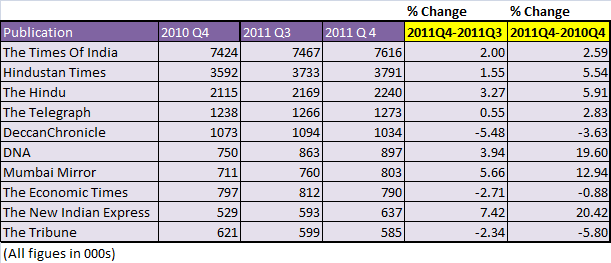
    The English dailies have performed exceedingly well in Q4, 2011. Seven out of the Top 10 English dailies have registered growth in their AIR. While DNA, Mumbai Mirror and The New Indian Express have registered growth in double digits, the top four English Dailies: The Times of India, Hindustan Times, The Hindu and The Telegraph have also witnessed growth quarter on quarter.


    IRS Q4, 2011 Vs Q3, 2011:

    The results for Q4, 2011 in comparison to the previous quarter also highlight the growth for most of the top Ten English dailies.


    Top 10 Language Dailies:

    IRS Q4, 2010 Vs IRS Q4, 2011:

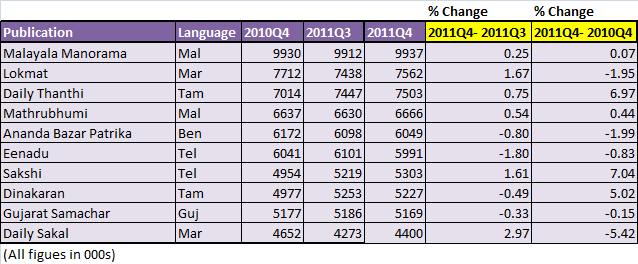
    The Q4, 2011 results as compared to the Q4, 2010 results have shown mixed reactions for Language dailies as only five publications witnessed growth since Q4, 2010 to Q4, 2011. Malayala Manorama continues to be the number one publication among the Language Dailies. According to IRS Q4, 2011 v/s Q4, 2010 findings, the Malayalam daily grew 0.07 per cent.


    Ranked second is Marathi daily, Lokmat which saw a decline of 1.95 per cent. The other Language dailies to have registered growth in their AIR are Daily Thanthi, Mathrubhumi, Sakshi and Dinakaran.


    Unlike the top two dailies, Daily Thanthi, ranked as third Language daily, grew by 6.97 per cent in IRS Q4, 2011 when compared to IRS Q4, 2010.


    It has been observed that the Malayalam dailies – Malayala Manorama and Mathrubhumi and the Tamil dailies – Daily Thanthi and Dinakaran have recorded growth in their AIR. Malayalam, Marathi, Tamil, Telugu, Gujarati and Bengali are some of the popular language dailies to have found a place in the Top 10 Language dailies.


    IRS Q4, 2011 v/s Q3, 2011:

    The top four Language dailies: Malayala Manorama, Lokmat, Daily Thanthi and Mathrubhumi have registered growth in their AIR numbers in IRS Q4, 2011 v/s IRS Q3, 2011. Besides the top four language dailies, Sakshi, the Telugu daily and Daily Sakal, the Marathi daily have also witnessed growth in their readership numbers.


    AIR or Average Issue Readership is defined as the readers of an average issue of a publication i.e. the estimated number of those who have read or looked at any issue of the publication within a specified time interval, which is equal to the periodicity of the publication (excluding the day of the interview). This is the preferred currency of media agencies across the country though often publications quote Total Readership (TR) when their AIR numbers are not impressive. MxMIndia only uses AIR in its IRS reportage.

  • IRS 2011 Q4: Media consumption grows but Radio and Cinema continue to decline

    By A Correspondent


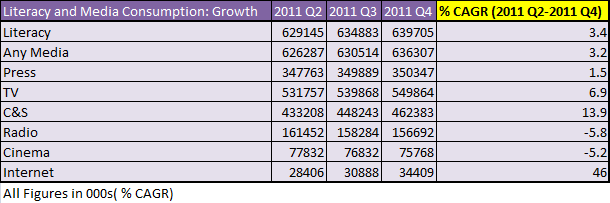
    IRS Q4 2011 findings have revealed that the literacy rate and media consumption in India has witnessed growth when compared to IRS Q3 2011. The other media categories to have grown are Press, Television, C&S (Cable and Satellite) and the Internet. While Radio and Cinema consumption have witnessed a decline, the Internet has emerged as the fastest growing medium in the country.


    Press has seen a marginal increase of 1.5 per cent in the CAGR (Compound Annual Growth Rate) whereas TV grew only 6.9 per cent of the CAGR. After the Internet, C&S is the second largest medium to have grown in double digits i.e. a CAGR of 13.9 per cent. Radio and Cinema on the other hand declined -5.8 per cent -5.2 per cent respectively.