Blog

  • The Anchor: 5 ‘must-do’s for the future of radio in India

    By Uday Chawla


    #1 A level playing field is needed

    Under Phase III, content freedom is still severely restricted. Only AIR-provided news capsules can be broadcasted. Current affairs and even sports commentary are restricted. There is no such restriction on print, television or even the internet. The government’s view is that a central monitoring system is needed to be put in place before news on FM is freely allowed. With the process on, early lifting of restrictions should be expected. (Even in Nepal, news on FM is freely allowed.)


    #2 DAVP rates should be rationalised

    Government advertisement rates need to be equal across all media, but currently they are heavily skewed against FM. For instance, local newspapers are given a rate of Rs.159 per column cm per lakh reach, while for FM it is over 10 times less even for a 10-second spot. There has been a high listenership growth in FM and on an average FM now reaches 70 per cent of populations in metros. In smaller towns it should be higher. The criterion for relative ad rates within a city amongst different FM should be logical and transparent.


    #3 A transparent system for license extension is needed

    Under the phase II policy, licenses were issued for 10 years, while under Phase III they will be issued for 15 years. A license period of 10 or15 years, with absolute darkness or renewal parameters, discourages away investors and bankers. Even now, phase II players have no idea on what or when is the license extension criterion, and thus making it extremely difficult for them to raise funds for even FM phase III bidding. The solution therefore lies in having prefixed and transparent extension criteria even at the time of allocation of first licenses.


    #4 Developing and regulating human resources

    With 800-plus new radio stations to be set up under Phase III, a four-fold increase, there will be a huge demand for radio journalists. Emerged and emerging content freedom means that a more trained and disciplined RJ resource would be required.

    I believe content freedom brings greater responsibility on radio and incidents like the Darjeeling violence (caused by a derogatory remark by an RJ) puts national security and unity under risk. Therefore a self-regulatory content code needs to be formulated and implemented.


    #5 Building Brand Radio

    Currently Brand Radio is not top-of-mind, be it government or shareholders or even advertisers, and this is not because radio has less reach or is less effective than other medium. In fact radio is the only medium that can be simultaneously consumed along with other activities. Besides, it is also the only medium that can reach the most remote areas of the country and I believe that there is an emerging India in smaller cities and towns, which can be opened up through FM.


    Uday Chawla is the Secretary General, Association of Radio Operators for India (AROI).


  • iPad3 could revolutionise ad & content


    [youtube width=”400″ height=”200″]http://www.youtube.com/watch?v=bAF51B0HgDg[/youtube]

    By A Correspondent


    Apple brightened up our lives on Holi day with the third generation of the iPad. That it launched on Holi was obviously a coincidence. India sadly figures nowhere in the iPad 3’s roll-out later this month.


    On March 7 in the US, Apple introduced the new iPad featuring a stunning new Retina display, its new A5X chip with quad-core graphics and a 5 megapixel iSight camera with advanced optics for capturing amazing photos and 1080p HD video.  The battery life is 10 hours.


    And what happens to the iPad 2? It is now offered at $399 (Rs 24,500 in India) for the 16GB Wi-Fi model and $529 (Rs 32,900 in India) for the 16GB Wi-Fi + 3G model.


    “The new iPad redefines the category Apple created less than two years ago, delivering the most amazing experience people have ever had with technology,” said Philip Schiller, Apple’s senior vice president of Worldwide Marketing. “The new iPad now has the highest resolution display ever seen on a mobile device with 3.1 million pixels, delivering razor sharp text and unbelievable detail in photos and videos.”


    According to Mumbai-based IT consultant Lionel Faleiro, the new iPad is a great evolutionary product for its screen, processing power and upgraded camera. “The main reasons that sells the iPad the most is its availability of Apps and its consistent OS updates. The quality of design of iPad optimized Apps in the iOS Store is much better than its Android counterparts,” he said, adding that he expects the iPad3 to launch in India in May this year.


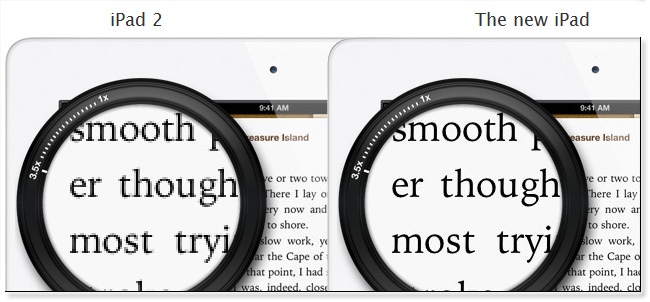
    The new iPad’s Retina display delivers four times the number of pixels of iPad 2, so dense that the human eye is unable to distinguish individual pixels when held at a normal distance, making web pages, text, images and video look incredibly sharp and realistic. The 3.1 million pixels in the Retina display are more than one million more pixels than an HDTV, and with 44 per cent increased colour saturation the new iPad displays colors that are unbelievably richer, deeper and more vivid. Movies are now capable of playing at full 1080p HD-resolution, delivering an incomparable viewing experience on a mobile device.


    The A5X chip with quad-core graphics promises to deliver a fast, responsive user experience while supporting the incredible Retina display. With double the graphics performance of the A5 chip, the A5X facilitates a Multi-Touch interface, immersive gameplay and visual depth.


    Writes Patrick Thornton on Poynter.org:

    “The new iPad could finally elevate the text reading experience on a tablet to something much more akin to reading a printed newspaper, magazine or book. Most major news organizations have released iPad apps, but the blurry, pixelated text from the relatively low-resolution iPad 1 and 2 always stood out. iPad news apps may have great looking photos, videos and interactive graphics, but text – often the core of what a news organization produces – doesn’t look that good, especially in comparison to what humans have been able to enjoy for hundreds of years.”


    iPad Wi-Fi + 4G with built-in next generation 4G LTE offers support for fast networks including HSPA+ and DC-HSDPA, and now both CDMA and GSM iPad users have the ability to easily roam internationally.


    Comments Amy Gahran on the Knight Digital Media Center site: “Over the last two weeks, such updates include the iPad apps for the New York Times, Associated Press, New York Daily News, Pulse News, Flipboard, NBC Nightly News, the Guardian (Eyewitness app), the Star Tribune and more.


    Now that the specs and capabilities of the iPad3 have been confirmed, it’s likely that even more news organizations will be revamping both their apps and the kind of content delivered through them-especially the resolution of photos, video, and graphics.”


    The new iPad also supports dictation, another amazing way to get things done just using your voice. Instead of typing, tap the microphone icon on the keyboard, then say what you want to say and the new iPad listens. Tap done, and iPad converts your words into text. You can use dictation to write messages, take notes, search the web and more. Dictation also works with third-party apps, so you can update your Facebook status, tweet, or write Instagram captions.


    The new iPad Wi-Fi models will be available in black or white from Friday, March 16 for a suggested retail price of $499 for the 16GB model, $599 for the 32GB model and $699 for the 64GB model. iPad Wi-Fi + 4G for either AT&T or Verizon will be available for a suggested retail price of $629 for the 16GB model, $729 for the 32GB model and $829 for the 64GB model. iPad will also be available in Australia, Canada, France, Germany, Hong Kong, Japan, Puerto Rico, Singapore, Switzerland, UK and the US Virgin Islands from March 16.


    By the end of March iPad will be available in Austria, Belgium, Bulgaria, Czech Republic, Denmark, Finland, Greece, Hungary, Iceland, Ireland, Italy, Liechtenstein, Luxembourg, Macau, Mexico, The Netherlands, New Zealand, Norway, Poland, Portugal, Romania, Slovakia, Slovenia, Spain and Sweden.


    A final word from Gahran: What will be more interesting will be to see if later this year Apple finally launches a smaller, cheaper iPad mini. This long-rumored unicorn so far has failed to materialize-but if the Kindle Fire and other smaller Android tablets keep gaining ground fast, Apple might be tempted to compete with this large consumer market segment.  It’s still a rough economy out there – and the lesson of how Android quickly came to dominate the US smartphone market is probably not lost on Apple. An iPad mini would have very different device and app support capabilities, which would require more significant adaptation from apps and mobile websites.”


    Please read:

    BusinessWeek: http://www.businessweek.com/articles/2012-03-07/apples-big-show-the-tech-bloggers-prom

    Poynter.org: http://www.poynter.org/latest-news/top-stories/165618/ipad-3s-retina-display-will-make -news-apps-stand-out-present-new-challenges-for-news-orgs/

    Knight Digital Media Center: http://www.knightdigitalmediacenter.org/news_blog/comments/20120307 _ipad_3_launches_what_does_it_mean_for_news_publishers/


  • Assam’s Manoj Barpujari wins Nat Award for film criticism

    By Archita Wagle


    The recently announced National Awards 2011 saw Manoj Barpujari win the Best Film Critic award Swarna Kamal and Rs75,000 for his critiques in English and Assamese.


    Mr Barpujari is based in Guwahati and works as Assistant Editor with the Assamese daily, Dainik Agradoot. He also “very occasionally” contributes to the English daily, Assam Tribune. He is a member of Indian section of FIPRESCI, the Paris-based international federation of film critics and contributes to the website, www.filmfocusindia.com. He has been associated with the film society movement for more than two decades and has been tutoring on media and film studies. Mr Barpujari’s win makes him the fourth from the North-east to win this award.


    Mr Barpujari said that winning the Best Critic award was “Beyond my expectation. I am feeling what any man would feel on winning such a prestigious award.”


    When asked about his foray as a film critic, Mr Barpujari said: “I started as a film critic in the early 80s, even before I became a full time journalist. I was very much influenced by the parallel cinema movement in India and that inspired me to write about films. I write mostly about political and social issues. Only 10 per cent of what I write is about films.”


    Fellow film critic and Assamese journalist and now a film-maker, Utpal Borpujari, who was also the first from the North-east to win the Best Critic in 2003, was all praise for Mr Barpujari. “Manoj is a very senior film critic. He follows Indian and world cinema very seriously. He is the fourth from the North-east to be awarded the Best film critic. This proves that there is serious film criticism happening in the North-east. Unlike the mainstream media, regional publications are giving space for serious film criticism.”
    Apart from Mr Barpujari and Mr Borpujari, Altaf Mazid and RK Bidur Singh, both from North-east, jointly won the Best Film critic award in 2009.


    Mr Barpujari is not just a film critic and a “working journalist” as he calls himself. He is the winner of the Hafeez Karamath Journalism Fellowship 2010 of Trinidad & Tobago and has published nine books on various subjects in the fields of socio- political issues, art and literature including cinema. He has co-edited with Dr Garima Kalita the first ever comprehensive volume on cinema of Assam titled Perspectives on Cinema of Assam (2007).


    Mr Barpujari has served as jury in many competitions and film festivals in India and abroad. He presented documentaries from Assam in a program organized under the auspices of the Media and Communication Department, Goldsmiths College, London in 2008.


    Mr Barpujari is also a poet whose have been translated in to several major Indian languages. A collection of his poems won the Munin Borkotoky Literary Award in 2004.


  • Yashraj Rao is National Sales Head for BIG Love & Spark

    By A Correspondent


    BIG CBS Networks announced the appointment of Yashraj Rao as the National Sales Head for its channels – BIG CBS Love and BIG CBS Spark. As part of his new role, Mr Rao will be responsible for growing sales and leading the team across the country, to grow client base and revenues for these channels. In his current profile, he will report to Vishal Rally, Business Head – BIG CBS Networks.


    With almost nine years of sales experience across industries, this trained pilot with the Indian Air Force holds a PGDBM from Birla Institute of Management. He began his career with Monster.com as a Corporate Relationship Manager, before moving into the Life Insurance Industry with Aviva Life Insurance as Assistant Manager, in the Corporate Sales portfolio. From there he moved to HDFC Life where he grew quickly from a Relationship Manager – Group Sales to Associate Vice President – Group Sales.


    A multifunctional sales, marketing, business development and professional services executive, Mr Rao comes armed with a combination of dynamic technical skills and proficient sales knowledge. His new profile marks his entry into the dynamic M&E industry. With skill sets which include relationship building, negotiating favourable deals, securing strategic alliances and laudable client development, Mr Rao is confident of being able to grow the market while offering excellent ROI to Clients through the Channels.


    Speaking on the appointment, Mr Rally, Business Head, BIG CBS Networks said: “Yashraj’s sound background across the dot com and insurance sectors along with skill sets, when combined with his ability to listen to prospects’ needs and develop solutions to meet their requirements, are what will work in his favour to lead the team to further growth. We are happy to have him on board and wish him an excellent innings at BIG CBS.”


    Commenting on his appointment Mr Rao said: “I feel honoured to take on this responsibility and feel proud to be part of an excellent media conglomerate. I look forward to working with the dynamic team here and am confident it will be long and fruitful journey for both.”


  • Games2Win sets 20 mn users target for 2012

    By A Correspondent


    About a month ago, Rovio – creator of one of the most successful online game Angry Birds – made a significant announcement when it proclaimed its intention to touch the 1 billion download mark of the game by end of 2012. Not a difficult proposition, one may think, given the spurt in the online gaming market especially following the entry of supporting smartphones and operating systems. And so if a developer comes up with a game that’s unique and appeals to the masses, it would be a matter of a few days before the game races its way to being the most downloaded of the lot. This was the case with Parking Frenzy by Games2Win that made its way into the top 10 most downloaded games in the world, a few days ago.


    Android Game ‘Parking Frenzy’ scaled its way to the No 7 position on the ‘Free Games’ section in the Android Market (USA) recently, making it probably the first game from India to have featured this high in the space. At last count, the game had witnessed 2,676,668 installs, led by the US which recorded 636,660 installs, Germany – 197,204, Britain – 138,182, Spain – 137,128, Korea – 122,665, France – 119,187, Russia – 93,916, Italy – 84,833, Holland – 62,468, and Israel with 56,747 installs. Acknowledging the success, Raj Menon, Director – Business, Games2win said, “To be honest we knew it was a good app and would do well. But we did not expect it to be such a big hit. The game started out as any of our other games – a slow steady creep in the number of people downloading the app and playing it. Installs started rocketing from week two, and the growth hasn’t stopped since.”


    According to Mr Menon, the feat is unique as it is not every day that your app ranks higher than Twitter, Facebook Messenger and Angry Birds Rio. “So we are just soaking it in. But in reality, we are just concentrating on shipping – shipping the best games, apps and platforms that we hope our consumers will like.”


    On how the gaming market in India is evolving, Mr Menon said, “Indians are now used to the best entertainment in the world thanks to the internet. But they want it with a local flavour – something that they relate to. They play games on the world’s best sites; so they are becoming increasingly demanding in terms of game play. We have more than matched their expectations – we have the largest library of cricket games in the world and Indians just can’t have enough,” he quips.


    Asked why Indian online games have failed to make a mark on a global front, Mr Menon said, “There is no global ranking for individual online games like there is for mobile games on iTunes and the Android market. comScore ranks sites by traffic and Games2win is a top 20 gaming site in the world with an audience of over 15 million consumers. Our games are on the top gaming sites like Addicting games, the Spillgroup and Yahoo! So it would be unfair to say that Indian online games haven’t made the cut.”


    In fact, Games2Win has carved out a roadmap for 2012 where it plans to grow its base from 15 million to 20 million users on the online front. On the mobile front too, it will be releasing an app a month. Affirms Mr Menon, “The biggest release we have is Appucino which is Leaderboards on Steroids. Appucino is basically a location based leaderboard where users can capture their favourite location on Google Maps with their scores. Other gamers can topple these owners by simply scoring better. This ping-pong amongst gamers, we believe, will do wonders for the life of an app.”


  • Debrief: Pepsi: Game changer

    By Anil Thakraney


    Ah, so Pepsi wants to totally change the game for the upcoming summer. Previously their ‘change the game’ ads involved cricketers doing offbeat stuff. This time cricket itself is gone; it’s time for some football action.


    In the new TVC (and I suppose there will be many more as the heat picks up), brand ambassador Ranbir Kapoor asks a lad to forget practising his football skills, and instead opt for playing cricket. But the boy keeps ignoring him. Then they reach a non-functional Pepsi vending machine which Kapoor is unable to operate. The boy heads the ball onto the machine and a bottle pops out. Voila! Game changed!


    [youtube width=”400″ height=”200″]http://www.youtube.com/watch?v=Ior6SXL35NY[/youtube]

    Yes, it works for me. The idea taps into the single-game malaise this nation suffers from, and it’s time the other games got some attention. In that sense, the TVC reflects the opinion of many, and so it’s a good consumer insight. Also, the creative treatment is simple and fun, so that’s fine too.


    However, on a personal note, I wish Pepsi had changed the game to hockey, which is our national game and which is languishing big-time. It definitely needs all the attention it can get. Perhaps Pepsi will take that on in another commercial in this series, we’ll have to wait and watch. However, it must be said Pepsi has opened its innings on a promising note this summer.


    Rating: (On a scale of 1 to 5): 3. Moving away from thakela cricket refreshes the campaign.


  • Changing Sky on its way ahead

    By A Correspondent


    Changing Sky, a Pune-based design agency has recently garnered recognition from The Rebrand 100. This Global Awards is the highest recognition for excellence in brand repositioning – and the first and only competition of its kind. Changing Sky has won the recognition for its work for Mapro.


    Talking about the journey of the agency, Gargi Sharma, Founder & Principal Designer of the agency said, “The journey of Changing Sky has been much like the “changing sky” itself both challenging and rewarding. Though two years old, we still feel like a start-up in spirit – rearing to go.”


    On future plans she said, “Our mantra is to grow with our customers. So the drivers very clearly are to deliver value to them that leads to tangible business results – from growth, profitability and sustainability points of view.”


    The agency has worked with clients that largely comprise sectors including FMCG, IT and Engineering sectors. Sharma added, “The playing field is global and we have been working with both national to international customers. The most rewarding though, have been domestic brands with global aspirations, whom we have been able to help carve a niche for themselves in the global marketplace.”


    Commenting on their expansion plans, Sharma concluded, “We have lots of plans that we are hoping to turn to reality in the course of the year. I must also add that they will be executed prudently so that there is no compromise on the quality of work – which I have seen happen due to scaling.”


  • Freaking News: It’s business as usual after the election euphoria

    By Ranjona Banerji


    Of course the media was to blame for the Bahujan Samaj Party’s loss in UP’s assembly elections. Sure, the Samajwadi Party, Congress and BJP were also involved but the media certainly played a role in the rout of Mayawati. Thankfully – perhaps – the former chief minister of UP did not blame the people, as Prakash Karat, chief dictator of the CPM did, after the Left managed to lose West Bengal to Mamata Banerjee.


    After the results were declared, TV land went into a sort of decline. Having expended this enormous amount of energy on getting the results out to the people in the usual frenzied fashion, the day after was a probably inevitable anti-climax. The arrival of Holi did not help either, because everyone went into holiday mood which for most TV channels means showing a stream of Hindi film songs (no point asking) and other fillers.


    Life was not different for newspapers as Holi meant holidays on different days across India. Was this a conspiracy by the Election Commission? If I were Mayawati or Salman Khurshid, I would certainly think so.


    The Times of India’s early edition for Dehra Dun on March 7 (more on the perils of being stuck with a mofussil edition coming soon) headlined the results as ‘UP has spoken, no Rahul Maya’, with the ‘sp’ of spoken in red. Other puns were also in evidence (Sonrise for Akhilesh and Bad Heir Day for Rahul Gandhi). The Hindustan Times went for ‘Akhilesh Pradesh’, DNA Mumbai had a bit of fun with ‘Rahul knocked down by cycle’.


    * * *


    Newspaper editorials summed up the results quite cogently. The Hindu argued that just depending on anti-incumbency isn’t enough; parties have to make more effort that expecting the other person to lose. The Times of India emphasised the fact that the Indian voter knows when someone is trying to take them for a ride and rather than traditional promises, deliverance and governance are the keys. Several commentators also pointed out that corruption at the Centre had an impact on local polls, which is bad news for the UPA and Anna Hazare, his team and Baba Ramdev had a little chuckle here. No one missed the fact that the regional parties had trumped the big two in UP either. The forthcoming perils for the UPA and the BJP have both been underlined.


    As expected, it takes print to make sense of anything and TV would do well to develop some expertise and analytical skills of its own.


    * * *


    By the time the euphoria died down, it was business as usual and the Samajwadi Party was up to its usual tricks which TV jumped on with alacrity – a young boy killed, journalists under siege, houses burnt. An IPS officer was killed in Madhya Pradesh, apparently by the mining mafia, several people in Mumbai were hospitalised by poisonous Holi colours and BS Yeddurappa wants his job back!


  • Exclusive: BCCL President Bhaskar Das is now also Principal Secretary to MD

    By A Correspondent

    It was Holi. And time for colour and loads of cheer.  In media-land, we received this missive via our BBM: Bhaskar Das, the man who brought to The Times of India group most of its monies (as head of response), and the man who’s captained many industry associations and is known for his very interesting and intellectual questions at media industry conferences, will now be President and Principal Secretary to the Managing Director at Bennett Coleman & Co Ltd (BCCL). MD = Vineet Jain.


    In a signed office advisory, Mr Jain recognises Dr Das’s contribution to the company. “Bhaskar Das has always excelled in every responsibility entrusted to him – be that of leading Response function to newer heights, brand management, profit centre head or special projects in the area of Wellness, Times Foundation among others.” And he mentions that the new role “has the potential of becoming a gamechanger for the Group”.


    So what does this gamechanging role mean?


    In addition to the responsibilities he has been entrusted with at ‘Brand Capital’ (eka Private Treaties), Dr Das will now look after the following:


    * Exploring new revenue opportunities across the group’s media initiatives

    * Evolving a collaborative sales approach across various group properties

    * charting out a future roadmap for Optimal Media Solutions (that is, Medianet)

    * Facilitating a shared understanding an aligning all functions and group cos. to shareholder philosophies and objectives


    The end-objective is to “capitalize on the wealth of knowledge and expertise and to leverage the same across the Group”.  Given this, Mr Arunabh Das Sharma, Executive President – Response will report to Mr Ravi Dhariwal.


    See also: MxMIndia interview with Dr Bhaskar Das


  • Power of +ve campaigning: Why SP won & BSP, Cong lost

    By Rajiv Singh


    Political pundits talk about caste factor, anti-incumbency, development, corruption and so on to explain Tuesday’s assembly election results, but some advertising experts give a completely different explanation – negative advertising failed and positive campaigning clicked.


    It’s open to debate if people vote on the basis of advertisements or not, but look at some campaigns:

    “Utho, jaago aur badlo” (Rise, awaken and change) and “Jawab hum denge” (We will give a befitting reply) – the taglines used by the Congress to woo voters in Uttar Pradesh flopped.


    Power of Positive Campaigning

    Jeeta and Jaggi – the toon characters used by the Congress to connect with the people in Punjab by poking fun at the Badal government – too failed.


    “Na hatya, na phiroti, na balatkaar, hum denge saaf suthri sarkaar” (No murder, extortion or rape, we would give you a clean government) – the BJP’s election plank in Uttar Pradesh didn’t revive the fortunes of the party.


    Now, look at what worked: “Umeed ki cycle” (Bicycle of hope), the tagline of Samajwadi Party’s successful campaign in Uttar Pradesh.


    “While Mayawati’s BSP and Rahul Gandhi-led Congress were busy fighting each other, the SP talked about problems faced by the aam aadmi,” said veteran adman KV Sridhar.


    “That’s why their campaign clicked; it didn’t take a potshot or dig at the rival parties,” added the national creative director of Leo Burnett.


    One of the TV commercials made by Arkash Entertainment – the Mumbai-based production house in charge of Samajwadi Party’s campaign – shows a cycle racing past an elephant.


    “We wanted to say something without saying anything,” said Arjun Sablok, the creative head of Arkash Entertainment, who made his debut in political advertising with this campaign.


    “Our campaign focused on positives and avoided mudslinging,” added the 45-year-old adman and filmmaker who first met Akhilesh Yadav three years ago in a UP village. Saurabh Uboweja, director of brand consulting firm Brands of Desire, said this approach worked because the voter is not in a negative mindset.


    “Voters have seen growth recently as a general positive economic environment reverberates in the nation. When one has a positive mindset in general, positive campaigning linked to higher growth will tend to prove more beneficial than dragging voters into the past,” he said.


    Mr Sablok – who has made a film with Hrithik Roshan and a music video with Lata Mangeshkar besides several commercials with leading Bollywood actors – said he started preparations for his first political campaign a good nine months before the elections. An outsider in Uttar Pradesh, he travelled extensively to know about the ground realities there. And he used real-life situations and people.


    In one of the television commercials, for example, Raju, a rickshaw puller, talks about his problem of working everyday to pay back the loan and then a voiceover says the Samajwadi Party will implement an insurance programme for rickshaw pullers. Other such characters used in the campaign include Buddhiram, a farmer lamenting about lack of electricity, and Neetu, a housewife whose husband works in another state because of lack of jobs in Uttar Pradesh.


    Mr Sridhar of Leo Burnett said this smart and straightforward campaign worked at a time when Mayawati and Rahul Gandhi were busy blaming each other.

    So, in his mind, Rahul Gandhi’s relentless campaigning failed to revive the Congress in the country’s most populous state partly because the party’s advertisements failed to connect with people.

    The Congress campaign in UP, created by Percept/H, talked about the misrule of the Mayawati government and asked people to give Congress a chance. “The campaign had no insight into people’s lives,” said Mr Sridhar. Negative campaigning proved disastrous for the Congress in Punjab too, a state that had never before voted the ruling party back to power.

    The opposition party’s campaign, created by Delhi-based advertising agency Crayons, featured toon characters Jeeta and Jaggi who talked about corruption and other problems under the ruling Shiromani Akali Dal-BJP government.

    This failed to pull down the Badal government.

    The Akalis’ campaign, handled by New Delhi-based agency Brand Curry, highlighted the development work done by the government.

    “Over the past few years, there has been a demographic and psychographic change in the profile of voters. In terms of demographic change, young voters have emerged, who abhor negative campaigning,” said Brand Curry MD Subrata Chakraborty. “In fact, even the old voters have no appetite for advertisements that look down upon others,” he added.

    The BJP, which rose to national prominence in early 1990s with its Ram Janmabhoomi movement centred on Ayodhya in Uttar Pradesh, lost the plot in the state not only in terms of negative slogans but also due to lack of synergy between its print and television campaigns. “The TV campaign was not in sync with the print campaign,” said a BJP leader in the state.

    One of the TV commercials showed famine-like situation in the state and starving people, he said, requesting anonymity. “But this is not the ground reality. This election was not fought on starvation and malnutrition…This left the people cold.”

    Sushil Pandit, owner of Hive Communications, the ad agency that handled the print campaign for the BJP in UP, said the party highlighted too many issues without a clear focus. “There was no consistency in approach,” he added.

    But experts say it’s up to the agencies to help political parties with a nice strategy.

    “Political advertising is driven by politicians, and not the ad agency, but the strategy should come from agency,” said Prathap Suthan, the creative mind behind the ‘India Shining’ and ‘Incredible India’ campaigns and chief creative officer of tech support firm iYogi.

    Source: The Economic Times

    Copyright © 2012, Bennett, Coleman & Co. Ltd. All Rights Reserved
     

  • Woman power at MxMIndia’s roundtable for Big CBS Love

    By A Correspondent


    Much has being spoken about how the media-advertising industry being one of the few industries in India that has seen many women professionals coming to the fore and showing the way to the younger and the aspiring lot to stand their ground for excellence, despite myriad challenges.


    To celebrate the spirit of women in the advertising-media domain, MxM India conceptualised a roundtable conference for Big CBS Love, in a half-hour show that was aired on Bloomberg-UTV on March 8, 2012.


    Eminent women professionals such as Punitha Arumugam, CEO, Madison Media, Anita Nayyar, CEO, MPG India, Shubha George, COO, MEC South Asia, Anisha Motwani, Director and Chief Marketing Officer, Max New York Life Insurance shared their views on the role of women in the industry.


    Ms Arumugam pointed out that advertising attracted a lot of women as against other industries, while Ms Nayyar and Shubha George referred to how Roda Mehta played an inspiring role. Ms Motwani, who started out in advertising, then joined the automobile industry and moved from there to insurance, remarked how women even today can’t ignore their responsibilities towards their families. Ms Motwani, who had taken a sabbatical after marriage for two years, said working women need to believe in themselves, their ability and not give up.


    On reasons why women have done so well in advertising and media, Ms Nayyar said: “Over the years, it is evident that when it comes to client relations and numbers – women have done very well. And since advertising has a casual sort of environment, it gives that extra advantage and scope for women to double up as a key member at home and the workplace.”


  • Intnl radio stns will soon enter India: Amitabh Srivastava

    By Robin Thomas


    Amitabh Srivastava is the Country Manager – South Asia, Radio Netherlands Worldwide. Prior to working with Radio Netherlands, Mr Srivastava was the Director, Affiliate Relations at Walt Disney Company and General Manager at TV Today where he worked for a total of five years. In conversation with MxMIndia’s Robin Thomas, Mr Srivastava spoke at length on the six-year-long journey of Radio Netherlands in India, on phase III developments, various initiatives of the Dutch international broadcaster in India and much more.


    Q: Radio Netherlands has been in India for the last six years. How would you rate the year 2011 for RNW and the journey since the India launch?

    Radio Netherlands Worldwide had exponential growth, both in terms of brand building and our key responsibility areas of promoting issues related to human and nature welfare. Our milestones were partnership with Reliance and State Radio Service AIR on co-production, which propelled the growth from thousands to millions. Apart from this, we have also tied up with regional and university radio – IGNOU Gyanwani, which has equally benefited us to mark our footprints in smaller areas, thus leading to a gradual development in this part of the world.


    Q: How are you viewing the Indian market from the radio perspective?

    India is a big nation and above all a huge audience size to attract any international broadcaster. Its diverse nature and broad media landscape ensures that any broadcaster invests resources on both commercial and for welfare means.


    Q: You had launched web and mobile sites Lovematters.info and Lovematters.in in November 2011; how has the response been so far? How do you plan to take this initiative forward?

    We had an overwhelming response and great uptake from our partners on both the versions of the websites. We had tie up with Reliance to launch the WAP version of the site which has been a great success. Also we had marketing campaigns (On Ground and Web) with various web portals and campuses which resulted into further promotion of our websites. We are also trying to get partnership with other telecom operators on pay mode to ensure sustainability in a longer run. FPA (Family Planning Association of India) also joined hands with us for this noble cause.


    We are planning to launch Love Matters to other parts of the world, for example in Latin America.


    Q: There are so many websites and information available on sexual health; how is Lovematters any different? How does the mobile site work? Is there a separate team working on these sites?

    We are an independent broadcaster which provides reliable information. Also, we have experience in making journalistic content for a young audience. It’s a one-stop solution and a comprehensive database for all sexual-related issues. It is to have a Dutch purview, but has been customised especially for the Indian audience with its cultural sensitivities taken care of.


    We have the mobile site on the WAP model on a lighter version which works quite brilliantly on the GPRS mode too. We have a dedicated editor in India as well as a complete editorial and technical team already on it from Hilversum, Holland.


    More so looking at the response we have a Hindi website too, which is www.lovematters.in.


    Q: Besides the audience, are advertisers, particularly youth marketers keen on advertising on the website?

    We are a state-funded organization, hence this is no issue for us.


    Q: In 2010 Radio Netherlands tied up with Web 18 for news on in.com as well as for international music on their website. Tell us more about how the deal has shaped up today? What are the other digital technologies you have invested in?

    Yes indeed we had a tie up with Web 18 for their web portal www.in.com. We are successfully running our strategic partnership with RNW music content on their sites as web stream radio and experienced good uptake by our listeners.


    We have developed APPS for Apple products, RNW Apps (Light Version) and other application programming Interface to strengthen our footprints in the new media.


    Q: Are you observing the FM phase III developments? The government has given its nod to air news on FM radio sourced from the government-owned All India Radio (AIR). FDI limit has been marginally increased from 20 to 26 per cent, there will be additional 800 stations in 300 new cities. How does Radio Netherlands India view all these developments?

    With this initiative I am sure many of the international broadcasters will try to base themselves, which will further enhance the need for talk radio which is already an established model on the global platform. The embargo on news and current affairs in India will be lifted as a result of this initiative, thus giving us more space to do some quality partnering with FM channels.


    Q: Are there any specific challenges that a foreign media faces when it enters the India market especially from a radio perspective? In a few years from now do you see these challenges being met or overcome?

    As stated, I believe, soon we will find the Indian radio industry catering to audiences from a global perspective. Besides this, since a new investment opportunity will also lift the embargo on news and current affairs, it will also make talk radio available in India. Hence I am hopeful to see these developments in the near future.


    Q: Do you agree that radio is a highly regulated medium in India and that it needs to be self-regulated?

    Yes radio is regulated to some extent which encompasses a restrictive circle to adhere to. In my opinion, we must have news and current affairs also to be part of the programming rights which will certainly prove a boon to the radio industry, as Bollywood songs and other contents are being exploited to a much desirable extent in other forms of media as well.


    Q: What are some of the lessons the Indian radio industry can learn from their international counterparts?

    Interactivity is the element that seems to be missing in the FM channels in India. Talk radio is the key to ensure that we have the missing piece in place. We are seeing the same already running successfully on the global platform.


    Q: Can you throw some light on the India-specific plans of Radio Netherlands? What is the business like in the South Asian markets?

    Radio Netherlands Worldwide needs to cut 70 per cent of its budget from 2013. We will focus entirely on making journalistic content to encourage free speech. It’s difficult to say anything about plans for the South Asian markets, because that’s still undecided.


    Q: How different is the radio industry in, say, Pakistan or Sri Lanka?

    The South Asian subcontinent on the landscape has primarily the same behaviour. Hence I don’t see any structural difference, however I do agree that press freedom is much curtailed and there is lack of free speech in these countries as compared to India.


    Q: What is the team size in India and in other South Asian markets? Any expansion plans?
    In India we have an office in New Delhi and dedicated producers for All India Radio co-productions. Apart from the distribution team we also have an editor based in the same region too.


    Q: On a lighter note what is a typical day like for Mr Amitabh Srivastava, Country Manager- South Asia, Radio Netherlands Worldwide?

    Well, I work in two countries at the same time. All my partners and potential partners work according to IST (Indian Standard Time) which normally starts at 10am, and since I have my team in Hilversum hence I have to work till the office timings in Netherlands which is 11pm IST. I enjoy being busy!! Plus I love meeting people and also spent good amount of time on social media for personal and professional reasons which helps me a great deal.