Blog

  • Rakesh Gopal joins Mogae Media from India Today group

    By A Correspondent


    Rakesh Gopal, who was with the India Today group, last with Mail Today, as Head – Impact for Delhi, East and South India for three-and-a-half years, has joined Mogae Media as the national No. 2 for Monetisation. He will be Senior Vice-President, based at the company’s Delhi NCR headquarters.


    A graduate in commerce from Delhi University, with an MBA degree as well, Mr Gopal has more than 20 years of experience in media sales. His earlier stints were with The Pioneer and the Hindustan Times – where he was Manager Key Accounts (media marketing), as also with DNA where he was GM Marketing and was actively involved in DNA’s launch, one of the biggest in Indian print media.


    Welcoming Mr Gopal to Mogae, Ms Tanya Goyal, Executive Director, Mogae Group said, “Rakesh is a matured professional with very good client outreach. He will be one of the leaders for Mogae in monetizing mobile as a medium.”


    “I have spent two decades in media sales, largely in print. I see mobile as the new game-changer in the media business … which is why I am here to evangelize a new catalyst of change,” said Mr Gopal.


    Mogae Media is the new venture of veteran adman Mr Sandeep Goyal, focused on mobile monetization. Mogae has an exclusive tie-up with Airtel, India’s largest telecom operator. In recent weeks, Mogae has attracted Messrs Pavan Chandra (from Vivaki), AtishiPradhan (from Contract), TusharDhingra (from BIG Cinemas), and Rahul Kishore (from Zenith Optimedia) to its fold.


  • Sony Max hits a chauka with IPL mauka

    By Rishi Vora


    Sony Max has unveiled a new marketing campaign for IPL season 5.

    A series of four TV ads currently running on air capture the pulse of the audience. The theme ‘Aisa Mauka Aur Kahan Milega’ uses various relations – father-son, friends and also relatives – making the case that IPL brings people together.

    JWT is the creative agency that has conceptualised the campaign.


    Neeraj Vyas, EVP and Business Head, MAX said, “We set out to create a unique piece of communication for a very unique property, which is the DLF IPL. We at MAX are proud to bring our viewers the ‘mauka’ to enjoy DLF IPL 2012 and we are certain that our communication campaign ‘Aisa Mauka Aur Kahan Milega’ will only take the this tournament to greater heights. The films capture the one emotion that binds our country – the undying passion for cricket everywhere.”


    Gaurav Seth, Marketing Head, Sony Max said, “We do a lot of consumer research to gauge the reactions of our audiences. So post IPL 4 we conducted a research with Ormax Media and what we found out was that a lot of people thought IPL was an ‘opportunity’ (mauka, which is the campaign theme) for the whole family to come together (even though they’re not very comfortable together as the ad highlights). Similarly, we found that a lot of kids watch IPL as they have their vacations at that time of the year. Our father-son commercial captures that insight very well, where the son gets a mauka to remind his father that he should go to sleep and not watch IPL as he has office next day…and the commercial where two friends find a mauka to bunk work.”


    The TV campaign started on Feb 23. Besides TV, Sony Max will do Press, Outdoor, Radio, Activation in malls, Digital etc. Print campaign will start as the launch date nears, alongwith Radio.


    “This year you will see a very large amount of noise being created by all stakeholders of the IPL – the franchises and the BCCI. As far as our campaign goes, it’s a complete 360 campaign. We will close our deals with various media service providers next week. I’m sure that IPL will be the most talked about event on TV with all the campaigns running in full swing,” he added.


    The channel has not announced exclusive media partnerships as it aims to broadbase its reach across demographics and geographies in India.


    [youtube width=”320″ height=”200″]http://www.youtube.com/watch?v=ZGgIO6MhwLA[/youtube] [youtube width=”320″ height=”200″]http://www.youtube.com/watch?v=cEjEYmEWhoA[/youtube]
    [youtube width=”320″ height=”200″]http://www.youtube.com/watch?v=UXQsIgN_530[/youtube] [youtube width=”320″ height=”200″]http://www.youtube.com/watch?v=XdDFD08QNpo[/youtube]


  • Sriram Kilambi quits Radio Mirchi, GG Jayanta is new national marketing head

    By Robin Thomas and Shubhangi Mehta


    Sriram Kilambi who was the National Marketing Head for Radio Mirchi has called it a day. GG Jayanta Regional Marketing Head – South Radio Mirchi will be the new National Marketing Head. Prashant Panday, CEO, Radio Mirchi, confirmed the news to MxM India.


    GG Jayanta was the business head of Andra Pradesh for three years and Regional Marketing Head- South, Radio Mirchi and hence handled two roles simultaneously for Mirchi.


    Mr Kilambi will be serving his notice period till March end. It is being speculated that he might be moving to UTV.


    In May 2011, Sriram Kilambi, who was the Senior Vice-President and Cluster Head, ENIL Mumbai, had been promoted as Marketing Head for Radio Mirchi.


    Mr Kilambi has spent more than 12 years across FMCG and media sectors in various roles like sales, marketing, and customer management, and had started his career with Coca-Cola India in 1999. In 2006, he joined ENIL as Vice-President and Cluster Head, East, where he successfully ran the Kolkata station and launched the Patna centre.


  • Denizen explores social media to create buzz

    By A Correspondent


    Denizen, the youth brand from Levi Strauss & Co, has been using social media effectively to connect with its consumers, the most recent example of this being its ‘We are Explorers’ initiative which has been quite a success in its first phase.


    Talking about the genesis of the idea, Arvind R P, Marketing Controller, Denizen, explained, “We know that the youth of today are increasingly spending time on social media engaging with friends & making new connections. Given that Denizen is a new brand, we have been exploring ways to connect strongly with the youth and be a part of their conversations. One of the exciting ways to deliver this is to have brand ambassadors who participate in the brand’s activities, get deeply involved in the brand programs and then build around these conversations. This is an exciting way to create buzz around the brand.”


    He aded, “Denizen is a global brand and hence this ‘We are explorers’ programme had to be on a global scale. We have Denizen brand ambassadors from India, China, Mexico, Singapore and Pakistan travelling to India, China and Mexico, in three phases.”


    When the initiative kicked off, there were about 200,000+ fans on Facebook which till date has more than doubled. This is for just Phase 1, with Phase 2 and 3 yet to happen in April. Most importantly, the quality of conversations around the brand has been heartening which is something that the brands today are increasingly looking at. Not to mention that this has helped drive buzz around the brand.


    The six young explorers, chosen from a large pool of hopeful applicants via a global casting call, hail from countries where Denizen clothes for youth can be purchased. This includes China, India, Mexico, Pakistan and Singapore. The explorers will be paired up as they head to their destination country during the next two months – March and April. They will embark on an action-packed trip where they will meet new people and take on tasks and challenges centered around creating new styles of denim based on their experiences. ‘We are Explorers’ campaign is being executed in three phases while the first phase is over, the next two phases will help in maintaining the momentum and buzz over a longer period of time. The company hopes that post this global program, the brand would have attained a sustainable base of fans and been a significant part of youth conversations. The plan is to build upon it and enrich the conversations around the brand.


    On other marketing initiatives around the brand, Mr Arvind said, “An important part of Denizen’s plans is to excite the youth with relevant innovations. Super shape, a new fit for young women which enhances the body curves, has just been launched. It has a more defined curve, a slimmer waist and longer leaner legs. We are planning a sustained promotion to build the women’s franchise with this innovation.”


    The brand Denizen has been designed keeping in mind the aspirational desires of the youth who increasingly identify with global trends. Leveraging LS&Co’s rich heritage and fit expertise of over 138 years, Denizen is re-inventing fits for this young generation of consumers. Affordable yet aspirational, the brand delivers great fitting and quality jeanswear with innovations.


    Denizen had taken the social media route when it was launched in India, where it used the social networking platform to engage its consumers and did events around the seven letters that spell Denizen, including a fashion show.


    In 2010, Levi Strauss & Co launched the Denizen brand in Asia – the company’s first brand launched outside the United States. In India, Levi Strauss Signature has transitioned into Denizen in 2011. Since its launch, the brand has gone to have over 300 exclusive brand stores and over two thousand multi-brand outlets.


  • @FF12 Takeaways: Digitization rules the roost @FICCI Frames 2012

    [youtube width=”400″ height=”200″]http://www.youtube.com/watch?v=VjZnsO1Wtb0[/youtube]

    Text and Video by Shruti Pushkarna


    FICCI Frames 2012 concluded on March 16 in Mumbai. MxM India spoke to some delegates at the event to find out what were their respective takeaways from the three-day convention.


    Nachiket Pantvaidya, Executive Vice President & General Manager, Star Pravah

    Well I think FICCI Frames has always been a good meeting point to exchange new ideas but in India this FICCI Frames is very important because we are at a juncture where most creative fields are exploding at exponential rates and I think we are at a stage where we are going to grow at an unreal pace both in terms of numbers and qualitative content. And it’s very important that all of us come together to surf over the waves of growth. So it’s been a very enriching experience.


    Naresh Chahal, Director-Finance, Indian Broadcasting Foundation

    I am coming since last ten years, there have been useful discussions on various issues, I like FICCI because of the fruitful discussions on various aspects.


    Leela Samson, Chairman, CBFC

    I come to these sessions to bring some sign of relief for the industry in terms of certification, the manner of certification. The speed of certification, these are things that film producers and directors are really worried about. So we are trying very hard in CBFC to make that as easy as possible, as agony free as possible but we expect the industry also to follow some norms in terms of the time that it would take to do that. So it’s a win situation for everybody if we can work together.


    Raman Kalra, Director & Partner, Industry Leader- Media & Entertainment, IBM Global Business Services India

    This is perhaps the best forum that can happen on media. FICCI has been doing a terrific job year after year and the best part this year is that for the first time Frames is completely away from movies and the focus is on digitization, essentially TV industry completely swept it away. A lot of positivity, people have stopped asking basic questions like, ‘will digitization happen’, the questions are more like. ‘will it happen on time’. So I think that shift itself is a lot of positivity, people have accepted the fact that it’s going to happen now. And the discussions are more on how to monetize it better, so I am quite happy.


    Gary Mittlestaedt, Policy Manager, Content & Media, Intel Corp

    It’s been very encouraging and informative session. An incredible place to come for networking, to explore business opportunities. The sessions have been very insightful, the quality of the engagement are better than years past, so it’s been very good.


    Ashok Mansukhani, Director, IndusInd Media & Communications Ltd

    I think it’s one of the most productive that we’ve had in the last decade. I think this time there’s been a lot of serious discussion, it’s been a good platform for various service providers to come together, a good platform for audience to participate with service providers and understand their viewpoint and I think this time FICCI Frames has been very focused.


    Ravi Mansukhani, Managing Director, IndusInd Media & Communications Ltd

    Being an MSO, a wonderful surprise to see a few sessions on digitization and on cable. FICCI is more about content but content has got a prominent role to play with digitization coming in, so it was very pleasant surprise to see people taking digitalization so seriously.


    Achyut Vaze, Dean, FLAME School of Communication. Veteran theatre & TV professional

    There was a full session on shortage of skills in media but what was not discussed at all was the need for education in basic arts related to media, starting from theatre, inclusive of filmmaking, going up to all the related areas. We require a combined area which can look into this so that we can have good media people, not just in films but also in print, TV, print and new media. I have been coming every year…I am finding it a little monotonous now. There have been a lot of issues which have been discussed over the last three days about the digital future, about how that can affect society at large, so that’s quite a significant aspect that has been discussed here.


  • @FF12: Day 3: Industry expects thoughts to lead to pertinent actions

    By A Correspondent


    The last day of FICCI Frames 2012 was an eventful day — insightful sessions, a lot of networking, sharing of ideas, deals being cracked — and amongst all of this, the highlight was the session on Women in Media and Entertainment.


    The day started off with a keynote presentation by Ashok Chawla, Chairman, Competition Commission of India (CCI). He said that the media and entertainment (M&E) industry was one of the fastest growing sectors inIndiawith an expected CAGR of 14-15 per cent. He then proceeded to outline the role of the CCI and its importance: “CCI is an overall market regulator whose objective is to ensure that market forces operate with transparency and fair play. It has been put in place to identify the boundaries of behaviour of the industry.


    Mr Chawla opined that self-regulation was of prime importance to avoid infringement of law or market practices and cautioned industry players that consumers should be given primary importance.


    Taking on the Digital threat

    The next session was on “Sustaining Long-term Newspaper Loyalty” by two biggies — N Ram, former Editor-in-Chief, The Hindu and Girish Agarwal, Director, Dainik Bhaskar Group, who shared their views on the future prospects of the newspaper industry.


    Mr N Ram started off his speech by stating that there was ‘anxiety and gloom’ over the fact that journalism was seeing a meltdown in the mature markets. He outlined two media world phenomenon next, where the less developed countries are witnessing increase in circulation of newspapers unlike the mature market. But he added a word of caution when he said that TV, even in the developing world, is going through a crisis which it has so far covered by showing entertainment as part of news. Inspite of this, Mr Ram was optimistic that the medium term prospects for the media industry are looking good.


    As is been spoken widely about, the key factor for the decline in the newspaper is the increasing popularity of the digital media. Mr Ram called this the Digital Age Paradox and added that in recent times the newspapers have seen an increase in the readership of their online editions but have witnessed a “double squeeze” on their revenue, as they have had to subsidise digital journalism, which in turn is cannibalising their circulation.


    On how to sustain loyal readers, he tipped, “Stick to the basic principles of journalism – they can build a relationship with the readers, which it can rent out to the advertisers. And most important – “newspapering” should not be reduced to consumer marketing of news.”


    Mr Girish Agarwal took the stage next. Contrary to Mr Ram’s belief, he said that Indian newspapers are growing in their circulation and readership. He spoke about the need to engage the ‘consumer’ by asking “How relevant are we (newspapers) to the reader?”


    He opined that a newspaper cannot rest on its past glory but should move ahead by acknowledging and understanding what the consumer wants and giving him what they think he needs. On how to keep pace with changing times, Mr Agarwal said that newspapers should have global vision and hyper local content.


    After the speeches the floor was opened to the audience who questioned Mr Ram and Mr Agarwal about threat perception of the culture of medianet and media houses being bought over by MNCs. Mr Ram denounced paid news as a rogue practice which has been rubbished by the Press Council. Mr Agarwal said that ethically media should report anything that may be perceived as defaming by the parent company but the ground reality is not always so rosy.


    Women to the fore

    A big highlight of Day 3 was a session titled   ‘Women in Media & Entertainment circa 2012: Leading from the front’.

    The panel members of this session were Vidya Balan, Actor; Anurradha Prasad, Managing Director, BAG Films; Jeni Tosi, CEO, Film Victoria; Ekta Kapoor, Creative Director, Balaji Telefilms; Barkha Dutt, Group Managing Editor, NDTV; and Usha Uthup, Singer. The session was moderated by Rajeev Masand, Entertainment Editor, CNN-IBN.


    This session discussed the journey of each of the above eminent women personalities and the challenges they faced during their journey. As the moderator, Rajeev Masand put it: “Traditional media, for long, was dominated by men, but not any longer. It’s become outdated.”


    All the eminent women personalities claimed that despite all their challenges they had an incredible journey and the results have been fruitful.  Ms Tosi observed that there would always be obstacles in a woman’s journey but, at the same she also admitted that at times a little bit of luck and timing also plays a part in one’s success nevertheless, she must also be hard working and committed to succeed.

    According to Ms Dutt, the real heroes are the women who came before them i.e. those who made a mark and their presence felt in the male dominated industry.


    One of the topics discussed at the session was whether ambition for men meant one thing and another for women, and how society reacts to ambitious women. Ms Ekta Kapoor agreed that ambition for men is a virtue, but for women it is seen as something negative. “I never took being a woman as a disadvantage. Today I am successful not in spite of being a woman but, because I am a woman,” she added.


    Ms Prasad said: “Today women have become mature, and so have their families. Women have to juggle multiple roles. Had I thought that since I am a woman, I cannot take on a task, then I would not have been successful. If you are happy with what you are doing, you will be successful in life.”


    Ms Uthup was of the view that what has really changed is the audience. “The field of Arts has been a level playing field for women. You really don’t have gender bias. I believe if we want change to take place, the people need to be awakened. Men and women must work together, but then there are things that women can do and men can’t and there are things men can and women can’t do.”


    Ms Balan said: “The Indian actress today has been humanized; she is getting to play a part in the story. I have never seen my gender as a disadvantage, all I knew was I had to be strong to move ahead in life. There is a wide variety of roles for women today and the fact that there is no model code for women any more is liberating.”


    While all these eminent women had plenty of inspiring stories to share, each of them have had to overcome their own tough challenges, change the societal mindset about women being weak and docile, to climb their way to the top.


    The road is set for 2013


    In a session which ran parallel to the one on Women in M&E, a panel of regional TV experts got together to discuss growth avenues. Moderated by Nachiket Pantvaidya, Executive Vice-President, Star Pravah and with speakers like K Madhavan, Managing Director, Asianet and Sharada Sunder, EVP – Regional Channels, Zee, the session concluded that “Regional was the new National.” One issue which was discussed in the session was how to attract talent and also how does regional broadcast channels attract youth, the single largest segment inIndia.


    A session on GEC regulation discussed dos and don’ts as far as content is concerned, what is permissible and what not. It included Justice AP Shah, Prof Jonathan Askin, Ashok Nambissan of Sony Entertainment Television and Naresh Chahal of IBF.


    The general feedback from delegates was that Frames 2012 had pertinent topics discussed. One hopes that industry put the many ideas and resolutions discussed to action.

     

  • We are a silent partner in DNA: Girish Agarwal (on Video)

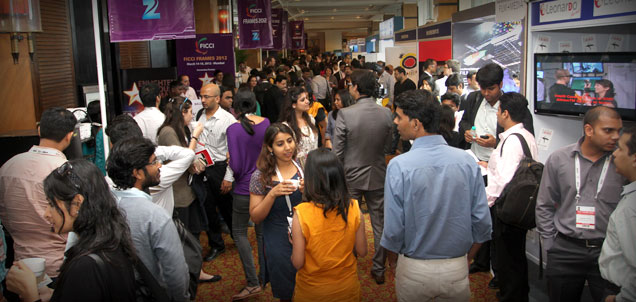
    The Dainik Bhaskar Group has been making rapid strides in publishing and its expansion into hitherto uncharted territories like Maharashtra have led to questions on where the group will head next. Girish Agarwal, director of the group, spoke to MxMIndia’s Shruti Pushkarna in an exclusive interview on the sidelines of Ficci-Frames 2012.

     

    Dainik Bhaskar was among the first to innovate in order to get more readership. What are the new frontiers… where are you headed next?

    We operate already in some 14 states in India. We have recently launched a Marathi newspaper, so we have some time to spend in Maharashtra as well as Jharkhand. At the same time, the states which we are already present in, like Rajasthan, Gujarat and Punjab, we need to work a lot there also to grow, because those states have a huge potential for us to grow. A large part of the growth we’ve been seeing in last 10 years, is coming from our existing states, so we need to work hard there.


    [youtube width=”400″ height=”250″]http://www.youtube.com/watch?v=UN43L63SCoU[/youtube]

    Technology and internet hasn’t really taken off as well as it was expected to have taken off. What are your views on the same?

    Internet penetration in India is roughly around 7 to 8 per cent, so with this kind of penetration, I don’t think we need to fear anything that they would take away from us. But at the same time we need to prepare for the future. For example, our website in Hindi today is the largest website in Hindi news as well as the Gujarati one, so we are preparing ourselves for the future. But at the moment, is the business shifting from the print platform to the internet? No.


    How do the readership wars affect newspapers?

    I think it is pretty good because anything that’s good for the market is good for the organization too. For the readership war, you actually go out and try to take more readers, for that you need to ensure that you are still relevant to the reader, because if you are not relevant, the reader won’t buy you at all.


    There is talk about Dainik Bhaskar opting out of DNA, how true is that?

    Yes, it is true that DNA is currently managed by our partner, Zee Group, which has the majority in DNA. We are a silent partner.


  • @FF12: Day 2: Seamless blending with traditional mediums – a big want!

    By A Correspondent


    After an invigorating day where suggestions and formulas surrounding digital came flying thick and fast, it was time for the mediums of television, advertising, radio, films etc to do some soul-searching and look for solutions to tackle the imminent challenges that digital is bound to bring. The day began with a keynote address by Hernan Lopez, CEO, Fox International, who began by praising the dominance that India had cast on several countries around the world. But he regretted the fact that despite ideas and innovations gaining prominence, one area that sadly lacked innovative ideas and content was television. According to Mr Lopez, the reason for India’s lack of show was due to the fact that Indian talent “operates under price control which equals creative shackles”.


    Mr Lopez continued saying that the Indian television industry is almost totally dependent on advertising revenues – almost $2.6 billion per year – which, coupled with the fact that there is an overabundance of channels and less number of affiliates, meant that broadcasters are in a bind. The way forward according to Mr Lopez was if the price control was done away with. He said that this would make it possible to pay the talent in the industry what it deserves and then it can operate without any constraints to produce the best possible content. Mr Lopez lauded the move to digitisation which would reduce the carriage fees being paid and increase the revenues for the industry.


    In a session moderated by Neeraj Roy of Hungama, Sanket Akerkar, MD of Microsoft India talked about “The converged future – Multiple platforms, technologies & transforming applications for media and entertainment”. The theme of his keynote address was significance and emergence of digitisation. Citing the example of ‘Occupy Wall Street’, Mr. Akerkar said that the consumer lifestyles today are controlling the way conversations happen. The industry has to takes its cues from what the consumers want. According to him, even ads will now be consumed as per the consumers’ choice and the advertisers can’t dictate the place and time for the consumption. Now the people are going to become the content creator and content consumer. The main challenge for the industry is now to seamlessly blend and enable technology to become user-friendly, he said.


    Mr Roy added by saying that technological progress has enabled applications that recognise the customer preferences, be it the Internet or the phone. All the speakers were in agreement that once the digitisation bill comes into effect, the choice of content available to the user will be limitless. As Mr Akerkar said, “the challenge will be to separate content, be it mainstream or user generated into what is relevant and what is not.”


    In another session titled “Innovations in the advertising industry in the digital world”, the panellists focused on why the much sought after medium of digital was rather ignored by advertisers who preferred to seek refuge elsewhere. The panellists comprised Rajan Anandan of Google India, Olivier Fleurot of MSL, Frederic Josue of Havas Media, Vikram Sakhuja of Group M, Kapil Agarwal of UFO Moviez and Varun Gupta of KPMG India. The session was moderated by Rajiv Makhni, Managing Editor, Technology, NDTV.


    Mr Anandan began by stating that India is still an emerging market where web advertising is concerned and it still constitutes just 3 per cent of the overall advertising spends in India – estimated to be around Rs 33,000 crore. The biggest driver of growth in advertising on the web would be through the rise in the number of users of smartphones, which is estimated to touch 100 million users in 4-5 years time. Smartphones alone could boost the growth of web advertising to about 8-10 per cent, he said.


    Mr Josue of Havas was of the view that it would be content that will drive the growth of the medium in the years to come. But the medium will face its share of issues which include multi-tasking across various platforms as an attempt will be have to be made to offer content seamlessly across various mediums, he said. Mr Fleurot began by stating how the marketing and communications industry was witnessing a profound disruption due to the invasion of technology and social media. This, he said, has led to an increased level of competition in the marketplace. The challenge, according to Mr Fleurot, is that clients today are not yet organised for the 21st century as they still prefer to work in silos. But in the case of online, the model of working in silos will disappear as all the other mediums work as a single unit on the internet. Going forward, the two key factors that will determine the growth of this medium, he said, include the speed with which marketers communicate with their users through the digital medium and the transparency with which they operate on the medium.


    Vikram Sakhuja was at his jingoistic best as he began by questioning what the term innovation in advertising actually stood for. “Innovation is a term that is broader than creativity. It is a new way of doing something better,” he said. He outlined the current scenario by stating that technology today is an overestimated medium in the short term but is underestimated for the long term. The problem according to him is that the medium has been underestimated for a long time now and that it was about time the medium leapfrogged ahead of the others – go from the current 3 to 15 percent in the shortest possible timeframe.


    In the session titled “Building sustainable models for niche content” honchos from the broadcast industry such as Paritosh Joshi of Star CJ (session moderator), Smeeta Chakrabarti of NDTV Lifestyle, Monica Tata of Turner International India, Ajay Chacko of A+E Networks I TV 18 JV, Atul Pande of Zee – Sports and Rasika Tyagi of Star India discussed on revenue models to sustain TV content catering to niche audiences and its long-term sustainability. Atul Pande stressed on the need to charge premium to audiences who really are on the lookout for speciality content. Smeeta Chakrabarti said that as a speciality channel one cannot talk about TRPs, rather it is the brand connect that needs to be spoken about as far as ad sales was concerned. Rasika Tyagi on the other hand remarked that the whole idea of measuring a speciality interest channel should be relooked at. “It’s not about how many people are watching you; it’s more about what kind of people are watching you.” She also said that the audiences of niche channels are of such quality that they do not mind paying, and that broadcast companies should look to tap into that opportunity.


    On whether the industry requires a different approach as far as measurement for these channels was concerned, Paritosh Joshi said, “The big challenge with respect to measurement is that we need to find a way to measure both quantity as well as quality. The quality aspect is very critical for a speciality channel.” Monica Tata added, “We need to have a different measurement system to evaluate special interest channels.”


    In the post-lunch session titled “Radio: Innovations in content”, industry veterans discussed at length the innovations that radio was witnessing with regards to content and the enormous innovation opportunities that FM Phase III would allow. The session was moderated by Apurva Purohit, CEO of Radio City and the panellists included Rabe Iyer of Big FM, Abhijit Avasthi of O&M, Bhavna Somaaya, Columnist and Writer and Charles Falzon of Ryerson University.


    Ms Purohit kick-started the session stating that radio currently is in a schizophrenic stage wherein on one hand the medium is witnessing immense growth, it has a huge reach in the country and the FM listenership has also further increased with higher number of mobile phones, while on the other hand the overall ad pie of the medium is at a dismal 4 per cent. She pointed out that in the next two years the industry anticipates another phase of growth which will bring news, sports commentary, multiple frequencies, besides further expansion into towns and cities.


    Speaking about the strengths of radio as a medium to advertise, Mr Avasthi first admitted that out of all the media, it is the toughest to write radio spots. He explained, “The strength of radio I believe is one can conjure up a world in the minds of the listeners. What you hear on radio today is mainly restricted to Bollywood music. There are so many kinds of music still to be explored and so many types of content that can be experimented, and I believe the industry requires some amount of courage to break this format.”


    According to Mr Iyer, although 80 per cent of content on radio is music and 20 per cent on the packaging of music, there has been some innovation in the medium and with the launch of phase III it will bring with it immense opportunities especially on the innovation and differentiation front.


    Key takeaways:

    – Need for television to do away with price control

    – Niche channels to broaden content choice for consumers

    – Post digitisation, consumers will dictate place and time of content consumption

    – Need for significant hike in digital adspends by clients

    – Phase III to steer growth of radio significantly


  • Counting on digital to be M&E’s trailblazer


    @FF12: Day 1: Digital attracts ‘desirable’ status
    on Day1
    @FF12: Day 2: Seamless blending with traditional mediums – a big want!
    @FF12: Day 3: Industry expects thoughts to lead to pertinent actions
    @FF12: Takeaways: Digitization rules the roost @FICCI Frames 2012

    By A Correspondent


    Those familiar with the going-ons at FICCI Frames would testify how an infatuation gets displayed by delegates at the event each year so as to summarise the mood of the convention even before it broadly takes off across the three days that it is entitled to. But probably, the setting was a bit different this time around when the delegates – joined in unison by the media – were running ballroom to ballroom trying to ingest giveaways that were being thrown up abundantly across several sessions. May be, it was a year where each day had something new to offer to the delegates that kept them at tenterhooks throughout the 3-day event. And going by the loud decibels that were being emanated across every nook and corner of the venue, it was evidently clear that there was some motivating factor that was driving the gathering to go on an overdrive spree.


    The organisers of FICCI Frames 2012 have every right to take credit for coming up with a theme around a medium that attracted the attention of one and all. Having kept it on the sidelines till last year, digital was finally given its due at the convention as experts, authorities and enthusiastic youngsters came face to face to deliberate and come up with outcomes that would redefine the way the consumers consume the medium. From television to print to films and even radio, digitisation and the benefits and effects it would cast on these sectors were discussed in length at the venue. In fact Star India CEO Uday Shankar in his keynote address didn’t hesitate in thanking the FICCI committee for putting across a theme that would go on to redefine the way the industry functions in the future.


    What was apparently clear through the various sessions at the convention is that with the nearing of date for total digitisation across key metros by June 30 2012, and then across the country by 2014, broadcasters had to relook their distribution and content provision models so as to keep the consumer at the heart of every shift that will transpire in the future. Emphasising on the current digitisation scenario in the country, Mr Shankar said, “Most of the discussions that I have participated in are still around whether digitization will happen and if it indeed were to go through, how chaotic it would be. But all these are meaningless discussions triggered by a bunch of retrograde interests who are living in denial.” According to Mr Shankar, digitisation of distribution is a big reality and the 40-45 million homes that have bought DTH boxes at some point or the other are a conclusive evidence of that.


    Shooting back at critics who had doubted whether the makeover to digital would ever be a reality, Mr Shankar said, “To the critics and the cynics who are still wondering whether digitization would happen, my answer is: Look around, it is already happening and the rest of it is bound to happen because even in this country it would be difficult to undo such a momentous shift. To those who wonder how chaotic it would be, my response is that there would be some chaos, but chaos is not necessarily bad if the alternative is status quo or regression. When a transition at such a scale is happening that affects the illegitimate but strong vested interest in certain pockets, then there is an incentive to put up with chaos in the interest of the larger social objectives.”


    A broader outlook was provided by a few panellists who said that digitization will come in as a relief for broadcasters who will be benefitted from additional subscription revenue, relaxation on paying heavy carriage fees, and of course providing viewers with a superior content experience – MSOs and cable operators have to quickly respond to the digitization mandate by investing in set-top boxes – the cost that is only possible to recover after four years.


    Sounding off the challenges that digitisation would present for the broadcast sector, Tarun Katial, CEO of Reliance Broadcast Network Ltd said that, “For television, it will be a combination of content as well as marketing. The old model which was a combination of carriage and product, as it stands today, won’t work. The business plan which currently has a very high rate of carriage will obviously see the content taking precedence.” And as for content, it will be niche content that will call the shots for broadcasters as according to experts at the convention, niche isn’t niche any more as all niche channels put together command a share that is equivalent to the share of Hindi GECs and the mass channels, so to say.


    Perhaps the many advantages that digitisation will have on several mediums was rounded off by Vikram Sakhuja, CEO, South Asia, Group M who said, “The inherent power that digital brings along with it is interactivity and its ability to link multiple devices. Also the ability to enhance real-time consumption of content; linked to that is the entire thing about going mobile.” On the roadmap for the industry, Mr Sakhuja said, “I think integrated media is the best way forward. Today when people think of multimedia planning, they do a separate TV plan, print plan, radio plan, internet plan and so on. I believe that if you actually look at media agnostically and at common metrics of each cost per thousand impressions, these are the ways in which you can construct a media agnostic plan. What it does is, it suddenly gets more money into digital, and when more money can come into digital, that’s when focus is going to come in.”


    While digitisation was the mainstay of every discussion, the all-important issue of regulation too was taken up by panellists who chose to have the government respond to the many queries surrounding the topic. Uday K Varma, I&B Secretary, said that “if people at large seem to be happy with self regulation, I think the government would have no problem in legitimizing them. But I think the self regulation mechanism which has been set up by both the news broadcasters and the entertainment broadcasters, they’ll have to really prove it, not to the government but to the people at large.” He was joined in his cause by Prithviraj Chavan, Chief Minister ofMaharashtrawho said that the challenge would be to adopt the regulatory framework to new technology and ensure that over regulation doesn’t kill a good thing. The Chief Minister emphasised on the need for regulation and suggested that instead of the state regulating the media, the medium should look at regulating itself.


    The other important announcements that came up at the venue included the soon-to-be-passed Copyright Amendment Bill, the roll-out of the imminent phase 3 radio policy that would steer the growth of the medium and increased government aid for the film & entertainment sector.


    New ventures @ FICCI


    BARC takes wings

    In between the many promises and hopes that were being doled out at the sessions came the news of the Indian Broadcasting Foundation (IBF), the Indian Society of Advertisers (ISA) and Advertising Agencies Association of India (AAAI) announcing the official formation of a nationwide audience research joint body — Broadcast Audience Research Council (BARC).

    While IBF will have 60 per cent stake in BARC, ISA and AAAI will each hold 20 per cent stake. The Board of the council will have 10 members, six members from the IBF and two members each from the ISA and AAAI.


    Discovery Kids to flag off ops in April

    Another important announcement was made by President & CEO of Discovery Networks International, Mark Hollinger who announced the launch of its new network for children inIndia, ‘Discovery Kids’. Mr Hollinger said, “Launching in April, the network will initially be available in three languages – Hindi, English and Tamil. The channel will offer children a fun and entertaining way to satisfy their natural curiosity with stimulating and imaginative programming,” he said. The company plans to roll out the channel inPhilippinesandIndonesialater this year.


    Ten Golf tees off

    Taj Television India Pvt Ltd announced the launch of Ten Golf, a dedicated 24-hour golf channel. Ten Golf is the fifth channel from Taj Television India Pvt Ltd and began transmission on March 15, 2012. The dedicated golf channel will showcase a mix of live, non-live and feature programming. The channel will also broadcast live, high quality Golf action from around the world.

    Ten Golf has acquired rights for European Tour and Asian Tour till 2016, and has also entered into partnership with PGTI for three years to telecast the Indian Tour. Further, Ten Golf will be telecasting 400 hrs of golf programming in association with NBC.


  • 12 ‘must-do’s when engaging a celeb for your brand

    By Anujita Jain


    #1 First, the key is to identify the need for a brand ambassador ­ whether it is to get noticed, or to catapult to a leadership position, or to change image or create demand, or other.


    #2 Think of a brand endorsement as a mid to long term investment. Quick successes or failures of endorsements are not representative. Riding on the equity of a known personality is a strategic call. By itself, the decision cannot guarantee success, it needs correct usage. For instance, an endorser doesn’t come at the cost of a good creative.


    #3 Go with a mindset to alter the script or storyline of a advertising creative if required, while approaching an endorser. While the communication strategy is brand objective dependent, the storyline may need to be re-thought with the chosen endorse in mind. Neither should the endorser be ideally selected with just one script in mind. The investment on an endorser often deserves and asks for that.


    #4 Match endorser motivations with your brand motivations, to get more out of the endorsement than what the contract promises. This may not just yield in the celebrity commitment to brand but also in the ripple effect the communication may create.


    #5 If as a brand manager, you are looking for a deal or a quick bargains, the only way is not in going for smaller names, but may also be about bigger names who are looking for new dimensions in their own stated personality. Match that need, and you may have a deal! While top end luxury brands have always had this advantage from even A-lister celebrities, this is often true for many other brands with respect to some potential endorsers.


    #6 Plan out how you will use the endorser days thoroughly, so that you don’t end up with expensive days you struggle to use within the year, a common issue with the bulk of endorsement deals. The first few days are often easily utilised through shoots etc., but the balance 2-3 days end up being hurriedly utilised for sub-optimal activation that doesn’t get the right ROI for the day cost.


    #7 Always have alternatives in mind while approaching endorsers. Options not only in the same grade of celebrities, but also pan grades and genres. This not only allows more creative thought for utilisation of the celebrity days, but also results in smarter value-benefit deals.


    #8 Unless you have 4X budget for media and magnification, don’t put more than X for the endorser.  If amplification is the chief reason for using the endorser, it defeats the purpose to cut corners in the resources put behind it.


    #9 Modern-day endorsements are best approached not only in terms of day count, but also digital or equity usage rights.  This again means a clear strategy of endorser usage, clear ideas of utilization of celebrity equity beyond just his/her days, and a strong plan


    #10 If the brand works its communication around the endorser, the likelihood of the endorser working their schedules around the brand is that much more. An endorser, being a human brand, is highly likely to value good planning by the brand, and go that extra mile to deliver.


    #11 Sharper the brand focus versus the category, the better the endorser choice.  So think of the brand positioning and attributes that define brand image, and then create your endorser consideration set. Often brands approach endorsers from the point of view of their category, failing to then translate an edge in their communication, resulting in a diluted or under-utilised endorsement.


    #12 Often, especially for mid-segment brands, considering a set of niche endorsers may bring more value than going for a single mid-range endorser. This de-risks the brand, at the same time allowing them to ride on to a cluster of icons that have a deep and strong, albeit smaller follower base. Today, there is a whole new breed of such celebrities, who have a die-hard loyal following in their chosen fields, who work as strongly as special interest channels do versus a general entertainment one, for the relevant brands.


    Anujita Jain is Founder & COO, Alchemist Talent Solutions.


  • From Zero, Bihar reaches 100: Hindustan shares a dream to take it beyond

    By A Correspondent


    Bihar has long been known as the land which gave the world “zero”, Gautama Buddha’s message of peace, the foundation of structured education with Nalanda and the seat of culture. It led the creation of modern thought. The recognition of Bihar’s contribution to society and the modern world led Hindustan to create a programme on the occasion of completion of 100 years of Bihar’s formation on March 22.


    With a stable and progressive government at the helm for the second time, citizens are nursing a dream of a modern and developed state. Unknown to most, at several places the seeds of change have been sown and have taken root as well. For the pools of transformation to become an ocean of development in Bihar, it is critical for the good work to be shared with the citizens of the state. With that objective in mind, Hindustan embarked on a grassroots campaign to unearth 100 “quiet reformers” who are working tirelessly for the betterment of society and life in the state. The zeal of these “gems of Bihar” deserves to be lauded and should not be a quiet endeavour.


    Over the last 25 years in Bihar, Hindustan has been a partner and a witness to the state’s transformation story. Hindustan kicked off a campaign in December 2011 with the mission to first locate 100 individuals and then reveal their stories to the citizens of the state. These real stories of hope and inspiration have a tremendous role in communicating the importance of “naya zariya”, initiative and responsibility of citizens to make their own future brighter. A multi-pronged strategy was used which involved communication through the newspaper and an appeal to readers to nominate deserving initiatives that they knew of in one of 8 categories:


    1. Education

    2. Agriculture

    3. Women Empowerment

    4. Employment Generation

    5. Communal Harmony

    6. Entrepreneurship

    7. Self-reliance

    8. Social Upliftment


    The news network was also used to reach out and identify transformation initiatives. January 1, saw the formal launch of “Bihar…100 ke aage” which featured the first of a daily series of articles to highlight people who were creating positive social impact. Readers were introduced to citizens who did not wait for help from any external source to make a change in their immediate surroundings. For the first time, these initiatives were brought into public knowledge.


    Along with these stories, a campaign was launched that appealed to readers to nominate deserving individuals. Hindustan created an out-reach programme by contacting opinion makers and other socially aware individuals for their collaboration in this effort. Schools and colleges were also activated through painting and essay competitions. Organisations like the Bihar Chamber of Commerce and Bihar Industries Association were also co-opted into the campaign. “Samvaads” were held to help spread the message and to get more leading citizens to join the movement. Close to 500 nominations were received. Of these, 100 deserving nominations were scrutinized closely by an eminent panel of judges which comprised Justice S Jha, Justice R Prasad and VS Dubey (retd. IAS, ex-Principal Secretary, Jharkhand) to identify initiatives with the maximum social impact in their respective categories.


    The Hindustan Samagaam on March 19, 2012 will bring these 100 individuals together. The Chief Minister of Bihar will honour selected individuals at this event.


    At the same event, eminent panelists like the Chief Minister of Bihar, Mr Nitish Kumar, Mrs Shobhana Bhartia (Chairperson, HT Media), Mr NK Singh (MP, Rajya Sabha), Mr Sunil Bharti Mittal (MD & Group Chairman, Bharti Enterprises) and Dr Rukmini Banerji (Director, Pratham) will participate in a dialogue on insights for growth and development in Bihar.


    Hindustan Media Ventures Limited (HMVL) is the publisher of the leading Hindi newspaper – Hindustan, Hindi magazines Nandan & Kadambini and the news website livehindustan.com. The Company has presence in the states of UP, Uttarakhand, Bihar, Jharkhand & Delhi and its publications have a combined Total Readership of 3.81 crore readers.


    The company is a subsidiary of the HT Media Group – a diversified media group with interests in Radio, print & online media.


  • Suvarna’s new fiction show begins today

    By A Correspondent


    Star Network’s Kannada General Entertainment channel Suvarna announces the launch of their new fiction show “Amrutavarshini”


    The show is about an innocent, docile girl from a poor family who has few expectations in life; she is content with the simple things that her family life has to offer. How her life changes when she gets married into a rich family is the story forward.


    The show will go on air from March 19, Monday to Friday 9.30 PM.


    Anup Chandrashekaran, Business Head, Suvarna Channel says “All our shows are unique and have a different treatment. We at Suvarna ensure that every fiction show has a strong story plot and an engaging screenplay. This show is unique as this showcases the mother in law – daughter in law relationship with a new lens. The making of this show is exceptional and the story will undoubtedly appeal to the viewers tastes. This show is ideal for the 9:30 pm slot as this will be the immediate program after “Kannadada Kotyadhipathi” which is the biggest show on Kannada Television”


    The show is produced by the production house RG Media Stuff which has also produced one of the most successful shows of Kannada General Entertainment “Krishna Rukmini” for Suvarna.


    Ravi Garani of RG Media Stuff says, “We have ensured that the production values of the show are not compromised, and the look and feel is of national standard. I am thankful to the Suvarna team for giving me this opportunity to do this show.”


    Anil Narang, Head of Marketing & Strategy, Suvarna Channel says “This show will enhance the fiction offering of our channel. The story line will relate well to our core audience. We have ensured that the artists chosen to play the key roles in the show are the best fit to the character values they portray.”